Quaternium-73 vs Azelaic Acid: Key Differences for Cosmetic Formulators
2026-08-31 14:42:32
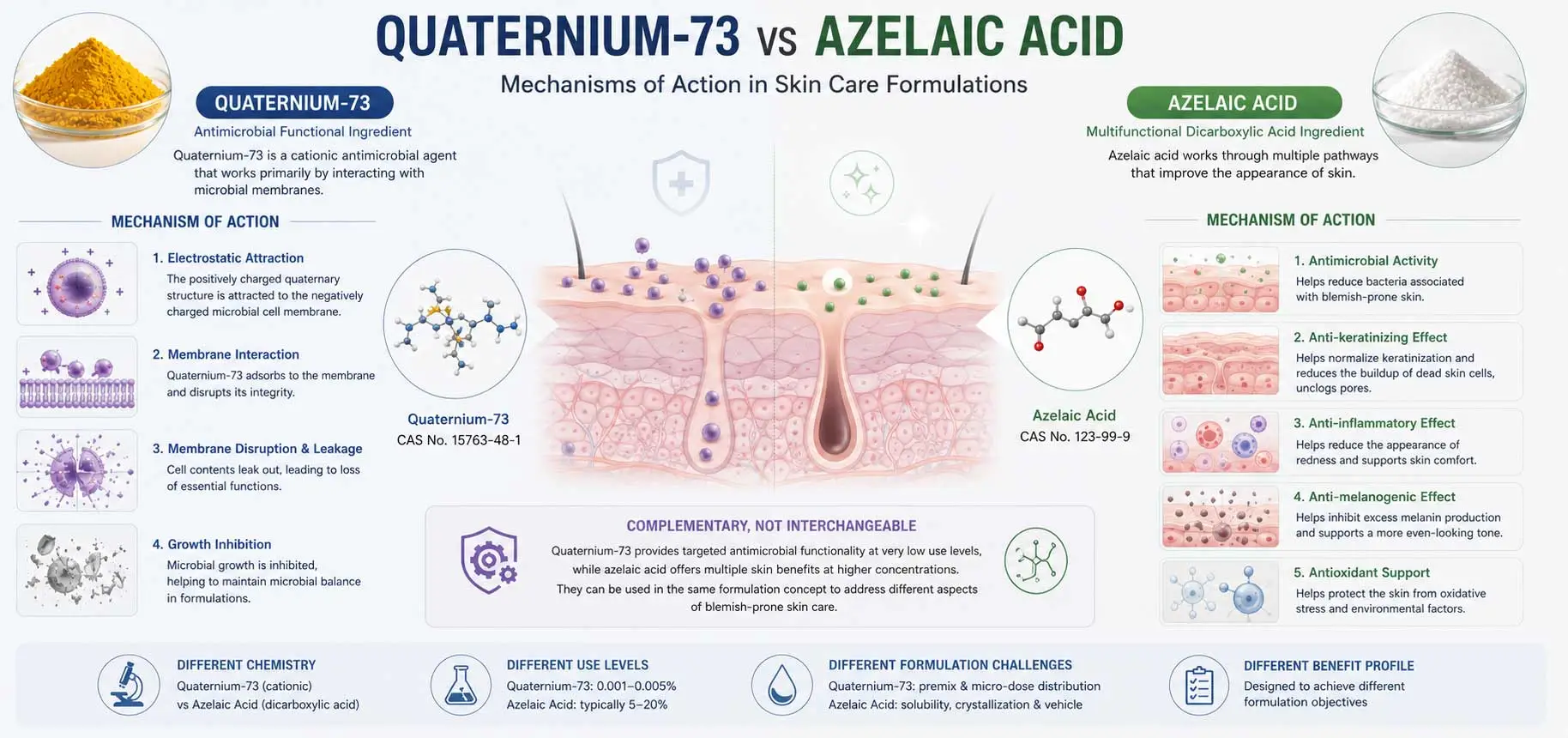
Quaternium-73 vs azelaic acid is not a comparison between two interchangeable ingredients for blemish-prone skincare. Although both appear in formulations associated with microbial balance and problem-skin care, their chemistry, working concentration and formulation behavior are markedly different. Quaternium-73 (CAS 15763-48-1) is a yellow crystalline material used at very low levels for antimicrobial-related functionality. Azelaic acid (CAS 123-99-9) is a nine-carbon saturated dicarboxylic acid with a much broader body of dermatological research, but its poor aqueous solubility makes vehicle design a central formulation issue.
For cosmetic formulators, the practical choice depends on the product brief. Quaternium-73 is relevant when a very-low-dose antimicrobial-functional strategy is required. Azelaic acid is more appropriate when the formulation is being built around the properties of a multifunctional dicarboxylic acid and the developer can accommodate its relatively high active loading and difficult solubility. They should not be treated as gram-for-gram substitutes.
For procurement teams, this distinction should be established before comparing quotations. A raw material with a higher price per kg may contribute very little to the cost of a finished batch when it is used at thousandths of a percent, while an ingredient used at several percent can have a very different impact on inventory, formulation and processing costs.
Quaternium-73 vs Azelaic Acid at a Glance
The main difference between Quaternium-73 and azelaic acid becomes clearer when the two materials are compared from a formulator's perspective rather than through consumer-facing claims.
|
Parameter |
Quaternium-73 |
Azelaic Acid |
|
INCI |
Quaternium-73 |
Azelaic Acid |
|
CAS No. |
15763-48-1 |
123-99-9 |
|
Chemical character |
Thiazolium/quaternary antimicrobial-related compound |
Saturated C9 dicarboxylic acid |
|
Typical appearance |
Yellowish to yellow crystalline powder |
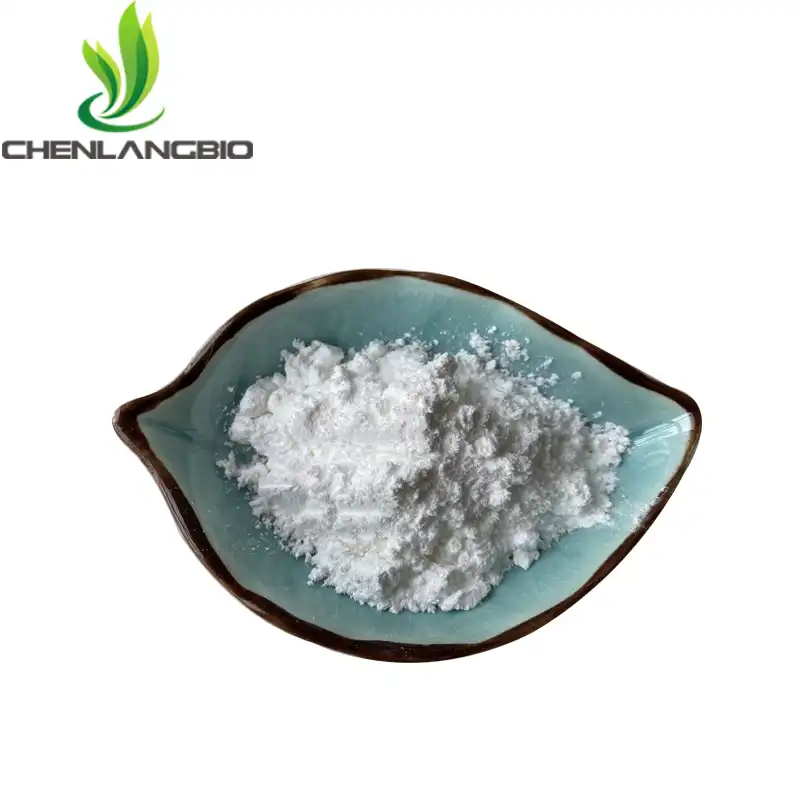
White crystalline solid/powder |
|
Main formulation interest |
Antimicrobial-related functionality |
Multifunctional dicarboxylic-acid active |
|
Published/commercial concentrations |
0.001–0.005% in one detailed commercial PDS; some suppliers specify up to 0.05% |
Topical literature commonly discusses 5–20%; 15–20% is predominantly therapeutic/dermatological territory |
|
Water solubility |
Very low/slight |
Low, about 2.4 g/L at 20°C |
|
Major formulation issue |
Premixing and uniform distribution at micro-dose levels |
Solubilization/dispersion, high active load and crystallization |
|
pH consideration |
5.5–8.0 for the referenced commercial grade |
pKa approximately 4.55; ionization changes with pH |
|
Direct substitutes? |
No |
No |
The concentration figures require careful interpretation. The Quaternium-73 numbers come primarily from commercial technical documentation rather than a universal regulatory use limit. Likewise, the 15–20% azelaic acid concentrations widely discussed in clinical literature are associated primarily with dermatological preparations and must not automatically be presented as a recommended concentration for an ordinary cosmetic in every market.
That distinction is important for both regulatory review and responsible product marketing.
What Is Quaternium-73 and What Role Does It Play in Cosmetic Formulations?
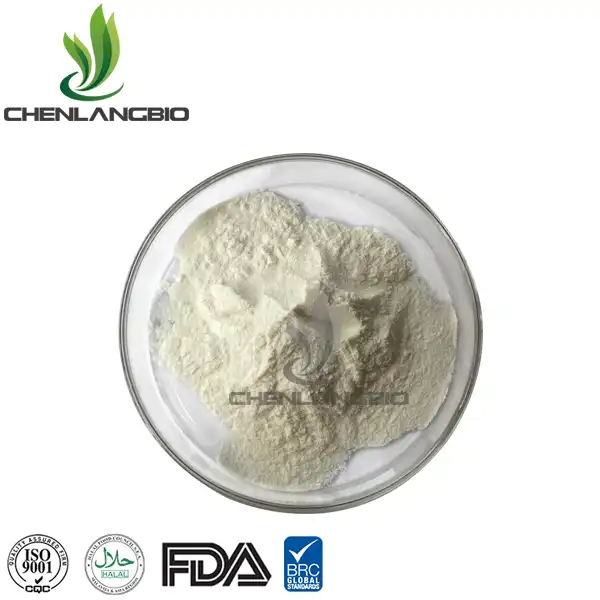
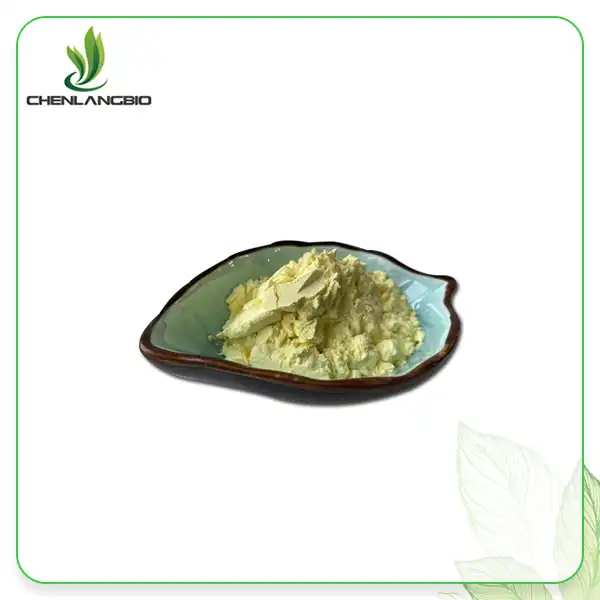
Quaternium-73 function in cosmetics is closely associated with antimicrobial-related formulation strategies. Its CAS number is 15763-48-1, and commercial specifications typically describe it as a yellowish-to-yellow crystalline powder with HPLC purity requirements of at least 98% for the referenced grades.
One detailed product data sheet recommends a concentration of 0.001–0.005%, stability between approximately pH 5.5 and 8.0, and pre-dissolution in butylene glycol, propylene glycol or 1,2-pentanediol. The same source estimates water solubility at only 0.6068 mg/L at 25°C and reports good thermal stability up to approximately 90°C. It also identifies photostability as a concern and recommends opaque packaging for finished products containing the ingredient.
These properties explain why Quaternium-73 for blemish-prone skin needs to be treated as a formulation problem rather than simply another powder to add to the water phase. At a concentration of 0.003%, a 100 kg batch contains only 3 g. Accurate weighing, quantitative transfer and uniform distribution can therefore matter as much as nominal assay.
Commercial literature positions the ingredient in facial cleansers, oily-skin products, shampoos and other specialized skin/scalp applications. However, supplier claims should be distinguished from independently established clinical evidence, particularly when a cosmetic is marketed in jurisdictions where acne-treatment claims may change the regulatory status of the finished product.
What Is Azelaic Acid and Why Is It Used in Topical Formulations?
Azelaic acid in cosmetic formulations presents a very different technical profile. It is a saturated nine-carbon dicarboxylic acid with CAS 123-99-9. Modern reviews describe antimicrobial, anti-inflammatory, anti-keratinizing and antimelanogenic biological activities, which explains the considerable research interest surrounding the molecule.
The formulation challenge is equally well established.
PubChem reports aqueous solubility of approximately 2,400 mg/L at 20°C and a pKa of about 4.55. This means that a formula containing several percent azelaic acid cannot be approached as though the complete active load will simply dissolve in room-temperature water.
A 2025 review describes poor aqueous solubility and limited skin permeability as major constraints on topical delivery. This has driven research into liposomes, niosomes, nanostructured lipid carriers, microemulsions, nanosponges and deep-eutectic-solvent systems.
Published dermatological products and studies frequently use 15–20% azelaic acid. A broader review reports commercial topical formulations ranging from approximately 5–20%. Those values are useful for understanding the formulation literature, but a cosmetic grade azelaic acid buyer should not assume that every such concentration is appropriate for a cosmetic product in every target market.
The finished-product classification, claims and destination-market rules need to be established independently.
Quaternium-73 vs Azelaic Acid Mechanism: Why Their Functions Are Not Equivalent
The Quaternium-73 vs azelaic acid mechanism comparison is more nuanced than “antimicrobial ingredient A versus antimicrobial ingredient B.”
Commercial Quaternium-73 technical literature emphasizes interaction with microbial membranes and very-low-concentration antimicrobial activity. This makes antimicrobial-related functionality central to its formulation positioning.
Azelaic acid has a much broader documented biological profile. A 2024 review describes antibacterial, anti-keratinizing, antimelanogenic, antioxidant and anti-inflammatory mechanisms. A 2025 review likewise emphasizes that its performance derives from multiple pathways rather than a single antimicrobial effect.
Consequently, even where the two ingredients appear to overlap in microbial-related research, their formulation roles are not equivalent.
A cosmetic developer choosing Quaternium-73 is dealing with an ingredient used at very low concentration and generally introduced through a premix. A developer working with azelaic acid may instead be managing several percent of a poorly water-soluble crystalline material, with the resulting effects on vehicle design, rheology, particle behavior and sensory performance.
This distinction also matters for claims. Published pharmacological mechanisms or clinical outcomes associated with azelaic acid do not automatically become permissible cosmetic claims. Similarly, antimicrobial data for Quaternium-73 should not automatically be translated into a claim that the raw material treats a medical condition.
Quaternium-73 vs Azelaic Acid Use Level: Why Dosage Changes the Manufacturing Strategy
The difference in Quaternium-73 vs azelaic acid use level becomes particularly tangible at production scale.
For the Quaternium-73 grade referenced above, commercial guidance recommends 0.001–0.005%. Another supplier TDS gives a broader suggested range extending to 0.05%, illustrating why formulators should use the technical documentation for the exact commercial grade being purchased rather than assuming that all Quaternium-73 products share identical guidance.
For a 100 kg batch:
|
Concentration |
Raw Material Required |
|
0.001% Quaternium-73 |
1 g |
|
0.003% Quaternium-73 |
3 g |
|
0.005% Quaternium-73 |
5 g |
|
5% azelaic acid |
5 kg |
|
10% azelaic acid |
10 kg |
|
15% azelaic acid |
15 kg |
The azelaic acid examples illustrate formulation load rather than universal cosmetic recommendations. Published literature includes topical formulations in the 5–20% range, while much of the strongest clinical evidence concerns 15% and 20% dermatological preparations.
The manufacturing implications are obvious. Quaternium-73 dosage in cosmetics raises questions about balance accuracy and homogeneous distribution. High-load azelaic-acid systems raise completely different questions about bulk handling, dispersion, crystallization, viscosity and sensory properties.
Dosage therefore changes not only efficacy considerations but also how the factory has to manufacture the product.
Quaternium-73 vs Azelaic Acid Solubility: Which Is More Difficult to Formulate?
Quaternium-73 vs azelaic acid solubility is one of the most useful comparisons for a formulation team because both materials have low water solubility, yet the practical problems are very different.
Quaternium-73 is used in such a small quantity that a glycol premix is feasible. The referenced PDS recommends butylene glycol, propylene glycol or 1,2-pentanediol and also reports solubility in ethanol.
The premix serves two purposes: it helps incorporate a poorly water-soluble material and makes a few grams of active easier to distribute uniformly through a commercial batch.
Azelaic acid solubility in water, approximately 2.4 g/L at 20°C according to PubChem, becomes much more consequential when kilograms rather than grams are being incorporated.
Consider a simple illustration. One liter of water at that reported equilibrium solubility would dissolve only a small fraction of the azelaic acid required for a 10% system. Real cosmetic formulas are more complex than pure water, but the comparison explains why solvent and vehicle engineering are central to how to formulate azelaic acid.
Complete molecular dissolution is not necessarily the only formulation strategy. Depending on product architecture, developers may investigate controlled dispersions, emulsions, suspended systems or advanced delivery technologies. Particle size can therefore become commercially relevant when azelaic acid is present as a dispersed phase.
The 2025 review of topical azelaic-acid technology highlights precisely this problem: advanced carriers are being investigated because conventional aqueous delivery is constrained by poor solubility and limited permeability.
For procurement, this means “99% purity” alone is not enough information to select the most appropriate grade.
Quaternium-73 vs Azelaic Acid pH Compatibility: Can They Share a Formulation Window?
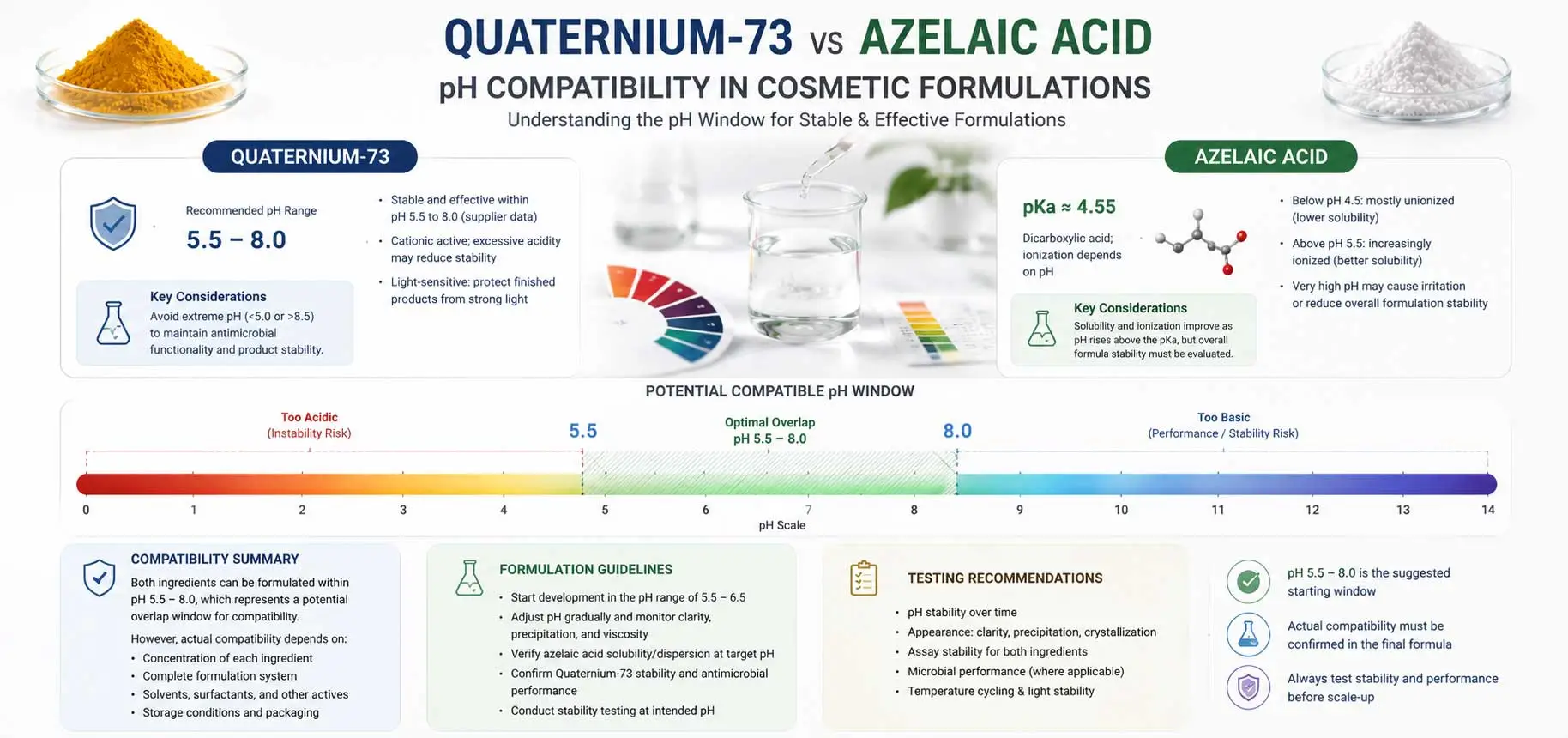
Quaternium-73 azelaic acid pH compatibility is a more plausible formulation question than the equivalent comparison with strongly acidic exfoliating systems, but it still cannot be answered with a universal yes.
The referenced Quaternium-73 commercial guidance specifies approximately pH 5.5–8.0 as its stable formulation range.
Azelaic acid has a reported pKa of approximately 4.55. As formulation pH moves above the pKa, a progressively larger fraction becomes ionized. This affects physicochemical behavior, including aqueous compatibility, but pH manipulation cannot be considered independently from the rest of the formulation.
There may therefore be technically interesting formulation space around the lower portion of the Quaternium-73 guidance range, depending on how the azelaic acid is delivered. That observation is not evidence of universal compatibility.
The more appropriate development question is:
Can the selected azelaic-acid delivery system and the specific Quaternium-73 grade remain physically and chemically stable at the same final pH?
Publicly available evidence does not establish a universal Quaternium-73 and azelaic acid compatibility window for ordinary cosmetic emulsions or serums. Formulators should therefore validate the actual system rather than inferring compatibility solely from theoretical pH ranges.
Quaternium-73 vs Azelaic Acid for Different Blemish-Prone Skincare Goals
For Quaternium-73 vs azelaic acid for blemish-prone skin, ingredient selection should begin with the formulation objective.
|
Product Development Goal |
More Relevant Starting Strategy |
|
Very-low-dose antimicrobial-functional concept |
Evaluate Quaternium-73 |
|
Multifunctional dicarboxylic-acid concept |
Evaluate azelaic acid |
|
High-active-load cream |
Azelaic-acid vehicle design becomes central |
|
Clear/lightweight serum |
Solubility may limit azelaic-acid strategy |
|
Oily-skin/scalp microbial-control concept |
Evaluate Quaternium-73 |
|
Multi-mechanism concept |
Investigate complementary use |
|
Simple manufacturing process |
Compare processing requirements before selection |
The distinction is especially important for contract manufacturers. A customer may request an “azelaic acid serum” without recognizing that concentration, clarity, solvent system and crystallization stability are interconnected.
Conversely, the extremely low quantity of Quaternium-73 can make it appear easy to formulate, while micro-dose weighing and premixing still require process control.
The raw material should therefore follow the formulation architecture, not the other way around.
Can Quaternium-73 Replace Azelaic Acid?
Can Quaternium-73 replace azelaic acid? Not as a direct functional substitute.
Replacing several percent of azelaic acid with a few thousandths of a percent of Quaternium-73 changes active loading, chemistry, rheological contribution, solvent requirements and the functional basis of the product. Any resulting formula would effectively be a new formulation rather than an equivalent substitution.
For the same reason, describing Quaternium-73 simply as an alternative to azelaic acid is technically imprecise.
There may be commercial reasons to develop a different blemish-prone skincare concept without azelaic acid—for example, vehicle limitations or a desire for a lightweight format—but the developer should define what functionality the replacement system is intended to provide rather than implying equivalence.
This distinction is useful during supplier qualification. Two ingredients appearing in the same skincare category do not belong in the same raw-material RFQ unless the purchasing team understands the different formulation objectives.
Can Quaternium-73 and Azelaic Acid Be Used Together?
Can Quaternium-73 be used with azelaic acid? Potentially, but public evidence is not strong enough to justify a blanket compatibility claim.
The mechanisms are sufficiently different that complementary use is scientifically interesting. Azelaic acid itself has antimicrobial-related evidence as part of a broader biological profile, while Quaternium-73 is commercially positioned around strong antimicrobial functionality at very low concentrations.
However, theoretical complementarity is not the same as formulation compatibility.
A development team evaluating Quaternium-73 with azelaic acid formulation should examine final pH, the physical state of azelaic acid, Quaternium-73 distribution, viscosity, precipitation, crystallization, color and chemical stability. Light exposure also deserves attention because the referenced Quaternium-73 technical guidance identifies poor photostability and recommends opaque finished-product packaging.
The absence of published incompatibility data should not be interpreted as proof that the ingredients are compatible in every vehicle.
This is a situation where a small laboratory trial provides considerably more useful information than a generic supplier compatibility chart.
A Practical Quaternium-73 and Azelaic Acid Formulation Development Workflow
A sensible Quaternium-73 azelaic acid formulation project starts with characterization of the individual raw materials.
First, review the Quaternium-73 specification and TDS and establish the recommended concentration, solvent, pH range and storage requirements for the actual grade. Then determine whether the azelaic acid will be molecularly solubilized, partially solubilized or intentionally dispersed in the intended vehicle.
A practical development sequence is:
raw-material qualification → azelaic-acid delivery strategy → Quaternium-73 premix → base-formula development → final pH adjustment → dispersion/crystallization assessment → accelerated stability → temperature cycling → light stability → packaging compatibility → microbiological evaluation where appropriate → pilot batch
Particle size should be monitored when azelaic acid remains dispersed. For clear or translucent systems, delayed crystallization deserves particular attention. A prototype that is visually acceptable immediately after manufacture may behave differently after several weeks at low temperature or after repeated temperature cycling.
Where analytical capability is available, assay measurements during stability provide stronger evidence than appearance alone.
This workflow is also commercially useful because it allows procurement to qualify representative material before committing to a larger order.
Quaternium-73 vs Azelaic Acid in Serums, Creams and Cleansers
Product format can change the answer to Quaternium-73 or azelaic acid for skincare.
A clear serum places severe constraints on poorly soluble crystalline materials. At meaningful azelaic-acid loading, maintaining clarity can require a sophisticated solvent or delivery system. Quaternium-73 is used at far lower concentration, although it still requires an appropriate premix.
Creams and emulsions provide greater flexibility. They can accommodate more complex vehicle architectures and, where technically justified, dispersed active phases. Published azelaic-acid research includes creams, gels, foams and increasingly sophisticated carrier technologies, illustrating how strongly performance depends on the vehicle.
Cleansers present another design problem. Rinse-off contact time, surfactant compatibility and deposition all influence whether an ingredient makes sense in that format. Commercial Quaternium-73 documentation specifically lists facial cleansers and shampoos among its applications.
Formulators should therefore avoid deciding on the active before deciding what the finished product is supposed to be.
What Should Buyers Check When Sourcing Quaternium-73 or Azelaic Acid?
A professional Quaternium-73 supplier should provide more than a purity number and quotation.
For cosmetic grade Quaternium-73, procurement should request the current specification, representative batch COA, TDS and SDS. Identity, HPLC assay, appearance, moisture, recommended use level, solvent guidance, storage and photostability information are particularly relevant.
Azelaic-acid sourcing requires a somewhat different qualification process.
|
Procurement Parameter |
Why It Matters |
|
CAS / identity |
Confirms correct raw material |
|
Assay |
Establishes commercial quality |
|
Analytical method |
Provides context for purity |
|
Impurity profile |
Supports supplier qualification |
|
Moisture |
Relevant to material consistency |
|
Particle size |
Important for dispersed systems |
|
COA |
Verifies actual batch |
|
TDS |
Supports processing decisions |
|
SDS |
Handling and transport |
|
Shelf life |
Inventory planning |
|
Representative sample |
Formulation qualification |
|
Batch consistency |
Commercial-scale reproducibility |
Particle size deserves particular attention when selecting cosmetic grade azelaic acid for a formulation in which the material will not be completely dissolved. Two suppliers can offer the same assay while delivering materially different particle-size distributions and therefore different dispersion behavior.
For Quaternium-73, consistency at very low dosage and accurate technical guidance may be more important than chasing a marginal difference in nominal assay.
Quaternium-73 vs Azelaic Acid Cost-in-Use: Why Price per Kg Can Be Misleading
Quaternium-73 price per kg and azelaic acid price per kg do not tell a procurement team which formulation costs less.
Consider a 100 kg batch containing 0.003% Quaternium-73. Only 3 g of raw material is consumed. A hypothetical 10% azelaic-acid formulation requires 10 kg.
The relevant calculation is therefore:
raw-material cost per batch = purchase price per kg × actual kilograms consumed
But cost-in-use goes further. Azelaic-acid formulation may require specialized solvent systems, dispersion equipment or additional stability work. Quaternium-73 requires precise weighing and premix handling and may influence packaging selection because of photostability.
A higher-priced raw material can therefore make a negligible contribution to finished-product cost when its dosage is extremely low.
This is why procurement teams evaluating bulk cosmetic ingredients should compare total formulation economics rather than supplier quotations in isolation.
How to Qualify a Reliable Quaternium-73 Supplier Before Scale-Up
When evaluating a reliable Quaternium-73 supplier, the best first purchase is often not a commercial-volume order but a representative sample from material produced to the same specification as future supply.
Request the current Quaternium-73 COA, specification, Quaternium-73 TDS, SDS, storage information and available analytical information. R&D can then verify dissolution behavior and formulation compatibility using the intended process.
The logical qualification sequence is:
documentation review → representative sample → bench formulation → stability evaluation → supplier approval → commercial purchasing
At CHEN LANG BIO TECH, we supply Quaternium-73 for cosmetic raw-material projects and support R&D and procurement teams with specifications, batch documentation and representative samples for formulation evaluation. This allows the customer's laboratory to qualify the actual material before scale-up rather than making the decision solely from a quoted assay or Quaternium-73 price.
For a technical ingredient used at only a few grams per 100 kg of finished product, reliable documentation and batch consistency can be more commercially important than a small difference in kilogram price.
FAQ: Quaternium-73 vs Azelaic Acid
What is the main difference between Quaternium-73 and azelaic acid?
The main difference between Quaternium-73 and azelaic acid is their overall formulation role and concentration. Quaternium-73 is a very-low-use-level antimicrobial-functional ingredient, while azelaic acid is a dicarboxylic acid used at substantially higher loading and has broader documented biological activities.
Is Quaternium-73 stronger than azelaic acid?
There is no scientifically useful universal potency ratio. They have different chemistry, mechanisms, concentrations and formulation objectives. Comparing 0.003% Quaternium-73 with 10% or 15% azelaic acid does not demonstrate that one is thousands of times “stronger.”
Can Quaternium-73 replace azelaic acid?
No direct equivalence should be assumed. Quaternium-73 vs azelaic acid represents two different formulation strategies. Replacing one with the other changes the functional concept and usually requires reformulation rather than simple ingredient substitution.
Can Quaternium-73 and azelaic acid be formulated together?
Potential co-use can be investigated, but Quaternium-73 azelaic acid compatibility should be demonstrated in the actual vehicle. pH, azelaic-acid physical state, Quaternium-73 distribution, crystallization, light stability and overall formula stability should be evaluated.
What is the typical Quaternium-73 use level compared with azelaic acid?
One detailed commercial Quaternium-73 PDS recommends 0.001–0.005%. Published azelaic-acid topical formulations commonly contain several percent, with clinical/therapeutic literature frequently studying 15–20%. These concentrations represent different product contexts and should not be interpreted as equivalent cosmetic recommendations.
Why is azelaic acid difficult to formulate?
Its low water solubility is a major limitation. PubChem reports approximately 2.4 g/L at 20°C, while practical topical products may contain concentrations many times higher than simple aqueous solubility permits. Vehicle design, dispersion, crystallization and particle characteristics therefore become important.
What documents should I request from a Quaternium-73 supplier?
At minimum, request a current specification, batch COA, TDS and SDS. A Quaternium-73 sample is also valuable because formulation compatibility, premix behavior and stability should ideally be evaluated before a commercial purchase.
Choosing Between Quaternium-73 and Azelaic Acid Starts With the Formula
Quaternium-73 vs azelaic acid should ultimately be decided by formulation objective rather than ingredient popularity. Quaternium-73 fits a specialized, very-low-dose antimicrobial-functional strategy, whereas azelaic acid requires a substantially different approach because higher active loading, low aqueous solubility and vehicle design become central development issues.
They are therefore neither direct substitutes nor automatically compatible partners. If a formulation team wants to investigate both, the most defensible approach is to establish the intended product format first, then validate pH, solubility or dispersion, crystallization, chemical stability and packaging using the actual commercial grades.
For Quaternium-73 specifications, TDS, batch COA or a representative sample for formulation evaluation, contact CHEN LANG BIO TECH at admin@chenlangbio.com.
References
1. Petrovici AG, Spennato M, Bîtcan I, et al. A Comprehensive Review of Azelaic Acid Pharmacological Properties, Clinical Applications, and Innovative Topical Formulations. Pharmaceuticals. 2025;18(9):1273. The review covers azelaic-acid mechanisms, 15–20% dermatological formulations and advanced delivery technologies developed to address poor aqueous solubility and skin permeability.
2. Feng X, Shang J, Gu Z, et al. Azelaic Acid: Mechanisms of Action and Clinical Applications. Clinical, Cosmetic and Investigational Dermatology. 2024;17:2359–2371. Reviews antibacterial, anti-keratinizing, antimelanogenic, antioxidant and anti-inflammatory mechanisms.
3. King S, Campbell J, Rowe R, et al. A systematic review to evaluate the efficacy of azelaic acid in the management of acne, rosacea, melasma and skin aging. Journal of Cosmetic Dermatology. 2023;22(10):2650–2662. The systematic review included 43 randomized controlled trials and provides useful context for distinguishing clinical evidence from cosmetic ingredient claims.
4. Del Rosso JQ. Azelaic Acid Topical Formulations: Differentiation of 15% Gel and 15% Foam. Journal of Clinical and Aesthetic Dermatology. 2017;10(3):37–40. Discusses how vehicle technology affects azelaic-acid topical formulation performance.
5. U.S. National Library of Medicine, PubChem. Azelaic Acid, CID 2266. Reports water solubility of approximately 2,400 mg/L at 20°C and a pKa of approximately 4.55, among other physicochemical data.
6. The multiple uses of azelaic acid in dermatology: mechanism of action, preparations, and potential therapeutic applications. PubMed-indexed review. Reports commercial topical preparations in approximately the 5–20% range and discusses formulation technologies including liposomal delivery.
7. M.C. BIOTEC Inc. Quaternium-73 Product Data Sheet. Commercial technical documentation reports a recommended concentration of 0.001–0.005%, pH 5.5–8.0, thermal stability up to approximately 90°C, slight water solubility, glycol/ethanol solubility, premixing recommendations and limited photostability. These are supplier-grade technical data rather than independent clinical evidence.
8. ZLEY. Quaternium-73 Technical Data Sheet. Identifies Quaternium-73 as CAS 15763-48-1, yellowish-to-yellow crystalline powder, HPLC purity ≥98%, with a suggested concentration of 0.001–0.05% for that supplier's grade and recommended pre-dissolution. The difference from other supplier guidance illustrates why formulators should consult the TDS for the exact commercial material being qualified.

Send Inquiry
Related Industry Knowledge
- What is Trans-resveratrol Used For
- Avenanthramides Skin Benefits Explained: What International Buyers Should Know Before Sourcing
- Yohimbine Hydrochloride for Fat Loss: Mechanism, Dosage, and Results
- What are the Health Benefits of Calcium Alpha-Ketoglutarate Monohydrate?
- How Does L-Ergothioneine Function As An Antioxidant?
- How Can I Use Mung Bean Peptide Powder in My Diet?
- How Does Cetyl Tranexamate HCL Work?
- Does Loratadine Affect the Kidneys
- Is Phenylethyl Resorcinol Better Than Vitamin C
- Alpha Arbutin Powder for Skin Whitening