
What Is Quaternium-73? Properties, Uses and Formulation Considerations
2026-08-21 16:09:06
Quaternium-73 is an INCI-listed cosmetic ingredient commonly associated with the name Pionin and identified by CAS 15763-48-1. For cosmetic formulators, the ingredient is of particular interest because of its antimicrobial characteristics and its use in formulations developed for acne-prone, oily and problem skin, as well as selected scalp and personal-care products. From a raw-material purchasing perspective, however, selecting Quaternium-73 involves more than identifying the ingredient by name. Assay, material identity, batch consistency, formulation compatibility, regulatory requirements and supplier documentation all need to be considered before the ingredient is approved for commercial production.
This distinction matters because online descriptions of Quaternium-73 in cosmetics often focus almost entirely on finished-product benefits. A formulation laboratory or purchasing department needs a different level of information. It must be able to confirm exactly what material is being purchased, understand how its physical and formulation characteristics affect processing, review the supplier's specification and COA, and determine whether the material is appropriate for the intended market and finished formula.
For manufacturers evaluating Quaternium-73 as a cosmetic ingredient, this guide examines the material from that practical perspective: identity and properties first, followed by cosmetic applications, formulation considerations, quality evaluation and the commercial factors that matter when moving from laboratory samples to routine supply.
What Is Quaternium-73? INCI Name, CAS Number and Ingredient Identity
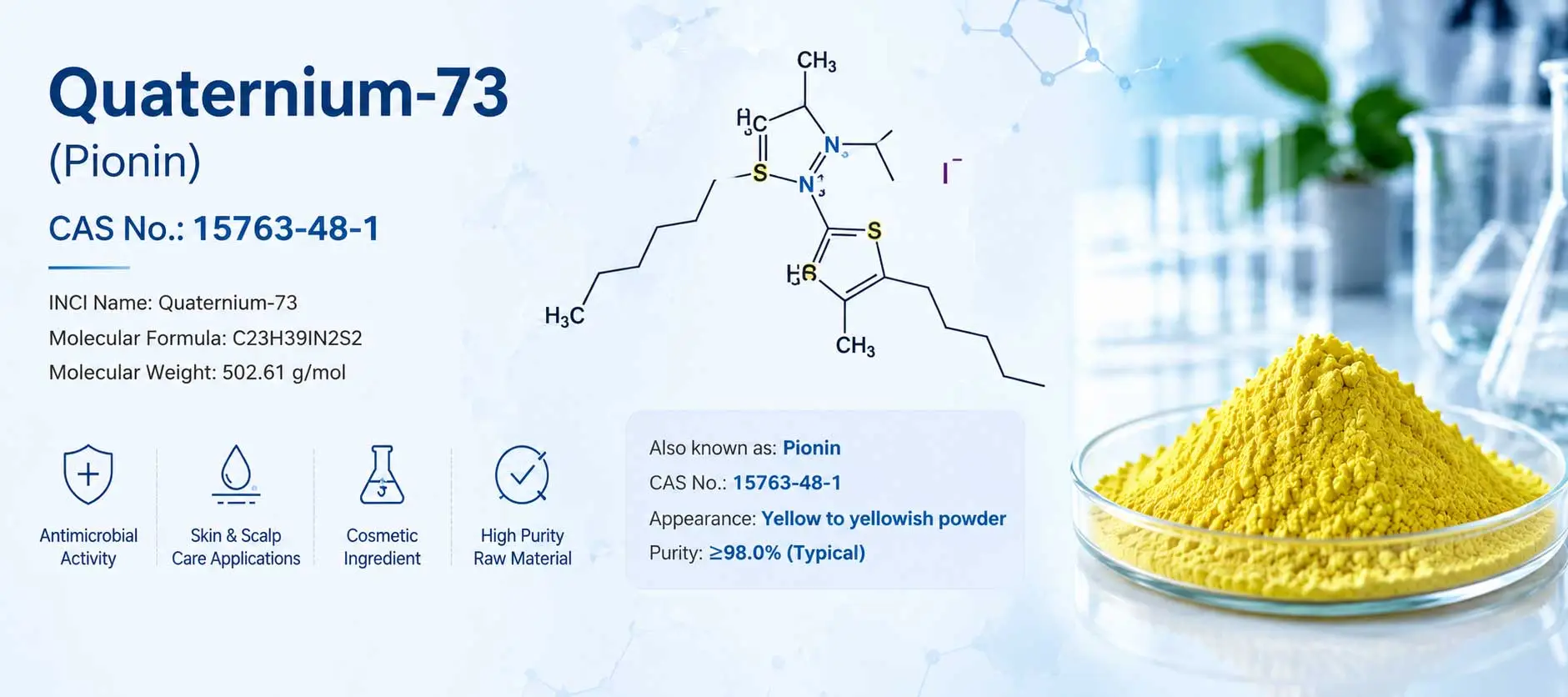
When buyers ask what is Quaternium-73, the first step is to separate the standardized ingredient identity from the various names encountered in technical literature and commercial listings. Quaternium-73 is the INCI name used to identify the ingredient in the cosmetics sector, while Pionin is another name frequently associated with the same substance. Its CAS Registry Number is 15763-48-1.
These identifiers are particularly useful in international sourcing. A purchasing inquiry containing only a commercial or local name can create ambiguity, whereas combining the INCI name and Quaternium-73 CAS number gives the supplier and buyer a much clearer basis for confirming identity.
Is Pionin the Same as Quaternium-73?
Yes. In cosmetic ingredient and chemical databases, Pionin Quaternium-73 refers to the substance identified by the INCI name Quaternium-73 and CAS 15763-48-1. Pionin is therefore useful as a search and cross-reference term, particularly when reviewing older technical literature or sourcing the ingredient internationally.
This does not mean buyers should approve a raw material simply because a supplier uses the word Pionin. The material still needs to be matched against the required specification and supporting analytical documentation.
|
Identification item |
Information |
|
INCI name |
Quaternium-73 |
|
Commonly associated name |
Pionin |
|
CAS No. |
15763-48-1 |
|
Molecular formula |
C23H39IN2S2 |
|
Molecular weight |
Approx. 502.6 g/mol |
|
Material category |
Cosmetic raw material |
|
Typical commercial form |
Powder |
For procurement records, technical specifications and sample evaluation, using Quaternium-73 INCI, CAS number and specification together provides a much stronger identity trail than relying on a trade or common name alone.
Quaternium-73 Properties That Matter in Cosmetic Formulation
The useful Quaternium-73 properties for a formulator are not limited to molecular formula or molecular weight. Raw-material appearance, assay, solubility, handling behavior and consistency between production batches have more direct consequences for formulation work.
Commercial Quaternium-73 powder should be assessed against an agreed specification before formulation trials begin. Appearance can provide a quick preliminary check, but it cannot establish chemical identity or purity. That requires appropriate analytical testing. A purchasing specification should therefore distinguish visual characteristics from quantitative parameters such as assay and any other quality indicators relevant to the supplied grade.
This becomes particularly important when comparing quotations. Two materials described simply as CAS 15763-48-1 may not necessarily have identical specifications, analytical methods or impurity controls. For a cosmetic manufacturer, a lower quotation has little commercial value if the material creates inconsistent results between production batches or requires repeated requalification.
Appearance, Identity and Raw Material Consistency
Raw-material qualification should start with a representative sample from the same specification that will be supplied commercially. The laboratory can then compare appearance and analytical data against the supplier's documentation and retain the approved sample as a reference where appropriate.
At CHEN LANG BIO TECH, we view batch consistency as part of the commercial specification rather than an issue to address only after an order is placed. For customers developing repeat-production formulas, the objective is to supply material against defined quality parameters so that subsequent batches can be evaluated against the same acceptance criteria.
Solubility and Handling Characteristics
Quaternium-73 solubility deserves particular attention during formulation development because low-use-level ingredients can still present processing challenges if they are introduced incorrectly. A formulator should consider the intended solvent or carrier system, order of addition, processing temperature and the characteristics of the finished formulation rather than assuming that a powder can simply be added directly to the bulk phase.
A small laboratory compatibility trial is therefore preferable to relying solely on a general solubility statement. This is particularly useful when a manufacturer is changing suppliers or incorporating the ingredient into an existing formula.
What Is Quaternium-73 Used for in Cosmetic Formulations?
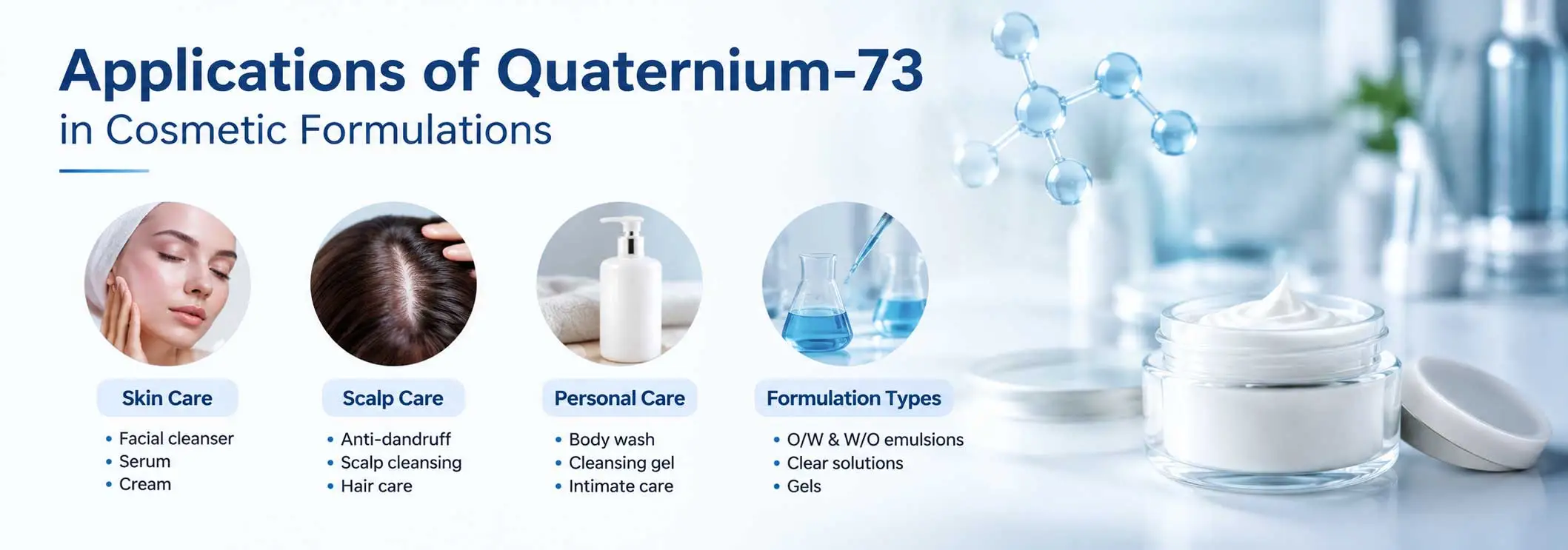
The principal Quaternium-73 uses in cosmetics are associated with its antimicrobial characteristics and its suitability for selected skin, scalp and personal-care formulations. It has attracted particular attention in products intended for acne-prone and oily skin, where formulators may be looking for an ingredient that fits a broader strategy for managing the microbial environment of the formulation and skin surface.
These Quaternium-73 cosmetic uses should nevertheless be considered at formulation level rather than translated directly into medical claims. A cosmetic raw material is one component of a finished formulation, and its suitability depends on concentration, vehicle, other ingredients, product positioning and applicable cosmetic regulations.
Quaternium-73 in Skin Care Formulations
In skin care, Quaternium-73 in cosmetics may be evaluated for facial cleansers, serums, creams, gels and other products designed for oily or acne-prone skin. Its antimicrobial characteristics are one reason formulators investigate the ingredient, particularly when developing products in which microbial balance is relevant to the formulation concept.
For a raw-material buyer, the more useful question is not simply whether Pionin “works for acne,” but whether the selected grade can be incorporated consistently into the intended formula. Solubility, compatibility, use level, finished-product stability and local regulatory requirements should all be reviewed during development.
This distinction also helps brands avoid inappropriate claims. Cosmetic manufacturers can evaluate Pionin uses within a skin-care formulation without positioning the raw material as a pharmaceutical treatment.
Quaternium-73 in Scalp and Personal-Care Formulations
The same formulation logic extends to selected scalp-care and cleansing products. Antimicrobial ingredients may be investigated as part of formulations intended to manage scalp conditions associated with excess sebum or microorganisms, but performance must be established in the finished product rather than inferred from raw-material literature alone.
For commercial projects, this means application testing should follow raw-material qualification. The supplier's data can guide formulation work, but it cannot replace stability, compatibility, preservative efficacy where applicable, and finished-product performance testing.
How Does Quaternium-73 Work as an Antimicrobial Cosmetic Ingredient?
Quaternium-73 antimicrobial activity is one of the main reasons the ingredient is discussed in cosmetic formulation. Literature and ingredient references describe Pionin as having antimicrobial activity, including activity relevant to microorganisms associated with acne-prone skin. This has led to its inclusion in formulation concepts for problem skin and other applications where microbial control is of interest.
For formulators, however, Quaternium-73 antibacterial activity should be interpreted in context. Raw-material activity observed under defined test conditions does not automatically predict the performance of a finished serum, cream or cleanser. Surfactants, emulsifiers, solvents, pH and other actives can influence how an ingredient behaves within the formulation.
This is why we recommend separating three questions during development: whether the raw material meets its specification, whether it remains compatible and stable in the intended formula, and whether the finished product delivers the performance required by the brand. Treating those as separate validation steps produces more reliable commercial decisions.
Is Quaternium-73 a Preservative?
The presence of antimicrobial activity does not automatically mean that Quaternium-73 should be treated as a direct replacement for a conventional preservative system. When buyers search is Quaternium-73 a preservative, this distinction is important.
A finished cosmetic product has its own microbiological protection requirements. Preservative selection depends on the formulation, packaging, water activity, manufacturing environment and applicable regulations. If Quaternium-73 is included for a specific formulation function, the finished product should still undergo the appropriate microbiological and preservative efficacy assessment rather than assuming that its antimicrobial characteristics alone provide adequate preservation.
Quaternium-73 Formulation Considerations: Solubility, Use Level and Compatibility
Successful Quaternium-73 formulation work begins with the finished product rather than a generic recipe. A clear facial serum, an emulsion and a rinse-off cleanser have different solvent systems, processing conditions and compatibility requirements. Consequently, how to use Quaternium-73 should be determined within the specific formulation architecture.
Solubility and Addition Method
Before scaling up, formulators should confirm how the supplied material behaves in the intended phase or carrier. Pre-dissolution may be appropriate in some systems, while other formulas require a different incorporation approach. The goal is to obtain uniform distribution without creating undissolved particles, localized high concentrations or unnecessary processing stress.
The supplier's technical information provides a starting point, but a laboratory trial using the actual formulation is more informative. During this stage, formulators can observe clarity, precipitation, color changes and other signs of incompatibility before committing to pilot production.
Quaternium-73 Use Level Should Follow the Finished Formula
There is no sound formulation practice in selecting a Quaternium-73 use level simply because a percentage appears repeatedly on supplier websites. The appropriate concentration should be evaluated against the intended application, supplier technical information, applicable regulations and the characteristics of the finished formulation.
This is particularly important for international brands. A concentration that can technically be incorporated into a laboratory formula is not automatically suitable for every market. Regulatory review should therefore form part of formulation approval rather than being performed only after the product is ready for launch.
For the same reason, searches for Quaternium-73 dosage should lead to formulation-specific evaluation rather than an isolated percentage presented as universally applicable.
Compatibility and Stability Testing
Quaternium-73 compatibility should be evaluated with the ingredients that will actually be present in the finished product. Changes in pH, temperature, solvent composition and interaction with other formulation components can affect appearance and stability.
Pilot batches should be monitored under the manufacturer's normal stability protocol. Depending on the product, evaluation may include appearance, odor, pH, viscosity, precipitation, assay of relevant actives and microbiological parameters. This approach provides much more meaningful evidence than evaluating Quaternium-73 in isolation.
How to Evaluate Quaternium-73 Quality Before Formulation
For professional buyers, Quaternium-73 quality should be defined through measurable specifications. The starting point is identity: the supplied material must correspond to Quaternium-73 / Pionin, CAS 15763-48-1. The next question is whether the lot meets the agreed analytical and physical parameters.
A useful Quaternium-73 specification should clearly state the acceptance criteria relevant to the grade being purchased. Buyers can then compare those criteria with the batch-specific Quaternium-73 COA rather than treating the COA as a generic sales document.
Identity and Assay
Assay or Quaternium-73 purity is an important purchasing parameter, but the percentage should always be considered together with the analytical method. A supplier stating a high purity without identifying how it is measured gives a buyer less useful information than a defined specification supported by batch testing.
This is particularly relevant when qualifying a new Quaternium-73 raw material source. Purchasing teams should compare specification against specification, not price against price, and ask for clarification when analytical methods or acceptance limits differ between suppliers.
What Should Buyers Check on a Quaternium-73 COA?
A Quaternium-73 COA should correspond to an identifiable production batch and provide actual test results rather than merely repeating a marketing specification. Depending on the agreed grade and specification, buyers should review parameters such as identity, appearance, assay and other relevant quality indicators, together with the methods used to generate those results.
The COA should also be consistent with supporting technical documents. If the product name, CAS number, specification or test method changes between documents, the discrepancy should be resolved before the material is approved.
For regulated quality systems, buyers may additionally request TDS, SDS/MSDS and other documentation required by their internal qualification procedure or destination market.
What Cosmetic Raw Material Buyers Should Check When Sourcing Quaternium-73
Evaluating a Quaternium-73 supplier is different from locating a company that can quote the material. Cosmetic manufacturers need to know whether a prospective source can maintain the agreed specification through sampling, scale-up and repeat commercial orders.
When evaluating a Quaternium-73 manufacturer, buyers should ask for evidence that relates directly to the material: a current specification, representative COA, test methods where available, packaging information, storage requirements, sample availability and traceable batch documentation. These records are more useful than broad claims about being a “leading supplier.”
The same principle applies when searching for a Pionin supplier or CAS 15763-48-1 supplier. Different search terms may lead to the same ingredient, but supplier qualification should ultimately return to the same questions of identity, quality control and commercial consistency.
Specification and Batch Documentation
Documentation should be reviewed before a substantial order whenever possible. A Quaternium-73 raw material supplier should be able to provide enough information for the customer's quality or R&D team to determine whether the grade is worth evaluating.
A COA establishes batch-specific analytical information; a technical specification defines the acceptance limits; an SDS addresses handling and safety information. These documents serve different purposes and should not be treated as interchangeable.
Sample Evaluation Before Bulk Purchasing
A Quaternium-73 sample can reduce risk before commercial procurement. The sample should preferably represent the same grade and specification intended for subsequent supply so that formulation results remain relevant when the project moves to scale.
For a new project, we recommend evaluating the sample in the actual base formula rather than assessing only appearance or solubility in a simple solvent. This provides early information on compatibility, processing behavior and finished-product stability.
Commercial Supply and Batch Consistency
Once a sample has passed technical evaluation, procurement considerations become more important. Packaging, MOQ, normal production or dispatch lead time, batch size, documentation and the ability to support repeat orders all affect supply continuity.
A reliable Quaternium-73 bulk supplier should therefore be evaluated not only on the first shipment but also on its ability to maintain specification and documentation across subsequent batches.
Buying Quaternium-73 in Bulk: Questions to Ask a Supplier
Companies planning to buy Quaternium-73 for commercial formulation should request technical and commercial information together. Comparing only Quaternium-73 price can obscure differences in assay, testing, packaging or documentation that later affect qualification costs.
Before placing a bulk Quaternium-73 order, a practical purchasing review should establish the following:
1. What specification and assay are supplied?
2. Which analytical methods are used for release testing?
3. Can the supplier provide a batch-specific COA?
4. Is a representative sample available for formulation evaluation?
5. What are the MOQ and commercial packaging options?
6. What storage conditions and shelf life apply?
7. What is the normal lead time for the required quantity?
8. Can the same specification be maintained for repeat orders?
9. Which technical and shipping documents can be supplied for international orders?
These questions are equally relevant when searching to buy Pionin, locate a Quaternium-73 bulk supplier, or compare a quotation from a Quaternium-73 manufacturer with one from another commercial source. For an industrial buyer, the lowest unit price is rarely the lowest total cost if a material subsequently fails formulation or supplier qualification.
Quaternium-73 FAQ for Formulators and Raw Material Buyers
Is Pionin the same as Quaternium-73?
Yes. Pionin is a name commonly associated with Quaternium-73, which is identified by CAS 15763-48-1. For purchasing and quality documentation, buyers should use the INCI name and CAS number together with the required material specification to avoid ambiguity.
What is the CAS number of Quaternium-73?
The Quaternium-73 CAS number is 15763-48-1. Including the CAS number in RFQs, specifications and sample requests helps ensure that the buyer and supplier are discussing the same chemical substance.
What is Quaternium-73 used for in cosmetics?
The main Quaternium-73 uses are associated with cosmetic formulations in which its antimicrobial characteristics are relevant. It is particularly discussed in skin-care products for oily or acne-prone skin and in selected scalp and personal-care formulations. The suitability of the ingredient should nevertheless be verified in the finished formula.
Is Quaternium-73 a preservative?
Quaternium-73 has antimicrobial characteristics, but formulators should not automatically assume that it can replace the preservative system required by a finished cosmetic. Preservation should be designed and validated according to the complete formula, packaging and relevant microbiological requirements.
What should buyers check on a Quaternium-73 COA?
A buyer reviewing a Quaternium-73 COA should first confirm product identity and batch information, then compare actual test results with the approved specification. Assay, appearance, identity and other applicable quality parameters should be evaluated according to the grade being purchased. The analytical method used for key quantitative parameters is also worth confirming during supplier qualification.
Where can cosmetic manufacturers source Quaternium-73?
Companies researching where to buy Quaternium-73 should source from a qualified Quaternium-73 supplier capable of providing a defined specification, batch COA, technical documentation, representative samples and consistent commercial supply.
CHEN LANG BIO TECH supplies Quaternium-73 for cosmetic raw-material projects and supports international manufacturers, formulation laboratories and ingredient distributors with sample evaluation and commercial quantities. Buyers can request the current specification and COA before deciding whether the material matches their formulation and quality requirements.
Final Considerations When Selecting Quaternium-73 for a Cosmetic Project
Selecting Quaternium-73 should ultimately be a technical and procurement decision rather than a response to a single ingredient claim. Formulators need to establish whether the material is compatible with the intended product, while purchasing and quality teams need evidence that its identity, assay, documentation and batch consistency can be maintained when the project progresses from laboratory evaluation to commercial production.
For cosmetic manufacturers or distributors currently evaluating Quaternium-73 powder, CHEN LANG BIO TECH can provide current product specifications, COA information, sample availability, packaging details and quotations for bulk Quaternium-73 supply. This allows R&D and purchasing teams to review the material against their own requirements before committing to a commercial order.
For technical documentation, samples or current commercial supply information, contact admin@chenlangbio.com or your CHEN LANG BIO TECH sales representative.

Send Inquiry
Related Industry Knowledge
- What Is 9 ME BC? Benefits, Mechanism, Safety & Research Overview
- Chondroitin Sulfate vs Glucosamine: Which One is Better for Joint Health?
- L-Carnosine: The Safe and Effective Dipeptide for Immune and Gut Health
- 3 Compelling Uses of Fucoidan Powder for Beauty Brands
- How does D-Luciferin Sodium Salt Work in Bioluminescence?
- Sesamin Powder vs. Other Antioxidants: Which is Best?
- How Do You Use Kopexil for Hair Loss?
- Is Lufenuron Safe
- What Does Coenzyme Q10 Do for Your Body
- Fisetin Powder Antioxidant Activity and Health Supplement