
Quaternium-73 Recommended Use Level and Dosage: A Formulator’s Guide
2026-08-26 12:58:29
For formulators working with Quaternium-73, the most frequently cited Quaternium-73 recommended use level in current commercial technical literature is 0.001–0.005% of the finished formulation. This range appears in several ingredient suppliers’ technical guidance, including the current CHEN LANG BIO TECH product specification and other commercial sources. However, it should not be treated as a universal dosage for every grade, formulation or market. Some technical data sheets specify a broader range of 0.001–0.05%, demonstrating why formulators should verify the documentation supplied with the actual raw material rather than copying a percentage from another formula.
The distinction becomes even more important when regulations are involved. Taiwan’s current official list, for example, specifies Quaternium-73 at a maximum concentration of 0.005% in the relevant preservative listing. The amended list scheduled to take effect on October 1, 2027 retains the 0.005% figure. That regulatory maximum is not the same thing as a supplier’s recommended formulation range or an antimicrobial MIC value.
For a cosmetic manufacturer, therefore, selecting a Quaternium-73 dosage involves four separate questions: What does the commercial-grade TDS recommend? What concentration is appropriate for the formulation being developed? What does the destination market permit? And can the selected concentration be incorporated accurately and validated in the finished product?
What Quaternium-73 Use Levels Are Reported in Technical Literature?
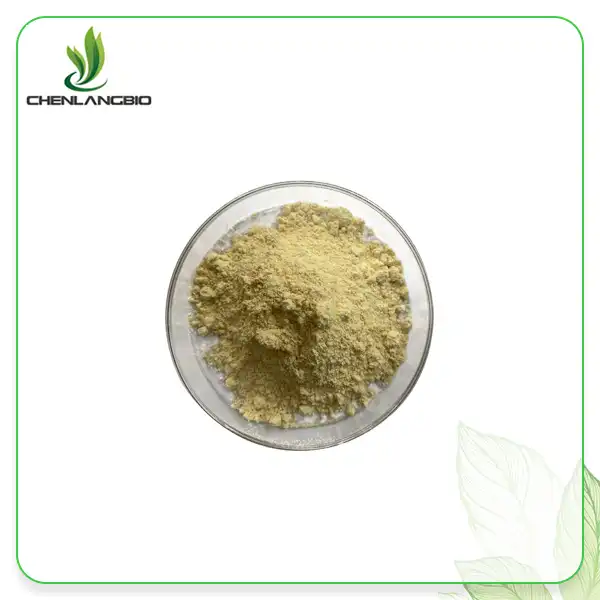
Quaternium-73, CAS 15763-48-1, is a yellow to yellowish crystalline cosmetic raw material normally used at relatively low concentrations. A review of currently accessible commercial technical information shows that there is no single dosage figure repeated by every supplier.
Several commercial sources specify a Quaternium-73 use level of 0.001–0.005%. Winkey Technology gives 0.001–0.005% for its Quaternium-73 ingredient, while Suzhou Health Chemicals reports the same range. CHEN LANG BIO TECH currently specifies an advised dosage of 0.001–0.005% for its commercial Quaternium-73 powder.
Another current technical data sheet illustrates why the underlying source matters. ZLEY’s TDS identifies Quaternium-73, CAS 15763-48-1, with HPLC purity of at least 98%, but gives a suggested usage amount of 0.001–0.05%, ten times the upper concentration stated in the sources above. The same TDS recommends pre-dissolution in ethanol, butanediol or glutarediol before incorporation.
|
Information source |
Reported concentration |
How formulators should interpret it |
|
CHEN LANG BIO TECH commercial grade |
0.001–0.005% |
Supplier-recommended formulation range |
|
Winkey commercial ingredient |
0.001–0.005% |
Grade-specific commercial guidance |
|
Health Chemicals Quaternium-73 |
0.001–0.005% |
Supplier-recommended use level |
|
ZLEY Quaternium-73 TDS |
0.001–0.05% |
Grade-specific suggested usage |
|
Taiwan regulatory listing |
Maximum 0.005% |
Market-specific regulatory restriction |
The table highlights a point that is easy to miss when searching for Pionin recommended dosage online: a supplier recommendation and a regulatory limit answer different questions.
Why Do Quaternium-73 Suppliers Report Different Recommended Dosages?
A Quaternium-73 recommended dosage should always be connected to the commercial grade from which the recommendation was generated.
Supplier technical documents can differ because specifications, analytical standards, intended applications and the evidence used to develop formulation guidance may differ. A raw material offered at ≥98% HPLC purity is also conceptually different from a future commercial blend or diluted preparation in which Quaternium-73 represents only part of the supplied material.
Intended formulation conditions matter as well. A transparent toner, surfactant cleanser, polymer-thickened gel and emulsion do not present identical solvent systems or incorporation conditions. Even when two suppliers sell materials under the same INCI and CAS number, their technical recommendations should be reviewed rather than assumed to be interchangeable.
Regulatory conditions introduce another layer. A supplier may publish a technically feasible Quaternium-73 dosage range, but that does not override a lower legal limit in a destination market.
For this reason, a supplier-recommended use level should be regarded as formulation guidance for the commercial grade concerned—not as a universal concentration applicable to every Quaternium-73 raw material and every market.
How Do You Calculate Quaternium-73 Dosage?
Once a starting percentage has been selected, the calculation itself is straightforward:
Required Quaternium-73 (g) = batch weight (kg) × use level (%) × 10
For example, a 100 kg batch formulated at 0.003% requires:
100 × 0.003 × 10 = 3 g
A 500 kg batch at 0.005% requires:
500 × 0.005 × 10 = 25 g
The calculation is simple, but low percentages are easy to misread. A concentration of 0.001% means one part in 100,000, not a decimal fraction of 0.001. Expressed as a decimal fraction, 0.001% is 0.00001.
That difference is critical when calculating how much Quaternium-73 to use. A misplaced decimal point can increase the addition by orders of magnitude.
For manufacturing records, we recommend recording both the percentage and the calculated mass rather than leaving the operator to convert the percentage during production.
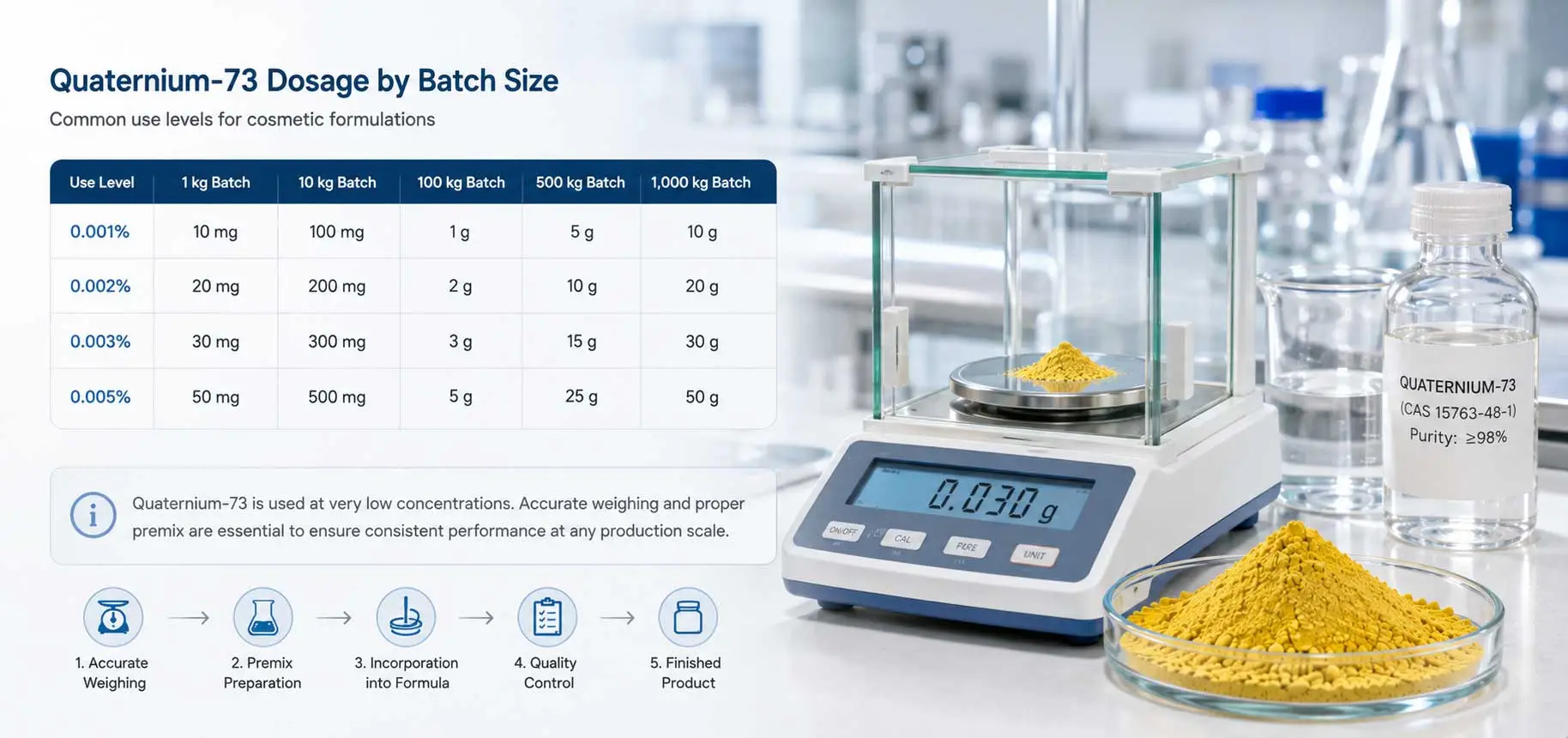
Quaternium-73 Dosage by Batch Size
The low Quaternium-73 formulation percentage becomes easier to understand when translated into actual production quantities.
|
Quaternium-73 use level |
1 kg batch |
10 kg batch |
100 kg batch |
500 kg batch |
1,000 kg batch |
|
0.001% |
10 mg |
100 mg |
1 g |
5 g |
10 g |
|
0.002% |
20 mg |
200 mg |
2 g |
10 g |
20 g |
|
0.003% |
30 mg |
300 mg |
3 g |
15 g |
30 g |
|
0.005% |
50 mg |
500 mg |
5 g |
25 g |
50 g |
This table also explains why Quaternium-73 dosage per kg cannot be separated from manufacturing controls. At 0.001%, a one-kilogram laboratory formulation contains only 10 mg of Quaternium-73. Even a 100 kg batch requires just 1 g.
For formulators moving from a 1 kg prototype to a 500 or 1,000 kg pilot or production batch, percentage scaling is therefore only one part of the process. Weighing accuracy, quantitative transfer and homogeneous distribution need equal attention.
Why Low Quaternium-73 Dosage Makes Accurate Weighing Important
An ingredient used at several percent is relatively forgiving of small transfer losses. A Quaternium-73 low dosage is not.
Suppose a laboratory is preparing a 1 kg prototype at 0.001%. The target is 10 mg. A balance with inadequate readability or an uncontrolled transfer procedure can introduce a meaningful error relative to the total quantity being added.
At 100 kg scale, the same formulation requires 1 g. Material retained on weighing paper, spatulas or the walls of a premix vessel can still represent a measurable percentage of the intended addition.
Good practice therefore includes using an appropriate balance, recording actual weight, minimizing transfer surfaces and using quantitative transfer where practical. The manufacturing SOP should also define how the material reaches the main batch rather than stopping at the instruction “add 0.001% Quaternium-73.”
This is particularly important when comparing laboratory results with production results: an apparent formulation difference may actually originate from inaccurate low-level dosing.
Should Quaternium-73 Be Added Directly or as a Premix?
For low-dose ingredients, a controlled premix can make incorporation easier and reduce the challenge of distributing a very small quantity through a much larger batch.
Commercial technical guidance also supports pre-dissolution for Quaternium-73. One TDS recommends ethanol, butanediol or glutarediol, while another commercial grade is described as slightly soluble in water and recommends preparing a polyol solution before use. The latter source also specifies a formulation pH range of 5.5–8.0 for its grade.
The correct Quaternium-73 premix, however, depends on the formulation. A glycol already present in a serum may provide a practical carrier, while another formulation may require a different incorporation strategy.
Pre-dissolution does not change the final Quaternium-73 dosage. If a 100 kg formula requires 3 g of Quaternium-73 to achieve 0.003%, preparing those 3 g in a larger premix simply changes how the material is delivered to the batch. The final active amount remains 3 g.
The premix procedure should record carrier, ratio, temperature if relevant, mixing conditions and endpoint. This makes the method reproducible during scale-up.
Does the Recommended Quaternium-73 Use Level Change by Product Type?
Current supplier information describes Quaternium-73 for several skincare applications, but formulators should be cautious about assigning arbitrary fixed percentages to individual product types.
There is not enough basis to state, for example, that every Quaternium-73 serum dosage should be 0.003% while every Quaternium-73 cleanser dosage should be 0.005%.
A more defensible formulation approach is:
|
Product type |
Factors affecting use-level selection |
|
Serum |
Grade-specific guidance, solvent system, pH, clarity and leave-on stability |
|
Toner |
Solubility, clarity, precipitation and final pH |
|
Gel |
Polymer compatibility, distribution and viscosity |
|
Cream/emulsion |
Phase incorporation and physical stability |
|
Cleanser |
Surfactant system, incorporation and rinse-off conditions |
|
Scalp-care product |
Vehicle, contact conditions and finished-product validation |
A leave-on serum and rinse-off cleanser also expose the ingredient under fundamentally different conditions. The same nominal concentration does not imply equivalent finished-product performance.
Consequently, Quaternium-73 concentration in cosmetics should be selected for the actual formulation and not copied from a product in another category.
Is Quaternium-73 MIC the Same as Its Recommended Dosage?
No. Quaternium-73 MIC vs dosage compares two different technical concepts.
MIC—minimum inhibitory concentration—is a microbiological endpoint. It identifies the lowest tested concentration that inhibits visible microbial growth under specified experimental conditions. A recommended use level is a formulation parameter.
An MIC obtained against a particular Cutibacterium acnes strain in culture therefore cannot simply be copied into a serum formula as the “correct dosage.” A cosmetic contains solvents, surfactants, polymers, emulsifiers and other ingredients, and its exposure conditions differ substantially from those of an antimicrobial assay.
This distinction is especially important because Quaternium-73 is often discussed in relation to C. acnes. Laboratory antimicrobial evidence can inform ingredient selection, but it does not determine the commercial formulation percentage.
For a detailed review of organism-specific evidence, MIC interpretation and MIC versus MBC, see our related article Quaternium-73 and Cutibacterium acnes: What Does the Research Show?
Recommended Use Level vs Regulatory Maximum: What Is the Difference?
Three numbers are frequently confused when buyers research Quaternium-73:
|
Term |
Meaning |
Does it determine final formulation dosage by itself? |
|
MIC |
Microbiological inhibition endpoint under defined test conditions |
No |
|
Recommended use level |
Technical/formulation guidance associated with a commercial grade |
No |
|
Regulatory maximum |
Legally permitted upper concentration where a jurisdiction imposes one |
No; the formulation must still be technically validated |
The distinction becomes concrete in Taiwan. Its official cosmetic preservative list specifies Quaternium-73, CAS 15763-48-1, at 0.005%. The amended ingredient list due to take effect on October 1, 2027 continues to show 0.005%.
This means that a TDS from another source suggesting up to 0.05% should not be interpreted as authorization to use 0.05% in a product governed by a 0.005% local maximum.
For international brands, regulatory review should therefore be performed against the destination market rather than against a supplier website.
This is one of the most important principles when interpreting a Quaternium-73 maximum concentration: technical feasibility and legal permissibility are separate questions.
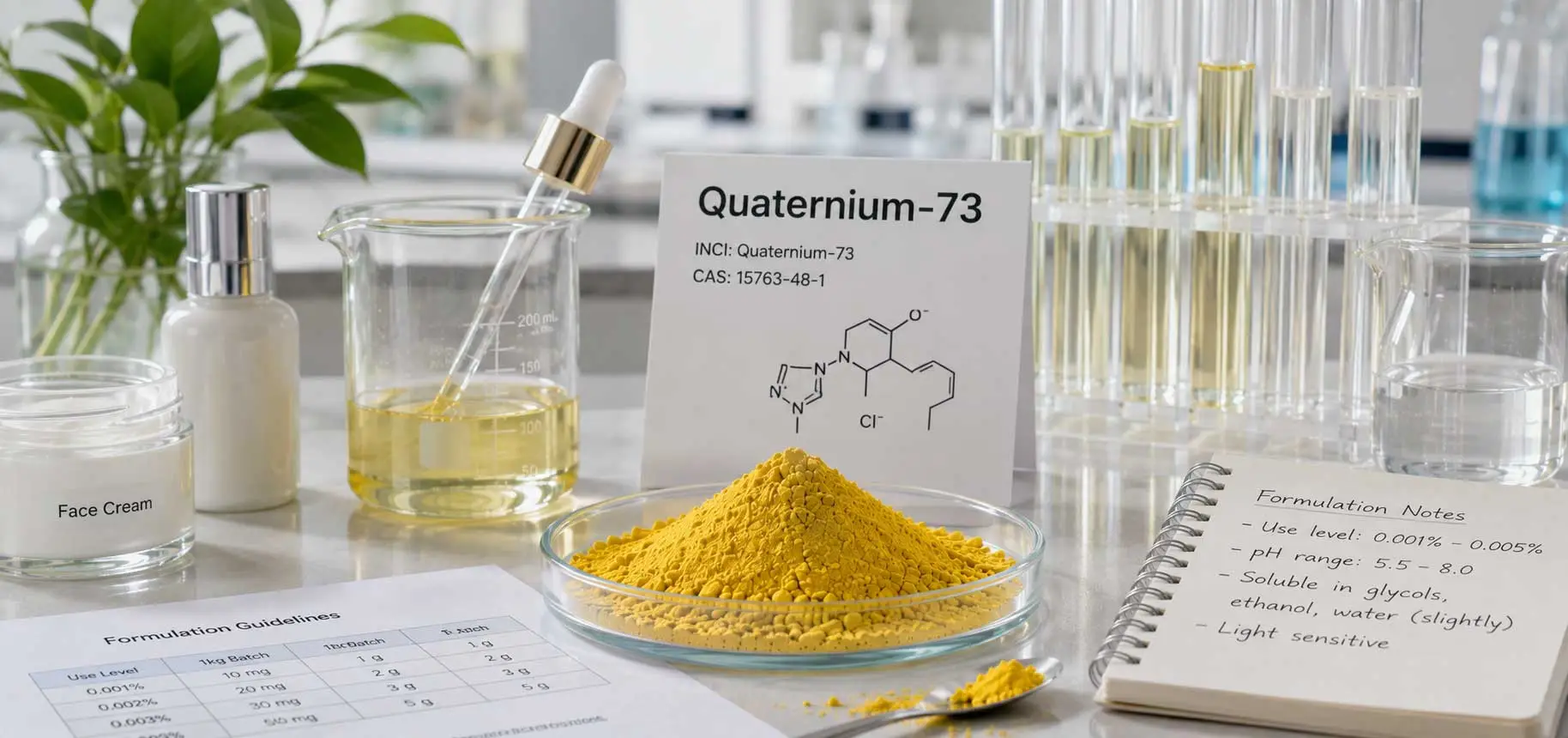
How Should Formulators Select a Starting Quaternium-73 Concentration?
A defensible starting concentration can be selected through a short decision sequence.
First, identify the exact commercial grade and obtain its current specification and TDS. Second, confirm whether the material is supplied as high-purity Quaternium-73 or in another form and establish the active content. Third, check the regulations applicable to the intended sales market and product category. Only then should the formulator select a starting concentration within the technically and legally appropriate range.
The selected Quaternium-73 recommended percentage should then be evaluated in a laboratory prototype. Observe incorporation, clarity or appearance, pH and physical compatibility before moving to stability testing.
After the prototype is satisfactory, confirm that the same procedure remains reproducible at pilot scale.
This sequence—commercial grade → TDS → regulatory review → starting concentration → prototype → validation → scale-up—is more reliable than selecting a percentage from a competitor formula.
Why More Quaternium-73 Does Not Automatically Mean Better Formulation Performance
Increasing Quaternium-73 concentration should not be treated as an automatic route to better product performance.
A higher concentration can alter solubility behavior, raw-material color contribution and interactions within the finished formulation. It may also exceed the technical recommendation associated with the grade or a market-specific regulatory limit.
Nor should antimicrobial results be extrapolated indefinitely: a concentration-response relationship observed under one laboratory method does not prove that doubling the concentration in a cosmetic doubles finished-product performance.
The practical objective is therefore not to use the largest possible amount. It is to identify a justified concentration that can be incorporated reproducibly, remains within applicable regulatory requirements and performs acceptably in the complete formulation.
What Should Be Tested After Selecting the Quaternium-73 Dosage?
A Quaternium-73 recommended dosage is a starting point, not a substitute for finished-product validation.
After selecting the concentration, formulation teams should monitor appearance, color, clarity where relevant, pH, viscosity, precipitation and phase separation. Accelerated and real-time stability programs should follow the company's normal product-development protocol.
Light exposure deserves consideration as well. Current technical information for one commercial Quaternium-73 grade describes the material as unstable on exposure to light and recommends light-protective finished-product packaging. This should be verified for the grade actually purchased rather than generalized blindly to every supplier's material.
Where antimicrobial or preservation performance forms part of the finished-product strategy, appropriate microbiological testing must be performed on the complete formula. Raw-material antimicrobial data do not replace finished-product challenge testing.
Why Raw Material Purity Matters When Comparing Quaternium-73 Dosage
A percentage has meaning only when the material being weighed is clearly defined.
Several current commercial Quaternium-73 products specify HPLC purity ≥98%. ZLEY, for example, lists NLT 98.0% HPLC purity, while another current supplier specifies ≥98.0% by HPLC-DAD.
For high-purity Quaternium-73 raw material, formulators normally work from the specification of the supplied material. If a commercial preparation is instead diluted in a carrier, the as-supplied addition and active Quaternium-73 concentration are no longer the same number.
For example, a hypothetical 10% active preparation would require ten times as much supplied material to deliver the same active mass as a 100% basis calculation. This example is mathematical only; it should not be interpreted as the specification of the CHEN LANG BIO TECH grade.
Procurement teams should therefore determine whether a supplier's recommended percentage refers to product as supplied or active Quaternium-73 before comparing dosage recommendations between grades.
What Should Buyers Check on a Quaternium-73 COA and TDS?
For a commercial purchase, the Quaternium-73 COA, specification and TDS serve different purposes.
The specification defines the quality criteria for the grade. A batch-specific COA reports actual results for the lot being supplied. The TDS provides technical information such as identity, recommended handling, incorporation guidance and storage.
At minimum, buyers should verify:
•INCI identity and CAS 15763-48-1
•Appearance
•Quaternium-73 assay or purity
•Analytical method, such as HPLC where specified
•Batch identification
•Storage conditions and shelf life
•Recommended use and incorporation guidance
The documentation should refer to the commercial material actually being offered. A generic TDS copied from another grade provides little value if the supplier cannot connect it to the specification and batch COA of the shipment.
How to Compare Quaternium-73 Suppliers Before Formulation Approval
When evaluating a Quaternium-73 supplier, price should be considered after technical comparability has been established.
A buyer should first determine whether each supplier can provide a consistent specification, batch-specific COA, representative sample and technical information for the same commercial grade. Packaging, traceability, repeat supply and the ability to answer formulation-related questions also matter.
This approach is particularly important when comparing a Quaternium-73 manufacturer with a distributor or trader. The label alone does not establish quality; traceable manufacturing information and batch documentation are more useful.
For a cosmetic grade Quaternium-73 supplier, the sample should ideally correspond to the specification that will be supplied commercially. If a laboratory approves one grade and procurement later purchases a materially different specification based only on a lower Quaternium-73 price per kg, the formulation may need to be re-evaluated.
Buying Quaternium-73 for R&D and Bulk Cosmetic Production
For companies preparing to buy Quaternium-73, a practical procurement path is:
Specification and TDS → batch COA → representative sample → dosage trial → prototype approval → pilot batch → commercial order
CHEN LANG BIO TECH supplies high-purity Quaternium-73 for cosmetic formulation projects. Our current product information specifies 98%+ purity and an advised 0.001–0.005% use level. Standard packaging includes 1 kg aluminum foil bags and 25 kg fiber drums, and stocked material is typically arranged for dispatch within 2–3 working days after order, while requirements above 500 kg are scheduled according to availability and production planning.
Cosmetic manufacturers, R&D laboratories, OEM/ODM companies and distributors evaluating where to buy Quaternium-73, bulk Quaternium-73, MOQ or current Quaternium-73 price can request the current technical documents and a representative sample before commercial approval.
Quaternium-73 Dosage and Use Level FAQ
What is the recommended use level of Quaternium-73?
A Quaternium-73 recommended use level of 0.001–0.005% is commonly reported by several current commercial sources, including our commercial grade. Other TDS documents report broader ranges, so formulators should use the technical guidance for the specific grade and verify destination-market regulations.
What is the recommended dosage of Quaternium-73?
There is no single universal Quaternium-73 recommended dosage applicable to every commercial grade and market. The appropriate concentration should be selected from grade-specific technical guidance after checking active content, formulation requirements and applicable regulations.
How much Quaternium-73 do I need for a 100 kg batch?
At 0.001%, a 100 kg batch requires 1 g; at 0.003%, it requires 3 g; and at 0.005%, it requires 5 g. Because these quantities are small, balance accuracy and quantitative transfer are important.
Is Quaternium-73 MIC the same as its cosmetic dosage?
No. Quaternium-73 MIC vs use level compares a laboratory microbiological endpoint with a formulation parameter. MIC data can help characterize antimicrobial activity but should not be copied directly into a cosmetic formula as the recommended percentage.
Can I use a higher concentration of Quaternium-73?
A higher concentration should not be selected simply because a supplier TDS provides a broad range. Check the commercial-grade guidance, formulation compatibility and destination-market Quaternium-73 regulatory limit first. Taiwan, for example, lists a maximum of 0.005% in the relevant regulatory listing.
Should Quaternium-73 dosage be calculated on active content?
The calculation should reflect the specification of the material actually supplied. For a diluted commercial preparation, the as-supplied amount and active Quaternium-73 concentration are different. Confirm active content on the specification or TDS before calculating the formulation addition.
A Practical Approach to Quaternium-73 Dosage Selection
Selecting a Quaternium-73 dosage should begin with the documentation for the commercial grade, not with a percentage copied from another formulation. MIC, supplier-recommended use level and regulatory maximum concentration are different concepts and should not be used interchangeably. Once a technically and legally appropriate starting level has been identified, accurate weighing, controlled incorporation and finished-product validation determine whether that concentration is suitable for commercial production.
For a current Quaternium-73 specification, COA, TDS, sample, MOQ, packaging information or bulk Quaternium-73 quotation, contact CHEN LANG BIO TECH at admin@chenlangbio.com.
References
1. Taiwan Food and Drug Administration. List of Preservatives Allowed in Cosmetic Products. The official listing identifies Quaternium-73, CAS 15763-48-1, with a maximum concentration of 0.005%.
2. Taiwan Food and Drug Administration. Amended List of Ingredients Restricted in Cosmetic Products, scheduled to become effective October 1, 2027. Quaternium-73 remains listed at 0.005%.
3. ZLEY Group. Technical Data Sheet: ZLEY Quaternium-73. Lists CAS 15763-48-1, HPLC purity NLT 98.0%, suggested use of 0.001–0.05%, and pre-dissolution guidance. This is commercial technical information rather than a universal dosage standard.
4. Winkey Technology. WActive Pionin Technical/Product Information. Identifies the INCI as Quaternium-73 and reports a recommended use level of 0.001–0.005%.
5. Suzhou Health Chemicals. Quaternium-73 Product Information. Reports a recommended use level of 0.001–0.005% and provides commercial application and storage information.
6. Anallerg. Quaternium-73 Technical Information. Specifies ≥98.0% HPLC-DAD purity, a 0.001–0.005% use level, pre-dissolution guidance, pH 5.5–8.0 for the referenced grade and light-protection recommendations.
7. CHEN LANG BIO TECH. Quaternium-73, CAS 15763-48-1. Current commercial information specifies 98%+ purity, advised dosage of 0.001–0.005%, 1 kg/25 kg packaging and typical stock-order dispatch information.

Send Inquiry
Related Industry Knowledge
- Ashwagandha Root Extract vs. Powder: Which Is Better for Supplements and Formulations?
- Best L-Theanine Supplement Ingredients for Manufacturers & Bulk Suppliers
- What Is Dutasteride Powder Used For? A Practical Guide for Pharmaceutical Buyers and Product Development Teams
- Top 5 Uses of Hydrolyzed Keratin in Beauty Products
- Does Beta Ecdysterone Build Muscle?
- Is D-Luciferin Potassium Salt Soluble in Water?
- Can Minoxidil be Used in Combination with Other Treatments?
- Could Ergothioneine Cure Alzheimer's Disease
- What Does Coenzyme Q10 Do for Your Body
- What Is Tongkat Ali Root Powder