
Quaternium-73 Solubility: How to Incorporate It Into Cosmetic Formulas
2026-08-26 12:59:28
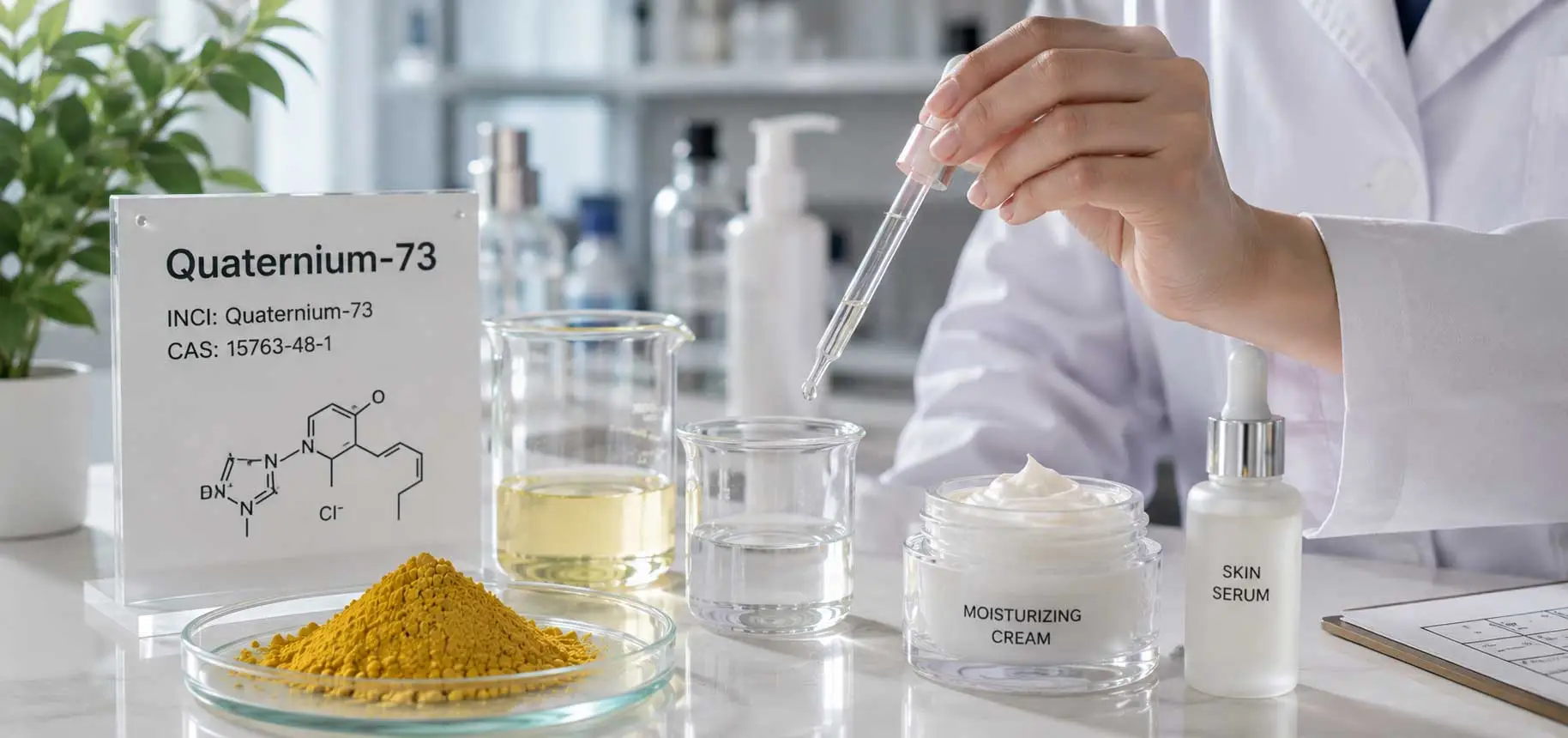
Quaternium-73 solubility is one of the first technical questions formulators need to resolve before working with this low-use-level cosmetic raw material. Quaternium-73, also known as Pionin and identified by CAS 15763-48-1, should not normally be treated as a conventional freely water-soluble powder. Commercial formulation dat a describe it as soluble in several cosmetic solvents—including butylene glycol, propylene glycol, ethanol and 1,2-pentanediol—while its water solubility is limited. One technical data sheet reports estimated water solubility of approximately 0.6068 mg/L at 25°C and recommends pre-dissolving the material in a compatible glycol before incorporation.
For formulation teams, this distinction is more important than whether the powder appears to disappear immediately during mixing. Dissolution, dispersion and long-term solubility are not the same thing. A batch may look homogeneous immediately after manufacture and still develop haze, crystals or sediment later as the solvent composition, pH and temperature equilibrate.
A controlled approach therefore begins with the technical documentation for the purchased commercial grade: confirm the concentration to be used, select a compatible premix carrier, dissolve or uniformly incorporate the material, transfer it quantitatively into the batch, and then verify that the ingredient remains stable in the finished cosmetic during the company's normal stability program.
Is Quaternium-73 Soluble in Water?
The practical answer to is Quaternium-73 water soluble is that available commercial technical information describes its water solubility as limited rather than high.
One current technical source lists Quaternium-73 as soluble in butylene glycol, propylene glycol, ethanol and 1,2-pentanediol, but only slightly soluble in water, with an estimated water solubility of 0.6068 mg/L at 25°C. A secondary chemical-property database reports the same estimated value.
That figure needs to be interpreted carefully. It is presented as an estimated value, not a universally validated experimental solubility constant for every commercial grade. It is useful for explaining why formulators should not assume that a small quantity of Quaternium-73 powder will automatically form a stable molecular solution simply because it has been added to the water phase.
This is particularly relevant at typical low formulation levels. If a formulator adds a few grams of Quaternium-73 directly to a large aqueous batch, agitation may initially produce what looks like an even dispersion. That visual observation does not prove complete dissolution.
There are three different outcomes worth distinguishing:
Dissolved: the material is present at molecular or ionic level in the solvent system.
Dispersed: fine solid material is distributed through the liquid but may remain undissolved.
Temporarily clear: a premix or finished formulation may appear clear initially but later precipitate as solvent conditions change.
For this reason, Quaternium-73 solubility in water should be evaluated using the actual grade and final formulation conditions rather than assumed from the ingredient name alone.
What Is the Best Solvent for Quaternium-73?
There is no universally “best” solvent for every formulation. The most appropriate Quaternium-73 solvent is one that can adequately incorporate the purchased grade while remaining compatible with the finished cosmetic.
Commercial formulation guidance provides several practical starting points:
|
Carrier or solvent |
Reported technical information |
What the formulator should verify |
|
Water |
Slight/limited solubility reported |
Whether complete dissolution is achieved |
|
Butylene glycol |
Reported soluble |
Premix ratio and finished-formula compatibility |
|
Propylene glycol |
Reported soluble |
Solvent load, clarity and stability |
|
Ethanol |
Reported soluble |
Product category and overall solvent system |
|
1,2-Pentanediol |
Reported soluble |
Premix behavior and compatibility |
|
Other polyols |
May be technically useful depending on grade |
Supplier TDS and laboratory trial |
These solvent descriptions are supported by commercial Quaternium-73 formulation documentation rather than independent thermodynamic solubility studies, so they should be treated as grade-specific technical guidance.
For many skincare formulations, Quaternium-73 solubility in glycols is especially useful because polyols such as butylene glycol or propylene glycol may already be present as part of the formula. Using an existing formulation component as the premix carrier can simplify the ingredient list and reduce the need to introduce an additional solvent.
Ethanol is another reported option. However, Quaternium-73 solubility in ethanol should not be interpreted as a recommendation to introduce ethanol into every formula. A formulator working on an alcohol-free serum, sensitive-skin positioning or a polymer system that responds poorly to ethanol may prefer a compatible glycol instead.
The relevant question is therefore not “Which solvent dissolves Quaternium-73 fastest?” but:
Which compatible carrier allows the required amount of the purchased Quaternium-73 grade to be incorporated reproducibly without destabilizing the finished cosmetic?
Why Is a Quaternium-73 Premix Often Better Than Direct Powder Addition?
The need for a Quaternium-73 premix becomes clear when dosage and solubility are considered together.
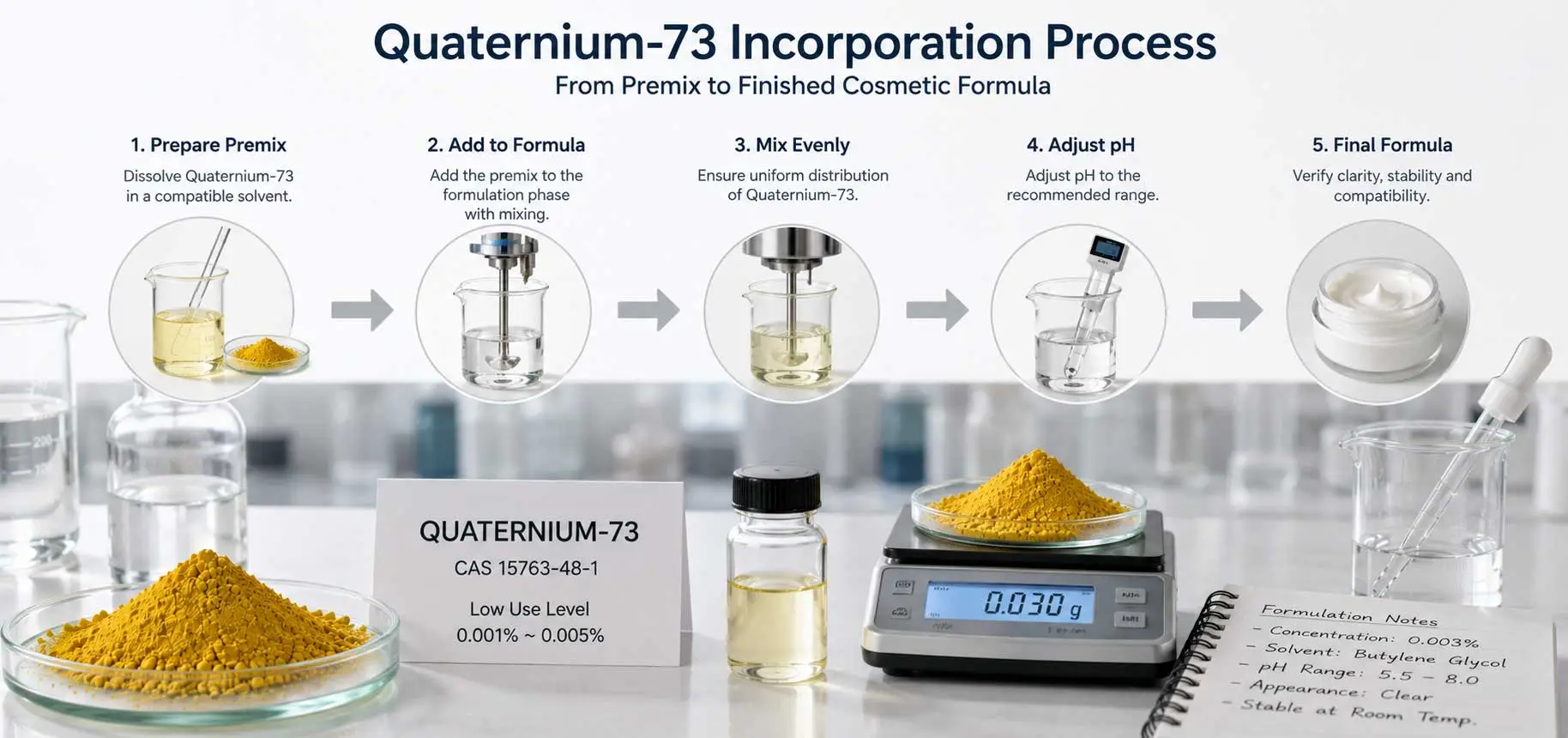
Commercial technical guidance commonly places Quaternium-73 at very low levels; several sources recommend approximately 0.001–0.005% for their grades. CHEN LANG BIO TECH's current product information also lists this advised dosage range.
At 0.003%, a 100 kg production batch contains only:
100 kg × 0.003% = 3 g Quaternium-73
Adding 3 g of yellow powder directly to 100 kg of product creates several practical problems. The powder represents only 0.00003 of the total batch mass as a decimal fraction. Some material can remain on weighing tools or vessel walls; poor wetting may leave particles floating or agglomerated; and even apparently successful mixing does not guarantee uniform molecular distribution.
A premix changes that handling problem.
Instead of distributing 3 g of dry material directly through the production vessel, the formulator can first incorporate it into a measured amount of a compatible carrier. The resulting liquid premix is easier to transfer quantitatively and distribute throughout the main batch.
The objective is not to increase the activity of the ingredient. The objective is accurate delivery and reproducible incorporation.
How to Prepare a Quaternium-73 Premix Step by Step
A useful Quaternium-73 formulation process starts with the purchased raw material rather than a generic internet formula.
Step 1: Confirm the Commercial Grade and Technical Data
Before deciding how to dissolve Quaternium-73 powder, check the supplier's current TDS and specification.
Confirm:
•INCI identity: Quaternium-73
•CAS 15763-48-1
•physical form and appearance
•assay or purity
•advised use level
•recommended carrier or solvent
•formulation pH guidance
•processing and storage information
PubChem identifies Pionin/Quaternium-73 as CAS 15763-48-1 with molecular formula C23H39IN2S2 and molecular weight approximately 534.6 g/mol.
Step 2: Calculate the Required Amount
Suppose a 100 kg formula uses 0.003%.
Required Quaternium-73:
100 × 0.003 × 10 = 3 g
The dosage calculation should be completed and documented before premixing.
Step 3: Select a Compatible Carrier
If the formula already contains butylene glycol or propylene glycol, part of that planned phase may be evaluated as the carrier. Commercial technical data specifically identify both materials, along with ethanol and 1,2-pentanediol, as solvents for Quaternium-73.
The carrier should not be selected solely because it dissolves the raw material. It must also fit the complete formulation.
Step 4: Introduce Quaternium-73 Under Controlled Mixing
Add the accurately weighed raw material gradually to the carrier while mixing.
Observe whether:
•particles wet immediately;
•undissolved material remains;
•the premix becomes uniform;
•haze or sediment develops after standing.
Technical guidance from M.C. BIOTEC recommends pre-dissolving Quaternium-73 in butylene glycol, propylene glycol or 1,2-pentanediol before adding it to the formulation.
Step 5: Transfer the Premix Quantitatively
At low use levels, transfer loss deserves attention.
If the calculated requirement is only 3 g, leaving even a small amount behind in the premix vessel changes the actual dosage. Rinsing the premix vessel with another compatible portion of the formulation phase, where appropriate, can help achieve more complete transfer.
Step 6: Verify the Finished Batch
After incorporation, evaluate the completed formulation—not only the premix.
Check:
appearance, clarity where relevant, pH, viscosity, precipitation, sedimentation and phase stability.
The fact that the premix was clear does not prove the ingredient will remain dissolved after the carrier is diluted into a much larger cosmetic matrix.
Does the Premix Ratio Change the Final Quaternium-73 Dosage?
No. A Quaternium-73 premix ratio changes the concentration of the intermediate premix, not the amount of Quaternium-73 in the final batch.
For example:
3 g Quaternium-73 + 97 g compatible carrier = 100 g premix
If all 100 g of that premix is incorporated into a 100 kg finished batch, the formulation still contains approximately:
3 g / 100 kg = 0.003% Quaternium-73
The carrier simply provides a more manageable way to deliver the active material.
This distinction becomes important when technical teams exchange formulas. A statement such as “add 1% premix” is incomplete unless the active concentration of that premix is known.
For commercial manufacturing, the formulation record should identify both the raw-material amount and the premix preparation method.
At What Stage Should Quaternium-73 Be Added to a Cosmetic Formula?
There is no universal Quaternium-73 addition phase suitable for every formulation.
Technical data from one commercial grade report thermal stability up to approximately 90°C, but that should not be converted into the instruction “add Quaternium-73 at 90°C.” It merely describes technical stability information for that grade.
The correct Quaternium-73 incorporation stage depends on the architecture of the product.
In a simple toner or serum, the prepared premix may be introduced into an already homogeneous liquid phase.
In a polymer-thickened gel, addition timing may matter because solvents and ionic materials can affect polymer hydration or final viscosity.
In an emulsion, the R&D team must determine whether the premix is best introduced before or after emulsification and whether the carrier affects either phase.
In a cleanser, the surfactant environment deserves particular attention.
A useful formulation principle is:
Introduce Quaternium-73 at a stage where the premix remains incorporated and can distribute uniformly without interfering with formation of the finished cosmetic system.
What Temperature Should Be Used When Incorporating Quaternium-73?
Quaternium-73 formulation temperature should be based on the grade-specific TDS and the needs of the complete formulation.
One commercial PDS describes good thermal stability up to 90°C and notes that dissolution can be accelerated with heat.
That does not mean heating is always necessary.
If the ingredient dissolves adequately in the selected glycol at room temperature, heating the premix simply to make the process appear faster may introduce unnecessary complexity. Conversely, if a specific supplier recommends controlled warming for its grade, the laboratory can evaluate that procedure within the intended formula.
Extreme or prolonged heating should not be adopted without technical justification.
This is another reason supplier-specific documentation matters: different websites sometimes publish different Quaternium-73 addition temperature recommendations. Those statements should not be blended into a fabricated universal procedure.
What pH Range Should Formulators Consider for Quaternium-73?
Commercial technical guidance from M.C. BIOTEC reports a stable pH range of 5.5–8.0 for the referenced Quaternium-73 grade.
This is useful during prototype development, but it should be understood correctly.
The range is not a universal regulatory limit or a fundamental guarantee that every commercial Quaternium-73 material will behave identically from pH 5.5 to 8.0. It is technical guidance associated with that commercial material.
The final Quaternium-73 formulation pH must also accommodate other components of the cosmetic. Surfactants, polymers, acids, preservatives and other active ingredients may have their own preferred pH windows.
Formulators should measure final product pH after all phases and premixes have been incorporated. Monitoring pH throughout stability testing is equally useful because a material that remains visually homogeneous while the pH drifts may still indicate an underlying formulation change.
How to Incorporate Quaternium-73 Into Different Cosmetic Product Types
The incorporation method should reflect the formulation system rather than the marketing category.
|
Cosmetic format |
Main incorporation question |
What should be evaluated |
|
Quaternium-73 in toner |
Will the premix remain clear after dilution? |
clarity, pH, precipitation |
|
Quaternium-73 in serum |
Is the carrier compatible with the serum vehicle? |
clarity, viscosity, long-term stability |
|
Quaternium-73 in gel |
Does the premix affect polymer behavior? |
viscosity, haze, uniformity |
|
Quaternium-73 in cream |
When should the premix enter the emulsion? |
phase stability, incorporation, color |
|
Quaternium-73 in cleanser |
How does the surfactant matrix influence it? |
compatibility, viscosity, precipitation |
|
Scalp formulation |
Is the carrier suitable for the product vehicle? |
uniformity and finished-product stability |
This is why how to use Quaternium-73 in skincare does not have one universally correct process.
A transparent serum gives the formulator an immediate visual warning if precipitation occurs. In an opaque cream, the same problem may be less obvious and may need to be identified through microscopy, centrifugation or longer-term physical stability observation according to the manufacturer's own development protocol.
Can Quaternium-73 Be Added to Surfactant Systems?
A Quaternium-73 cleanser formulation deserves specific compatibility testing.
Quaternium-73 is an ionic compound, and surfactant systems can contain anionic, amphoteric, nonionic and other charged components. It would be technically unsafe to assume that every surfactant system behaves identically with it.
Important observations include:
•development of haze;
•precipitation;
•unexpected viscosity change;
•loss of clarity;
•separation after temperature cycling;
•changes following pH adjustment.
The objective is not to create a generic “compatible surfactant list.” Quaternium-73 surfactant compatibility should be demonstrated in the actual cleansing base because total surfactant concentration, salt content and other formulation components influence the final environment.
What Ingredients Can Affect Quaternium-73 Compatibility?
Quaternium-73 compatibility is a whole-formula question. Potentially relevant categories include surfactants, ionic polymers, electrolytes, acids and bases, other active ingredients, preservative systems and concentrated botanical or mineral components.
The effect does not necessarily mean direct chemical incompatibility. For example, adding another ingredient may alter the pH or dilute the original premix solvent sufficiently to reduce Quaternium-73 solubility. A polymer may remain chemically intact but experience a viscosity change because the ionic environment has changed.
This is why binary testing—mixing Quaternium-73 with one other ingredient in a small vial—can be useful for screening but cannot replace finished-formula testing.
Compatibility should be demonstrated in the complete cosmetic system rather than inferred solely from two-ingredient compatibility.
For procurement teams, supplier technical guidance can identify likely starting conditions, but the finished-product manufacturer ultimately has to qualify the actual formulation.
Why Is Quaternium-73 Not Dissolving Completely?
When a formulator encounters Quaternium-73 dissolution problems, the most useful response is to diagnose the process rather than automatically add more solvent or heat.
|
Observation |
Possible cause |
What to review |
|
Visible yellow particles remain |
Inappropriate carrier or insufficient mixing |
Supplier solvent guidance |
|
Powder floats initially |
Poor wetting |
Addition rate and premixing |
|
Premix is clear but main batch becomes hazy |
Solvent environment changed after dilution |
Finished-formula composition |
|
Crystals appear after storage |
Long-term solubility changed |
pH, temperature, carrier level |
|
Lab batch works but production fails |
Mixing and transfer conditions changed |
Scale-up procedure |
If the powder remains visibly undissolved in water, the limited reported Quaternium-73 water solubility makes the solvent choice an obvious first point to examine.
If a glycol premix dissolves correctly but precipitation occurs after addition to the main batch, the problem is different. In that case, the ingredient may have been adequately soluble in the concentrated premix but not after the carrier was diluted into the complete cosmetic.
Why Can Quaternium-73 Precipitate After It Initially Dissolves?
Quaternium-73 precipitation after apparently successful manufacturing is one of the clearest reasons not to equate “looks dissolved today” with “formulation is stable.”
A premix might contain enough glycol or ethanol to keep the ingredient incorporated. Once that small premix is diluted into a large aqueous formula, the solvent environment changes substantially.
Further changes may then occur as:
•pH is adjusted;
•electrolytes are introduced;
•polymers hydrate;
•water and solvent redistribute;
•the product experiences cold or elevated temperatures;
•water slowly evaporates from an inadequately sealed package.
This leads to an important formulation principle:
Complete dissolution during manufacturing does not necessarily guarantee long-term solubility in the finished cosmetic formulation.
For that reason, Quaternium-73 formulation stability should be assessed after the final formulation is complete, not just immediately after the ingredient is added.
How Should Quaternium-73 Solubility Be Evaluated During Stability Testing?
A Quaternium-73 stability test should be integrated into the normal stability program established for the finished cosmetic.
Relevant observations can include:
appearance, transparency or haze, yellow color contribution, crystallization, sedimentation, pH, viscosity and phase separation.
Commercial technical documentation also reports that Quaternium-73 can be light-sensitive and recommends light-protective packaging for the referenced grade.
This is another property that should be verified for the purchased material rather than automatically generalized from one TDS.
For a transparent product, changes may be visually obvious. For opaque emulsions, a formulation team may need to pay closer attention to sediment or crystal formation during accelerated and real-time storage.
Temperature cycling can also reveal a formulation that appears stable under only one condition.
The relevant endpoint is not whether Quaternium-73 remained dissolved in the original premix. It is whether the finished cosmetic remains physically and chemically acceptable over its intended shelf life.
What Changes When Quaternium-73 Is Scaled From Lab to Production?
The nominal concentration remains the same during scale-up, but the physical process does not.
At 0.003%:
1 kg laboratory batch = 30 mg Quaternium-73
1,000 kg commercial batch = 30 g Quaternium-73
The 1,000-fold increase in batch size changes vessel geometry, mixing efficiency, transfer distance, shear environment and addition time.
A beaker stirred with an overhead mixer is fundamentally different from a production vessel with a large impeller, recirculation line or homogenizer.
For Quaternium-73 scale up, R&D should therefore document:
premix concentration, premix vessel, carrier amount, mixing endpoint, transfer method, addition location, mixing time after addition and final batch observations.
This documentation makes troubleshooting possible if a pilot or commercial batch behaves differently from the approved laboratory prototype.
Successful laboratory dissolution alone does not guarantee successful production-scale incorporation.
Why Solubility Data Matter When Choosing a Quaternium-73 Supplier
A technically useful Quaternium-73 supplier should provide more than purity and price.
Before approving a source, formulation teams should ask:
•How does the supplier describe Quaternium-73 solubility?
•Which premix solvents are recommended for this grade?
•Is pre-dissolution recommended?
•Is there grade-specific pH guidance?
•Is processing-temperature information available?
•Does the technical guidance correspond to the same material shown on the COA?
•Can a representative sample be supplied for formulation testing?
These questions are particularly important when comparing a Quaternium-73 manufacturer, distributor or CAS 15763-48-1 supplier. The INCI and CAS may be the same, but formulation guidance and commercial specifications can differ between suppliers.
A supplier that can connect its TDS, specification, COA and representative sample gives R&D a more useful qualification package than one that simply advertises “high purity.”
What Should Buyers Check on a Quaternium-73 TDS Before Formulation Trials?
A Quaternium-73 TDS should help the formulator understand how to handle the material. A COA serves a different purpose.
The TDS should ideally provide or clarify:
•INCI and CAS identity;
•physical appearance;
•assay or purity;
•Quaternium-73 solubility data or qualitative solvent guidance;
•recommended use level;
•premix or incorporation recommendations;
•relevant pH information;
•processing or storage guidance.
A Quaternium-73 COA, by contrast, should report batch-specific analytical results against the supplier's specification.
CHEN LANG BIO TECH's current commercial page identifies the product as Quaternium-73, CAS 15763-48-1, with aluminum-foil and fiber-drum packaging available for commercial orders.
For supplier qualification, documentation should refer to the actual grade being sold. A technically impressive TDS has little value if it cannot be tied to the batch and specification offered to the buyer.
Should Formulators Request a Quaternium-73 Sample Before Bulk Purchase?
Yes. A Quaternium-73 sample is particularly valuable when a new supplier or new formula is being qualified.
The sample gives the laboratory an opportunity to verify:
raw-material appearance, premix behavior, solvent selection, incorporation, compatibility, precipitation risk and finished-formulation stability.
It should ideally represent the same grade that the supplier intends to provide commercially. Record the sample lot number and retain its COA with the formulation trial.
This becomes important later if procurement needs to qualify another source. Two products both labeled Quaternium-73 cannot automatically be assumed to produce identical handling or formulation behavior simply because they share CAS 15763-48-1.
Buying Quaternium-73 for Cosmetic Formulation and Commercial Production
For companies preparing to buy Quaternium-73, the purchasing sequence should follow the technical qualification process:
TDS and specification → batch COA → representative sample → solubility/premix trial → prototype → stability evaluation → pilot batch → bulk purchase
This approach is more reliable than choosing a Quaternium-73 bulk supplier from Quaternium-73 price per kg alone.
CHEN LANG BIO TECH supplies Quaternium-73 to cosmetic formulators, manufacturers, OEM/ODM companies and ingredient distributors. Our current product page lists packaging options including 1 kg aluminum foil bags and 25 kg fiber drums, with routinely stocked material generally arranged for shipment within approximately 2–3 working days after an order, subject to current stock confirmation.
Buyers evaluating where to buy Quaternium-73, MOQ, samples or bulk Quaternium-73 can request the current specification, COA and technical information before committing to commercial quantities.
Quaternium-73 Solubility and Formulation FAQ
Is Quaternium-73 soluble in water?
Commercial technical data describe Quaternium-73 solubility in water as limited. One source gives an estimated value of approximately 0.6068 mg/L at 25°C and describes the material as slightly soluble in water, while reporting better solubility in several glycols and ethanol.
What is the best solvent for Quaternium-73?
No single solvent is ideal for every formula. Commercial technical guidance reports solubility in butylene glycol, propylene glycol, ethanol and 1,2-pentanediol. The best Quaternium-73 solvent is the compatible carrier that incorporates the purchased grade without destabilizing the final product.
Should Quaternium-73 be premixed before adding it to cosmetics?
Commercial technical guidance recommends Quaternium-73 pre-dissolution in compatible glycols for certain grades. A controlled premix can also improve quantitative transfer and uniform distribution when only a few grams are required in a large manufacturing batch.
At what stage should Quaternium-73 be added?
There is no universal addition stage. When to add Quaternium-73 depends on the premix carrier, formulation type, processing temperature, polymer or surfactant system and final pH. The supplier TDS and prototype testing should guide the manufacturing procedure.
Why does Quaternium-73 precipitate after dissolution?
A concentrated premix can keep Quaternium-73 incorporated while the finished formula cannot. Dilution of the premix solvent, pH changes, electrolytes, temperature changes or interaction with other formulation components can lead to Quaternium-73 precipitation after initially successful dissolution.
Can the same incorporation method be used for every cosmetic formula?
No. A toner, serum, gel, emulsion and cleanser provide very different solvent and ionic environments. How to incorporate Quaternium-73 should therefore be validated in the actual product rather than transferred automatically from another formulation.
A Practical Approach to Incorporating Quaternium-73
Successful Quaternium-73 incorporation is not defined by whether yellow powder disappears during mixing. The stronger formulation approach is to work from the technical documentation for the purchased grade, select a compatible carrier, prepare a controlled premix where appropriate, transfer the low-dose material quantitatively and confirm that it remains incorporated after final pH adjustment and throughout stability testing.
For raw-material buyers, solubility information should be part of supplier qualification alongside specification, assay and batch COA. Cosmetic manufacturers and formulation laboratories that need a current Quaternium-73 specification, COA, sample, packaging information, MOQ or commercial quotation can contact CHEN LANG BIO TECH at admin@chenlangbio.com.
References
1. PubChem. Pionin / Quaternium-73, CID 6444337. Chemical identity, CAS 15763-48-1, molecular formula C23H39IN2S2 and molecular weight approximately 534.6 g/mol.
2. M.C. BIOTEC INC. Quaternium-73 Product Data Sheet / Formulation Guidelines. Reports recommended use level of 0.001–0.005%, grade-specific pH guidance of 5.5–8.0, thermal stability information, solubility in butylene glycol, propylene glycol, ethanol and 1,2-pentanediol, limited water solubility and a recommendation to pre-dissolve before incorporation.
3. M.C. BIOTEC. Quaternium-73 Technical Information. Online commercial technical information reporting the same formulation and solubility guidance.
4. BenchChem. Pionin (Quaternium-73) Technical Information. Secondary chemical data source reporting estimated water solubility and reported solubility in several organic/polyol solvents. Used here as supporting secondary information rather than a primary experimental solubility study.
5. Taiwan Food and Drug Administration. List of Preservatives Allowed in Cosmetic Products. Lists Quaternium-73, CAS 15763-48-1, at 0.005% in the relevant regulatory entry, illustrating why formulation guidance must be distinguished from jurisdiction-specific legal limits.
6. CHEN LANG BIO TECH. Quaternium-73, CAS 15763-48-1. Current commercial product information, advised use level, packaging and supply information.

Send Inquiry
Related Industry Knowledge
- Monobenzone Side Effects: What Buyers and Formulators Should Know
- Yohimbine vs L-Carnitine: Key Differences in Fat Loss Mechanisms
- NAD Powder vs NADH Powder: Differences, Applications and Selection Guide
- Is Pine Bark Extract Water Soluble? Supplier Insights and Formulation Tips
- Is Spermidine Trihydrochloride Toxic?
- Does PQQ Aid in Sleep Improvement?
- Top Benefits of Isobutylamido Thiazolyl Resorcinol in Skincare
- Why is L-Carnosine Beneficial for Vegetarians
- Is Monobenzone Same As Hydroquinone
- Is L Carnitine (R)-3-Hydroxy-4-(trimethylammonio)butyrate A Fat Burner