
How to Choose a Berberine HCl Supplier for Commercial Production
November 13, 2026
Choosing a reliable berberine HCl supplier for commercial production requires more than comparing purity percentages and price quotations. Supplement manufacturers, contract manufacturers, and ingredient distributors need a supplier capable of delivering consistent raw material quality, verifiable analytical documentation, and dependable supply across multiple production batches.
A competitive quotation has limited value if the material fails incoming inspection, performs inconsistently during manufacturing, or cannot be supplied according to an agreed production schedule. Likewise, a supplier's claimed manufacturing capacity means little without appropriate quality controls, traceability, and technical support.
For buyers sourcing berberine HCl powder for supplement manufacturing, supplier qualification should address five areas: raw material specifications, analytical reliability, manufacturing controls, batch consistency, and commercial supply performance.
This guide explains how to evaluate these factors, compare suppliers objectively, and establish purchasing requirements before approving a source for long-term production.
Berberine HCl Manufacturer vs Distributor: Understanding the Supply Chain
The first step in selecting a supplier is understanding who manufactures the material, who controls its quality, and who is responsible for commercial delivery.
•Berberine HCl Manufacturer Capabilities and Production Traceability
A berberine HCl manufacturer is directly involved in producing or processing the ingredient, while a distributor typically purchases material from an upstream producer and supplies it to customers.
Both business models can support reliable commercial sourcing. However, their responsibilities and access to manufacturing information may differ.
Direct manufacturers may have greater visibility into production processes, analytical methods, and manufacturing changes. Established distributors, meanwhile, may offer local inventory, consolidated purchasing, and additional logistical support.
Buyers should therefore evaluate the actual supply chain rather than assuming one business model is automatically superior.
Before approving a supplier, confirm the manufacturing site, legal manufacturer, country of origin, batch identification system, and responsibility for product release.
For materials derived from botanical sources, traceability should also extend to relevant starting materials and production stages.
•Berberine HCl Powder Supplier Qualification Beyond Company Claims
A professional berberine HCl powder supplier should be able to explain its role in the supply chain and provide documentation appropriate to that role.
During berberine HCl supplier qualification, buyers should distinguish between a supplier's marketing statements and independently verifiable information.
For example, a company may advertise GMP manufacturing, but procurement teams still need to establish which facility, processes, products, and activities fall within the applicable quality system.
Similarly, manufacturing photographs and certificates are useful supporting materials, but they cannot replace batch-specific documentation or a risk-based supplier assessment.
Berberine HCl Raw Material Specifications: Purity, Identity and Quality Standards
A well-defined purchasing specification establishes the technical requirements against which incoming material will be evaluated.
Without an agreed specification, buyers may receive products with similar commercial descriptions but different analytical characteristics.
Berberine HCl 97% vs 98%: Selecting the Appropriate Assay Specification
Commercial berberine HCl 97% powder and berberine HCl 98% powder are commonly differentiated by their declared assay specifications.
However, the percentage alone does not establish whether two products are analytically equivalent.
Buyers should verify whether the assay is expressed as berberine hydrochloride, berberine content, or another defined reporting basis. The analytical method, reference standard, moisture correction, and treatment of related substances can affect how results are interpreted.
A berberine HCl 98% supplier should therefore provide a clear specification rather than relying exclusively on the advertised purity figure.
Likewise, a berberine HCl 97% powder supplier may offer material suitable for a particular application when the complete specification meets the manufacturer's requirements.
The appropriate choice depends on formulation needs, product labeling, applicable regulations, and the finished manufacturer's established acceptance criteria.
Berberine HCl Quality Standards for Commercial Manufacturing
A comprehensive set of berberine HCl raw material specifications should address chemical identity, assay, relevant impurities, contaminant limits, and application-specific physical properties.
|
Quality parameter |
What procurement teams should verify |
|
Identity |
Confirmation of the specified chemical form |
|
Assay |
Declared content, reporting basis, and analytical method |
|
Related substances |
Relevant impurities and established limits |
|
Moisture or loss on drying |
Storage, stability, and processing implications |
|
Elemental contaminants |
Applicable limits and analytical methods |
|
Microbial quality |
Requirements appropriate to intended use |
|
Particle size |
Compatibility with formulation and equipment |
|
Bulk density |
Suitability for filling and handling |
|
Batch traceability |
Link between material, testing, and shipment |
Appropriate berberine HCl quality standards should reflect the intended market and manufacturing application.
A specification suitable for one supplement manufacturer may not automatically satisfy another customer's requirements, particularly when physical properties or regulatory expectations differ.

Berberine HCl COA Verification and HPLC Testing: Evaluating Analytical Reliability
A certificate of analysis is one of the most important documents in commercial ingredient purchasing. However, its value depends on the reliability of the underlying testing and its connection to the supplied batch.
Berberine HCl COA Verification and Batch-Specific Test Results
Effective berberine HCl COA verification begins by confirming that the certificate identifies the actual manufacturing or release batch.
The document should include relevant specifications, analytical results, test methods or method references, and sufficient information to establish traceability.
Buyers should pay particular attention to the distinction between specification limits and measured results.
A certificate stating only that a material complies with a purity requirement provides less analytical information than one reporting the actual assay result.
Likewise, a generic specification sheet should not be mistaken for a batch-specific COA.
When reviewing berberine HCl supplier documentation, procurement teams should also confirm document authenticity, revision control, and the availability of supporting analytical information when required.
Berberine HCl HPLC Testing and Independent Laboratory Verification
Berberine HCl HPLC testing is commonly used to assess ingredient content and support analytical identification.
However, chromatographic peak area percentage should not automatically be interpreted as the absolute purity or assay of a material.
Reliable quantitative analysis requires an appropriate method, suitable reference standards, and defined calculations and acceptance criteria.
For higher-risk purchasing decisions, independent laboratory verification can provide additional confidence in the supplier's analytical results.
Nevertheless, comparisons between laboratories must account for differences in sample preparation, reference standards, analytical methods, and reporting bases.
When results disagree, buyers should investigate the analytical conditions before concluding that the supplied material is nonconforming.
Berberine HCl GMP Manufacturing and Factory Production Capacity
Manufacturing infrastructure matters because commercial supply depends on more than the ability to produce an acceptable laboratory sample.
Production facilities, process controls, analytical resources, and operational capacity all influence a supplier's ability to deliver consistent material over time.
Berberine HCl GMP Manufacturing Facilities and Process Controls
When assessing berberine HCl GMP manufacturing, buyers should establish which quality requirements apply to the intended ingredient and market.
For pharmaceutical applications, applicable API manufacturing principles may be relevant. Dietary supplement ingredients and finished supplements, however, can be subject to different regulatory frameworks.
The supplier's quality system should be evaluated within the correct regulatory context.
Important manufacturing controls include documented operating procedures, equipment cleaning, prevention of contamination and cross-contamination, batch records, deviation management, and appropriate product release procedures.
Buyers should also establish how the supplier manages production changes that could affect identity, impurity profiles, or physical characteristics.
A well-organized manufacturing site provides a foundation for quality management, but facility size alone does not demonstrate product compliance.
Berberine HCl Manufacturing Capacity and Long-Term Supply Reliability
Manufacturing infrastructure becomes particularly important when buyers move from sample qualification to recurring commercial orders.
CHEN LANG BIO TECH's manufacturing infrastructure includes a facility occupying approximately 80,000 square meters of land, with 14,000 square meters of building space and total investment exceeding RMB 100 million.
The site includes six refining, drying, and packaging production lines designed to meet pharmaceutical GMP requirements, five synthesis workshops, and one hydrogenation workshop.
In addition, the facility is equipped with a quality control laboratory and a research and development center, supporting analytical evaluation, process development, and manufacturing-related technical activities.
Environmental infrastructure includes a wastewater treatment system and associated environmental protection facilities. Landscaped areas account for at least 40% of the site.
The overall manufacturing infrastructure has a stated annual production capacity of approximately 500 metric tons for APIs and pharmaceutical intermediates.
This figure represents the facility's broader manufacturing capacity, not a product-specific annual capacity for Berberine HCl.
For buyers evaluating berberine HCl manufacturing capacity, the relevant questions remain whether the required product specification can be produced consistently, what capacity is allocated to that product, and how repeat orders will be scheduled.
These considerations are central to berberine HCl long-term supply, particularly for manufacturers operating established production schedules.
Berberine HCl Batch Consistency and Contaminant Control for Commercial Production
Passing a single incoming inspection is not sufficient evidence of long-term supply reliability.
Commercial manufacturers need confidence that successive batches will remain within agreed quality limits.
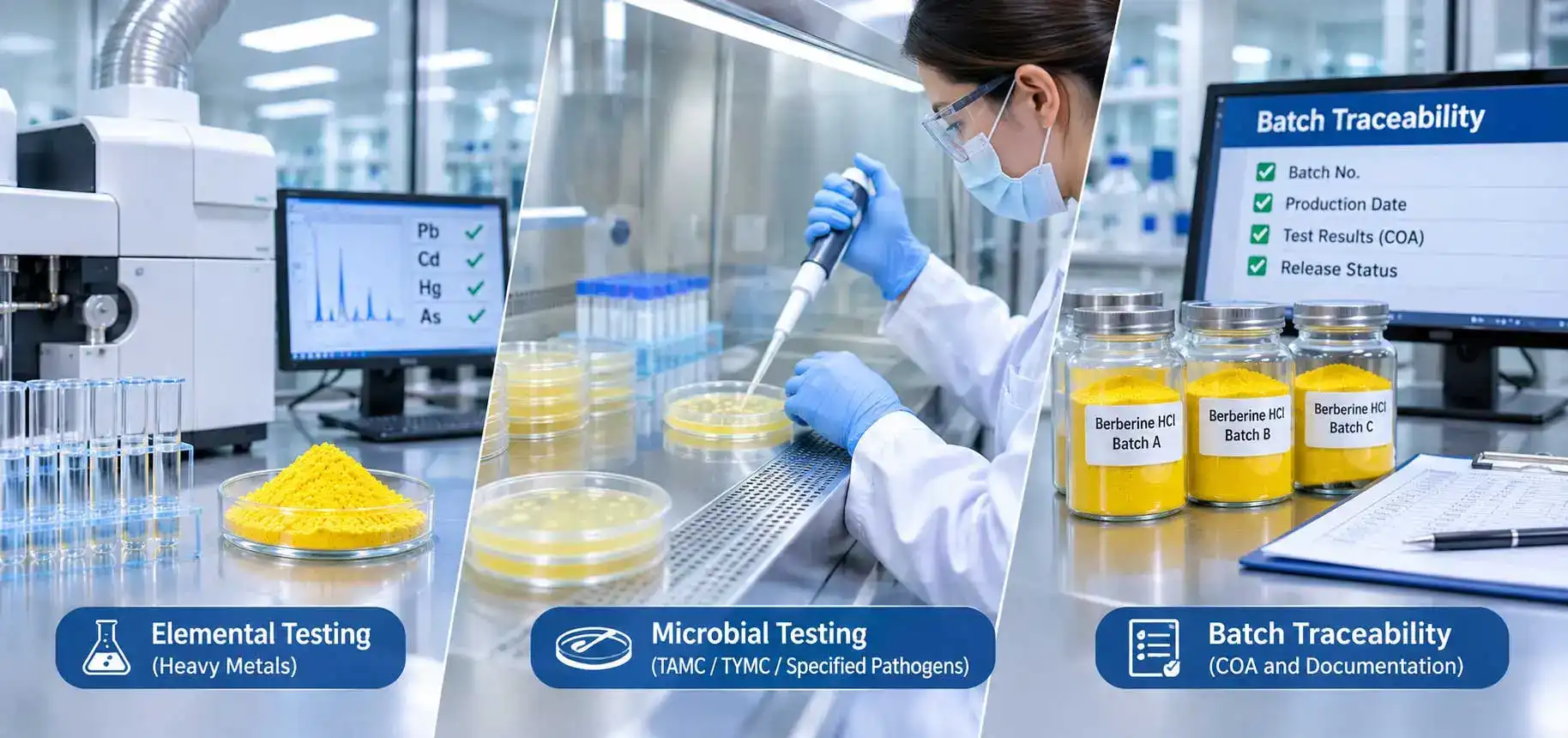
Berberine HCl Heavy Metals and Microbial Testing
Berberine HCl heavy metals testing should be evaluated against the contaminant requirements applicable to the ingredient's intended use.
Depending on the target market and product category, manufacturers may need to assess specific elemental contaminants rather than rely on an unspecified total heavy metals result.
Similarly, berberine HCl microbial testing should address appropriate microbiological specifications, including relevant objectionable organisms where applicable.
Buyers should confirm the test methods, acceptance criteria, and whether results represent the actual supplied batch.
A general statement that material meets international standards is insufficient without identifying the applicable requirements.
Berberine HCl Batch Consistency and Change Control
Berberine HCl batch consistency includes more than maintaining an acceptable assay result.
Changes in drying, milling, processing conditions, or raw material inputs may affect moisture, particle size distribution, bulk density, or impurity characteristics.
These variations can become commercially significant when a finished-product formulation has already been optimized around an established raw material profile.
Procurement teams should therefore discuss change control, batch traceability, deviation handling, and complaint investigation with prospective suppliers.
For recurring orders, reviewing historical batch results can also help identify whether critical quality attributes remain reasonably consistent.
Berberine HCl Sample Testing and Supplier Approval Before Bulk Orders
A structured sample qualification process reduces the risk of approving material that meets a paper specification but performs poorly during commercial manufacturing.
Berberine HCl Sample Request and Laboratory Qualification
A berberine HCl sample request should identify the intended application, target assay, required documentation, and any important physical characteristics.
After receiving a representative sample, the buyer should verify identity and content using appropriate methods.
For capsule or tablet manufacturing, evaluation may also include particle size, bulk density, powder handling, blending, and finished-product performance.
A practical qualification sequence is:
1,Review the supplier's specifications and documentation.
2,Obtain a representative sample with traceable batch information.
3,Perform appropriate incoming laboratory testing.
4,Conduct formulation or manufacturing trials.
5,Establish acceptable raw material characteristics.
6,Approve the supplier and material for commercial purchasing.
The purpose of berberine HCl sample testing is to establish technical suitability before committing to larger quantities.
Berberine HCl Supplier Qualification Checklist for Procurement Teams
A useful berberine HCl supplier audit checklist should combine quality, manufacturing, and commercial considerations.
Buyers should document the supplier's manufacturing role, quality system, analytical capabilities, batch traceability, sample results, and response to technical inquiries.
Where necessary, qualification may include a document-based audit, remote assessment, or on-site inspection.
The depth of the assessment should reflect the risk associated with the ingredient, its intended use, and the purchasing relationship.
Berberine HCl Bulk Supply Reliability: Lead Times, Packaging and Logistics
A supplier that meets technical specifications must also demonstrate the ability to deliver material when required.
Berberine HCl Bulk Supplier Capacity and Delivery Planning
When evaluating a berberine HCl bulk supplier, buyers should distinguish total factory capacity from available product-specific production capacity.
The supplier should be able to discuss realistic lead times, available inventory, production scheduling, and expected delivery quantities.
For recurring orders, manufacturers may benefit from forecast sharing and agreed replenishment arrangements.
These practices help reduce disruptions caused by unexpected demand, production scheduling conflicts, or international logistics delays.
Berberine HCl Packaging and International Shipping Requirements
Commercial bulk berberine HCl powder should be supplied in packaging appropriate to its handling, storage, and transportation requirements.
Buyers should confirm packaging materials, unit weights, labeling, batch identification, and protection against moisture or contamination.
International orders may also require product documentation, customs information, and transport-related paperwork.
Shipping terms should clearly establish responsibility for freight, import procedures, and delivery.
For long-term purchasing, packaging consistency and reliable shipment documentation can be just as important as the initial delivery date.
Berberine HCl Price per kg, MOQ and Wholesale Purchasing Terms
Commercial pricing should be evaluated in relation to material specifications, qualification costs, and the supplier's ability to support repeat production.
Berberine HCl Bulk Price and Commercial Cost Comparison
The berberine HCl price per kg can vary according to assay requirements, purchasing quantity, testing, packaging, and delivery terms.
A lower berberine HCl bulk price does not necessarily represent better purchasing value.
If a material requires additional testing, causes formulation adjustments, or fails incoming inspection, the resulting costs may outweigh the initial price difference.
When comparing berberine HCl powder wholesale offers, buyers should ensure that quotations refer to equivalent specifications and commercial conditions.
This is particularly important when suppliers quote different assay bases or include different shipping and documentation arrangements.
Berberine HCl MOQ and Bulk Quotation Requirements
The berberine HCl MOQ should be confirmed before placing an order because minimum quantities may depend on the selected specification and available stock.
Buyers planning to buy berberine HCl powder in bulk should provide a clear request for quotation that includes the required assay, estimated quantity, delivery destination, packaging preferences, and documentation requirements.
A complete berberine HCl bulk quotation should identify the quoted specification, price basis, minimum quantity, estimated lead time, payment terms, and quotation validity.
These details make supplier comparisons more meaningful and reduce misunderstandings during purchasing.
Berberine HCl Powder Manufacturing and Bulk Supply — CHEN LANG BIO TECH
At CHEN LANG BIO TECH, we understand that commercial raw material purchasing depends on consistent specifications, reliable documentation, and practical manufacturing support.
Our production infrastructure includes dedicated processing facilities, analytical laboratory resources, and research and development capabilities.
We work with supplement manufacturers, ingredient distributors, and commercial buyers sourcing bulk berberine HCl powder.
Customers can contact our team to discuss available product specifications, COA and technical documentation, sample evaluation, and commercial purchasing requirements.
Frequently Asked Questions About Berberine HCl Supplier Selection
How do I verify a Berberine HCl manufacturer?
Confirm the manufacturing site's identity, production responsibilities, applicable quality systems, and batch traceability. Request supporting documentation and conduct a risk-based supplier assessment before commercial approval.
What documents should a Berberine HCl supplier provide?
Buyers should request a batch-specific COA, product specification, SDS, and relevant analytical information. Additional manufacturing, quality, or regulatory documents may be necessary depending on the intended application.
Is Berberine HCl 98% always better than 97%?
Not necessarily. The appropriate specification depends on assay methodology, reporting basis, formulation requirements, and applicable quality criteria. Higher declared purity alone does not establish overall material suitability.
Can I request Berberine HCl samples before bulk purchasing?
Yes. Sample evaluation is an important qualification step. Buyers should confirm that the sample is representative of the proposed commercial material and assess relevant chemical and physical characteristics.
What affects Berberine HCl wholesale pricing?
Pricing depends on factors such as assay specification, purchasing volume, testing requirements, packaging, delivery terms, and commercial arrangements. Equivalent specifications should be compared before selecting a supplier.
Conclusion — Selecting a Reliable Berberine HCl Supplier for Long-Term Production
A reliable berberine HCl supplier should demonstrate consistent raw material quality, credible analytical documentation, appropriate manufacturing controls, and dependable commercial supply.
Before approving a supplier, buyers should establish clear specifications, qualify representative samples, and compare technical and commercial performance.
For product specifications, samples, or wholesale purchasing discussions, contact CHEN LANG BIO TECH with your required quantity and intended application.
References
1. U.S. Food and Drug Administration. 21 CFR Part 111 — Current Good Manufacturing Practice in Manufacturing, Packaging, Labeling, or Holding Operations for Dietary Supplements.
2. International Council for Harmonisation. ICH Q7 — Good Manufacturing Practice Guide for Active Pharmaceutical Ingredients.
3. International Council for Harmonisation. ICH Q9(R1) — Quality Risk Management.
4. United States Pharmacopeia. General Chapter <621> — Chromatography.
5. United States Pharmacopeia. General Chapter <616> — Bulk Density and Tapped Density of Powders.
6. International Organization for Standardization. ISO 9001 — Quality Management Systems — Requirements.

Send Inquiry
Related Industry Knowledge
- What is Ivermectin Powder? Benefits, Uses, and How to Safely Buy from Trusted Suppliers
- Lotus Leaf Extract Powder Benefits: What Buyers and Formulators Should Know
- 5 Alpha Hydroxy Laxogenin vs Turkesterone Which Is Better for Muscle Growth?
- Meso-Zeaxanthin vs Zeaxanthin: What Is the Difference?
- Lutein vs Zeaxanthin: What Is the Difference?
- Understanding Ergothioneine COA: What Bulk Buyers Should Check Before Purchasing
- Pine Bark Extract in Functional Beverages: Applications, Specifications & Supplier Insights
- The No.1 Choice for Athletes: 5HTP Powder for Recovery & Focus
- Honokiol Powder Benefits
- What's Different Between Honokiol Powder and Magnolol