
How to Read a Berberine HCl COA: Purity, HPLC and Quality
November 3, 2026
A berberine HCl COA is one of the most important documents a supplement manufacturer should review before approving a new raw material supplier. A reliable certificate of analysis identifies the material, reports batch-specific test results, and demonstrates whether the ingredient meets defined quality specifications.
However, a COA stating “98% HPLC” does not necessarily establish that the powder contains 98% berberine hydrochloride by mass. The analytical method, reference standard, moisture correction, and reporting basis can significantly influence how purity results should be interpreted.
For buyers sourcing bulk berberine HCl powder, reviewing a COA involves more than checking whether each result says “Pass.” It requires understanding the analytical evidence, verifying batch traceability, and determining whether the material meets the requirements of the intended manufacturing process.
This guide explains how to read a berberine HCl COA and identify potential quality concerns before committing to a commercial purchase.
Berberine HCl COA Requirements: What a Certificate of Analysis Should Include
A berberine HCl certificate of analysis should provide a traceable record of testing performed on an identified material batch. Its purpose is to demonstrate conformity with established specifications, rather than simply describe the product's typical characteristics.
Berberine HCl COA vs Specification Sheet: Understanding the Difference
A berberine HCl specification sheet defines the requirements a material must meet. These may include identity, assay, moisture, related substances, microbial quality, and relevant contaminant limits.
The COA reports the results obtained for a particular batch against those requirements.
For example, a specification may require an assay of not less than 98.0%, while the COA reports an actual result of 98.6%. The specification establishes the acceptance criterion; the COA documents the measured outcome.
A specification is not a substitute for batch-specific evidence, and a COA should not be treated as proof that every future batch will perform identically.
Batch Number, Test Methods and Release Results
Before reviewing the analytical results, buyers should confirm that the document identifies the product, manufacturer or issuing organization, batch number, and relevant testing information.
|
COA field |
What buyers should verify |
|
Product name |
Correct chemical identity and salt form |
|
Batch or lot number |
Traceability to the material offered |
|
Specification |
Defined acceptance criteria |
|
Test method |
Identifiable analytical procedure |
|
Actual result |
Quantitative value where appropriate |
|
Test date |
Relevant testing period |
|
Release authorization |
Appropriate quality review or approval |
|
Document identification |
Report number or controlled document reference |
A result marked “Pass” may be appropriate for certain qualitative tests. However, quantitative parameters such as assay and moisture are generally more useful when the actual measured values are disclosed.
Berberine HCl Identity Testing: CAS Number, Salt Form and Botanical Origin
Berberine HCl identity testing should establish that the supplied material is the intended chemical substance, not merely a yellow botanical powder containing berberine-related compounds.
Berberine Hydrochloride Identification and CAS 633-65-8
Anhydrous berberine chloride is commonly identified by CAS 633-65-8, with the molecular formula C₂₀H₁₈ClNO₄ and a molecular weight of approximately 371.81 g/mol.
However, berberine chloride may also be described in hydrated forms. Consequently, buyers should confirm whether the stated assay, molecular identity, and reference standard correspond to the supplied material.
A chromatographic retention-time match against a reference standard can support identification, but it is not necessarily sufficient on its own. Depending on the applicable method, additional evidence may include ultraviolet spectral comparison, infrared spectroscopy, or other suitable identity tests.
The identification procedure should be sufficiently specific to distinguish the intended ingredient from relevant alternatives.
Botanical Source Verification for Natural Berberine HCl
Natural berberine HCl raw material may originate from botanical sources such as Coptis chinensis, Phellodendron species, or Berberis species.
Nevertheless, chemical identity and botanical origin are separate quality questions.
An HPLC assay can establish the amount of berberine detected under a defined procedure, but it cannot automatically confirm which plant species supplied the starting material.
Where botanical origin is commercially important, buyers should request species identification, plant-part information, and appropriate sourcing records.
Berberine HCl HPLC Assay: How to Interpret Purity Results
The berberine HCl HPLC assay is often the most closely examined result on a supplier's COA. Yet different analytical approaches can produce percentages that appear comparable while representing fundamentally different measurements.
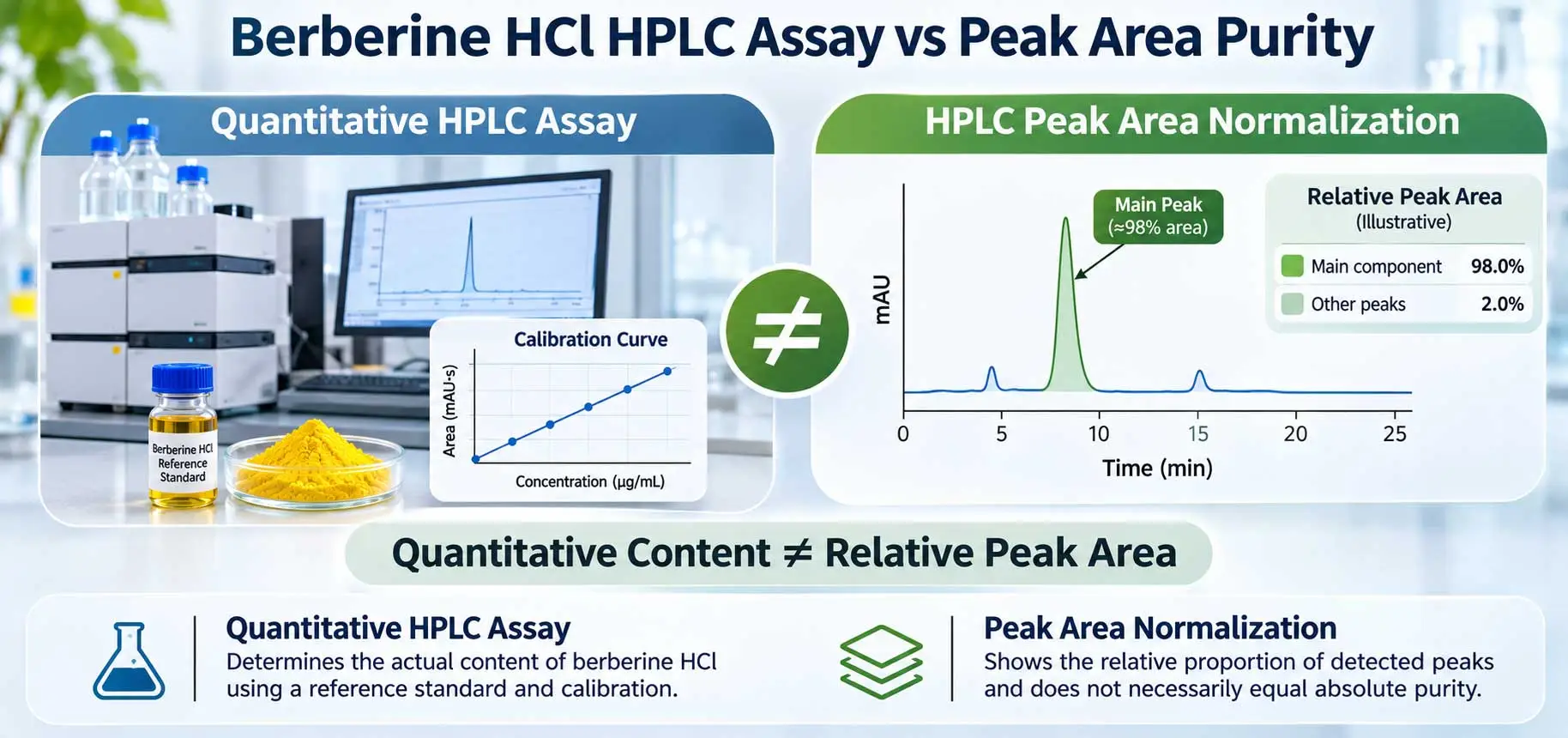
Quantitative Berberine HCl HPLC Assay vs Peak Area Normalization
A calibrated quantitative HPLC assay determines the concentration of berberine using an appropriate reference standard and a defined analytical procedure.
The result is calculated from the instrument response, standard concentration, sample preparation, and applicable correction factors.
By contrast, chromatographic peak-area normalization expresses the area of an individual peak relative to the total area of selected detected peaks.
For example, a chromatogram showing 98% area attributable to the main peak does not necessarily demonstrate that the sample contains 98% berberine hydrochloride by mass.
Different compounds can have different detector responses. Moreover, substances that do not produce a detectable signal under the selected conditions may not contribute meaningfully to the chromatographic area calculation.
This distinction is especially important when evaluating high purity berberine HCl powder from multiple suppliers.
|
Analytical approach |
What the result represents |
Main limitation |
|
Calibrated HPLC assay |
Quantified analyte content against a reference standard |
Depends on method suitability and calculation basis |
|
HPLC area normalization |
Relative area of detected chromatographic peaks |
Not necessarily absolute mass purity |
|
Retention-time identification |
Agreement with a reference under specified conditions |
May require additional identity confirmation |
|
Related-substance testing |
Specified impurities or detectable impurity peaks |
Limited by the method's selectivity and sensitivity |
Reference Standards, Calibration and Method Validation
A reliable berberine HCl assay method should use a suitable reference standard with documented identity and assigned content.
Where relevant, the calculation should account for reference-standard purity, sample dilution, moisture, and the stated assay basis.
Analytical performance should also be supported by appropriate validation or verification, including specificity, accuracy, precision, and the working range.
System suitability checks help establish that the chromatographic system is performing adequately during analysis.
For procurement teams reviewing berberine HCl purity testing, the practical questions are whether the method measures the intended substance, whether the result is reported on a clear basis, and whether the procedure is suitable for the agreed specification.
A supplier unwilling to clarify these points may create unnecessary uncertainty during incoming quality control.
Berberine HCl 97% vs 98%: Assay Basis, Moisture and Specification Differences
The distinction between berberine HCl 97% vs 98% is meaningful only when both values are determined using comparable analytical methods and reporting conventions.
A higher numerical assay does not automatically indicate lower contaminant levels, better powder flow, or superior performance in finished supplements.
As-Is vs Dried-Basis Berberine HCl Assay
An assay reported on an as-is basis describes the material in its tested condition, including moisture and other mass contributions.
A dried-basis assay adjusts the result to exclude the mass removed under the specified drying procedure.
For illustration, assume a sample has a 98.0% dried-basis assay and a measured moisture content of 2.0%.
Its approximate as-is assay would be:
As-is assay (%) = Dry-basis assay (%) × (100 − Moisture %) / 100
98.0 × 0.98 = 96.04%
This simplified calculation assumes the measured moisture represents the relevant excluded mass. Loss on drying may include volatile substances other than water, so the appropriate calculation must follow the analytical method.
Why Moisture and Hydration Matter in Purity Comparison
For berberine HCl 98% powder, buyers should confirm whether the specification refers to the anhydrous salt, a hydrated form, or another defined analytical equivalent.
The theoretical berberine-cation fraction of pure anhydrous berberine chloride is approximately 90.47% by mass.
Therefore, an assay expressed as berberine hydrochloride cannot be compared directly with one expressed as berberine cation without an appropriate conversion.
These distinctions should be resolved before approving a purchase specification.
Berberine HCl Impurity Testing: Related Alkaloids and Residual Solvents
A satisfactory main-component assay does not eliminate the need to evaluate impurities. Berberine HCl impurity profile requirements should reflect the botanical source, purification process, intended application, and applicable quality standards.
Related Alkaloids and Berberine HCl Impurity Profile
Botanical sources of berberine may contain structurally related alkaloids, including palmatine, coptisine, and other source-dependent constituents.
These compounds may be reduced during purification, but their presence cannot be evaluated solely from the main berberine assay.
Appropriate berberine HCl related substances testing should distinguish the principal ingredient from relevant known impurities and, where necessary, report unidentified chromatographic peaks.
Buyers should verify whether impurity limits apply individually, collectively, or both. The method's detection capability and response factors also affect the interpretation of results.
Residual Solvent Testing Based on the Extraction Process
Berberine HCl residual solvents should be assessed according to the solvents actually used during extraction, purification, crystallization, or other manufacturing operations.
A generic statement such as “solvent-free” provides limited analytical assurance unless its meaning and supporting evidence are defined.
Headspace gas chromatography is commonly used for suitable volatile residual solvents, although the appropriate method depends on the analytes being measured.
Relevant limits should be established according to the intended application and regulatory framework. Pharmaceutical guidance such as ICH Q3C may provide useful technical principles, but its applicability to dietary supplement ingredients must be evaluated rather than assumed.
Berberine HCl Heavy Metals and Microbiological Testing for Supplement Ingredients
Botanical raw materials can introduce contamination risks through cultivation, environmental exposure, harvesting, storage, and processing.
Consequently, berberine HCl contaminant testing should reflect the risks associated with the source material and the intended finished product.
Lead, Cadmium, Arsenic and Mercury in Botanical Raw Materials
Berberine HCl heavy metals testing should address relevant elements individually, particularly lead, cadmium, arsenic, and mercury.
A COA reporting only “Total Heavy Metals: Pass” may not provide enough information for a manufacturer to evaluate element-specific exposure.
Appropriate methods, including ICP-MS, can quantify individual elements at relevant concentrations.
However, acceptance limits should not be copied indiscriminately from another ingredient specification. They should reflect applicable regulatory requirements, the intended daily ingredient intake, and the finished product's overall contaminant exposure.
Buyers should request actual results, units, and sufficient information about detection or quantitation limits.
Microbiological Limits for Berberine HCl Powder
Relevant berberine HCl microbiological limits may include total aerobic microbial count, total yeast and mold count, and tests for specified microorganisms.
The necessary testing program depends on the ingredient's manufacturing process, intended use, and destination market.
A low microbial count in one batch does not independently establish that the manufacturing environment is consistently controlled.
For berberine HCl supplement ingredient quality, buyers should review both batch results and the supplier's documented approach to contamination prevention.
Berberine HCl COA Authenticity and Batch Traceability: Supplier Verification
A technically complete COA is valuable only when its authenticity and relationship to the supplied material can be established.
Berberine HCl batch traceability should connect the document to an identifiable production or packaging lot and support investigation if a quality concern arises.
How to Verify a Berberine HCl COA Before Purchasing
During berberine HCl COA verification, procurement teams should compare the product description, lot number, testing dates, and reported specifications with the quotation and other technical documents.
Unexplained differences between document versions, missing test methods, or identical results repeatedly appearing across unrelated batches warrant clarification.
However, such inconsistencies are reasons to investigate, not automatic proof that a report is fraudulent.
Where the COA was issued by an independent laboratory, buyers can verify its authenticity directly with the issuing organization.
Third-Party Testing and Production Batch Consistency
Berberine HCl third-party testing can provide independent confirmation of selected analytical results.
Nevertheless, third-party testing does not replace manufacturing controls, supplier qualification, or the purchaser's own responsibilities for incoming material acceptance.
A sample may pass an independent assay while a later commercial lot differs in moisture, particle size, or impurity profile.
For repeat purchasing, suppliers should maintain appropriate records and procedures for investigating deviations, handling complaints, and communicating significant changes.
Berberine HCl Supplier Qualification: COA Review Before Bulk Purchasing
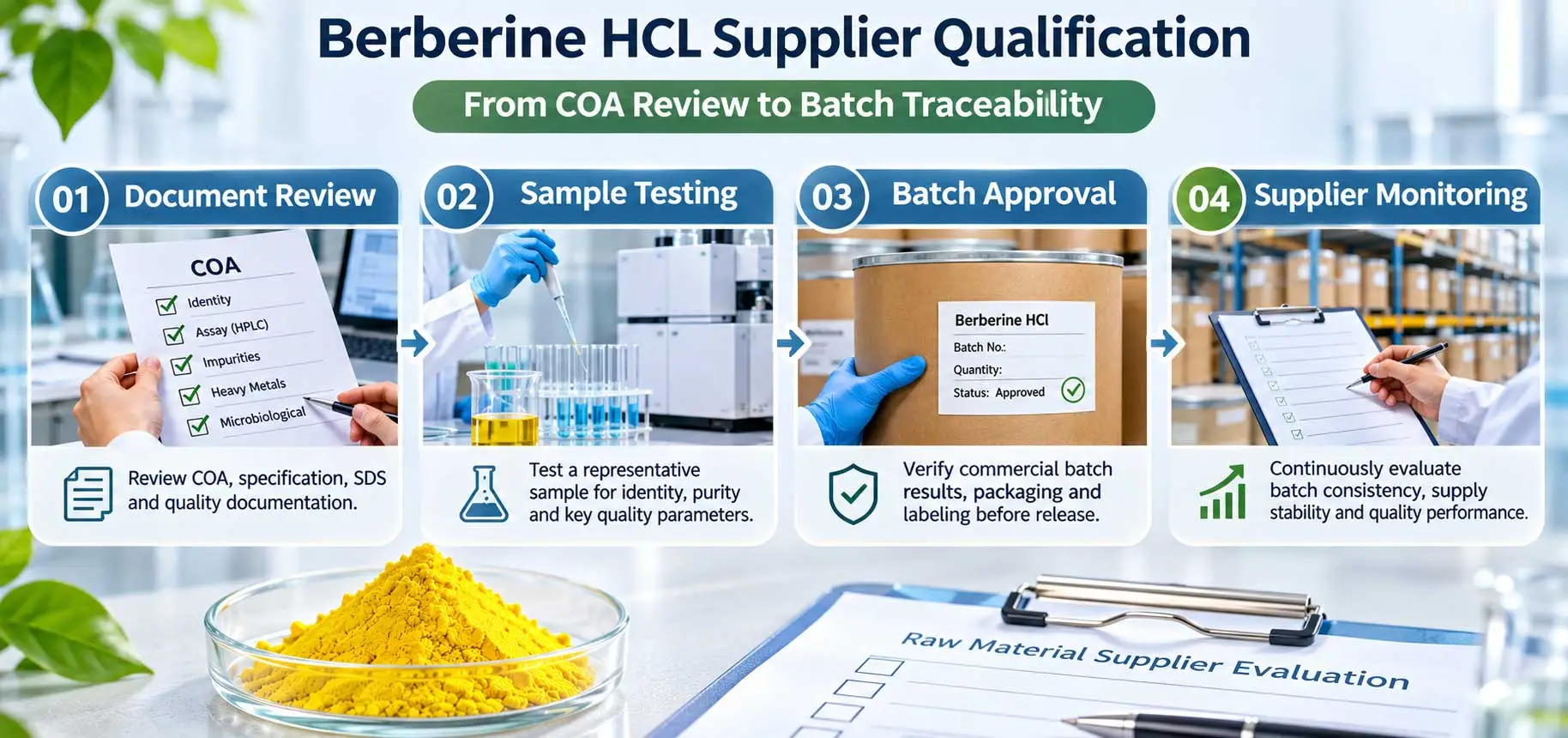
A supplier's ability to provide an acceptable COA is an important qualification criterion, but it should be evaluated within a broader quality and procurement framework.
An effective berberine HCl supplier qualification process establishes whether the organization can consistently deliver material meeting the purchaser's approved specifications.
Sample Testing and Incoming Quality Control for Berberine HCl
Before approving a berberine HCl powder supplier, buyers should obtain representative samples and compare their test results with the supplied documentation.
Identity and assay testing are essential considerations. Depending on the intended manufacturing process, additional evaluations may include moisture, contaminants, particle size, bulk density, and flowability.
Sample acceptance should be based on predetermined criteria rather than visual appearance alone.
For US dietary supplement manufacturers, 21 CFR Part 111 establishes requirements concerning component specifications, identity verification, and quality control. Supplier COAs can support certain verification activities under specified conditions, but they do not eliminate the manufacturer's applicable responsibilities.
Manufacturer Documentation and Commercial Batch Approval
When evaluating a berberine HCl manufacturer, buyers should review available manufacturing-quality documentation, traceability arrangements, change-control practices, and procedures for addressing nonconforming material.
A berberine hydrochloride bulk supplier should also clarify whether it manufactures the material directly or sources it through another producer.
The purchasing organization should establish a documented procedure covering initial approval, incoming inspection, batch acceptance, and periodic supplier review.
For berberine HCl raw material quality control, this approach reduces the risk of approving a sample that does not adequately represent subsequent production lots.
Berberine HCl COA Review Checklist for Ingredient Buyers
The following checklist provides a practical starting point for commercial ingredient evaluation.
|
Review item |
Buyer verification |
|
Chemical identity |
Confirm correct salt form and identification method |
|
Assay |
Verify method, reference standard, result, and reporting basis |
|
Moisture |
Confirm limits and relationship to assay calculation |
|
Impurities |
Review relevant related substances and residual solvents |
|
Contaminants |
Check element-specific and microbiological requirements |
|
Batch traceability |
Match documentation to the offered or delivered lot |
|
Supplier qualification |
Confirm documentation, sample results, and quality procedures |
Any unresolved issue should be clarified before the material is released for production. A COA is part of the quality decision, not a substitute for it.
Bulk Berberine HCl Powder Purchasing: Price, MOQ and Quality Documentation
Commercial purchasing decisions should consider the cost of achieving a verified specification rather than the quoted ingredient price alone.
Berberine HCl Price per kg and Specification-Based Quotations
When comparing berberine HCl price per kg, buyers should confirm that quotations refer to equivalent assay grades, analytical bases, testing requirements, and packaging conditions.
For example, two suppliers may both offer berberine HCl 98% bulk material, but one may report a calibrated dried-basis assay while the other provides only an HPLC peak-area percentage.
Those quotations should not be treated as technically equivalent without further clarification.
Testing expenses, freight, import requirements, and the potential cost of rejected material also affect the total purchasing cost.
MOQ, Packaging and Sample Evaluation Before Wholesale Orders
For berberine HCl wholesale purchasing, the order quantity should be considered alongside batch availability, packaging integrity, and delivery requirements.
The berberine HCl MOQ may vary with stock availability and commercial arrangements.
Before placing a substantial order, buyers should request a representative berberine HCl sample and agree on the specifications that will apply to the delivered material.
Packaging should protect the powder against relevant storage and transportation risks, particularly unnecessary moisture exposure and contamination.
Berberine HCl COA and Bulk Raw Material Supply from CHEN LANG BIO TECH
At CHEN LANG BIO TECH, we understand that ingredient purchasing decisions depend on reliable technical information as well as competitive commercial terms.
We work with international buyers to clarify berberine hydrochloride specifications, review documentation requirements, and discuss sample evaluation before commercial ordering.
For customers planning to buy berberine HCl powder in bulk, we can discuss available product grades, current batch documentation, packaging options, and shipment arrangements according to the order requirements.
Please share your target assay, purchasing quantity, intended application, and destination market. Our team can review the available COA and technical information and provide a berberine HCl bulk quotation.
You can also visit our Berberine HCl Powder product page for further ingredient information.
Frequently Asked Questions About Berberine HCl COA and HPLC Purity
What does 98% HPLC mean on a berberine HCl COA?
It depends on the analytical method. A calibrated quantitative assay may report the mass-based content of berberine hydrochloride, while an HPLC peak-area percentage represents relative detector response. Buyers should verify the method, reference standard, and reporting basis before interpreting the result as chemical purity.
Is HPLC purity the same as berberine HCl assay?
Not necessarily. A quantitative HPLC assay and chromatographic area normalization are different analytical approaches. Their results may not be directly comparable, especially when impurities have different detector responses or the assay is corrected for moisture or hydration.
What contaminants should a berberine HCl COA include?
Relevant testing may include lead, cadmium, arsenic, mercury, microbial contamination, and residual solvents associated with manufacturing. The appropriate testing program and acceptance limits depend on the intended application, destination market, and risk assessment.
Can buyers accept a supplier COA without third-party testing?
Acceptance depends on applicable regulations, supplier qualification, and the purchaser's quality procedures. Independent testing can strengthen verification, but it is not universally mandatory for every parameter or shipment. US dietary supplement manufacturers must also meet applicable component identity and quality-control requirements.
Should the COA batch number match the delivered berberine HCl powder?
Yes. The documentation should be traceable to the material received. Where a shipment contains multiple production lots, the buyer should obtain appropriate documentation for each relevant lot and verify the relationship between the COA, packaging labels, and receiving records.
Conclusion — Berberine HCl COA Review for Reliable Raw Material Purchasing
A reliable berberine HCl COA should provide more than a purity percentage. It should establish chemical identity, explain how the assay was measured, identify the reporting basis, and document relevant impurity and contaminant controls.
For commercial ingredient buyers, the most effective review follows a clear sequence: identity verification, analytical method assessment, specification comparison, batch traceability, and supplier qualification.
A higher declared assay does not compensate for incomplete documentation or inconsistent manufacturing quality.
Before approving a new source, request the current specification, representative COA, and sample information. A technically sound purchasing decision helps protect production consistency and supports a more dependable long-term supply relationship.
References
1. U.S. Food and Drug Administration. 21 CFR Part 111 — Current Good Manufacturing Practice in Manufacturing, Packaging, Labeling, or Holding Operations for Dietary Supplements. Particularly §§111.70 and 111.75 concerning specifications and verification requirements.
2. International Council for Harmonisation (ICH). Q2(R2): Validation of Analytical Procedures. 2023. Principles covering analytical procedure performance, including specificity, accuracy, precision, and range.
3. International Council for Harmonisation (ICH). Q3C(R9): Impurities — Guideline for Residual Solvents. 2024. A pharmaceutical regulatory reference for residual-solvent risk classification and limits; applicability to dietary supplement ingredients requires separate assessment.
4. United States Pharmacopeia. General Chapter , Chromatography. Technical principles relevant to chromatographic analysis and system suitability.
5. United States Pharmacopeia. General Chapters and , Elemental Impurities — Limits and Procedures. Pharmaceutical reference standards that may inform analytical assessment where appropriate.
6. United States Pharmacopeia. General Chapters and , Microbiological Examination of Nonsterile Products. Methods for microbial enumeration and specified microorganism testing.
7. Japanese Pharmacopoeia. Berberine Chloride Monograph. Reference information on chemical identity, assay, and analytical specifications.

Send Inquiry

Related Industry Knowledge
- Pine Bark Extract and Hyaluronic Acid in Beauty Supplements
- HPLC vs. CPC: Which Testing Method Ensures the Real Purity of Chondroitin Sulfate?
- How Does Cetyl Tranexamate HCL Work?
- What are the Applications of Kopyrrol Powder?
- Kola Nut Extract Powder for Weight Management
- What Does Ascorbyl Glucoside Do to Your Skin? Benefits Revealed
- What is Monobenzone Powder Used for
- Which Is Better, Bakuchiol or Niacinamide
- What Does Bakuchiol Do to Skin
- Is Ecdysterone And Turkesterone Superior To Hyaluronic Acid Powder?