
Berberine HCl 97% vs 98%: Purity, Quality and Buying Guide
November 4, 2026
The difference between berberine HCl 97% vs 98% is one percentage point in the stated assay, provided both grades are tested using comparable analytical methods and reported on the same basis. For supplement manufacturers, however, a higher assay does not automatically mean better ingredient quality, improved formulation performance, or greater purchasing value.
When selecting berberine HCl powder for supplement manufacturing, buyers must consider more than the declared purity. Impurity profiles, moisture, particle characteristics, batch consistency, analytical documentation, and total procurement costs can influence whether a particular grade is suitable for commercial production.
A 97% grade may fully satisfy an approved manufacturing specification, while a 98% grade may be preferable when tighter assay requirements or formulation constraints apply.
This guide compares the two berberine HCl purity grades from a technical and commercial perspective, helping ingredient buyers make informed sourcing decisions.
Berberine HCl 97% vs 98%: Understanding the Actual Purity Difference
The primary berberine HCl 97% vs 98% difference is the nominal concentration of the assayed substance. If both materials are evaluated using the same quantitative method and reporting basis, 97% indicates 970 mg of the specified analyte per gram of material, while 98% indicates 980 mg.
The difference is measurable, but its practical significance depends on the intended application.
Berberine HCl 97% Powder and 98% Powder: What the Specifications Mean
Commercial berberine HCl 97% powder and berberine HCl 98% powder are generally distinguished by their declared assay specifications. However, the stated percentage should be interpreted alongside the analytical method and acceptance criteria.
A specification of not less than 97% does not mean every batch contains exactly 97%. A compliant batch may test above that minimum. Similarly, a material sold as 98% grade may have an actual assay exceeding 98%, depending on its specification and measured results.
Consequently, buyers should distinguish between a minimum specification, a typical product description, and an actual batch result.
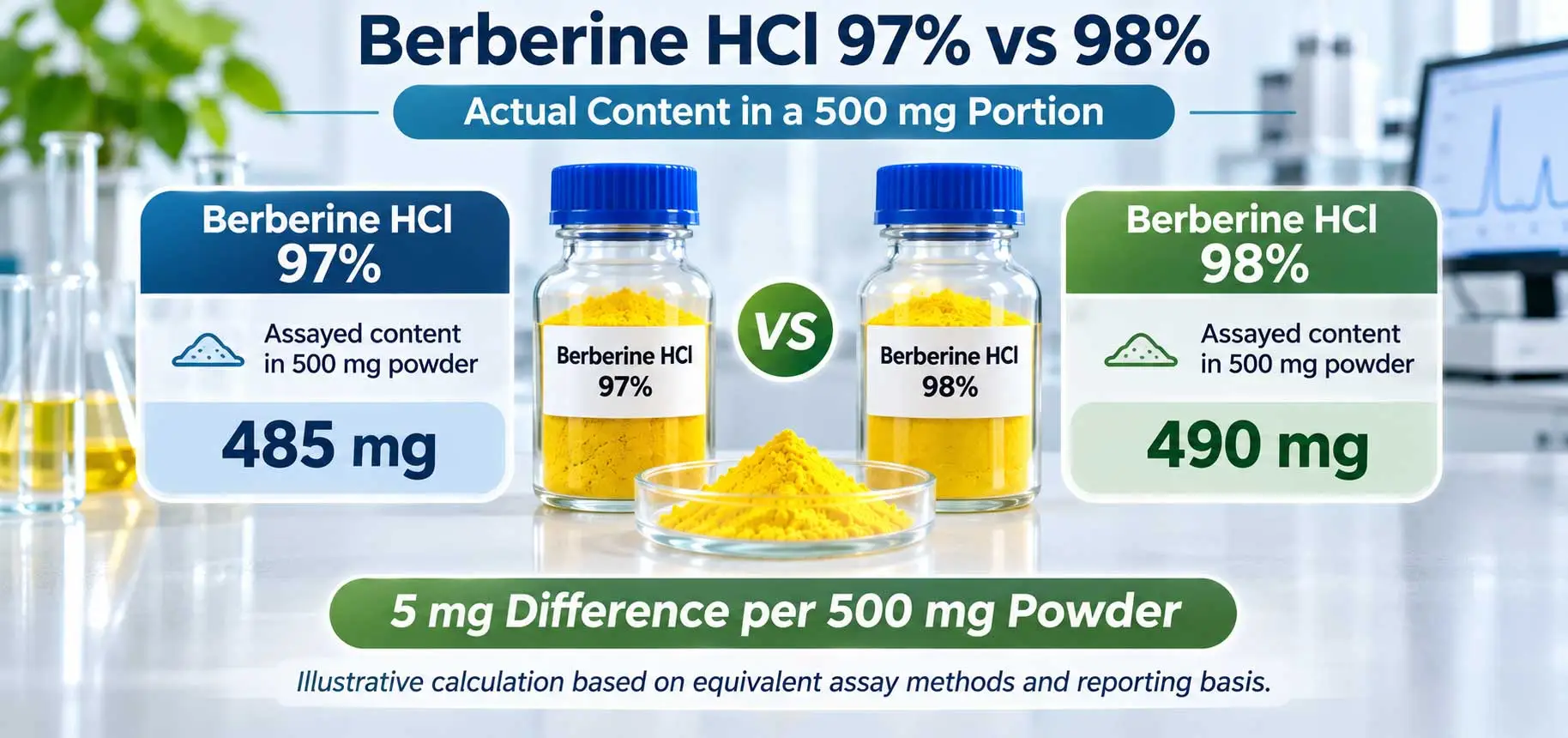
Berberine HCl 97% vs 98% Difference in a 500 mg Ingredient Portion
The following comparison assumes both percentages represent the mass fraction of the same assayed substance, measured on an equivalent basis.
|
Parameter |
97% Grade |
98% Grade |
|
Nominal assay |
97.0% |
98.0% |
|
Assayed substance in 500 mg powder |
485 mg |
490 mg |
|
Difference per 500 mg |
— |
+5 mg |
|
Nominal fraction not represented by the assay |
3.0% |
2.0% |
|
Automatically lower heavy metals |
No |
No |
|
Automatically better processing performance |
No |
No |
The 5 mg difference is relatively small, but it may matter when manufacturers calculate ingredient inputs against a defined assay target.
Importantly, the remaining 3% or 2% should not automatically be classified as harmful impurities. Depending on the material and analytical basis, it may include moisture, related substances, or other components not represented by the assay.
Berberine HCl Assay Comparison: HPLC Methods and Reporting Basis
A meaningful berberine HCl assay comparison requires equivalent analytical methods, reference standards, and calculation conventions.
Two supplier quotations may appear to describe the same ingredient grade while relying on different testing approaches.
Berberine HCl HPLC Purity vs Quantitative Assay
Berberine HCl HPLC purity is frequently used in commercial product descriptions, but the term requires clarification.
A quantitative HPLC assay typically measures analyte content using a suitable reference standard and calibrated instrument response. By contrast, chromatographic peak-area normalization calculates the relative area of detected peaks.
These measurements are not necessarily interchangeable.
For example, a main chromatographic peak representing 98% of the total detected peak area does not automatically demonstrate 98% berberine hydrochloride by mass. Different compounds may have different detector responses, and some substances may not be adequately detected under the selected conditions.
For purchasing decisions, a validated or appropriately verified quantitative method provides a stronger basis for comparing actual assay values.
Berberine HCl Purity on Dried Basis vs As-Is Basis
Berberine HCl purity on dried basis excludes the mass removed during the specified drying procedure, whereas an as-is assay reflects the material in its tested condition.
Consider two hypothetical suppliers:
Supplier A reports 97.0% assay on an as-is basis.
Supplier B reports 98.0% assay on a dried basis, with 2.0% measured moisture.
Assuming the relevant correction is based on moisture alone, Supplier B's approximate as-is assay would be:
98.0% × (1 − 0.02) = 96.04%
Under these assumptions, Supplier A has the higher as-is assay despite the lower headline percentage.
The calculation must follow the applicable analytical procedure, particularly when loss on drying includes volatile substances other than water.
Buyers should also confirm whether results are expressed as berberine chloride, a hydrated form, or berberine cation equivalents.
For a more detailed explanation of analytical methods, see our guide, How to Read a Berberine HCl COA: Purity, HPLC and Quality.
Berberine HCl 97% vs 98% Quality: Impurities, Moisture and Contaminant Control
The quality of high purity berberine HCl powder cannot be established by assay alone.
A 98% material may contain a different impurity profile from a 97% material, depending on botanical sources, extraction methods, purification conditions, and storage practices.
Does Berberine HCl 98% Have a Better Impurity Profile?
Not necessarily.
The berberine HCl impurity profile may include related botanical alkaloids, process-related substances, residual solvents, and degradation products.
For example, some berberine-containing plants also contain alkaloids such as palmatine or coptisine. Their residual concentrations depend on the source material and purification process.
A higher main-component assay does not establish that every individual impurity is lower. A material with a 98% assay could theoretically contain more of a particular undesirable impurity than a 97% material.
This is why buyers should review relevant impurity limits rather than relying exclusively on the main assay percentage.
Berberine HCl Quality Specifications Beyond the Main Assay
Appropriate berberine HCl quality specifications should address the characteristics relevant to the intended manufacturing application.
|
Quality parameter |
Procurement significance |
|
Assay |
Establishes measured content of the specified substance |
|
Related substances |
Helps evaluate the impurity profile |
|
Moisture or loss on drying |
Affects assay interpretation and material handling |
|
Residual solvents |
Addresses solvents associated with production |
|
Elemental impurities |
Supports control of relevant toxic elements |
|
Microbiological quality |
Helps establish suitability for the intended application |
|
Particle size |
Influences blending and processing behavior |
|
Bulk density |
Affects powder handling and capsule filling |
For botanical-derived ingredients, lead, cadmium, arsenic, and mercury may require particular attention. However, appropriate limits depend on the destination market, intended daily intake, and applicable quality requirements.
A 97% grade meeting all approved specifications may therefore be more suitable than a 98% grade with inadequate contaminant documentation.
Berberine HCl 97% vs 98% for Capsule and Tablet Formulation
For supplement manufacturers, ingredient selection extends beyond laboratory assay results.
Berberine HCl capsule formulation and tablet manufacturing require attention to the physical characteristics of the powder, including flowability, particle-size distribution, bulk density, and moisture sensitivity.
Berberine HCl Capsule Formulation: Active Content and Fill Weight
When a formulation targets a defined amount of assayed berberine hydrochloride, the theoretical raw material requirement changes with purity.
For example, assume a manufacturer needs 500 mg of assayed berberine hydrochloride per serving.
Using the declared assay fractions:
97% grade: 500 ÷ 0.97 = 515.46 mg
98% grade: 500 ÷ 0.98 = 510.20 mg
The theoretical difference is approximately 5.26 mg of powder per serving.
These calculations assume equivalent assay bases and do not account for overages, manufacturing losses, or other formulation adjustments.
If the product specification instead calls for 500 mg of the ingredient itself, rather than 500 mg of assayed berberine hydrochloride, the calculation and labeling considerations are different.
Manufacturers should establish the intended basis before finalizing their formulation.
Berberine HCl Tablet Manufacturing: Flowability, Particle Size and Consistency
In berberine HCl tablet manufacturing, assay is only one of several critical material attributes.
A finer powder may provide different blending behavior from a coarser material. Poor flowability can contribute to inconsistent die filling, while particle-size differences may affect content uniformity and processing efficiency.
Likewise, bulk density influences the volume occupied by a given powder mass.
These properties are not determined by whether the assay is 97% or 98%.
A lower-assay material with suitable physical characteristics may perform more consistently in a particular manufacturing process than a higher-assay alternative.
Consequently, manufacturers should evaluate representative samples under relevant production conditions before approving a new grade.

Berberine HCl 97% vs 98%: Choosing the Right Grade for Supplement Manufacturing
Effective berberine HCl ingredient selection begins with the finished product's approved specifications rather than the assumption that the highest available assay is always preferable.
When Berberine HCl 97% May Meet Commercial Manufacturing Requirements
A 97% grade may be suitable when the finished product's quality requirements permit that assay level and the material meets all other applicable specifications.
For example, a manufacturer may prefer a well-characterized 97% material if it demonstrates consistent batch quality, acceptable impurity levels, suitable powder properties, and reliable commercial availability.
The decision should be supported by documented qualification rather than price alone.
When Berberine HCl 98% Is the Preferred Ingredient Specification
A 98% grade may be preferable when the customer's purchasing specification explicitly requires a higher minimum assay, or when the formulation benefits from a modest reduction in raw material input.
However, berberine HCl 98% powder should still undergo appropriate quality and processing evaluation.
|
Selection criterion |
97% Grade |
98% Grade |
|
Minimum assay requirement |
Suitable if specification permits |
Suitable if specification permits |
|
Higher assay requirement |
May not qualify |
May qualify |
|
Impurity compliance |
Must be independently verified |
Must be independently verified |
|
Capsule and tablet performance |
Requires formulation testing |
Requires formulation testing |
|
Batch consistency |
Supplier-dependent |
Supplier-dependent |
|
Purchasing value |
Depends on total cost |
Depends on total cost |
Neither grade is universally superior. The appropriate choice is the one that consistently meets the approved requirements of the intended product.
Berberine HCl 97% vs 98% Cost Comparison: Price per kg and Active Content
When evaluating berberine HCl price per kg, buyers should distinguish between the purchase price of the powder and the cost of the assayed ingredient content.
A higher assay may reduce the theoretical quantity required to deliver a given amount of berberine hydrochloride, but that advantage may be offset by a higher purchasing price.
Berberine HCl Price per kg vs Cost per kg of Assayed Material
A useful preliminary calculation is:
Cost per kg of assayed material = Raw material price per kg ÷ Assay fraction
Consider the following hypothetical quotations:
|
Parameter |
97% Grade |
98% Grade |
|
Illustrative powder price |
$80/kg |
$84/kg |
|
Assay fraction |
0.97 |
0.98 |
|
Cost per kg of assayed material |
$82.47 |
$85.71 |
These figures are illustrative calculations, not actual supplier quotations.
Although the 98% grade contains more assayed material per kilogram, it has a higher effective cost in this example.
The calculation assumes equivalent analytical bases and does not include freight, testing expenses, manufacturing losses, or other procurement costs.
Is Paying More for Berberine HCl 98% Economically Justified?
Whether a higher berberine HCl wholesale price is justified depends on the buyer's approved specification and operational requirements.
If 98% is mandatory, a lower-priced 97% grade is not an acceptable substitute.
However, if both grades satisfy the applicable requirements, buyers should compare total delivered cost, processing performance, and supplier reliability.
For bulk berberine HCl powder purchasing, a small difference in nominal assay may be less important than consistent quality, predictable lead times, and reduced risk of production interruption.
Berberine HCl Batch Consistency: Why Reliable Supply Matters More Than One Assay Result
Berberine HCl batch consistency is particularly important for manufacturers operating repeated commercial production runs.
An initial sample with an assay of 98.5% does not establish that every subsequent production batch will have the same result.
Berberine HCl Batch-to-Batch Consistency for Commercial Production
Buyers should review whether the supplier maintains appropriate controls over raw material sourcing, extraction, purification, drying, and finished-product testing.
Where available, historical batch results can help assess variability in assay, moisture, and other relevant quality attributes.
For long-term supply, consistent conformity to an approved specification is more meaningful than an unusually high result from a single sample.
Sample Approval vs Actual Bulk Shipment Quality
A qualified sample should represent the material that will be supplied commercially.
For berberine HCl bulk quality control, buyers should establish how production lots are identified, how changes are communicated, and how deviations are investigated.
A dependable berberine HCl raw material supplier should support batch traceability and provide documentation corresponding to the actual material shipped.
A consistently compliant 97% grade may be preferable to an inadequately documented 98% grade, provided the lower grade meets the purchaser's approved requirements.
Berberine HCl 97% and 98% Supplier Comparison: What Buyers Should Verify
Selecting a berberine HCl powder manufacturer requires an assessment of both technical capability and commercial reliability.
A supplier's advertised assay should be supported by appropriate documentation and a clear understanding of the material being offered.
Evaluating a Berberine HCl Powder Manufacturer
Buyers should confirm the available specifications, analytical methods, batch documentation, and production or sourcing arrangements.
Where relevant, request a current COA, technical data sheet, safety data sheet, and information about packaging and storage.
For berberine HCl ingredient sourcing, it is also useful to establish whether the organization manufactures the ingredient directly or obtains it through another producer.
The critical consideration is not simply the supplier's business classification, but its ability to demonstrate traceability, quality control, and dependable fulfillment.
Berberine HCl 98% Supplier Qualification Before Commercial Orders
When evaluating a berberine HCl 98% supplier, procurement teams should compare equivalent specifications and request representative samples.
A high purity berberine HCl supplier should be able to clarify the assay method, reporting basis, relevant impurity controls, and batch identification.
For international buyers, a berberine hydrochloride bulk supplier should also communicate packaging arrangements, available quantities, documentation requirements, and expected lead times.
These details help buyers determine whether a technically acceptable material is also commercially suitable.
Berberine HCl 97% vs 98% Buying Checklist for Ingredient Procurement
Before approving either grade, buyers should document the following decisions.
|
Purchasing criterion |
Key question |
|
Assay method |
Are both grades tested using comparable methods? |
|
Reporting basis |
Are results expressed on the same basis? |
|
Impurity profile |
Do both grades meet the approved limits? |
|
Formulation suitability |
Has the material passed relevant manufacturing trials? |
|
Batch consistency |
Is the supplier capable of maintaining specifications? |
|
Effective cost |
Which grade provides acceptable value? |
|
Documentation |
Are current COAs and specifications available? |
A technically sound comparison should resolve these questions before purchase orders are finalized.
Buying Berberine HCl 97% or 98% in Bulk: MOQ, Samples and Quotation Requirements
Commercial procurement becomes more efficient when buyers communicate their specifications before requesting prices.
Berberine HCl MOQ and Sample Evaluation
The berberine HCl MOQ may depend on the requested grade, available inventory, packaging, and commercial arrangements.
A representative berberine HCl sample allows the purchaser to verify identity, assay, and relevant physical properties before committing to a larger order.
Sample testing should follow the purchaser's intended acceptance criteria.
What to Include in a Berberine HCl Bulk Quotation Request
Buyers planning to buy berberine HCl 98% powder or another qualified grade should specify the target assay, required quantity, intended application, destination country, and documentation requirements.
A request for a berberine HCl bulk quotation should also identify preferred packaging, delivery terms, and expected purchasing schedule.
Clear technical requirements help suppliers prepare more accurate offers and reduce the likelihood of comparing materials that do not meet equivalent specifications.
Berberine HCl 97% and 98% Powder Supply from CHEN LANG BIO TECH
At CHEN LANG BIO TECH, we understand that commercial ingredient selection depends on verified specifications, manufacturing suitability, and dependable supply.
We work with supplement manufacturers, ingredient distributors, and formulation businesses to clarify product requirements and discuss available Berberine HCl grades.
For buyers evaluating bulk berberine HCl 98% or alternative assay specifications, our team can review current availability, relevant batch documentation, sample requirements, and commercial purchasing conditions.
Please provide your target purity, order quantity, destination market, and required quality documents so we can prepare an appropriate quotation.
Frequently Asked Questions About Berberine HCl 97% vs 98%
What is the main difference between Berberine HCl 97% and 98%?
The nominal assay differs by one percentage point. Under equivalent analytical conditions, 500 mg of 97% material contains 485 mg of the assayed substance, compared with 490 mg for 98% material. Actual purchasing decisions should also consider impurities, moisture, and physical characteristics.
Is Berberine HCl 98% better for supplement manufacturing?
Not automatically. A 98% grade may be preferable when higher assay is required, but formulation performance and overall quality depend on additional parameters. A qualified 97% material can be suitable when it meets the manufacturer's approved specifications.
Can Berberine HCl 97% and 98% be used interchangeably?
Only after appropriate technical evaluation. The grades may require different input calculations, and their impurity profiles or powder properties may differ. Manufacturers should assess specification compliance, formulation performance, and applicable quality requirements before substitution.
Does Berberine HCl 98% have fewer impurities?
A higher assay does not necessarily mean every individual impurity is lower. Related substances, residual solvents, elemental impurities, and microbiological quality require appropriate assessment. Buyers should compare actual test results rather than assuming that assay alone establishes overall quality.
How should buyers compare Berberine HCl 97% and 98% prices?
Compare the berberine HCl price per kg alongside the cost per unit of assayed material, testing requirements, packaging, shipping, and supplier reliability. Both grades must first satisfy the intended product specification; a lower price does not compensate for noncompliant quality.
Conclusion — Choosing Between Berberine HCl 97% and 98% for Bulk Purchasing
The choice between berberine HCl 97% vs 98% should be based on the requirements of the finished product, not the assumption that a higher assay always represents better value.
When analytical methods are comparable, the nominal difference is one percentage point. Yet impurity control, formulation performance, batch consistency, and supplier reliability can be equally important in commercial manufacturing.
For ingredient buyers, the better grade is the one that consistently meets the approved specification at an acceptable total procurement cost.
Before purchasing, confirm the assay basis, review current batch documentation, evaluate representative samples, and request a quotation aligned with your technical requirements.
References
1. International Council for Harmonisation (ICH). Q2(R2): Validation of Analytical Procedures. 2023.
2. United States Pharmacopeia. General Chapter <621>: Chromatography. Principles for chromatographic analysis and system suitability.
3. United States Pharmacopeia. General Chapters <232> and <233>: Elemental Impurities — Limits and Procedures.
4. U.S. Food and Drug Administration. 21 CFR Part 111: Current Good Manufacturing Practice in Manufacturing, Packaging, Labeling, or Holding Operations for Dietary Supplements.
5. International Council for Harmonisation (ICH). Q3C(R9): Impurities — Guideline for Residual Solvents. 2024.
6. Japanese Pharmacopoeia. Berberine Chloride Monograph. Reference information concerning identity, assay, and pharmaceutical quality specifications.

Send Inquiry
Related Industry Knowledge
- How Monobenzone Powder Works for Vitiligo Depigmentation
- How Ashwagandha Extract Supports Testosterone and Sports Nutrition Applications
- How to Formulate Sports Supplements with 5 Alpha Hydroxy Laxogenin Powder?
- What Makes Freeze-Dried Raspberry Powder a Must-Have Ingredient for Food Manufacturers?
- Are There Any Solubility Considerations for Kopyrrol Powder?
- Pro-xylane Powder in DIY Beauty Products
- The Science Behind Lupinus Albus Extract and Its Benefits
- Paeoniflorin 80%: Health Benefits and Uses in 2024
- Does Alpha-GPC Make You Stronger
- What Does Rhodiola Rosea Extract powder Do for You