
How Ashwagandha Extract Supports Testosterone and Sports Nutrition Applications
2026-03-26 13:49:48
Ashwagandha extract, derived from the roots of Withania somnifera, has evolved from a traditional herbal remedy into a scientifically recognized ingredient in modern performance and recovery formulations. As interest in plant-based and functional ingredients continues to expand, ashwagandha has gained particular relevance in sports nutrition due to its adaptogenic properties and its role in supporting physiological balance under stress.
At a fundamental level, understanding what is ashwagandha extract involves looking at its active composition. Unlike raw plant powders, extracts are concentrated and often standardized to contain defined levels of withanolides—the compounds most closely associated with its biological activity. This makes withania somnifera extract more suitable for formulations where consistency and measurable outcomes are required.
In the context of performance nutrition, the appeal of ashwagandha extract for athletes lies in its ability to address multiple physiological pathways simultaneously. Rather than targeting a single function, it contributes to stress modulation, recovery support, and hormonal balance—factors that are increasingly recognized as critical in athletic performance.
As a result, herbal extract for sports nutrition formulations has shifted toward ingredients that can support both mental and physical resilience. Ashwagandha is often positioned within this category, particularly in products designed for recovery, endurance, and overall performance optimization.
In addition, its association with natural testosterone support supplement strategies has further strengthened its role in sports-focused formulations. This dual functionality—supporting both stress adaptation and hormonal balance—distinguishes ashwagandha from many other botanical ingredients used in the same category.
The Science Behind Ashwagandha and Testosterone Support
The relationship between stress physiology and hormonal balance has become a central focus in sports nutrition research. Ashwagandha extract is increasingly studied in this context due to its ability to influence key regulatory systems involved in both stress response and endocrine function.
Cortisol Reduction and Its Role in Testosterone Balance
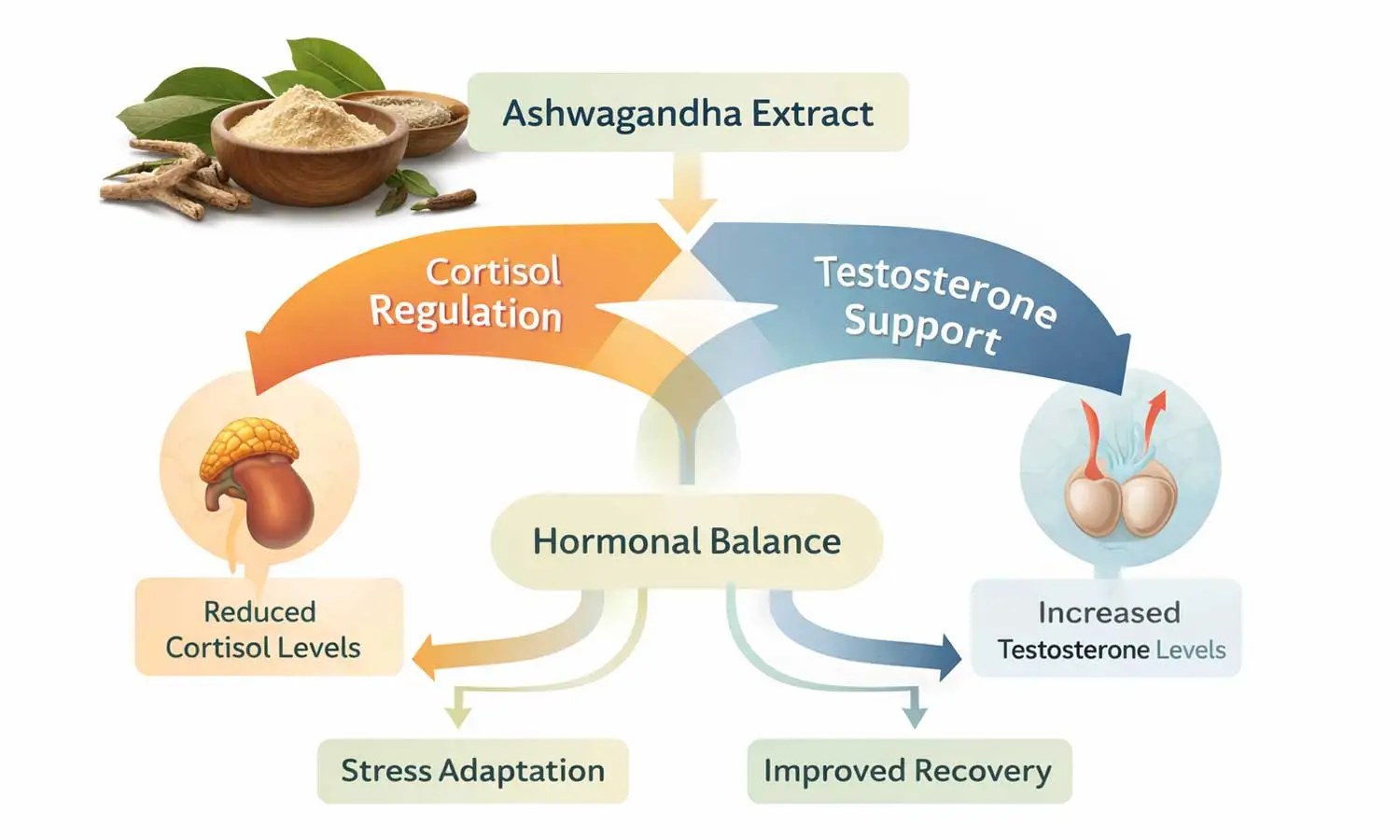
One of the primary mechanisms through which ashwagandha testosterone support is understood involves its effect on cortisol levels. Cortisol, often referred to as the body’s primary stress hormone, has a well-documented inverse relationship with testosterone.
Elevated cortisol levels—common in high-intensity training or prolonged stress—can suppress testosterone production. By supporting cortisol regulation, cortisol reduction supplements based on ashwagandha may indirectly contribute to maintaining a more favorable hormonal environment.
As an adaptogen testosterone support ingredient, ashwagandha does not act as a direct hormonal stimulant. Instead, it helps modulate the body’s response to stress, allowing endocrine function to operate more efficiently under demanding conditions.
This mechanism is particularly relevant in sports contexts where recovery and hormonal balance are closely linked to performance outcomes.
Withanolides and Hormonal Regulation
The functional properties of ashwagandha are largely attributed to its active compounds, especially withanolides. These compounds play a central role in the observed withanolides benefits testosterone relationship, particularly in the context of stress adaptation and endocrine support.
A deeper understanding of the active compounds in ashwagandha highlights the importance of extract quality and standardization. Products formulated with standardized ashwagandha extract allow for more predictable outcomes, as the concentration of withanolides is controlled within a defined range.
From a formulation standpoint, this consistency is essential—not only for efficacy but also for aligning with clinical data and ensuring reproducibility across batches.
In practical terms, the presence of standardized withanolides provides a measurable framework for evaluating how ashwagandha works in performance-oriented applications.
Clinical Insights into Ashwagandha for Male Performance
In recent years, a growing number of studies have explored the role of ashwagandha in physical performance and male health. These findings have contributed to its increasing use in formulations targeting strength, endurance, and recovery.
Research examining ashwagandha for male performance suggests potential benefits in areas such as:
•Muscle strength and output
•Recovery from physical exertion
•Overall vitality and performance capacity
In addition, its application in ashwagandha for strength and endurance formulations reflects a broader trend toward integrating adaptogens into sports nutrition products traditionally dominated by amino acids and stimulants.
While it is sometimes categorized alongside herbal testosterone booster ingredients, its mechanism remains distinct—focused more on restoring balance than artificially elevating hormone levels.
This distinction is important, as it aligns with the increasing demand for sustainable, physiology-based performance support rather than short-term stimulation.
Key Benefits of Ashwagandha Extract in Sports Nutrition Formulations
The integration of ashwagandha extract into sports nutrition is driven by its ability to address multiple performance-related factors within a single ingredient. This multifunctional profile allows it to be used across a wide range of formulations without the need for complex ingredient stacking.
Supporting Muscle Strength and Recovery
One of the most recognized applications of ashwagandha for muscle growth lies in its role in supporting recovery and muscle adaptation. Recovery is a critical component of performance, influencing both training consistency and long-term progress.
In formulations focused on recovery, ashwagandha is often included alongside other muscle recovery supplement ingredients, contributing to reduced fatigue and improved post-exercise adaptation.
Its growing presence in performance-focused formulations also reflects increased interest from brands working with sports nutrition ingredients supplier networks that prioritize multifunctional, plant-based components.
Enhancing Endurance and Performance
Beyond recovery, ashwagandha has also been associated with improvements in endurance and sustained performance.
As an ingredient in endurance-focused formulations, it is often positioned alongside compounds used in pre workout supplement ingredients, where it contributes to:
•Improved energy utilization
•Reduced perception of fatigue
•Enhanced training consistency
Unlike traditional stimulants, ashwagandha’s role as a herbal performance enhancer is more aligned with long-term adaptation rather than acute stimulation. This makes it particularly relevant in formulations designed for sustained performance rather than short-term output spikes.
Stress Reduction for Athletic Recovery
Physical performance is closely linked to stress management, particularly in high-intensity or high-frequency training environments.
Ashwagandha’s role in stress recovery supplements is centered on its ability to reduce physiological stress load, allowing for more efficient recovery between training sessions.
As an adaptogen for athletes, it supports:
•Faster recovery cycles
•Improved resilience to training stress
•Balanced nervous system response
Its inclusion in post workout recovery ingredients reflects a shift toward more holistic recovery strategies, where both physical and mental factors are addressed simultaneously.
Why Ashwagandha Extract Is Widely Used in Sports Nutrition Products
The increasing adoption of ashwagandha extract in sports nutrition is not only a result of its functional properties, but also its compatibility with evolving trends in ingredient selection and formulation design.
Growing Demand for Natural Performance Ingredients
The global shift toward clean-label and plant-based products has significantly influenced ingredient selection in sports nutrition.
As part of this movement, natural sports nutrition ingredients have gained traction, particularly those with a history of traditional use supported by modern research.
Ashwagandha has emerged as a key component in plant based performance supplements, offering a balance between traditional credibility and contemporary scientific relevance.
Its role within adaptogen sports nutrition reflects a broader industry trend—moving away from purely stimulant-based products toward formulations that support long-term physiological balance.
Compatibility with Pre-Workout and Recovery Formulas
Another factor contributing to its widespread use is its formulation flexibility.
Ashwagandha is commonly incorporated into:
•Pre-workout blends (ashwagandha in pre workout)
•Recovery formulations combined with amino acids
•Multi-ingredient performance products
It is also frequently paired with compounds such as creatine (ashwagandha with creatine) to create formulations that support both strength and recovery.
This level of supplement formulation compatibility allows it to be integrated into existing product frameworks without requiring significant reformulation.
Suitable Formats: Capsules, Powders, and Functional Blends
From a manufacturing perspective, ashwagandha extract is adaptable across a range of delivery formats.
It is commonly used in:
•Powder-based products, including ashwagandha extract powder bulk applications
•Encapsulated supplements aligned with sports supplement capsules formats
•Complex formulations involving functional nutrition ingredients
This versatility supports its continued adoption across different product categories, particularly as brands seek ingredients that can perform consistently across multiple formats.
Standardized Ashwagandha Extract: Choosing the Right Withanolide Content
Standardization is one of the most important parameters in evaluating the functional quality of ashwagandha extract, particularly in sports nutrition and testosterone-support formulations. Among all measurable indicators, withanolide content is widely recognized as the primary marker of biological activity.
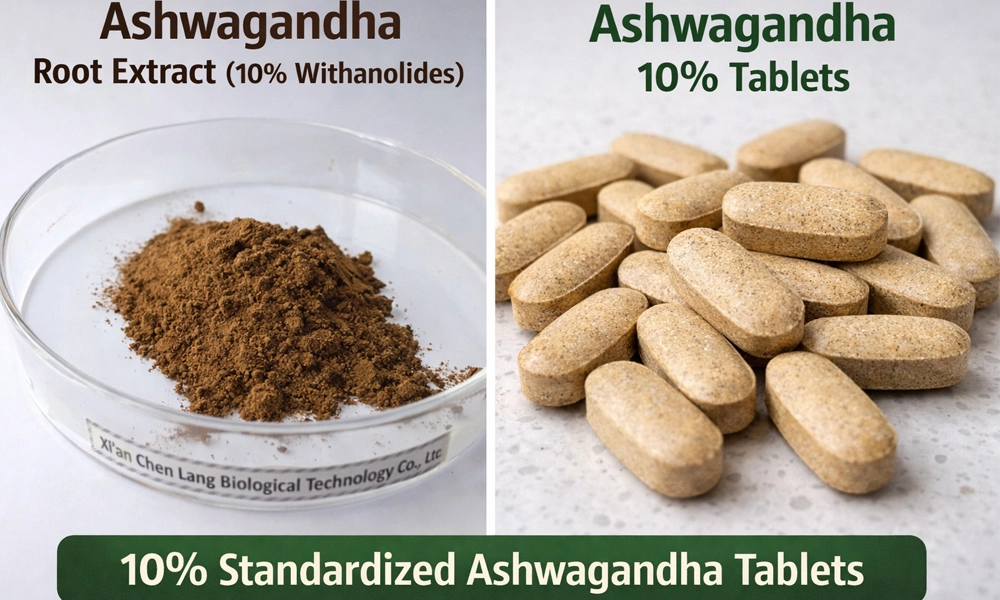
In practice, most formulations rely on standardized extracts with defined withanolide levels, commonly including ashwagandha extract 5% withanolides and higher concentrations such as 10% withanolides ashwagandha. These specifications are not interchangeable—they are selected based on formulation intent, dosage strategy, and product positioning.
From a manufacturing perspective, producing a consistent standardized ashwagandha extract requires controlled extraction conditions, stable raw material sourcing, and validated processing systems. This is typically achieved by an experienced ashwagandha extract powder manufacturer with established quality control protocols.
Key Differences Between 5% and 10% Withanolides Ashwagandha Extract
|
Parameter |
Ashwagandha Extract 5% Withanolides |
10% Withanolides Ashwagandha |
|
Typical Use |
Daily wellness & recovery products |
High-performance & targeted formulations |
|
Potency Level |
Moderate |
High (classified as high potency ashwagandha extract) |
|
Dosage Flexibility |
Higher dosage required |
Lower dosage needed for similar effect |
|
Application |
Adaptogen blends, general stress support |
Testosterone support, sports performance |
|
Cost Impact |
More cost-efficient |
Higher ashwagandha extract price per kg |
|
Formulation Positioning |
Broad market products |
Premium or specialized formulations |
Why Withanolide Standardization Matters
The role of withanolides goes beyond simple concentration—it directly influences how ashwagandha extract performs in finished products.
Key considerations include:
•Consistency: Standardized extracts ensure stable active compound levels across batches
•Efficacy alignment: Many studies on withanolides benefits testosterone are based on defined concentrations
•Formulation predictability: Reliable dosing and performance in supplements
•Quality control: A clear benchmark for evaluating extract performance
For this reason, most formulation strategies prioritize extracts produced by a standardized herbal extract supplier capable of maintaining reproducible specifications.
How to Select the Right Specification for Your Application
Choosing between different withanolide levels depends on formulation goals rather than a “higher is always better” approach.
In general:
•5% withanolides
→ Suitable for daily use formulations
→ Balanced performance and cost
→ Common in stress and recovery products
•10% withanolides ashwagandha
→ Used in targeted performance formulations
→ Preferred in testosterone-support positioning
→ Enables lower dosage with higher functional intensity
For sports nutrition applications, higher concentrations are often selected when positioning products around performance optimization or hormonal balance. However, for broader formulations, moderate concentrations provide greater flexibility.
Manufacturing Consistency and Supplier Capability
Achieving reliable standardization depends heavily on production expertise. Variability in raw material quality, extraction techniques, and processing conditions can significantly affect final composition.
A qualified ashwagandha extract supplier should be able to provide:
•Controlled withanolide standardization
•Batch-to-batch consistency
•Complete documentation (COA, testing reports)
•Scalable production capability
As an experienced ashwagandha extract powder manufacturer, maintaining uniformity in active compounds is not only a technical requirement but also a critical factor in supporting long-term formulation stability.
How to Select a Reliable Ashwagandha Extract Supplier for Sports Nutrition
Selecting a production partner for ashwagandha extract involves more than evaluating price or availability. It requires a detailed assessment of manufacturing standards, quality systems, and long-term supply reliability.
Quality Indicators: COA, Testing, and Certification
A well-documented product profile is fundamental when evaluating extract quality. A complete ashwagandha extract COA should include:
•Withanolide content verification
•Microbiological testing results
•Heavy metal and solvent residue analysis
In addition, extracts that are third party tested extract provide an additional layer of validation, particularly for applications requiring regulatory compliance across different markets.
Manufacturing environments operating under recognized quality systems—such as those associated with a GMP herbal extract supplier—ensure that production processes are standardized, traceable, and repeatable.
These elements are essential not only for compliance, but also for maintaining consistency across production cycles.
Bulk Supply and Manufacturing Consistency
Consistency in supply is a critical consideration in sports nutrition, where production schedules and product launches depend on reliable raw material availability.
A qualified ashwagandha extract supplier should be able to demonstrate:
•Stable production capacity for bulk ashwagandha extract supplier requirements
•Consistent batch-to-batch quality
•Predictable lead times and logistics coordination
As an ashwagandha extract powder manufacturer, maintaining uniform particle size, solubility, and active compound levels is essential for ensuring compatibility across different formulations.
In practice, supply reliability is often determined by upstream control of raw materials as well as downstream process stability—both of which require experience and infrastructure.
What Sports Nutrition Brands Should Look For
When evaluating an ashwagandha extract manufacturer, several factors tend to define long-term reliability:
•Controlled sourcing of botanical raw materials
•Established extraction and standardization protocols
•Transparent documentation and traceability systems
Understanding how to choose herbal extract supplier often comes down to identifying partners capable of delivering consistency over time, rather than short-term cost advantages.
From an industry perspective, the most reliable sports nutrition ingredient supplier is one that aligns production quality with formulation requirements—ensuring that the ingredient performs as expected across different product formats.
Ashwagandha Extract Bulk Price: Cost Factors in Sports Nutrition Ingredients
Pricing of ashwagandha extract is influenced by a combination of technical specifications, raw material quality, and production processes. Understanding these variables is essential for aligning cost with formulation goals.
Withanolide Content and Extract Potency
The concentration of active compounds is one of the primary drivers of ashwagandha extract bulk price.
Higher standardized extracts typically involve:
•Greater raw material input
•More complex extraction processes
•Lower yield per batch
As a result, products with higher potency often correspond to a higher ashwagandha extract price per kg, particularly when consistency and purity are maintained.
Raw Material Quality and Origin
The botanical origin of ashwagandha plays a significant role in determining both quality and cost.
Factors influencing pricing include:
•Cultivation practices (organic vs conventional)
•Geographic sourcing conditions
•Harvesting and drying processes
These variables contribute to differences in wholesale sports nutrition ingredients pricing, particularly when traceability and quality control are prioritized.
Extraction Technology and Manufacturing Standards
Processing methods also impact final pricing.
Advanced extraction techniques may offer:
•Improved preservation of active compounds
•Higher purity profiles
•Reduced variability between batches
However, these benefits are typically associated with increased production costs, which are reflected in final pricing structures.
For manufacturers operating at scale, balancing efficiency with quality is a key factor in maintaining competitive yet stable pricing.
FAQ: Ashwagandha Extract for Testosterone and Sports Nutrition
Does ashwagandha really increase testosterone?
Research suggests that ashwagandha testosterone studies indicate a supportive role in maintaining healthy testosterone levels, primarily through stress reduction and cortisol regulation rather than direct hormonal stimulation.
What is the best ashwagandha extract for athletes?
The most suitable extract depends on formulation goals. Standardized extracts with defined withanolide content are typically preferred, as they provide consistent performance across applications.
How much withanolides content is ideal?
Commonly used concentrations range between 2.5% and 10%. The appropriate level depends on dosage format, target function, and overall formulation strategy.
Can ashwagandha be used in pre-workout supplements?
Yes, ashwagandha pre workout formulations are increasingly common, particularly in products designed to support endurance, stress resilience, and sustained performance.
Where to source bulk ashwagandha extract?
Sourcing typically involves working with an established ashwagandha extract supplier or experiencedashwagandha extract powder manufacturer capable of providing standardized extracts, documentation, and consistent supply.
Conclusion: Ashwagandha Extract as a Strategic Ingredient in Sports Nutrition
The role of ashwagandha extract in sports nutrition continues to expand as the industry moves toward more holistic and physiology-based performance solutions.
Its ability to support stress regulation, recovery, and hormonal balance positions it as a versatile ingredient across a wide range of formulations—from endurance products to testosterone-support applications.
In practice, the effectiveness of ashwagandha extract powder is closely tied to its quality, standardization, and consistency. As a result, careful selection of manufacturing partners and extract specifications becomes a defining factor in long-term product performance.
At CHEN LANG BIO TECH, production of ashwagandha extract is managed through controlled sourcing, standardized extraction processes, and batch-level verification to ensure consistency across applications.
For technical documentation or formulation-related inquiries, communication can be directed to:
📧 Email: admin@chenlangbio.com
🌐 Website: www.chenlangbio.com

Send Inquiry
Related Industry Knowledge
- Nitenpyram for Flea Control in Dogs and Cats: How This Fast-Acting Insecticide Works
- Dimethylmethoxy Chromanyl Palmitate vs Kojic Acid: Which Ingredient Is Better for Skin Brightening?
- 9 ME BC vs Other Dopamine Nootropics: What Makes It Different?
- Is Bifida Ferment Lysate Good for Skin?
- How Does Fucoidan Powder Improve Skin Elasticity?
- What are the Benefits of Acetyl Hexapeptide-8 in Skincare?
- Is Centella Asiatica An Antioxidant
- Future Trends of Sodium Methylesculetin Acetate in Healthcare
- Is Monobenzone Same As Hydroquinone
- What is the Difference Between Copper PCA and Copper Peptides