Lutein vs Zeaxanthin: What Is the Difference?
2026-09-07 14:19:33
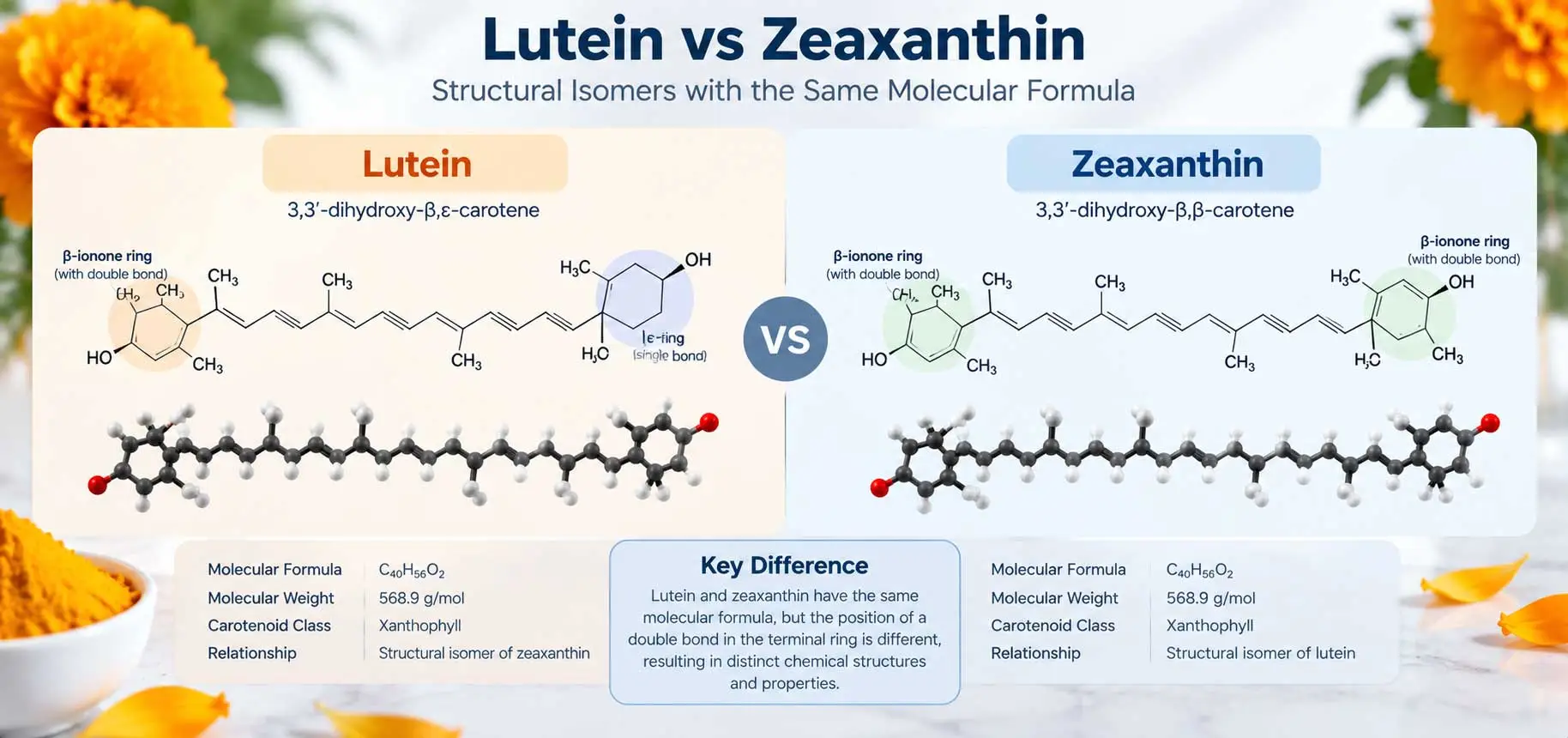
Lutein vs zeaxanthin is a comparison between two closely related xanthophyll carotenoids that share the same molecular formula, C₄₀H₅₆O₂, and a molecular weight of about 568.9 g/mol, but they are not the same compound. The structural difference lies mainly in the position of one double bond in a terminal ring. Lutein contains one β-ionone-type ring and one ε-type ring, whereas zeaxanthin has two β-type end rings. That apparently small difference gives each carotenoid a distinct chemical identity and affects how the compounds are separated, specified and supplied commercially.
For ingredient buyers, the more important point is that neither carotenoid should be chosen by name or assay alone. Commercial materials can differ in botanical source, ester or free form, active concentration, carrier system, particle design and delivery format. A high-assay powder for a capsule and a lower-assay microencapsulated ingredient for a beverage may both be appropriate products even though their specifications look very different.
This is why the difference between lutein and zeaxanthin needs to be understood at two levels: first as a chemical distinction between related carotenoids, and second as a practical difference between commercial ingredient forms used in real formulations.
Lutein vs Zeaxanthin at a Glance: Key Differences for Ingredient Buyers
A practical lutein vs zeaxanthin comparison begins with chemical identity but quickly moves into product form and application.
|
Feature |
Lutein |
Zeaxanthin |
|
Carotenoid class |
Xanthophyll |
Xanthophyll |
|
Molecular formula |
C₄₀H₅₆O₂ |
C₄₀H₅₆O₂ |
|
Molecular weight |
~568.9 g/mol |
~568.9 g/mol |
|
Structural relationship |
Structural isomer of zeaxanthin |
Structural isomer of lutein |
|
Typical commercial botanical source |
Marigold (Tagetes erecta) |
Marigold, including specialized high-zeaxanthin cultivars |
|
Native water behavior |
Lipophilic, insoluble in water |
Lipophilic, essentially insoluble in aqueous media |
|
Common commercial forms |
Free lutein powder, lutein esters, beadlets, oil suspensions |
Standardized powder, oil-compatible grades, CWS/microencapsulated forms |
|
Key purchasing question |
Which lutein form and assay fit the product? |
Which zeaxanthin form and delivery system fit the product? |
Lutein is formally listed in the Food Chemicals Codex as an orange-red powder obtained from saponified Tagetes erecta oleoresin and described as insoluble in water. Zeaxanthin is likewise strongly lipophilic.
The key procurement lesson is simple: lutein and zeaxanthin differences are not limited to molecule names. The commercial grade determines how the ingredient behaves during manufacturing.
Lutein vs Zeaxanthin Structure: Why Are They Different If Their Molecular Formula Is the Same?
Lutein vs zeaxanthin structure is the clearest scientific explanation of why these two compounds cannot be treated as interchangeable.
PubChem lists lutein as C₄₀H₅₆O₂ with a molecular weight of 568.9 g/mol. Zeaxanthin has the same molecular formula and essentially the same molecular weight. They are structural isomers because the end-ring unsaturation differs. One literature review summarizes the relationship particularly well: lutein and zeaxanthin differ by the position of a single double bond, with zeaxanthin possessing a fully conjugated system across both terminal rings.
That distinction matters analytically. Two molecules can have the same elemental composition while still showing different chromatographic behavior and reference-standard requirements.
For ingredient qualification, lutein and zeaxanthin chemical structure therefore has a practical consequence: identity testing must confirm the actual target carotenoid rather than infer it from color or total carotenoid concentration.
The phrase “same formula” should never be interpreted as “same ingredient.” This is especially important when reviewing a marigold extract that contains several related xanthophylls.
Are Lutein and Zeaxanthin Both Xanthophyll Carotenoids?
Lutein and zeaxanthin carotenoids belong to the oxygen-containing subgroup generally known as xanthophylls. This distinguishes them from hydrocarbon carotenoids such as β-carotene.
Both molecules contain hydroxyl groups, which make them somewhat more polar than purely hydrocarbon carotenoids, but they remain strongly lipophilic overall. PubChem gives lutein a calculated XLogP around 11, which is consistent with poor compatibility with water.
For procurement teams, the xanthophyll classification is useful because it helps explain several shared behaviors: both compounds are colored carotenoids, both require protection from unfavorable environmental conditions, and both often need formulation technology when a water-based application is intended.
This is the useful context behind the term lutein zeaxanthin xanthophylls. They belong to the same carotenoid family, but family membership does not eliminate the need for individual assay and identity specifications.
Lutein vs Zeaxanthin Sources: Where Do Commercial Ingredients Come From?
Lutein vs zeaxanthin sources should be considered differently from dietary sources. Leafy vegetables, corn, eggs and fruits may contain one or both carotenoids, but commercial ingredient production depends on a source that can provide adequate pigment concentration, agricultural scale and processing consistency.
Marigold flowers are particularly important in industrial carotenoid production. FAO's Feedipedia notes that lutein can represent up to about 90% of the identified pigments in Tagetes erecta petals, with smaller quantities of zeaxanthin and other carotenoids. Dried petals have been reported to contain up to about 2,000 mg/kg total carotenoids, although cultivar and processing conditions create substantial variability.
For zeaxanthin, commercial production can use specialized marigold cultivars bred for a higher zeaxanthin-to-lutein ratio. The FDA's response to GRAS Notice 639 describes a purified concentrated zeaxanthin extract derived from a specialized Tagetes erecta variety developed to contain higher zeaxanthin levels relative to lutein and other carotenoids.
This distinction is important for buyers comparing natural lutein and zeaxanthin. “Marigold-derived” does not mean every crop produces the same carotenoid profile.
Lutein and Zeaxanthin from Marigold: Why Tagetes erecta Matters
Lutein and zeaxanthin from marigold are closely connected through plant chemistry and industrial processing.
In marigold flowers, lutein occurs mainly as esterified xanthophylls. A 2024 human study reviewing commercial marigold materials notes that around 90–99% of lutein in marigold can occur in ester form. Another paper describes the principal commercial lutein ester profile of marigold as roughly 56% lutein dipalmitate, 36% lutein dimyristate and 8% lutein monomyristate in the cited source material.
Industrial free-lutein production therefore commonly involves extraction of marigold oleoresin followed by alkaline saponification to hydrolyze ester bonds. FCC similarly defines commercial lutein as the purified fraction obtained from saponified Tagetes erecta oleoresin.
Zeaxanthin can also be present naturally in marigold material, but specialized production may involve cultivars or processing strategies aimed at increasing the relative zeaxanthin fraction.
At CHEN LANG BIO TECH, our marigold raw-material network covers more than 200,000 mu across Yunnan, India and Zambia. That agricultural scale is useful because xanthophyll production begins with crop variability. Controlled sourcing gives processing and analytical teams a more consistent foundation than relying solely on spot-market flowers.
For a deeper look at this supply chain, the related article Marigold Zeaxanthin: How Zeaxanthin Is Produced from Marigold Flowers covers extraction and standardization in more detail.
Do Lutein and Zeaxanthin Have the Same Solubility?
Lutein vs zeaxanthin solubility is similar in one important respect: both are highly lipophilic compounds with poor intrinsic water solubility.
The FCC monograph describes lutein as insoluble in water. A zeaxanthin review likewise describes zeaxanthin as a lipophilic compound that is insoluble in aqueous media. More broadly, carotenoid-processing literature characterizes carotenoids as hydrophobic, lipophilic and insoluble in water.
So when a customer asks is lutein water soluble or is zeaxanthin water soluble, the answer for the native carotenoids is essentially no.
Commercial behavior can be very different, however. Beadlets, emulsified products and microencapsulated powders can be designed to wet and disperse far more readily in water. That is a physical delivery improvement, not proof that the underlying carotenoid has become molecularly water soluble.
This distinction matters particularly for beverage development. A formulater should evaluate the finished grade's dispersion behavior rather than extrapolate from the chemistry of the free carotenoid.
Lutein vs Zeaxanthin Powder: Why Commercial Form Matters More Than Appearance
Lutein vs zeaxanthin powder cannot be evaluated reliably from color alone. Both may range through yellow, orange and red-orange tones depending on concentration and formulation, while carrier materials can further change the visual appearance.
Commercial lutein can be supplied as free lutein, ester preparations, beadlets or oil dispersions. Zeaxanthin may be supplied as higher-assay conventional material or formulated into microencapsulated/CWS powders for applications that require improved aqueous handling.
A buyer comparing lutein powder vs zeaxanthin powder should therefore establish the active form, assay basis and carrier composition before discussing which product is “stronger.”
For example, a 5% zeaxanthin CWS powder should not be judged as lower quality simply because a conventional lutein ingredient is offered at 20%. One is a formulated delivery system with substantial carrier material; the other may be a more concentrated active ingredient.
The commercial form often tells a formulator more about expected processing behavior than powder color or headline assay alone.
Lutein vs Zeaxanthin Stability: Are They Equally Sensitive to Light, Heat and Oxygen?
Lutein vs zeaxanthin stability shares many common principles because both molecules contain long conjugated polyene systems.
Carotenoid-processing reviews note that light, heat, acids and oxygen can promote isomerization or oxidation, while metals, pro-oxidants and surrounding formulation conditions can further influence degradation.
Lutein has been studied specifically under varied extrinsic factors. In laboratory work using marigold-derived lutein, researchers performed extraction and purification under dull yellow light specifically to reduce photoisomerization and oxidation during handling.
Zeaxanthin has also shown heat- and light-related isomerization in published research. The practical conclusion is not that one molecule is universally “more stable.” Stability comparisons require the same matrix, concentration, packaging and exposure conditions.
For procurement purposes, lutein zeaxanthin stability data should be product-specific. A stabilized beadlet cannot be compared directly with a free crystalline carotenoid simply because both materials contain the same active molecule.
Does Microencapsulation Change the Lutein vs Zeaxanthin Comparison?
Microencapsulated lutein and zeaxanthin are no longer just active molecules; they are complete delivery systems.
Once either carotenoid is embedded in a carrier matrix, performance depends on both the active and the formulation surrounding it. Particle size, carrier material, active loading, moisture and encapsulation efficiency can influence storage behavior and dispersion.
This is especially important for microencapsulated zeaxanthin powder, where a product may be intentionally designed for cold-water dispersion. The resulting ingredient should be compared against another dispersible grade—not automatically against a high-assay conventional powder.
The same principle applies to lutein beadlets used in beverage, tablet or dry-blend systems.
For R&D teams, the correct comparison shifts from “Which carotenoid is better?” to “Which delivery system meets the finished-product requirements with the appropriate active?”
Lutein vs Zeaxanthin Specifications: What Should Ingredient Buyers Compare?
Lutein vs zeaxanthin specification review should begin with identity and assay basis. Only after those are clear does the rest of the comparison become commercially meaningful.
For lutein, a specification should state whether the result refers to free lutein, lutein esters or another defined basis. A marigold material can contain substantial esterified xanthophylls before saponification, so ambiguous assay language can lead to incorrect comparisons.
For zeaxanthin, product form becomes equally important. A conventional powder and a water-dispersible microencapsulated grade may require very different release criteria.
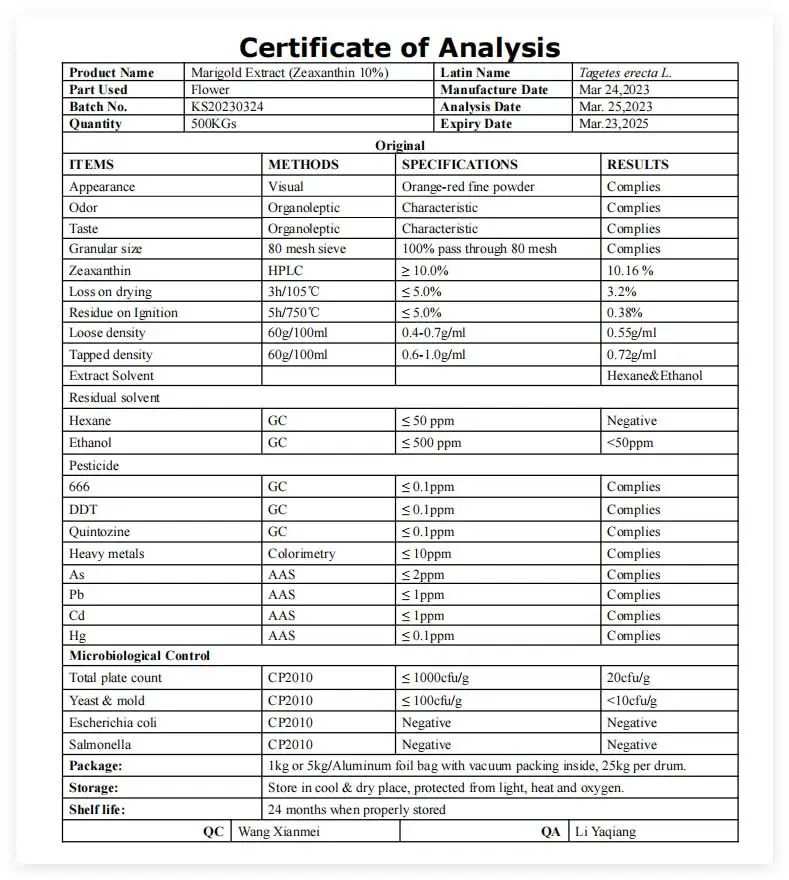
The lutein zeaxanthin assay should therefore be supported by an analytical method appropriate to the product. Physical parameters, moisture, contaminant limits and microbiological criteria then help define the finished material more fully.
A useful procurement principle is:
Two carotenoid powders cannot be meaningfully compared until their assay basis, physical form and analytical specification have been aligned.
That principle saves time because it prevents a purchasing team from comparing technically different ingredients solely by price per kilogram.
How Are Lutein and Zeaxanthin Tested by HPLC?
Lutein and zeaxanthin HPLC analysis is valuable because chromatography can separate related carotenoids before quantification.
Marigold extracts contain multiple xanthophylls, and the presence of geometrical isomers further increases analytical complexity. Research on lutein isomers has used C30 HPLC coupled with UV-visible and mass-spectral information to separate and identify trans and cis forms, illustrating the level of chromatographic selectivity available for carotenoid analysis.
A specification does not necessarily require such an elaborate research method, but the underlying principle is the same: lutein zeaxanthin HPLC analysis is more informative than judging concentration from color.
For QA teams, assay values should be interpreted alongside the declared test method and reference standard. If two suppliers use materially different assay definitions, the numbers should not be treated as directly equivalent without method review.
This is why a COA is more useful when it provides enough analytical context to explain what was actually measured.
Lutein vs Zeaxanthin for Formulation: Which Ingredient Form Should You Choose?
Lutein vs zeaxanthin for formulation should be approached from the finished dosage form backward rather than selecting the active first and forcing it into the product later.
|
Application |
Main Ingredient Consideration |
|
Capsules / Tablets |
Active assay, blend uniformity, powder handling |
|
Softgels |
Oil compatibility and active concentration |
|
Gummies |
Matrix compatibility and process stability |
|
Beverages |
Dispersibility, suspension behavior and color |
|
Solid drinks |
Reconstitution and powder compatibility |
|
Functional foods |
Heat, oxygen exposure and matrix interaction |
For lutein vs zeaxanthin for supplements, the dosage form is therefore more informative than the word “supplement.” A hard capsule may accept a conventional high-assay powder, while an instant drink mix may require a dispersible delivery system.
The same reasoning applies to foods. A dairy beverage, cereal premix and oil-based filling create different processing environments, even if the target carotenoid dose is identical.
Formulation selection should therefore follow this sequence:
application requirement → delivery form → technical specification → active concentration.
That approach is more robust than choosing an ingredient solely from a headline assay.
Can Lutein and Zeaxanthin Be Used Together in Commercial Formulations?
Lutein and zeaxanthin together can be incorporated into the same commercial formulation, and combined carotenoid ingredients are common in nutrition products.
For raw-material buyers, the important issue is how the combination is specified.
A premix may report lutein and zeaxanthin separately, or it may provide a broader xanthophyll or carotenoid value. Those approaches are not interchangeable. If a formulation requires a defined quantity of each active, the analytical documentation should support individual component control.
A lutein and zeaxanthin formulation also needs a delivery format compatible with the finished product. A combination intended for a dry capsule can be designed very differently from one intended for a beverage.
The existence of both carotenoids in the same formula therefore does not remove the need for separate identity and assay logic.
Lutein vs Zeaxanthin COA: Why Assay Numbers May Not Be Directly Comparable
A lutein vs zeaxanthin COA comparison should never treat assay concentration as a quality ranking.
A 20% lutein powder and a 5% microencapsulated zeaxanthin powder serve different formulation purposes. The first provides a higher active loading; the second may provide a delivery system designed for dispersion and physical protection.
The same issue applies within lutein itself. Free lutein and lutein esters are different specification concepts, and published marigold literature shows that esterified forms dominate the natural flower matrix before downstream processing.
The useful rule is:
Assay concentration is not a quality ranking.
A high number tells the buyer how much active is present under the stated analytical basis. It does not, by itself, indicate whether the material is the right ingredient for the intended manufacturing process.
How Should Buyers Compare Lutein and Zeaxanthin Ingredient Quality?
A zeaxanthin supplier should be evaluated through the consistency of the ingredient behind the specification rather than through a marketing claim about purity alone.
For natural carotenoids, quality begins with raw-material control. Our marigold supply network extends across more than 200,000 mu in Yunnan, India and Zambia, providing an agricultural base that supports commercial carotenoid programs. Downstream processing is supported by analytical testing, including HPLC capability, and by batch-level traceability.
This matters because botanical variation does not disappear simply because a product reaches the factory. Raw-material history, processing control and analytical release all influence repeatability.
For buyers, the strongest evidence of quality is therefore a coherent relationship between source, production record, specification and batch-specific test results.
Does Lutein vs Zeaxanthin Price Tell You Which Ingredient Is Better?
Lutein price vs zeaxanthin price only becomes meaningful after the materials being compared are technically aligned.
A high-assay conventional powder may appear more expensive per kilogram but deliver more active per unit weight. A lower-assay microencapsulated grade may have a higher processing cost because it includes carrier technology, yet it may reduce formulation work in an aqueous system.
The more useful comparison is therefore based on cost per required unit of active together with delivery-system performance.
Price should follow technical qualification, not substitute for it.
Choosing Between Lutein and Zeaxanthin for a Commercial Project
A lutein supplier should be able to define the exact material being offered, just as a zeaxanthin program should be based on a clear grade and specification.
The first decision should be the intended product. From there, formulators can determine whether they need lutein, zeaxanthin or both, followed by the required delivery system and assay.
Quality documentation and regulatory suitability then become part of the approval process. Finally, commercial scale, packaging and lead time determine whether the selected grade can move from laboratory evaluation into routine production.
For ingredient procurement, this decision sequence is more reliable than asking which carotenoid is universally “better.”
Lutein and Zeaxanthin Are Similar Carotenoids, Not Interchangeable Ingredients
Lutein vs zeaxanthin is not a contest between two versions of the same ingredient. They are closely related structural isomers with the same molecular formula, but commercial suitability depends on identity, active form, assay, delivery system and application.
The practical distinctions are equally important:
same formula does not mean same compound;
similar color does not mean identical specification;
higher assay does not automatically mean better quality.
The right ingredient is the one whose chemistry and commercial form match the finished product.
Frequently Asked Questions About Lutein vs Zeaxanthin
Are lutein and zeaxanthin the same thing?
No. They share the same formula, C₄₀H₅₆O₂, but they differ in terminal-ring structure and are classified as structural isomers. Their analytical identity and commercial specifications are therefore distinct.
What is the main difference between lutein and zeaxanthin?
The main difference between lutein and zeaxanthin is the position of one double bond in the terminal ring. Lutein has β- and ε-type end rings, whereas zeaxanthin has two β-type rings, creating a different conjugated structure.
Are lutein and zeaxanthin both carotenoids?
Yes. Are lutein and zeaxanthin carotenoids? Both are oxygen-containing carotenoids known as xanthophylls. Their hydroxyl groups make them somewhat more polar than hydrocarbon carotenoids, but both remain strongly lipophilic.
Do lutein and zeaxanthin come from marigold?
Lutein zeaxanthin from marigold is commercially important. Marigold is the major botanical source of lutein and also contains zeaxanthin. Specialized Tagetes erecta varieties can be cultivated with higher zeaxanthin relative to lutein.
Are lutein and zeaxanthin water soluble?
No in their native forms. Both are lipophilic carotenoids with very poor intrinsic water compatibility. Commercial dispersible or microencapsulated grades use formulation technology to improve incorporation into aqueous products rather than changing the underlying molecule into a truly water-soluble compound.
Can lutein and zeaxanthin be used in the same formulation?
Yes. Lutein and zeaxanthin together can be formulated in the same finished product. Buyers should confirm whether the ingredient specification controls the two carotenoids individually and whether the chosen delivery system is appropriate for the dosage form.
Can buyers request samples before commercial purchasing?
Before deciding to buy zeaxanthin powder, a sample can be used to confirm physical behavior, application compatibility and documentation. This is particularly useful for beverage, powder and microencapsulated grades where dispersion and processing performance cannot be judged from the COA alone.
Lutein and Zeaxanthin Ingredient Support from CHEN LANG BIO TECH
As a zeaxanthin manufacturer, CHEN LANG BIO TECH supports commercial ingredient qualification with defined specifications, analytical documentation and sample evaluation according to the intended formulation. Our marigold supply chain, large-scale carotenoid processing capability and HPLC-based quality control provide support from botanical sourcing through batch release.
Commercial packaging and zeaxanthin MOQ can be confirmed once the required grade, assay and application have been defined.
For specifications, samples or project quotations, contact admin@chenlangbio.com.
References
1. National Center for Biotechnology Information. PubChem Compound Summary: Lutein. Molecular formula C₄₀H₅₆O₂, molecular weight 568.9 g/mol and physicochemical information for lutein.
2. United States Pharmacopeia. Food Chemicals Codex Monograph: Lutein. Describes lutein as a purified fraction obtained from saponified Tagetes erecta oleoresin and insoluble in water.
3. Olmedilla-Alonso B., et al. Bioavailability of Lutein from Marigold Flowers (Free vs. Ester Forms): A Randomised Cross-Over Study. Nutrients. 2024;16(10):1415. Discusses marigold as the major commercial lutein source and the predominance of lutein esters in the flowers.
4. Efficacy of Diacetate Esters of Macular Carotenoids: Effect of Supplementation on Macular Pigment. Reports representative ester composition of lutein in marigold and the role of saponification in commercial processing.
5. FAO Feedipedia. Mexican Marigold (Tagetes erecta). Reviews carotenoid composition of marigold flowers and identifies lutein as the dominant xanthophyll pigment with smaller amounts of zeaxanthin.
6. U.S. Food and Drug Administration. Agency Response Letter GRAS Notice No. 639. Describes a purified zeaxanthin extract produced from a specialized high-zeaxanthin Tagetes erecta cultivar.
7. Mezzomo N., Ferreira S.R.S. Carotenoids Functionality, Sources, and Processing by Supercritical Technology: A Review. Journal of Chemistry. Discusses carotenoid lipophilicity, water insolubility and sensitivity to light, heat and oxidation.
8. Jia Y.P., et al. Zeaxanthin: Metabolism, Properties, and Antioxidant Protection of Eyes, Heart, Liver, and Skin. BioMed Research International. 2019. Reviews zeaxanthin physicochemical properties, including its lipophilic nature and aqueous insolubility.
9. Bhat I., et al. Oxidative Stability of Lutein on Exposure to Varied Extrinsic Factors. Examines lutein stability and the precautions used during extraction and purification to reduce photoisomerization and oxidation.
10. Lutein Isomers: Preparation, Separation, Structure Elucidation, and Occurrence in 20 Medicinal Plants. Uses HPLC-DAD-MS and reference standards to distinguish lutein and its geometrical isomers, illustrating the analytical complexity of carotenoid identification.

Send Inquiry
Related Industry Knowledge
- Is 3-O-Ethyl Ascorbic Acid Effective for Commercial Skincare Products?
- L-Theanine vs Caffeine: How They Are Used in Functional Formulas (Ingredient Supplier Guide for Beverage & Supplement
- Can 3-O-ethyl Ascorbic Acid Improve Collagen Synthesis and Skin Elasticity?
- Can Chondroitin Sulfate Powder Improve Skin Health?
- What Are the Potential Health Benefits of L-Ergothioneine?
- Can You Take EGCG Everyday
- Are Lutein Supplements Safe
- China Phellinus Linteus Extract Powder Supplier
- What's The Difference Between Kojic Acid and Kojic Acid Dipalmitate Powder
- What Is Difference Between Tranexamic Powder, Alpha Arbutin Powder and Nicotinamide