
Meso-Zeaxanthin vs Zeaxanthin: What Is the Difference?
2026-09-07 14:28:53
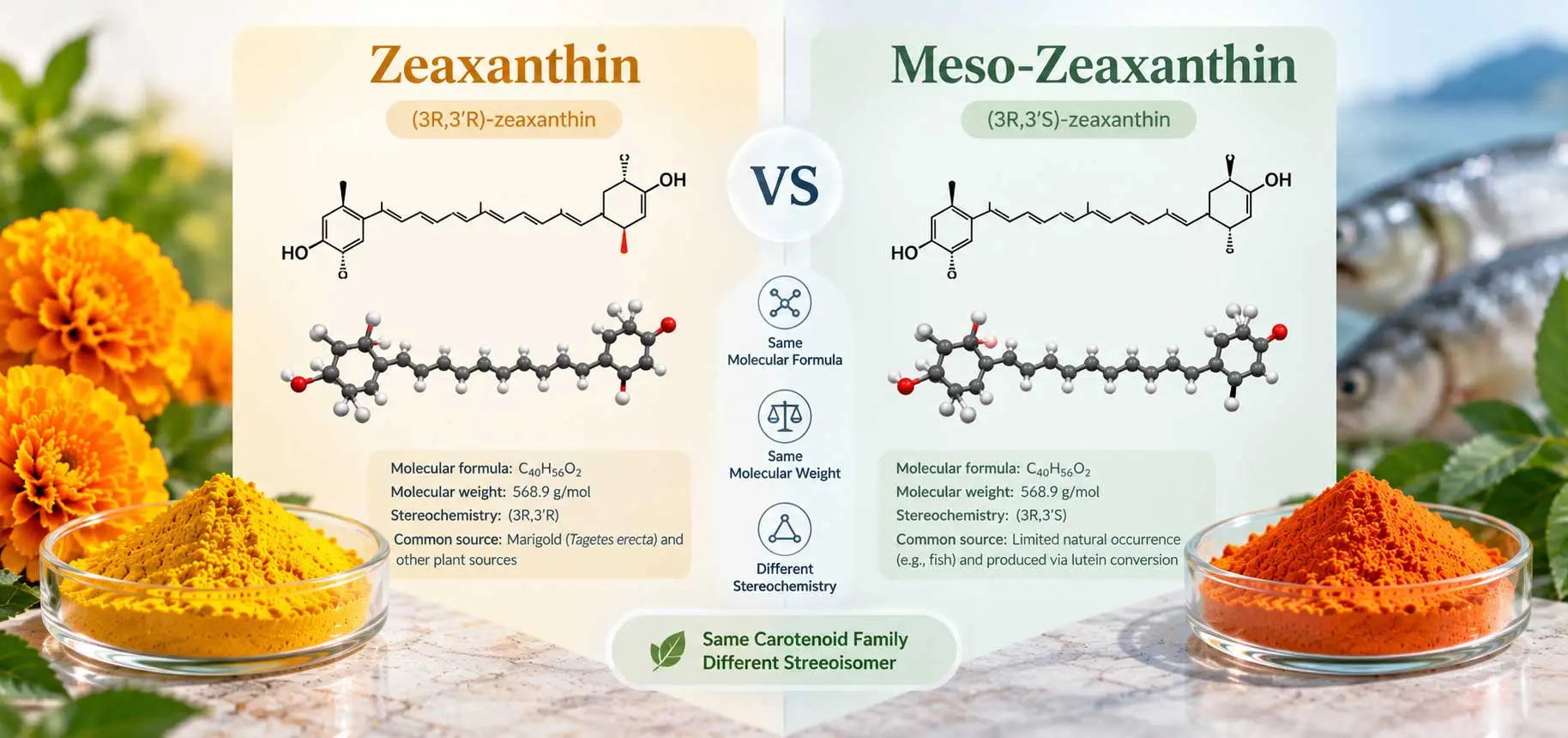
Meso-zeaxanthin vs zeaxanthin is primarily a stereochemistry question rather than a comparison between two unrelated carotenoids. Both compounds belong to the xanthophyll family, share the molecular formula C₄₀H₅₆O₂ and have a molecular weight of approximately 568.9 g/mol. The commercially familiar form of zeaxanthin derived from plants is predominantly (3R,3′R)-zeaxanthin, whereas meso-zeaxanthin is (3R,3′S)-zeaxanthin. The molecules therefore contain the same atoms and carotenoid backbone but differ in the spatial configuration around their chiral centers.
For ingredient buyers, this distinction has consequences well beyond nomenclature. A total zeaxanthin assay does not necessarily establish which stereoisomer is present. The origin of the material, production route, analytical method, stereoisomer profile and reference standard all become relevant when the specification specifically calls for meso-zeaxanthin.
The practical difference between meso-zeaxanthin and zeaxanthin is therefore best understood through identity first, followed by sourcing, manufacturing and analytical verification.
Meso-Zeaxanthin vs Zeaxanthin at a Glance: Key Differences for Ingredient Buyers
A meso-zeaxanthin vs zeaxanthin comparison becomes much clearer when chemical identity and commercial sourcing are separated.
|
Feature |
Zeaxanthin |
Meso-Zeaxanthin |
|
Molecular formula |
C₄₀H₅₆O₂ |
C₄₀H₅₆O₂ |
|
Molecular weight |
~568.9 g/mol |
~568.9 g/mol |
|
Carotenoid class |
Xanthophyll |
Xanthophyll |
|
Common stereochemical designation |
(3R,3′R)-zeaxanthin |
(3R,3′S)-zeaxanthin |
|
Relationship |
Zeaxanthin stereoisomer |
Zeaxanthin stereoisomer |
|
Natural occurrence |
Widely associated with plant-derived foods and botanical sources |
Reported in selected animal-derived foods; much less broadly distributed |
|
Commercial route |
Botanical extraction and downstream purification |
May be produced through controlled conversion of lutein |
|
Critical QC question |
Identity and quantitative assay |
Stereoisomer identity and quantitative assay |
|
Procurement implication |
Confirm grade and active concentration |
Confirm stereochemical composition and production route |
The essential meso-zeaxanthin and zeaxanthin difference is not visible from molecular weight or elemental composition. It lies in stereochemical configuration.
For procurement purposes, that creates an important rule:
Meso-zeaxanthin and conventional zeaxanthin are stereoisomers. When meso-zeaxanthin is specifically required, total zeaxanthin content alone is not sufficient evidence of ingredient identity.
Meso-Zeaxanthin Structure: Why Is It Different from Zeaxanthin?
Understanding the meso-zeaxanthin structure requires looking at the stereogenic centers of the zeaxanthin molecule.
The principal plant-derived form is (3R,3′R)-zeaxanthin. Meso-zeaxanthin is designated (3R,3′S)-zeaxanthin, while a third stereoisomer, (3S,3′S)-zeaxanthin, is also known. Research using chiral chromatographic methods has separated and quantified these forms individually.
This makes meso-zeaxanthin a stereoisomer rather than a different carotenoid with a different elemental composition. The term “meso” is important because the opposite configurations at the relevant stereogenic centers give the molecule an internal stereochemical relationship distinct from the R,R and S,S forms.
For an ingredient buyer, the chemistry has an immediate analytical consequence. Mass alone cannot distinguish these forms because their molecular weights are identical. A generic zeaxanthin UV-visible spectrum may also be insufficient because the stereoisomers retain closely related chromophore characteristics.
This is why zeaxanthin stereoisomers need to be considered whenever a specification claims a defined meso form.
The most useful way to state the distinction is:
The difference between meso-zeaxanthin and conventional zeaxanthin is stereochemical, not molecular-formula based.
That distinction should carry through from product naming to specification design and final COA review.
Do Meso-Zeaxanthin and Zeaxanthin Have the Same Molecular Formula?
Yes. The meso-zeaxanthin molecular formula is C₄₀H₅₆O₂, the same as zeaxanthin, and both have a molecular weight of approximately 568.9 g/mol.
That similarity can create confusion in purchasing documentation. Formula and molecular weight establish basic chemical composition, but neither identifies the stereoisomer.
In practical terms, a document showing:
C₄₀H₅₆O₂
568.9 g/mol
Zeaxanthin assay: 5~10%
does not by itself answer is meso-zeaxanthin the same as zeaxanthin or demonstrate that the material is predominantly (3R,3′S)-zeaxanthin.
When stereochemistry is commercially relevant, the specification and analytical package need to go beyond basic molecular information.
Where Does Natural Zeaxanthin Come From?
A natural zeaxanthin source can be found in a range of foods and botanical materials. Zeaxanthin occurs in yellow and orange plant foods and is also present alongside other xanthophylls in marigold.
For industrial production, however, dietary occurrence is not the same as a commercially practical raw-material source. A manufacturer needs sufficient pigment concentration, agricultural availability, reproducible crop quality and a process capable of obtaining a standardized ingredient.
This is why marigold zeaxanthin has become commercially important. Specialized Tagetes erecta varieties can provide botanical material suitable for carotenoid extraction and downstream purification.
At CHEN LANG BIO TECH, our marigold sourcing network extends across more than 200,000 mu of cultivation in Yunnan, India and Zambia. For large-scale carotenoid programs, this agricultural foundation helps connect raw-material traceability with subsequent extraction and analytical control.
The production chain for botanical zeaxanthin is covered separately in Marigold Zeaxanthin: How Zeaxanthin Is Produced from Marigold Flowers, allowing the present comparison to focus on stereochemical identity rather than repeating the extraction process.

Where Does Meso-Zeaxanthin Come From Naturally?
The meso-zeaxanthin source question is more complicated because natural occurrence and commercial manufacturing are separate issues.
Meso-zeaxanthin should not be described simply as “non-natural.” An analytical study published in 2015 confirmed it in salmon skin, sardine skin, trout skin and trout flesh. The researchers used retention-time matching, absorption spectra and sample spiking to verify the compound, while no meso-zeaxanthin was detected in the fruits and vegetables included in that study.
Earlier literature also reported meso-zeaxanthin among zeaxanthin stereoisomers isolated from certain fish, shrimp and turtles.
The concentrations and distribution are not necessarily comparable across studies. For example, another analysis reported only about 0.02 ppm meso-zeaxanthin in salmon skin and found predominantly (3R,3′R)-zeaxanthin in the examined fillets.
Consequently, the correct answer to where does meso-zeaxanthin come from is nuanced: it does occur naturally, but its reported distribution is considerably more limited than the familiar plant-derived carotenoids lutein and conventional zeaxanthin.
For procurement, a “natural occurrence” statement should therefore never be used as a substitute for explaining how a commercial ingredient was actually manufactured.
How Is Commercial Meso-Zeaxanthin Produced?
Meso-zeaxanthin production can use lutein as the starting carotenoid. This route is particularly relevant because natural lutein esters can first be obtained from marigold oleoresin, providing a botanical starting material for subsequent conversion.
Published work provides a useful example. In a 2019 study, natural lutein esters were extracted from Tagetes erecta oleoresin and hydrolyzed using ethanolic potassium hydroxide. The resulting lutein was then subjected to controlled base-mediated isomerization. The researchers found that KOH and NaOH were effective for the conversion, whereas several bulkier bases did not produce the same isomerization behavior. Under several alcohol/base systems, reported yields were around 60–65% before further optimization.
This chemistry explains why the phrase meso-zeaxanthin from lutein appears in commercial and technical literature.
However, knowing the starting material is only part of the qualification process. Reaction conditions can influence the carotenoid profile, and downstream purification and standardization determine what ultimately appears in the finished ingredient.
A study examining marigold lutein concentrate found no detectable meso-zeaxanthin in material processed at 60°C under the tested conditions, while more severe alkaline processing increased meso-zeaxanthin formation; under one experimental condition—100°C, 80% KOH and three hours—the reported meso-zeaxanthin proportion approached 75%.
These are experimental process data, not a universal commercial recipe. Their value for buyers is to demonstrate that processing conditions materially affect stereoisomer composition.
Meso-Zeaxanthin from Lutein: What Does the Conversion Actually Change?
The lutein to meso-zeaxanthin conversion is particularly interesting because the process does not simply add more “zeaxanthin” to a mixture.
Lutein and zeaxanthin are structural isomers. Under appropriate alkaline and thermal conditions, the ε-ring arrangement of lutein can be converted to the β-ring configuration associated with meso-zeaxanthin while retaining the relevant stereochemistry of the precursor. Published synthetic work has investigated this transformation mechanistically and demonstrated preparation of (3R,3′S)-zeaxanthin from naturally derived lutein material.
For purchasing teams, the important issue is not reproducing the chemistry. It is understanding that starting-material composition and reaction control can influence the finished stereoisomer profile.
This is why the origin of the lutein, processing conditions, purification strategy and analytical confirmation all matter when evaluating a commercial meso-zeaxanthin ingredient.
Can Regular HPLC Distinguish Meso-Zeaxanthin from Zeaxanthin?
This is one of the most important analytical questions in the entire comparison.
A routine meso-zeaxanthin HPLC method is not automatically capable of separating (3R,3′S)-meso-zeaxanthin from (3R,3′R)-zeaxanthin. Conventional non-chiral chromatography may quantify a zeaxanthin-containing fraction without resolving its stereochemical composition.
Specialized chiral chromatography addresses that limitation. Methods in the scientific literature use normal-phase chiral columns to separate lutein and individual zeaxanthin stereoisomers. One published method describes a Chiralpak AD column and detection at 450 nm for this purpose.
A separate food-analysis method using chiral HPLC-DAD reported a detection limit of 18 μg/100 g, a quantification limit of 45 μg/100 g, an inter-assay coefficient of variation of 2.4%, and recovery of 94.7% for (3R,3′R)-zeaxanthin analysis using meso-zeaxanthin as a diastereomeric internal standard.
The exact method appropriate for a commercial raw material will depend on the specification and matrix. The procurement principle, however, is broader:
A zeaxanthin assay result does not automatically establish which zeaxanthin stereoisomer is present.
That is why zeaxanthin stereoisomer analysis deserves separate attention when meso-zeaxanthin is the declared ingredient.
Why Chiral Analysis Matters for Meso-Zeaxanthin Identification
Meso-zeaxanthin chiral HPLC addresses two questions that should not be confused: quantity and stereochemical identity.
A conventional assay may answer “how much zeaxanthin-like carotenoid is present?” A properly validated chiral method can answer which stereoisomer contributes to that measurement.
This difference is not merely theoretical. A study of nine commercial supplement products across three batches used chiral HPLC-DAD and reported zeaxanthin concentrations ranging from 47% to 248% of declared values. Meso-zeaxanthin was also detected in six of seven products that did not declare it.
Those findings were specific to the tested products and should not be generalized to today's market. They do demonstrate why stereochemical resolution can reveal information that a generic total assay may miss.
For ingredient qualification:
Assay answers “how much.” Chiral analysis of zeaxanthin can help establish “which stereoisomer.”
Reference standards, chromatographic resolution and peak assignment should therefore be considered when the commercial specification differentiates meso-zeaxanthin from other zeaxanthin forms.
Meso-Zeaxanthin vs Zeaxanthin Specifications: What Should Buyers Compare?
A useful meso-zeaxanthin specification begins with the declared identity rather than the highest assay number.
If the ingredient is sold specifically as meso-zeaxanthin, the specification should make clear what the assay represents and how stereochemical composition is controlled. A value reported simply as “total zeaxanthin” may be technically useful for some products but is not equivalent to a defined (3R,3′S)-zeaxanthin result.
The analytical method and reference standard therefore deserve attention alongside meso-zeaxanthin purity. Physical form is also relevant. A concentrated carotenoid material, an oil preparation and a formulated powder contain different amounts of carrier and are designed for different processing environments.
Moisture, residual solvents where applicable, heavy metals and microbiological criteria then complete the broader raw-material specification according to the grade and intended market.
For purchasing teams, the most important rule is:
A high total zeaxanthin assay cannot replace evidence of stereoisomer composition when meso-zeaxanthin is the specified ingredient.
This makes technical equivalence more important than headline concentration when comparing offers.
Meso-Zeaxanthin COA vs Zeaxanthin COA: What Should Be Different?
A meso-zeaxanthin COA and a conventional zeaxanthin COA may share many familiar quality parameters, but the identity section deserves different scrutiny.
Both can contain batch information, appearance, assay, moisture-related parameters, contaminants and microbiological results. For meso-zeaxanthin, however, the documentation should make it possible to understand whether the assay is stereoisomer-specific or represents a broader zeaxanthin measurement.
This is especially important because the three zeaxanthin stereoisomers share the same molecular formula and closely related spectroscopic properties.
A COA should describe the ingredient being sold, not merely report a generic “zeaxanthin” number.
During supplier qualification, the COA should therefore be reviewed together with the product specification and analytical method rather than as a stand-alone certificate.
Meso-Zeaxanthin vs Zeaxanthin Solubility and Formulation Behavior
Meso-zeaxanthin solubility and conventional zeaxanthin solubility share the broader physicochemical behavior expected of xanthophyll carotenoids: the free compounds are lipophilic and poorly suited to direct incorporation into aqueous systems.
In commercial formulations, however, stereochemistry is only one part of ingredient behavior.
An oil suspension places the carotenoid in a very different physical environment from a dry concentrated powder. A microencapsulated system can use carrier materials and particle engineering to improve wetting and dispersion in water-based products.
Consequently, a meso-zeaxanthin formulation should be evaluated as a complete ingredient system. Active concentration, carrier composition, particle properties and compatibility with the final matrix may matter more to processing behavior than a small stereochemical difference between the carotenoids.
Stereochemical identity defines which zeaxanthin is present; formulation technology largely determines how the commercial ingredient behaves during manufacturing.
Meso-Zeaxanthin vs Zeaxanthin Stability: Does Stereochemistry Change Storage Requirements?
There is not a strong basis for making a universal claim that meso-zeaxanthin stability is categorically higher or lower than conventional zeaxanthin.
Both retain the highly conjugated carotenoid backbone associated with sensitivity to environmental stress. Light exposure can promote photochemical change, oxygen can contribute to oxidation, and elevated temperature can accelerate degradation or isomerization.
For commercial materials, the carrier system, oxygen exposure, packaging barrier and storage temperature can be at least as important as stereochemical identity.
This is why meso-zeaxanthin vs zeaxanthin stability should ideally be compared using product-specific data under equivalent conditions. Results obtained from a purified compound should not automatically establish the shelf life of a formulated powder.
In procurement, storage instructions and shelf-life evidence should therefore correspond to the actual commercial grade being purchased.
Meso-Zeaxanthin vs Zeaxanthin for Commercial Formulations
A meso-zeaxanthin ingredient should be selected by working backward from the finished dosage form.
|
Application |
Important Selection Factor |
|
Capsules |
Assay, stereoisomer identity and blend uniformity |
|
Tablets |
Powder handling and processing compatibility |
|
Softgels |
Oil compatibility and concentration |
|
Gummies |
Matrix and processing stability |
|
Powder blends |
Particle behavior and blend uniformity |
|
Beverage systems |
Appropriate dispersible delivery system |
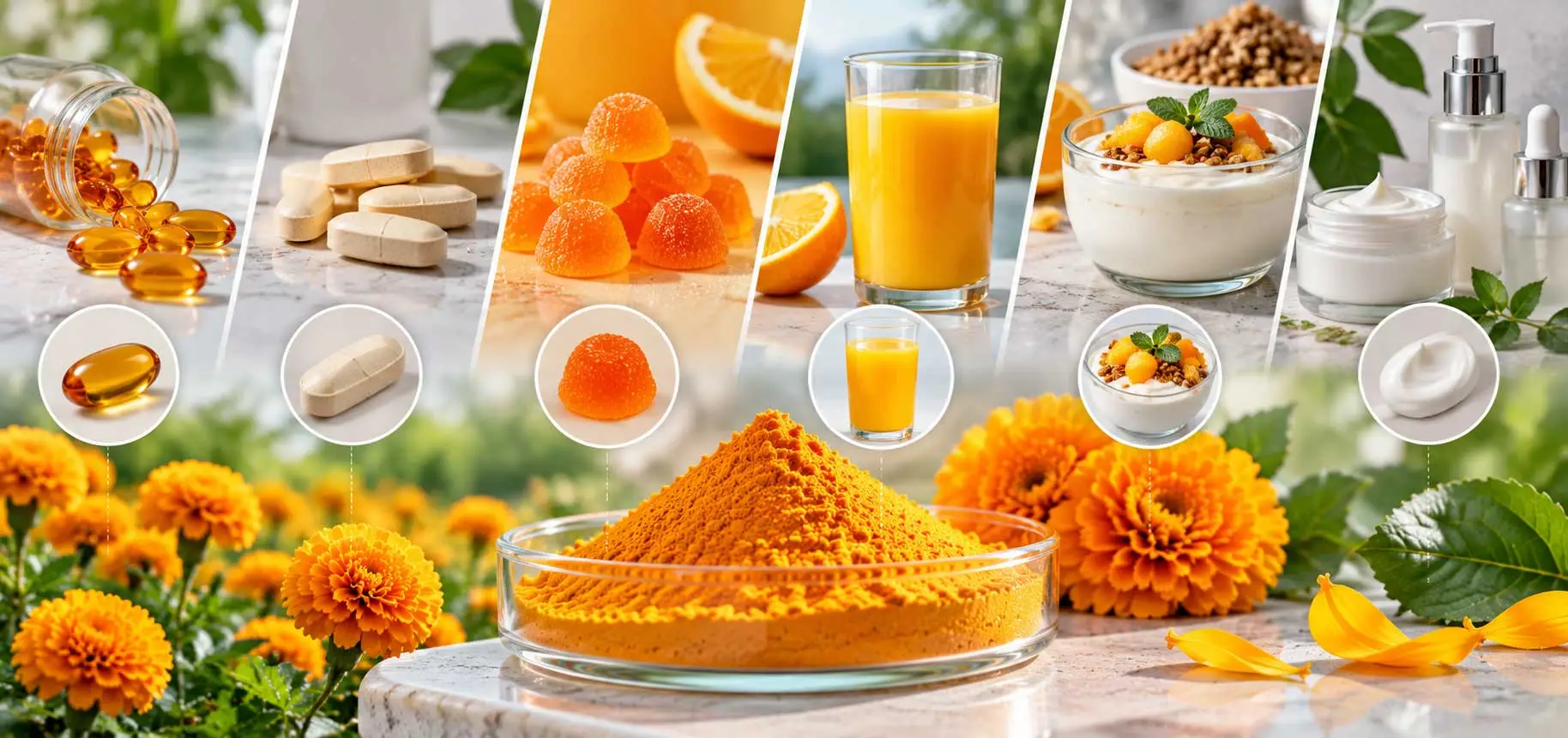
For a capsule, a concentrated dry material may be appropriate if blend uniformity can be maintained. Softgel projects usually place greater emphasis on oil compatibility. Beverage development introduces a different problem because free carotenoids are poorly compatible with aqueous systems, making the delivery technology particularly important.
The correct zeaxanthin formulation is therefore not determined by carotenoid name alone. Identity, assay and delivery system need to be considered together.
Can Meso-Zeaxanthin and Zeaxanthin Be Used in the Same Ingredient System?
Meso-zeaxanthin and zeaxanthin together can exist in the same carotenoid system, and commercial formulations may also contain lutein.
From a raw-material perspective, the important issue is how those components are declared and measured.
If a premix is designed around lutein, (3R,3′R)-zeaxanthin and meso-zeaxanthin, a purchaser should understand whether the specification controls each component individually or provides only total carotenoids or total xanthophylls.
This distinction becomes especially important when the finished-product formula requires a defined ratio. A total carotenoid value cannot demonstrate the individual contribution of each stereoisomer.
The analytical specification should therefore match the way the ingredient is described and used.
How Should Buyers Evaluate a Meso-Zeaxanthin Supplier?
A meso-zeaxanthin supplier should be able to explain the identity of the material with greater precision than simply presenting an orange carotenoid powder and a total assay.
The production route should be clear enough to establish where the target stereoisomer originates. Analytical documentation should then support the declared identity, particularly where a stereoisomer-specific specification is required. Batch-to-batch consistency, traceability and the suitability of the physical grade for the intended application complete the technical picture.
CHEN LANG BIO TECH works with carotenoid ingredient projects through controlled raw-material sourcing, analytical testing and technical documentation. For a meso-zeaxanthin project, the exact grade and analytical requirements should be established before a commercial specification is agreed rather than assuming that conventional zeaxanthin documentation is automatically sufficient.
This is particularly important for customers developing products for different international markets, where ingredient identity and documentation requirements can vary.
Why Meso-Zeaxanthin Price Should Be Compared on an Equivalent Basis
Meso-zeaxanthin price should be evaluated only after the competing materials have been shown to be technically comparable.
A generic zeaxanthin powder and a material with verified stereoisomer composition may differ in starting material, processing, purification and analytical requirements. A formulated grade also includes carrier technology that changes active loading.
Comparing these products only in USD/kg can therefore produce a misleading purchasing decision.
A meaningful commercial comparison begins with identity, assay basis and product form. Price becomes useful after technical equivalence has been established.
Meso-Zeaxanthin vs Zeaxanthin Is Primarily an Identity Question
The central distinction in meso-zeaxanthin vs zeaxanthin is stereochemistry. Conventional plant-derived zeaxanthin is predominantly the (3R,3′R) form, while meso-zeaxanthin is (3R,3′S). They share the same formula and molecular weight, so those basic values cannot distinguish them.
For ingredient buyers, the commercial consequences are clear: production route, stereoisomer composition, analytical method and specification matter more than color or a generic total-zeaxanthin result.
Frequently Asked Questions About Meso-Zeaxanthin vs Zeaxanthin
Is meso-zeaxanthin the same as zeaxanthin?
No.Meso-zeaxanthin is a stereoisomer of zeaxanthin. It is normally designated (3R,3′S)-zeaxanthin, while the common plant-derived form is (3R,3′R)-zeaxanthin. They have the same molecular formula but different stereochemical configurations.
What is the difference between meso-zeaxanthin and zeaxanthin?
The principal difference between meso-zeaxanthin and zeaxanthin is stereochemistry. Meso-zeaxanthin has the (3R,3′S) configuration, whereas dietary plant-derived zeaxanthin is predominantly (3R,3′R). This distinction is important because a generic zeaxanthin assay may not prove which stereoisomer is present.
What is the molecular formula of meso-zeaxanthin?
The meso-zeaxanthin molecular formula is C₄₀H₅₆O₂, with a molecular weight of approximately 568.9 g/mol. These values are the same as for the other zeaxanthin stereoisomers, which is why formula and molecular weight alone cannot establish stereochemical identity.
Is meso-zeaxanthin naturally occurring?
Yes. Natural meso-zeaxanthin has been identified in selected fish-derived materials. One study verified its presence in salmon skin, sardine skin, trout skin and trout flesh, although it was not detected in the fruits and vegetables examined in the same investigation.
Is meso-zeaxanthin made from lutein?
It can be. Published research demonstrates production of meso-zeaxanthin from lutein through controlled base-mediated conversion. The exact stereoisomer composition depends on process conditions, so a commercial material should still be analytically characterized rather than identified solely from its starting material.
Can HPLC distinguish meso-zeaxanthin from zeaxanthin?
Method selection matters. Conventional non-chiral chromatography may not adequately distinguish the stereoisomers. Meso-zeaxanthin HPLC analysis using an appropriate chiral stationary phase can resolve (3R,3′S)-meso-zeaxanthin from (3R,3′R)-zeaxanthin and other relevant carotenoids.
Can buyers request a sample before commercial qualification?
Before deciding to buy meso-zeaxanthin, a representative sample can support formulation evaluation and allow technical teams to review the corresponding specification and analytical documentation. Where stereoisomer composition is critical, analytical confirmation should be part of qualification rather than relying solely on powder appearance or total carotenoid content.
Meso-Zeaxanthin and Zeaxanthin Ingredient Support
CHEN LANG BIO TECH supports carotenoid projects with raw-material traceability, product specifications, batch analytical documentation and technical communication based on the required ingredient form. Our laboratory quality-control capabilities include HPLC analysis, while application samples can be discussed according to the intended formulation and specification.
For meso-zeaxanthin projects, the target stereoisomer profile and analytical requirements should be confirmed before commercial qualification. Packaging and meso-zeaxanthin MOQ can then be discussed according to the selected grade.
For specifications, samples and project quotations, contact admin@chenlangbio.com.
References
1. Nolan JM, Meagher K, Kashani S, Beatty S. What is meso-zeaxanthin, and where does it come from? Eye. 2013. Reviews meso-zeaxanthin origin, natural occurrence and its relationship with lutein and zeaxanthin.
2. Nolan JM, Beatty S, Meagher KA, Howard AN, Kelly D, Thurnham DI. Verification of Meso-Zeaxanthin in Fish. Journal of Food Processing & Technology. 2014/2015. Verified meso-zeaxanthin in selected fish tissues using chromatographic and spectroscopic evidence.
3. Prado-Cabrero A, Beatty S, Howard A, Stack J, Bettin P, Nolan JM. Assessment of lutein, zeaxanthin and meso-zeaxanthin concentrations in dietary supplements by chiral high-performance liquid chromatography. European Food Research and Technology. 2016. Demonstrates chiral HPLC-DAD differentiation of lutein and zeaxanthin stereoisomers in commercial formulations.
4. Nolan JM et al. Quantification of zeaxanthin stereoisomers and lutein in trout flesh using chiral high-performance liquid chromatography-diode array detection. Journal of Food Composition and Analysis. 2016. Describes individual analysis of (3R,3′R)-zeaxanthin, meso-zeaxanthin and related carotenoids.
5. Schlatterer J, Maurer S, Breithaupt DE. Quantification of 3R,3′R-zeaxanthin in plant derived food by a diastereomeric dilution assay applying chiral high-performance liquid chromatography. Journal of Chromatography A. 2006;1137:216–222. Reports chiral HPLC-DAD performance data including detection and quantification limits, recovery and inter-assay variation.
6. A Simple and Efficient Method for the Partial Synthesis of Pure (3R,3′S)-Astaxanthin from (3R,3′R,6′R)-Lutein and Lutein Esters via (3R,3′S)-Zeaxanthin and Theoretical Study of Their Formation Mechanisms. Molecules. 2019;24:1386. Describes preparation of meso-zeaxanthin from natural marigold-derived lutein material and evaluates base-mediated conversion conditions.
7. Maoka T et al. The first isolation of enantiomeric and meso-zeaxanthin in nature. Comparative Biochemistry and Physiology Part B. 1986;83(1):121–124. Early report separating the three optical forms of zeaxanthin and identifying meso-zeaxanthin in selected natural materials.
8. Formation of meso-zeaxanthin and changes in xanthophyll isomer composition during production of lutein concentrate from marigold oleoresin. Reports the influence of temperature, KOH level and reaction time on lutein-to-meso-zeaxanthin conversion during alkaline processing.

Send Inquiry

Related Industry Knowledge
- Coenzyme Q10 Powder vs Softgel: Which Form is Best for Your Supplement Formulations?
- What Are the Top Industrial Applications of Indole-3-methanol in 2025?
- Are There Any Side Effects or Risks Associated with Genistein?
- Is Cactus Extract Powder Safe to Consume?
- What to Plant with Bergenia?
- Can Resveratrol Powder Interact with Medications?
- Why Paeoniflorin 80% Is Trending in Natural Medicine
- Unlocking the Benefits Understanding the Uses of TUDCA
- What is Broccoli Extract Glucoraphanin Powder Good For
- What is Elderberry Extract Powder Used for