
Is Piroctone Olamine Allowed in the EU? Cosmetic Regulation and Use Limits Explained
2026-09-23 11:01:10
For cosmetic brands, formulators and raw-material buyers developing products for Europe, is Piroctone Olamine allowed in the EU is a more nuanced question than a simple yes or no. Piroctone Olamine is listed under the EU Cosmetics Regulation, but its permitted concentration depends on the product category and the regulatory context in which it is used.
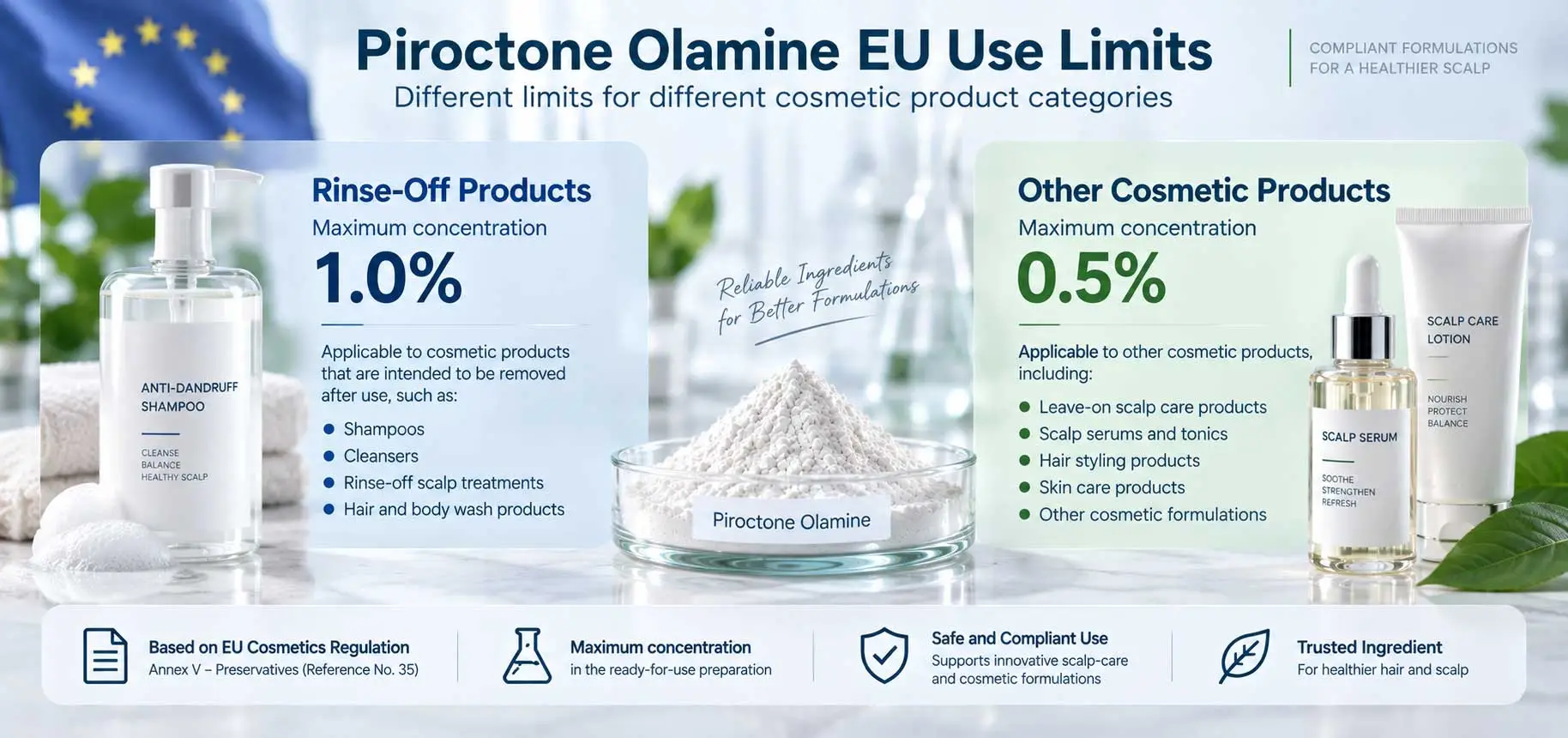
Under Regulation (EC) No 1223/2009, Piroctone Olamine appears in Annex V, the list of preservatives allowed in cosmetic products. The current entry specifies a maximum concentration of 1.0% in rinse-off products and 0.5% in other products. Buyers should also consider requirements relevant to monoalkanolamines and their salts, particularly purity, secondary amines, nitrosamines and nitrosating systems.
For procurement teams, understanding Piroctone Olamine EU regulation therefore means looking beyond a headline concentration limit. Raw-material quality, impurity control, documentation and the finished cosmetic product's regulatory assessment all matter.
What Is the Piroctone Olamine EU Use Limit?
The quick answer is that Piroctone Olamine is included in Annex V, reference No. 35, of Regulation (EC) No 1223/2009. The Annex V entry identifies Piroctone Olamine and related piroctone and specifies the following maximum concentrations in the ready-for-use preparation: 1.0% for rinse-off products and 0.5% for other products.
|
EU Regulatory Point |
Current Regulatory Entry |
|
Regulation |
Regulation (EC) No 1223/2009 |
|
Annex |
Annex V |
|
Reference number |
35 |
|
Ingredient |
Piroctone Olamine |
|
CAS number |
68890-66-4 |
|
Rinse-off products |
Maximum 1.0% |
|
Other products |
Maximum 0.5% |
For someone searching for the Piroctone Olamine EU limit, these figures provide an important starting point, but they should not be interpreted as recommended formulation dosages. A Piroctone Olamine maximum concentration in the EU is a regulatory ceiling under the relevant entry; the concentration actually selected for a shampoo or scalp-care formulation may be lower.
Where Is Piroctone Olamine Listed in the EU Cosmetics Regulation?
The principal legal framework is Regulation (EC) No 1223/2009 on cosmetic products. Piroctone Olamine Annex V reference No. 35 covers 1-hydroxy-4-methyl-6-(2,4,4-trimethylpentyl)-2-pyridone and its monoethanolamine salt and identifies CAS numbers 50650-76-5 and 68890-66-4. ECHA also identifies CAS 68890-66-4 as Piroctone Olamine and associates the substance with Annex V of the Cosmetics Regulation.
This detail matters because Annex V is specifically the list of preservatives allowed in cosmetic products. When discussing Piroctone Olamine EU cosmetic regulation, the legal context should therefore be stated rather than reducing the entry to an isolated percentage.
For regulatory and purchasing teams, using the INCI name alone is not always sufficient when reviewing documentation. The product specification, SDS and COA should consistently identify the material so that the buyer can connect the commercial raw material with the substance being assessed.
What Is the Piroctone Olamine EU Limit for Rinse-Off Products?
For the Annex V entry, the Piroctone Olamine rinse-off limit EU buyers usually encounter is 1.0% in the ready-for-use preparation. The Cosmetics Regulation defines a rinse-off product as a cosmetic product intended to be removed after application to the skin, hair or mucous membranes.
A conventional rinse-off shampoo falls naturally within that product concept. This is why searches for Piroctone Olamine shampoo limit EU or Piroctone Olamine concentration in shampoo EU commonly lead to the 1.0% figure.
The wording still needs care. It is more accurate to say that Annex V No. 35 establishes a maximum of 1.0% for rinse-off products under that regulatory entry than to say that every European anti-dandruff shampoo should contain 1% Piroctone Olamine.
The intended function, complete formulation, claims, safety assessment and other applicable provisions remain part of finished-product compliance.
What Is the Piroctone Olamine Limit for Other Cosmetic Products?
Annex V No. 35 establishes 0.5% as the maximum concentration for “other products.”
This distinction is particularly relevant when a customer asks about the Piroctone Olamine leave-on limit EU for a scalp serum, tonic or another product designed to remain on the scalp. Although “0.5%” is often described commercially as a leave-on limit, the actual Annex V wording is other products. Regulatory documentation should preserve that distinction rather than rewriting the legislation.
For a Piroctone Olamine scalp serum EU project, the development team should therefore identify the finished product correctly, establish the intended function and concentration, and review the complete formulation against the current legislation.
The same principle applies to new product formats that do not fit the conventional anti-dandruff shampoo model.
Does the 1% EU Limit Mean the Recommended Piroctone Olamine Shampoo Dosage Is 1%?
No. A regulatory maximum should not be treated as a formulation target.
This distinction is essential when discussing the Piroctone Olamine recommended dosage EU buyers may see in supplier literature.
|
Term |
What It Actually Means |
|
Regulatory maximum |
Highest concentration permitted under the relevant regulatory condition |
|
Supplier use guidance |
Technical recommendation provided for formulation development |
|
Formulation optimum |
Concentration selected after performance, stability and safety evaluation |
The appropriate Piroctone Olamine use level in shampoo depends on more than the legal ceiling. Solubilization, surfactant architecture, deposition, finished-product pH, stability and the desired product positioning can all influence the concentration selected by the formulator.
Consequently, asking how much Piroctone Olamine in shampoo should lead to two separate checks: what is legally applicable to the product, and what concentration is technically appropriate for the finished formulation.
Piroctone Olamine as a Preservative vs Anti-Dandruff Ingredient in the EU
One of the most important details in interpreting Piroctone Olamine anti-dandruff EU regulation is that Annex V is the EU Cosmetics Regulation's list of preservatives. Piroctone Olamine appears there at reference No. 35.
At the same time, Piroctone Olamine is widely known in commercial hair care as an ingredient used in anti-dandruff and scalp-care formulations. These two facts should not be collapsed into the statement that the Annex V limits automatically represent a universal anti-dandruff dosage.
EU cosmetics legislation itself recognizes that some substances listed in Annexes III to VI can be added for purposes other than the purpose covered by the Annex, provided the use complies with the other applicable requirements of the Regulation. This makes the intended function and finished-product assessment important when interpreting an ingredient entry.
For an Piroctone Olamine anti-dandruff shampoo EU project, regulatory teams should therefore review the intended function, concentration and product claims rather than relying only on a supplier's marketing statement.
This is particularly important when a raw-material quotation simply describes the material as “EU compliant.” That description does not, by itself, define how the ingredient may be used in every finished cosmetic.
Piroctone Olamine and EU Annex III: Why Monoalkanolamine Restrictions Matter
Another area that deserves attention is Piroctone Olamine Annex III considerations related to monoalkylamines, monoalkanolamines and their salts.
Annex III entry 61 establishes conditions for this substance group, including minimum purity of 99%, a maximum secondary amine content of 0.5% applicable to raw materials, a maximum nitrosamine content of 50 μg/kg, a prohibition on use with nitrosating systems, and a requirement to keep the material in nitrite-free containers. The current consolidated Regulation available through EUR-Lex retains these conditions.
These requirements explain why Piroctone Olamine EU purity requirement discussions should go beyond a single assay value.
Piroctone Olamine is the monoethanolamine salt of piroctone, so an EU-oriented regulatory review should consider the relevance of the monoalkanolamine provisions to the supplied material and intended use. This is more precise than claiming that Annex III entry 61 is a separate Piroctone Olamine-specific listing.
For buyers, the practical implication is straightforward: ask for sufficient specification and impurity information to support your regulatory review.
Why Piroctone Olamine Nitrosamine Control Matters for EU Cosmetic Buyers
Piroctone Olamine nitrosamine testing is not an obscure analytical detail when a material is being qualified for European cosmetic manufacturing.
Annex III entry 61 sets a maximum nitrosamine content of 50 μg/kg for the relevant monoalkylamine/monoalkanolamine category, while also restricting use with nitrosating systems. The same entry establishes a 0.5% maximum secondary amine content for raw materials.
For procurement teams, this means a “99% purity” statement alone is not a complete EU-oriented quality assessment.
A technically useful Piroctone Olamine impurity control package should allow the buyer's QA or regulatory team to assess relevant impurities rather than infer them from total purity. If a supplier controls nitrosamines, the test specification, result and analytical context should be reviewed as part of qualification.
This becomes especially important when comparing two materials that both claim ≥99% purity. Their impurity-control programs and supporting documentation may not be equivalent.
What Should an EU Buyer Check on a Piroctone Olamine COA?
A Piroctone Olamine COA EU buyer receives should be batch-specific and read together with the approved specification. The COA is evidence about the tested batch; the specification defines the acceptance criteria.
A practical review may include:
|
Item |
Why the Buyer Reviews It |
|
Identity / appearance |
Confirms the supplied raw material |
|
Purity |
Supports grade and regulatory assessment |
|
Assay |
Confirms batch-specific content |
|
Ethanolamine-related parameters |
Supports compositional review |
|
Nitrosamine |
Relevant impurity control |
|
Residual solvents |
Raw-material quality |
|
Loss on drying / moisture |
Batch consistency and handling |
|
Microbiology |
Quality control where specified |
Our current commercial specification for cosmetic grade Piroctone Olamine uses a purity requirement of at least 99.0%. A recent production batch, for example, returned 99.8% purity and 99.9% assay, while its nitrosamine result was below 10 ppb. Those figures are representative batch results rather than permanent guarantees for every future lot; purchasing decisions should always use the current specification and the COA issued for the actual batch.
This distinction between specification and batch result is particularly useful when evaluating an EU compliant Piroctone Olamine offer.
Does “EU Compliant Piroctone Olamine” Mean the Finished Cosmetic Is EU Compliant?
No. Raw-material qualification and finished-product compliance are related, but they are not the same thing.
Regulation (EC) No 1223/2009 requires a cosmetic product placed on the EU market to be safe under normal or reasonably foreseeable conditions of use. It also requires a Responsible Person for products placed on the market.
A raw-material supplier can support Piroctone Olamine EU compliance by providing reliable identity information, specification, COA, technical documentation, traceability and relevant impurity information. That documentation becomes input for the customer's assessment.
It cannot make the customer's shampoo compliant automatically.
The finished formula may contain dozens of ingredients, and compliance also depends on concentrations, intended use, product safety, manufacturing, claims, labelling and other obligations applicable to the finished cosmetic.
For this reason, we prefer to provide buyers with the documentation needed for their review rather than use “EU compliant” as an unsupported blanket certificate.
Piroctone Olamine CPSR, PIF and Responsible Person Requirements
European cosmetic compliance is organized around the finished product.
Regulation (EC) No 1223/2009 requires a Responsible Person for each cosmetic product placed on the EU market. Before market placement, the product must undergo a safety assessment and have a Cosmetic Product Safety Report. The Regulation also establishes Product Information File requirements. Its Annex I specifies that safety information includes the qualitative and quantitative composition, physicochemical characteristics and stability, and microbiological quality, among other information.
For a buyer preparing Piroctone Olamine PIF documentation or supporting a Piroctone Olamine CPSR, supplier documentation can therefore be commercially important.
The raw-material supplier may provide the ingredient specification, COA, SDS, TDS, identity information, storage conditions and relevant quality or impurity information. The finished-product Responsible Person and safety assessor use appropriate information within the broader regulatory process.
This distinction also prevents a common misunderstanding: a Chinese ingredient manufacturer does not replace the EU Responsible Person simply by supplying the active ingredient.
Does Piroctone Olamine Need CPNP Notification?
A raw material such as Piroctone Olamine should not be confused with the cosmetic product notification process.
The European Commission describes the Cosmetic Products Notification Portal as the system used in connection with cosmetic product notification under Article 13, with Responsible Persons and certain distributors among its users.
Therefore, a request for a Piroctone Olamine CPNP certificate should be clarified. The normal regulatory question is not whether the supplier has “registered Piroctone Olamine in CPNP” as a standalone raw material, but whether the finished cosmetic product has been handled according to the applicable EU notification requirements.
For ingredient buyers, supplier documentation is still necessary, but it serves a different function from CPNP notification.
What Documents Should a Piroctone Olamine Supplier Provide to EU Cosmetic Buyers?
When sourcing from a cosmetic grade Piroctone Olamine supplier, documentation should allow purchasing, QA, R&D and regulatory teams to evaluate the same material without relying on marketing claims.
A practical qualification package can include:
|
Document |
Procurement Purpose |
|
Current specification |
Defines the supplied grade and acceptance criteria |
|
Batch COA |
Provides actual release results |
|
TDS |
Supports formulation and handling |
|
SDS |
Supports safe handling and transport review |
|
INCI / identity information |
Supports regulatory documentation |
|
Storage and shelf-life information |
Supports inventory control |
|
Relevant impurity information |
Supports quality and regulatory assessment |
|
Regulatory statements |
Supports market-specific review where applicable |
A Piroctone Olamine TDS SDS COA package should also be internally consistent. The identity, grade and basic specification should not change from one document to another without explanation.
More documentation is not automatically better. Current, traceable and product-specific information is more useful than a large collection of generic certificates.
How to Qualify a Piroctone Olamine Supplier for the EU Market
Selecting a Piroctone Olamine supplier EU customers can use consistently requires both regulatory-document review and ordinary supplier qualification.
Begin with identity and specification, then examine representative COAs to understand batch consistency. Review relevant impurity controls and confirm that documentation corresponds to the commercial grade being quoted. Traceability, change control and the supplier's ability to communicate specification changes are particularly important once the material enters routine production.
When evaluating a Piroctone Olamine manufacturer, buyers should also consider whether samples and future production lots are supplied against the same approved specification.
For companies sourcing a Piroctone Olamine supplier China option, export documentation, packaging, lead time and responsiveness to EU regulatory-document requests can be just as important operationally as the initial laboratory sample.
Supplier qualification should ultimately answer whether the material can be repeatedly sourced with the quality and documentation the finished-product manufacturer requires.
Requesting a Piroctone Olamine Sample for EU Formulation Development
Regulatory acceptability does not prove formulation compatibility. A Piroctone Olamine sample should therefore be tested in the intended shampoo or scalp-care base before commercial approval.
Evaluate solubilization, finished pH, appearance, viscosity, crystallization and stability under the company's established development protocol. For a leave-on concept, assess the actual finished format rather than extrapolating from a shampoo test.
A cosmetic grade Piroctone Olamine sample is most useful when it represents the specification that will later be supplied commercially. This allows regulatory review and formulation testing to proceed on the same grade.
Buying Piroctone Olamine Powder for EU Cosmetic Production
Once documentation and formulation performance have been reviewed, procurement can move from qualification to commercial sourcing.
Companies planning to buy Piroctone Olamine Powder should compare quotations on an equivalent specification and documentation basis rather than treating every “99% Piroctone Olamine” offer as interchangeable.
For bulk Piroctone Olamine Powder, packaging, production lead time, shipment terms and supply continuity become increasingly important. Piroctone Olamine price should therefore be considered together with quality control and documentation rather than as an isolated number.
MOQ depends on the supplier and commercial arrangement. Buyers evaluating Piroctone Olamine MOQ for a new EU project may find it more practical to begin with a representative sample before committing to production quantities.
CHEN LANG BIO TECH can provide current specifications, batch COAs, TDS/SDS documentation, sample support and commercial quotations according to project requirements. For documentation or purchasing enquiries, contact admin@chenlangbio.com.
FAQ: Piroctone Olamine EU Regulation and Use Limits
Is Piroctone Olamine allowed in the EU?
Yes. For buyers asking is Piroctone Olamine allowed in the EU, it is listed in Annex V No. 35 of Regulation (EC) No 1223/2009, subject to the conditions and maximum concentrations established by the Regulation.
What is the maximum Piroctone Olamine concentration in EU cosmetics?
Under Annex V No. 35, the Piroctone Olamine maximum concentration EU entry specifies 1.0% for rinse-off products and 0.5% for other products in the ready-for-use preparation. These are regulatory maxima, not formulation targets.
What is the Piroctone Olamine limit in rinse-off shampoo?
The relevant Annex V entry establishes a maximum concentration of 1.0% for rinse-off products. A shampoo formulation should still be assessed for its intended function, safety, stability, claims and other applicable regulatory requirements.
What is the Piroctone Olamine limit in other cosmetic products?
Annex V No. 35 specifies 0.5% for “other products.” Buyers should retain this regulatory wording rather than automatically describing the category as leave-on products without considering the actual finished product.
Is Piroctone Olamine listed in Annex V?
Yes. Piroctone Olamine Annex V reference No. 35 includes CAS 68890-66-4 and establishes the corresponding concentration conditions for rinse-off and other products.
Does Piroctone Olamine need to meet nitrosamine limits?
EU buyers should assess the applicable monoalkanolamine provisions. Annex III No. 61 specifies a maximum nitrosamine content of 50 μg/kg, alongside minimum purity, secondary-amine and nitrosating-system conditions for monoalkylamines, monoalkanolamines and their salts.
Does Piroctone Olamine need CPNP registration?
CPNP is a cosmetic product notification system rather than a simple standalone raw-material registration certificate. The Responsible Person should address notification of the finished cosmetic product in accordance with the applicable EU requirements.
What documents should an EU buyer request from a Piroctone Olamine supplier?
A useful starting package includes the current specification, batch COA, TDS, SDS, identity information, storage and shelf-life information, relevant impurity data and appropriate regulatory statements. Additional documentation may be requested according to the finished product and safety assessment.
EU Compliance Starts With the Regulation but Does Not End With the Use Limit
The Piroctone Olamine regulatory status in Europe provides buyers with a clear starting framework, including the Annex V concentration limits. Commercial qualification, however, should not stop at the familiar 1.0% and 0.5% figures.
A stronger EU sourcing decision considers the applicable regulatory context alongside raw-material identity, purity, impurity control, batch documentation and finished-formulation validation. For manufacturers developing shampoos and scalp-care products, that combination of regulatory understanding and material-level evidence provides a more reliable basis for moving from a laboratory sample to repeat commercial production.
References
1. European Parliament and Council. Regulation (EC) No 1223/2009 of 30 November 2009 on Cosmetic Products, current consolidated text, including Annex III and Annex V.
2. European Commission. Cosmetic Products Notification Portal (CPNP). Guidance and user information for Responsible Persons and distributors.
3. European Chemicals Agency (ECHA). Substance Information: Piroctone Olamine, CAS 68890-66-4.
4. European Commission. Regulation (EC) No 1223/2009, Annex I: Cosmetic Product Safety Report Requirements.
5. CHEN LANG BIO TECH. Piroctone Olamine Current Product Specification and Representative Batch Certificate of Analysis.

Send Inquiry
You may like
Related Industry Knowledge
- Piroctone Olamine vs Salicylic Acid: What Is the Difference in Scalp-Care Formulations?
- How Laminaria Japonica Extract Is Used in Modern Skincare Formulations?
- How to Choose a Reliable Quaternium-73 Supplier
- Spermidine vs Spermidine Trihydrochloride: Stability, Purity and Manufacturing Insights
- Is Loratadine Safe for the Heart
- What is the Classification of Phytosphingosine
- Fisetin Powder Manufacturer
- Why Should Put Pure Fisetin Powder in My Diet
- Are Tribulus Terrestris Extract Powder Good for You
- What is Cnidium Monnieri Fruit Extract Used for