Piroctone Olamine vs Salicylic Acid: What Is the Difference in Scalp-Care Formulations?
2026-09-17 11:14:03
Piroctone Olamine vs Salicylic Acid is not a like-for-like comparison. Although both ingredients appear in scalp-care and anti-dandruff shampoos, they are selected for different formulation purposes. Piroctone Olamine is commonly used as a scalp-care active with activity relevant to dandruff-control systems, whereas Salicylic Acid is primarily valued for its keratolytic and exfoliating role in helping remove accumulated scale from the scalp surface.
For formulators and ingredient buyers, this distinction matters more than asking which ingredient is simply “better.” The decision involves the intended product function, finished-product pH, solubility, surfactant system, stability, regulatory requirements and the possibility of combining both ingredients. Published shampoo studies have, in fact, evaluated Piroctone Olamine and Salicylic Acid together, showing that the two can serve complementary roles rather than functioning only as alternatives.
What Is the Difference Between Piroctone Olamine and Salicylic Acid?
The quickest way to understand the difference between Piroctone Olamine and Salicylic Acid is to look at what each ingredient is expected to contribute to the finished formulation.
Piroctone Olamine is a pyridone-derived ethanolamine salt, CAS 68890-66-4, while Salicylic Acid is 2-hydroxybenzoic acid, CAS 69-72-7. Their different chemistry leads to different formulation behavior and different roles in scalp-care products. ECHA identifies Piroctone Olamine under CAS 68890-66-4 and lists it within the EU Cosmetic Products Regulation framework.
|
Formulation Factor |
Piroctone Olamine |
Salicylic Acid |
|
Main scalp-care role |
Anti-dandruff/scalp-care active |
Keratolytic and scale-management ingredient |
|
CAS No. |
68890-66-4 |
69-72-7 |
|
Chemical character |
Pyridone derivative, ethanolamine salt |
Beta-hydroxy aromatic acid |
|
Water behavior |
Limited and pH-dependent solubility |
Limited water solubility; ionization is pH-dependent |
|
Key development issue |
Solubilization, delivery and retention |
Solubilization, pH and keratolytic function |
|
Combination potential |
Can complement Salicylic Acid |
Can complement Piroctone Olamine |
Therefore, when evaluating Piroctone Olamine or Salicylic Acid for shampoo, the first question should be what the product is intended to accomplish. They should not automatically be treated as substitutes.
What Does Piroctone Olamine Do in Scalp-Care Formulations?
The role of Piroctone Olamine in scalp care goes beyond simply adding an anti-dandruff ingredient to a shampoo base. Its effectiveness depends partly on how the formulation delivers the active during a rinse-off application.
A 2023 study in the International Journal of Cosmetic Science investigated Piroctone Olamine delivery from shampoo and found that surfactant micellar properties and polymer coacervates influenced its retention on the scalp. Weaker association between Piroctone Olamine and micelles improved delivery to the scalp surface and follicular infundibula in the systems studied.
This has an important implication for Piroctone Olamine shampoo formulation: concentration alone does not describe performance. Two formulas containing the same nominal level of Piroctone Olamine may not necessarily deliver it in the same way if their surfactant and polymer architectures differ.
For formulators developing Piroctone Olamine for dandruff shampoo, the active should therefore be evaluated as part of the complete rinse-off delivery system, including solubilization, surfactant selection, deposition behavior and stability.
What Does Salicylic Acid Do in Scalp-Care Formulations?
Salicylic Acid in scalp care has a different formulation rationale. It is widely used for its keratolytic properties, making it relevant where the formulation objective includes loosening and removing accumulated scales from the scalp surface.
Chemically, Salicylic Acid is a weak acid. PubChem reports a carboxylic-acid pKa of approximately 2.98 and water solubility of about 2.24 g/L at 25°C. This means that its ionization state changes substantially as formulation pH changes, which is important when designing a Salicylic Acid shampoo formulation.
This is fundamentally different from selecting Piroctone Olamine primarily as a scalp-care active whose delivery and interaction with the shampoo system are key considerations.
The distinction also explains why a formula designed around Salicylic Acid for flaky scalp should not simply be considered an alternative version of a Piroctone Olamine formula. The product objectives may overlap, but the technical roles of the ingredients are different.
Piroctone Olamine vs Salicylic Acid: Key Differences for Formulators
When formulators compare Salicylic Acid vs Piroctone Olamine for shampoo, chemistry is only the starting point. The more useful comparison is how each ingredient changes the design requirements of the finished formula.
Piroctone Olamine development requires attention to its incorporation, surfactant environment, delivery and physical stability. Salicylic Acid development requires particular attention to pH-dependent ionization, solubilization and the concentration needed for the intended cosmetic function.
Their scalp-care roles also differ. Salicylic Acid can support scale removal, while Piroctone Olamine is used within anti-dandruff systems targeting a different aspect of scalp condition. This difference creates a rationale for using them together when the product brief calls for both functions.
Can Salicylic Acid Replace Piroctone Olamine?
Not on a function-for-function basis.
The question can Salicylic Acid replace Piroctone Olamine assumes the two ingredients are performing the same job. In many formulations, they are not. A reformulation that removes one and adds the other should therefore be treated as a change in product architecture rather than a straightforward active substitution.
The appropriate choice depends on the required scalp-care function, regulatory positioning and evidence generated with the finished product.
Piroctone Olamine vs Salicylic Acid Solubility: Why the Difference Matters
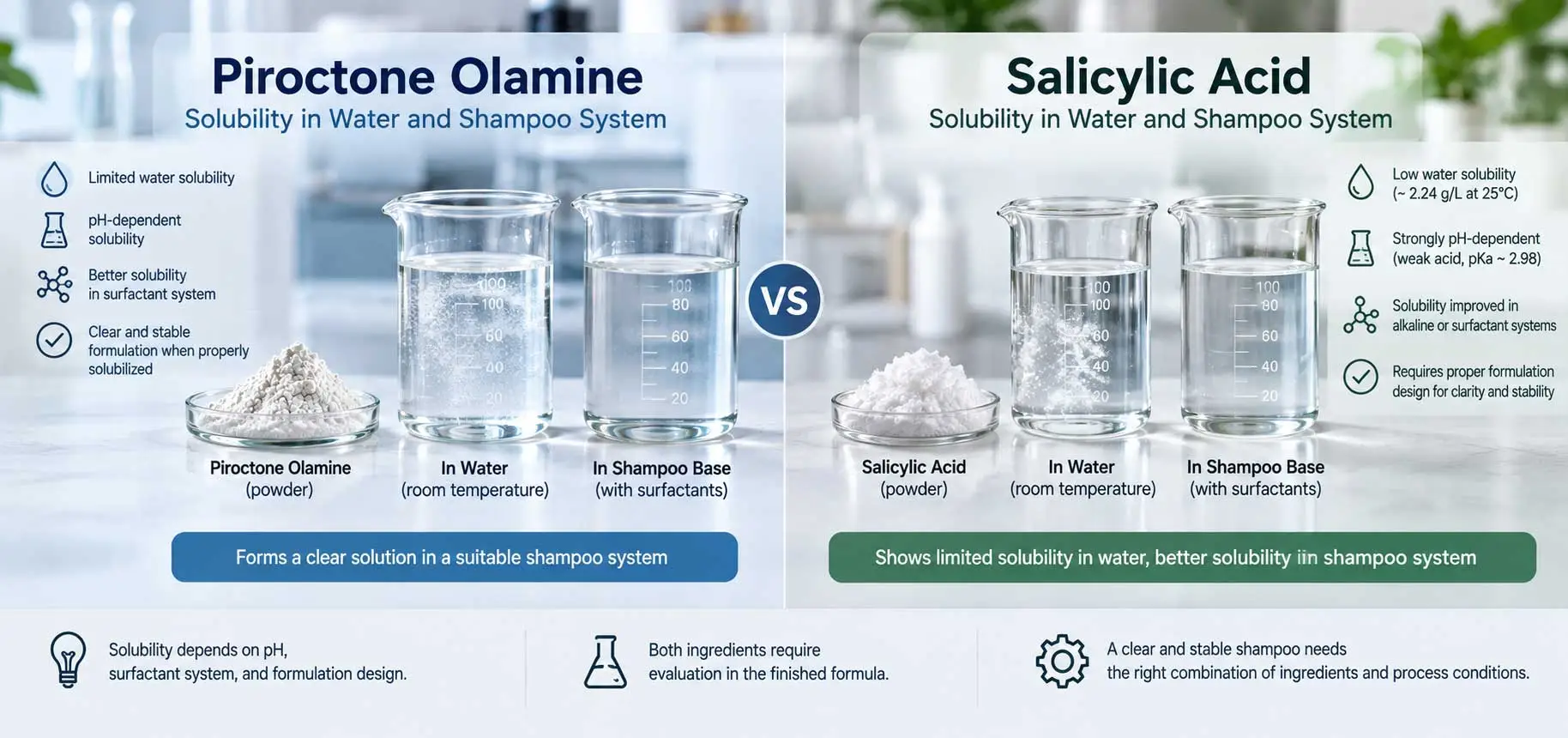
Piroctone Olamine vs Salicylic Acid solubility becomes especially important when a formulator wants a clear shampoo or serum.
Salicylic Acid has limited intrinsic water solubility; PubChem reports approximately 2.24 g/L at 25°C. Its pKa of about 2.98 also means that pH strongly influences ionization.
Piroctone Olamine also has limited aqueous solubility, and its behavior changes with pH and formulation environment. Consequently, neither ingredient should be judged solely from a single water-solubility number.
A finished shampoo is not water. It may contain anionic and amphoteric surfactants, glycols, conditioning polymers, electrolytes, fragrances, chelating agents and rheology modifiers. These components can materially change apparent solubilization and physical stability.
When investigating how to dissolve Piroctone Olamine and Salicylic Acid, formulators should therefore evaluate the intended solvent and surfactant environment rather than assuming that successful dissolution in an isolated laboratory solvent predicts finished-product stability.
A clear premix is useful, but the more meaningful observation is whether the complete formula remains clear and homogeneous after cooling and during storage.
Piroctone Olamine and Salicylic Acid pH: Can One Formula Work for Both?
The Piroctone Olamine Salicylic Acid pH question is one of the most important technical issues in a combination formula.
Because Salicylic Acid has a pKa close to 3, the proportion present in ionized and non-ionized forms changes substantially with pH. Piroctone Olamine also exhibits pH-dependent solubility behavior. The pH selected for the final shampoo therefore affects more than one ingredient.
This does not mean that there is one universal Piroctone Olamine and Salicylic Acid pH range that can be copied into every formulation.
Why pH Is a Formulation Compromise, Not a Single-Ingredient Setting
A commercial shampoo may also contain surfactants, preservatives, thickeners, conditioning polymers and other actives with their own pH requirements. The correct Piroctone Olamine Salicylic Acid formulation pH must therefore balance ingredient behavior with the stability, performance and regulatory requirements of the complete product.
A practical development approach is to prepare comparable prototypes around the intended pH target and evaluate clarity, viscosity, precipitation, crystallization and pH drift over time. This produces more useful information than attempting to optimize the formula around one ingredient in isolation.
Can Piroctone Olamine and Salicylic Acid Be Used Together?
Published evidence shows that Piroctone Olamine and Salicylic Acid have been formulated together.
One randomized, double-blind bilateral study evaluated a shampoo containing 0.75% Piroctone Olamine and 2% Salicylic Acid against a shampoo containing 1% zinc pyrithione. Nineteen subjects used the shampoos twice weekly for almost four weeks. Both shampoos reduced dandruff, while the Piroctone Olamine/Salicylic Acid formula was reported as slightly more effective in reducing severity and affected scaling area under the study conditions.
Another randomized double-blind study evaluated a non-tar shampoo containing 2% Salicylic Acid, 0.75% Piroctone Olamine and 0.5% elubiol against a coal-tar shampoo.
These studies provide a clear answer to can Piroctone Olamine and Salicylic Acid be used together: the combination is technically established in published shampoo research.
However, the concentrations used in those studies must not be interpreted as universal recommended commercial use levels. A study formula is evidence that a combination has been investigated; it is not a substitute for regulatory assessment, compatibility testing or stability validation of a new commercial product.
Piroctone Olamine and Salicylic Acid Compatibility in Shampoo
Successful Piroctone Olamine Salicylic Acid compatibility cannot be assumed merely because published products or studies contain both ingredients.
A new formula introduces its own surfactant ratios, solvents, polymers, electrolytes, fragrances and rheology modifiers. The interaction of these variables can affect solubility, clarity, viscosity and active delivery. The 2023 Piroctone Olamine delivery research is particularly relevant here because it demonstrated that changes in micellar stability and polymer coacervation can change the behavior of Piroctone Olamine in shampoo.
A Piroctone Olamine and Salicylic Acid shampoo formulation should therefore be evaluated after complete cooling, not just while the batch is warm. Development teams should monitor pH drift, viscosity, haze, sediment and crystal formation throughout stability testing.
Where active retention is critical, analytical assay can help distinguish physical precipitation from chemical loss. This becomes especially useful when troubleshooting Piroctone Olamine Salicylic Acid stability, because visual inspection alone cannot determine why an active concentration has changed.
Which Ingredient Should Formulators Choose?
The question which is better Piroctone Olamine or Salicylic Acid has no technically useful universal answer. The better ingredient is the one that performs the required function within the intended product architecture.
|
Product Development Objective |
Formulation Direction |
|
Anti-dandruff/scalp-care active system |
Consider Piroctone Olamine |
|
Keratolytic and scale-management function |
Consider Salicylic Acid |
|
Both objectives are required |
Evaluate a combination |
|
Clear shampoo is required |
Compare solubilization in the actual base |
|
Formula has a narrow pH target |
Validate both ingredients at finished pH |
|
Multi-market launch |
Review regulations market by market |
This decision matrix also shows why Piroctone Olamine or Salicylic Acid should not be decided on ingredient popularity or price alone.
The formulator should first define the intended function, then establish concentration and regulatory feasibility before building prototypes. Once the formula is technically viable, stability, packaging compatibility and pilot-scale behavior can determine whether it is suitable for commercialization.
Piroctone Olamine vs Salicylic Acid Regulations: Why Intended Function Matters
Regulatory comparison is one area where ingredient buyers should avoid generic statements such as “approved for cosmetics.”
In the EU, ECHA currently identifies Piroctone Olamine under the Cosmetic Products Regulation Annex V framework for allowed preservatives. The Annex V entry provides maximum concentrations of 1.0% in rinse-off products and 0.5% in other products when used under that regulatory function.
The Salicylic Acid EU regulation is different. Under Annex III, Salicylic Acid used for purposes other than preservation is permitted up to 3.0% in rinse-off hair products and up to 2.0% in specified other products, subject to the listed restrictions. As a preservative under Annex V, the maximum is 0.5%, expressed as acid. The regulation also contains restrictions concerning children under three, oral products and applications that may result in lung exposure.
These percentages should not be interpreted as recommended formulation concentrations or as evidence that a higher permitted concentration means greater efficacy.
For Piroctone Olamine vs Salicylic Acid regulation, the practical procurement rule is to confirm the ingredient, intended function, concentration, product category and destination market before commercial production.
Comparing Piroctone Olamine and Salicylic Acid Specifications and COAs
A Piroctone Olamine COA and a Salicylic Acid COA should be reviewed as quality documents rather than reduced to a headline purity percentage.
For Piroctone Olamine, buyers should evaluate identity, appearance, assay or purity, moisture-related parameters, relevant impurities, residual solvents where specified, microbiological criteria where applicable, and the analytical methods behind those results.
Our current Piroctone Olamine specification requires at least 99.0% purity. A recent production batch reported 99.8% purity and 99.9% assay. These are batch-specific quality results, not universal values that should be assumed for every shipment.
When qualifying cosmetic grade Piroctone Olamine, buyers should also confirm that the COA corresponds to the actual lot being offered. A generic specification defines acceptance criteria; a batch-specific COA demonstrates how a particular production lot performed against them.
The same principle applies when comparing Salicylic Acid sources. A procurement decision should be based on equivalent specifications, not simply two prices attached to “99% material.”
Sample Testing Before Choosing Piroctone Olamine or Salicylic Acid
A representative Piroctone Olamine sample is most valuable when it is tested in the customer's intended commercial base.
For a meaningful side-by-side assessment, development teams can prepare four controlled samples: the base formula, a Piroctone Olamine version, a Salicylic Acid version and, where relevant, a combination version. Keeping the underlying surfactant system as consistent as possible makes differences easier to interpret.
The cosmetic ingredient sample testing program should compare incorporation, finished pH, clarity, viscosity, color, odor, precipitation and crystallization. Promising prototypes should then enter low-temperature, ambient and accelerated stability programs appropriate to the manufacturer's internal protocols.
This approach also makes Piroctone Olamine formulation testing more commercially useful. Rather than asking whether the powder “works,” procurement and R&D can determine whether a specific qualified lot works within the formulation and manufacturing process that will actually be scaled.
Only after this stage should the project move into pilot production and commercial raw-material approval.
Choosing a Piroctone Olamine Supplier for Scalp-Care Formulations
A professional Piroctone Olamine supplier should provide more than a quotation and a product name.
Ingredient buyers should request a current specification, lot-specific COA, TDS, SDS, storage information and representative sample, together with clear traceability and commercial supply information. Technical communication becomes particularly valuable when a project involves a challenging solvent system, combination actives or a narrow finished-product pH.
When evaluating a Piroctone Olamine manufacturer, buyers should also consider batch consistency. A formulation optimized around one development sample may require unnecessary adjustment if later commercial lots show meaningful variability in relevant quality parameters.
CHEN LANG BIO TECH supplies cosmetic grade Piroctone Olamine for formulation and manufacturing projects and can support customers with technical documentation, sample evaluation and commercial supply information. This allows the customer's R&D and procurement teams to qualify the ingredient within their own formulation and quality systems.
Piroctone Olamine Price, MOQ and Bulk Purchasing Considerations
Piroctone Olamine price should be evaluated in the context of cost-in-use rather than purchasing cost alone. Raw-material quality, target concentration, solubilization requirements, processing complexity, batch consistency and the risk of reformulation can all influence the true commercial cost.
After sample and pilot qualification, buyers evaluating bulk Piroctone Olamine Powder should confirm the approved specification, packaging, lead time, logistics and Piroctone Olamine MOQ before placing an order.
Likewise, a Piroctone Olamine price per kg comparison is meaningful only when suppliers are quoting against comparable quality and documentation requirements. Customers ready to buy Piroctone Olamine Powder should therefore establish the technical specification before making the final price comparison.
Formulator's Decision Checklist: Piroctone Olamine, Salicylic Acid or Both?
Before deciding between Piroctone Olamine or Salicylic Acid, formulation and procurement teams should be able to answer a connected set of questions: What is the intended scalp-care function? Is scale removal an important part of the product brief? What finished pH is required? Can the solvent and surfactant system maintain the selected active or actives in a stable formulation?
If a Piroctone Olamine Salicylic Acid combination is being considered, the team should also confirm whether the proposed concentrations and intended functions meet the requirements of every target market. The combination prototype should be evaluated for clarity, pH drift, viscosity, precipitation, crystallization and package compatibility before scale-up.
Finally, raw-material COAs and specifications should be approved before the pilot batch, and representative samples should be linked to the commercial material being qualified.
The resulting decision is evidence-based: ingredient selection follows the product objective and finished-formulation data rather than a generic ranking of which ingredient is “better.”
FAQ: Piroctone Olamine vs Salicylic Acid
Is Piroctone Olamine the same as Salicylic Acid?
No. Piroctone Olamine vs Salicylic Acid compares two chemically different ingredients with different formulation roles. Piroctone Olamine is commonly used in anti-dandruff/scalp-care systems, while Salicylic Acid is valued for keratolytic and scale-management functions.
Which is better, Piroctone Olamine or Salicylic Acid?
The answer depends on the formulation objective. If the requirement is an anti-dandruff active system, Piroctone Olamine may be considered; if keratolytic scale management is the objective, Salicylic Acid has a different and relevant role. When both functions are needed, a combination may be evaluated rather than declaring a universal winner.
Can Piroctone Olamine and Salicylic Acid be used together?
Yes, the combination has been evaluated in published shampoo research. One clinical study used 0.75% Piroctone Olamine with 2% Salicylic Acid. These concentrations belong to that specific study and should not be interpreted as a universal commercial recommendation.
What pH should a Piroctone Olamine and Salicylic Acid shampoo have?
There is no universal Piroctone Olamine Salicylic Acid pH that is appropriate for every shampoo. Salicylic Acid ionization is strongly pH-dependent, while Piroctone Olamine also has pH-dependent formulation behavior. The target should therefore be established using the complete formula and confirmed by stability testing.
Which ingredient is easier to dissolve in shampoo?
A simple Piroctone Olamine vs Salicylic Acid solubility ranking can be misleading because a shampoo contains surfactants and other solubilizing components. Salicylic Acid has reported aqueous solubility around 2.24 g/L at 25°C, but its ionization changes with pH. Both ingredients should be tested in the intended finished system.
Does Salicylic Acid replace Piroctone Olamine in shampoo?
Not on a function-for-function basis. They serve different formulation purposes, so replacing one with the other changes the technical design and potentially the intended positioning of the product.
Should buyers test a sample before bulk purchasing?
Yes. A Piroctone Olamine sample should be evaluated in the intended formula before commercial approval, particularly when the project also contains Salicylic Acid or other functional actives. Sample testing followed by stability and pilot validation provides much more useful procurement evidence than relying on the COA alone.
Conclusion: Choose by Function, Then Validate the Finished Formula
The most useful conclusion from Piroctone Olamine vs Salicylic Acid is that the ingredients should not be treated as interchangeable competitors. Piroctone Olamine and Salicylic Acid can address different scalp-care objectives, and published research demonstrates that they have also been formulated together.
For a commercial project, selection should move logically from product objective to ingredient function, concentration, pH and solubility, followed by regulatory review, compatibility testing, stability validation and raw-material qualification.
For current Piroctone Olamine specifications, COA, TDS/SDS, samples and commercial information, contact CHEN LANG BIO TECH at admin@chenlangbio.com.
References
1. Lodén M, Wessman C. The antidandruff efficacy of a shampoo containing piroctone olamine and salicylic acid in comparison to that of a zinc pyrithione shampoo. International Journal of Cosmetic Science. DOI: 10.1046/j.1467-2494.2000.00024.x.
2. Piérard-Franchimont C, Piérard GE, Vroome V, Lin GC, Appa Y. Comparative anti-dandruff efficacy between a tar and a non-tar shampoo. Dermatology. 2000;200(2):181–184. DOI: 10.1159/000018362.
3. Johnson ES, Chang DW, Schwartz JR, et al. Enhanced piroctone olamine retention from shampoo for superior anti-dandruff efficacy. International Journal of Cosmetic Science. 2023;45(2):236–245. DOI: 10.1111/ics.12835.
4. PubChem. Salicylic Acid, CID 338. National Center for Biotechnology Information. Chemical properties including aqueous solubility and dissociation constants.
5. European Chemicals Agency (ECHA). Piroctone Olamine, CAS 68890-66-4 — Substance Information and Cosmetic Products Regulation obligations.
6. European Commission. Commission Regulation (EU) 2019/1966 amending Annexes II, III and V to Regulation (EC) No 1223/2009, including restrictions for Salicylic Acid in cosmetics.

Send Inquiry
Related Industry Knowledge
- Is Pine Bark Extract Water Soluble? Supplier Insights and Formulation Tips
- What is the Use of Myricetin?
- How Does Vitamin D3 Powder Support Bone Health and Calcium Absorption?
- What are the Skin Care Benefits of Hydroxypropyl Tetrahydropyrantriol?
- Is Kopexil Effective for Treating Male and Female Pattern Baldness?
- Is Dimethylmethoxy Chromanol Safe
- How Does Nitenpyram Work
- What not to Mix with Sodium Ascorbyl Phosphate
- Lutein Extract Powder and zeaxanthin: Eye and vision benefits
- What Are the Benefits of Chaga Mushroom Extract Powder