
Can Quaternium-73 Be Used in Facial Cleansers and Acne Serums? A Formulation Guide
2026-08-31 14:48:01
Quaternium-73 in facial cleansers and Quaternium-73 in acne serums is technically feasible, but the same incorporation strategy should not be transferred blindly from one product format to the other. Facial cleansers are predominantly surfactant-based, rinse-off systems, so compatibility with surfactants, thickeners, electrolytes and the final pH becomes important. Serums are leave-on systems in which clarity, compatibility with other actives, long-term precipitation, color stability and packaging can become more critical.
Commercial technical documentation for Quaternium-73 (CAS 15763-48-1) specifically lists facial cleansers and other cleansing products among its applications and also supports leave-on skin-care use. One detailed product data sheet recommends 0.001–0.005%, a formulation pH of 5.5–8.0, and pre-dissolution in butylene glycol, propylene glycol or 1,2-pentanediol because the material is only slightly soluble in water. It also identifies limited photostability as a formulation consideration.
For formulators, therefore, the question is not simply whether Quaternium-73 can be added to a cleanser or serum. The more useful question is how to formulate Quaternium-73 so that the exact commercial grade remains uniformly incorporated and stable within the complete product.
Quaternium-73 in Facial Cleansers vs Acne Serums: Key Formulation Differences
The main difference between a Quaternium-73 facial cleanser formulation and a Quaternium-73 serum formulation is the environment surrounding the ingredient. The raw material may be identical, but a surfactant-rich rinse-off cleanser and a polymer-thickened leave-on serum present very different compatibility challenges.
|
Formulation factor |
Facial cleanser |
Serum |
|
Product format |
Rinse-off |
Leave-on |
|
Main system |
Surfactant-based |
Aqueous, glycol or emulsion |
|
Q73 incorporation |
Premix recommended |
Premix recommended |
|
Key compatibility issue |
Surfactants, polymers, electrolytes |
Actives, polymers, humectants |
|
Appearance |
Clear, pearlescent or opaque |
Often clear/translucent |
|
Physical stability concern |
Viscosity, haze, precipitation |
Haze, precipitation, color |
|
pH |
Surfactant-system dependent |
Active-system dependent |
|
Skin contact |
Short |
Prolonged |
|
Light/package concern |
Relevant |
Particularly relevant |
The distinction is important when moving from laboratory concept to commercial production. A cleanser that is intentionally pearlescent may tolerate a minor optical change that would be unacceptable in a transparent serum. Likewise, an electrolyte that is useful for building cleanser viscosity can influence the behavior of ionic ingredients and polymers.
This is why Quaternium-73 in rinse-off and leave-on products should be evaluated as two separate formulation cases rather than one generic application.
Why Is Quaternium-73 Used in Formulations for Acne-Prone Skin?
Quaternium-73 for acne-prone skin is primarily of interest because of its antimicrobial-related activity. Recent scientific literature discussing acne-related cosmetic strategies identifies Quaternium-73 among quaternary compounds used to suppress Cutibacterium acnes. A 2025 experimental paper also used Quaternium-73 as a positive antimicrobial control at 1 mg/mL in a C. acnes inhibition experiment.
Commercial technical data go further, reporting very low minimum inhibitory concentrations against acne-associated microorganisms, although such supplier-generated efficacy data should be distinguished from independent clinical evidence.
This distinction matters when describing Quaternium-73 antimicrobial activity on a cosmetic website. Demonstrating antimicrobial activity against an organism associated with blemish-prone skin is not equivalent to demonstrating that a cosmetic product treats acne as a disease.
For cosmetic development, a more defensible positioning is to evaluate the ingredient in products designed for oily, blemish-prone or acne-prone skin while keeping finished-product claims consistent with the regulations of the destination market.
What Is the Recommended Quaternium-73 Use Level in Facial Cleansers and Serums?
One of the unusual features of Quaternium-73 is how little raw material is required. A detailed commercial PDS gives a Quaternium-73 recommended use level of 0.001–0.005%. Other commercial documentation specifies a wider suggested range extending to 0.05%, which demonstrates why formulators should follow the TDS for the exact grade they are qualifying rather than treating internet dosage figures as universal limits.
The 0.001–0.005% range translates into surprisingly small quantities:
|
Batch size |
0.001% |
0.003% |
0.005% |
|
10 kg |
0.1 g |
0.3 g |
0.5 g |
|
100 kg |
1 g |
3 g |
5 g |
|
500 kg |
5 g |
15 g |
25 g |
For a 100 kg commercial batch at 0.003%, for example, only 3 g of Quaternium-73 is required.
This is an important manufacturing consideration. The practical challenge with Quaternium-73 dosage in facial cleanser or Quaternium-73 dosage in serum is not simply deciding whether to use 0.002% or 0.003%; it is ensuring that a few grams can be accurately weighed, quantitatively transferred and distributed throughout a large batch.
A suitably diluted premix can therefore improve both incorporation and dosing control.
How to Dissolve Quaternium-73 Before Adding It to a Cleanser or Serum
Quaternium-73 solubility is one of the most important processing considerations. The M.C. Biotec technical sheet estimates water solubility at only 0.6068 mg/L at 25°C and identifies butylene glycol, propylene glycol, ethanol and 1,2-pentanediol as suitable solvents. It specifically recommends pre-dissolving Quaternium-73 in butylene glycol, propylene glycol or 1,2-pentanediol before incorporation.
A sensible Quaternium-73 premix workflow is therefore:
accurate weighing → premixing in a validated solvent → complete incorporation → quantitative transfer to the main batch → adequate mixing → final pH verification
This should not be interpreted as a universal manufacturing recipe. The solvent ratio, temperature and order of addition need to be validated for the exact formula and commercial grade.
The value of a premix goes beyond the question of how to dissolve Quaternium-73. Imagine trying to distribute 1–3 g of crystalline material directly through 100 kg of bulk product. Even if the material eventually dissolves, incomplete transfer from the weighing container or localized incorporation can introduce avoidable variability. A premix gives the production team a larger, more manageable intermediate mass to transfer and disperse.
How to Use Quaternium-73 in Facial Cleanser Formulations
A Quaternium-73 facial cleanser formulation should be developed around the complete cleansing system rather than by adding the active to an already established formula and assuming nothing else will change.
A typical development sequence begins with the aqueous phase and humectant system, followed by the surfactant architecture and rheology system. Quaternium-73 can then be incorporated through a previously validated premix at a point where sufficient mixing is available without compromising the other ingredients. Final pH and viscosity are evaluated after the system is complete.
The important variables are not identical for every cleanser. A mild amino-acid cleanser, a betaine/glucoside system and a traditional anionic surfactant system can behave differently.
After incorporation, the laboratory should examine whether the product develops haze or precipitate, whether viscosity shifts, whether foam characteristics change materially and whether the product remains stable during temperature cycling.
Commercial Quaternium-73 documentation explicitly lists cleaning products, including facial cleansers and shampoos, among the intended applications. That establishes that Quaternium-73 in cleansing formulations is a recognized commercial application, but it does not establish compatibility with every surfactant combination.
Quaternium-73 Surfactant Compatibility in Facial Cleansers
Quaternium-73 surfactant compatibility deserves more attention than it usually receives in ingredient marketing literature.
Quaternium-73 is an ionic thiazolium compound. This makes it inappropriate to assume that it will behave identically in anionic, amphoteric and nonionic surfactant environments. General formulation chemistry also tells us that cationic/quaternary materials can interact unfavorably with some anionic surfactants. One ingredient database, for example, flags precipitation risk between Quaternium-73 and sodium lauryl sulfate, although this is not a substitute for a controlled compatibility study on the finished formula.
For Quaternium-73 with surfactants, the more defensible approach is therefore empirical evaluation of the complete system.
A cleanser development program should monitor appearance, precipitation, viscosity and foam performance immediately after manufacture and during stability testing. This becomes particularly important when the formula contains anionic surfactants, charged rheology modifiers or substantial electrolyte concentrations.
Publicly available technical literature does not justify the broad statement that Quaternium-73 is “compatible with all surfactants.” Procurement teams should be cautious when a supplier makes such an absolute claim without formula-specific data.
How to Use Quaternium-73 in Acne-Prone Skin Serum Formulations
A Quaternium-73 serum formulation presents different challenges because the finished product remains on the skin and is often expected to be visually clear or translucent.
In a simple aqueous serum, poor direct water solubility makes premixing particularly relevant. The formulator also needs to evaluate whether Quaternium-73 remains incorporated after the polymer network is built and after the final pH is established.
A glycol-rich serum may provide a more favorable environment for premixing because commercial technical documentation reports solubility in several commonly used glycols. This does not eliminate the need for stability testing; the behavior of the isolated ingredient in a solvent does not prove stability in the complete serum.
Emulsion serums add another layer of complexity because emulsifiers, polymers, electrolytes and other active ingredients may all influence the system.
For Quaternium-73 in blemish-prone skin serum, formulators should monitor clarity, sediment or crystallization, viscosity, pH and color over time. Light exposure deserves particular attention. The referenced PDS describes Quaternium-73 as photounstable and recommends opaque packaging for products containing it.
A transparent glass bottle may therefore look attractive on a concept board but should not be selected before package/light stability has been evaluated.
Quaternium-73 Compatibility With Niacinamide, Zinc PCA, Hyaluronic Acid and Salicylic Acid
Modern blemish-prone serums rarely contain one active, which makes Quaternium-73 compatibility with skincare ingredients commercially important.
|
Ingredient |
Why formulators use it |
Main issue to evaluate with Q73 |
|
Niacinamide |
Multifunctional skin-care active |
Final pH and long-term stability |
|
Zinc PCA |
Oily-skin formulations |
Ionic/electrolyte effects |
|
Hyaluronic acid |
Humectancy and rheology |
Polymer behavior and clarity |
|
Salicylic acid |
Exfoliating formulation strategy |
pH and solubilization |
|
Panthenol |
Humectant/conditioning |
Complete-formula stability |
There is an important evidence limitation here: publicly available technical data do not establish universal compatibility between Quaternium-73 and each of these materials. Finding both ingredients in the same commercial INCI list can be useful evidence of practical feasibility, but it does not reveal concentration, processing method or stability data.
For Quaternium-73 compatibility with niacinamide, for example, the sensible starting point is whether the finished formulation can remain within the validated pH and stability requirements of both materials. With Quaternium-73 with zinc PCA, ionic strength and polymer behavior deserve additional attention.
Quaternium-73 with salicylic acid is more challenging because the acid's solubility and preferred formulation conditions can narrow the shared formulation window. Co-use should therefore be validated rather than inferred from the marketing roles of the two ingredients.
What pH Is Suitable for Quaternium-73 Facial Cleansers and Serums?
For the commercial grade documented by M.C. Biotec, the specified Quaternium-73 pH range is 5.5–8.0. ZLEY technical documentation likewise describes stability within pH 5.5–8.0.
That does not mean every Quaternium-73 formulation pH should automatically be set to 5.5.
In a facial cleanser, the final pH also needs to account for the surfactant system, rheology, preservative system and intended product characteristics. In a serum, acids, niacinamide, ionic actives and pH-sensitive polymers may further constrain the available window.
A more useful formulation principle is:
The correct pH is the range in which Quaternium-73 and the complete formulation remain physically and chemically stable.
This distinction becomes particularly important when developing multi-active products. If another key active requires conditions outside the technical guidance for the Quaternium-73 grade, the correct response is not to ignore one supplier's TDS. The formulation architecture needs to be reconsidered or experimentally validated.
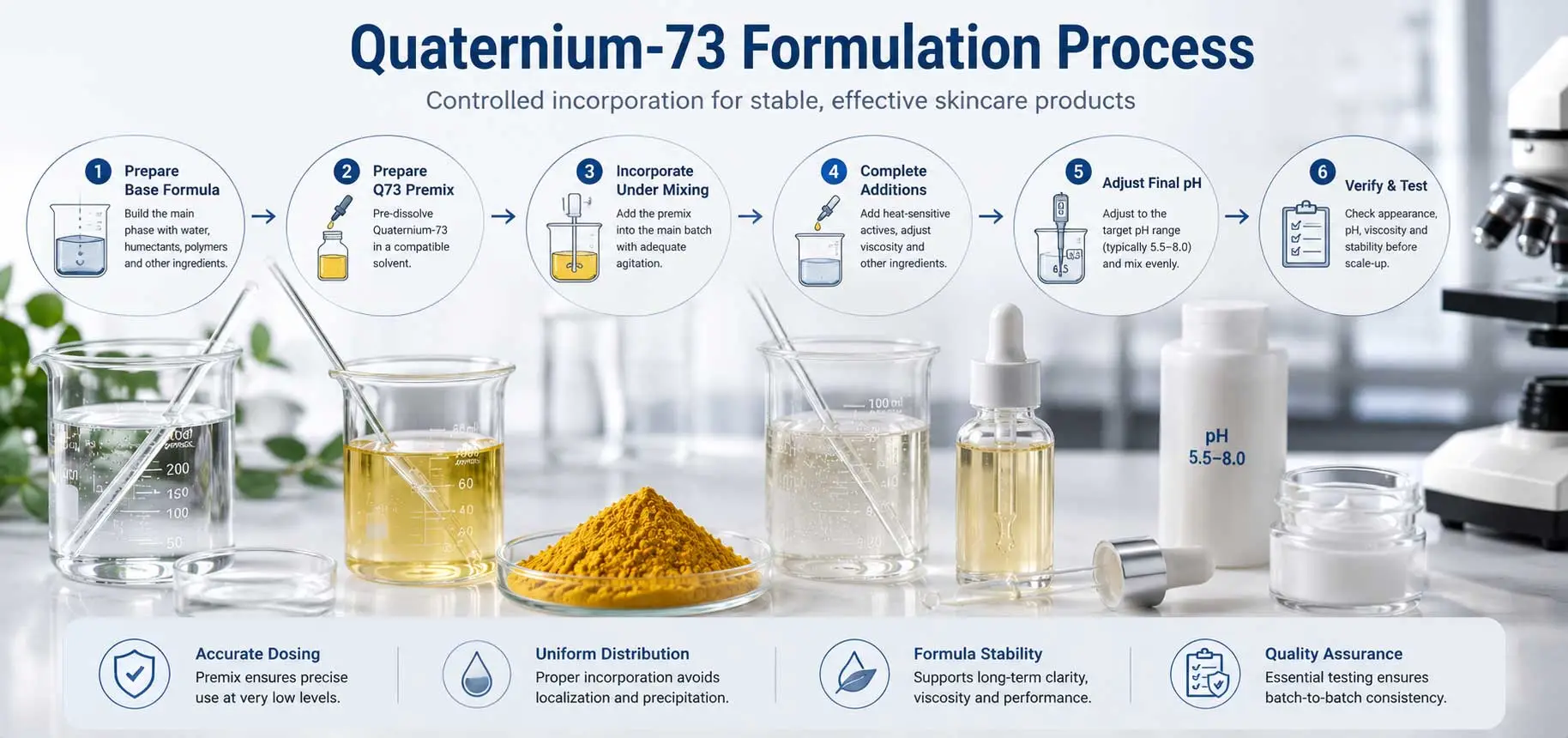
When Should Quaternium-73 Be Added During Manufacturing?
There is no evidence-based universal statement that Quaternium-73 must always be added at one particular manufacturing temperature or at one fixed phase.
Commercial guidance does, however, provide useful boundaries. The referenced PDS reports thermal stability up to approximately 90°C and recommends pre-dissolution in suitable glycols before addition.
For how to add Quaternium-73 to cosmetics, a controlled manufacturing sequence is preferable:
prepare the base system → prepare Quaternium-73 premix separately → incorporate under adequate mixing → complete remaining additions → adjust final pH → evaluate appearance, color and viscosity
The fact that a raw material can tolerate elevated temperature does not mean it needs to be exposed to the highest process temperature. The actual Quaternium-73 formulation process should minimize unnecessary thermal and light exposure while remaining compatible with the rest of the formula.
Does Quaternium-73 Replace the Preservative System?
Is Quaternium-73 a preservative? Commercial documentation sometimes describes preservative or preservative-synergist functionality, but formulators should not automatically interpret this as permission to remove a validated broad-spectrum preservation system.
Targeted antimicrobial functionality and preservation of a finished cosmetic are different formulation objectives.
A water-based cleanser or serum may be exposed to bacteria, yeast and mold during manufacturing and consumer use. Preservation performance depends on the complete formula, including pH, water activity, packaging, manufacturing hygiene and interactions between the preservative system and other ingredients.
Therefore, Quaternium-73 should not automatically replace phenoxyethanol or another established preservation strategy merely because supplier literature reports antimicrobial activity.
Where a developer intends to rely on Quaternium-73 as part of the preservation system, appropriate finished-product microbiological testing—including challenge testing where required—becomes essential.
What Stability Tests Should Be Run on Quaternium-73 Cleansers and Serums?
A commercially meaningful Quaternium-73 stability testing program should evaluate more than whether a fresh laboratory sample looks acceptable.
For both cleansers and serums, record initial appearance, color, odor, pH and viscosity. Monitor these parameters under the company's validated accelerated, ambient and low-temperature conditions, with temperature cycling where appropriate. Clear serums deserve particularly close observation for haze, delayed precipitation or crystallization.
For cleansers, monitor viscosity and phase behavior because surfactant/electrolyte systems can change significantly during storage.
Light exposure deserves its own evaluation. Commercial documentation specifically identifies poor photostability, so Quaternium-73 serum stability should ideally be evaluated in the proposed package rather than only in laboratory glassware.
Where analytical capability is available, HPLC assay at selected stability intervals provides stronger evidence of chemical stability than appearance alone.
Microbiological evaluation should be treated separately from active assay. A formula can remain visually and chemically stable while still having inadequate preservation.
Facial Cleanser or Serum: Which Format Is Better for Quaternium-73?
There is no universal winner in a Quaternium-73 facial cleanser vs serum comparison.
A cleanser makes sense when the product concept centers on cleansing, sebum removal and a rinse-off antimicrobial-functional strategy. The major technical questions are surfactant compatibility, viscosity, pH and rinse-off product performance.
A serum is more appropriate when Quaternium-73 needs to sit within a leave-on, multi-active skincare concept. It also places greater emphasis on clarity, active compatibility, long-term color and precipitation stability, and packaging.
Commercial sources recognize both rinse-off and leave-on applications for Quaternium-73.
The best formulation for Quaternium-73 is therefore not determined simply by longer skin-contact time. Product architecture, intended cosmetic claims, the other ingredients in the formula and the regulatory framework of the destination market should drive format selection.
What Should Buyers Check When Sourcing Cosmetic Grade Quaternium-73?
When qualifying a Quaternium-73 supplier, procurement teams should look beyond a website purity statement.
For cosmetic grade Quaternium-73, request the current specification and a representative batch COA showing identity-related information, appearance, assay method and relevant quality parameters. Commercial specifications commonly describe yellowish-to-yellow crystalline powder and HPLC purity of at least 98%.
The TDS should also be reviewed for:
•recommended use level;
•solvent and premixing guidance;
•validated pH range;
•thermal and light stability;
•storage conditions and shelf life.
SDS documentation and a representative Quaternium-73 sample should be obtained before commercial approval.
For formulation projects, CHEN LANG BIO TECH can provide current specifications, batch documentation and representative material for laboratory evaluation. The purpose of the sample stage is not simply to confirm color or appearance; R&D should test the actual material in the intended cleanser or serum base before procurement moves to commercial scale.
That process—documentation review, sample evaluation, stability work and then supplier approval—is more reliable than choosing a Quaternium-73 raw material solely on quoted purity.
Quaternium-73 Sample, MOQ and Cost-in-Use for Formulation Development
Because the ingredient is used at very low concentrations, Quaternium-73 price per kg can give buyers a distorted impression of actual formulation economics.
At 0.003%, a 100 kg finished batch requires only 3 g of raw material. Even a substantial difference in Quaternium-73 price between suppliers may therefore have a relatively small effect on the cost of the finished formula.
Procurement should instead consider cost per finished batch alongside assay consistency, documentation, technical support and formulation performance.
During R&D, a Quaternium-73 sample can be sufficient for numerous bench trials because each prototype consumes very little material. When requesting a commercial quotation or Quaternium-73 MOQ, buyers should tell the supplier the expected annual usage and intended product type. This helps avoid purchasing quantities that are disproportionate to the actual dosage and shelf-life requirements.
FAQ: Quaternium-73 in Facial Cleansers and Acne Serums
Can Quaternium-73 be used in facial cleansers?
Yes. Commercial technical documentation specifically lists facial cleansers among its applications. For Quaternium-73 in facial cleansers, formulators should still validate surfactant compatibility, premixing, final pH, viscosity and stability in the complete cleansing system.
Can Quaternium-73 be used in acne serums?
It can be evaluated in leave-on serums intended for acne-prone or blemish-prone skin. Quaternium-73 in acne serums requires particular attention to premixing, active compatibility, clarity, pH, photostability and finished-product claims.
What is the recommended Quaternium-73 dosage in a facial cleanser?
One commercial PDS recommends 0.001–0.005%, while another supplier gives a wider range up to 0.05%. The exact Quaternium-73 dosage in facial cleanser should therefore follow the documentation for the grade being purchased and be validated in the finished formula.
How should Quaternium-73 be dissolved?
Because it is only slightly soluble in water, technical documentation recommends pre-dissolution in solvents such as butylene glycol, propylene glycol or 1,2-pentanediol. The premix also facilitates accurate transfer and homogeneous distribution at very low dosage.
What pH is suitable for Quaternium-73?
The referenced commercial technical sheets specify approximately pH 5.5–8.0. The final pH must nevertheless be compatible with the complete cleanser or serum rather than Quaternium-73 alone.
Can Quaternium-73 be formulated with salicylic acid or niacinamide?
Potential co-use can be evaluated, but public technical evidence does not establish universal compatibility. Quaternium-73 compatibility with niacinamide or salicylic acid should be confirmed in the actual formula, with particular attention to pH, solubility, precipitation and long-term stability.
Does Quaternium-73 replace phenoxyethanol?
Not automatically. Antimicrobial activity does not by itself demonstrate adequate broad-spectrum preservation of a finished cosmetic. Any proposed Quaternium-73 preservative system should be supported by appropriate microbiological testing.
Formulate Quaternium-73 According to the Product Format, Not a Generic Recipe
Quaternium-73 can be used in facial cleansers and evaluated in serums for acne-prone or blemish-prone skin, but the development strategy should follow the product format. In a cleanser, surfactant compatibility, viscosity and rinse-off architecture deserve particular attention. In a serum, clarity, active compatibility, photostability and long-term physical stability become more important.
For both formats, the most defensible development path is to work from the technical documentation for the actual commercial grade, prepare a controlled premix, keep the finished formulation within a validated pH window and confirm performance through stability testing rather than relying on a generic internet recipe.
Formulators and raw-material buyers evaluating cosmetic grade Quaternium-73 can contact CHEN LANG BIO TECH for current specifications, COA, TDS and representative sample information at admin@chenlangbio.com.
References
1. M.C. Biotec Inc. Quaternium-73 Product Data Sheet. Provides commercial formulation guidance including 0.001–0.005% recommended use, pH 5.5–8.0, estimated water solubility of 0.6068 mg/L at 25°C, glycol/ethanol solubility, thermal stability up to 90°C, premixing instructions, photostability considerations and facial-cleanser applications.
2. ZLEY. ZLEY Quaternium-73 Technical Data Sheet. Lists CAS 15763-48-1, HPLC purity ≥98%, yellowish-to-yellow crystalline appearance, suggested use of 0.001–0.05%, pH stability guidance and pre-dissolution recommendations. The broader dosage range compared with other commercial PDS documents demonstrates the importance of grade-specific technical documentation.
3. Knowde / M.C. Biotec. Quaternium-73 Technical Product Information. Identifies both leave-on and rinse-off applications, including skin cleansers, and reproduces formulation guidance on dosage, pH, solubility, premixing and photostability.
4. Feng et al. Truncal Acne: Pathophysiology, Clinical Features, and Management Strategies. Journal of Cosmetic Dermatology, 2026. The review identifies quaternary ammonium compounds including Quaternium-73 among cosmetic ingredients used in antimicrobial strategies targeting C. acnes.
5. Validation of Madecassoside Synergy Significantly Enhanced Cryptotanshinone's Therapeutic Efficacy Against Acne Vulgaris. Bioengineering, 2025;12(9):935. Quaternium-73 was used as a positive control at 1.0 mg/mL in a C. acnes inhibition-zone experiment, providing recent peer-reviewed evidence of its use as an antimicrobial reference material.
6. Genie Ingredient Database. Quaternium-73 Ingredient Compatibility. Flags potential precipitation involving Quaternium-73/cationic quat chemistry and sodium lauryl sulfate. This is useful as a formulation-screening signal but should not replace direct compatibility and stability testing of the finished cleanser.

Send Inquiry
Related Industry Knowledge
- High Purity Sialic Acid Benefits for Skin Hydration and Radiance
- Best Nootropic Ingredients for Focus Supplement Formulation (Including L-Theanine) – Bulk Supplier & OEM Manufacturer Guide China 2026
- How to Verify a DHEA Powder COA Before Bulk Purchase?
- Does Chondroitin Sulfate Powder Interact with Other Medications?
- What is Chondroitin Sulfate Powder Used for?
- Is Cactus Extract Powder Safe to Consume?
- Where to Buy the Best Pure Fisetin
- Unlocking the Benefits: Understanding the Uses of Indole-3-Carbinol
- What is Yohimbine Hydrochloride Used for
- Is Kava kavalactone Powder Good for Anxiety