
Quaternium-73 and Cutibacterium acnes: What Does the Research Show?
2026-08-24 21:57:34
Quaternium-73 and Cutibacterium acnes have an unusually specific relationship in cosmetic ingredient research. Quaternium-73, also known commercially as Pionin and identified by CAS 15763-48-1, has been investigated for antimicrobial activity against Cutibacterium acnes, the organism formerly known as Propionibacterium acnes. Recent literature continues to identify Quaternium-73 among quaternary ammonium compounds used in cosmetic approaches intended to suppress C. acnes, while older technical data report minimum inhibitory concentrations against several P. acnes strains.
The evidence needs careful interpretation. An MIC result demonstrates inhibition under defined laboratory conditions; it does not by itself establish bactericidal activity, clinical treatment of acne, or efficacy of a finished cosmetic product. This distinction matters to formulators, regulatory teams and buyers evaluating quaternium-73 antimicrobial activity because supplier claims can otherwise appear stronger than the underlying evidence.
For raw-material sourcing, the useful question is therefore not simply whether Quaternium-73 is “antibacterial.” Buyers should examine which organism and strain were tested, the endpoint and methodology used, whether the tested material corresponds to the commercial grade, and whether a supplier can support its material with consistent identity, purity and batch documentation.
What Is Cutibacterium acnes and Why Is It Relevant to Quaternium-73 Research?
C. acnes is a Gram-positive bacterium and a normal component of human skin microbiota. It is particularly associated with sebaceous areas and follicles, but its presence alone should not be interpreted as disease. Modern acne research recognizes a considerably more complex relationship involving microbial strain diversity, sebaceous activity, follicular keratinization, host inflammatory responses and the broader skin microenvironment.
That distinction is relevant when evaluating Quaternium-73 for acne-prone skin. A cosmetic ingredient does not need to—and generally should not be described as attempting to sterilize the skin. Rather, C. acnes is one of the microorganisms against which antimicrobial activity can be characterized under controlled experimental conditions.
A 2026 review in the Journal of Cosmetic Dermatology, for example, discusses antimicrobial approaches to acne-oriented skincare and specifically identifies quaternary ammonium compounds such as Quaternium-73 among agents that suppress C. acnes. The same review also emphasizes that acne-related skin conditions cannot be reduced to one microorganism alone.
For ingredient buyers, this makes organism-specific data much more informative than broad statements such as “strong antibacterial ingredient.”
Cutibacterium acnes vs Propionibacterium acnes: Why Do Quaternium-73 Studies Use Both Names?
Anyone researching Quaternium-73 and Cutibacterium acnes will quickly encounter a terminology problem: much of the older technical literature uses Propionibacterium acnes or P. acnes.
They refer to the organism now classified as Cutibacterium acnes. Following genomic and biochemical research, the cutaneous species formerly grouped under Propionibacterium were reorganized, and P. acnes was transferred to the newly established genus Cutibacterium. The newer name reflects genomic differences between these skin-associated organisms and other Propionibacterium species.
This matters for procurement research because searches limited to Quaternium-73 C. acnes may miss older material indexed under Quaternium-73 Propionibacterium acnes, Pionin Propionibacterium acnes, or simply “P. acnes.”
In this article, C. acnes is used for current scientific discussion. Where older experiments are being described, the name reported by the original source is retained when necessary to make the data traceable.
What Research Evidence Is Available for Quaternium-73 Against C. acnes?
The evidence base for Quaternium-73 research is smaller than that for established pharmaceutical acne treatments, and this needs to be acknowledged. However, several different types of evidence are relevant.
The first is in-vitro antimicrobial testing. Older Pionin technical documentation reports MIC measurements against multiple P. acnes strains using serial dilution testing. These results provide direct evidence of microbial growth inhibition under the specified experimental conditions.
A second level is finished-product research. A 2002 Japanese study evaluated a four-product skincare regimen containing Pionin together with other ingredients in 22 people with acne vulgaris. Twenty-one participants completed the two-week use period without reported adverse effects; one participant developed itchy erythematous papules after three days of using the washing powder, which resolved after discontinuation. Importantly, this was a multi-product, multi-ingredient skincare evaluation—not evidence that isolated Quaternium-73 produced a specific clinical outcome.
More recently, a 2025 study published in Microsystems & Nanoengineering investigated a dissolved bubble microneedle system co-delivering Pionin, dipotassium glycyrrhizinate and salicylic acid. The antibacterial experiments used P. acnes ATCC 6919 cultured anaerobically, with bacterial viability assessed after treatment. Again, this is valuable formulation research, but the delivery system contained multiple components, so its findings cannot be assigned to Quaternium-73 alone.
A 2026 review provides additional contemporary context by explicitly listing Quaternium-73 among compounds used to suppress C. acnes in acne-oriented skincare.
Quaternium-73 Research Evidence at a Glance
For formulators and purchasing teams, it is useful to separate what different studies can actually establish.
|
Evidence type |
Test subject |
What it can indicate |
What it cannot establish alone |
|
MIC testing |
P./C. acnes strains |
In-vitro growth inhibition |
Finished cosmetic efficacy |
|
Antimicrobial assay |
Microbial culture |
Activity under defined conditions |
Acne treatment in humans |
|
Mechanistic testing |
Bacterial cells |
Possible mode of antimicrobial action |
Consumer outcome |
|
Finished-product research |
Multi-ingredient formulation |
Performance of the tested system |
Effect attributable solely to Quaternium-73 |
|
Human product evaluation |
Participants using finished products |
Tolerability/performance of tested products |
Isolated raw-material efficacy |
This distinction is central to understanding Quaternium-73 antimicrobial evidence. A laboratory endpoint, finished-formulation result and human outcome answer different questions. Treating them as interchangeable can lead to technically unsupported product claims.
What Do Quaternium-73 MIC Studies Against C. acnes Actually Mean?
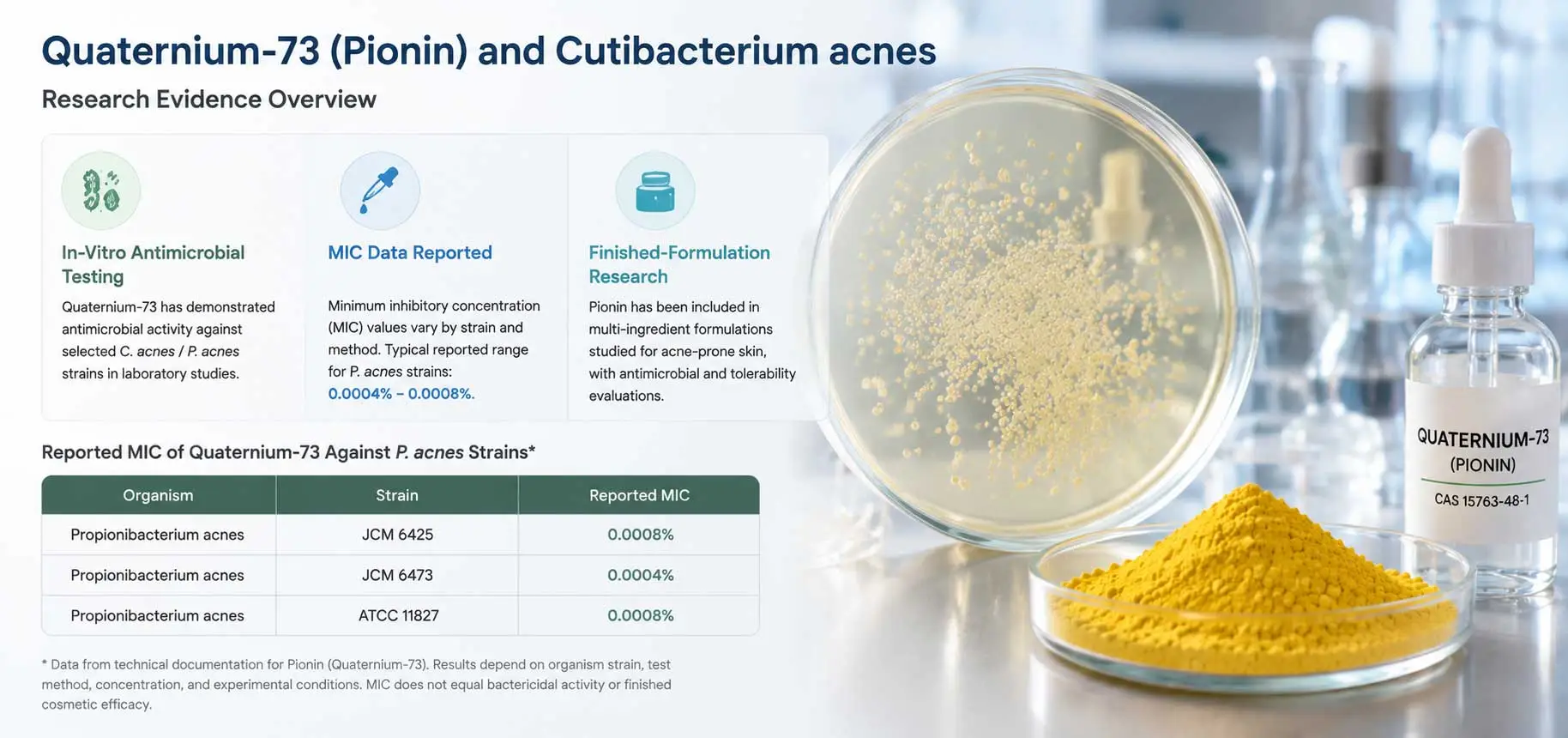
One of the most useful quantitative datasets for Quaternium-73 MIC comes from technical documentation for Pionin.
The reported test used two-fold serial dilution and defined MIC as the lowest concentration at which microbial growth was inhibited. Three Propionibacterium acnes strains produced the following reported values:
|
Organism reported in source |
Strain |
Reported MIC |
|
Propionibacterium acnes |
JCM 6425 |
0.0008% |
|
Propionibacterium acnes |
JCM 6473 |
0.0004% |
|
Propionibacterium acnes |
ATCC 11827 |
0.0008% |
These numbers are more useful than a generic statement that Quaternium-73 has “powerful antibacterial activity,” because they show an important feature of microbiological data: the measured result can vary between strains.
The range reported for these three strains is 0.0004–0.0008%, equivalent to approximately 4–8 mg/L if a simple aqueous-equivalent conversion is made. That range should not be converted into a universal Quaternium-73 minimum inhibitory concentration. It represents the results reported for specific organisms under a particular test method.
This is also why buyers should be cautious with secondary commercial pages reporting a single MIC such as 0.00002%. That number appears on several current supplier pages and secondary technical resources, but the traceable Pionin technical document we located reports 0.0004–0.0008% for the three named P. acnes strains above. Until the experimental source, organism, strain and method behind a different value can be verified, it is more responsible to report it as supplier data rather than established universal MIC.
Why Quaternium-73 MIC Is Not the Same as Cosmetic Use Level
Quaternium-73 MIC vs use level is an important distinction for formulation teams.
MIC is a microbiological endpoint. It describes the minimum tested concentration that prevents visible growth under specified experimental conditions. A Quaternium-73 dosage in a serum, toner, cleanser or emulsion is a formulation decision involving a completely different system.
A culture broth does not reproduce the solvent composition, surfactants, polymers, emulsifiers, pH, contact time or physical structure of a finished cosmetic.
Commercial technical sheets therefore provide formulation-use recommendations separately from antimicrobial MIC data. One current TDS, for example, recommends 0.001–0.05% for its particular Quaternium-73 grade and advises pre-dissolution before incorporation. Those figures are supplier-specific formulation guidance and should not be interpreted as either an MIC or a universal regulatory limit.
For commercial development, formulators should use the specification and technical guidance associated with the actual purchased grade, check applicable market regulations, and validate the intended finished formula.
How Does Quaternium-73 Affect C. acnes?
Quaternium-73 belongs to the broader class of quaternary ammonium compounds. Its antimicrobial behavior is commonly associated with interaction with microbial cell envelopes and loss of membrane integrity.
This provides a plausible basis for Quaternium-73 antibacterial activity, but mechanism should not be oversimplified. The effect observed in an antimicrobial assay depends on exposure concentration, microorganism, growth environment and experimental endpoint.
For buyers, mechanism data are most useful when connected to actual organism-specific measurements. A supplier illustration showing “membrane destruction” is considerably weaker evidence than a report identifying the test organism, strain, method and result.
Readers interested specifically in the mechanistic side can refer internally to How Does Quaternium-73 Work? Antimicrobial Activity Explained, while the present article focuses on the strength and interpretation of the evidence.
Does Quaternium-73 Kill Cutibacterium acnes?
The scientifically appropriate answer is more precise than a simple yes.
Available MIC data demonstrate that Quaternium-73 can inhibit growth of tested P. acnes strains under defined in-vitro conditions. An MIC result does not automatically demonstrate that the organism was killed.
This distinction matters for pages targeting searches such as does Quaternium-73 kill C. acnes or “does Quaternium-73 kill acne bacteria.” Using “kill” when the supporting experiment measured only inhibition overstates the evidence.
To demonstrate bactericidal activity, a study would normally require an appropriate bactericidal endpoint rather than relying solely on MIC.
MIC vs MBC: Does Quaternium-73 Inhibit or Kill C. acnes?
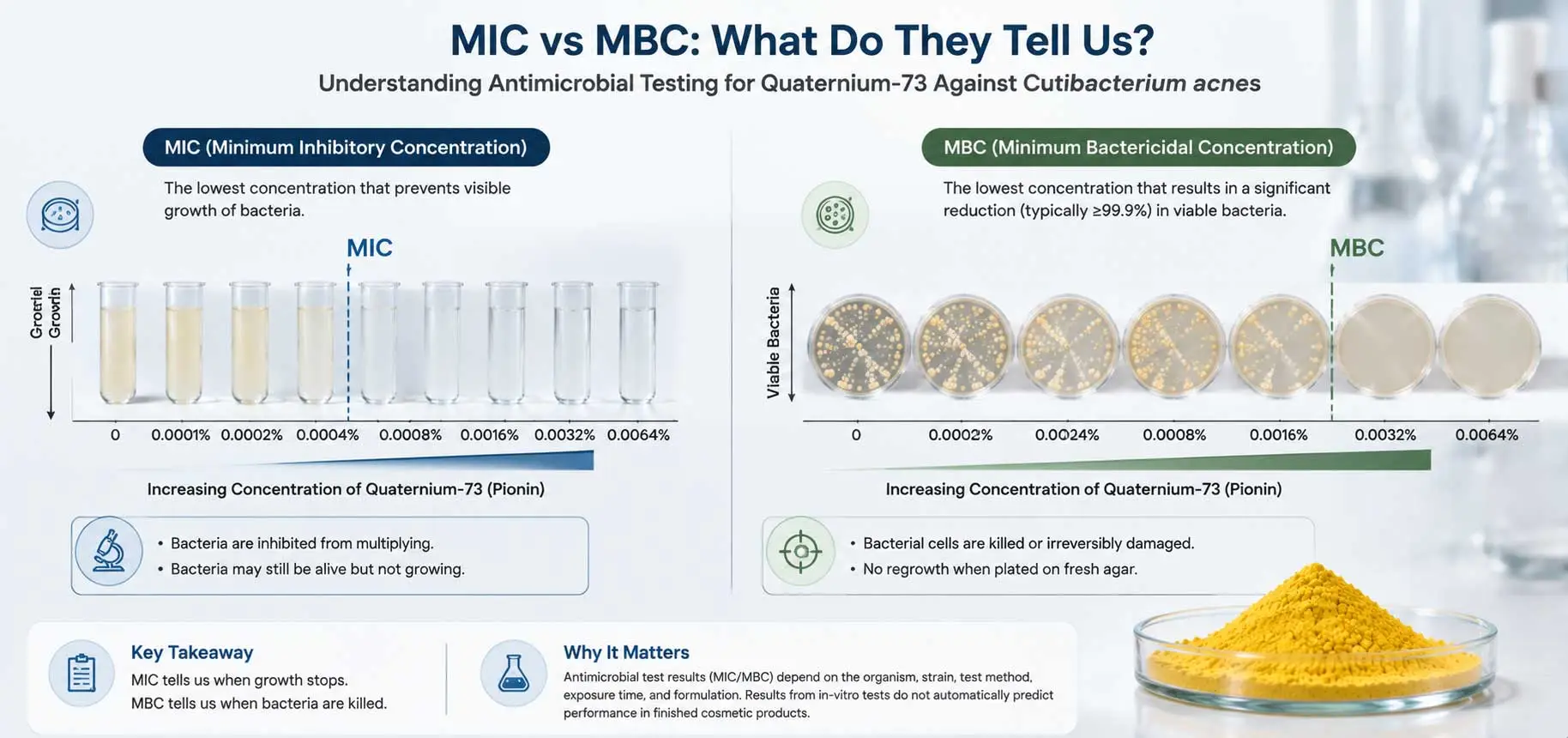
MIC and MBC answer different microbiological questions.
MIC, or minimum inhibitory concentration, identifies the lowest tested concentration preventing visible microbial growth under the assay conditions.
MBC, or minimum bactericidal concentration, is intended to determine the concentration associated with a bactericidal endpoint after appropriate culture/subculture assessment.
Consequently, an MIC of 0.0008% should be described as growth inhibition at that experimental endpoint—not automatically as bacterial killing.
This difference is particularly relevant when evaluating Quaternium-73 bactericidal activity in supplier presentations. If only MIC data are supplied, purchasing and R&D teams should ask whether MBC or other bactericidal testing was actually performed before accepting stronger wording.
Does Activity Against C. acnes Mean Quaternium-73 Treats Acne?
No. Quaternium-73 for acne should not be positioned as an acne treatment solely because the ingredient demonstrates antimicrobial activity against C. acnes in laboratory testing.
Acne is multifactorial, and C. acnes itself is part of normal skin microbiota. Contemporary research increasingly emphasizes strain-level differences, host response and the overall microbial ecosystem rather than treating the presence of the species as a simple infection.
There is also a substantial evidentiary difference between demonstrating inhibition of a bacterial culture and demonstrating clinical treatment in humans.
For cosmetic companies, the safer and scientifically stronger approach is to describe the evidence accurately: Quaternium-73 has reported antimicrobial activity against specified C. acnes/P. acnes strains and may be considered when developing formulations for oily, blemish-prone or acne-prone skin. Finished-product claims must be supported separately and comply with the rules of the destination market.
Why Finished Cosmetic Formulations May Perform Differently From Laboratory Tests
Quaternium-73 antimicrobial efficacy measured in culture cannot simply be transferred numerically to a finished cosmetic.
A leave-on serum may contain glycols, humectants, polymers, botanical ingredients and other actives. An emulsion introduces oil phases and emulsifiers. A facial cleanser adds a surfactant-rich environment and is removed shortly after application.
Each system can influence ingredient availability, solubility, distribution and contact conditions.
The 2025 microneedle research illustrates this particularly well. Pionin was incorporated into a sophisticated delivery system alongside salicylic acid and dipotassium glycyrrhizinate; P. acnes ATCC 6919 was used for antibacterial testing. The resulting performance belongs to that tested delivery system rather than isolated Pionin alone.
This is why a Quaternium-73 cosmetic formulation should ultimately be evaluated as a finished formulation.
How Should Formulators Evaluate Quaternium-73 Antimicrobial Data?
When a supplier provides Quaternium-73 antimicrobial data, the headline number should be the beginning of the technical review, not the end.
Ask which microorganism was tested and whether the organism was identified to strain level. Determine whether the test measured MIC, MBC, inhibition zone, log reduction or another endpoint. Check the medium, concentration units, incubation conditions and exposure period where available.
The material itself also matters. Was purified Quaternium-73 tested? Was it a commercial grade? Did the sample contain a carrier or other antimicrobial component?
Finally, establish whether the evidence relates to the raw ingredient or a finished formulation.
A technically credible Quaternium-73 antibacterial test should allow the buyer to understand what was tested, how it was tested and what the reported result actually means.
What Should Buyers Ask a Quaternium-73 Supplier About Antimicrobial Testing?
When qualifying a Quaternium-73 supplier, buyers can use a straightforward evidence checklist:
1. Which microorganisms and strains were tested?
2. Was C. acnes or the historical P. acnes specifically included?
3. Which test method and endpoint were used?
4. Are the values MIC, MBC or another measurement?
5. Was the tested material the same commercial grade being offered?
6. Can the supplier provide a specification and batch-specific COA?
7. How is identity and assay confirmed for commercial lots?
These questions are more valuable than asking a Quaternium-73 manufacturer simply whether the material is “antibacterial.”
They also help distinguish transferable raw-material information from marketing claims copied between websites.
Why Quaternium-73 Purity and Batch Consistency Matter
Research evidence is most useful commercially when the material used in development can be related to the material subsequently purchased.
Quaternium-73 is formally identified as CAS 15763-48-1; historical European cosmetic ingredient documentation lists the INCI name QUATERNIUM-73, CAS 15763-48-1 and EINECS/ELINCS 239-852-5.
When qualifying Quaternium-73 raw material, procurement teams should therefore verify identity alongside assay/purity and other specification parameters. If Quaternium-73 HPLC is used for assay or purity determination, the batch COA should state the result according to the supplier's defined analytical method.
A Quaternium-73 specification defines the acceptance criteria for the grade. A Quaternium-73 COA should report the results of the individual commercial batch.
This distinction is important when comparing quotations. Two materials advertised online as “98% Quaternium-73” are not automatically equivalent merely because they share a CAS number and nominal assay.
Should Buyers Test a Quaternium-73 Sample Before Bulk Purchase?
For a new formulation project, testing a Quaternium-73 sample before commercial scale-up is sensible.
The sample allows the R&D team to evaluate appearance, handling, dissolution or premix behavior, compatibility and stability in the actual formulation. Its lot number and COA should be retained with the development record so that the first commercial shipment can be compared against the material originally approved.
When submitting a Quaternium-73 sample request, buyers should also confirm that the sample represents the commercial grade they would receive in subsequent orders. This is especially important when qualifying a new Quaternium-73 raw material supplier for an existing formulation.
Buying Quaternium-73 for Cosmetic R&D and Commercial Production
For companies preparing to buy Quaternium-73, a technical purchasing sequence is more reliable than selecting solely on Quaternium-73 price per kg:
Technical review → specification and COA → representative sample → formulation evaluation → commercial order → repeat-lot monitoring
CHEN LANG BIO TECH supplies Quaternium-73 to cosmetic manufacturers, formulation laboratories, OEM/ODM companies and ingredient distributors. Buyers evaluating where to buy Quaternium-73 or requiring bulk Quaternium-73 can request current specifications, COA information, sample availability, MOQ, packaging details and a commercial quotation.
For a material used at relatively low formulation levels, batch consistency and documentation can have greater practical value than a small difference in unit price.
Quaternium-73 and C. acnes Research FAQ
Does Quaternium-73 inhibit Cutibacterium acnes?
Yes, available technical testing reports inhibition of multiple strains historically identified as Propionibacterium acnes. Reported MICs in traceable Pionin technical documentation range from 0.0004% to 0.0008% for three specified strains. These are in-vitro results, not finished-product efficacy data.
Is Propionibacterium acnes the same as Cutibacterium acnes?
Yes in the context of the renamed species. Propionibacterium acnes was reclassified as Cutibacterium acnes following genomic and taxonomic research. Older Quaternium-73 research therefore commonly uses P. acnes, while contemporary literature generally uses C. acnes.
What is the reported MIC of Quaternium-73 against C. acnes?
A Pionin technical document reports MIC values of 0.0008%, 0.0004% and 0.0008% against P. acnes JCM 6425, JCM 6473 and ATCC 11827, respectively. The result should always be linked to the strain and test method rather than presented as a universal MIC.
Does a low MIC mean Quaternium-73 should be used at the same concentration in cosmetics?
No. Quaternium-73 MIC vs use level compares two different concepts. MIC is an experimental microbiological endpoint; cosmetic dosage is determined by formulation requirements, grade-specific technical guidance, finished-product testing and applicable regulations.
Does Quaternium-73 kill C. acnes or only inhibit it?
The cited MIC experiments demonstrate inhibition. A claim of bacterial killing requires an appropriate bactericidal endpoint such as MBC or other validated killing data. MIC alone should not be described as proof that Quaternium-73 kills C. acnes.
Does Quaternium-73 treat acne?
Antimicrobial activity against C. acnes does not by itself establish treatment of acne in humans. For cosmetic applications, it is more appropriate to discuss Quaternium-73 in the context of antimicrobial activity and formulations designed for oily, blemish-prone or acne-prone skin.
What the Current Evidence Means for Formulators and Raw Material Buyers
The current evidence supports antimicrobial activity of Quaternium-73 against tested C. acnes/P. acnes strains under defined experimental conditions, while newer research continues to investigate Pionin-containing systems and contemporary reviews recognize Quaternium-73 among cosmetic ingredients relevant to C. acnes control.
The important qualification is that MIC data demonstrate inhibition, not automatically bacterial killing, acne treatment or finished-product efficacy. For formulators and buyers, the strongest approach is therefore to connect research evidence with verified raw-material identity, assay, batch consistency and actual formulation testing.
For a current Quaternium-73 COA, specification, sample, MOQ, packaging information or bulk Quaternium-73 quotation, cosmetic raw-material buyers can contact CHEN LANG BIO TECH at admin@chenlangbio.com.
References
1. Feng et al. Truncal Acne: Pathophysiology, Clinical Features, and Management Strategies. Journal of Cosmetic Dermatology, 2026. The review discusses Quaternium-73 among quaternary ammonium compounds used to suppress C. acnes in acne-oriented skincare.
2. Zhang X, et al. Dissolved bubble microneedle patches for co-delivery of hydrophobic and hydrophilic drugs to improve acne vulgaris therapy. Microsystems & Nanoengineering, 2025. The study evaluated a Pionin-containing multi-component microneedle system and included antibacterial testing using P. acnes ATCC 6919.
3. Hayashibara/Nagase PIONIN technical information. Antimicrobial testing reports MIC values of 0.0008%, 0.0004% and 0.0008% for P. acnes JCM 6425, JCM 6473 and ATCC 11827, respectively. Because the accessible copy is a reproduced technical document rather than a peer-reviewed publication, these values should be identified as technical supplier data.
4. Safety Evaluation of Skin Care Products (NOV AC Series) in Patients with Acne Vulgaris. Skin Research, 2002. Evaluated a Pionin-containing multi-product skincare system in 22 participants.
5. Dréno B, et al. Cutibacterium acnes (Propionibacterium acnes) and acne vulgaris: a brief look at the latest updates. Journal of the European Academy of Dermatology and Venereology, 2018. Reviews the taxonomic reclassification and contemporary understanding of C. acnes.
6. European Commission. Inventory of Ingredients Employed in Cosmetic Products. Lists QUATERNIUM-73, CAS 15763-48-1, EINECS/ELINCS 239-852-5 and its chemical identity.
7. ZLEY Group. Technical Data Sheet for Quaternium-73. Provides contemporary commercial-grade information including HPLC purity specification, physical appearance and formulation guidance. It is used here as supplier technical information rather than independent clinical evidence.

Send Inquiry
You may like
Related Industry Knowledge
- 5 Benefits of High-Purity Lycopene Powder
- How Does Tretinoin Support Global Skincare Innovation in 2025?
- How Do I Use Kojic Acid Dipalmitate in My Skincare Routine?
- Quinoa Seed Extract for Natural Wellness
- What are the Benefits of Cetyl Tranexamate HCL in Skincare?
- What is Bulk Dimethylmethoxy Chromanol? Benefits & Uses
- Pure Fisetin: A Natural Senolytic Solution
- What is Sodium Ascorbyl Phosphate Used For
- Can Coenzyme Q10 Powder Improve Skin Health
- Can Icariin Increase Testosterone