How to Verify a DHEA Powder COA Before Bulk Purchase?
2026-05-27 12:36:16
Introduction
As the global nutraceutical industry becomes increasingly competitive, ingredient sourcing decisions are carrying greater operational and commercial significance for supplement manufacturers, formulation companies, and raw material distributors. Among these ingredients, bulk DHEA powder remains widely used in nutraceutical and wellness formulations, making supplier qualification and quality verification more important than ever.
In today’s international supply chain environment, procurement teams are under growing pressure to ensure that every raw material entering production meets consistent quality standards and documentation requirements. While pricing and lead time continue to influence purchasing decisions, experienced buyers understand that long-term supplier reliability depends heavily on transparency, testing procedures, and manufacturing control systems.
This is particularly true when sourcing pharmaceutical grade DHEA powder from overseas suppliers. Inconsistent purity levels, incomplete laboratory reports, and generic specification documents are still common problems within parts of the global ingredient market. For supplement brands operating in regulated markets, these issues can create formulation inconsistencies, production delays, and unnecessary regulatory risks.
DHEA powder COAAs a result, professional buyers increasingly request detailed DHEA powder COA documentation before confirming commercial orders. A properly prepared Certificate of Analysis provides far more than basic specification data. It offers insight into how a supplier manages quality control, batch traceability, laboratory testing, and manufacturing consistency.
At CHEN LANG BIO TECH, we have seen a clear shift in how international buyers evaluate ingredient suppliers. Procurement teams today are not simply searching for competitive pricing — they are looking for partners capable of delivering stable quality, transparent testing documentation, and dependable long-term supply support.
This guide explains how buyers can properly review and verify a DHEA powder COA before bulk procurement. From assay verification and HPLC testing to batch traceability and supplier qualification, understanding these technical details can help reduce sourcing risks and improve long-term procurement reliability.
Why COA Verification Matters in Bulk DHEA Powder Procurement
In the global nutraceutical ingredient market, quality verification has become one of the most important parts of professional procurement. For companies sourcing bulk DHEA powder, a Certificate of Analysis is often the first document buyers review when evaluating whether a supplier can meet long-term commercial requirements.
While many suppliers provide specification sheets or marketing materials, experienced procurement teams typically rely on the DHEA powder COA to assess actual product quality and manufacturing consistency. A properly prepared COA offers technical information that helps buyers verify purity standards, testing methods, batch traceability, and overall supplier transparency before moving forward with large-volume purchases.
This process has become increasingly important as the international ingredient market continues to expand. In recent years, buyers have encountered growing concerns related to inconsistent raw material quality, incomplete laboratory documentation, and unreliable supply chain practices. In some cases, products marketed as high-purity DHEA powder may lack sufficient testing verification or contain generic documentation that provides limited insight into actual production quality.
For supplement manufacturers, these inconsistencies can create significant operational challenges. Variations in assay content or raw material stability may affect formulation performance, production efficiency, and finished product consistency. This is one of the reasons professional buyers place strong emphasis on COA verification during supplier qualification.
Another important factor is supplier accountability. Reliable DHEA raw material suppliers are generally willing to provide transparent laboratory documentation, explain testing methodologies, and answer technical questions related to production standards. Procurement teams increasingly view this level of communication as an indicator of operational maturity and long-term supply reliability.
In practice, a detailed COA also helps buyers compare suppliers more effectively. Two manufacturers may offer similar pricing, but differences in assay verification, impurity testing, batch information, and laboratory standards can reveal significant differences in manufacturing quality. For companies sourcing pharmaceutical grade DHEA powder, these details are often more important than short-term pricing advantages alone.
The growing importance of COA verification also reflects broader changes within the nutraceutical industry itself. As supplement brands continue to prioritize quality assurance and regulatory compliance, procurement departments are becoming more selective about supplier qualification standards. Buyers increasingly expect suppliers to maintain documented quality systems, validated testing procedures, and stable production controls that support consistent commercial manufacturing.
Ultimately, reviewing a DHEA powder COA is not simply a technical exercise — it is part of a broader risk management strategy. Companies that carefully evaluate testing documentation before bulk procurement are generally better positioned to reduce sourcing uncertainty, maintain formulation consistency, and build more reliable long-term supplier relationships.
Understanding the Key Sections of a DHEA Powder COA
For many procurement professionals, reviewing a DHEA powder COA is one of the most effective ways to evaluate whether a supplier can consistently meet commercial quality expectations. However, not all Certificates of Analysis provide the same level of detail or reliability. Understanding how to interpret each section of the document is essential for identifying potential quality risks before confirming a bulk order.
A professional DHEA certificate of analysis should provide clear, traceable, and technically verifiable information related to the raw material being supplied. Beyond confirming basic specifications, the document should reflect the supplier’s overall approach to quality management, laboratory testing, and manufacturing control.
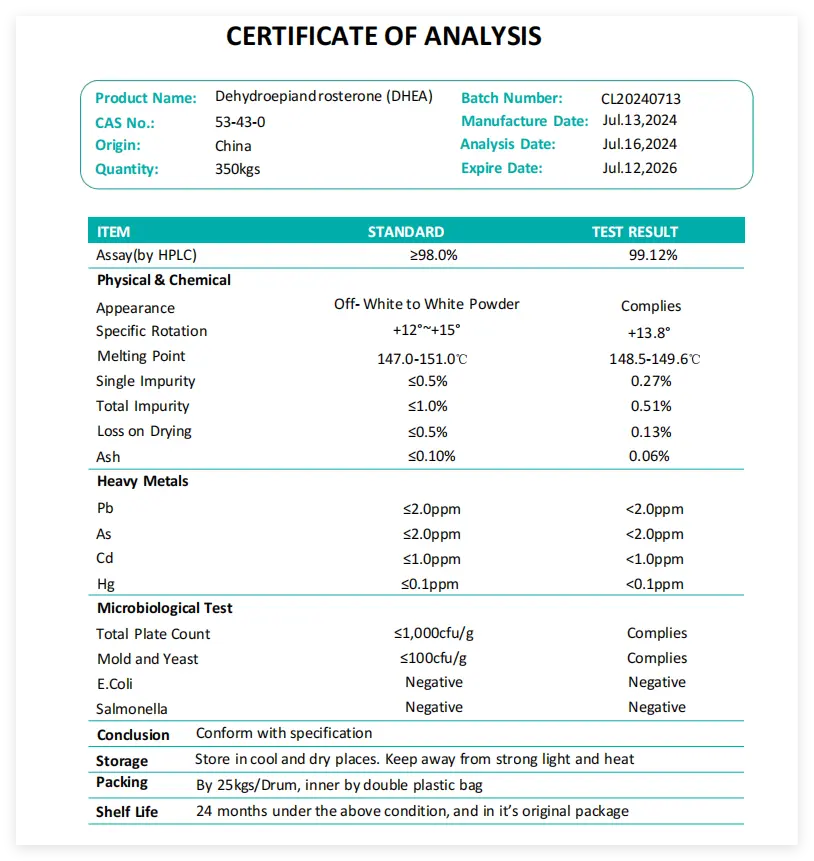
One of the first areas buyers should review is product identification. This includes the product name, CAS number, batch number, manufacturing date, and specification reference. For DHEA raw material, accurate identification is critical because it confirms that the tested material matches the actual product being purchased. Missing or inconsistent identification data may indicate weak documentation systems or poor batch traceability practices.
The CAS number is especially important during supplier qualification. Professional buyers often use the CAS number to confirm chemical identity and ensure consistency between procurement documents, testing reports, and regulatory records. Reliable suppliers of pharmaceutical grade DHEA powder should maintain complete and accurate product identification across all technical documentation.
Another key section involves assay and purity information. In most cases, the COA should clearly indicate the assay result along with the analytical method used for verification, typically HPLC analysis. Buyers sourcing high-purity DHEA powder often look for assay values aligned with pharmaceutical or nutraceutical industry standards, supported by validated testing procedures.
However, assay percentage alone should not be viewed as the only quality indicator. Procurement teams should also evaluate whether the testing method is properly documented and whether the laboratory results appear technically consistent. Reliable DHEA powder suppliers generally provide transparent information regarding testing conditions, specification limits, and analytical methodologies rather than relying on vague or incomplete reporting formats.
Physical property data is another important part of the COA review process. This may include appearance, particle size, moisture content, and solubility characteristics depending on the supplier’s specification standards. For manufacturers using bulk DHEA powder in capsule or tablet formulations, these physical properties can directly influence production performance and formulation consistency.
Batch traceability information is equally important. A professional COA should clearly reference production batch numbers, manufacturing dates, and shelf-life information. Buyers increasingly view traceability as an essential part of supplier qualification because it helps support inventory management, quality investigations, and long-term procurement consistency.
Another area procurement teams often review is impurity and contamination testing. Depending on market requirements, suppliers may include testing data related to heavy metals, microbial limits, residual solvents, or other quality indicators. While testing standards may vary across regions, transparent reporting of these parameters generally reflects stronger quality management systems.
In our experience working with international supplement companies, buyers are becoming increasingly skilled at evaluating technical documentation during supplier qualification. Procurement decisions are no longer based solely on pricing or product descriptions. Instead, companies sourcing bulk DHEA powder are placing greater emphasis on laboratory transparency, manufacturing consistency, and documentation accuracy when selecting long-term ingredient partners.
A well-prepared COA ultimately serves as more than a testing document. It reflects the supplier’s operational standards, quality philosophy, and ability to support commercial-scale manufacturing requirements within the global nutraceutical industry.
Key Quality Parameters Buyers Should Evaluate Before Bulk Purchase
For international buyers sourcing bulk DHEA powder, reviewing the COA itself is only the beginning of the supplier qualification process. Professional procurement teams typically go further by evaluating the underlying quality parameters that determine whether a raw material can consistently support commercial manufacturing requirements.
In practice, many quality issues within the nutraceutical supply chain do not become visible until production begins. A material may initially appear compliant based on a specification sheet, yet later create formulation inconsistencies, processing instability, or regulatory concerns due to insufficient testing standards or inconsistent batch quality. This is why experienced buyers place strong emphasis on detailed DHEA raw material testing before confirming long-term procurement agreements.
One of the most important quality indicators is assay verification. Reliable suppliers of pharmaceutical grade DHEA powder should provide clearly documented assay results supported by validated analytical methods, typically through HPLC analysis. Procurement teams should review not only the reported purity percentage, but also whether the testing methodology appears complete, technically credible, and consistent across documentation.
Inconsistent or overly simplified assay reporting can sometimes indicate weak laboratory standards or generic documentation practices. Professional buyers often compare assay values alongside batch traceability, testing frequency, and specification consistency to better evaluate supplier reliability.
Another critical area involves impurity and contamination testing. Depending on destination markets and formulation requirements, supplement manufacturers may require verification related to heavy metals, microbial limits, residual solvents, or other contamination parameters. Suppliers capable of providing transparent testing documentation in these areas generally demonstrate stronger quality management systems and a more mature manufacturing environment.
Heavy metal testing is particularly important for companies exporting finished products into highly regulated markets. Procurement teams increasingly request detailed information related to lead, arsenic, cadmium, and mercury limits when sourcing high-purity DHEA powder for commercial formulations. Transparent reporting of these parameters helps buyers assess overall supplier credibility and risk management standards.
Microbial testing is another area that has gained greater attention in recent years. Even when a raw material meets assay specifications, microbial contamination can still create significant downstream manufacturing challenges. Reliable suppliers should therefore maintain controlled production environments and standardized sanitation procedures designed to minimize contamination risks during processing and packaging.
Batch consistency has also become one of the most important procurement considerations within the global nutraceutical industry. For supplement manufacturers operating continuous production schedules, ingredient variability between shipments can create substantial operational disruptions. Differences in particle size, moisture content, flowability, or purity levels may affect capsule filling efficiency, tablet compression performance, and formulation stability.
This is one of the reasons professional buyers often request multiple batch records or historical testing documentation during supplier evaluation. A reliable DHEA powder supplier should be capable of demonstrating consistent manufacturing standards across repeated production cycles rather than relying solely on isolated sample results.
Storage stability and shelf-life information are equally important during quality review. Procurement teams should confirm whether the supplier provides clear recommendations regarding storage conditions, packaging standards, and expected product stability over time. Properly managed bulk DHEA powder should maintain specification integrity throughout transportation, warehousing, and commercial production use.
Packaging quality also plays a direct role in protecting material stability. Moisture-resistant packaging systems, double-layer inner protection, and professional export handling procedures help reduce the risk of contamination or product degradation during international shipping. Suppliers with established export experience generally place greater emphasis on these operational details because they understand the logistical realities of long-distance ingredient transportation.
In today’s increasingly competitive nutraceutical market, procurement decisions are no longer based solely on pricing or specification sheets. Buyers are placing greater emphasis on overall operational reliability, laboratory transparency, and long-term manufacturing consistency when evaluating ingredient suppliers.
Companies capable of demonstrating strong testing procedures, stable production controls, and transparent documentation systems are generally better positioned to support sustainable procurement partnerships with international supplement brands and formulation companies.
How HPLC Testing Confirms DHEA Powder Purity
Within the nutraceutical and pharmaceutical raw material industries, HPLC testing has become one of the most widely accepted analytical methods for verifying ingredient purity and consistency. For companies sourcing pharmaceutical grade DHEA powder, HPLC analysis plays a critical role in confirming whether the material meets specification requirements before commercial production begins.
High-performance liquid chromatography, commonly referred to as HPLC, is used to measure assay content, identify impurities, and evaluate overall material composition. Compared with basic visual inspection or simplified laboratory screening methods, HPLC provides a far more accurate assessment of DHEA powder purity and batch consistency.
Professional procurement teams increasingly rely on HPLC-tested DHEA powder because assay verification directly affects formulation stability, manufacturing efficiency, and finished product consistency. Even relatively small variations in purity may influence blending performance, dosage accuracy, and long-term product stability within commercial supplement manufacturing.
A properly prepared HPLC report should clearly identify the analytical method used, retention time, assay percentage, specification standards, and testing conditions associated with the batch being evaluated. Buyers reviewing DHEA laboratory testing documentation often compare these technical details across multiple suppliers to determine whether testing procedures appear professionally standardized and scientifically credible.
In many cases, HPLC testing also provides valuable insight into supplier operational maturity. Manufacturers that maintain advanced analytical capabilities and transparent reporting systems generally demonstrate stronger quality management practices overall. By contrast, incomplete or vague HPLC documentation may indicate limited laboratory capacity or weak quality assurance procedures.
For international buyers, transparent analytical reporting has become increasingly important as regulatory expectations continue to evolve across the nutraceutical industry. Supplement brands operating in North America, Europe, and other regulated markets often require suppliers to provide validated laboratory documentation that supports ingredient traceability and procurement compliance.
At CHEN LANG BIO TECH, we have observed that experienced buyers increasingly evaluate suppliers based on the consistency and professionalism of their testing systems rather than pricing alone. In many procurement environments, laboratory transparency and technical credibility have become key indicators of long-term supplier reliability.
Ultimately, HPLC analysis serves as more than a technical verification method. It has become an essential part of modern ingredient qualification, helping procurement teams reduce sourcing uncertainty and maintain greater confidence in the quality consistency of bulk DHEA powder used for commercial manufacturing.
Common Red Flags in DHEA Powder COA Reports
For professional buyers, reviewing a DHEA powder COA is not only about confirming specification values — it is also about identifying potential warning signs that may indicate quality control weaknesses, inconsistent manufacturing standards, or unreliable supplier practices. In many procurement situations, small irregularities within technical documentation can reveal much larger operational issues behind the production process itself.
One of the most common red flags involves incomplete or overly simplified laboratory data. A professional DHEA certificate of analysis should include detailed assay information, testing methods, batch identification, specification limits, and analytical results that can be clearly verified. When a COA contains only basic purity percentages without supporting technical information, buyers should evaluate the documentation carefully before moving forward with bulk procurement.
Another issue frequently encountered in the market is missing or unclear HPLC testing information. Reliable suppliers of pharmaceutical grade DHEA powder generally provide transparent assay verification supported by properly documented analytical methods. Incomplete chromatogram references, missing retention times, or vague laboratory reporting formats may indicate limited testing capabilities or generic documentation practices.
Experienced procurement teams also pay close attention to batch traceability details. A COA lacking batch numbers, manufacturing dates, or shelf-life information may suggest weak production management systems or inadequate internal quality controls. For companies sourcing bulk DHEA powder for commercial manufacturing, incomplete traceability can create significant operational risks if quality investigations or inventory reviews become necessary later.
Unrealistic purity claims are another important warning sign. While high-purity specifications are common within the nutraceutical industry, assay values that appear unusually high without proper testing support should be reviewed carefully. Professional buyers understand that reliable quality verification depends not only on the reported purity percentage itself, but also on the credibility of the analytical method used to generate the result.
Generic or reused COA templates are also increasingly common in parts of the global ingredient market. Procurement teams sometimes encounter documentation that appears visually identical across multiple batches or products, with only minimal information changed between reports. Inconsistent formatting, missing laboratory signatures, or vague testing references may indicate insufficient documentation management practices.
Another area buyers should evaluate is whether the COA aligns with other supplier documentation. Product specifications, packaging labels, testing reports, and export documents should all remain consistent regarding product identification, assay standards, and batch information. Discrepancies between documents can sometimes reveal communication problems or weak operational oversight within the supplier’s quality system.
At CHEN LANG BIO TECH, we have seen that experienced international buyers are becoming increasingly detail-oriented when reviewing supplier documentation. Rather than relying solely on pricing or marketing materials, procurement teams are placing greater emphasis on laboratory transparency, documentation consistency, and operational professionalism during supplier qualification.
Ultimately, identifying red flags early in the procurement process can help buyers reduce sourcing risks, improve long-term quality consistency, and avoid costly production disruptions later. In today’s increasingly competitive nutraceutical supply chain, careful COA evaluation has become an essential part of professional raw material procurement.
Supplier Qualification and Documentation Best Practices
As procurement standards continue to evolve across the nutraceutical industry, supplier qualification has become a far more comprehensive process than simply comparing quotations or reviewing product specifications. For companies sourcing bulk DHEA powder, evaluating documentation systems, manufacturing transparency, and operational consistency is now considered an essential part of long-term procurement planning.
Professional buyers increasingly prioritize suppliers capable of maintaining complete and organized technical documentation throughout the supply chain. This includes Certificates of Analysis, HPLC assay reports, product specifications, batch records, export documentation, and packaging information. Suppliers with structured documentation systems are generally viewed as more reliable because they demonstrate stronger internal quality management practices and better operational control.
Another important aspect of supplier qualification involves manufacturing standards. Reliable DHEA raw material suppliers should be able to explain their production workflows, laboratory testing procedures, and quality assurance systems clearly when requested. Procurement teams often evaluate how transparently a supplier communicates technical information as part of the overall qualification process.
For many international buyers, GMP compliance has also become a baseline requirement during supplier selection. Manufacturers operating under structured GMP procedures typically maintain stronger sanitation controls, batch traceability systems, and production consistency standards compared with suppliers lacking formal manufacturing oversight.
Export experience is equally important when sourcing pharmaceutical grade DHEA powder internationally. Suppliers familiar with customs documentation, packaging standards, shipping coordination, and international logistics requirements are generally better equipped to support long-term commercial procurement projects.
Communication quality also plays a major role in supplier evaluation. Reliable suppliers should respond clearly to technical inquiries, provide documentation promptly, and maintain transparent communication throughout production and shipping coordination. In many cases, operational responsiveness becomes an important indicator of how effectively a supplier can support future procurement stability.
At CHEN LANG BIO TECH, we have found that long-term supplier relationships are typically built through consistency, transparency, and practical operational support rather than pricing alone. Buyers increasingly prefer suppliers capable of combining strong quality systems with dependable communication and stable international supply capabilities.
As the global nutraceutical market becomes more competitive, supplier qualification is evolving into a broader risk management strategy. Companies that prioritize transparent documentation, manufacturing consistency, and reliable technical support are generally better positioned to build sustainable procurement partnerships within the international ingredient industry.
Frequently Asked Questions About DHEA Powder COA Verification
How can I verify whether a DHEA powder COA is reliable?
Professional buyers typically review assay data, HPLC testing information, batch numbers, manufacturing dates, and laboratory methods when evaluating a DHEA powder COA. Consistent formatting, transparent analytical reporting, and traceable batch information are often indicators of reliable documentation.
What purity level is commonly expected for pharmaceutical grade DHEA powder?
Purity standards may vary depending on application requirements and market regulations. However, buyers sourcing pharmaceutical grade DHEA powder generally expect clearly documented assay verification supported by validated HPLC testing methods.
Why is HPLC testing important when sourcing bulk DHEA powder?
HPLC testing helps verify assay content, identify impurities, and confirm batch consistency. For companies sourcing bulk DHEA powder, reliable analytical testing supports formulation stability and long-term production consistency.
Can suppliers provide third-party laboratory testing reports?
Many professional suppliers can provide third-party laboratory documentation upon request. International buyers often use these reports as an additional verification step during supplier qualification and procurement review.
What should buyers do if a COA appears incomplete or unclear?
If technical documentation appears inconsistent, incomplete, or lacks sufficient testing detail, buyers should request clarification directly from the supplier before confirming procurement decisions. Transparent communication is often an important indicator of supplier reliability within the nutraceutical ingredient industry.
Conclusion: Building Trust Through Transparent DHEA Quality Verification
As global quality expectations continue to rise across the nutraceutical industry, procurement teams are becoming increasingly selective about how they evaluate ingredient suppliers and technical documentation. For companies sourcing bulk DHEA powder, reviewing COA reports, HPLC testing data, and batch traceability information is no longer simply part of routine quality control — it has become an important step in reducing long-term sourcing risks and maintaining stable production standards.
Reliable suppliers understand that consistent quality is built through transparent testing procedures, organized documentation systems, and stable manufacturing practices. In many cases, the professionalism reflected in a supplier’s COA and laboratory reporting standards can provide valuable insight into their broader operational capabilities and long-term supply reliability.
At CHEN LANG BIO TECH, we regularly work with international supplement manufacturers, formulation companies, and ingredient distributors that place strong emphasis on documentation transparency, batch consistency, and export support during supplier qualification. Buyers requesting additional information related to pharmaceutical grade DHEA powder, HPLC testing reports, packaging specifications, or procurement documentation are welcome to contact our team directly at admin@chenlangbio.com for technical support and product-related inquiries.
As the global nutraceutical supply chain continues to evolve, suppliers capable of combining reliable manufacturing standards with transparent communication and consistent quality systems will remain better positioned to support long-term international procurement partnerships.

Send Inquiry
Related Industry Knowledge
- How to Use Hyaluronic Acid Powder for Skin Hydration and Anti-Aging?
- Is Tranexamic Acid the Same as Niacinamide? Key Differences for Cosmetic Formulations
- Bifida Ferment Lysate vs Retinol Which Ingredient Is Better for Sensitive Skin?
- 5 Alpha Hydroxy Laxogenin vs Turkesterone Which Is Better for Muscle Growth?
- How Does Liposomal CoQ10 Compare to Regular CoQ10 Supplements?
- Can Cactus Extract Powder Lower Blood Sugar Levels?
- What are the Potential Benefits of PQQ Supplementation?
- What Foods Contain Ergothioneine
- Can I Use Sodium Ascorbyl Phosphate with Retinol
- What Is Palmitoyl Isoleucine Used For