
Quaternium-73 Compatibility: What Ingredients Can It Be Formulated With?
2026-08-26 13:01:14
Quaternium-73 compatibility should be evaluated at the level of the finished cosmetic formula rather than by asking whether two raw materials can simply be mixed in a beaker. Current commercial formulations show that Quaternium-73 can be incorporated in multi-ingredient systems containing niacinamide, salicylic acid, sodium hyaluronate, glycols, carbomer, hydroxyethylcellulose and conventional preservative components. These real-world formulations provide useful evidence of co-use, but they do not establish universal compatibility at every concentration, pH or processing condition.
This distinction matters to both formulators and raw-material buyers. Quaternium-73, identified by CAS 15763-48-1, is an ionic, low-use-level cosmetic ingredient. A commercial product data sheet recommends a use level of 0.001–0.005%, a pH range of 5.5–8.0 for that particular grade, and pre-dissolution in selected glycols before incorporation. Those characteristics mean that solvent choice, pH, ionic strength, polymer system and ingredient addition order can all influence Quaternium-73 formulation compatibility.
The practical question is therefore not simply what ingredients can be used with Quaternium-73, but under what formulation conditions those combinations remain homogeneous and stable.
What Does “Compatible With Quaternium-73” Actually Mean in a Cosmetic Formula?
When formulators discuss Quaternium-73 ingredient compatibility, compatibility should cover more than the absence of an immediate visible reaction.
A combination may appear acceptable immediately after manufacturing but subsequently develop haze, sediment, crystals, viscosity loss or phase separation. Conversely, two ingredients with different solubility characteristics can sometimes be successfully incorporated when an appropriate carrier, addition sequence and pH are used.
For Quaternium-73, compatibility should therefore be considered across several dimensions: physical stability, solubility, pH, ionic environment, rheology, color and clarity, as well as the performance of the complete preservation system.
This is particularly relevant because Quaternium-73 is used at very low concentrations. One commercial PDS recommends 0.001–0.005% and describes the material as soluble in butylene glycol, propylene glycol, ethanol and 1,2-pentanediol but only slightly soluble in water.
A practical definition for formulators is:
Quaternium-73 compatibility means that the complete formulation remains physically stable and technically acceptable at the intended ingredient concentrations, pH and processing conditions—not merely that two ingredients can initially be mixed together.
That definition also prevents a common sourcing mistake: assuming that two Quaternium-73 grades from different suppliers will behave identically because their INCI and CAS number are the same.
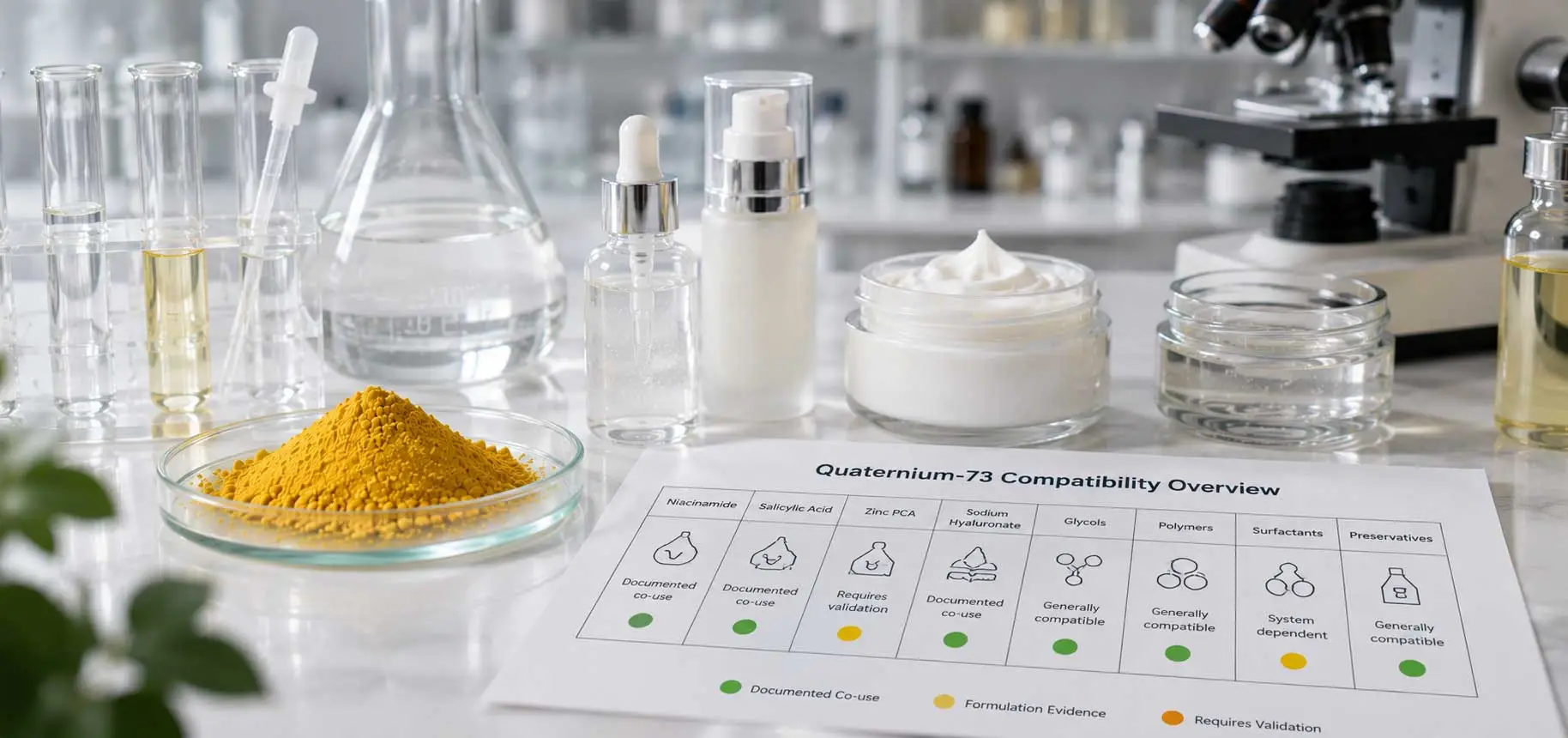
Quaternium-73 Compatibility Matrix: Which Ingredient Groups Need the Most Attention?
The available evidence is not equally strong for every combination. Published ingredient lists from finished products provide valuable formulation evidence for some combinations, while others are supported mainly by commercial technical guidance or formulation principles.
|
Ingredient group |
Current evidence |
Main issue to evaluate |
|
Niacinamide |
Documented in finished formulations |
pH and overall formula stability |
|
Salicylic acid |
Documented commercial co-use |
pH, solubility and complete formula stability |
|
Zinc PCA |
Commercial formulation guidance; limited direct studies |
ionic load, pH and polymer behavior |
|
Sodium hyaluronate |
Documented finished-formula co-use |
ionic environment, viscosity and hydration |
|
Glycols/polyols |
Strong technical relevance |
solvent and premix behavior |
|
Surfactants |
System-dependent |
ionic interactions, haze and precipitation |
|
Carbomer/xanthan/HEC |
Documented commercial co-use |
viscosity and electrolyte sensitivity |
|
Conventional preservatives |
Documented commercial co-use |
finished-product preservation validation |
|
Electrolytes |
Formula-dependent |
ionic strength, solubility and rheology |
This Quaternium-73 compatibility chart should not be interpreted as a universal approved-combination list. “Documented co-use” means that the ingredients have appeared together in an identifiable finished formula; it does not mean every ratio and formulation architecture has been experimentally validated.
Can Quaternium-73 Be Formulated With Niacinamide?
There is practical evidence supporting the formulation of Quaternium-73 and niacinamide in the same finished product.
A 2025 DailyMed formulation lists Quaternium-73 alongside niacinamide, propylene glycol, butylene glycol, glycerin, panthenol, phenoxyethanol, ethylhexylglycerin and an acrylate polymer. Another current commercial moisturizer formula similarly lists niacinamide and Quaternium-73 in a system containing salicylic acid, carbomer, sodium hyaluronate and several glycols.
That is useful evidence when assessing Quaternium-73 niacinamide compatibility, but it does not establish a universal optimum ratio.
From a formulation perspective, niacinamide is readily incorporated into aqueous systems, whereas Quaternium-73 may require pre-dissolution in an appropriate carrier. The development sequence should therefore be designed around the behavior of each raw material rather than premixing the powders simply because they are intended for the same finished product.
Final pH also matters. A Quaternium-73 PDS gives 5.5–8.0 as the stable range for the referenced commercial grade. This provides a useful starting point, but the finished formula—not the individual ingredients in isolation—should be evaluated.
The evidence therefore supports saying that Quaternium-73 can be used with niacinamide in appropriately designed formulations, rather than claiming that the two materials are unconditionally compatible.
Can Quaternium-73 Be Used With Salicylic Acid?
Quaternium-73 and salicylic acid deserve more careful formulation attention because both pH and solvent conditions can become important.
There is clear evidence of commercial co-use. Current DailyMed data include formulations containing Quaternium-73 together with salicylic acid and other ingredients such as niacinamide, glycols, phenoxyethanol and sodium hyaluronate. One 2026 listing also contains salicylic acid, niacinamide, Quaternium-73, butylene glycol, propylene glycol, propanediol, glycerin, retinol and phenoxyethanol in the same product.
This demonstrates something useful but limited: the two ingredients can coexist in successfully designed commercial systems.
It does not mean a formulator can add Quaternium-73 directly to any salicylic acid solution. Salicylic acid presents its own solubility and pH considerations, while the referenced Quaternium-73 technical guidance recommends pre-dissolution in selected glycols and gives a grade-specific pH range.
For a Quaternium-73 salicylic acid formulation, the development team should therefore examine the solvent system, final pH, clarity immediately after production, precipitation during storage and the effect of any neutralizers or electrolytes present.
This is an important example of why commercial co-use should not be confused with universal chemical compatibility. A finished formulation represents an engineered system in which solvent balance, concentration and processing have already been adjusted.
Can Quaternium-73 Be Combined With Zinc PCA?
The evidence for Quaternium-73 and Zinc PCA is less definitive than the evidence for niacinamide or sodium hyaluronate.
Commercial ingredient literature recommends Zinc PCA among ingredients that can be considered when developing Quaternium-73-containing skincare systems, but robust direct studies establishing universal Quaternium-73 Zinc PCA compatibility are difficult to identify.
For formulators, Zinc PCA should also be considered an electrolyte-containing ingredient rather than simply another skincare active. Introducing zinc ions and the PCA salt changes the ionic environment of the formula. Depending on the polymer, surfactant and other salts present, this may affect viscosity, clarity or physical stability.
Consequently, Quaternium-73 with Zinc PCA is better described as a technically plausible formulation combination that requires prototype validation, rather than a proven universally compatible pair.
A sensible laboratory trial should monitor the Quaternium-73 premix after introduction, final pH, immediate clarity, viscosity and changes during stability storage. If a carbomer or another electrolyte-sensitive rheology modifier is present, the effect on the polymer system deserves particular attention.
This evidence distinction is useful for ingredient buyers: a supplier recommendation can provide a starting point, but it should not be presented as equivalent to controlled compatibility data.
Can Quaternium-73 Be Formulated With Hyaluronic Acid or Sodium Hyaluronate?
There is meaningful finished-formula evidence for Quaternium-73 and hyaluronic acid, particularly sodium hyaluronate.
A current DailyMed acne-relief formulation lists Quaternium-73, sodium hyaluronate, carbomer and hydroxyethylcellulose in the same finished product. Another commercial moisturizer combines Quaternium-73 with sodium hyaluronate, carbomer and ammonium acryloyldimethyltaurate/VP copolymer.
These examples show that Quaternium-73 sodium hyaluronate compatibility can be achieved in commercial formulations.
However, sodium hyaluronate is a polyelectrolyte, and its behavior depends on molecular weight, concentration, hydration procedure and the ionic environment. The practical question is therefore not merely whether both INCI names can appear in the same formula.
During development of a Quaternium-73 hyaluronic acid serum, formulators should monitor hydration, viscosity development, clarity or haze where relevant, and changes after the Quaternium-73 premix is introduced. Addition order can also matter: complete hydration of the polymer before introducing other ionic ingredients may behave differently from attempting to hydrate everything simultaneously.
Commercial co-use provides a good starting point. The exact polymer grade and finished formulation still require validation.
Are Glycols and Humectants Compatible With Quaternium-73?
Glycols have particular importance in Quaternium-73 compatibility because some function not only as humectants but also as practical incorporation carriers.
A commercial Quaternium-73 PDS describes the material as soluble in butylene glycol, propylene glycol, ethanol and 1,2-pentanediol and specifically recommends pre-dissolving it in butylene glycol, propylene glycol or 1,2-pentanediol before addition.
Finished-product evidence also shows Quaternium-73 appearing alongside butylene glycol, propylene glycol and glycerin.
This makes Quaternium-73 with butylene glycol and Quaternium-73 propylene glycol compatibility especially relevant to formulators. Where one of these glycols is already part of the formula, a portion may potentially serve as the premix carrier, subject to the grade-specific TDS and laboratory verification.
Glycerin should be treated differently. Its presence alongside Quaternium-73 in commercial formulations demonstrates co-use, but that does not automatically establish glycerin as the preferred dissolution solvent.
The distinction between compatible co-ingredient and recommended premix carrier should therefore be maintained.
Is Quaternium-73 Compatible With Surfactants?
Quaternium-73 surfactant compatibility cannot responsibly be reduced to a single yes-or-no answer.
Commercial technical documentation identifies facial cleansers and shampoos among potential applications for Quaternium-73, demonstrating that surfactant-based formulation is technically relevant.
However, cleanser systems vary substantially. They may contain anionic, amphoteric, nonionic or cationic surfactants, often in mixtures. Quaternium-73 is itself an ionic material, so the complete charge environment deserves attention, particularly in strongly anionic systems.
This does not justify the common shortcut of saying that Quaternium-73 is “incompatible with all anionic surfactants.” The behavior of an ionic ingredient depends on concentration, surfactant structure, micellar environment, salt concentration, pH and the other ingredients present.
When evaluating Quaternium-73 with surfactants, formulators should monitor haze, precipitation, viscosity, phase behavior and changes in foam or appearance. Those observations should continue through stability testing rather than stopping immediately after mixing.
For a Quaternium-73 cleanser formulation, compatibility is therefore best established in the complete surfactant base. Predicting performance solely from the charge classification of one surfactant is not sufficiently reliable.
Which Polymers and Thickeners Can Be Used With Quaternium-73?
Commercial formulations provide useful evidence that several polymer systems can coexist with Quaternium-73.
Current ingredient disclosures show Quaternium-73 in formulations containing carbomer, hydroxyethylcellulose, xanthan gum, acrylate crosspolymers and ammonium acryloyldimethyltaurate/VP copolymer.
This is valuable evidence for Quaternium-73 polymer compatibility, but it should not be converted into the claim that every grade of every polymer is automatically compatible.
Carbomers, for example, are sensitive to neutralization conditions and can respond to electrolyte loading. A formulation containing Quaternium-73 plus Zinc PCA, salts, botanical extracts and other ionic components may behave differently from a simpler carbomer gel.
Likewise, successful Quaternium-73 carbomer compatibility in one finished product does not guarantee identical viscosity retention in another.
When screening Quaternium-73 thickener compatibility, record viscosity before and after addition of the Quaternium-73 premix, final pH, visual homogeneity and viscosity changes during accelerated storage. Addition sequence should also be documented.
The same principle applies to Quaternium-73 xanthan gum compatibility: commercial co-use is encouraging formulation evidence, while the complete rheology system still determines the final result.
Can Quaternium-73 Be Used With Common Cosmetic Preservatives?
Yes, commercial formulations show Quaternium-73 being used alongside several conventional preservation components.
Recent ingredient disclosures contain Quaternium-73 together with phenoxyethanol, ethylhexylglycerin, 1,2-hexanediol and hydroxyacetophenone.
This provides practical evidence relevant to Quaternium-73 with phenoxyethanol and Quaternium-73 ethylhexylglycerin compatibility.
However, there is an important distinction between ingredient compatibility and preservation efficacy.
Quaternium-73 is associated with antimicrobial activity, and one commercial PDS describes preservation-synergist use among its applications. That does not mean the ingredient can automatically replace a properly designed preservation system or that adding it guarantees adequate microbiological protection.
The complete Quaternium-73 preservative system must account for water activity, pH, packaging, manufacturing hygiene and all other formulation components. Appropriate finished-product microbiological or preservative-efficacy testing should be conducted according to the manufacturer's market and validation requirements.
Commercial co-use therefore supports compatibility screening; it does not replace preservation validation.
How Do Electrolytes Affect Quaternium-73 Compatibility?
Quaternium-73 electrolyte compatibility deserves more attention than it usually receives in ingredient marketing.
A cosmetic formula may obtain electrolytes from obvious salts, Zinc PCA, neutralizers, organic-acid salts, buffers, botanical extracts and other raw materials. Their combined contribution determines the ionic environment of the finished system.
This matters because increasing ionic strength can influence more than Quaternium-73 itself. It may change polymer hydration, rheology, surfactant behavior, clarity and the solubility of other components.
Consequently, a formulation problem attributed to “Quaternium-73 incompatibility” may actually reflect excessive total electrolyte loading or a rheology modifier that is sensitive to the changed ionic environment.
For Quaternium-73 ionic compatibility testing, formulators should therefore evaluate the full ingredient list and not only Quaternium-73 against one individual salt.
This is especially important in complex formulas combining Quaternium-73, Zinc PCA, sodium hyaluronate, acid neutralizers and ionic polymers. Each component may be acceptable independently while the combined ionic load produces an undesirable physical change.
What Ingredients Should Not Be Combined With Quaternium-73?
There is currently no sufficiently supported universal blacklist of Quaternium-73 incompatible ingredients.
That is a more useful conclusion than inventing one.
Current commercial formulations demonstrate that Quaternium-73 can coexist with ingredient categories that might initially appear technically challenging, including salicylic acid, sodium hyaluronate, carbomer and multi-component preservation systems.
Instead of searching for a simplistic list of what not to mix with Quaternium-73, formulators should identify higher-attention formulation environments:
•strongly ionic or heavily electrolyte-loaded systems;
•strongly anionic surfactant systems;
•extreme-pH formulas outside grade-specific guidance;
•solvent systems that do not adequately incorporate Quaternium-73;
•electrolyte-sensitive polymer systems;
•complex formulas containing several acids, salts and ionic actives.
“Higher attention” does not mean “prohibited.” It means the combination requires evidence from the actual prototype.
This distinction protects formulation teams from rejecting useful ingredient combinations on theoretical grounds while also avoiding unsupported claims that Quaternium-73 is universally compatible.
Does pH Determine Whether Ingredients Are Compatible With Quaternium-73?
pH is an important part of Quaternium-73 pH compatibility, but it is not the only variable.
One commercial product data sheet specifies a stable pH range of 5.5–8.0 for its Quaternium-73 grade. This is useful technical guidance for that material, not a universal chemical constant applicable to every supplier grade.
The distinction becomes particularly relevant when formulating with acids. A salicylic-acid system may be designed around conditions different from a niacinamide moisturizer. A formulator must therefore consider both the desired product pH and the technical limitations of every critical raw material.
Final pH should be measured after all ingredients, neutralizers and premixes have been incorporated. It should also be monitored during stability testing.
An initially acceptable Quaternium-73 formulation pH does not guarantee that the value will remain unchanged during storage.
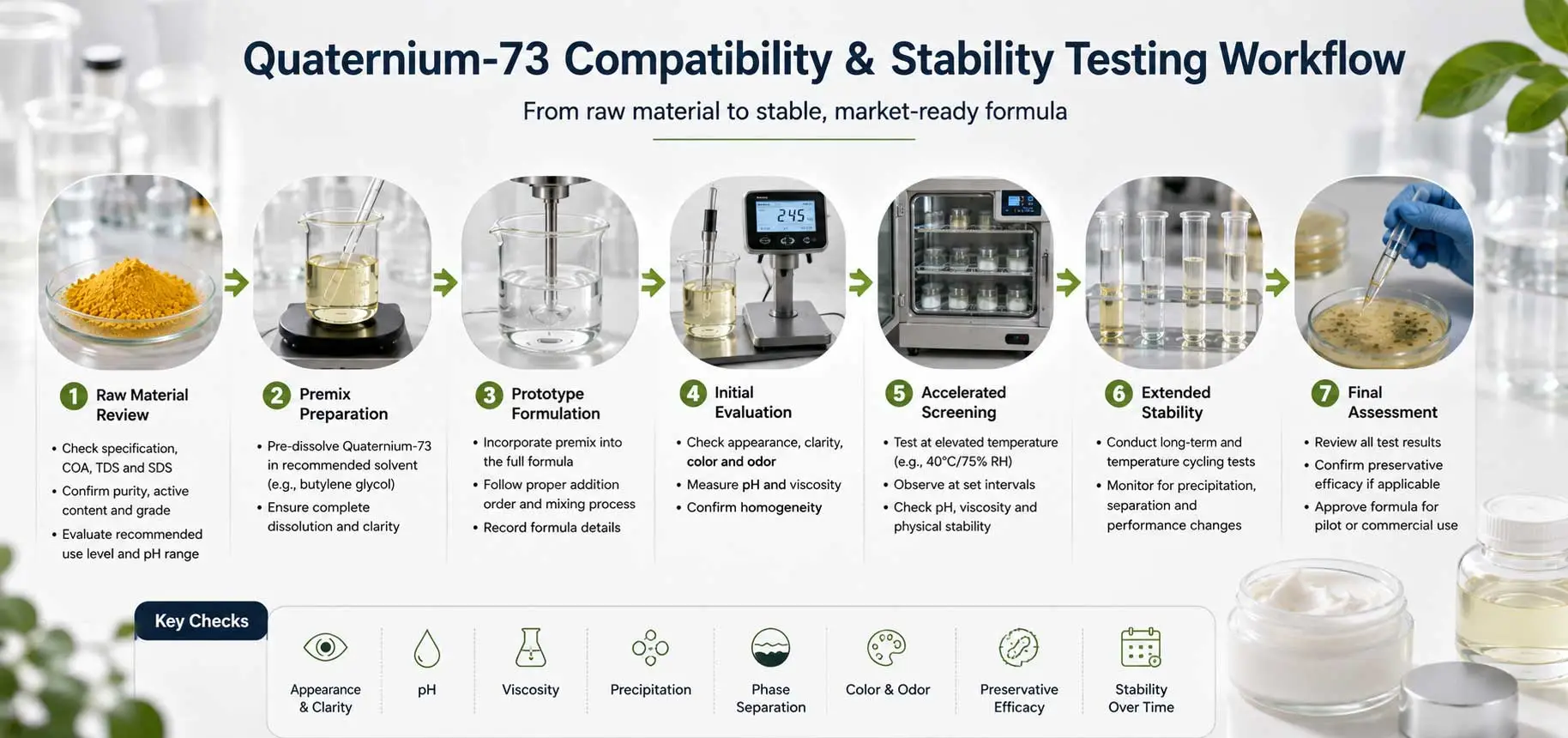
How Should Formulators Test Quaternium-73 Compatibility?
Reliable Quaternium-73 compatibility testing starts before the first full prototype is made.
Review the supplier specification and TDS first. Confirm identity, assay, recommended use level, solvent guidance, pH information and storage requirements. If a specific ingredient interaction is uncertain, a small-scale screening experiment can help identify obvious precipitation or color changes.
The decisive test, however, is the complete formulation.
A useful development sequence is:
raw-material review → premix trial → complete prototype → initial appearance/pH/viscosity → accelerated screening → temperature-cycle evaluation where appropriate → longer-term stability → microbiological validation where required
During Quaternium-73 stability testing, record more than whether the product separates. Depending on the product format, monitor:
clarity or haze, color, precipitation, crystallization, pH drift, viscosity change, sedimentation and phase separation.
For transparent toners and serums, small changes may be immediately visible. In opaque emulsions, rheology measurements and careful inspection may reveal problems that are difficult to see initially.
Compatibility testing should also use the intended commercial raw-material grade. A prototype developed with one supplier's sample should not automatically be assumed to validate another source.
Why Compatibility Data Matter When Choosing a Quaternium-73 Supplier
A technically useful Quaternium-73 supplier should be able to support formulation work with more than a purity number and quotation.
When qualifying a Quaternium-73 manufacturer or Quaternium-73 raw material supplier, buyers should ask for the current specification, batch COA and TDS and then determine whether the technical documentation addresses solvent selection, recommended use level, pH, storage and handling.
Useful questions include: Which carrier is recommended for pre-dissolution? Is there grade-specific pH guidance? Are there known formulation examples? What storage conditions apply? Can the supplier provide a representative sample from the same cosmetic grade Quaternium-73 intended for commercial supply?
For an R&D department, these answers are often more useful than a generic statement that the ingredient is “compatible with most cosmetic ingredients.”
The same standard should apply when comparing a CAS 15763-48-1 supplier with another source. Matching INCI and CAS identity establishes what the ingredient is; it does not establish identical batch specification, impurity profile or handling behavior.
What Should Buyers Request Before Purchasing Quaternium-73?
Before commercial approval, buyers should request a Quaternium-73 specification, current Quaternium-73 TDS, batch-specific Quaternium-73 COA and SDS, together with a representative sample where formulation qualification is required.
The specification establishes the supplier's quality requirements. The COA shows the results for an individual lot. The TDS should provide technical handling information, while the sample allows the buyer to verify the material in its own formula.
Where Quaternium-73 HPLC purity forms part of the purchase specification, buyers should also confirm that the analytical method and acceptance criterion correspond to the commercial grade being quoted.
A useful procurement sequence is therefore:
specification → TDS → COA → SDS → representative sample → formulation compatibility trial → supplier approval
This process reduces the risk of selecting a raw material based on Quaternium-73 price before determining whether it performs acceptably in the intended formulation.
Buying Quaternium-73 for Cosmetic Formulation
Companies preparing to buy Quaternium-73 should connect purchasing decisions to formulation qualification rather than treating them as separate processes.
For a new project, request technical documentation and a representative sample first. Complete the premix and Quaternium-73 formulation trial, confirm compatibility with the intended active ingredients and rheology system, and then move to pilot and commercial quantities after the formula has passed the company's internal evaluation.
CHEN LANG BIO TECH supplies Quaternium-73 raw material for cosmetic formulation projects and can provide buyers with current product specifications, COA, technical information, sample availability, packaging and commercial quotation.
For procurement teams evaluating where to buy Quaternium-73, bulk Quaternium-73, Quaternium-73 MOQ, Quaternium-73 price per kg or a long-term Quaternium-73 bulk supplier, the most useful comparison is one made between technically qualified grades rather than price quotations alone.
For current documentation or a sample request, contact admin@chenlangbio.com.
Quaternium-73 Compatibility FAQ
Can Quaternium-73 be used with niacinamide?
Yes, there is documented commercial co-use of Quaternium-73 and niacinamide. Current formulations list both ingredients together with glycols and other skincare components. This demonstrates practical formulation feasibility, although the finished product should still be validated for pH, appearance and stability.
Can Quaternium-73 be combined with salicylic acid?
Commercial formulations demonstrate that Quaternium-73 and salicylic acid can coexist in the same finished system. Because salicylic acid introduces important solvent and pH considerations, the combination should nevertheless be evaluated in the actual formula rather than assumed compatible at every concentration.
Is Quaternium-73 compatible with hyaluronic acid?
Finished-product ingredient disclosures show Quaternium-73 together with sodium hyaluronate, providing useful evidence for Quaternium-73 and hyaluronic acid formulations. Polymer grade, hydration procedure, ionic environment and viscosity should still be evaluated during development.
Can Quaternium-73 be formulated with Zinc PCA?
The combination appears in commercial formulation guidance, but strong direct compatibility studies are limited. Quaternium-73 and Zinc PCA should therefore be treated as a formulation combination requiring prototype validation, particularly where electrolyte-sensitive polymers or additional salts are present.
Is Quaternium-73 compatible with carbomer and xanthan gum?
Commercial formulations document Quaternium-73 alongside carbomer and other polymeric thickeners, supporting practical co-use. However, Quaternium-73 polymer compatibility remains dependent on polymer grade, neutralization, total electrolyte load and the complete rheology system.
What ingredients should not be mixed with Quaternium-73?
There is no reliable universal list of Quaternium-73 incompatible ingredients. Formulators should instead give additional attention to strongly ionic systems, high electrolyte loads, extreme pH, unsuitable solvent environments and electrolyte-sensitive rheology systems, then confirm compatibility in the complete prototype.
A Practical Approach to Quaternium-73 Compatibility
Current commercial formulations provide practical evidence that Quaternium-73 can be formulated alongside niacinamide, salicylic acid, sodium hyaluronate, glycols, several polymer systems and conventional preservative components. The important qualification is that documented co-use is not proof of universal compatibility. Concentration, pH, solvent selection, ionic strength, polymer choice and processing conditions determine how the complete system behaves.
For raw-material buyers, compatibility should therefore become part of supplier qualification. Reviewing the TDS and COA, testing a representative sample and validating the intended commercial formulation provide considerably more useful evidence than relying on a generic “compatible ingredients” list.
References
1. M.C. BIOTEC Inc. Quaternium-73 Product Data Sheet. Technical formulation guidance including 0.001–0.005% recommended dosage, pH 5.5–8.0 for the referenced grade, solvent information, premix guidance and application information.
2. U.S. National Library of Medicine, DailyMed. Product formulation record revised July 2025. Documents Quaternium-73 in a formula containing niacinamide, propylene glycol, butylene glycol, glycerin, panthenol, phenoxyethanol, ethylhexylglycerin, 1,2-hexanediol and an acrylate polymer.
3. U.S. National Library of Medicine, DailyMed. Product formulation record revised May 2026. Documents Quaternium-73 in a multi-active formulation containing salicylic acid, niacinamide, glycols, glycerin, phenoxyethanol and other formulation components.
4. U.S. National Library of Medicine, DailyMed. Acne Relief Cream formulation record, revised May 2026. Documents Quaternium-73 with salicylic acid, sodium hyaluronate, carbomer, hydroxyethylcellulose and other ingredients.
5. Gmaeum. HydraClear Acne Moisturizer. Commercial ingredient disclosure showing Quaternium-73 with niacinamide, salicylic acid, butylene glycol, propylene glycol, carbomer, ammonium acryloyldimethyltaurate/VP copolymer and sodium hyaluronate. Used as commercial formulation evidence rather than controlled compatibility research.
6. ZLEY Group. Technical/commercial discussion of Quaternium-73 combinations, including niacinamide and Zinc PCA. Used as supplier formulation guidance rather than proof of universal compatibility.

Send Inquiry
You may like
Related Industry Knowledge
- NAD Powder for Capsules: Formulation, Stability and Manufacturing Considerations
- Spermidine Trihydrochloride Bulk Price Guide: What Buyers Should Know
- Pelargonium Sidoides: Natural Support for Respiratory Health
- What are the Health Benefits of Mung Bean Peptide Powder?
- What Are the Potential Health Benefits of L-Ergothioneine?
- Is Minoxidil Powder Effective for Hair Regrowth?
- Is Ergothioneine A Longevity Vitamin
- Should Green Tea Extract be Taken with Food
- China Phellinus Linteus Extract Powder Supplier
- What is Ginger Extract Powder used for