
NAD Powder for Capsules: Formulation, Stability and Manufacturing Considerations
2026-08-17 10:54:05
NAD powder for capsules can be developed into a commercially practical supplement format, but successful encapsulation depends on much more than the purity stated on a raw-material specification. Once NAD⁺ moves from its original package into a capsule blend, manufacturers need to consider powder flow, bulk density, active loading, blend uniformity, excipient selection, capsule-shell characteristics, environmental exposure, filling performance and finished-product stability.
For supplement brands and contract manufacturers, the distinction is important: an NAD powder specification establishes requirements for the incoming ingredient, while the manufacturability and shelf life of the finished capsule must be demonstrated in the actual formulation. FDA dietary supplement CGMP guidance similarly distinguishes component, in-process, packaging and finished-product specifications rather than treating raw-material approval as sufficient evidence of finished-product quality.
NAD Powder for Capsules: What Should Manufacturers Evaluate Before Formulation?
A practical NAD capsule formulation starts with the finished-product target and works backward. Before selecting a commercial NAD⁺ grade, the development team should understand how much active material the formulation requires, what capsule format is planned, how much volume is available for excipients, and whether the resulting powder blend can be processed consistently on the intended equipment.
|
Factor |
Why It Matters in Capsule Manufacturing |
|
NAD⁺ identity and specification |
Establishes the incoming active material |
|
Assay and purity |
Supports raw-material release |
|
Particle characteristics |
Can affect flow, blending and segregation |
|
Bulk density |
Influences fill volume and capsule-size selection |
|
Flowability |
Affects dosing and fill-weight consistency |
|
Active loading |
Determines the remaining space for functional excipients |
|
Moisture |
Can influence powder behavior and stability |
|
Capsule shell |
Forms part of the finished-product environment |
|
Packaging |
Controls environmental exposure during shelf life |
The commercial objective is therefore not simply to obtain the highest stated NAD powder purity. Manufacturers need a material that meets the required chemical specification and can also be incorporated into a reproducible capsule process.
This becomes particularly important during supplier comparison. Two NAD⁺ materials carrying similar assay values may behave differently if their particle characteristics, moisture levels or physical properties differ. Those differences may not matter when reviewing a COA, but they can become significant when the material reaches the hopper of a capsule-filling machine.
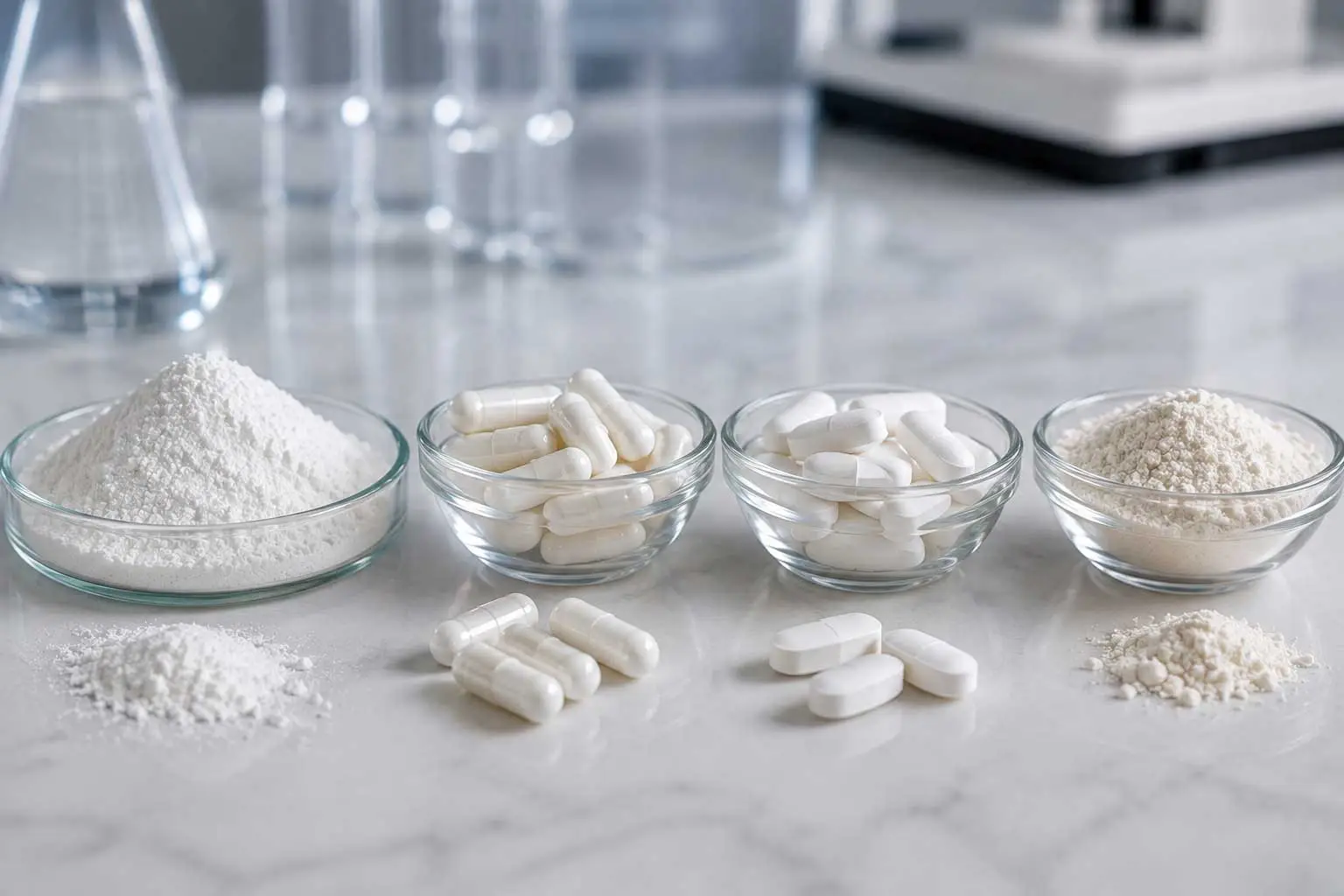
NAD Powder Specifications for Capsule Manufacturing: What Should Buyers Check?
Raw-material qualification should begin with identity. From there, buyers can evaluate assay or chromatographic purity, related substances and other quality parameters appropriate to the material and intended market.
NAD Powder Purity, Identity and Batch Specifications
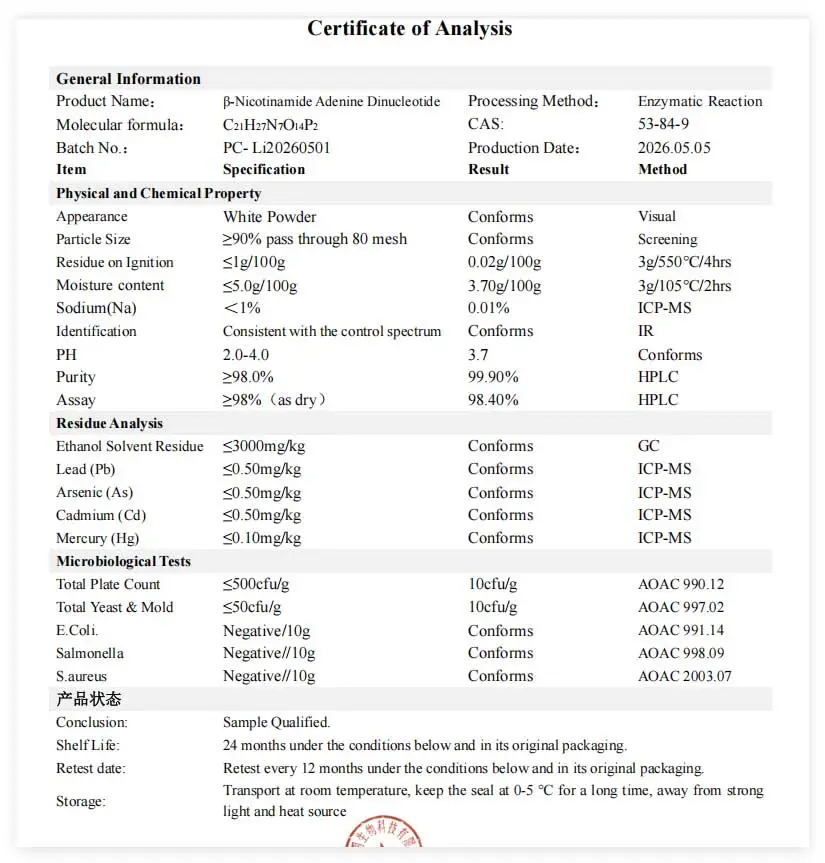
A commercial NAD powder COA should be evaluated against an established specification rather than read as an isolated list of numbers. Depending on the grade and quality program, relevant parameters may include identity, assay, chromatographic purity, water or moisture, related substances, residual solvents where applicable, heavy metals and microbiological requirements.
This is also where the meaning of “purity” matters. An HPLC area percentage and a quantitative assay are not automatically interchangeable measures. When comparing high purity NAD powder, buyers should understand the method behind the reported value and review the broader specification instead of ranking suppliers by a single percentage.
For products manufactured for the U.S. dietary supplement market, FDA's 21 CFR Part 111 framework requires manufacturers to establish specifications for components, in-process production, packaging and labeling, and finished batches. FDA also defines dietary supplement quality in terms of established specifications for identity, purity, strength, composition and contaminant limits.
Why Physical Powder Properties Matter Alongside NAD Purity
Chemical quality answers whether the raw material meets its compositional requirements. It does not tell an encapsulation team everything it needs to know about manufacturing behavior.
For NAD raw material for capsules, particle characteristics, NAD powder bulk density, tapped density where relevant, moisture and flow behavior can influence how easily the powder is blended, transferred and filled. These properties should be measured on the commercial material under consideration rather than inferred from NAD⁺ as a chemical compound.
A change of supplier or grade may therefore justify more than a paperwork update. If the physical characteristics change materially, the capsule formulation and filling process may need to be reassessed.
NAD Capsule Formulation: Active Loading, Fill Weight and Capsule Size
Once a target formulation has been defined, NAD capsule fill weight becomes a volumetric as well as a gravimetric problem.
How NAD Active Loading Affects Capsule Formulation
Suppose a product development team has already established the target amount of NAD⁺ per capsule. That target determines the mass of active material required, but it does not by itself determine the final fill volume.
The formulation may also require functional excipients to support flow, filling consistency or other manufacturing properties. Increasing NAD capsule active loading leaves less physical space for those excipients, while a lower active proportion may provide greater formulation flexibility.
This is why NAD powder capsule dosage should not be treated as a manufacturing specification in isolation. Consumer-facing serving size and manufacturing fill characteristics are different questions.
How Bulk Density Influences NAD Capsule Size
The relationship is straightforward:
mass does not equal volume.
A lower-density powder occupies more space at the same mass than a higher-density material. Consequently, NAD powder bulk density can influence the capsule size required to accommodate the intended active quantity plus excipients.
It would therefore be misleading to state that a particular milligram quantity of NAD⁺ always fits a particular capsule size. Actual fill volume depends on the measured properties of the complete formulation, not merely the weight of NAD⁺ on the Supplement Facts panel.
For commercial development, NAD capsule size should be selected using the target fill weight and measured formulation density, followed by practical filling trials on representative equipment.
NAD Powder Flowability and Blend Uniformity in Capsule Manufacturing
Powder behavior becomes particularly important as a formulation moves from hand-filled development capsules to automated production.
Why NAD Powder Flowability Matters During Encapsulation
Poor or inconsistent flow can interfere with hopper feeding and dosing, contributing to variations in fill performance. NAD powder flowability should therefore be considered in the context of the complete blend rather than the active ingredient alone.
Common powder-characterization tools include bulk and tapped density measurements, angle of repose, Hausner ratio and Carr's compressibility index. These measurements can help characterize a formulation, but no single number should be treated as a universal predictor of performance on every capsule-filling machine.
For an NAD capsule manufacturing process, what ultimately matters is whether the blend feeds reproducibly under the actual operating conditions. Filling speed, equipment design, powder residence time and environmental conditions can all affect practical performance.
Blend Uniformity and Segregation Risk in NAD Capsule Formulations
Good flow alone is not enough. The formulation must remain compositionally uniform.
Differences in particle size, density and morphology between NAD⁺ and excipients can contribute to segregation during blending, transfer, vibration or hopper residence. Mixing sequence and active-to-excipient ratio can also influence the behavior of the blend.
This creates an important distinction between NAD powder blending and successful commercial encapsulation. A sample collected immediately after laboratory mixing may appear homogeneous, yet the formulation can still segregate later during transfer or filling.
For that reason, NAD capsule blend uniformity should be evaluated in conjunction with the production process. The objective is not merely a homogeneous mixing vessel; it is consistent active distribution in the capsules leaving the machine.
Choosing Excipients for NAD Capsule Formulation
Excipients should have a defined technical purpose. They are not simply material added to fill unused capsule space.
Fillers, Glidants and Lubricants in NAD Capsules
A filler may help establish the required fill volume and influence bulk properties. A glidant may be considered where the blend requires improved flow, while lubricants or other processing aids may be selected to address equipment and manufacturing requirements.
The appropriate NAD capsule excipients therefore depend on what the formulation needs to accomplish.
Adding more excipients is not inherently better. Each additional material changes the physical composition of the blend and potentially its moisture environment, density and long-term behavior. Formulators should use the minimum complexity necessary to achieve a robust product rather than build a long excipient list without a clear manufacturing purpose.
Why NAD–Excipient Compatibility Should Be Tested
NAD powder excipient compatibility cannot be established simply by confirming that each component is individually stable.
Once ingredients are combined, moisture migration, local microenvironmental changes and physical interactions can create conditions that were absent in separate raw-material packages. This becomes more relevant in an NAD multi-ingredient capsule formulation containing vitamins, minerals, botanical extracts or other active ingredients.
The finished blend should therefore be evaluated as its own system. Compatibility work does not need to begin with the assumption that a particular excipient will damage NAD⁺; its purpose is to determine whether the proposed combination continues to meet the required specifications over time.
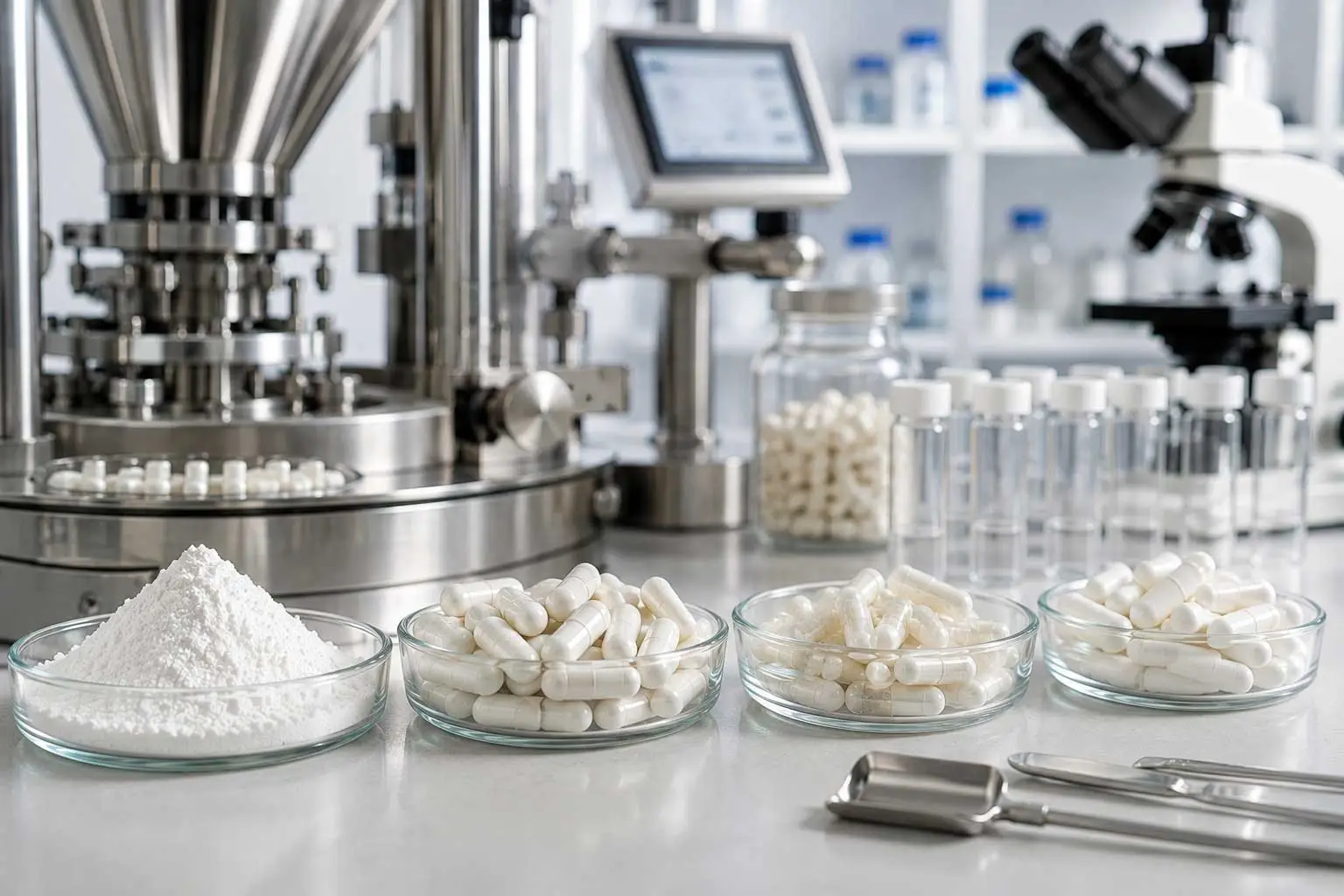
HPMC vs Gelatin Capsules for NAD Powder: What Should Manufacturers Consider?
The question of HPMC vs gelatin capsules for NAD cannot be answered reliably by declaring one shell material universally superior.
|
Consideration |
HPMC Capsules |
Gelatin Capsules |
|
Basic shell system |
Cellulose-derived polymer |
Gelatin-based |
|
Product positioning |
Commonly selected for vegetarian formulations |
Conventional hard-capsule option |
|
Shell properties |
Depend on the particular capsule specification |
Depend on the particular capsule specification |
|
Manufacturing suitability |
Requires evaluation with the formulation and equipment |
Requires evaluation with the formulation and equipment |
|
NAD⁺ stability |
Must be demonstrated in finished capsules |
Must be demonstrated in finished capsules |
For an NAD powder HPMC capsule, the manufacturer should review the actual shell supplier's technical specification and determine how the shell performs with the formulation under intended storage conditions. The same approach applies to NAD powder gelatin capsules.
Shell selection can affect product positioning and manufacturing decisions, but shell identity alone does not establish NAD capsule shell compatibility. The more defensible approach is to evaluate the proposed NAD blend, shell and final packaging as one finished-product system.
NAD Powder Stability in Capsules: Moisture, Temperature and Storage
Stability is where the distinction between raw material and finished capsule becomes especially important.
Raw NAD Powder vs NAD Blend vs Finished Capsule Stability
There are effectively three different stability environments:
raw NAD powder → NAD/excipient blend → filled capsule in its final package
Each step introduces new variables.
Published NAD stability research demonstrates why formulation environment matters. A validated RP-HPLC study found that NAD degradation in buffered solutions depended on the buffer system. More importantly for dry-product development, NAD incorporated into commercial dry test strips retained more than 80% of its initial level after three months at 50°C under the specific experimental conditions.
That result should not be interpreted as a shelf-life specification for NAD capsules. The formulation, matrix and packaging were entirely different. It does, however, provide useful evidence that NAD stability cannot be predicted from the molecule alone; the surrounding formulation and storage environment matter.
How Moisture Can Influence NAD Capsule Stability
For NAD capsule moisture stability, manufacturers should consider moisture from several sources: the NAD raw material, excipients, capsule shell, production environment and atmosphere entering the package during filling.
The important question is not whether “moisture is bad for NAD” as a general statement. It is whether moisture exposure under the actual manufacturing and storage conditions produces a measurable change in the finished product.
This distinction matters commercially because a formulation can remain acceptable in a controlled development environment but encounter different relative humidity during commercial manufacturing, transportation or consumer use.
Temperature and Finished NAD Capsule Shelf Life
Temperature should likewise be assessed over the entire product lifecycle, including manufacturing, warehouse storage and transportation.
A supplier's stated NAD powder shelf life applies to that raw material under the supplier's defined packaging and storage conditions. Once the material is blended, encapsulated and placed into a new packaging system, the basis for stability has changed.
Accordingly, NAD capsule shelf life should be supported by stability work on the finished capsule in the proposed commercial package rather than copied from the bulk ingredient's retest or expiry period.
NAD Capsule Manufacturing Process: From Blending to Encapsulation
A typical NAD capsule manufacturing process may involve raw-material release, dispensing, sieving where appropriate, pre-blending, final blending, encapsulation, in-process control, finished-product testing and packaging. The exact sequence should be determined by the formulation and manufacturing equipment rather than treated as a universal SOP.
From Raw Material Release to Encapsulation
Raw materials should first be released against established specifications. After dispensing, the process may require particle-size management or pre-blending depending on the characteristics and proportions of the components.
The final blend then needs sufficient uniformity and flow for the selected encapsulation equipment. During NAD powder encapsulation, excessive unnecessary handling should be avoided, and any process variables that could influence product quality should be identified and controlled.
For U.S. dietary supplements, FDA's CGMP framework requires master manufacturing records to include component quantities, relevant process specifications, sampling/testing procedures and other production controls.
In-Process Controls During NAD Capsule Filling
Commercial NAD capsule filling should be monitored through meaningful in-process controls rather than a generic statement that “strict QC” is performed.
Depending on the process, manufacturers may monitor fill weight, weight variation, capsule integrity, machine performance and environmental conditions, with samples taken at appropriate intervals.
USP General Chapter <2091> specifically provides procedures and limits for weight variation of dietary supplement capsules, tablets and chewable gels. Weight consistency, however, should not automatically be interpreted as proof of active-ingredient uniformity; that depends on the formulation and applicable analytical requirements.
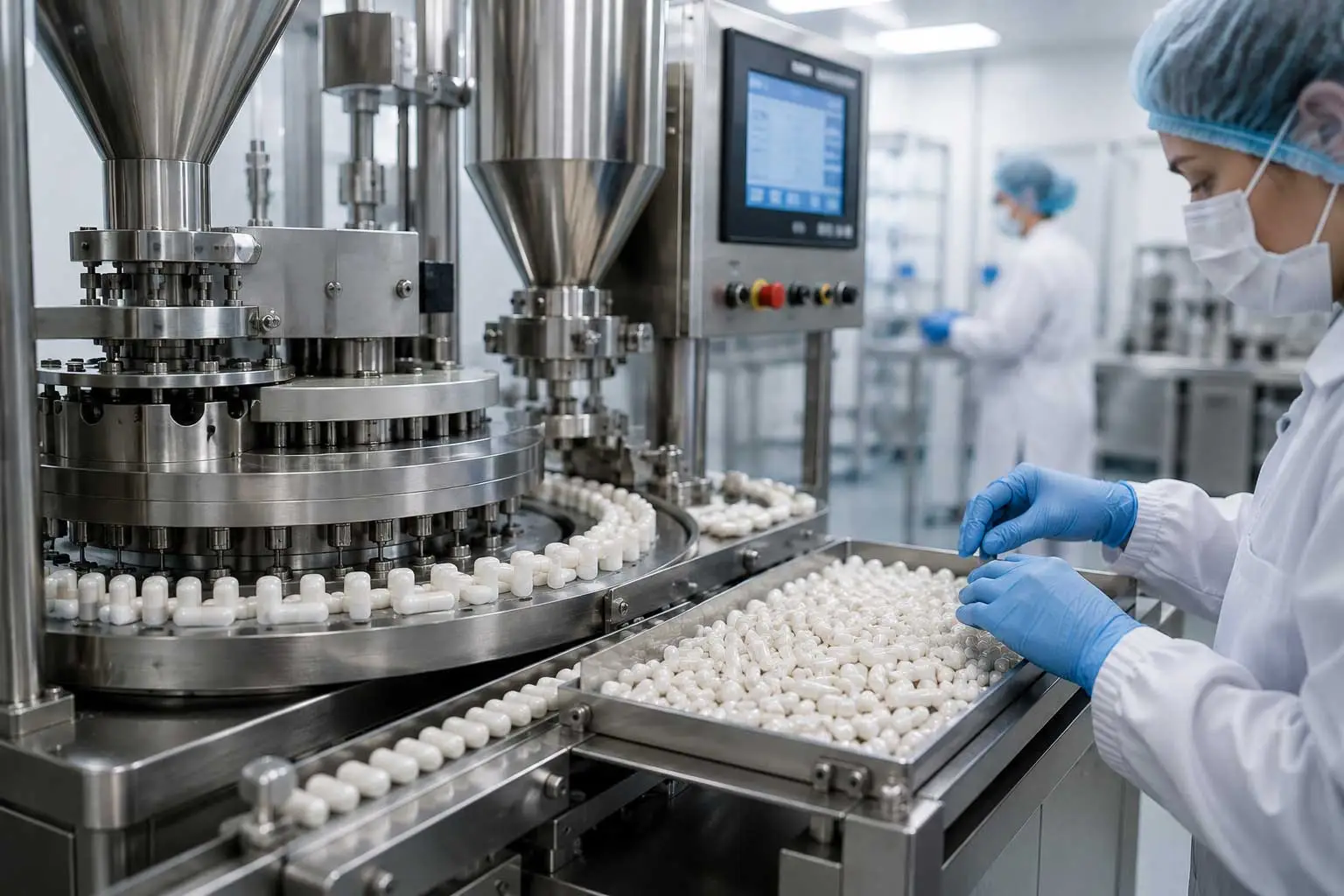
NAD Capsule Quality Control: Assay, Content Uniformity and Finished-Product Testing
An incoming NAD powder HPLC result answers a raw-material question. It does not automatically answer whether every finished capsule contains the intended amount of NAD⁺.
Raw Material Testing vs Finished NAD Capsule Testing
Raw-material testing may establish identity, assay or purity and other parameters required by the specification. Finished-product NAD capsule testing has a different objective: confirming that the manufacturing process has produced a product meeting its established finished specifications.
The analytical method also needs to work in the finished-product matrix. A method that separates NAD⁺ cleanly in raw powder may encounter interference or extraction challenges when fillers, other vitamins or botanical ingredients are present.
Published work has demonstrated RP-HPLC separation of NAD from degradation products including ADP-ribose and nicotinamide, illustrating the value of stability-indicating analytical methods where degradation needs to be monitored.
Why Content Uniformity Matters in NAD Capsules
NAD capsule content uniformity becomes particularly relevant when the active is not distributed consistently throughout the blend.
USP <905> recognizes content uniformity and weight variation as distinct approaches to dosage-unit uniformity and notes that content uniformity can be applied in all cases; its harmonized framework also sets conditions under which weight variation can be used for hard capsules.
For supplement development, the broader principle is useful: consistent capsule weight does not by itself prove consistent NAD content when the blend can segregate. Formulation homogeneity, filling performance and an appropriate NAD capsule assay should therefore be considered together.
NAD Capsule Packaging: Bottles, Blisters and Moisture Protection
Packaging should be selected after considering the stability requirements of the finished formulation, not simply because a particular format is conventional in the supplement market.
Bottle vs Blister Packaging for NAD Capsules
Bottle packaging can be efficient for commercial production and consumer use, but opening the container repeatedly exposes the remaining capsules to the surrounding atmosphere. Blister packaging can provide individual-unit separation, although actual protection depends on the barrier properties of the materials and package design.
Therefore, a NAD capsule bottle packaging versus NAD capsule blister packaging decision should compare barrier performance, intended shelf life, consumer use, manufacturing capability, market requirements and cost.
Neither format should automatically be described as the best packaging for NAD capsules without stability data.
When Should Desiccants or High-Barrier Packaging Be Considered?
A desiccant or higher-barrier material may be useful when moisture control is supported by formulation and stability requirements. It should not be added simply because the active ingredient is NAD⁺.
FDA CGMP guidance requires dietary supplements and components to be held under appropriate temperature, humidity and light conditions so their identity, purity, strength and composition are not affected. The packaging system should support those requirements throughout commercial distribution and storage.
Scaling NAD Capsule Production from Pilot Batch to Commercial Manufacturing
A formulation that performs well during manual or small-scale encapsulation may behave differently on high-speed commercial equipment.
During NAD capsule scale-up, changes in batch size, mixer geometry, transfer distance, blending time, hopper residence time and filling speed can alter powder behavior. Environmental exposure can also increase simply because a commercial batch remains in production longer.
Why NAD Capsule Formulations Should Be Evaluated at Pilot Scale
A representative NAD capsule pilot batch provides a bridge between bench development and full commercial production. It allows the manufacturer to assess whether the blend remains homogeneous during realistic transfer and filling operations and whether capsule weights and analytical results remain consistent throughout the run.
The development pathway can therefore proceed logically:
raw-material sample → formulation trial → pilot blending → pilot encapsulation → analytical evaluation → stability program → commercial manufacturing
What Can Change During Commercial Scale-Up?
Flow and segregation deserve particular attention. A blend that feeds smoothly through a small laboratory filler may behave differently in a larger hopper, while vibration and longer residence times can reveal segregation tendencies that were not apparent during development.
This is why NAD commercial capsule manufacturing should be based on demonstrated process performance rather than a direct multiplication of laboratory batch quantities.
How to Choose NAD Powder for Commercial Capsule Manufacturing
Selecting NAD powder for capsule manufacturing should begin with technical qualification.
Buyers should confirm ingredient identity, review the specification and representative COA, understand how assay and purity are determined, and examine relevant moisture and physical-property information. Once the documentation is acceptable, the actual material should be evaluated in the intended formulation.
Why an NAD Powder Sample Should Be Tested Before Bulk Purchasing
An NAD powder sample is most valuable when it is part of a defined development program. It can be used for incoming analytical evaluation, powder characterization, blending trials, encapsulation tests and preliminary stability work.
That produces a more rational commercial sequence:
technical documentation → sample → formulation → pilot encapsulation → QC/stability review → supplier approval → bulk purchasing
For a manufacturer considering bulk NAD powder for capsules, this process reduces the risk of committing to inventory before determining whether the commercial grade works in the intended product.
Choosing an NAD Powder Supplier for Capsule Production
Supplier qualification should address both ingredient quality and the ability to support repeat commercial production.
A prospective NAD powder supplier for capsules should be able to provide a current specification, representative quality documentation and information needed to understand the grade being offered. Where available and relevant, physical-property information can also help formulation teams anticipate manufacturing requirements.
What Capsule Manufacturers Should Ask an NAD Powder Supplier
Beyond the specification and NAD powder COA, procurement teams should discuss sample availability, standard packaging, storage conditions, shelf life, batch consistency and production lead time. For recurring commercial programs, supply capacity and the ability to maintain the agreed specification across lots become increasingly important.
Commercial questions such as NAD powder MOQ and NAD powder price make more sense after the technical grade has been identified. A lower quotation offers little advantage if changing material properties later require reformulation or additional process work.
From NAD Powder Sample to Commercial Capsule Production
Brands planning to buy NAD powder in bulk can request a quotation once the required grade, approximate quantity and destination are known. Packaging requirements, documentation and shipping arrangements can then be incorporated into the commercial discussion rather than treated as afterthoughts.
At CHEN LANG BIO TECH, new capsule projects generally begin with the specification and representative documentation, followed by an NAD powder sample where formulation evaluation is required. Providing the intended capsule format, approximate raw-material requirement and destination market helps us address the actual technical and supply requirements of the project instead of starting with a generic NAD powder quotation.
FAQ About NAD Powder for Capsule Manufacturing
Can NAD powder be formulated into capsules?
Yes. NAD powder for capsules can be evaluated for hard-capsule formulations, but commercial suitability depends on the actual material and formulation. Powder flow, density, active loading, excipients, shell selection, encapsulation performance and finished-product stability should be assessed before commercial production.
What affects NAD powder flow during capsule filling?
NAD powder flowability can be influenced by particle characteristics, bulk density, moisture and the other components in the blend. Equipment design and manufacturing conditions also matter, which is why flow should ultimately be evaluated using the finished blend under representative encapsulation conditions.
How is the right capsule size selected for an NAD formulation?
NAD capsule size should be selected using the target active amount, total formulation fill weight and measured density or filling behavior of the complete blend. Active weight alone is insufficient because two powders with the same mass can occupy different volumes.
Are HPMC or gelatin capsules better for NAD powder?
There is no universal answer to HPMC vs gelatin capsules for NAD. HPMC can support vegetarian product positioning, while gelatin remains a widely used conventional capsule material. Technical selection should consider the actual shell specification, manufacturing process, formulation and finished-product stability rather than assuming that one shell is inherently more stable for NAD⁺.
What affects the shelf life of NAD capsules?
NAD capsule shelf life depends on the complete system: NAD raw material, excipients, capsule shell, moisture exposure, temperature, packaging and storage conditions. The raw ingredient's shelf life should not simply be transferred to the finished capsule.
Should manufacturers test an NAD powder sample before commercial encapsulation?
For a new supplier or formulation, testing an NAD powder sample is a sensible qualification step. It allows analytical and formulation work to be completed before a substantial bulk NAD powder order is placed and can identify flow, blending or encapsulation issues while they are still relatively inexpensive to address.
Building a Stable and Scalable NAD Capsule Product
Successful NAD capsule manufacturing connects raw-material quality with powder behavior, formulation design, encapsulation performance and finished-product stability. A high-purity NAD⁺ ingredient may fully meet its incoming specification while still requiring formulation work to achieve the flow, fill consistency, content uniformity and shelf-life performance expected in commercial production.
The most reliable development path is therefore sequential: qualify the raw material, characterize the formulation, test representative samples, confirm the encapsulation process at an appropriate scale and establish finished-product quality and stability before recurring production. Brands and capsule manufacturers evaluating NAD⁺ can contact CHEN LANG BIO TECH for current specifications, representative documentation and sample information. Sharing the planned capsule format, expected raw-material requirement and destination market allows the discussion to focus on the practical requirements of the formulation and supply program.
References
1. U.S. Food and Drug Administration. Small Entity Compliance Guide: Current Good Manufacturing Practice in Manufacturing, Packaging, Labeling, or Holding Operations for Dietary Supplements. Guidance addressing 21 CFR Part 111, including component, in-process and finished-product specifications, supplier qualification and quality-control requirements.
2. United States Pharmacopeia. General Chapter <905> Uniformity of Dosage Units. USP–NF. The chapter describes content uniformity and weight variation approaches for dosage-unit uniformity and is harmonized with corresponding European and Japanese Pharmacopoeia texts.
3. United States Pharmacopeia. General Chapter <2091> Weight Variation of Dietary Supplements. USP–NF. Provides procedures and limits for permissible weight variation of dietary supplement capsules, tablets and chewable gels.
4. Forrow J, Shabir GA. Development and Validation of a HPLC Method for NAD: Application to Stability Studies in Buffered Solutions and Dry Test Strips. Journal of Liquid Chromatography & Related Technologies. 2009;32(19):2807–2821. The validated RP-HPLC method separated NAD from degradation products; dry NAD-containing test strips retained more than 80% NAD after three months at 50°C under the experimental conditions.

Send Inquiry
Related Industry Knowledge
- Inside Scoop: Fucoidan Powder’s Role in UV Skin Defense
- Oleuropein Powder: A Rising Star in the Botanical Extract Industry
- Health Benefits of Pelargonium Sidoides Extract
- Is Hops Safe for the Liver
- What is the Difference Between Curcumin and Tetrahydrocurcuminoids
- How to Make Tadalafil Powder: A Step-by-Step Guide
- How to Use Monobenzone Powder
- Is Magnesium Ascorbyl Phosphate the Same as Vitamin C
- How Is Polyphenol Good for You
- Honeysuckle Extract for Skin