
Tranexamic Acid vs Vitamin C: Which Ingredient Should Skincare Brands Choose?
2026-07-28 15:29:20
Introduction: Choosing Between Two Widely Used Cosmetic Active Ingredients
Tranexamic acid vs vitamin c is a common comparison among skincare brands and cosmetic formulators developing advanced active ingredient-based products. Both ingredients have become widely recognized in modern skincare formulations, but they represent different approaches to cosmetic product development. Tranexamic Acid is an amino acid derivative with unique physicochemical properties, while Vitamin C refers to a group of antioxidant ingredients with different chemical forms and stability profiles.
For professional formulators, the decision is not simply about choosing the ingredient with greater market popularity. The more important consideration is how each ingredient behaves inside a complete formulation system. Factors such as solubility, pH requirements, oxidation stability, processing conditions, packaging selection, and raw material consistency all influence the final product design.
A brand developing a lightweight serum may evaluate ingredients differently from a company creating a daily moisturizer or a multifunctional skincare product. Therefore, the comparison between tranexamic acid vs vitamin c should be based on formulation objectives rather than a simple ranking of ingredient performance.
Tranexamic Acid is often evaluated by manufacturers because of its good water solubility and compatibility with many aqueous cosmetic systems. Vitamin C, especially L-ascorbic acid, is valued for its antioxidant properties but requires more careful control during formulation because of its sensitivity to environmental factors.
For companies sourcing active ingredients internationally, choosing the right raw material supplier is also an important part of product development. A reliable tranexamic acid powder supplier should provide consistent quality, technical documentation, and stable supply support to help manufacturers move from laboratory testing to commercial production.
This guide compares Tranexamic Acid and Vitamin C from a cosmetic formulation perspective, focusing on the technical factors that skincare brands and R&D teams should consider before selecting an active ingredient.

What Is Tranexamic Acid as a Cosmetic Ingredient?
Tranexamic acid cosmetic ingredient refers to Tranexamic Acid supplied for use in cosmetic and personal care formulations. Chemically, Tranexamic Acid is a synthetic amino acid derivative related to lysine metabolism. Unlike botanical extracts that contain multiple naturally occurring compounds, Tranexamic Acid is a defined single compound with a consistent molecular structure.
For cosmetic manufacturers, this standardized chemical profile provides advantages during formulation development because the ingredient characteristics are easier to evaluate and reproduce between different production batches.
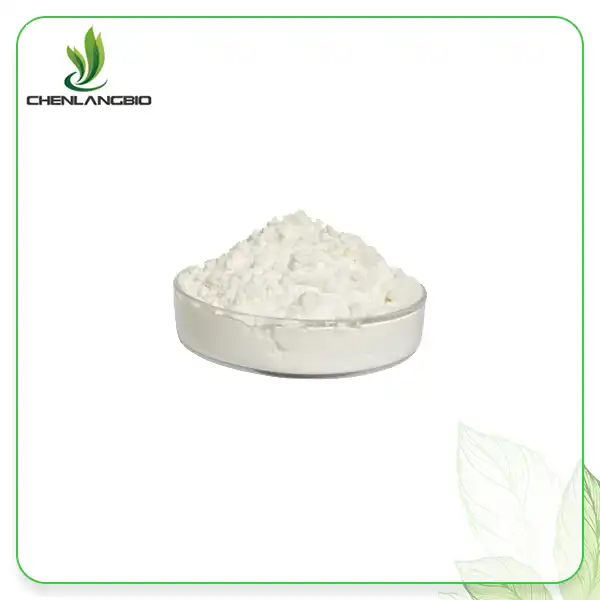
The raw material is commonly supplied as a white crystalline powder and is mainly considered for water-based skincare formulations. Due to its hydrophilic structure, it can be incorporated into products such as serums, essences, lotions, and other aqueous systems.
When evaluating cosmetic grade tranexamic acid, professional buyers usually consider more than the ingredient name. They evaluate purity, analytical data, solubility characteristics, documentation, and whether the supplier can maintain consistent quality for long-term manufacturing.
Chemical Characteristics and Formulation Properties of Tranexamic Acid
The basic physicochemical properties of Tranexamic Acid influence how it behaves during cosmetic manufacturing.
|
Parameter |
Tranexamic Acid |
|
Chemical name |
trans-4-(aminomethyl)cyclohexane carboxylic acid |
|
CAS number |
1197-18-8 |
|
Molecular formula |
C8H15NO2 |
|
Molecular weight |
157.21 g/mol |
|
Appearance |
White crystalline powder |
|
Solubility |
Freely soluble in water |
|
Ingredient classification |
Synthetic amino acid derivative |
The molecular weight of Tranexamic Acid is relatively low compared with many cosmetic actives, and its chemical structure contributes to its strong affinity with water. This property is important because many modern skincare products are developed as water-based systems where active ingredients must dissolve evenly and remain stable throughout manufacturing and storage.
For formulators developing tranexamic acid formulation systems, water solubility is one of the practical advantages of this ingredient. It allows the ingredient to be incorporated into the aqueous phase of many cosmetic products without requiring complicated solubilization strategies.
However, solubility alone does not determine formulation success. During commercial development, manufacturers also need to evaluate how the ingredient interacts with other components, including preservatives, moisturizers, thickeners, and additional active ingredients.
Water Solubility and Processing Considerations of Tranexamic Acid
One of the reasons Tranexamic Acid attracts attention from cosmetic manufacturers is its favorable dissolution behavior.
According to technical references, Tranexamic Acid is freely soluble in water, with reported water solubility of approximately 167 mg/mL at 20°C. This characteristic makes it suitable for many lightweight skincare systems where the active ingredient is introduced into the water phase.
For example, when developing a serum containing tranexamic acid powder, formulators generally consider:
•how quickly the powder dissolves;
•whether complete dispersion is achieved;
•whether the ingredient remains stable after processing;
•how it interacts with other water-soluble ingredients.
A laboratory formula may appear successful at a small scale, but commercial production requires additional consideration because mixing efficiency, batch size, and manufacturing equipment can influence the final product.
For this reason, manufacturers sourcing from a professional tranexamic acid manufacturer often require not only product specifications but also technical information that supports scale-up production.
pH Compatibility of Tranexamic Acid in Cosmetic Formulations
Tranexamic acid formulation development also requires attention to pH because the final environment of a cosmetic product affects ingredient stability and compatibility.
Tranexamic Acid aqueous solutions generally show a mildly acidic to near-neutral pH profile. A typical 1% aqueous solution is commonly reported within approximately pH 6.5–8.0, although the exact value depends on concentration and testing conditions.
Compared with some acidic cosmetic actives, this pH profile provides flexibility when designing different skincare systems. However, professional formulators do not evaluate pH based on one ingredient alone. The final product pH must be optimized according to the complete formulation, including other active ingredients and the preservation system.
For example, a formula containing multiple active ingredients may require additional stability testing to confirm that all components remain compatible during storage.
This is why experienced cosmetic manufacturers evaluate both ingredient properties and supplier reliability when selecting raw materials. A qualified cosmetic ingredient supplier should provide accurate technical information to support formulation decisions.
Why Tranexamic Acid Is Considered in Modern Skincare Development
The role of Tranexamic Acid in cosmetic development is closely related to its formulation flexibility. Unlike some ingredients that require specific delivery systems or strict processing environments, Tranexamic Acid can be considered for a variety of water-based skincare formats.
From a manufacturing perspective, its advantages are mainly related to:
•predictable chemical identity;
•water compatibility;
•formulation flexibility;
•stable raw material supply.
For skincare brands, these characteristics are important because successful product development requires not only an interesting ingredient concept but also a reliable path from R&D testing to commercial manufacturing.
A professional cosmetic raw material supplier supports this process by providing consistent material quality and the documentation needed for product approval and production planning.
What Is Vitamin C as a Cosmetic Ingredient?
Vitamin C cosmetic ingredient is one of the most widely recognized active ingredients in modern skincare formulations. However, unlike Tranexamic Acid, Vitamin C is not a single chemical entity. In cosmetic manufacturing, the term “Vitamin C” may refer to pure L-ascorbic acid or various stabilized derivatives developed to improve formulation compatibility.
For skincare manufacturers, understanding the specific form of Vitamin C is essential because different derivatives have different chemical properties, including solubility, stability, pH requirements, and processing considerations.
The most commonly discussed form is L-ascorbic acid, which is the pure form of Vitamin C. Other derivatives, such as sodium ascorbyl phosphate, magnesium ascorbyl phosphate, and ascorbyl glucoside, are often selected by formulators because they offer different stability profiles and formulation flexibility.
Therefore, when comparing tranexamic acid vs vitamin c, it is important to clarify which Vitamin C form is being evaluated. Comparing Tranexamic Acid with pure L-ascorbic acid is different from comparing it with a stabilized Vitamin C derivative.
For brands sourcing vitamin c ingredient supplier materials, the choice of Vitamin C form directly affects the product development strategy, manufacturing process, and final product positioning.
Chemical Characteristics and Formulation Properties of Vitamin C
Among different Vitamin C forms, L-ascorbic acid remains the most studied and commonly referenced form in cosmetic science.
Its basic physicochemical characteristics are:
|
Parameter |
L-ascorbic acid |
|
Chemical name |
Ascorbic acid |
|
CAS number |
50-81-7 |
|
Molecular formula |
C6H8O6 |
|
Molecular weight |
176.12 g/mol |
|
Appearance |
White to slightly yellow crystalline powder |
|
Solubility |
Soluble in water |
|
Typical formulation pH |
Approximately 2.5–3.5 |
The molecular structure of L-ascorbic acid gives it strong reducing properties, which is also the reason it requires careful handling during formulation. The same chemical activity that makes it valuable as a cosmetic ingredient also makes it more sensitive to environmental conditions.
Unlike tranexamic acid powder, which generally shows good stability in suitable aqueous systems, pure Vitamin C requires greater attention to oxidation control.
Why Vitamin C Formulation Requires More Stability Control
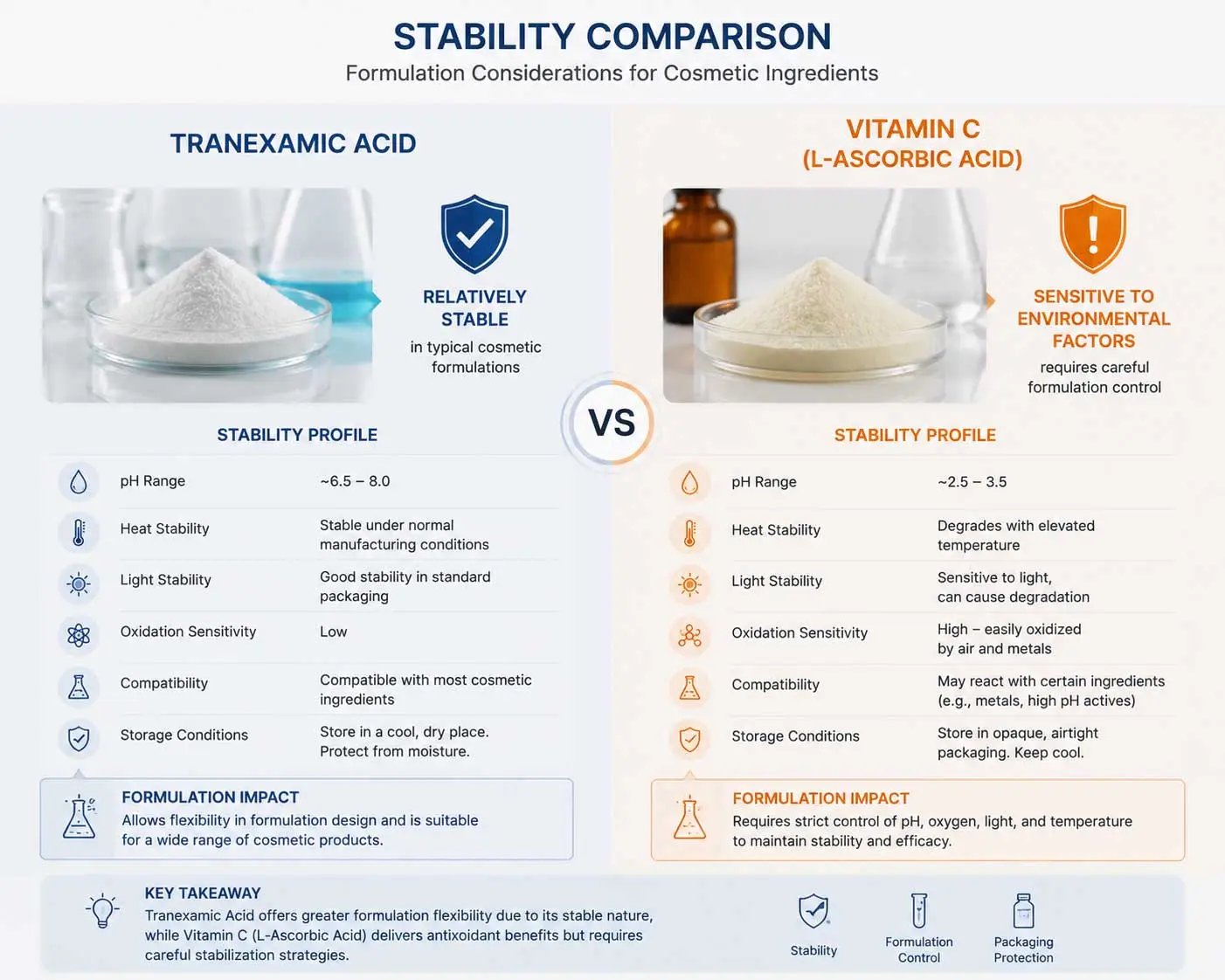
The main challenge with vitamin c skincare formulation is not simply dissolving the ingredient. The greater challenge is maintaining stability throughout the product lifecycle.
L-ascorbic acid is sensitive to several environmental factors, including:
•oxygen exposure;
•light exposure;
•elevated temperature;
•unsuitable pH conditions;
•interaction with certain metal ions.
During manufacturing and storage, oxidation may lead to color changes and reduced ingredient stability. Therefore, formulators often need to consider packaging design, antioxidant systems, manufacturing environment, and storage conditions.
For example, many Vitamin C serums use:
•opaque packaging;
•airless containers;
•controlled filling conditions.
These considerations increase the technical requirements for commercial production.
By comparison, tranexamic acid formulation generally involves fewer oxidation-related challenges, although pH compatibility and ingredient interaction still require evaluation.
This difference is one of the main reasons why skincare brands evaluate both ingredients carefully before selecting an active ingredient strategy.
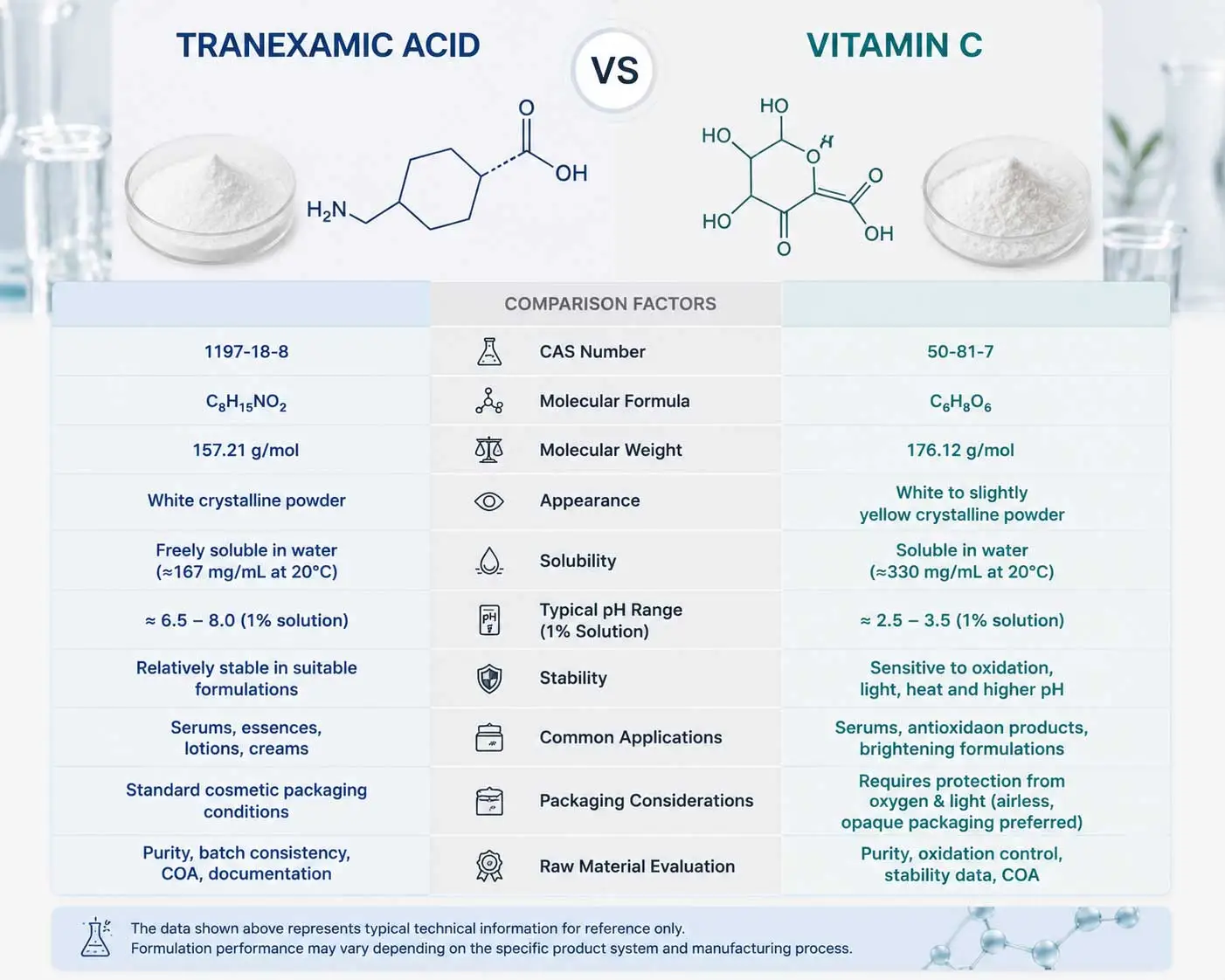
Tranexamic Acid vs Vitamin C: Technical Comparison for Cosmetic Formulators
The comparison between tranexamic acid vs vitamin c should be based on formulation characteristics rather than simply market popularity.
Both ingredients can be used in skincare products, but they require different approaches during development and manufacturing.
|
Evaluation factor |
Tranexamic acid |
Vitamin C (L-ascorbic acid) |
|
Ingredient type |
Synthetic amino acid derivative |
Antioxidant vitamin |
|
CAS number |
1197-18-9 |
50-81-7 |
|
Molecular formula |
C8H15NO2 |
C6H8O6 |
|
Molecular weight |
157.21 g/mol |
176.12 g/mol |
|
Appearance |
White crystalline powder |
White crystalline powder |
|
Water solubility |
Freely soluble in water |
Soluble in water |
|
Typical pH range |
Approximately 6.5–8.0 |
Approximately 2.5–3.5 |
|
Main formulation challenge |
Compatibility optimization and formula stability |
Oxidation control and stability protection |
|
Common product formats |
Serums, essences, lotions, creams |
Serums, antioxidant-focused products |
|
Packaging considerations |
Standard cosmetic packaging systems |
Often requires protection from oxygen and light |
|
Raw material evaluation |
Purity, COA, batch consistency |
Purity, oxidation stability, storage requirements |
How pH Differences Influence Formulation Design
One of the most significant differences between these ingredients is their preferred formulation environment.
Tranexamic acid formulation typically works within a near-neutral pH environment. A 1% aqueous solution is commonly reported around pH 6.5–8.0, allowing compatibility with many water-based cosmetic systems.
L-ascorbic acid, however, requires a more acidic environment. Many stable L-ascorbic acid formulations are developed around pH 2.5–3.5 because the ingredient becomes less stable as pH increases.
This difference has practical implications for formulators.
A near-neutral active ingredient may allow broader compatibility with moisturizers, humectants, and other cosmetic components. A low-pH Vitamin C formula may require more careful selection of supporting ingredients to maintain stability.
For this reason, choosing between these ingredients is not only about ingredient performance; it is also about whether the ingredient fits the desired formulation architecture.
Solubility and Processing Differences
Both Tranexamic Acid and Vitamin C are water-soluble ingredients, but their processing requirements are different.
For tranexamic acid powder, the primary processing consideration is usually achieving complete dissolution and maintaining uniform distribution throughout the formula.
For Vitamin C, dissolution is only the first step. The manufacturing process must also minimize oxidation during:
•mixing;
•filling;
•storage.
This difference becomes particularly important when scaling from laboratory batches to commercial production.
A formula that performs well during small-scale testing may require additional optimization when produced in larger quantities because exposure time, mixing conditions, and oxygen contact may change.
Therefore, professional manufacturers evaluate not only ingredient properties but also manufacturing feasibility.
Recommended Usage Level and Product Development Considerations
In cosmetic formulations, both ingredients are typically used within specific concentration ranges depending on product objectives and regulatory requirements.
Tranexamic Acid is commonly evaluated around 1–5% in cosmetic formulations, while L-ascorbic acid formulations often use higher concentrations depending on product design and stability strategy.
However, concentration alone does not determine formula quality. Increasing active content may also increase formulation challenges, including stability, texture, and manufacturing control.
Experienced formulators consider:
•active ingredient concentration;
•supporting ingredients;
•packaging system;
•stability testing results.
For companies sourcing cosmetic active ingredient supplier partners, technical support and raw material consistency are important factors when selecting ingredients for commercial products.
Which Ingredient Should Skincare Brands Choose: Tranexamic Acid or Vitamin C?
The choice between tranexamic acid vs vitamin c depends largely on the product strategy rather than the ingredient itself. Both ingredients have established positions in cosmetic formulation, but they solve different formulation challenges.
For a skincare brand, selecting an active ingredient is usually connected with several practical questions:
•What type of product is being developed?
•What formulation environment is required?
•How much stability control can the manufacturing process support?
•What ingredient positioning matches the target market?
A brand developing a stable daily-use serum may have different priorities from a brand creating a premium antioxidant-focused product. Therefore, the decision should be based on the entire product concept, including formulation design, manufacturing capability, and supply chain reliability.
When Tranexamic Acid May Be the Preferred Choice
Manufacturers often evaluate tranexamic acid formulation when they are looking for an active ingredient with good water compatibility and relatively flexible formulation characteristics.
Because Tranexamic Acid is freely soluble in water and generally compatible with near-neutral formulation systems, it can be considered for various water-based skincare formats, including:
•lightweight serums;
•essences;
•lotions;
•cream formulations.
From a manufacturing perspective, one of the practical advantages of Tranexamic Acid is that it does not typically require the same level of oxidation protection as pure L-ascorbic acid. This can simplify certain aspects of production, especially for brands developing formulas that need longer storage stability.
However, this does not mean that Tranexamic Acid can simply be added to any formula without testing. Professional formulators still evaluate:
•final formula pH;
•compatibility with other actives;
•preservative system;
•storage stability.
For brands sourcing cosmetic grade tranexamic acid, the quality and consistency of the raw material remain important because commercial production requires the same ingredient performance from one batch to another.
When Vitamin C May Be the Preferred Choice
Vitamin C remains one of the most recognized cosmetic active ingredients, particularly for brands building products around antioxidant positioning.
However, selecting Vitamin C requires a deeper understanding of the specific form being used.
Pure L-ascorbic acid offers a strong scientific background, but it also presents formulation challenges because of its sensitivity to oxidation. Brands using L-ascorbic acid often need to consider:
•oxygen exposure;
•packaging protection;
•formula color stability;
•storage conditions.
For this reason, some manufacturers choose stabilized Vitamin C derivatives instead, such as sodium ascorbyl phosphate or ascorbyl glucoside, depending on the desired product characteristics.
A vitamin c ingredient supplier should provide clear information about the specific Vitamin C form, because different derivatives have different formulation behaviors.
The choice of Vitamin C is therefore not simply a choice of ingredient name. It is a choice of chemical form, stability profile, and manufacturing approach.
Can Tranexamic Acid and Vitamin C Be Used Together in Skincare Formulations?
Tranexamic acid and vitamin c compatibility is a topic that many formulators consider when developing multi-active skincare products.
In theory, both ingredients can be evaluated within the same product concept, but successful combination depends on the specific Vitamin C form and the complete formula system.
The main challenge is that different Vitamin C derivatives behave differently.
For example:
•L-ascorbic acid requires an acidic environment and careful oxidation control;
•Tranexamic Acid is generally compatible with a more neutral pH range.
When combining these ingredients, formulators usually need to evaluate:
•final pH balance;
•stability over time;
•packaging requirements;
•interaction with other ingredients.
The goal is not simply to include more active ingredients, but to create a stable formulation where each component remains suitable throughout the product lifecycle.
For this reason, professional cosmetic manufacturers normally conduct compatibility testing before moving a combined active formula into commercial production.
Raw Material Selection: Why Supplier Quality Matters
The comparison between tranexamic acid vs vitamin c is often discussed from a formulation perspective, but commercial manufacturers also need to consider raw material sourcing.
A technically suitable ingredient can still create challenges if the supplier cannot maintain consistent quality.
When evaluating a cosmetic raw material supplier, manufacturers usually review:
|
Evaluation area |
Importance for manufacturers |
|
Raw material purity |
Ensures consistent formulation performance |
|
Batch consistency |
Supports repeatable commercial production |
|
COA documentation |
Helps quality departments complete approval procedures |
|
Analytical testing |
Confirms ingredient identity and specifications |
|
Supply capability |
Supports long-term production planning |
For companies planning regular purchases of bulk tranexamic acid powder, supplier stability becomes especially important. A skincare product may remain on the market for years, and manufacturers need confidence that the raw material quality will remain consistent throughout the product lifecycle.
A professional tranexamic acid powder supplier should provide not only the ingredient but also the technical support required for international cosmetic manufacturing.
Frequently Asked Questions About Tranexamic Acid vs Vitamin C
Is Tranexamic Acid better than Vitamin C for skincare formulations?
Tranexamic acid vs vitamin c is not a simple comparison of which ingredient is better. They have different chemical characteristics and formulation requirements. Tranexamic Acid may offer advantages in certain water-based systems, while Vitamin C remains widely used in antioxidant-focused formulations.
The appropriate choice depends on the product concept, stability requirements, and manufacturing strategy.
What is the main difference between Tranexamic Acid and Vitamin C?
The main difference is their chemical nature and formulation behavior.
Tranexamic Acid is an amino acid derivative with good water compatibility and a near-neutral formulation profile.
Vitamin C, especially L-ascorbic acid, is an antioxidant vitamin compound that requires more attention to oxidation control and acidic formulation conditions.
Can Tranexamic Acid and Vitamin C be combined?
Some formulations may consider combining these ingredients, but compatibility depends on the Vitamin C form, formula pH, stability requirements, and processing conditions.
A complete stability evaluation is necessary before commercial production.
Which ingredient is easier to formulate?
The answer depends on the formulation system. Tranexamic Acid is generally easier to incorporate into water-based systems because of its solubility and stability characteristics.
Pure L-ascorbic acid requires more careful handling because oxidation control and packaging protection are important parts of product development.
Where can manufacturers buy Tranexamic Acid powder?
Companies looking to buy tranexamic acid powder should evaluate suppliers based on quality consistency, documentation, testing capability, and long-term supply reliability. A qualified tranexamic acid supplier can provide specifications, COA, samples, and commercial supply support.
Conclusion: Selecting the Right Active Ingredient Requires a Formulation-Based Approach
The comparison of tranexamic acid vs vitamin c shows that both ingredients have important roles in modern skincare development, but they are suited to different formulation strategies.
Tranexamic Acid offers advantages related to water compatibility, formulation flexibility, and stable raw material characteristics. Vitamin C remains a highly recognized active ingredient, but its formulation requires careful attention to oxidation control, pH, and packaging.
For skincare brands, the best choice is not determined by ingredient popularity alone. It depends on the product concept, technical requirements, manufacturing process, and the reliability of the raw material supplier.
Working with an experienced cosmetic active ingredient supplier helps manufacturers obtain consistent materials, complete documentation, and technical support throughout product development. Please feel free contact us Email: admin@chenlangbio.com if you need more information about tranexamic acid powder.
References
1. Pullar, J. M., Carr, A. C., & Vissers, M. C. M. (2017). The roles of vitamin C in skin health. Nutrients, 9(8), 866.
2. Telang, P. S. (2013). Vitamin C in dermatology. Indian Dermatology Online Journal, 4(2), 143–146.
3. Pinnell, S. R., Yang, H., Omar, M., et al. (2001). Topical L-ascorbic acid: Percutaneous absorption studies. Dermatologic Surgery, 27(2), 137–142.
4. Ebrahimi, B., & Naeini, F. F. (2014). Topical tranexamic acid as a promising treatment for melasma. Journal of Research in Medical Sciences, 19(8), 753–757.
5. Tse, T. W., & Hui, E. (2013). Tranexamic acid: An important emerging treatment option for melasma. Journal of Clinical and Aesthetic Dermatology, 6(11), 26–30.
6. Pazyar, N., Yaghoobi, R., & Kazerouni, A. (2017). Tranexamic acid in dermatology: A review of its mechanisms and applications. Dermatologic Therapy, 30(6), e12586.
7. Draelos, Z. D. (2008). Cosmetic Dermatology: Products and Procedures. Wiley-Blackwell.

Send Inquiry
_1747705745203.webp "Natural Beta Glucan")
Related Industry Knowledge
- How Ashwagandha Extract Supports Testosterone and Sports Nutrition Applications
- How to Choose a Reliable Hydrolyzed Keratin Powder Supplier
- Is Madecassoside Suitable for Sensitive Skin
- How to Formulate Bakuchiol Serum for Cosmetic Applications
- Why Oleuropein Powder Beats Traditional Antioxidants in Formulations?
- Benefits of Helichrysum Arenarium Flower Extract
- What are Hops Flavonoids
- What Does Andrographolide Do for Your Skin
- Are Camellia Oleifera and Camellia Japonica Seed Oil the Same
- Latest Discovery: Hydrogel Dressings Containing NMN May Accelerate the Healing of Diabetic Ulcers