
Tranexamic Acid for Skin Whitening Formulations: What Cosmetic Manufacturers Should Know
2026-07-30 16:19:09
Understanding the Role of Tranexamic Acid in Modern Cosmetic Formulations
Tranexamic acid for skin whitening formulations has become an important topic among skincare brands that are developing active ingredient-based products. However, from a cosmetic manufacturing perspective, selecting Tranexamic Acid is not simply about following an ingredient trend. The decision involves understanding how the raw material behaves inside a formulation, whether it fits the intended product system, and whether the ingredient can maintain consistent quality during commercial production.
In professional skincare development, an active ingredient must meet several requirements before it becomes part of a finished product. The ingredient needs to demonstrate suitable physicochemical properties, reliable batch consistency, and compatibility with other components used in the formula.
Tranexamic acid in skincare is considered by many formulators because it has a clearly defined molecular structure, good water solubility, and relatively straightforward handling characteristics compared with some actives that require complex delivery systems. These characteristics allow formulation teams to evaluate it in different cosmetic systems while focusing on the overall balance of stability, texture, and product performance.
For companies sourcing tranexamic acid powder supplier the quality of the raw material is equally important as the ingredient itself. A manufacturer developing a commercial skincare product needs confidence that the material tested during the development stage will perform consistently when production expands from laboratory batches to larger manufacturing volumes.
Therefore, ingredient selection and supplier selection are closely connected. A reliable tranexamic acid manufacturer should provide not only a specification sheet but also consistent quality control, analytical documentation, and technical information that supports formulation development.
What Is Tranexamic Acid as a Cosmetic Ingredient?
Tranexamic acid cosmetic ingredient refers to Tranexamic Acid supplied for use in cosmetic and personal care formulations. Chemically, Tranexamic Acid is a synthetic derivative of lysine, an amino acid, with the chemical name trans-4-(aminomethyl)cyclohexane carboxylic acid.
Unlike botanical extracts, which may contain numerous naturally occurring compounds with potential variation between batches, Tranexamic Acid is a single defined compound. This characteristic provides a more predictable raw material profile, which is valuable for manufacturers seeking consistency in commercial skincare production.
The ingredient is generally supplied as a white crystalline powder. Its hydrophilic structure contributes to its strong compatibility with water-based formulation environments, allowing cosmetic developers to evaluate it in products where the active ingredient needs to be uniformly distributed throughout the aqueous phase.
For a brand developing a new skincare formula, the question is not only whether Tranexamic Acid can be incorporated into the product. The more important consideration is whether it remains stable and compatible after being combined with other components, including moisturizers, preservatives, emulsifiers, and additional active ingredients.
This is why companies looking for cosmetic grade tranexamic acid usually review more than the ingredient name. They evaluate analytical data, purity consistency, documentation quality, and whether the supplier can support long-term commercial supply.
Chemical Properties of Tranexamic Acid Powder and Their Importance in Formulation
Understanding the physicochemical characteristics of tranexamic acid powder helps formulators predict how the ingredient will behave during production.
|
Parameter |
Tranexamic Acid |
|
Chemical name |
trans-4-(aminomethyl)cyclohexane carboxylic acid |
|
CAS number |
1197-18-8 |
|
Molecular formula |
C8H15NO2 |
|
Molecular weight |
157.21 g/mol |
|
Appearance |
White crystalline powder |
|
Ingredient type |
Synthetic amino acid derivative |
|
Water solubility |
Freely soluble in water |
|
Typical aqueous solution pH |
Approximately 6.5–8.0 |
The relatively small molecular structure and hydrophilic characteristics of Tranexamic Acid contribute to its good water compatibility. For formulation scientists, this property affects how the ingredient can be introduced into a formula and how easily a uniform solution can be achieved during processing.
However, solubility should not be viewed as the only indicator of formulation suitability. In commercial cosmetic production, the ingredient must also perform consistently under real manufacturing conditions.
Factors such as raw material purity, particle characteristics, production temperature, mixing conditions, and interaction with other ingredients may influence the final product quality.
For this reason, experienced manufacturers evaluate both the chemical properties of the ingredient and the reliability of the supplier behind it. A qualified cosmetic ingredient supplier should provide sufficient technical information to help customers optimize formulation design and avoid unnecessary adjustments during scale-up.
Water Solubility and Processing Considerations of Tranexamic Acid
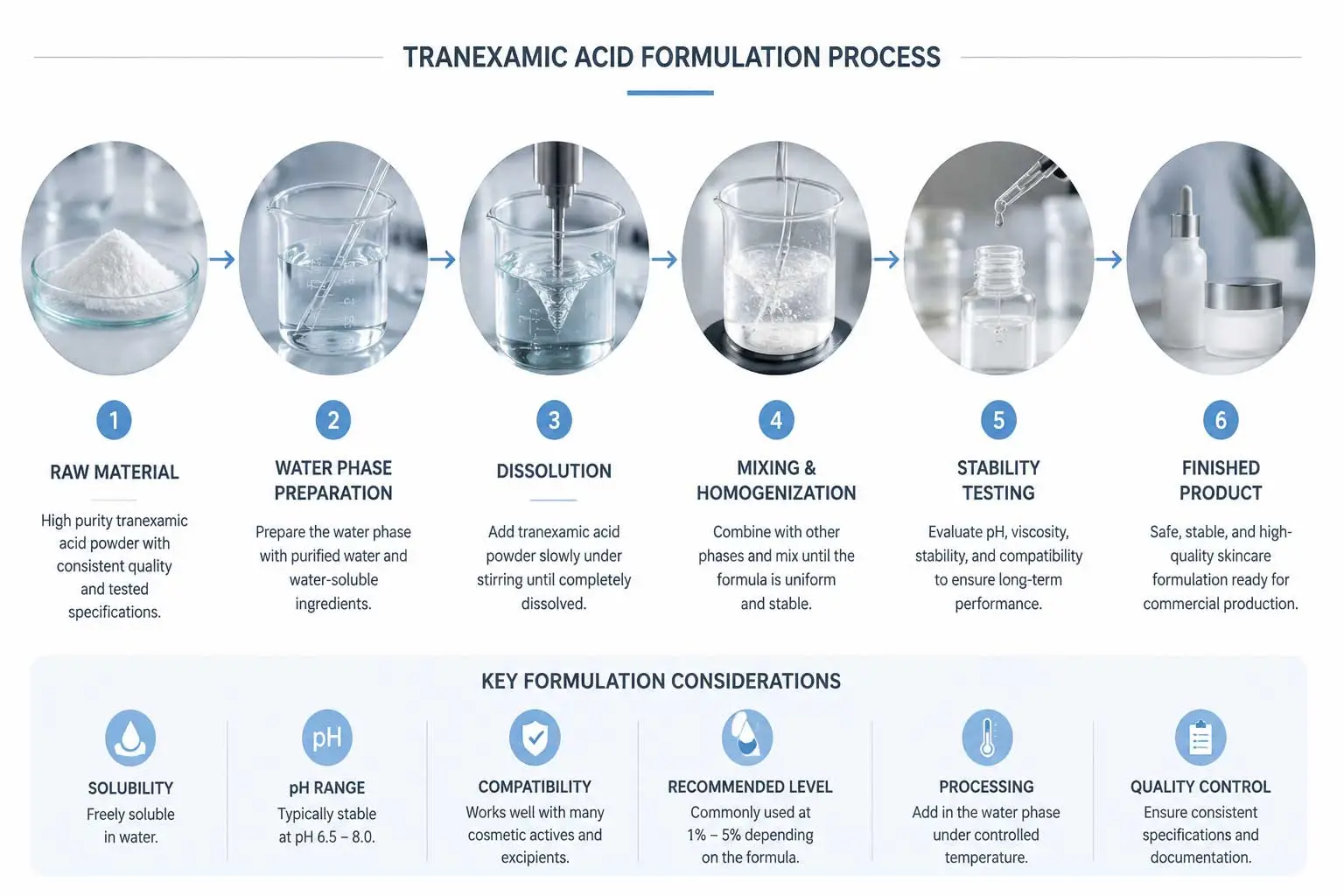
One of the main technical advantages of Tranexamic Acid is its favorable water solubility. According to available technical references, Tranexamic Acid is freely soluble in water, with reported solubility of approximately 167 mg/mL at 20°C.
For cosmetic developers, this means the ingredient can generally be incorporated into the aqueous phase without requiring advanced solubilization technologies. However, successful processing depends on more than simply adding powder into water.
During manufacturing, formulators need to consider how quickly the material dissolves, whether complete dispersion is achieved, and whether the ingredient remains evenly distributed throughout the finished product.
These considerations become more important when moving from laboratory development to industrial production. A small-scale formulation prepared under controlled conditions may behave differently when produced in larger batches because mixing efficiency, processing time, and equipment conditions can change.
For companies purchasing bulk tranexamic acid powder, stable raw material characteristics are essential because consistent ingredient behavior helps manufacturers maintain product quality across multiple production cycles.
pH Compatibility of Tranexamic Acid in Cosmetic Formulas
Tranexamic acid pH compatibility is another important factor during formulation development.
Tranexamic Acid aqueous solutions generally show a mildly acidic to near-neutral pH profile. A typical 1% aqueous solution is commonly reported around pH 6.5–8.0, depending on concentration and analytical conditions.
This characteristic gives formulators flexibility when designing cosmetic systems because many skincare formulas operate within mildly acidic or near-neutral environments. However, the raw material pH should not be considered separately from the final product.
Once Tranexamic Acid is combined with other functional ingredients, the complete formulation environment becomes the determining factor. Preservatives, antioxidants, botanical components, and other active ingredients may influence the final stability profile.
Therefore, manufacturers typically evaluate the complete formula through stability testing rather than relying only on individual ingredient specifications.
How Tranexamic Acid Is Considered in Cosmetic Formulation Development
When developing a skincare product containing tranexamic acid formulation, cosmetic manufacturers need to evaluate the ingredient as part of a complete formulation system rather than as an isolated active component.
In commercial skincare development, an ingredient must work together with the entire formula architecture. The performance of a finished product depends on how the active ingredient interacts with water phase components, humectants, preservatives, emulsifiers, stabilizers, and other functional ingredients.
Because Tranexamic Acid has good water compatibility and a defined chemical structure, it is often considered by formulators who are developing aqueous-based skincare products. However, successful incorporation requires appropriate processing control and stability evaluation.
For example, when a formulation team develops a serum containing Tranexamic Acid, the main technical questions are not simply whether the ingredient can dissolve. The development team also needs to understand whether the ingredient remains stable throughout manufacturing, filling, storage, and the expected shelf life of the final product.
This approach is especially important for international skincare brands because commercial products require consistent performance across thousands or even millions of units. A formulation that performs well in laboratory testing must also remain reliable when transferred to large-scale production.
How Tranexamic Acid Is Incorporated Into Skincare Formulas
The incorporation process of tranexamic acid powder depends on the overall formula design. Since Tranexamic Acid is highly water soluble, it is commonly evaluated as part of the aqueous phase during formulation development.
In a typical water-based system, the formulation team considers several practical aspects:
•the sequence of ingredient addition;
•the temperature during processing;
•mixing efficiency;
•final concentration;
•compatibility with other ingredients.
The purpose of these evaluations is not only to achieve dissolution but also to ensure that the ingredient is evenly distributed throughout the product.
For example, when manufacturing a serum at laboratory scale, a formulator may achieve complete dissolution under controlled mixing conditions. However, during commercial production, larger batch volumes and different equipment conditions may influence the dissolution process.
Therefore, manufacturers sourcing from a professional tranexamic acid powder supplier usually value suppliers who can provide consistent particle characteristics, reliable specifications, and technical information that supports production optimization.
Recommended Usage Level of Tranexamic Acid in Cosmetic Formulations
The appropriate concentration of tranexamic acid formulation depends on the product category, formula structure, regulatory requirements, and the role of the ingredient within the product concept.
In cosmetic applications, Tranexamic Acid is commonly evaluated at approximately 1–5%, although the final usage level should be determined through formulation testing rather than selected only based on a target percentage.
A common mistake in cosmetic development is assuming that a higher active ingredient concentration automatically creates a better product. In reality, increasing concentration may also influence:
•formula stability;
•sensory properties;
•ingredient compatibility;
•manufacturing difficulty.
For example, a serum designed with multiple active ingredients requires a different optimization approach compared with a simple single-active formula. The formulation team must balance ingredient concentration with overall product performance.
For brands purchasing cosmetic grade tranexamic acid, having access to accurate technical specifications helps R&D teams determine the appropriate formulation strategy.
Compatibility of Tranexamic Acid With Other Cosmetic Ingredients
One of the most important considerations in modern skincare development is how an active ingredient behaves when combined with other ingredients.
Tranexamic acid compatibility is frequently evaluated because many commercial skincare products contain multiple active components rather than a single ingredient.
Tranexamic Acid vs Niacinamide
Niacinamide is one of the most commonly used cosmetic actives, and many formulators evaluate its compatibility with Tranexamic Acid.
Both ingredients are water soluble, which provides flexibility when designing aqueous formulations. However, compatibility depends on the complete formula environment, including:
•final pH;
•ingredient concentration;
•preservative system;
•storage stability.
The fact that two ingredients are individually stable does not automatically guarantee that every combination will perform identically in every formulation. Proper stability testing remains necessary before commercial production.
Tranexamic Acid vs Vitamin C
The combination of Tranexamic Acid with Vitamin C requires additional consideration because Vitamin C exists in different chemical forms.
Pure L-ascorbic acid typically requires a lower pH environment and is more sensitive to oxidation, while Tranexamic Acid is generally evaluated in a near-neutral formulation environment.
Therefore, when developing a formula containing both ingredients, formulators need to consider:
•the specific Vitamin C derivative used;
•final formula pH;
•packaging protection;
•oxidation stability.
This is why technical evaluation is essential when combining multiple active ingredients.
For manufacturers exploring tranexamic acid and vitamin c compatibility, the focus should be on formulation balance rather than simply combining popular ingredients.
Tranexamic Acid vsAlpha Arbutin
Alpha Arbutin is another ingredient commonly considered in formulas designed around skin tone-related product concepts.
Both Tranexamic Acid and Alpha Arbutin are water-soluble ingredients, but they have different molecular structures and stability considerations.
When combining these ingredients, formulators usually evaluate:
•pH conditions;
•processing temperature;
•concentration balance;
•long-term stability.
A successful multi-active formula depends on how the ingredients perform together, not only on the individual characteristics of each ingredient.
Manufacturing Considerations During Commercial Production
Moving from laboratory development to commercial manufacturing is one of the most important stages in cosmetic product development.
A formula that works in a small laboratory sample may require additional optimization before large-scale production.
For products containing tranexamic acid in skincare, manufacturers commonly evaluate:
Raw Material Dispersion and Mixing
Consistent mixing is important because uneven distribution of active ingredients may affect batch uniformity.
Processing Temperature
Although Tranexamic Acid has good stability characteristics, production conditions should still be controlled to protect the overall formula system.
Stability Testing
Commercial products usually undergo stability evaluation under different storage conditions to confirm that appearance, texture, and ingredient consistency remain acceptable over time.
For a reliable tranexamic acid manufacturer, understanding these manufacturing requirements is important because customers need more than a raw material supplier. They need a partner who understands how ingredient quality affects final product development.
Why Supplier Quality Matters in Tranexamic Acid Formulation
For cosmetic manufacturers, ingredient selection and supplier selection are closely connected.
A high-quality raw material provides a more predictable foundation for formulation development. Differences in purity, analytical testing, and batch consistency may influence how efficiently a formula can be developed and reproduced.
When evaluating a cosmetic raw material supplier, manufacturers typically consider:
|
Evaluation factor |
Why it matters |
|
Purity consistency |
Supports predictable formulation performance |
|
COA documentation |
Helps quality approval and internal review |
|
Analytical testing |
Confirms raw material identity and specifications |
|
Batch consistency |
Supports commercial manufacturing |
|
Supply capability |
Ensures long-term production continuity |
For companies planning regular procurement of bulk tranexamic acid powder, supplier reliability becomes a critical part of the overall business strategy.
What Cosmetic Manufacturers Should Evaluate Before Purchasing Tranexamic Acid Powder
For companies planning to source tranexamic acid powder, the purchasing decision should not be based only on price or availability. In professional cosmetic manufacturing, raw material selection is closely connected with formulation reproducibility, regulatory documentation, and long-term production stability.
A qualified supplier should provide a consistent raw material profile that allows formulation teams to develop products with confidence. Even when two suppliers provide Tranexamic Acid with the same CAS number, differences in manufacturing processes, quality control systems, and analytical verification may influence the practical performance of the ingredient.
Before approving a supplier, cosmetic manufacturers usually evaluate several technical aspects.
The first consideration is purity and specification consistency. A stable purity profile helps R&D teams maintain the same formulation performance when moving from laboratory samples to commercial production. The second consideration is documentation quality. International customers typically require reliable documents, including Certificate of Analysis (COA), specification sheets, and analytical information, before completing supplier approval.
For brands purchasing cosmetic grade tranexamic acid, supply capability is also important. A formulation that succeeds during product development must be supported by a stable supply chain once the product enters commercial production.
This is why many skincare brands prefer working with a specialized [Anchor: tranexamic acid supplier] that understands both ingredient quality requirements and cosmetic manufacturing needs.
Frequently Asked Questions About Tranexamic Acid in Cosmetic Formulations
How is Tranexamic Acid used in skincare formulations?
Tranexamic acid in skincare is mainly evaluated as a water-compatible active ingredient for cosmetic formulation development. Because of its good solubility and defined chemical structure, it can be incorporated into many aqueous skincare systems when appropriate processing and stability evaluation are applied.
The actual formulation approach depends on the product type, ingredient combination, pH environment, and manufacturing process.
What is the typical usage level of Tranexamic Acid in cosmetics?
The commonly evaluated range for tranexamic acid formulation is approximately 1–5%, depending on the formula design, product category, and regulatory requirements of different markets.
The final concentration should be determined through formulation testing rather than simply selecting the highest possible level. A successful product requires a balance between ingredient concentration, stability, sensory properties, and manufacturing feasibility.
Can Tranexamic Acid be combined with other cosmetic active ingredients?
Yes, Tranexamic Acid can be considered together with other cosmetic actives, but compatibility depends on the complete formulation system.
For example, when combining Tranexamic Acid with niacinamide, vitamin C derivatives, or Alpha Arbutin, formulators need to evaluate pH compatibility, ingredient stability, and long-term storage performance.
A combination of multiple active ingredients does not automatically improve a formula. The final product quality depends on whether the ingredients remain stable and compatible throughout the product lifecycle.
What should manufacturers look for in a Tranexamic Acid supplier?
When selecting a tranexamic acid powder supplier, manufacturers should evaluate more than product pricing.
Important factors include:
•consistent raw material quality;
•complete technical documentation;
•reliable analytical testing;
•stable production capability;
•experience supplying cosmetic manufacturers.
For international skincare brands, a supplier’s ability to provide accurate information and maintain consistent batches is essential for long-term cooperation.
Conclusion: Building Reliable Skincare Formulations With Quality Tranexamic Acid
The application of tranexamic acid for skin whitening formulations requires a formulation-based approach rather than simply adding an active ingredient into a product concept. For cosmetic manufacturers, the success of a formula depends on understanding ingredient properties, controlling processing conditions, evaluating compatibility, and selecting a reliable raw material partner.
Tranexamic Acid offers several formulation advantages, including good water solubility, a defined chemical structure, and compatibility with many aqueous skincare systems. However, professional product development still requires careful evaluation of pH, stability, manufacturing conditions, and ingredient interactions.
For companies sourcing bulk tranexamic acid powder, supplier capability is an important part of the product development process. Consistent quality, complete documentation, and technical support help manufacturers move efficiently from formulation research to commercial production.
As a professional cosmetic raw material supplier, CHEN LANG BIO TECH focuses on providing stable-quality ingredients, technical documentation, and reliable supply solutions for global skincare manufacturers.
References
1. Ebrahimi, B., & Naeini, F. F. (2014). Topical tranexamic acid as a promising treatment for melasma. Journal of Research in Medical Sciences, 19(8), 753-757.
2. Tse, T. W., & Hui, E. (2013). Tranexamic acid: An important emerging treatment option for melasma. Journal of Clinical and Aesthetic Dermatology, 6(11), 26-30.
3. Pazyar, N., Yaghoobi, R., & Kazerouni, A. (2017). Tranexamic acid in dermatology: A review of its mechanisms and applications. Dermatologic Therapy, 30(6), e12586.
4. Lee, J. H., Park, J. G., Lim, S. H., Kim, J. Y., Ahn, S. G., & Park, Y. M. (2016). Localized topical tranexamic acid for the treatment of melasma: A randomized controlled trial. Journal of Dermatological Treatment, 27(6), 508-513.
5. Pilbrant, Å., Schannong, M., & Vessman, J. (1981). Pharmacokinetics and bioavailability of tranexamic acid after oral administration. European Journal of Clinical Pharmacology, 20, 65-72.
6. European Pharmacopoeia Commission. (2023). Tranexamic Acid Monograph. European Pharmacopoeia.
7. United States Pharmacopeial Convention. (2023). Tranexamic Acid Monograph. United States Pharmacopeia.
8. Draelos, Z. D. (2008). Cosmetic Dermatology: Products and Procedures. Wiley-Blackwell.

Send Inquiry
Related Industry Knowledge
- Madecassoside vs Centella Asiatica Extract: What’s the Real Difference
- Levodopa Powder CAS 59-92-7: Secure Your API Supply for the Aging Population Boom
- DHEA Powder MOQ and Bulk Pricing Guide for International Buyers
- Why Sea Buckthorn Oligopeptide is Essential for Gut Health?
- What is EGCG Green Tea Extract
- Does Bakuchiol Build Collagen
- How Long Does Praziquantel Stay Active in Water
- Is lysozyme Safe
- What is Saw Palmetto Extract Powder Used for
- Is it Safe to use Hyaluronic Acid Powder Cosmetic Grade Every Day