
Madecassoside vs Centella Asiatica Extract: What’s the Real Difference
2025-12-29 17:03:46
Madecassoside vs centella asiatica extract is a comparison that frequently arises during ingredient selection for cosmetic and personal care formulations, yet the distinction between the two is often misunderstood. Although both originate from Centella asiatica, they represent fundamentally different ingredient forms with implications for formulation design, specification control, and product positioning.
From our experience working with international cosmetic brands and formulators, questions around the difference between madecassoside and Centella Asiatica extract typically surface when teams move from concept development to scale-up. At this stage, assumptions based solely on plant origin are no longer sufficient. Decisions must account for composition, purity, consistency, and how an ingredient behaves within a finished formulation.
Madecassoside is commonly recognized as a defined active compound, while centella asiatica extract is a complex botanical matrix containing multiple triterpenes and supporting components. Treating these two materials as interchangeable can lead to challenges in standardization, performance consistency, and regulatory alignment. Understanding madecassoside vs Centella Asiatica extract from a manufacturing and application perspective helps clarify why each ingredient serves a different role in modern cosmetic formulations.
In this article, we examine the real differences between madecassoside and centella asiatica extract, focusing on composition, production methods, formulation behavior, and sourcing considerations. Our goal is to provide a practical framework that supports informed decision-making for brands and formulators seeking clarity beyond ingredient names.
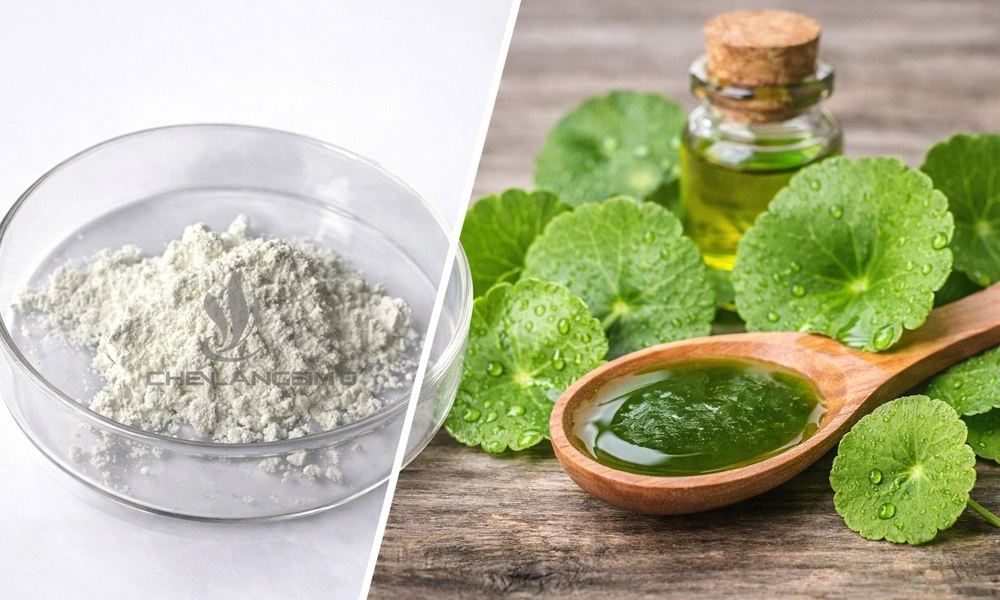
What Is Madecassoside? (Definition, Origin, and Typical Purity)
Madecassoside is a naturally occurring triterpenoid saponin derived from Centella asiatica. In cosmetic and personal care applications, it is treated as a defined active ingredient rather than a whole botanical extract. When formulators ask what is madecassoside, the answer centers on its identity as a single, well-characterized molecule with measurable purity.
In commercial supply, madecassoside is typically obtained through further separation and purification from Centella asiatica extract. This additional processing step distinguishes it from standard plant extracts and allows suppliers to offer madecassoside powder with clearly specified assay values. As a result, purity levels can be documented and verified using analytical methods such as HPLC, which is an important consideration for brands requiring consistency across batches.
From a manufacturing perspective, madecassoside purity is one of the most critical parameters. Higher purity enables more precise dosage control in formulations and supports stable performance in finished products. This level of definition is particularly relevant for products positioned around sensitive skin care or targeted functional claims, where ingredient consistency directly affects formulation reliability.
As a result, madecassoside is commonly selected when formulators need a focused active component rather than a complex botanical matrix. Its defined structure and controlled specifications make it suitable for applications where clarity, reproducibility, and documentation are essential parts of product development.
What Is Centella Asiatica Extract? (Standardization and Active Markers)
Centella asiatica extract is a botanical ingredient obtained by extracting bioactive components from the aerial parts of Centella asiatica. Unlike isolated compounds, the extract represents a multi-component system that contains several naturally occurring triterpenes and supportive plant constituents. When formulators ask what is Centella Asiatica extract, it is best described as a standardized botanical preparation rather than a single active molecule.
In commercial practice, centella asiatica extract is often standardized to specific marker compounds, such as asiaticoside, madecassoside, asiatic acid, and madecassic acid. These markers help define extract quality, but their relative proportions may vary depending on raw material source and extraction conditions. This is why Centella Asiatica extract standardized products are typically specified by total triterpene content or marker ranges rather than by one precise component.
From a formulation standpoint, centella asiatica extract active compounds work collectively rather than individually. This multi-component nature supports its use in products positioned around botanical synergy and whole-plant functionality. However, it also means that extract-based ingredients tend to show greater batch-to-batch variability compared to purified single molecules.
For brands and formulators, understanding how centella asiatica extract is standardized helps clarify its role in cosmetic formulations. While it offers flexibility and a broad botanical profile, its performance and consistency depend heavily on sourcing and manufacturing control. Recognizing these characteristics is essential when comparing extract-based ingredients with isolated actives such as madecassoside.
Madecassoside vs Centella Asiatica Extract: Key Differences at a Glance
While both ingredients originate from the same plant, their ingredient level and formulation role are fundamentally different.
|
Aspect |
Madecassoside |
Centella Asiatica Extract |
|
Ingredient type |
Single active compound |
Multi-component botanical extract |
|
Source |
Isolated from Centella asiatica |
Extracted directly from plant material |
|
Composition |
Predominantly madecassoside |
Mixed triterpenoids + phytochemicals |
|
Standardization |
High, compound-specific |
Total actives or marker-based |
|
Batch consistency |
Very high |
Depends on extraction and plant source |
|
Typical use level |
Low (active-level dosing) |
Higher (extract-level dosing) |
|
Positioning |
Precision active ingredient |
Natural botanical ingredient |
This distinction is central to understanding the difference between madecassoside and Centella asiatica extract.
Standardization and Purity: Why It Matters
One of the most important practical differences between madecassoside vs Centella asiatica extract lies in standardization.
With Centella asiatica extract, standardization often refers to:
•A minimum percentage of total triterpenoids;
•Or a combined content of asiaticoside and madecassoside;
Because plant extracts are influenced by:
Plant origin;
Harvest conditions;
Extraction method;
their exact composition can vary from batch to batch.
By contrast, madecassoside is typically supplied with:
•A defined purity specification;
•Analytical confirmation (e.g., HPLC assay);
•Narrow batch-to-batch variation;
For formulators, this means:
Extracts offer botanical complexity and “whole-plant” storytelling
Madecassoside offers predictability and formulation precision
Formulation Strategy: When to Use Each Ingredient
When Formulators Choose Centella Asiatica Extract
Centella asiatica extract is commonly selected when:
•A formulation emphasizes natural or botanical positioning
•A broader spectrum of plant compounds is desired
•The ingredient story highlights traditional or herbal origins
It is frequently used in:
Skincare products with “plant-based” positioning
Formulas where ingredient simplicity is less critical than narrative
Products targeting general skin-conditioning concepts
When Formulators Choose Madecassoside
Madecassoside is often preferred when:
•Precise control of active content is required
•Product claims rely on a specific, identifiable compound
•Consistency and reproducibility are critical
This makes madecassoside particularly suitable for:
High-end or dermocosmetic formulations
Products positioned around defined active ingredients
Formulas requiring low-dose, high-impact actives
Can Madecassoside Replace Centella Asiatica Extract?
A common question in formulation discussions is whether madecassoside can replace Centella asiatica extract.
In practice, they are not direct substitutes.
Madecassoside represents one specific component of Centella asiatica.
Centella asiatica extract delivers a broader phytochemical profile.
Replacing an extract with madecassoside changes:
The ingredient narrative
The complexity of the formulation
The way the ingredient is perceived by end users
In some formulations, both ingredients are used together—Centella asiatica extract for botanical context, and madecassoside for targeted activity—to achieve a balanced formulation approach.
How to Choose Between Madecassoside and Centella Asiatica Extract
When deciding between madecassoside vs Centella asiatica extract, the choice should be driven by formulation goals rather than perceived potency.
Choose Centella asiatica extract if your product emphasizes natural, whole-plant ingredients and botanical storytelling.
Choose madecassoside if your formulation requires precision, consistency, and a clearly defined active compound.
Consider using both ingredients when you want to combine botanical identity with active-level control.
Understanding these differences allows formulators to make informed decisions and avoid treating these two ingredients as interchangeable.
Final Thoughts
Although they share a common botanical origin, madecassoside and centella asiatica extract serve different roles in modern formulations. One is a purified active compound, the other a complex botanical extract. Recognizing this distinction is essential for effective ingredient selection, accurate labeling, and coherent product positioning.
For formulators and ingredient buyers, the comparison of madecassoside vs Centella asiatica extract is not about choosing a superior ingredient, but about selecting the right ingredient for the intended application.
Selecting between madecassoside and centella asiatica extract depends on formulation goals, standardization requirements, and application format.
👉Contact us Email: admin@chenlangbio.com to request specifications, samples, or technical support for formulation development.
References
1.James, J. T., & Dubery, I. A. (2009). Pentacyclic triterpenoids from the medicinal herb, Centella asiatica. Journal of Ethnopharmacology, 126(2), 181–187.
2.Brinkhaus, B., Lindner, M., Schuppan, D., & Hahn, E. G. (2000). Chemical, pharmacological and clinical profile of the East Asian medicinal plant Centella asiatica. Phytomedicine, 7(5), 427–448.
3.Gohil, K. J., Patel, J. A., & Gajjar, A. K. (2010). Pharmacological review on Centella asiatica. Indian Journal of Pharmaceutical Sciences, 72(5), 546–556.
4.PubChem. Madecassoside – Compound Summary. National Center for Biotechnology Information (NCBI).
5.Cosmetic Ingredient Review (CIR). Safety Assessment of Centella asiatica–Derived Ingredients.

Send Inquiry
Related Industry Knowledge
- Is Hydroxyphenyl Propamidobenzoic Acid Suitable For All Skin Types
- Avenanthramides Skin Benefits Explained: What International Buyers Should Know Before Sourcing
- How Does Indole-3-methanol Contribute to Hormone Balance and Immune Support?
- How to Deadhead Bergenia?
- How Does Ergothioneine Benefit Health?
- How Does Kopexil Work for Hair Loss?
- Is Loratadine Better Than Antihistamine
- What Foods are High in Ergothioneine and Glutathione
- How Does Quaternium 73 Work As A Preservative
- Which Food Contain Anti-aging compound Fisetin