
Tranexamic Acid vs Niacinamide: Which Ingredient Should Skincare Manufacturers Choose?
2026-07-28 15:26:51
Introduction: Choosing the Right Active Ingredient for Skincare Formulation
Tranexamic acid vs niacinamide is a common comparison among skincare manufacturers and formulation teams when developing modern cosmetic products. Both ingredients are widely used water-soluble cosmetic actives, but they have different chemical structures, formulation characteristics, and application considerations.
For professional formulators, the question is not simply which ingredient is more popular or which ingredient is more effective. The more important question is which ingredient better matches the product concept, formulation system, target market, and manufacturing requirements.
Tranexamic acid is an amino acid derivative that has gained attention in cosmetic formulations because of its unique molecular structure, good water solubility, and compatibility with many aqueous skincare systems. Niacinamide, also known as vitamin B3, is a well-established cosmetic ingredient widely used because of its versatility and compatibility with different skincare formulations.
When selecting between these two ingredients, cosmetic manufacturers usually evaluate factors such as:
•chemical properties;
•solubility behavior;
•pH compatibility;
•formulation stability;
•recommended usage level;
•supplier quality and documentation.
For companies looking to buy tranexamic acid powder or source other cosmetic active ingredients, understanding the differences between these materials helps R&D teams make better formulation decisions and allows procurement departments to select suitable raw material suppliers.
A professional cosmetic ingredient supplier should not only provide ingredients but also understand the technical requirements behind formulation development, including raw material consistency, analytical testing, and long-term supply reliability.
What Is Tranexamic Acid as a Cosmetic Ingredient?
Tranexamic acid cosmetic ingredient refers to Tranexamic Acid supplied for use in cosmetic and personal care formulations. Chemically, Tranexamic Acid is a synthetic derivative of the amino acid lysine, with the molecular formula C8H15NO2 and a molecular weight of approximately 157.21 g/mol.
Its hydrophilic molecular structure contributes to its good water compatibility, making it suitable for incorporation into water-based skincare formulations such as serums, essences, and lotions.
For manufacturers developing products with tranexamic acid formulation, several physical and chemical characteristics are important.
Chemical properties of Tranexamic Acid
|
Parameter |
Tranexamic Acid |
|
Chemical name |
trans-4-(aminomethyl)cyclohexane carboxylic acid |
|
CAS number |
1197-18-8 |
|
Molecular formula |
C8H15NO2 |
|
Molecular weight |
157.21 g/mol |
|
Appearance |
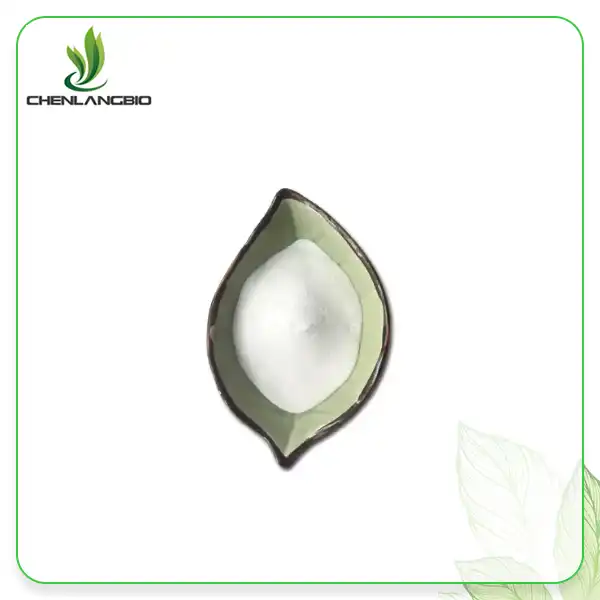
White crystalline powder |
|
Solubility |
Freely soluble in water |
|
pH of aqueous solution |
Approximately 6.5–8.0 (depending on concentration and test conditions) |
|
Ingredient type |
Amino acid derivative |
For cosmetic manufacturers, these characteristics influence how the ingredient is handled during formulation development. Because Tranexamic Acid is highly water soluble, it is commonly incorporated into the aqueous phase of cosmetic formulations.
However, solubility alone does not determine formulation success. The final product performance depends on the complete formula system, including other active ingredients, preservatives, emulsifiers, pH environment, and storage conditions.
Formulation Characteristics of Tranexamic Acid Powder
When evaluating tranexamic acid powder for skincare formulation, manufacturers usually focus on three practical factors: dissolution behavior, compatibility, and batch consistency.
►Water solubility
Tranexamic Acid has relatively high water solubility compared with many oil-soluble cosmetic ingredients. This allows formulators to incorporate it into water-based products without requiring complicated solubilization systems.
For serum and essence formulations, this characteristic provides flexibility during product development because the ingredient can generally be introduced into the water phase under appropriate processing conditions.
►pH compatibility
Tranexamic Acid solutions generally show a mildly acidic to near-neutral pH profile. A typical 1% aqueous solution is commonly reported within approximately pH 6.5–8.0.
For formulators, this range provides compatibility with many skincare systems, but the final formula pH must always be evaluated together with other ingredients.
►Typical cosmetic usage consideration
In cosmetic formulations, Tranexamic Acid is commonly evaluated at approximately 1–5% depending on product type, formulation objectives, regional regulations, and stability testing.
Professional manufacturers determine the final concentration through formulation trials rather than simply selecting a higher percentage.
For companies sourcing cosmetic grade tranexamic acid, raw material consistency is equally important as the ingredient itself. A reliable tranexamic acid manufacturer should provide consistent specifications, COA documentation, and analytical testing support.
What Is Niacinamide as a Cosmetic Ingredient?
Niacinamide cosmetic ingredient refers to the amide form of vitamin B3 (nicotinamide), a widely used water-soluble cosmetic active ingredient. Compared with Tranexamic Acid, Niacinamide has a longer history of use in skincare formulations and is commonly selected because of its versatility and compatibility with different product categories.
Niacinamide has the molecular formula C6H6N2O and a molecular weight of approximately 122.13 g/mol. It is a white crystalline powder with good water solubility, making it suitable for many aqueous cosmetic systems.
For companies sourcing niacinamide powder, manufacturers usually evaluate purity, assay value, stability, and supplier consistency.
Chemical properties of Niacinamide
|
Parameter |
Niacinamide |
|
Chemical name |
Nicotinamide |
|
CAS number |
98-92-0 |
|
Molecular formula |
C6H6N2O |
|
Molecular weight |
122.13 g/mol |
|
Appearance |
White crystalline powder |
|
Solubility |
Freely soluble in water |
|
Typical solution pH |
Approximately 5.0–7.0 depending on concentration |
|
Ingredient type |
Vitamin B3 derivative |
Because Niacinamide is highly water soluble and generally stable in many cosmetic systems, it is frequently used by skincare manufacturers developing multifunctional formulas.
However, similar to Tranexamic Acid, successful formulation depends on the overall formula design rather than the ingredient alone.
Tranexamic Acid vs Niacinamide: Key Differences for Cosmetic Formulators
Tranexamic acid vs niacinamide is a comparison that frequently appears during skincare product development because both ingredients are water-soluble cosmetic actives widely used by modern skincare brands. However, choosing between these two ingredients is not simply a matter of selecting the ingredient with the stronger market reputation. From a formulation perspective, they represent two different approaches to active ingredient selection.
Tranexamic Acid is an amino acid derivative with specific physicochemical characteristics, while Niacinamide is a vitamin B3 derivative known for its broad compatibility in cosmetic systems. Although both ingredients can be incorporated into water-based formulations, their molecular structures, recommended formulation conditions, and product positioning are different.
For cosmetic manufacturers, the better question is not “Which ingredient is superior?” but rather “Which ingredient better fits the formulation objective, product positioning, and manufacturing requirements?”
A skincare brand developing a targeted serum may have different considerations from a brand creating a daily-use moisturizer. Therefore, professional formulators usually evaluate ingredients based on the complete formula system rather than comparing individual ingredients in isolation.
Tranexamic Acid vs Niacinamide: Technical Comparison for Skincare Manufacturers
|
Evaluation factor |
Tranexamic Acid |
Niacinamide |
|
Ingredient classification |
Amino acid derivative |
Vitamin B3 derivative |
|
CAS number |
1197-18-8 |
98-92-0 |
|
Molecular formula |
C8H15NO2 |
C6H6N2O |
|
Molecular weight |
157.21 g/mol |
122.13 g/mol |
|
Appearance |
White crystalline powder |
White crystalline powder |
|
Water solubility |
Freely soluble in water |
Freely soluble in water |
|
Typical aqueous solution pH |
Approximately 6.5–8.0 (depending on concentration and testing conditions) |
Approximately 5.0–7.0 (depending on concentration and formulation conditions) |
|
Common cosmetic formats |
Serums, essences, lotions, creams |
Serums, moisturizers, lotions, creams |
|
Typical cosmetic usage level |
Commonly evaluated around 1–5% depending on formulation requirements |
Commonly evaluated around 2–5% depending on formulation requirements |
|
Main formulation focus |
Dissolution behavior, pH compatibility, ingredient interaction |
pH stability, formula compatibility, ingredient interaction |
|
Raw material purchasing focus |
Purity, COA, batch consistency, supplier reliability |
Purity, assay value, documentation, supplier reliability |
This comparison shows that the two ingredients share some similarities, particularly their water solubility and suitability for aqueous skincare systems. However, their differences become important when formulators move from ingredient selection into actual product development.
Chemical Characteristics and Their Influence on Formulation Design
The difference between tranexamic acid vs niacinamide begins with their molecular structures.
Tranexamic Acid is a synthetic derivative of lysine and contains both amino and carboxylic acid functional groups. These structural characteristics contribute to its hydrophilic behavior and explain why it dissolves well in water-based systems.
Niacinamide, on the other hand, is the amide form of vitamin B3. Its molecular structure gives it good water solubility and allows it to be incorporated into a wide variety of cosmetic formulations.
Although both ingredients are water soluble, their behavior inside a finished formula is not identical. A formulation containing Tranexamic Acid may require careful evaluation of dissolution conditions and final pH because these factors influence how consistently the ingredient is distributed throughout the product. Niacinamide formulations are also sensitive to formulation environment, particularly when the formula contains acidic ingredients or requires long-term stability under different storage conditions.
For this reason, experienced formulators do not simply replace one ingredient with another. They consider the role each ingredient plays within the entire formulation architecture.
pH Compatibility and Stability Considerations
Tranexamic acid formulation development requires attention to pH because the stability of an active ingredient is closely related to the environment in which it is formulated.
Tranexamic Acid aqueous solutions generally show a slightly acidic to near-neutral pH profile. A 1% aqueous solution is commonly reported around pH 6.5–8.0, although the exact value depends on concentration and analytical conditions.
This pH range provides flexibility for many water-based skincare formulations. However, when Tranexamic Acid is combined with other active ingredients, formulators usually evaluate the final formula rather than the raw material alone. The interaction between different ingredients, preservatives, and stabilizing agents can influence the overall stability of the product.
Niacinamide is generally considered stable in formulations around pH 5.0–7.0. It is widely used because it can fit into many cosmetic systems, but extremely acidic environments may increase the possibility of conversion to nicotinic acid, which is why formulators carefully control formula pH.
For manufacturers developing products containing tranexamic acid and niacinamide, the compatibility of both ingredients depends on the complete formula design, not only the individual characteristics of each raw material.
Difference in Formulation Applications
The choice between tranexamic acid formulation and Niacinamide formulation often depends on the positioning of the finished product.
Tranexamic Acid is frequently considered by brands developing concentrated skincare products such as serums and essences. Its water solubility allows it to be incorporated into lightweight formulations where formulators need an active ingredient that can be evenly dispersed in the aqueous phase.
Niacinamide is commonly used across a broader range of cosmetic products, including moisturizers, lotions, creams, and daily skincare products. Its versatility makes it a popular choice for multifunctional formulas.
For skincare manufacturers, this does not mean one ingredient replaces the other. Instead, the selection depends on the intended product concept.
A premium serum designed around a specific active ingredient strategy may evaluate Tranexamic Acid differently from a daily moisturizer designed around broader skincare positioning.
Recommended Usage Level and Formulation Considerations
When comparing tranexamic acid vs niacinamide, usage level is another factor considered by formulation teams.
Tranexamic Acid is commonly evaluated in cosmetic formulations at approximately 1–5%, depending on product type, formulation objectives, and regulatory requirements in different markets.
Niacinamide is often used within approximately 2–5% in skincare products, although the suitable concentration depends on the formula structure and intended application.
The recommended usage level should not be considered independently. Increasing the amount of an ingredient does not automatically improve a formula. Professional manufacturers evaluate the balance between ingredient concentration, stability, sensory properties, and production feasibility.
For companies sourcing cosmetic active ingredients, understanding these formulation principles helps avoid selecting raw materials based only on market trends.
Raw Material Selection: Why Supplier Quality Matters
For professional buyers, the comparison between Tranexamic Acid and Niacinamide does not end with formulation properties. The quality of the raw material supplier also affects the success of commercial production.
When sourcing tranexamic acid powder supplier or Niacinamide suppliers, manufacturers usually evaluate whether the supplier can provide consistent quality, accurate documentation, and reliable production capability.
Two suppliers may provide the same ingredient with the same CAS number, but differences in quality control procedures, analytical testing, and batch consistency can influence long-term cooperation.
A reliable tranexamic acid manufacturer should provide clear specifications, COA documentation, and technical support to help customers complete ingredient evaluation and maintain stable production.
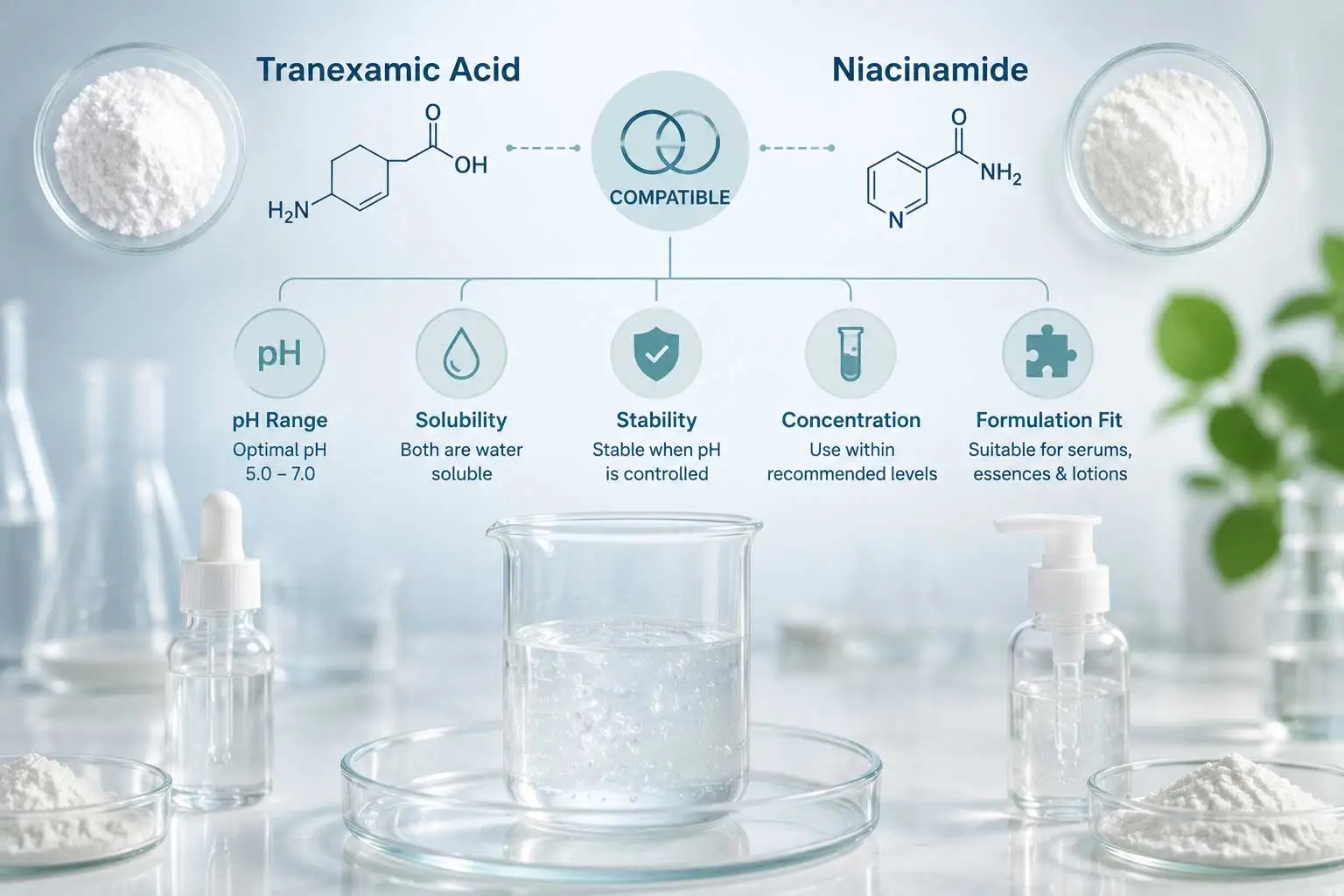
Can Tranexamic Acid and Niacinamide Be Used Together in Skincare Formulations?
Tranexamic acid and niacinamide compatibility is an important topic for cosmetic formulators because both ingredients are widely used in modern skincare development. Instead of choosing only one active ingredient, many brands evaluate whether these two ingredients can be incorporated into the same formulation system.
From a chemical perspective, both Tranexamic Acid and Niacinamide are water-soluble ingredients, which makes them suitable for many aqueous skincare formulations. However, successful combination depends on the complete formula design rather than simply mixing two popular ingredients together.
Professional formulators usually evaluate the compatibility of multiple active ingredients based on the entire formulation environment, including pH, concentration, solvent system, preservatives, and long-term stability.
For example, a serum containing both ingredients needs to maintain a suitable pH range while ensuring that each component remains stable during storage. The performance of the final product depends not only on the individual ingredients but also on how they interact within the complete formula.

Formulation Considerations When Combining Tranexamic Acid and Niacinamide
When developing a formula containing tranexamic acid and niacinamide, cosmetic manufacturers typically pay attention to several technical factors.
The first consideration is pH compatibility. Tranexamic Acid solutions generally show a mildly acidic to near-neutral pH profile, while Niacinamide is commonly formulated in systems around pH 5.0–7.0. Therefore, formulators usually optimize the final product pH rather than adjusting each ingredient separately.
Another important consideration is concentration. A formula containing multiple active ingredients requires careful balancing because higher levels of individual components may influence texture, stability, or overall product performance.
The manufacturing process is also important. The order of addition, dissolution method, mixing conditions, and temperature control can affect the final quality of the product.
For this reason, professional skincare manufacturers usually conduct laboratory testing and stability evaluation before moving a formula into commercial production.
Tranexamic Acid vs Niacinamide: How Should Skincare Manufacturers Make the Final Choice?
Which is better tranexamic acid or niacinamide is a common question among skincare brands, but professional formulators usually approach this decision differently.
The selection should be based on the role that the ingredient needs to play within the product.
A manufacturer developing a targeted serum may evaluate tranexamic acid formulation because the ingredient offers specific formulation characteristics and fits well into water-based active systems.
A brand developing a multifunctional daily skincare product may consider Niacinamide because of its broad compatibility and long history of use across different product categories.
The decision-making process usually considers:
|
Decision factor |
Tranexamic Acid |
Niacinamide |
|
Product positioning |
Suitable for targeted active formulations |
Suitable for multifunctional skincare products |
|
Formula type |
Commonly evaluated in serums, essences, lotions |
Widely used in serums, creams, lotions, moisturizers |
|
Main formulation focus |
Solubility, pH, active ingredient compatibility |
Stability, concentration, ingredient compatibility |
|
Development approach |
Often evaluated as a focused active ingredient |
Often used as a versatile supporting active |
|
Supplier considerations |
Purity, COA, batch consistency |
Purity, assay, stability, documentation |
The table shows that both ingredients have their own place in cosmetic development. The choice depends on the product strategy rather than a simple ranking.
Why Raw Material Quality Matters When Choosing Tranexamic Acid
Tranexamic acid powder supplier selection is an important part of successful cosmetic product development. Even when two suppliers provide the same ingredient name and CAS number, differences in raw material quality can influence formulation consistency and manufacturing efficiency.
For professional buyers, ingredient sourcing involves more than comparing prices. A reliable supplier should provide consistent quality, transparent documentation, and technical support that helps customers evaluate the raw material effectively.
When purchasing tranexamic acid powder, manufacturers usually review information such as:
•Certificate of Analysis (COA);
•product specification;
•analytical testing results;
•batch consistency;
•storage and handling information.
A professional tranexamic acid manufacturer should have effective quality control procedures to ensure that different production batches maintain consistent characteristics.
This is particularly important for brands planning long-term production because formulation teams need confidence that the raw material used during commercial manufacturing will match the quality evaluated during the development stage.
How to Select a Reliable Tranexamic Acid Supplier for Skincare Manufacturing
For companies looking to buy tranexamic acid powder, supplier selection should focus on long-term reliability rather than short-term purchasing decisions.
A qualified cosmetic ingredient supplier should understand the requirements of skincare manufacturers and provide support throughout the sourcing process.
The evaluation process usually involves several practical considerations.
•Quality Documentation and Testing Capability
A professional supplier should provide complete technical documents that allow customers to verify product quality. COA information, specification sheets, and analytical testing records help procurement teams and R&D departments complete supplier qualification more efficiently.
•Production Stability and Supply Capability
For brands requiring bulk tranexamic acid powder, supply consistency is a key consideration.
A supplier with stable production capability can support continuous manufacturing and reduce risks caused by inconsistent raw material availability.
•Understanding of Cosmetic Applications
A supplier experienced in cosmetic raw materials can better understand the needs of formulation teams.
This includes providing accurate information about:
•solubility;
•formulation compatibility;
•product specifications;
•quality expectations.
For international buyers, working with a knowledgeable cosmetic raw material supplier creates a more efficient sourcing process and supports long-term cooperation.
Frequently Asked Questions About Tranexamic Acid vs Niacinamide
Is tranexamic acid better than niacinamide for skincare formulations?
Tranexamic acid vs niacinamide is not a question of which ingredient is universally better. Both ingredients have different characteristics and formulation roles. The best choice depends on the product concept, target market, formula design, and manufacturing requirements.
Can tranexamic acid and niacinamide be used together?
Yes, many formulators consider combining tranexamic acid and niacinamide in skincare formulations. However, compatibility should be evaluated based on the complete formula, including pH, concentration, processing conditions, and stability testing.
Which ingredient should skincare manufacturers choose?
The choice depends on the purpose of the product. Manufacturers should evaluate ingredient properties, formulation requirements, supplier quality, and commercial objectives before selecting an active ingredient.
Where can manufacturers buy tranexamic acid powder?
Companies looking to buy tranexamic acid powder should select suppliers that provide consistent quality, complete documentation, and stable supply capability.
A reliable tranexamic acid powder supplier should support customers with product specifications, COA, samples, and bulk supply solutions.
Conclusion: Selecting the Right Active Ingredient and Supplier
Tranexamic acid vs niacinamide comparison shows that both ingredients have valuable roles in cosmetic formulation. Rather than choosing an ingredient based only on popularity, skincare manufacturers should evaluate the complete picture, including chemical characteristics, formulation requirements, quality standards, and supplier capability.
For brands developing skincare products, the right raw material partner can make the transition from formulation testing to commercial manufacturing more efficient and reliable.
CHEN LANG BIO TECH provides cosmetic raw materials with professional quality control, technical documentation, and stable supply support for global customers.
For companies sourcing tranexamic acid powder supplier solutions, product specifications, COA, samples, and bulk purchasing information are available upon request.
References
1. Ebrahimi, B., & Naeini, F. F. (2014). Topical tranexamic acid as a promising treatment for melasma. Journal of Research in Medical Sciences, 19(8), 753-757.
2. Tse, T. W., & Hui, E. (2013). Tranexamic acid: An important emerging treatment option for melasma. Journal of Clinical and Aesthetic Dermatology, 6(11), 26-30.
3. Pazyar, N., Yaghoobi, R., & Kazerouni, A. (2017). Tranexamic acid in dermatology: A review of its mechanisms and applications. Dermatologic Therapy, 30(6), e12586.
4. Wohlrab, J., & Kreft, D. (2014). Niacinamide – mechanisms of action and its topical use in dermatology. Skin Pharmacology and Physiology, 27(6), 311-315.
5. Bissett, D. L., Miyamoto, K., Sun, P., Li, J., & Berge, C. A. (2005). Topical niacinamide reduces yellowing, wrinkling, and hyperpigmentation in aging facial skin. International Journal of Cosmetic Science, 27(5), 273-279.
6. Draelos, Z. D. (2008). Cosmetic Dermatology: Products and Procedures. Wiley-Blackwell.
7. European Pharmacopoeia Commission. (2023). Tranexamic Acid Monograph. European Pharmacopoeia.
8. United States Pharmacopeial Convention. (2023). Tranexamic Acid Monograph. United States Pharmacopeia.

Send Inquiry

Related Industry Knowledge
- Monobenzone vs Benoquin: Comparing Their Roles in Vitiligo Depigmentation
- High Purity Sialic Acid Benefits for Skin Hydration and Radiance
- What is Trans-resveratrol Used For
- 5 Alpha Hydroxy Laxogenin vs Turkesterone Which Is Better for Muscle Growth?
- How to Evaluate Tranexamic Acid Powder Quality Through COA Before Buying
- How Does Ergothioneine Support Cognitive Function?
- What Products Contain Dimethylmethoxy Chromanyl Palmitate
- Can Powdered L-Carnosine Be Mixed into Body Lotion
- Why is L-Carnosine Beneficial for Vegetarians
- Is Magnesium Ascorbyl Phosphate A Skin-lightening Agent