
Quaternium-73 vs Phenoxyethanol: Function and Formulation Differences
2026-08-28 13:26:14
Quaternium-73 vs phenoxyethanol is not a simple comparison between two interchangeable preservatives. Both ingredients are associated with microbial control in cosmetic formulations, but they serve different technical purposes, are typically used at very different concentrations, and require different formulation strategies. Phenoxyethanol is an established cosmetic preservative with broad activity against Gram-positive and Gram-negative bacteria and yeasts. In the EU, it is authorized as a preservative at up to 1.0%, and the Scientific Committee on Consumer Safety concluded that this maximum concentration is safe for cosmetic use. Quaternium-73, by contrast, is a very-low-use-level cosmetic ingredient associated with antimicrobial functionality, particularly in formulations designed around skin and scalp microbial control. Commercial technical guidance for one Quaternium-73 grade recommends 0.001–0.005%, along with pre-dissolution in selected glycols.
For formulators and raw-material buyers, this means that a difference between Quaternium-73 and phenoxyethanol cannot be reduced to “which one is stronger.” The more useful questions are what role each ingredient is intended to perform, how it enters the formulation, what concentration is technically and legally appropriate, and whether the complete finished product passes stability and microbiological validation.
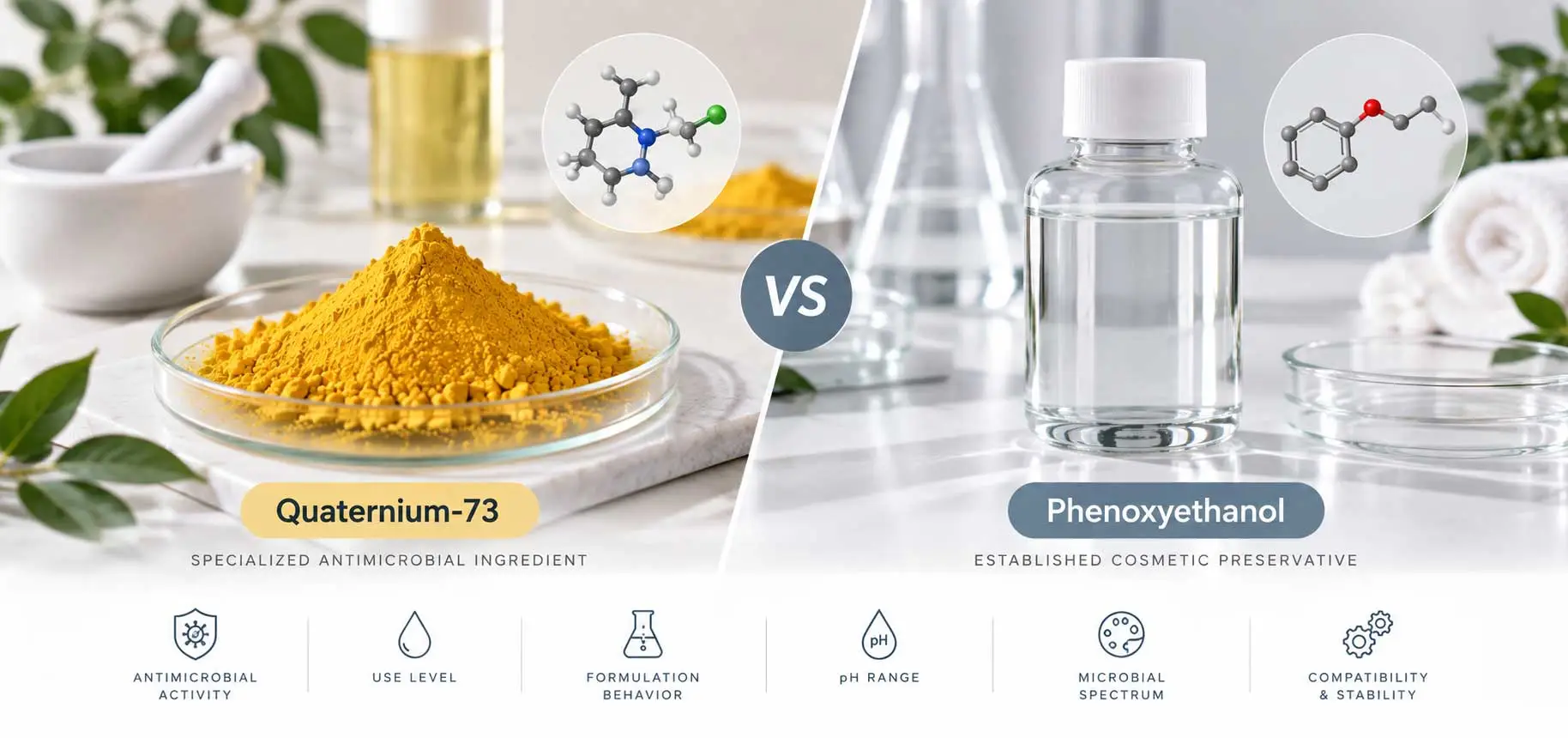
Quaternium-73 vs Phenoxyethanol at a Glance: Key Formulation Differences
The table below summarizes the most relevant differences for formulation and sourcing decisions.
|
Comparison factor |
Quaternium-73 |
Phenoxyethanol |
|
Main formulation role |
Antimicrobial-functional cosmetic ingredient; application dependent |
Established cosmetic preservative |
|
Typical technical use level |
0.001–0.005% in one referenced commercial PDS |
Up to 1.0% as an EU-authorized preservative |
|
Physical form |
Typically supplied as a yellow/yellowish raw material |
Liquid raw material |
|
Incorporation |
Often pre-dissolved in selected glycols |
Generally easier to incorporate into conventional cosmetic systems |
|
Water behavior |
Slightly soluble in water in one commercial PDS |
Different, more conventional preservative formulation behavior |
|
Key technical concern |
Low-dose accuracy, solubility, pH, compatibility |
Preservation efficacy, formulation compatibility, regulatory compliance |
|
Can they be used together? |
Yes, commercial co-formulation examples exist |
Yes |
|
Direct 1:1 substitutes? |
No |
No |
|
Final validation |
Stability, compatibility and microbiological assessment |
Preservative efficacy/challenge testing and stability |
The important point is that Quaternium-73 vs phenoxyethanol preservative discussions should not assume equivalence merely because both materials have antimicrobial activity. Their functional positioning and formulation behavior are substantially different.
What Is Quaternium-73 and What Function Does It Serve in Cosmetics?
Quaternium-73 function in cosmetics is generally discussed in the context of antimicrobial activity and specialized skincare applications rather than as a conventional broad-spectrum preservative used at comparatively high levels.
Quaternium-73 is identified by CAS 15763-48-1 and is also known commercially as Pionin. Current scientific literature continues to identify Quaternium-73 among quaternary ammonium compounds used in skincare strategies targeting Cutibacterium acnes. A 2026 review in the Journal of Cosmetic Dermatology specifically lists Quaternium-73 among agents used to suppress C. acnes in acne-oriented skincare.
Commercial formulation guidance adds the practical information that formulators need. One Quaternium-73 PDS recommends 0.001–0.005%, reports a grade-specific stable pH range of 5.5–8.0, and describes solubility in butylene glycol, propylene glycol, ethanol and 1,2-pentanediol, with only slight water solubility. The same document recommends pre-dissolution in a compatible glycol before the material is added to the main batch.
Those properties shape the way Quaternium-73 is used. It is not simply poured into a formula as though it were a conventional liquid preservative. At such low concentrations, accurate weighing, premixing and uniform distribution can be as important as the nominal use percentage.
What Is Phenoxyethanol and Why Is It Used as a Cosmetic Preservative?
Phenoxyethanol preservative use is much more established and clearly defined. Phenoxyethanol, or 2-phenoxyethanol, is an aromatic ether alcohol that has been used in cosmetics for decades because it provides broad antimicrobial activity and is readily incorporated into a wide range of rinse-off and leave-on products.
The published literature reports activity against Gram-negative organisms such as Pseudomonas aeruginosa, Gram-positive organisms such as Staphylococcus aureus, and yeasts including Candida albicans. Its antimicrobial action involves several mechanisms, including effects on membrane permeability and cellular energy processes.
From a regulatory perspective, its role is also much clearer. Under EU cosmetics rules, phenoxyethanol is authorized as a preservative at a maximum concentration of 1.0%, and the SCCS concluded that it is safe at that level in cosmetic products.
That regulatory status is an important part of the phenoxyethanol function in cosmetics: it is not merely an ingredient with incidental antimicrobial activity; it is widely used specifically to contribute to finished-product preservation.
Quaternium-73 vs Phenoxyethanol: How Do Their Functions Differ?
The main difference between Quaternium-73 and phenoxyethanol is the role for which each ingredient is normally selected.
Phenoxyethanol is generally chosen because a formulation requires a reliable preservation strategy. Its function is directed toward controlling microbial contamination of the product itself during manufacture, storage and consumer use.
Quaternium-73 is more often selected as a specialty antimicrobial-functional ingredient in skincare or scalp-care concepts. Its technical relevance to C. acnes is one reason it appears in acne-oriented formulations, although raw-material antimicrobial evidence should not be translated into medical claims.
This distinction explains why the phrase Quaternium-73 antimicrobial ingredient is usually more technically accurate than automatically calling Quaternium-73 a direct phenoxyethanol substitute.
Commercial technical literature does mention Quaternium-73 as a potential preservative synergist, which means it may contribute to a broader preservation strategy in some systems. However, a synergist and a primary preservative are not the same thing. The finished product still has to demonstrate adequate preservation through appropriate testing.
Quaternium-73 vs Phenoxyethanol Use Level: Why Dosage Is Not Directly Comparable
Quaternium-73 vs phenoxyethanol concentration illustrates just how different the two ingredients are.
A commercial Quaternium-73 PDS recommends approximately 0.001–0.005% for that grade. By comparison, phenoxyethanol is permitted in the EU as a preservative up to 1.0%.
That means the maximum phenoxyethanol concentration allowed under the EU preservative provision is approximately 200 times higher than 0.005% and 1,000 times higher than 0.001%. The comparison is useful for understanding manufacturing scale, but it should not be used to infer that one ingredient is “more powerful” than the other.
Concentration alone does not establish antimicrobial equivalence.
For example, replacing 0.8% phenoxyethanol with 0.005% Quaternium-73 is not a legitimate mathematical substitution. The two ingredients do not necessarily provide the same microbial spectrum, preservation function or regulatory role.
For formulators working specifically with Quaternium-73 dosage, the commercial-grade technical range should be treated as a starting point, followed by compatibility, stability and product-specific validation.
Quaternium-73 vs Phenoxyethanol Solubility and Incorporation Differences
The Quaternium-73 vs phenoxyethanol solubility comparison also has practical manufacturing implications.
Quaternium-73 is a low-dose solid raw material. The commercial PDS cited above describes it as soluble in selected glycols and ethanol but slightly soluble in water, and recommends pre-dissolution in butylene glycol, propylene glycol or 1,2-pentanediol.
This means that a 100 kg cosmetic batch formulated at 0.003% requires only 3 g of Quaternium-73. Directly adding 3 g of powder into 100 kg of bulk product may not provide the best control over wetting, transfer loss and distribution. A measured premix usually gives the formulator a more reproducible process.
Phenoxyethanol, by contrast, is handled as a liquid raw material and has a long history of use in conventional cosmetic preservation systems. This generally makes the manufacturing workflow different even before microbiological performance is considered.
Therefore, switching between these ingredients may require a process change, not merely an ingredient substitution.
Does pH Affect Quaternium-73 and Phenoxyethanol Differently?
Quaternium-73 vs phenoxyethanol pH should be considered in the context of the complete formula.
For one commercial Quaternium-73 grade, the supplier reports a stable formulation range of approximately pH 5.5–8.0. This is grade-specific technical guidance and should not be treated as a universal chemical constant for every Quaternium-73 raw material.
Phenoxyethanol is widely used across many cosmetic product formats and is commonly selected because its preservative performance is less narrowly dependent on acidic conditions than preservatives such as benzoic or sorbic acid. Preservation performance nevertheless remains dependent on the total system, including other antimicrobial components, water activity and the microbial challenge being addressed.
For formulators developing an acidic serum, a neutral moisturizer or a surfactant cleanser, the correct question is therefore not merely “Which ingredient tolerates the pH?” but whether the complete preservation and active-ingredient system remains stable and effective at the chosen final pH.
Do Quaternium-73 and Phenoxyethanol Have the Same Antimicrobial Spectrum?
The evidence does not justify saying that they have an identical spectrum. Phenoxyethanol antimicrobial spectrum is relatively well documented. Review literature describes activity against Gram-positive and Gram-negative bacteria as well as yeasts, and more recent preservative surveys also describe activity against molds.
For Quaternium-73, published and commercial literature places greater emphasis on activity against specific skin-related organisms, particularly C. acnes. A recent dermatology review specifically identifies Quaternium-73 as an agent used to suppress C. acnes.
This difference matters when comparing Quaternium-73 vs phenoxyethanol antimicrobial activity. Data from separate studies should not be placed side by side as though they were generated under identical experimental conditions. Differences in strain, assay type, solvent, concentration, incubation time and endpoint can substantially affect apparent antimicrobial performance.
In the absence of a robust head-to-head study performed under the same protocol, it is more accurate to describe their antimicrobial profiles separately rather than rank one as stronger.
Can Quaternium-73 Replace Phenoxyethanol as a Cosmetic Preservative?
Can Quaternium-73 replace phenoxyethanol? Not as a universal drop-in substitution.
This is the most important formulation conclusion in the comparison.
Phenoxyethanol is an established cosmetic preservative with a clearly defined regulatory role and broad antimicrobial spectrum. Quaternium-73 is a much lower-use-level ingredient with antimicrobial functionality and different formulation characteristics. A supplier PDS may describe Quaternium-73 as useful as a preservative synergist, but that does not mean a formulator can remove phenoxyethanol, add Quaternium-73 and assume equivalent preservation.
The term phenoxyethanol alternative for cosmetics should therefore be used carefully. Quaternium-73 can be evaluated as part of an alternative preservation strategy, but the strategy may require additional preservative components and must be validated in the finished formulation.
Changing the preservation system means reassessing:
microbial coverage, pH, water activity, packaging, manufacturing hygiene, intended consumer use and formulation stability.
The finished product should then undergo appropriate preservative-efficacy or challenge testing. A successful raw-material antimicrobial test is not a substitute for this evaluation.
Can Quaternium-73 and Phenoxyethanol Be Used Together?
Yes. There is practical evidence for Quaternium-73 and phenoxyethanol appearing together in finished formulations.
A DailyMed formulation revised in 2025 lists Quaternium-73 and phenoxyethanol in the same product, together with ingredients including sodium hyaluronate, carbomer, ethylhexylglycerin, caprylyl glycol, panthenol and several glycols.
This is useful evidence for Quaternium-73 phenoxyethanol compatibility, but it should be interpreted correctly. A commercial ingredient list demonstrates that co-formulation has been achieved in at least one specific product; it does not prove that every concentration or every base will be compatible.
A formulator still needs to evaluate:
•final pH;
•Quaternium-73 premix behavior;
•viscosity and clarity;
•other preservatives or antimicrobial boosters;
•polymer and electrolyte interactions;
•stability under the intended storage conditions.
The fact that both ingredients may be used together also reinforces the main point of this article: Quaternium-73 and phenoxyethanol do not necessarily occupy the same functional position in a formulation.
Quaternium-73 or Phenoxyethanol: Which Should a Formulator Choose?
The answer depends on the formulation objective.
If the primary requirement is finished-product preservation, phenoxyethanol is the more conventional starting point because it is established specifically as a cosmetic preservative and has broad antimicrobial coverage.
If the development objective includes a low-use-level antimicrobial-functional ingredient for skin or scalp applications, Quaternium-73 may be worth evaluating. Its relevance to C. acnes and its very low recommended concentration make it technically different from a traditional preservation ingredient.
If both objectives are relevant, a combined system can also be investigated. Existing formulations demonstrate that both ingredients can coexist.
The correct decision framework is therefore:
Preservation objective → select preservation system
Specialized antimicrobial-functional objective → evaluate Quaternium-73
Both objectives → evaluate a combined formulation and validate the complete system
Ingredient selection should follow formulation purpose rather than choosing whichever ingredient currently receives more marketing attention.
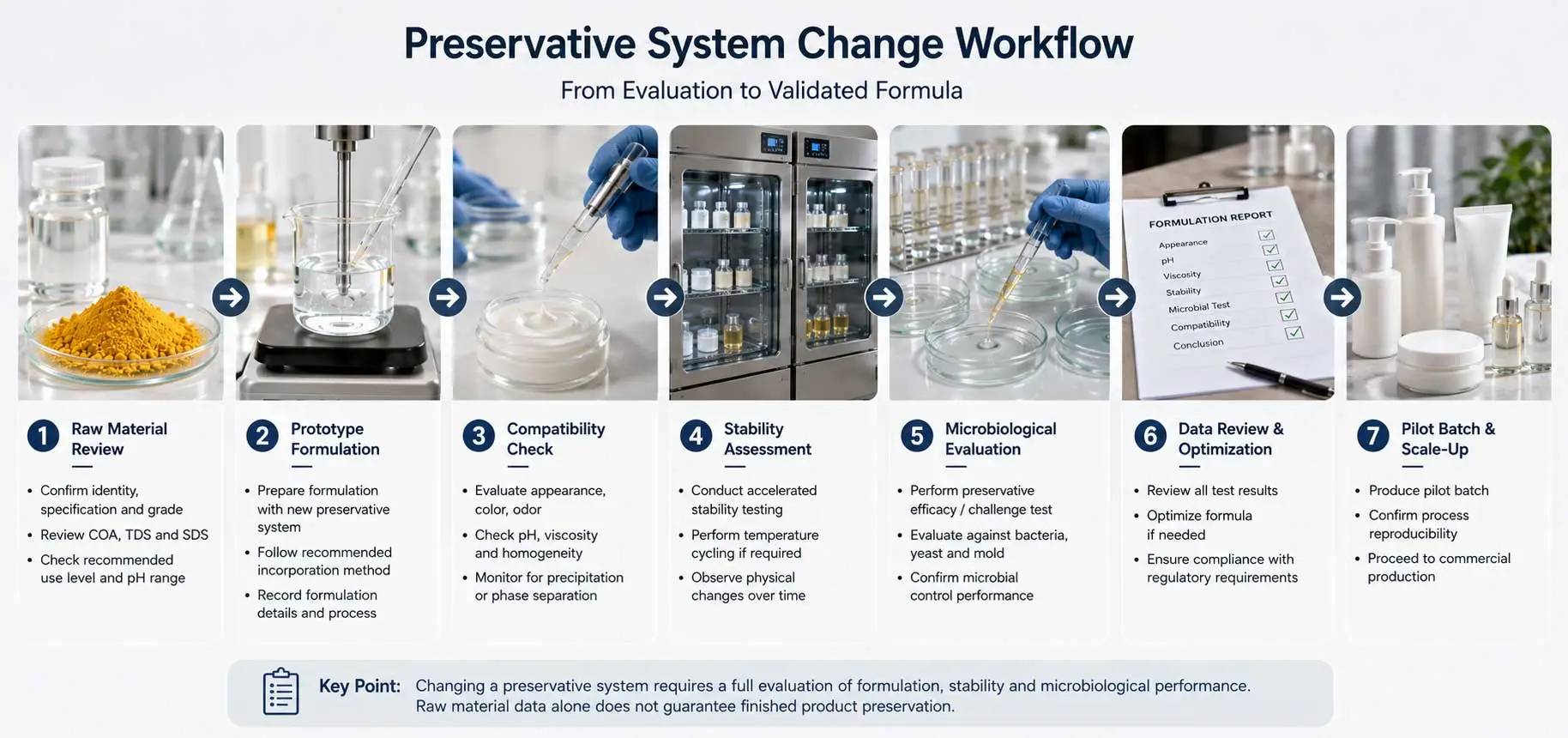
What Should Cosmetic Manufacturers Test Before Changing From Phenoxyethanol to Quaternium-73?
A phenoxyethanol replacement testing program should be treated as reformulation work rather than a simple raw-material swap.
The first step is to review the specification and technical documentation for the Quaternium-73 grade being evaluated. Confirm its recommended concentration, solvent or premix requirements, pH guidance and storage conditions.
The second step is to make a complete prototype. Record appearance, clarity, pH and viscosity after Quaternium-73 incorporation and compare those values with the original formula.
Next, run the company's normal stability protocol. Depending on product type, that may include accelerated storage, temperature cycling and observations for precipitation, viscosity change, phase separation and color shift.
Finally, the preservation strategy must be tested microbiologically.
Preservative efficacy depends on the complete formulation, not just the presence of one antimicrobial raw material. For that reason, replacing phenoxyethanol should trigger a fresh cosmetic preservative challenge test or the relevant preservative-efficacy validation required by the manufacturer and destination market.
This is where technically strong suppliers are useful: they provide the documentation and representative sample needed for controlled formulation trials rather than simply suggesting a percentage.
What Should Buyers Compare When Sourcing Quaternium-73 and Phenoxyethanol?
A procurement team comparing the two ingredients should avoid beginning with unit price.
For Quaternium-73, a technically useful Quaternium-73 supplier should be able to provide a current specification, TDS, batch COA and representative sample. The Quaternium-73 TDS is particularly important because formulation guidance may include solvent selection, dosage and pH information specific to that commercial grade.
Phenoxyethanol sourcing should likewise begin with identity, assay, regulatory suitability, batch documentation and intended cosmetic grade.
For either raw material, buyers should review:
|
Procurement item |
What it tells the buyer |
|
Specification |
Acceptance criteria for the commercial grade |
|
COA |
Actual results for the supplied batch |
|
TDS |
Formulation and handling information |
|
SDS |
Safety and transport information |
|
Sample |
Whether the material performs in the intended formulation |
|
Storage guidance |
Inventory and shelf-life requirements |
|
Batch consistency |
Whether scale-up and repeat orders remain reproducible |
A cosmetic grade Quaternium-73 sample should ideally represent the same specification that will be supplied after the formulation is approved. This prevents an R&D team from validating one material while purchasing a materially different grade later.
Does a Lower Price per Kilogram Mean a Lower-Cost Preservative System?
No. Quaternium-73 price per kg and phenoxyethanol unit price should not be compared without considering actual use level and the rest of the preservation system.
The more useful purchasing concept is cost-in-use.
A raw material with a high kilogram price may contribute very little cost to a formula when used at thousandths of a percent. Conversely, a lower-priced ingredient used at a much higher concentration may contribute more cost per finished kilogram.
But ingredient cost is only part of the calculation.
Reformulation can introduce additional expenses through laboratory trials, stability testing, microbiological challenge testing, process changes and potential packaging adjustments. If Quaternium-73 is incorporated as part of a multi-component alternative preservation strategy, the cost of the other preservation ingredients also needs to be included.
For procurement teams, the technically cheapest option is therefore not necessarily the raw material with the lowest quotation. It is the system that meets formulation, regulatory, manufacturing and shelf-life requirements at an acceptable total cost.
Quaternium-73 vs Phenoxyethanol FAQ
Is Quaternium-73 a preservative like phenoxyethanol?
Not in exactly the same sense. Phenoxyethanol is an established cosmetic preservative authorized in the EU at up to 1.0%. Quaternium-73 is a low-use-level antimicrobial-functional ingredient, and commercial technical literature may describe preservative-synergist applications. The two roles should not automatically be treated as equivalent.
Can Quaternium-73 replace phenoxyethanol?
A Quaternium-73 phenoxyethanol alternative strategy may be evaluated during reformulation, but Quaternium-73 should not be treated as a universal 1:1 replacement. Any change in the preservation system requires finished-product microbiological validation.
Can Quaternium-73 and phenoxyethanol be used together?
Yes. Published commercial ingredient information documents formulations containing both Quaternium-73 and phenoxyethanol. Their co-use should still be verified in the intended formulation for pH, compatibility, stability and preservation performance.
Which is used at a lower concentration, Quaternium-73 or phenoxyethanol?
Commercial guidance for one Quaternium-73 grade recommends 0.001–0.005%, whereas EU regulations permit phenoxyethanol as a preservative up to 1.0%. These numbers describe different formulation roles and should not be used to rank relative antimicrobial strength.
Do Quaternium-73 and phenoxyethanol have the same antimicrobial spectrum?
Available evidence does not establish an identical spectrum. Phenoxyethanol has documented activity against Gram-positive and Gram-negative bacteria and yeasts, while Quaternium-73 research often focuses more specifically on organisms such as C. acnes.
What testing is required when changing a cosmetic preservation system?
A reformulated product should normally be evaluated for compatibility, pH, viscosity, physical stability and microbiological preservation performance. Raw-material antimicrobial data alone are not sufficient to demonstrate that a finished cosmetic remains adequately preserved.
Quaternium-73 and Phenoxyethanol Serve Different Formulation Decisions
Quaternium-73 vs phenoxyethanol is ultimately a comparison between ingredients with different formulation roles rather than two interchangeable versions of the same preservative. Phenoxyethanol has a well-established function in finished-product preservation and broad antimicrobial coverage, while Quaternium-73 is used at much lower levels and is selected for specialized antimicrobial-related formulation objectives. Depending on the product concept, the two ingredients can be evaluated separately or incorporated into the same system.
For formulators considering Quaternium-73, the most useful next step is to review the actual commercial grade rather than rely on generic internet dosage recommendations. CHEN LANG BIO TECH can provide the current Quaternium-73 specification, TDS, batch COA and representative sample for formulation evaluation.
Email: admin@chenlangbio.com
References
1. Scientific Committee on Consumer Safety. Opinion on Phenoxyethanol. SCCS/1575/16, final version adopted October 6, 2016. The SCCS concluded that 2-phenoxyethanol is safe for use as a cosmetic preservative at a maximum concentration of 1.0%.
2. Dréno B, Zuberbier T, Gelmetti C, Gontijo G, Marinovich M. Safety review of phenoxyethanol when used as a preservative in cosmetics. Journal of the European Academy of Dermatology and Venereology. 2019;33(S7):15–24. The review discusses phenoxyethanol's antimicrobial spectrum, established preservative use and safety profile.
3. Halla N, Fernandes IP, Heleno SA, et al. Cosmetics Preservation: A Review on Present Strategies. Molecules. 2018;23(7):1571. Reviews antimicrobial mechanisms and preservation strategies, including phenoxyethanol.
4. Feng X, Chen Y, Liu Y. Truncal Acne: Pathophysiology, Clinical Features, and Management Strategies. Journal of Cosmetic Dermatology. 2026;25(2):e70715. Identifies Quaternium-73 among quaternary ammonium compounds used in skincare strategies targeting C. acnes.
5. M.C. BIOTEC INC. Quaternium-73 Product Data Sheet. Reports a recommended dosage of 0.001–0.005%, grade-specific pH range of 5.5–8.0, solvent information and pre-dissolution guidance. Also describes preservation-synergist use among potential applications. This is supplier technical information rather than an independent comparative study.
6. U.S. National Library of Medicine, DailyMed. CHEBOHO Tea Tree Acne Gel, revised September 2025. Ingredient disclosure lists Quaternium-73 and phenoxyethanol in the same finished formulation, along with carbomer, sodium hyaluronate, ethylhexylglycerin, caprylyl glycol and other formulation components. This provides commercial co-formulation evidence rather than proof of universal compatibility.
7. Kerdudo A, Burger P, Merck F, Dingas A, Rolland Y, Michel T, Fernandez X. A Survey of Preservatives Used in Cosmetic Products. Applied Sciences. 2024;14:1581. Reports phenoxyethanol among the most frequently encountered preservatives and discusses its broad antimicrobial spectrum.

Send Inquiry
Related Industry Knowledge
- Urolithin A Powder vs NMN: Which Is Better for Longevity Supplements?
- How Oyster Peptides Support Male Health: A Nutritional Perspective
- Ergothioneine Powder for Dietary Supplements: What Manufacturers and Brands Need to Know?
- What Are Procyanidins in Pine Bark Extract and Why Do They Matter in Formulations?
- Vitamin E Powder: Insights from Clean-Label Demand
- Is Cactus Extract Powder Good for Skin?
- What Does Phytosphingosine Do For Your Skin?
- Deoxyarbutin Manufacturer for Skin
- Benefits of the Reishi Mushroom Extract Powder
- What Benefits of the Acanthopanax Senticosus Root Extract Eleutheroside