
Quaternium-73 vs Chlorphenesin: How Do Their Roles Differ in Cosmetic Formulations?
2026-08-28 13:34:04
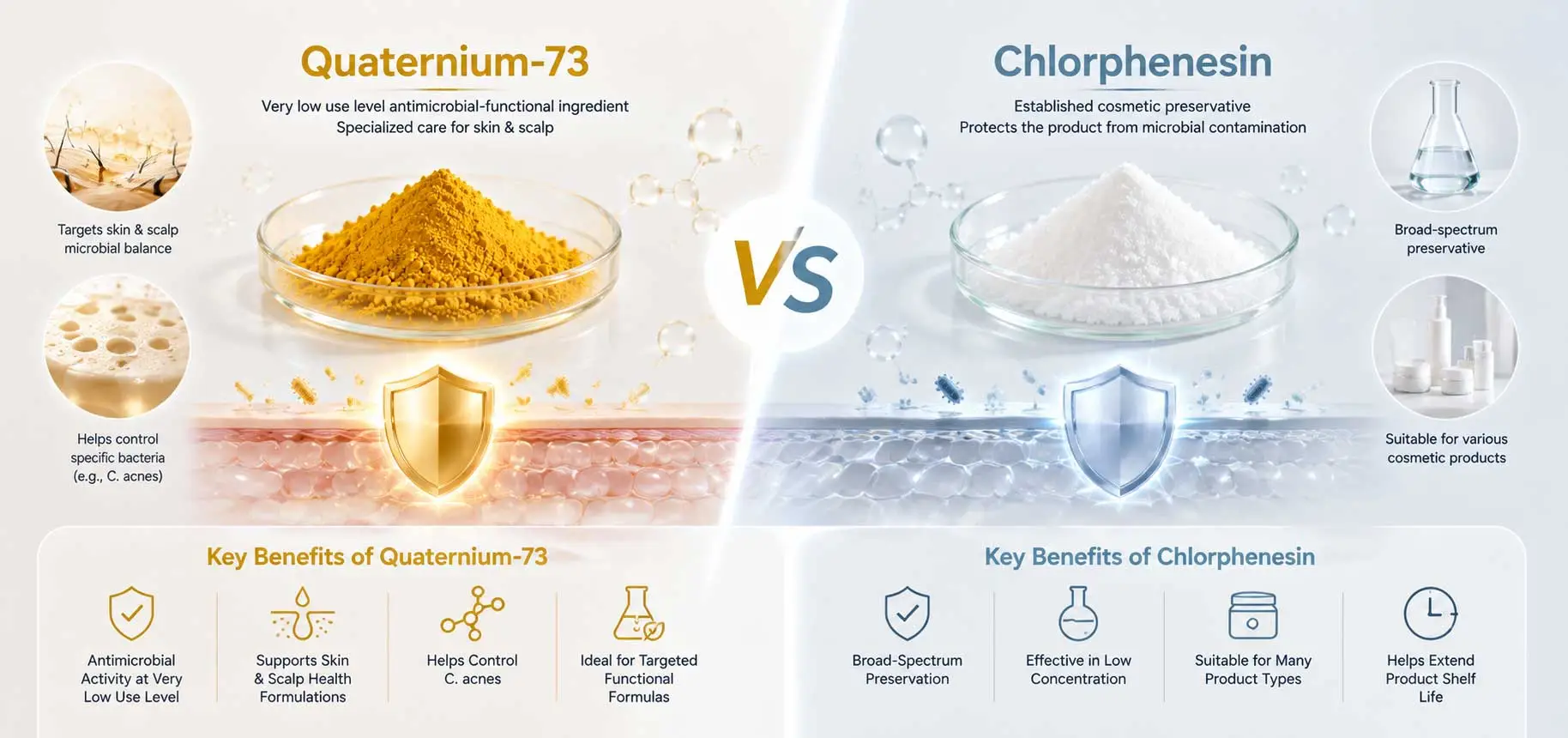
Quaternium-73 vs chlorphenesin is best understood as a comparison between two antimicrobial-related cosmetic ingredients that occupy different positions in formulation design. Chlorphenesin, CAS 104-29-0, is an established cosmetic preservative and is listed in Annex V of the EU Cosmetics Regulation at a maximum concentration of 0.3% in the ready-to-use product. Quaternium-73, CAS 15763-48-1, is a yellow crystalline ingredient used at much lower concentrations and is associated with antimicrobial functionality, particularly in skin- and scalp-oriented formulations. Commercial technical guidance for Quaternium-73 commonly recommends pre-dissolution before incorporation and use at very low levels.
The practical difference between Quaternium-73 and chlorphenesin therefore goes beyond antimicrobial activity. A formulator deciding between them has to consider why the ingredient is being added, the required microbial coverage, concentration, solubility, manufacturing process, regulatory market and the preservation strategy of the complete finished product.
For procurement teams, these distinctions are equally important. Two raw materials can both have antimicrobial activity without being technically interchangeable or serving the same purchasing specification.
Quaternium-73 vs Chlorphenesin at a Glance
The most useful starting point for a Quaternium-73 chlorphenesin comparison is to separate ingredient function from antimicrobial activity.
|
Comparison point |
Quaternium-73 |
Chlorphenesin |
|
INCI |
Quaternium-73 |
Chlorphenesin |
|
CAS No. |
15763-48-1 |
104-29-0 |
|
Appearance |
Yellowish to yellow crystalline powder |
Typically white crystalline solid |
|
Main formulation positioning |
Very-low-use-level antimicrobial-functional ingredient; application dependent |
Established cosmetic preservative |
|
Use level |
Grade-specific; 0.001–0.005% in one commercial PDS |
Up to 0.3% as an EU Annex V preservative |
|
Solubility consideration |
Slight water solubility; glycol premix commonly recommended |
Solubility and processing must be managed in the finished system |
|
Regulatory position |
Market and intended function must be checked |
EU Annex V-listed preservative |
|
Direct 1:1 substitutes? |
No |
No |
|
Finished-product validation |
Required |
Required |
The concentration figures require context. The 0.001–0.005% figure for Quaternium-73 comes from commercial technical guidance rather than an EU-wide preservative limit, whereas the 0.3% chlorphenesin figure is a regulatory maximum for ready-to-use cosmetics under EU Annex V. They are therefore different types of numbers and should not be presented as equivalent regulatory specifications.
What Is Quaternium-73 and Why Is It Used in Cosmetic Formulations?
Quaternium-73 function in cosmetics is closely associated with antimicrobial activity and specialized skin or scalp formulations. Its INCI name is Quaternium-73 and its CAS number is 15763-48-1. Commercial specifications describe the ingredient as a yellowish to yellow crystalline powder, typically with HPLC purity requirements around 98% or higher depending on grade.
The ingredient is technically interesting because only a small quantity may be required in a formulation. One detailed commercial PDS recommends 0.001–0.005%, a stable formulation range of approximately pH 5.5–8.0 for that grade, and pre-dissolution in butylene glycol, propylene glycol or 1,2-pentanediol. The same document describes Quaternium-73 as only slightly soluble in water and notes that finished products containing it should be protected from light.
Those characteristics explain why Quaternium-73 antimicrobial activity cannot be separated from formulation technique. At 0.003%, for example, a 100 kg production batch contains only 3 g of Quaternium-73. Accurate weighing, quantitative transfer and homogeneous distribution become significant manufacturing issues at that scale.
Quaternium-73 is consequently better evaluated as a specialized functional raw material rather than treated automatically as another conventional preservative.
What Is Chlorphenesin and What Role Does It Play in Cosmetics?
Chlorphenesin preservative use has a clearer regulatory definition.
Chlorphenesin is 3-(p-chlorophenoxy)-propane-1,2-diol, CAS 104-29-0. Under the current EU Cosmetics Regulation Annex V, it is an authorized preservative at a maximum concentration of 0.3% in the ready-to-use preparation. The same 0.3% maximum is also present in ASEAN cosmetic requirements.
Its practical use is not confined to one cosmetic category. A 2023 analytical study examined 61 personal-care products across facial care, body cleansing, sun protection, makeup, hairstyling, fragrance and oral-care categories. Among products labeled as containing chlorphenesin, measured concentrations ranged from 0.10 to 2.67 mg/g, equivalent to approximately 0.01–0.267% by weight, although three labeled products showed no detectable chlorphenesin.
That real-market dataset is useful to procurement teams because it shows that the legal maximum and the concentration actually selected by formulators are not necessarily the same.
A separate peer-reviewed study evaluating chlorphenesin in a cosmetic emulsion used 0.30% chlorphenesin, demonstrating its practical use as the preservative in an experimental cream system.
This makes the chlorphenesin function in cosmetics fundamentally easier to define: it is an established preservative used as part of a finished-product microbial-control strategy.
Quaternium-73 vs Chlorphenesin: How Do Their Functions Actually Differ?
The central difference between Quaternium-73 and chlorphenesin is not simply that one has greater antimicrobial activity than the other. Available evidence does not support such a broad ranking.
Chlorphenesin has an explicit regulatory position as a cosmetic preservative. When a formulator includes it for that purpose, the technical objective is primarily to help protect the cosmetic product against microbial contamination during its expected shelf life and use.
Quaternium-73 occupies a less conventional position. Commercial technical literature describes applications in facial cleansers, shampoos, oily-skin products and other specialized formulations, and also describes preservative-synergist use.
This distinction matters.
An ingredient intended to contribute to control of microorganisms associated with a skin or scalp formulation concept is not automatically equivalent to an ingredient selected to preserve an entire water-containing cosmetic product against the organisms that can contaminate it during manufacturing and consumer use.
For this reason, describing Quaternium-73 merely as a chlorphenesin alternative oversimplifies the formulation decision. The product developer should first define the technical objective and then select the preservation architecture around the finished formula.
Quaternium-73 vs Chlorphenesin Use Level: Why Concentration Matters
The Quaternium-73 vs chlorphenesin use level difference becomes particularly clear at manufacturing scale.
Using the commercial Quaternium-73 guidance of 0.001–0.005%, a 100 kg batch would contain:
•0.001% = 1 g
•0.003% = 3 g
•0.005% = 5 g
At the EU maximum of 0.3%, the same 100 kg batch would contain 300 g of chlorphenesin.
That does not mean Quaternium-73 is 60, 100 or 300 times “stronger.” These are different types of use-level guidance for ingredients with different regulatory and formulation positions.
What the comparison does show is that Quaternium-73 dosage introduces different production-control requirements. Measuring a few grams into a 100 kg batch makes balance accuracy, transfer loss and premix uniformity relevant to batch reproducibility.
Chlorphenesin at tenths of a percent presents a different manufacturing problem: ensuring dissolution and maintaining the intended preservation system throughout the formulation.
For a buyer, use level also affects inventory planning. Purchasing decisions should therefore be based on expected consumption per finished-product batch rather than simply comparing kilogram quantities.
Quaternium-73 vs Chlorphenesin Solubility: How Does Each Enter a Formula?
Quaternium-73 vs chlorphenesin solubility is one of the most practically important differences for a production team.
Commercial guidance for Quaternium-73 reports solubility in butylene glycol, propylene glycol, ethanol and 1,2-pentanediol while describing water solubility as slight. The recommended manufacturing approach is to pre-dissolve the ingredient in a suitable carrier before introducing it into the main formula.
At very low dosage, this premix does more than solve a solubility problem. It improves quantitative transfer and distribution.
Chlorphenesin is also a solid ingredient, so it should not be treated as though it behaves like a freely water-soluble liquid preservative. Its successful use in emulsions and other personal-care formats demonstrates that it can be incorporated into conventional cosmetic systems, but solvent system, process temperature and formulation composition remain relevant. A peer-reviewed photolysis study, for example, examined chlorphenesin at 0.3% within an emulsion containing water, glycerol, oils, surfactants and a carbomer-type gelling system.
Consequently, switching between the two ingredients can require changes to the manufacturing process. A laboratory should establish dissolution and addition order before a reformulated product is transferred to pilot scale.
Does pH Affect Quaternium-73 and Chlorphenesin Differently?
Quaternium-73 vs chlorphenesin pH stability should be evaluated using the technical data for the exact commercial grades under consideration.
For the Quaternium-73 grade referenced above, the supplier specifies stability from approximately pH 5.5 to 8.0. This is useful formulation guidance, but it is not a universal regulatory limit for every Quaternium-73 source.
Chlorphenesin's EU Annex V entry specifies a 0.3% maximum but does not attach a pH condition to that entry. That does not mean pH is irrelevant to a chlorphenesin formula. Finished-product pH can affect other preservatives, surfactants, polymers, actives and ultimately overall preservation performance.
A development team working on a toner, serum, cream or cleanser should therefore set the desired product pH first and confirm that every important component—including the preservation system—performs acceptably under those conditions.
Quaternium-73 vs Chlorphenesin Antimicrobial Activity: Can the Data Be Compared Directly?
Quaternium-73 vs chlorphenesin antimicrobial activity should not be ranked by copying MIC values from unrelated studies.
A particularly useful chlorphenesin study published in the Journal of Applied Microbiology tested chlorphenesin and four multifunctional cosmetic ingredients against a substantial panel of microorganisms. The researchers examined 42 strains belonging to Acinetobacter spp., Burkholderia cepacia complex and Stenotrophomonas maltophilia and found complete inhibition under their experimental conditions. However, all 13 tested Pseudomonas aeruginosa strains grew in the presence of chlorphenesin under the study conditions.
This is exactly why the term “broad spectrum” needs context.
Microbial susceptibility varies by species and even by strain. The study's authors specifically noted differences between and within species and concluded that preservation strategies need to account for these variations.
Quaternium-73 technical literature, meanwhile, frequently emphasizes strong activity at very low concentrations and particular relevance to skin-associated microorganisms. However, much of the readily accessible quantitative information comes from supplier technical documentation rather than directly comparable independent head-to-head trials.
Therefore, Quaternium-73 antimicrobial spectrum and chlorphenesin antimicrobial spectrum should be reported separately. Unless both ingredients are tested against the same strains, with the same medium, inoculum, exposure time and endpoint, a numerical “X times stronger” claim would not be scientifically robust.
Can Quaternium-73 Replace Chlorphenesin in Cosmetic Formulations?
Can Quaternium-73 replace chlorphenesin? Not as a universal 1:1 substitution.
Chlorphenesin has a defined role as an EU-authorized cosmetic preservative up to 0.3%. Quaternium-73 has different concentration guidance, different incorporation characteristics and a different regulatory/function context.
Suppose an existing emulsion contains 0.3% chlorphenesin. Removing it and introducing 0.003% Quaternium-73 changes much more than the weight of one raw material. It changes the preservation system, microbial coverage assumptions, solvent balance and possibly the manufacturing process.
The reformulated product therefore has to stand on its own evidence.
This is especially important when discussing a chlorphenesin alternative for cosmetics. A formulator may investigate Quaternium-73 as part of an alternative antimicrobial or preservation strategy, but that is fundamentally different from claiming that Quaternium-73 can replace chlorphenesin gram-for-gram or function-for-function.
The correct endpoint is not whether the new prototype looks stable after 24 hours. It is whether the finished formulation meets its physical, chemical, microbiological and regulatory requirements throughout its intended shelf life.
Can Quaternium-73 and Chlorphenesin Be Used Together?
The question of Quaternium-73 chlorphenesin compatibility requires more caution than some supplier marketing pages imply.
I did not identify strong peer-reviewed head-to-head compatibility evidence establishing a universal rule for the combination. That does not demonstrate incompatibility; it means the public evidence is insufficient to claim that every Quaternium-73/chlorphenesin combination will behave predictably.
From a formulation perspective, Quaternium-73 and chlorphenesin can instead be approached as a candidate combination that requires evaluation in the intended base.
A useful screening program should examine dissolution, clarity or appearance, pH, viscosity and any precipitation immediately after manufacture and during stability storage. The complete preservation system then needs microbiological validation.
This distinction is important for raw-material buyers. “Can be formulated together” should ideally be supported by an actual formulation or compatibility study rather than a generic supplier statement.
Quaternium-73 or Chlorphenesin: Which Fits Different Cosmetic Formulation Goals?
Asking Quaternium-73 or chlorphenesin without defining the development objective is unlikely to produce a useful answer.
|
Formulation objective |
More relevant starting point |
|
Conventional finished-product preservation |
Evaluate an authorized preservative system, including chlorphenesin where appropriate |
|
Very-low-level antimicrobial-functional strategy |
Evaluate Quaternium-73 |
|
Skin/scalp formulation focused on specific microbial concerns |
Quaternium-73 may warrant evaluation |
|
Existing formula already preserved with chlorphenesin |
Do not replace without reformulation and validation |
|
Multi-component preservation approach |
Evaluate the complete system experimentally |
|
New export formula |
Check destination-market regulatory requirements before selection |
This is why Quaternium-73 vs chlorphenesin which is better is not a particularly useful technical question. “Better” depends on the job the ingredient is expected to perform.
For a conventional preservation objective, regulatory status and challenge-test performance matter more than marketing claims about raw-material antimicrobial potency. For a specialized low-dose antimicrobial formulation, Quaternium-73's technical characteristics may justify laboratory evaluation.
What Testing Is Needed Before Replacing Chlorphenesin With Quaternium-73?
Chlorphenesin replacement testing should begin before the first pilot batch.
First, obtain the specification, TDS and batch COA for the Quaternium-73 grade being evaluated. Confirm identity, assay, appearance, recommended dosage, dissolution method, storage requirements and any grade-specific pH guidance.
Next, prepare a bench-scale prototype using a controlled premix procedure. Compare it with the existing formula for appearance, pH, viscosity, odor where relevant, homogeneity and evidence of precipitation.
The development path should then proceed through:
raw-material qualification → premix evaluation → complete prototype → physical/chemical stability → packaging assessment → microbiological evaluation → preservative efficacy testing → pilot production
A cosmetic preservative challenge test is particularly important when an established preservation system has been changed. Antimicrobial data generated on a neat raw material cannot demonstrate that a finished emulsion, serum or cleanser is adequately protected.
The formula matrix can substantially alter preservation performance, as can packaging, manufacturing hygiene, water activity and the presence of other ingredients.
What Should Buyers Check When Sourcing Quaternium-73 or Chlorphenesin?
A professional Quaternium-73 supplier should provide enough technical information for the buyer to qualify the material before commercial scale-up.
For Quaternium-73, useful documentation includes the current specification, batch COA, TDS and SDS. Buyers should verify CAS identity, appearance, HPLC assay where specified, moisture requirements, recommended storage and the formulation guidance applicable to the grade being quoted.
The same principle applies when qualifying a chlorphenesin supplier. For a preservative, identity and assay are only the beginning. The purchasing team should understand the intended cosmetic grade, impurity requirements, storage conditions and whether the supplied material is suitable for the destination market.
|
Document / parameter |
Procurement purpose |
|
Specification |
Defines agreed quality limits |
|
Batch COA |
Shows actual lot results |
|
TDS |
Provides processing and formulation guidance |
|
SDS |
Supports handling and transport |
|
Assay method |
Helps interpret purity claims |
|
Storage / shelf life |
Supports inventory planning |
|
Representative sample |
Allows formulation qualification |
|
Batch consistency |
Supports commercial-scale reproducibility |
A nominal “98%” or “99%” purity value by itself does not demonstrate that two suppliers' materials will perform identically.
At CHEN LANG BIO TECH, our approach is to support formulation evaluation with the technical documentation and representative material needed by R&D and purchasing teams rather than treating the COA purity number as the entire purchasing decision.
Does Quaternium-73 Price per Kg Tell Buyers Which Option Costs Less?
Quaternium-73 price per kg should not be directly compared with chlorphenesin price without calculating cost-in-use.
Consider a hypothetical 100 kg formulation. At 0.003%, the formula contains 3 g of Quaternium-73. A formula containing 0.2% chlorphenesin contains 200 g. The raw materials can therefore have very different kilogram prices while contributing a very different cost to each finished batch.
The more useful procurement equation is:
ingredient cost per batch = purchase price per kg × actual kilograms used
Even this is incomplete when a preservation system is being redesigned. Development trials, additional antimicrobial components, stability studies, challenge testing and changes in manufacturing procedure all carry costs.
For that reason, the lowest quoted raw-material price does not necessarily produce the lowest-cost compliant finished formulation.
Quaternium-73 vs Chlorphenesin FAQ
Is Quaternium-73 the same as chlorphenesin?
No. Quaternium-73 vs chlorphenesin involves two chemically distinct ingredients with different CAS numbers, typical use levels and formulation positioning. Chlorphenesin is listed as a preservative in EU Annex V, while Quaternium-73 is commonly evaluated as a very-low-use-level antimicrobial-functional ingredient.
Is chlorphenesin a preservative in cosmetics?
Yes. Chlorphenesin preservative use is explicitly recognized under EU Cosmetics Regulation Annex V, where CAS 104-29-0 is permitted at up to 0.3% in ready-to-use preparations.
Can Quaternium-73 replace chlorphenesin?
Not as an automatic 1:1 replacement. Their concentration, formulation behavior and regulatory positioning differ. Removing chlorphenesin from an existing preservation system and adding Quaternium-73 requires reformulation and appropriate finished-product microbiological validation.
Can Quaternium-73 and chlorphenesin be used together?
Direct public evidence is limited, so Quaternium-73 chlorphenesin compatibility should be established in the actual formulation. Evaluate dissolution, pH, viscosity, physical stability and preservation performance rather than assuming compatibility from the antimicrobial properties of the individual raw materials.
Which is used at a lower concentration, Quaternium-73 or chlorphenesin?
Commercial Quaternium-73 guidance can be as low as 0.001–0.005%, whereas chlorphenesin is legally permitted in EU cosmetics up to 0.3%. These values serve different purposes and should not be interpreted as a direct comparison of antimicrobial potency.
Does changing from chlorphenesin to Quaternium-73 require challenge testing?
Changing an established preservation system should trigger appropriate finished-product preservation validation. Raw-material antimicrobial results do not establish that a reformulated cosmetic will remain adequately protected throughout its intended use and shelf life.
Different Roles Require Different Formulation Decisions
Quaternium-73 vs chlorphenesin should ultimately be evaluated according to the technical objective of the finished cosmetic. Chlorphenesin has an established regulatory role as a cosmetic preservative, while Quaternium-73 is used at much lower levels and occupies a more specialized antimicrobial-functional position. The available evidence does not justify treating them as universal substitutes or ranking one as inherently “stronger.”
For an R&D team evaluating Quaternium-73, the practical next step is to qualify the actual commercial grade in the intended formulation. CHEN LANG BIO TECH can provide the current Quaternium-73 specification, TDS, batch COA and representative sample for formulation assessment.
Email: admin@chenlangbio.com
References
1. European Parliament and Council. Regulation (EC) No 1223/2009 on cosmetic products, Annex V, current consolidated annex. Chlorphenesin (3-(p-chlorophenoxy)-propane-1,2-diol; CAS 104-29-0) is listed as an authorized preservative at a maximum concentration of 0.3% in the ready-to-use preparation.
2. ASEAN Cosmetic Directive. Annex VI, List of Preservatives Allowed for Use in Cosmetic Products. Chlorphenesin is listed at a maximum authorized concentration of 0.3%.
3. Youenou B, Chauviat A, Ngari C, Poulet V, Nazaret S. In vitro study to evaluate the antimicrobial activity of various multifunctional cosmetic ingredients and chlorphenesin on bacterial species at risk in the cosmetic industry. Journal of Applied Microbiology. 2022;132(2):933–948. doi:10.1111/jam.15245. The study evaluated chlorphenesin against multiple strains of cosmetic-industry-relevant bacteria and demonstrated substantial species- and strain-dependent differences.
4. Ben Ouaghrem M, de Vaugelade S, Bourcier S, Genty C, Pirnay S, Bouchonnet S. Characterization of photoproducts and global ecotoxicity of chlorphenesin: A preservative used in skin care products. International Journal of Cosmetic Science. 2022;44(1):10–19. doi:10.1111/ics.12760. The work studied chlorphenesin in aqueous solution and in a cosmetic emulsion containing 0.30% chlorphenesin.
5. Determination of chlorphenesin in cosmetics, a preservative that can affect anti-doping test result interpretations. 2023. PMID: 37753668. The study analyzed 61 personal-care products; chlorphenesin concentrations measured in labeled products ranged from 0.10 to 2.67 mg/g, with three labeled products showing no detection.
6. M.C. BIOTEC Inc. Quaternium-73 Product Data Sheet. Commercial technical documentation reporting a recommended use level of 0.001–0.005%, pH 5.5–8.0 for the referenced grade, solubility in selected glycols and ethanol, slight water solubility, premix recommendations and light-protection considerations. This is supplier technical information rather than an independent comparative study.
7. ZLEY Quaternium-73 Technical Data Sheet. Commercial documentation identifying Quaternium-73 as CAS 15763-48-1, a yellowish-to-yellow crystalline powder with HPLC purity specification and pre-dissolution guidance. Supplier-recommended concentration ranges vary by commercial grade, reinforcing the need to use the TDS for the material actually purchased.

Send Inquiry
Related Industry Knowledge
- Monobenzone vs Benoquin: Comparing Their Roles in Vitiligo Depigmentation
- Is Centella Asiatica Extract Powder Better Than Vitamin C?
- How Mangiferin Compares to Other Natural Extracts?
- Why Palmitoylethanolamide Powder Is Gaining Global Popularity?
- How Do You Use Broccoli Extract Powder?
- How Do Hops Flavonoids Work in the Body
- How Strong is Ascorbyl Glucoside? Benefits and Uses
- Can Dihydroavenanthramides Help With Eczema
- What is Nuciferine
- Does Green Coffee Bean Extract Powder Reduce Belly Fat