
Quaternium-73 in Anti-Dandruff and Scalp Care Formulations: Uses, Use Level and Formulation Considerations
2026-09-01 11:17:28
Quaternium-73 for scalp care is best considered a low-use-level antimicrobial-functional ingredient that can be evaluated in shampoos, scalp serums, tonics and other scalp-focused cosmetic products. Commercial technical documentation specifically lists shampoo among its applications and recommends very low concentrations for the referenced grade. However, this positioning needs an important qualification: antimicrobial activity does not by itself establish Quaternium-73 as a primary anti-dandruff active, nor does it prove activity against Malassezia, the yeast genus strongly associated with dandruff.
For formulators, the more useful question is therefore not whether Quaternium-73 can simply be labelled an anti-dandruff ingredient, but how it fits into a complete Quaternium-73 scalp care formulation alongside surfactants, established anti-dandruff ingredients, scalp-conditioning components and the preservation system.
The formulation details matter. One commercial Quaternium-73 PDS recommends 0.001–0.005%, reports a stable pH range of 5.5–8.0, lists solubility in butylene glycol, propylene glycol, ethanol and 1,2-pentanediol, and describes direct water solubility as only about 0.6068 mg/L at 25°C. It also recommends pre-dissolution and opaque packaging because of limited photostability.
For R&D and procurement teams, those characteristics make dosage accuracy, premixing, surfactant compatibility and finished-product stability central to successful development.
What Role Does Quaternium-73 Play in Scalp Care Formulations?
The rationale for evaluating Quaternium-73 in anti-dandruff formulations starts with its antimicrobial-related functionality, but its role should be kept separate from the functions performed by the rest of a scalp-care formula.
A shampoo still requires a suitable surfactant architecture to remove sebum, soil and loosely attached material. A conditioning system determines much of the wet-combing and after-feel performance. Keratolytic or exfoliating ingredients, when used, perform another function. A dedicated anti-dandruff active may target microorganisms associated with dandruff. Quaternium-73 should not automatically be credited with all of these effects.
This distinction becomes particularly important when a product is marketed internationally. An older European Commission cosmetic ingredient inventory identifies Quaternium-73, CAS 15763-48-1, EC 239-852-5, with the cosmetic function “antistatic.” The European Commission also makes clear that the current CosIng glossary is a nomenclature resource rather than a list of ingredients authorized for every cosmetic use.
Accordingly, a Quaternium-73 cosmetic ingredient for scalp care should be evaluated according to the intended formula, claims and target market rather than assigned a universal regulatory or anti-dandruff status.
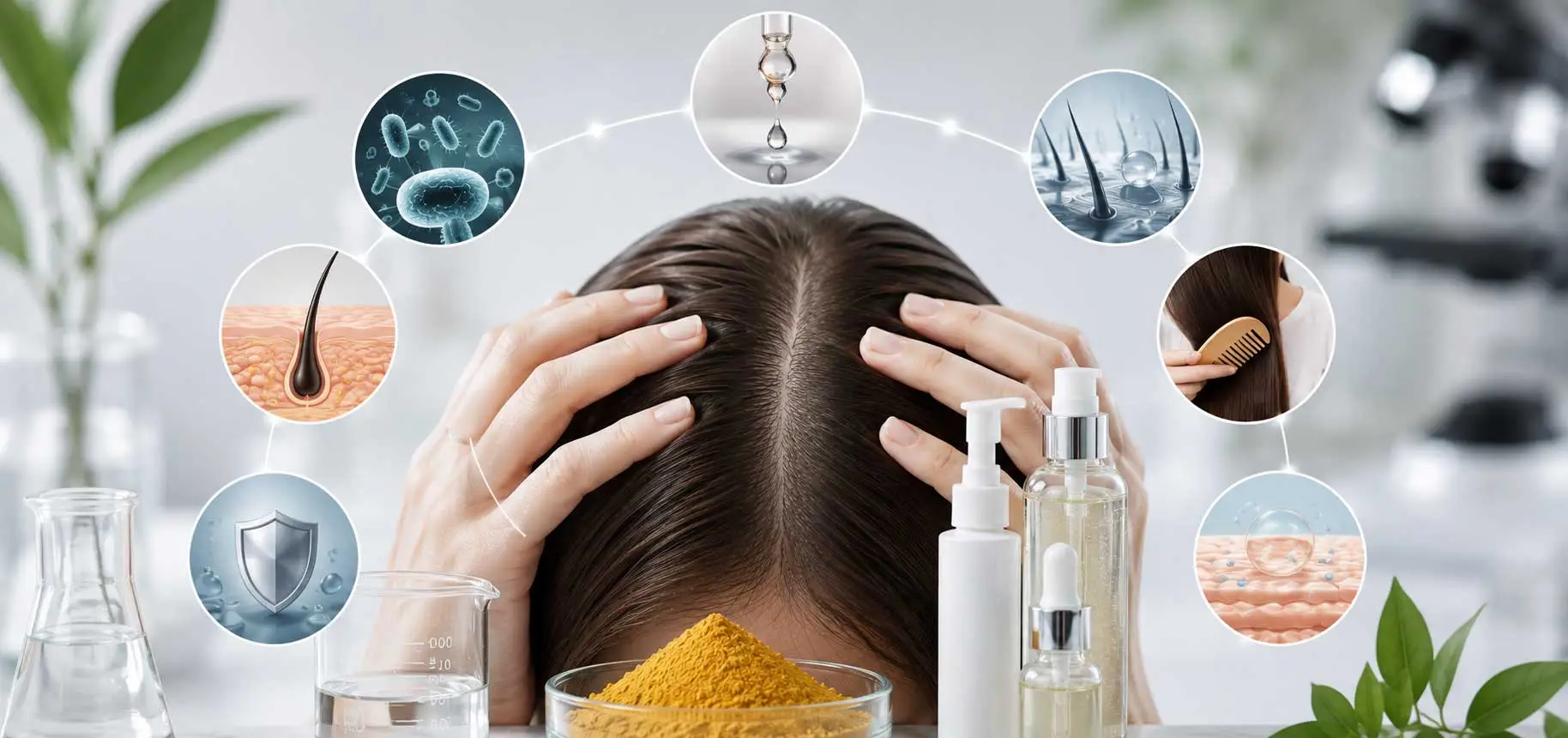
Quaternium-73 and Dandruff: What Does the Evidence Actually Support?
The evidence boundary matters here.
Dandruff is associated with a complex scalp environment in which Malassezia species have an important role. Published anti-dandruff studies have specifically evaluated ingredients such as piroctone olamine, climbazole, ketoconazole and zinc pyrithione against Malassezia species or in dandruff-affected subjects.
For example, a clinical study involving 41 subjects reported that a sulfate-free shampoo containing 0.5% piroctone olamine reduced dandruff and Malassezia density. Another controlled study evaluated a shampoo containing 0.75% piroctone olamine plus 2% salicylic acid and reported substantial reduction in dandruff.
By contrast, the public evidence located for Quaternium-73 for dandruff does not provide the same level of direct clinical or Malassezia-specific substantiation. Commercial Quaternium-73 documentation supports antimicrobial-related applications and shampoo use, but that should not be converted into an unsupported statement that Quaternium-73 is a clinically established anti-dandruff active.
For a technical article or product specification, the distinction can be summarized as follows:
|
Claim |
Evidence Position |
|
Quaternium-73 has antimicrobial-related functionality |
Relevant to formulation |
|
Quaternium-73 can be evaluated in shampoo |
Supported by commercial technical guidance |
|
Quaternium-73 has proven direct activity against Malassezia |
Public evidence is currently insufficient |
|
Quaternium-73 treats dandruff |
Should not be assumed |
|
Quaternium-73 replaces an established anti-dandruff active |
Not established |
This is the appropriate evidence standard when discussing Quaternium-73 anti-dandruff activity with R&D departments or customers.
Why Anti-Dandruff and Scalp Care Are Not the Same Formulation Target
A scalp care cosmetic formulation can be designed for cleansing, oily-scalp management, hydration, sensory comfort, visible flaking, conditioning or microbial-related concerns without necessarily being an anti-dandruff product.
That distinction influences raw-material selection.
An oily-scalp shampoo may prioritize efficient but mild cleansing and good rinseability. A dry-scalp serum may prioritize humectancy and barrier-supportive ingredients. A dandruff-focused shampoo requires an evidence-based strategy appropriate to its claims and regulatory market.
The distinction is especially useful to procurement teams. Before requesting a Quaternium-73 sample, buyers should know whether the R&D project is a general scalp-care shampoo, an oily-scalp cleanser, a leave-on scalp serum or a specifically positioned anti-dandruff product. The required compatibility testing and supporting documentation will not necessarily be the same.
What Is the Recommended Quaternium-73 Use Level in Shampoo and Scalp Care Products?
For the commercial grade documented by M.C. Biotec, the Quaternium-73 recommended use level is 0.001–0.005%. The same PDS identifies shampoo as an application. This concentration should be treated as supplier-specific technical guidance rather than a universal concentration for every grade, product category or jurisdiction.
The low percentage becomes more meaningful when converted into actual manufacturing quantities:
|
Batch Size |
0.001% |
0.003% |
0.005% |
|
10 kg |
0.1 g |
0.3 g |
0.5 g |
|
100 kg |
1 g |
3 g |
5 g |
|
1,000 kg |
10 g |
30 g |
50 g |
At a Quaternium-73 dosage in shampoo of 0.003%, a 1,000 kg production batch contains only 30 g of raw material.
That is not simply a cost consideration. It is a manufacturing issue.
Adding 30 g directly into a 1,000 kg vessel makes quantitative transfer and uniform distribution harder to control. For this reason, an appropriate premix can be valuable even when dissolution itself is not the only concern. The production SOP should address balance accuracy, premix preparation, quantitative vessel transfer and sufficient mixing.
When deciding how much Quaternium-73 to use, formulators should therefore start with the current TDS for the actual supplied grade and then establish the working level experimentally.
Quaternium-73 Solubility: How Should It Be Added to a Shampoo?
Quaternium-73 solubility is one of the most practical reasons not to add the powder directly into the water phase.
The referenced PDS reports solubility in butylene glycol, propylene glycol, ethanol and 1,2-pentanediol, while estimated water solubility is only 0.6068 mg/L at 25°C. It recommends pre-dissolving Quaternium-73 in butylene glycol, propylene glycol or 1,2-pentanediol before incorporation.
A practical Quaternium-73 premix for shampoo can therefore follow this development sequence:
accurate weighing → preparation of a compatible premix → confirmation of complete incorporation → quantitative transfer into the shampoo base → controlled mixing → final pH and physical-property adjustment
This is a development framework rather than a fixed manufacturing formula. The appropriate carrier concentration, premix ratio, temperature and point of addition depend on the finished system.
For a production team asking how to add Quaternium-73 to shampoo, the key principle is to validate both dissolution and distribution. A visually clear premix is useful, but the process must also deliver the intended concentration uniformly throughout the finished batch.
Quaternium-73 Surfactant Compatibility in Anti-Dandruff Shampoo
Quaternium-73 surfactant compatibility deserves more attention in shampoo than in many simple leave-on formulations because shampoos are complex ionic systems.
A modern shampoo may combine anionic surfactants with amphoteric and nonionic co-surfactants, conditioning polymers, salts, chelators, humectants and preservatives. Quaternium-73 itself is a quaternary compound, so charge-related interactions should be considered during development.
There is not enough publicly available Quaternium-73-specific evidence to justify a blanket statement that it is compatible—or incompatible—with every member of a particular surfactant class.
Instead, Quaternium-73 compatibility with shampoo surfactants should be established in the actual surfactant blend.
For an anionic-rich shampoo, R&D should pay particular attention to precipitation, haze and rheology changes. In amphoteric/nonionic-rich systems, the same endpoints remain relevant because total surfactant composition, ionic strength and polymers can still affect physical behavior.
A useful control is to compare the shampoo base before and after addition of the Quaternium-73 premix. Record appearance, pH and viscosity at initial manufacture, then monitor them during stability storage. Foam characteristics should also be checked because a physically stable formula is not commercially successful if cleansing and foam performance have changed significantly.
This is a more reliable approach to Quaternium-73 in shampoo formulation than relying on a generic compatibility chart.
Can Quaternium-73 Be Formulated With Piroctone Olamine?
The concept of Quaternium-73 with piroctone olamine is technically interesting because the two ingredients may be selected for different reasons. Piroctone olamine has direct published evidence in dandruff-focused shampoo systems, whereas Quaternium-73 can be evaluated as a complementary antimicrobial-functional ingredient.
Piroctone olamine has been studied at concentrations including 0.5%, 0.75% and 1% in different published shampoo studies. These figures describe the tested research formulations; they are not universal formulation recommendations or regulatory limits.
A recent 2026 study involving 41 volunteers with oily dandruff also reported clinical improvement and measurable restructuring of bacterial and fungal scalp communities during 28 days of use of a piroctone-olamine shampoo. Interestingly, sebum levels increased during the study, reinforcing the point that dandruff improvement and sebum reduction are not necessarily the same biological outcome.
However, different functional roles do not prove Quaternium-73 piroctone olamine compatibility.
Formulators still need to establish a solvent system, pH and surfactant architecture that accommodate both ingredients. Appearance, crystallization or precipitation, viscosity and accelerated stability should be checked in the complete formula.
Regulatory status and permitted concentration for piroctone olamine should also be verified for the intended product type and sales market before commercialization.
Quaternium-73 With Salicylic Acid in Scalp Care Formulations
Quaternium-73 with salicylic acid presents a different formulation challenge.
Published dandruff research demonstrates that salicylic acid has been formulated together with piroctone olamine. In one double-blind randomized bilateral study involving 19 subjects, a shampoo containing 0.75% piroctone olamine plus 2% salicylic acid was compared with a 1% zinc pyrithione shampoo, with both reducing dandruff.
That does not establish Quaternium-73 salicylic acid scalp care compatibility.
Salicylic acid introduces its own solubility, solvent, pH and regulatory constraints. Meanwhile, the referenced Quaternium-73 PDS gives a stable range of pH 5.5–8.0.
A formulator considering both materials should therefore begin with the target final pH and the solubilization strategy for salicylic acid. If the proposed acid system requires conditions outside the supported range of the selected Quaternium-73 grade, compatibility cannot simply be assumed because both ingredients fit the same scalp-care marketing concept.
Can Quaternium-73 Be Used With Zinc PCA in Oily Scalp Formulations?
A Quaternium-73 oily scalp formulation may also contain Zinc PCA when the development brief includes oily-scalp or sebum-management positioning.
Their conceptual roles should remain separate. Zinc PCA may be selected as part of the oil-management strategy, while Quaternium-73 is better positioned around its antimicrobial-related functionality.
When evaluating Quaternium-73 with Zinc PCA, R&D should consider the complete ionic environment. Zinc salts can affect electrolyte-sensitive polymers, and a shampoo or scalp gel may show changes in viscosity even when no obvious precipitation occurs.
Rather than asking whether two raw materials are “compatible” in isolation, compare the complete formula for pH, clarity, viscosity and physical stability with and without the combination. This is particularly important for clear scalp serums and low-viscosity tonics where minor precipitation is immediately visible.
What pH Is Suitable for Quaternium-73 Scalp Care Formulations?
The referenced supplier PDS reports a Quaternium-73 pH range of 5.5–8.0 and thermal stability up to 90°C for that particular commercial material.
These figures describe the ingredient's technical guidance; they do not mean every Quaternium-73 shampoo pH should simply be set at 5.5.
The final target must also accommodate the surfactant system, anti-dandruff ingredient, conditioning polymer, preservative and any additional scalp actives.
The useful development rule is:
The final Quaternium-73 formulation pH should remain within a range supported by the selected grade while also meeting the stability and performance requirements of the complete shampoo or scalp-care system.
Where those requirements conflict, formulation data should determine whether the combination is viable.
Quaternium-73 in Rinse-Off Shampoo vs Leave-On Scalp Serum or Tonic
The optimal development priorities change substantially by format.
|
Format |
Primary Development Questions |
|
Shampoo |
Surfactant compatibility, viscosity, foam, rinse performance |
|
Scalp serum |
Clarity, multi-active compatibility, leave-on sensory profile |
|
Scalp tonic |
Solubility, solvent architecture, clarity |
|
Lightweight scalp gel |
Polymer and electrolyte compatibility |
In a Quaternium-73 shampoo vs scalp serum decision, rinse-off shampoo has the additional complexity of a concentrated surfactant environment. A Quaternium-73 scalp serum avoids some of that complexity but places greater emphasis on clarity, residue, leave-on stability and compatibility with other actives.
A Quaternium-73 scalp tonic may appear simple because of its low viscosity, yet inadequate dissolution becomes highly visible in a transparent product.
Format selection should therefore start with the consumer and product objective. The formula should not be forced into a shampoo, serum or tonic simply because Quaternium-73 can technically be incorporated into it.
Does Quaternium-73 Replace the Anti-Dandruff Active or Preservative System?
Two questions need separate answers.
First, is Quaternium-73 an anti-dandruff active? The available public evidence does not support treating it as a direct replacement for anti-dandruff ingredients with specific Malassezia or clinical dandruff evidence. Research on piroctone olamine, for example, includes both Malassezia-focused testing and human shampoo studies.
Second, is Quaternium-73 a preservative? Supplier documentation lists preservative-synergist use, but antimicrobial functionality against selected organisms does not automatically establish adequate broad-spectrum preservation of a finished shampoo.
A Quaternium-73 preservative system must still account for relevant bacteria, yeast and mold as well as pH, water activity, manufacturing hygiene and packaging.
Finished-product microbiological testing—and challenge testing where applicable—should determine whether the preservation strategy is adequate.
Stability Testing for Quaternium-73 Anti-Dandruff Shampoo and Scalp Products
A Quaternium-73 shampoo stability program should be designed around the commercial formula rather than the raw material alone.
Start by recording the initial appearance, color, odor, pH and viscosity. For clear products, monitor haze and precipitation carefully. For shampoo, track rheology because surfactant/electrolyte interactions can develop gradually during storage. Foam and rinse performance should also be compared against the control formula.
Temperature storage and cycling protocols should be selected according to the company's development standard and intended distribution conditions.
Quaternium-73 photostability deserves specific attention. The referenced PDS describes the ingredient as photounstable and recommends opaque packaging for products containing it.
Consequently, Quaternium-73 stability testing should include the intended packaging configuration where practical. A formula that remains unchanged in an amber laboratory bottle does not necessarily establish performance in a transparent retail pack.
For higher-value development projects, analytical assay at selected stability intervals can provide information beyond visual inspection. Microbiological stability remains a separate endpoint.
A Practical Development Workflow for Quaternium-73 Scalp Care Products
For teams investigating how to formulate Quaternium-73 shampoo, a disciplined development sequence reduces unnecessary reformulation:
define the scalp-care objective → select the primary anti-dandruff/scalp actives → establish the surfactant or serum base → determine the target pH → prepare and evaluate the Quaternium-73 premix → incorporate under controlled mixing → adjust final pH and viscosity → conduct physical, chemical and microbiological stability work → complete pilot scale → approve commercial production
This sequence also helps procurement teams avoid qualifying raw materials too early.
A supplier sample that performs well in a simple aqueous bench test may behave differently in the actual surfactant, polymer and active system. Commercial approval should therefore follow formulation evaluation rather than precede it.
What Should Buyers Check When Sourcing Cosmetic Grade Quaternium-73 for Hair Care?
Selecting a Quaternium-73 supplier requires more than comparing assay values.
Procurement teams evaluating cosmetic grade Quaternium-73 should request a current specification and batch COA covering identity, appearance and assay. They should also obtain the TDS and SDS and review the supplier's recommendations for concentration, solvents, pH, storage, packaging and shelf life.
This matters because formulation guidance can vary between commercial grades.
For a Quaternium-73 raw material supplier, useful technical support includes representative sample availability and documentation that corresponds to the material actually being sold—not simply generic Quaternium-73 literature downloaded from another producer.
For shampoo manufacturers, a sensible qualification sequence is:
technical document review → representative sample → bench formulation → accelerated stability → pilot batch → supplier approval
CHEN LANG BIO TECH can provide current product specifications, batch documentation and representative samples for R&D teams evaluating Quaternium-73 for shampoo manufacturers and other scalp-care applications.
Quaternium-73 Sample, MOQ and Price for Shampoo Manufacturers
For this ingredient, Quaternium-73 price per kg can be misleading if it is considered without the use level.
Suppose a shampoo factory manufactures 100 metric tons of finished product annually and its validated formula contains 0.003% Quaternium-73:
100,000 kg × 0.003% = 3 kg Quaternium-73 per year.
That calculation changes the procurement discussion.
A relatively small Quaternium-73 MOQ may be more valuable than a lower kilogram price tied to an unnecessarily large purchase. Shelf life, packaging size, inventory turnover and batch consistency become commercially important because annual consumption may remain modest even for a substantial shampoo production volume.
During development, a Quaternium-73 sample can support multiple laboratory trials because the use level is so low.
Companies planning to buy Quaternium-73 or source bulk Quaternium-73 should therefore compare total cost-in-use, documentation, lot consistency and supply flexibility rather than selecting material solely on the lowest Quaternium-73 price.
FAQ: Quaternium-73 in Anti-Dandruff and Scalp Care Formulations
Is Quaternium-73 an anti-dandruff ingredient?
Quaternium-73 can be evaluated as a complementary antimicrobial-functional ingredient in scalp-care products, and commercial documentation lists shampoo as an application. However, the available public evidence does not establish it as a direct substitute for established anti-dandruff actives with Malassezia-specific or clinical evidence.
Does Quaternium-73 work against Malassezia?
The public evidence located for this review is insufficient to make a robust Quaternium-73-specific Malassezia efficacy claim. By comparison, published research directly evaluates piroctone olamine, climbazole and other anti-dandruff agents against Malassezia species.
What is the recommended Quaternium-73 dosage in shampoo?
One commercial PDS recommends 0.001–0.005%. Because recommendations can be grade-specific, the Quaternium-73 dosage in shampoo should be established using the current TDS for the material being purchased and confirmed in the finished formula.
How do you dissolve Quaternium-73 for shampoo?
The referenced PDS recommends pre-dissolution in butylene glycol, propylene glycol or 1,2-pentanediol. It reports only slight water solubility, estimated at 0.6068 mg/L at 25°C.
Can Quaternium-73 be used with piroctone olamine?
The combination can be investigated, but complementary functional roles do not prove physicochemical compatibility. The complete formulation should be evaluated for solubility, pH, precipitation, viscosity and storage stability.
Can Quaternium-73 be used with salicylic acid?
Potential co-use requires careful pH and solubility assessment. The selected Quaternium-73 grade's technical pH guidance must be reconciled with the salicylic-acid system and the requirements of the complete formula.
Is Quaternium-73 compatible with shampoo surfactants?
There is insufficient public evidence to claim universal compatibility with every surfactant system. Quaternium-73 surfactant compatibility should be verified in the actual anionic, amphoteric and/or nonionic blend used in the commercial shampoo.
Can Quaternium-73 be used in a leave-on scalp serum?
A leave-on format can be evaluated where appropriate for the target market and product concept. Solubility, pH, other actives, sensory properties, photostability, packaging and finished-product safety all need to be considered.
Where Quaternium-73 Fits in Modern Scalp Care Formulation
Quaternium-73 for scalp care has the strongest technical positioning as a low-use-level, complementary antimicrobial-functional ingredient rather than as a stand-alone solution for dandruff. Its reported 0.001–0.005% use level, limited direct water solubility, pH guidance and light sensitivity also mean that successful use depends heavily on formulation and processing.
For raw-material buyers, this makes supplier qualification inseparable from R&D evaluation. Review the specification and technical documents, test representative material in the actual shampoo or scalp-care base, complete stability and microbiological work, and only then establish commercial purchasing requirements.
For the current Quaternium-73 specification, COA, TDS or sample, formulation and procurement teams can contact CHEN LANG BIO TECH at admin@chenlangbio.com.
References
1. M.C. Biotec Inc. Quaternium-73 Product Data Sheet. Commercial technical documentation covering recommended dosage (0.001–0.005%), pH 5.5–8.0, thermal stability, solvent and water-solubility information, premixing, photostability and shampoo application.
2. European Commission. First Update of the Inventory of Ingredients Employed in Cosmetic Products. Identifies Quaternium-73, CAS 15763-48-1, EC 239-852-5, and its historical listed cosmetic function.
3. European Commission. CosIng – Glossary of Ingredients. Official explanation of the EU cosmetic ingredient nomenclature glossary and its regulatory limitations.
4. Reygagne P, et al. How I treat dandruff using a shampoo with a sulfate-free tensio-active. Clinical evaluation of a 0.5% piroctone-olamine shampoo in 41 subjects, including Malassezia density. PMID: 28383830.
5. The antidandruff efficacy of a shampoo containing piroctone olamine and salicylic acid in comparison to that of a zinc pyrithione shampoo. Double-blind randomized bilateral study involving 19 subjects. PMID: 18503415.
6. Evaluation of novel cosmetic shampoo formulations against Malassezia species: Preliminary results of anti-dandruff shampoo formulations. Journal of Cosmetic Dermatology, 2024. Evaluated piroctone olamine/climbazole systems against multiple Malassezia species.
7. Clinical improvement and scalp microbiome restructuring following a 28-day piroctone olamine shampoo intervention. International Journal of Cosmetic Science, 2026. Study of 41 volunteers with oily dandruff.
8. Galleria mellonella as a superficial model for Malassezia globosa and its treatment. 2024. Evaluated commercial anti-dandruff shampoo systems against M. globosa.
9. Piérard-Franchimont C, et al. Effect of residence time on the efficacy of antidandruff shampoos. International Journal of Cosmetic Science. Compared shampoo exposure conditions for piroctone olamine and ketoconazole systems.

Send Inquiry
Related Industry Knowledge
- Nitenpyram Mode of Action: How This Insecticide Kills Pests
- Avenanthramides in Oat Extract: What Cosmetic Manufacturers Should Know About This High-Value Active?
- Discover the Versatility of Melatonin Powder in Dietary Supplements
- Understanding Bulk Dimethylmethoxy Chromanol for Skincare
- What is Dimethylmethoxy Chromanyl Palmitate Used for
- Pure Fisetin: Unlocking Its Health Benefits
- How to Mix Monobenzone Powder
- Does Melatonin Help you Sleep
- Is Centella Asiatica Extract Powder Good for Skin
- How Long Does Red Yeast Rice Extract Powder Take to Lower Cholesterol