
3-O-Ethyl Ascorbic Acid Solubility: A Guide for Formulators
2026-10-19 16:57:00
3-o-ethyl ascorbic acid solubility is an important consideration when developing water-based serums, lotions, and other cosmetic products containing this vitamin C derivative. Although 3-O-Ethyl Ascorbic Acid is generally described as water-soluble, its behavior depends on the solvent system, ingredient concentration, temperature, and surrounding formulation.
Published research provides useful quantitative evidence. In a study of cosmetic and topical solvents, the saturation solubility of 3-O-Ethyl Ascorbic Acid ranged from 463.6 ± 1.3 to 801.1 ± 1.7 mg/mL across the hydrophilic solvents investigated. By contrast, selected lipophilic solvents produced substantially lower values.
These results demonstrate why solvent selection matters. They do not mean that every water-containing formulation can dissolve 801 mg/mL, or that all cosmetic solvents behave identically.
For cosmetic manufacturers, successful ethyl ascorbic acid formulation requires more than obtaining a clear solution during mixing. The ingredient must remain dissolved, chemically stable, and compatible with the finished product throughout its intended shelf life.
How Soluble Is 3-O-Ethyl Ascorbic Acid in Water?
3-O-Ethyl Ascorbic Acid is a hydrophilic vitamin C derivative with a molecular formula of C₈H₁₂O₆ and a molecular weight of approximately 204.18 g/mol. Its ether modification changes the properties of conventional ascorbic acid while retaining substantial affinity for polar environments.
Ethyl Ascorbic Acid Solubility in Water: What Do the Data Show?
A published physicochemical investigation reported several experimentally determined properties relevant to solvent selection.
|
Physicochemical Property |
Published Experimental Result |
|
Molecular weight |
204.18 g/mol |
|
Melting point |
114.39 ± 0.5°C |
|
pKa |
7.72 ± 0.01 |
|
Octanol/water partition coefficient, log P |
−1.07 ± 0.03 |
|
Saturation solubility across investigated hydrophilic solvents |
463.6 ± 1.3 to 801.1 ± 1.7 mg/mL |
|
Saturation solubility across selected lipophilic solvents |
0.6 ± 0.2 to 56.6 ± 1.3 mg/mL |
The negative log P value indicates a preference for the aqueous environment over octanol under the conditions used to measure partitioning.
However, the reported hydrophilic-solvent range represents results across multiple solvents. It must not be presented as a single measured value for purified water.
For ethyl ascorbic acid solubility in water, buyers should request a solvent-specific test result that identifies the temperature, equilibrium method, and analytical procedure. A general supplier statement that the material is water-soluble does not establish its saturation concentration in a particular finished formulation.
Is Ethyl Ascorbic Acid Completely Water-Soluble at Cosmetic Use Levels?
Yes, ethyl ascorbic acid can be incorporated into suitable aqueous systems, but the word soluble does not imply unlimited solubility.
At a typical development concentration of 1% w/w, a formulation contains approximately 10 g of ingredient per kilogram of finished product. At 2%, the quantity increases to approximately 20 g/kg.
These concentrations are useful starting points for laboratory trials. Nevertheless, the amount of available water, other dissolved solids, electrolytes, polymers, and temperature changes may affect whether the ingredient remains dissolved.
For a transparent serum, the practical requirement is not merely initial dissolution. The product must maintain clarity and ingredient uniformity during storage.
Which Cosmetic Solvents Can Dissolve Ethyl Ascorbic Acid?
Solvent selection should be based on experimental evidence rather than the assumption that all polar liquids behave similarly.
Research on 3-O-Ethyl Ascorbic Acid has examined glycerol, propylene glycol, several alkanediols, alcohols, and lipophilic ester vehicles. The results indicate that solvent polarity and composition significantly influence saturation solubility.
Ethyl Ascorbic Acid Solubility in Glycerin
Glycerin is widely used in cosmetic formulations as a humectant and water-miscible solvent.
Published research has included glycerol among the vehicles investigated for ethyl ascorbic acid solubility and skin delivery.
However, ethyl ascorbic acid solubility in glycerin should be evaluated separately from its behavior in a glycerin-water mixture.
Pure glycerin has substantially greater viscosity than water, which can affect mixing and dissolution time. Adding water changes both the solvent environment and the physical handling characteristics.
For commercial development, the most relevant test is performed at the actual glycerin-to-water ratio intended for the finished product.
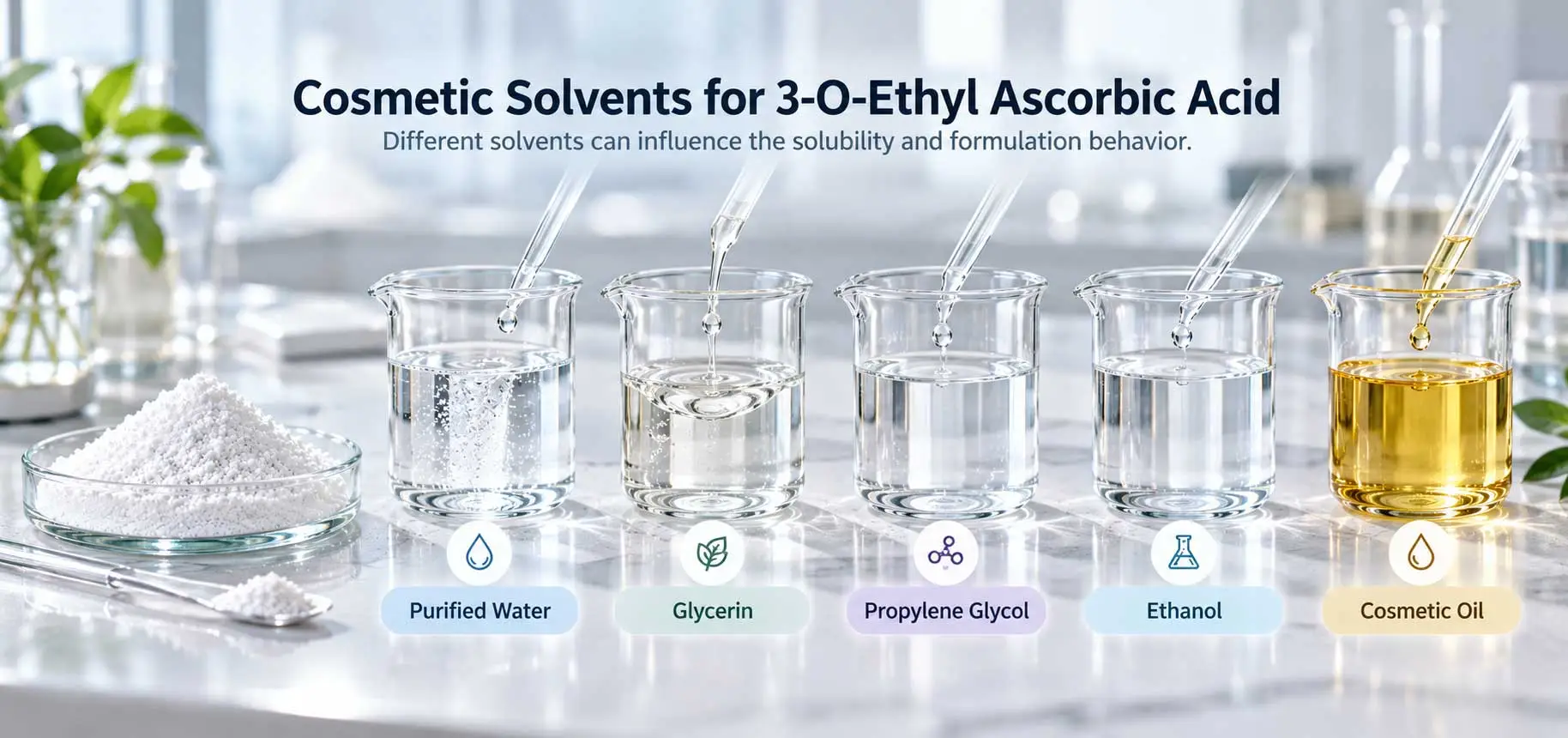
Ethyl Ascorbic Acid Solubility in Propylene Glycol
Propylene glycol, also known as 1,2-propanediol, is another established solvent used in cosmetic and topical formulations.
Experimental studies have examined ethyl ascorbic acid in propylene glycol and mixtures containing this solvent.
Importantly, a subsequent investigation found that combining hydrophilic glycols with selected fatty acid esters reduced ethyl ascorbic acid solubility compared with the neat glycols.
Therefore, ethyl ascorbic acid solubility in propylene glycol cannot be used to predict its solubility in every propylene glycol-based blend.
The ratio of glycol to other solvents must be evaluated directly.
Ethyl Ascorbic Acid Solubility in Ethanol
Ethanol is used in some cosmetic solvent systems because of its volatility and ability to modify product texture.
However, ethyl ascorbic acid solubility in ethanol should not be assigned a numerical value without a verified ethanol-specific measurement.
Published work has investigated isopropyl alcohol and mixed alcohol-containing vehicles, but results obtained with isopropyl alcohol cannot be transferred directly to ethanol.
For hydroalcoholic products, formulators should consider alcohol concentration, evaporation during manufacturing, packaging, and the possibility that changes in solvent composition could cause precipitation.
Is Ethyl Ascorbic Acid Soluble in Oil?
Ethyl ascorbic acid is not generally selected as an oil-soluble vitamin C ingredient.
In published research, selected lipophilic vehicles, including isopropyl myristate and certain fatty acid ester solvents, showed saturation solubility values within an overall range of 0.6–56.6 mg/mL.
These results were considerably lower than those obtained across the investigated hydrophilic solvents.
Consequently, ethyl ascorbic acid solubility in oil should not be assumed sufficient for a conventional anhydrous facial oil.
For such products, formulators may need to investigate a compatible delivery system or consider an alternative lipophilic vitamin C derivative.
Ethyl Ascorbic Acid Solvent Compatibility Comparison
|
Solvent System |
Published Evidence or Technical Consideration |
Formulation Recommendation |
|
Purified water |
Hydrophilic behavior supports aqueous incorporation |
Verify solubility at the target concentration |
|
Glycerin |
Investigated in published solvent studies |
Test the actual glycerin-water ratio |
|
Propylene glycol |
Investigated as a topical solvent |
Evaluate neat solvent and mixed systems separately |
|
Ethanol |
No verified ethanol-specific value established here |
Perform a solvent-specific solubility test |
|
Isopropyl alcohol |
Investigated in published research |
Do not substitute its data for ethanol |
|
Isopropyl myristate |
Included among lower-solubility lipophilic vehicles |
Avoid assuming complete dissolution |
|
Mixed glycol/ester systems |
Published values depend on blend composition |
Measure the actual solvent ratio |
In a study of binary and ternary vehicles at 32 ± 1°C, reported saturation solubility ranges were 64.4 ± 4.0 to 550.4 ± 9.5 mg/mL for binary systems and 104.6 ± 23.6 to 340.9 ± 16.4 mg/mL for ternary systems.
These are ranges across different tested mixtures, not recommended concentrations for finished skincare products.
How Do pH and Temperature Affect 3-O-Ethyl Ascorbic Acid Solubility?
pH and temperature influence formulation behavior, but their effects on solubility and chemical stability must be considered separately.
Ethyl Ascorbic Acid pH Stability vs Solubility
The experimentally measured pKa of 3-O-Ethyl Ascorbic Acid is 7.72 ± 0.01.
This value helps describe the compound's acid-base behavior. As pH approaches and exceeds the pKa, the proportion of ionized molecules changes, which can influence apparent solubility.
However, a pKa value is not an optimal formulation pH.
Ethyl ascorbic acid pH stability must be established by measuring ingredient retention over time at the intended product pH.
For example, a formulation may initially remain clear at a particular pH but experience chemical degradation during storage. Conversely, a chemically stable system may still develop physical instability.
Manufacturers should therefore monitor pH, assay, color, and precipitation independently.
Does Temperature Improve Ethyl Ascorbic Acid Dissolution?
Temperature can affect dissolution rate and equilibrium solubility, but the magnitude and direction of these effects must be measured for the specific solvent system.
The reported melting point of approximately 114.39°C should not be confused with a recommended processing temperature.
For our 3-O-Ethyl Ascorbic Acid 99%, we recommend incorporation below 40°C during formulation development.
This is a supplier processing recommendation, not evidence that the ingredient immediately degrades above 40°C.
When investigating ethyl ascorbic acid temperature stability, manufacturers should assess chemical retention at relevant manufacturing and storage temperatures.
Why Can Ethyl Ascorbic Acid Crystallize After Cooling?
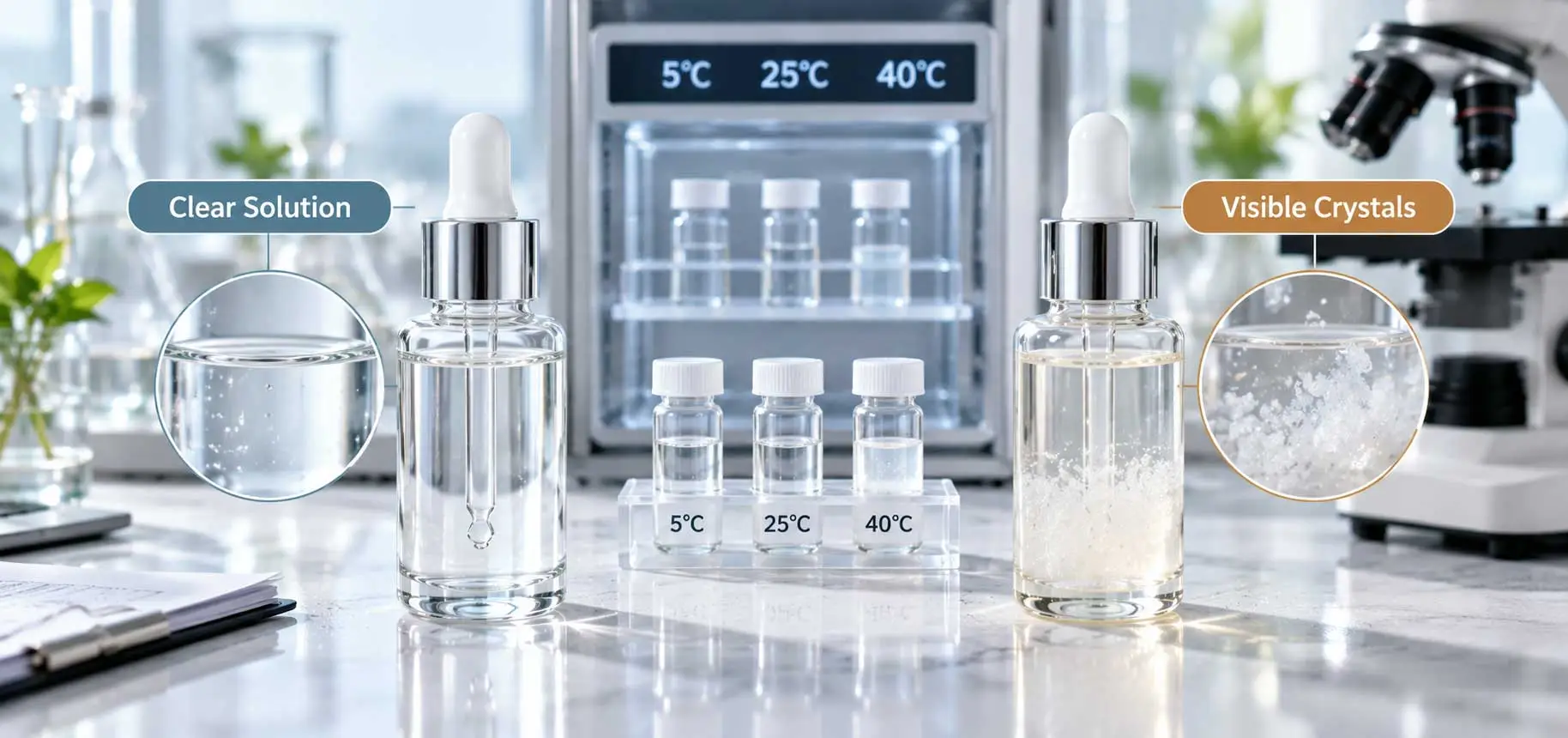
Crystallization may occur when a solution becomes supersaturated after a change in temperature or solvent composition.
A batch prepared under favorable dissolution conditions may develop crystals after cooling if the final system cannot maintain the dissolved concentration.
Other possible contributors include evaporation, addition of incompatible solvents, and changes in the concentration of dissolved ingredients.
The appearance of crystals should trigger a formulation investigation rather than an automatic conclusion that the raw material is defective.
How to Dissolve Ethyl Ascorbic Acid Powder in Cosmetic Formulations
The most reliable approach to how to dissolve ethyl ascorbic acid powder is to establish a controlled procedure using the intended solvent composition and raw material grade.
A laboratory method should be reproducible, measurable, and suitable for transfer to larger manufacturing equipment.
•Step-by-Step Ethyl Ascorbic Acid Dissolution Process
For an initial aqueous formulation trial, the following procedure provides a practical development framework.
1. Define the target concentration. Calculate the ingredient requirement based on the complete formulation weight, not only the weight of the water phase.
2. Prepare the solvent phase. Use purified water of suitable cosmetic manufacturing quality. Confirm the intended solvent and humectant ratios.
3. Control the temperature. For our material, maintain the addition stage below 40°C unless validated processing data support another condition.
4. Add the powder gradually. Introduce the ingredient under controlled agitation to reduce localized concentration differences and powder agglomeration.
5. Verify dissolution. Continue mixing until the solution is uniform, then inspect for undissolved particles.
6. Measure pH and appearance. Record the temperature, pH, clarity, and mixing time before incorporating additional ingredients.
7. Evaluate storage behavior. Examine samples at the intended storage temperature and under appropriate low-temperature and accelerated stability conditions.
This procedure is a development starting point rather than a validated manufacturing instruction for every cosmetic formula.
•How to Incorporate Ethyl Ascorbic Acid into a Water-Based Serum
For an ethyl ascorbic acid serum formulation, preparing a separate aqueous premix may simplify ingredient incorporation.
The premix can then be introduced into the main formulation at a controlled temperature, provided the surrounding ingredients and mixing conditions are compatible.
The order of addition becomes particularly important when the formula contains viscosity-building polymers, concentrated electrolytes, or ingredients with limited solubility.
Some thickening systems can make powder dispersion more difficult if they are fully hydrated before the active ingredient is incorporated.
Formulators should compare the processing sequence against the finished product's viscosity, clarity, and assay results.
•How Should Manufacturers Scale Up Ethyl Ascorbic Acid Dissolution?
An ethyl ascorbic acid manufacturing process that performs well in a 500 g laboratory batch may require adjustments at the 500 kg scale.
Mixing efficiency, vessel geometry, powder addition rate, and temperature distribution can all change during scale-up.
Manufacturers should establish measurable in-process controls, including dissolution time, solution appearance, pH, and batch uniformity.
Sampling from multiple vessel locations may help identify incomplete mixing.
A successful scale-up should reproduce the approved laboratory formulation without introducing new precipitation, color changes, or chemical degradation.
Why Does Ethyl Ascorbic Acid Precipitate or Turn Cloudy in Serums?
Visible instability is not always evidence of ingredient degradation.
A cloudy serum may contain undissolved material, precipitated ingredients, incompatible polymers, or changes in the emulsion or solubilization system.
Common Causes of Ethyl Ascorbic Acid Crystallization
Ethyl ascorbic acid crystallization can occur when the dissolved concentration exceeds the solubility limit under the prevailing conditions.
Potential contributing factors include excessive ingredient concentration, cooling, solvent evaporation, and changes in the solvent environment after other ingredients are added.
However, the presence of sediment does not prove that ethyl ascorbic acid is responsible.
Microscopic examination and appropriate chemical analysis may be necessary to identify the material.
How to Troubleshoot Cloudy Ethyl Ascorbic Acid Formulations
|
Observation |
Possible Explanation |
Recommended Investigation |
|
Powder remains undissolved |
Inadequate mixing or solvent capacity |
Check concentration and dissolution conditions |
|
Crystals appear after cooling |
Possible supersaturation |
Conduct controlled temperature studies |
|
Serum becomes cloudy after adding another ingredient |
Solvent or ingredient incompatibility |
Test ingredients individually and in combinations |
|
Sediment forms during storage |
Precipitation or contamination |
Identify sediment analytically |
|
Product becomes yellow or brown |
Possible chemical change |
Compare HPLC assay, pH, and stability results |
|
Viscosity decreases |
Polymer or electrolyte interaction |
Evaluate thickener compatibility |
For a cloudy vitamin c serum, the investigation should distinguish physical instability from chemical degradation.
This distinction matters commercially because the corrective action may involve changing the solvent ratio, processing sequence, or ingredient concentration rather than replacing the active material.
What Is the Recommended Ethyl Ascorbic Acid Concentration for Skincare?
The appropriate ethyl ascorbic acid recommended concentration depends on the product concept, supporting performance data, formulation stability, and supplier guidance.
For our 3-O-Ethyl Ascorbic Acid 99%, we recommend a starting use level of 0.5%–2% for cosmetic formulation development.
Ethyl Ascorbic Acid Use Level in Serums and Creams
The recommended ethyl ascorbic acid use level should be assessed in the actual product system.
A 1% concentration in a simple aqueous serum may behave differently from the same concentration in a cream containing oils, emulsifiers, polymers, and other active ingredients.
Higher concentrations also increase the amount of raw material that must remain dissolved or appropriately distributed throughout the product.
Manufacturers should establish the final concentration through formulation trials and appropriate performance evaluation.
How Does Concentration Affect Solubility and Formula Cost?
For a 1,000 kg production batch, the theoretical requirements are:
|
Ethyl Ascorbic Acid Concentration |
Ingredient Required |
|
0.5% |
5 kg |
|
1.0% |
10 kg |
|
2.0% |
20 kg |
These quantities are calculated from the nominal formulation percentage and exclude processing losses.
If the quoted raw material price is USD 100/kg, the theoretical ingredient cost would be USD 500, USD 1,000, or USD 2,000 respectively.
This is an illustrative calculation, not a current commercial quotation.
Cosmetic-Grade Ethyl Ascorbic Acid 99%: What Should Buyers Check?
A reliable cosmetic grade ethyl ascorbic acid supply program requires more than a stated purity percentage.
Manufacturers should qualify the material against a defined specification and confirm that commercial batches meet the same quality requirements used during formulation development.
How to Read an Ethyl Ascorbic Acid COA and HPLC Report
An ethyl ascorbic acid coa should identify the manufacturing batch and provide results against established acceptance limits.
|
Quality Parameter |
Procurement Consideration |
|
Identification |
Confirm correct chemical identity |
|
Assay |
Verify content against the agreed specification |
|
HPLC purity |
Review chromatographic purity and method |
|
Related impurities |
Assess compliance with impurity limits |
|
Moisture |
Check against the specified requirement |
|
Appearance |
Confirm batch consistency |
|
Batch traceability |
Link the material to manufacturing records |
When reviewing ethyl ascorbic acid hplc data, buyers should distinguish peak-area purity from a quantitative assay based on an appropriate reference standard.
The two results are not necessarily interchangeable.
Why Do Raw Material Specifications Matter for Solubility Testing?
Raw material quality can affect formulation evaluation, particularly when differences in impurities, moisture, or physical characteristics are significant.
However, a higher assay does not automatically establish a higher intrinsic solubility.
For meaningful comparisons, laboratories should test materials under consistent conditions using the same solvent composition, temperature, mixing method, and analytical procedure.
What Documents Should Cosmetic Manufacturers Request?
Before approving an ethyl ascorbic acid raw material, buyers should obtain the current specification, batch-specific COA, TDS, and SDS.
Additional documentation may be required depending on the intended market and customer quality system.
Our 3-O-Ethyl Ascorbic Acid 99% is supplied with available technical and quality documentation to support customer qualification.
How to Source Bulk Ethyl Ascorbic Acid Powder for Cosmetic Manufacturing
Selecting an ethyl ascorbic acid supplier involves assessing product quality, commercial reliability, and the ability to support repeat manufacturing orders.
For buyers developing long-term skincare products, consistency between sample approval and subsequent commercial deliveries is especially important.
♦What Should Buyers Expect from an Ethyl Ascorbic Acid Manufacturer?
An ethyl ascorbic acid manufacturer should provide a defined specification, appropriate analytical documentation, batch traceability, and clear packaging and storage information.
For bulk ethyl ascorbic acid powder, buyers should also discuss supply continuity, expected lead times, and procedures for communicating specification changes.
♦What Determines Bulk Ethyl Ascorbic Acid Price per Kilogram?
The ethyl ascorbic acid price per kg may vary with order quantity, quality requirements, packaging, destination, and delivery terms.
Procurement teams should compare quotations on a consistent basis, including the supplied grade, applicable documentation, and shipping conditions.
The lowest unit price may not represent the best overall purchasing value if additional testing, rework, or delays are required.
♦How to Request an Ethyl Ascorbic Acid Sample or Quotation
CHEN LANG BIO TECH supplies 3-O-Ethyl Ascorbic Acid 99% for cosmetic formulation and commercial production.
Customers requesting an ethyl ascorbic acid sample or ethyl ascorbic acid quotation should provide their required quantity, destination country, target specification, and intended application.
Our standard packaging options include 1–5 kg aluminum foil bags and 25 kg paper drums, subject to order arrangements.
For buyers planning to buy ethyl ascorbic acid powder, sample evaluation and technical document review are recommended before placing a commercial order.
Frequently Asked Questions About 3-O-Ethyl Ascorbic Acid Solubility
Is 3-O-Ethyl Ascorbic Acid Soluble in Water?
Yes. 3-O-Ethyl Ascorbic Acid is a hydrophilic vitamin C derivative suitable for aqueous formulation development. However, the maximum dissolved concentration depends on temperature, solvent composition, and other formulation ingredients. A water-soluble classification should not be interpreted as unlimited solubility.
Can Ethyl Ascorbic Acid Dissolve in Glycerin?
Glycerol has been investigated as a solvent for 3-O-Ethyl Ascorbic Acid in published research. Nevertheless, solubility in pure glycerin should not be assumed equivalent to solubility in a glycerin-water mixture. Formulators should test the actual solvent ratio intended for production.
Is Ethyl Ascorbic Acid Soluble in Propylene Glycol?
Propylene glycol is among the investigated solvents for 3-O-Ethyl Ascorbic Acid. Published studies also demonstrate that adding other solvents can substantially change its solubility. The concentration and composition of the complete solvent system should therefore be verified experimentally.
Can Ethyl Ascorbic Acid Be Used in Oil-Based Serums?
Ethyl ascorbic acid is primarily suited to hydrophilic formulation environments. Its comparatively limited solubility in selected lipophilic vehicles means that conventional anhydrous oil serums may require an alternative delivery system or a different vitamin C derivative.
Why Does Ethyl Ascorbic Acid Crystallize in a Serum?
Crystallization may occur when the dissolved ingredient exceeds its solubility limit after cooling or a change in solvent composition. However, sediment should be identified before attributing it to ethyl ascorbic acid. Solvent compatibility and storage-temperature testing are important troubleshooting steps.
What Documents Are Needed Before Buying Ethyl Ascorbic Acid Powder?
Buyers should request the current specification, batch-specific COA, TDS, and SDS. For commercial manufacturing, packaging information, storage recommendations, shelf life, and any market-specific documentation should also be reviewed before approving the material.
Conclusion: Selecting Ethyl Ascorbic Acid for Stable Cosmetic Formulations
3-O-Ethyl Ascorbic Acid offers useful solubility characteristics for aqueous cosmetic development, but successful formulation requires attention to solvent composition, concentration, pH, temperature, and long-term stability.
Published physicochemical data provide a valuable foundation for ingredient selection. Nevertheless, commercial manufacturers must validate dissolution and stability in their own finished products.
CHEN LANG BIO TECH supplies 3-O-Ethyl Ascorbic Acid 99% for cosmetic laboratories, skincare brands, and commercial manufacturers.
For technical specifications, COA, samples, and bulk quotations, contact admin@chenlangbio.com.
References
1. Iliopoulos, F., et al. (2019). 3-O-Ethyl-L-Ascorbic Acid: Characterisation and Investigation of Single Solvent Systems for Delivery to the Skin. International Journal of Pharmaceutics: X, 1, 100025. DOI: 10.1016/j.ijpx.2019.100025. Primary source for experimentally measured pKa, log P, melting point, and solvent-dependent solubility.
2. Iliopoulos, F., Hossain, A. S. M. M. A., Sil, B. C., Moore, D. J., Lucas, R. A., & Lane, M. E. (2020). Topical Delivery of 3-O-Ethyl-L-Ascorbic Acid from Complex Solvent Systems. Scientia Pharmaceutica, 88(2), 19. DOI: 10.3390/scipharm88020019. Experimental data on binary and ternary solvent systems at 32 ± 1°C.
3. International Organization for Standardization. (2018). ISO/TR 18811:2018 — Cosmetics: Guidelines on the Stability Testing of Cosmetic Products. Reference framework for cosmetic finished-product stability evaluation.
4. CHEN LANG BIO TECH. 3-O-Ethyl Ascorbic Acid 99% — Product Specification, Technical Data Sheet, and Batch-Specific Certificate of Analysis. Supplier documentation; current versions should be obtained for commercial qualification.

Send Inquiry

Related Industry Knowledge
- Is Piroctone Olamine Allowed in the EU? Cosmetic Regulation and Use Limits Explained
- 5 Alpha Hydroxy Laxogenin vs Turkesterone Which Is Better for Muscle Growth?
- Pionin vs Quaternium-73: Are They the Same Cosmetic Ingredient?
- How to Choose a Reliable DHEA Powder Supplier?
- Where to Buy Chondroitin Sulfate in Bulk: Trusted Supplier and Sourcing Guide
- Can Ascorbyl Tetraisopalmitate Cause Irritation or Breakouts?
- What to Avoid When Taking Loratadine
- How Does Alpha-GPC Help Growth Hormones
- Are There Any Side Effects of Using Ectoin Powder?
- Does Green Coffee Bean Extract Powder Reduce Belly Fat