
Pionin vs Quaternium-73: Are They the Same Cosmetic Ingredient?
2026-08-21 16:10:25
Pionin vs Quaternium-73 is primarily a question of ingredient naming rather than a comparison between two different cosmetic raw materials. Quaternium-73 is the INCI name used for cosmetic ingredient identification, while Pionin is a commonly encountered alternative name associated with the same substance, identified by CAS 15763-48-1. A buyer may therefore find “Pionin” on a supplier website and “Quaternium-73” in cosmetic ingredient documentation even though both names refer to the same chemical identity.
For cosmetic manufacturers, formulators and ingredient distributors, however, confirming that Pionin and Quaternium-73 refer to the same substance is only the first step in supplier qualification. Two products carrying the same CAS number can still differ in assay, impurity control, analytical methods, physical characteristics, documentation and batch consistency. These differences become important when a formulation moves from a laboratory trial to repeat commercial production.
The practical purchasing question is therefore not simply “is Pionin the same as Quaternium-73?” It is whether the material offered under either name can be verified against the identity, specification and quality requirements established for the project.
Pionin vs Quaternium-73: What Is the Actual Difference?
The difference between Pionin and Quaternium-73 lies mainly in how the ingredient is named and referenced. Quaternium-73 is the INCI name relevant to cosmetic ingredient identification, whereas Pionin is an alternative name that appears in commercial listings and technical references. Both are associated with CAS 15763-48-1.
This distinction is particularly useful in international sourcing because a purchasing team may receive quotations using different terminology. One supplier might quote “Pionin,” another might use “Quaternium-73,” and a chemical catalogue may emphasize the CAS number. These naming differences should not, by themselves, be interpreted as evidence that the materials are chemically different.
|
Identification point |
Pionin |
Quaternium-73 |
|
Name type |
Commonly used alternative name |
INCI name |
|
CAS number |
15763-48-1 |
15763-48-1 |
|
Ingredient identity |
Same substance |
Same substance |
|
Common context |
Commercial and technical references |
Cosmetic ingredient documentation |
|
Preferred reference for cosmetic INCI identification |
Quaternium-73 |
Quaternium-73 |
The table also highlights an important procurement principle: confirming the same identity does not confirm the same commercial quality. The supplier's specification and batch documentation still need to be reviewed separately.
Is Pionin the Same as Quaternium-73?
Yes. For buyers asking is Pionin the same as Quaternium-73, Pionin is an alternative name associated with the ingredient identified in cosmetics as Quaternium-73, CAS 15763-48-1.
That relationship should not be extended to the assumption that every commercially available material is interchangeable without qualification. If two suppliers offer the same ingredient but use different specifications, analytical methods or acceptance criteria, their products still require individual technical evaluation.
What Is Pionin? Understanding the Name Used for Quaternium-73
When buyers search what is Pionin, they will often encounter it in connection with specialty cosmetic raw materials. In this context, Pionin cosmetic ingredient references are generally associated with Quaternium-73 rather than a separate cosmetic ingredient that needs to be evaluated independently.
The alternative terminology can create confusion when information is collected from several markets. A formulation team may know the material as Quaternium-73 because that is the INCI terminology used in its cosmetic documentation, while a sourcing team may receive an offer headed “Pionin.” Older technical references or regional supplier catalogues can introduce additional naming conventions.
The safest approach is therefore to cross-check the name against a stable chemical identifier. For Pionin in cosmetics, that identifier is CAS 15763-48-1. Once identity is established, the buyer can move on to the more important commercial questions of specification, assay, testing and supply consistency.
What Is the CAS Number of Pionin?
The Pionin CAS number is 15763-48-1, the same CAS number associated with Quaternium-73.
For an international RFQ, using “Quaternium-73 / Pionin, CAS 15763-48-1” is more precise than requesting “Pionin” alone. It gives both parties several matching identifiers and reduces the risk of misunderstanding during initial sourcing.
What Is Quaternium-73? INCI Name and Cosmetic Ingredient Identity
For anyone asking what is Quaternium-73, it is a cosmetic ingredient identified by the INCI name Quaternium-73 and Quaternium-73 CAS number 15763-48-1. It is supplied as a specialty Quaternium-73 cosmetic ingredient for use in selected skin-care, scalp-care and personal-care formulation projects.
The distinction between INCI terminology and a chemical identifier is useful for purchasing departments. An INCI name serves a cosmetic ingredient identification function, while a CAS number identifies a chemical substance. A commercial specification then defines the actual grade a supplier is offering. These three pieces of information answer different questions and should not be treated as substitutes for one another.
For example, confirming Quaternium-73 INCI and CAS 15763-48-1 establishes the intended ingredient identity, but it does not tell a buyer the assay specification, physical appearance, test method or batch acceptance limits. Those details belong in the technical specification and COA.
For a broader discussion of its properties, applications and processing considerations, formulators should review our guide to what Quaternium-73 is and how it is used in cosmetic formulations.
Pionin vs Quaternium-73: INCI, CAS Number and Ingredient Identity Compared
A useful way to approach Pionin vs Quaternium-73 INCI identification is to separate identity information from quality information. The first tells a buyer what substance is being offered; the second determines whether the offered grade meets the company's purchasing requirements.
|
Buyer check |
What should be verified |
|
INCI |
Quaternium-73 |
|
Alternative name |
Pionin |
|
CAS |
15763-48-1 |
|
Commercial form |
Check supplier specification |
|
Assay |
Check specification and batch COA |
|
Appearance |
Compare with approved specification |
|
Analytical method |
Confirm for critical test parameters |
|
Batch identity |
Confirm lot/batch number on COA |
This distinction prevents a common sourcing error. CAS 15763-48-1 cosmetic ingredient listings from two suppliers may identify the same substance, but the materials are not necessarily equivalent from a quality-assurance perspective.
A buyer should therefore avoid comparing quotations solely by product name and CAS number. Assay specification, impurity control where relevant, analytical methodology, physical characteristics, packaging and consistency between production batches can all affect whether a material remains suitable after a formula has been commercialized.
In other words, the answer to Pionin vs Quaternium-73 CAS number is straightforward—they share the same identity reference. Determining whether two suppliers offer comparable material requires considerably more information.
Which Name Should Cosmetic Formulators Use: Pionin or Quaternium-73?
When deciding between Pionin or Quaternium-73, cosmetic formulators should generally use the standardized INCI name where INCI identification is required. Pionin remains useful as an alternative search term and commercial reference, particularly during supplier discovery.
Internally, consistency is more important than choosing one informal name over another. Raw-material specifications, formulation records, approved supplier lists and quality documentation should clearly identify the ingredient so that R&D, purchasing and quality teams are referring to the same material.
The situation is slightly different during sourcing. Buyers can search for both Pionin supplier and Quaternium-73 supplier because suppliers may index their materials differently. Once a potential source has been identified, however, the purchase specification should move beyond the search term and establish the required INCI, CAS number and technical acceptance criteria.
The same care should be applied to finished-product labeling. Labeling decisions should be based on applicable cosmetic regulations in the destination market rather than on the commercial terminology used by a raw-material supplier.
How Should Buyers Specify Quaternium-73 / Pionin in an RFQ?
A professional Quaternium-73 RFQ should contain enough information for a supplier to determine exactly what the buyer needs. Sending “Please quote Pionin” may obtain a price, but it does not establish whether the offered grade, quantity, documentation or packaging is appropriate for the project.
A more useful inquiry would identify:
•Product: Quaternium-73
•Alternative name: Pionin
•CAS: 15763-48-1
•Required specification or assay, if already established
•Trial or commercial quantity
•Intended cosmetic application
•Destination country
•Required technical documents
•Sample requirement
•Packaging requirements, if applicable
This information allows a CAS 15763-48-1 supplier to respond with a relevant specification rather than only a quotation. It also gives purchasing teams a consistent basis for comparing multiple offers.
For a new formulation, buyers who have not yet established a final Quaternium-73 specification can request the supplier's standard specification and representative COA first. R&D can then determine whether the proposed Quaternium-73 powder is suitable for laboratory evaluation.
Why CAS Number Alone Is Not Enough for Raw Material Purchasing
A CAS number is extremely useful for confirming chemical identity, but it does not define commercial grade.
It does not, by itself, establish Quaternium-73 purity, impurity limits, analytical methods, packaging, storage conditions or batch-release criteria. A buyer who purchases solely on the basis of CAS 15763-48-1 may therefore receive quotations for materials that share an identity but differ significantly in commercial specification.
This is why an RFQ should pair the CAS number with the required specification and documentation whenever possible.
How to Verify Pionin / Quaternium-73 on a COA
A Quaternium-73 COA should provide batch-specific evidence that the supplied lot was tested against the relevant release specification. It should not be confused with a specification sheet, which normally states acceptance criteria rather than the actual results obtained for an individual production lot.
Check Product Identity First
Start with basic document consistency. Product name, CAS 15763-48-1, batch or lot number and other identifying information should correspond with the material being offered.
When documentation uses both Pionin and Quaternium-73, buyers should verify that the documents consistently identify the same raw material rather than assuming the names are interchangeable in every supplier's documentation system.
Compare Assay With the Supplier Specification
The Quaternium-73 assay result should be reviewed against the acceptance limit stated in the specification. Buyers should also ask how the result was obtained when the analytical method is material to qualification.
A statement such as “high purity” is not analytical evidence. Likewise, a nominal Quaternium-73 purity shown on a web page should not replace the result reported for the production batch that will actually be shipped.
For repeat orders, consistency becomes particularly important. A cosmetic manufacturer should be able to compare subsequent COAs against the same approved specification rather than qualifying materially different criteria with each purchase.
Check Whether the COA Is Batch-Specific
A genuine batch COA normally identifies a particular production lot and reports results generated for that lot. A generic product specification serves a different purpose.
When evaluating a new Pionin COA or CAS 15763-48-1 COA, procurement and quality teams should therefore distinguish among a specification, sample COA and shipment-specific COA. Asking for this clarification before an order is placed can prevent delays during incoming material approval.
Does Pionin and Quaternium-73 from Different Suppliers Have the Same Quality?
No. Identical ingredient identity does not guarantee identical Quaternium-73 quality from different suppliers.
Commercial differences can arise from raw-material controls, manufacturing and purification processes, assay specifications, impurity management, analytical methods, packaging, storage and batch-release procedures. Even where two suppliers state the same nominal Quaternium-73 purity, their specifications and actual batch data should still be compared.
This matters most after a formulation has been approved. During initial R&D, a laboratory may successfully formulate with a small sample. Commercial production then depends on the supplier's ability to reproduce material within an agreed specification over subsequent orders. Uncontrolled variation can lead to additional incoming testing, formulation troubleshooting or supplier requalification.
From our experience supplying cosmetic raw materials, the most useful comparison is therefore not whether two samples carry the same CAS number. Buyers gain more information by comparing specifications, analytical methods, actual COA results and the supplier's ability to maintain those parameters over time.
That is also why qualification of a Pionin manufacturer or Quaternium-73 manufacturer should be based on documented material quality rather than the terminology used on a sales page.
How to Choose a Pionin / Quaternium-73 Supplier
A qualified Quaternium-73 supplier should be able to support both technical evaluation and commercial procurement. The objective is not simply to find a company that lists CAS 15763-48-1, but to establish whether the source can supply an appropriate grade with documentation and repeatable quality.
Technical Documentation
Before approving a Quaternium-73 raw material supplier, buyers should request the documents required by their internal qualification system. Depending on the project, these may include a product specification, COA, TDS and SDS/MSDS, together with relevant analytical information.
The documents should agree on basic product identity and specification. Unexplained inconsistencies in names, CAS numbers, assay limits or test methods deserve clarification before sample approval.
Sample and Batch Consistency
A Quaternium-73 sample is particularly useful when changing suppliers or developing a new formula. Ideally, the sample should represent the same grade that the supplier intends to provide commercially.
Rather than evaluating only appearance, formulators should test the material in the actual or representative base formula. Solubility, processing behavior, compatibility and stability observations can then be compared with the approved reference.
Commercial Supply Capability
Once technical qualification is complete, buyers should assess MOQ, packaging, lead time, export documentation and repeat-supply capability. These factors become increasingly important when a project moves from a few grams in R&D to regular commercial orders.
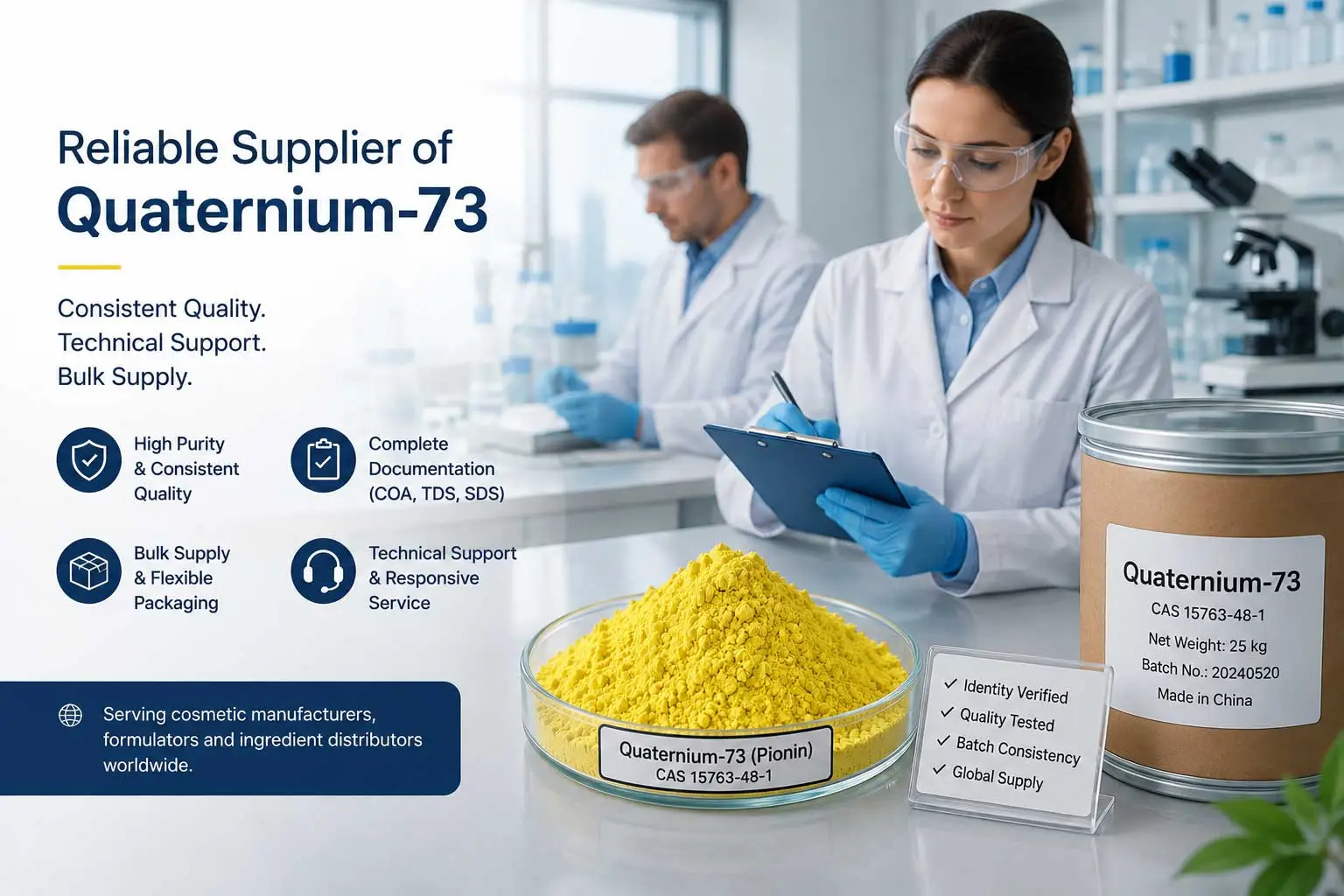
As a cosmetic raw material supplier, CHEN LANG BIO TECH supports customers with technical documentation, sample evaluation and commercial supply rather than treating the initial quotation as the end of the qualification process. For buyers establishing a second source or moving a formula into production, maintaining the agreed specification across repeat orders is particularly important.
Buying Quaternium-73 in Bulk: Should You Request Pionin or Quaternium-73?
Companies planning to buy Quaternium-73 can use either Pionin or Quaternium-73 during initial supplier searches, but the purchase confirmation should clearly establish the INCI name, CAS number, specification, quantity and documentation requirements.
The same principle applies when searching to buy Pionin. The name used in the search bar matters less than the identity and specification ultimately stated on the commercial documents.
Before placing a bulk Quaternium-73 order, buyers should also compare more than Quaternium-73 price or Pionin price per kilogram. A quotation should be evaluated alongside assay specification, test documentation, packaging, MOQ, lead time and shipping terms. A lower-priced material that requires additional qualification or produces inconsistent formulation results can have a higher total procurement cost.
For companies researching where to buy Quaternium-73 or where to buy Pionin, requesting a representative sample and current COA before a larger order is generally a more controlled sourcing approach. A capable Quaternium-73 bulk supplier should be prepared to discuss both technical requirements and the practical conditions of repeat commercial supply.
Pionin vs Quaternium-73 FAQ for Cosmetic Raw Material Buyers
Is Pionin the same ingredient as Quaternium-73?
Yes. Pionin and Quaternium-73 are names associated with the same ingredient identity, CAS 15763-48-1. Quaternium-73 is the INCI name relevant to cosmetic ingredient identification, while Pionin is commonly encountered as an alternative name.
What is the CAS number for Pionin and Quaternium-73?
Both are associated with CAS 15763-48-1. Including the INCI name and CAS number in an RFQ is preferable to relying only on an alternative or commercial name.
Is Pionin the INCI name?
For cosmetic ingredient identification, Quaternium-73 INCI is the relevant standardized name. Pionin is an alternative name associated with the ingredient. Cosmetic manufacturers should follow the applicable labeling and regulatory requirements of their target market when preparing finished-product ingredient declarations.
Can buyers use Pionin and Quaternium-73 interchangeably in an RFQ?
They can be cross-referenced, but a professional RFQ should ideally state “Quaternium-73 / Pionin, CAS 15763-48-1” and then specify the required grade, quantity and documentation. This avoids relying on terminology alone to define the material being purchased.
How can buyers verify the identity of Quaternium-73?
Start by matching the product name, CAS number and Quaternium-73 specification, then review the batch-specific Quaternium-73 COA and relevant analytical results. For a new supplier, a representative sample should also be evaluated before commercial approval.
Where can cosmetic manufacturers buy Quaternium-73?
Buyers searching for a Quaternium-73 supplier, Pionin supplier or CAS 15763-48-1 supplier should prioritize sources that can provide a clear specification, batch COA, technical documentation, samples and consistent commercial supply.
CHEN LANG BIO TECH supplies Quaternium-73 for cosmetic raw-material projects and works with cosmetic manufacturers, formulation laboratories and ingredient distributors on sample and commercial-quantity requirements. Buyers can request current technical documents before deciding whether the supplied grade meets their formulation and purchasing criteria.
Final Takeaway: Pionin and Quaternium-73 Are the Same Ingredient, but Supplier Quality Still Matters
The practical conclusion of Pionin vs Quaternium-73 is straightforward: the names refer to the same ingredient identity associated with CAS 15763-48-1, with Quaternium-73 serving as the INCI name used for cosmetic ingredient identification. For procurement teams, however, confirming the name is only the beginning of qualification.
When comparing suppliers, focus on the actual Quaternium-73 specification, assay method, batch COA, sample performance, documentation and consistency of commercial supply. These factors provide a much stronger basis for purchasing decisions than a CAS number or price quotation alone.
Cosmetic manufacturers, R&D laboratories and ingredient distributors evaluating bulk Quaternium-73 can contact CHEN LANG BIO TECH for current specifications, COA information, sample availability, packaging and commercial quotations.
Email: admin@chenlangbio.com

Send Inquiry
Related Industry Knowledge
- What Not to Mix with Madecassoside: A Practical Formulation Perspective
- L-Theanine Supplement Formulation: Capsule, Tablet & Powder Applications for Bulk Ingredient Suppliers & OEM Manufacturers in China
- Vitamin E Powder for Functional Foods—Why?
- How to Choose the Best Pure Pomegranate Powder
- Is Tetrahydrocurcumin Safe for the Skin
- Sodium Methylesculetin Acetate: Uses, Benefits & Safety
- Sea Buckthorn Oligopeptide vs. Collagen: Which is Better
- What Brand of Green Tea Has the Best EGCG
- Regulate Immunity Pure Natural Quercetin
- Is Dimethylmethoxy Chromanyl Palmitate Safe