
Thaumatin vs Stevia: What Is the Difference?
2026-09-24 11:48:06
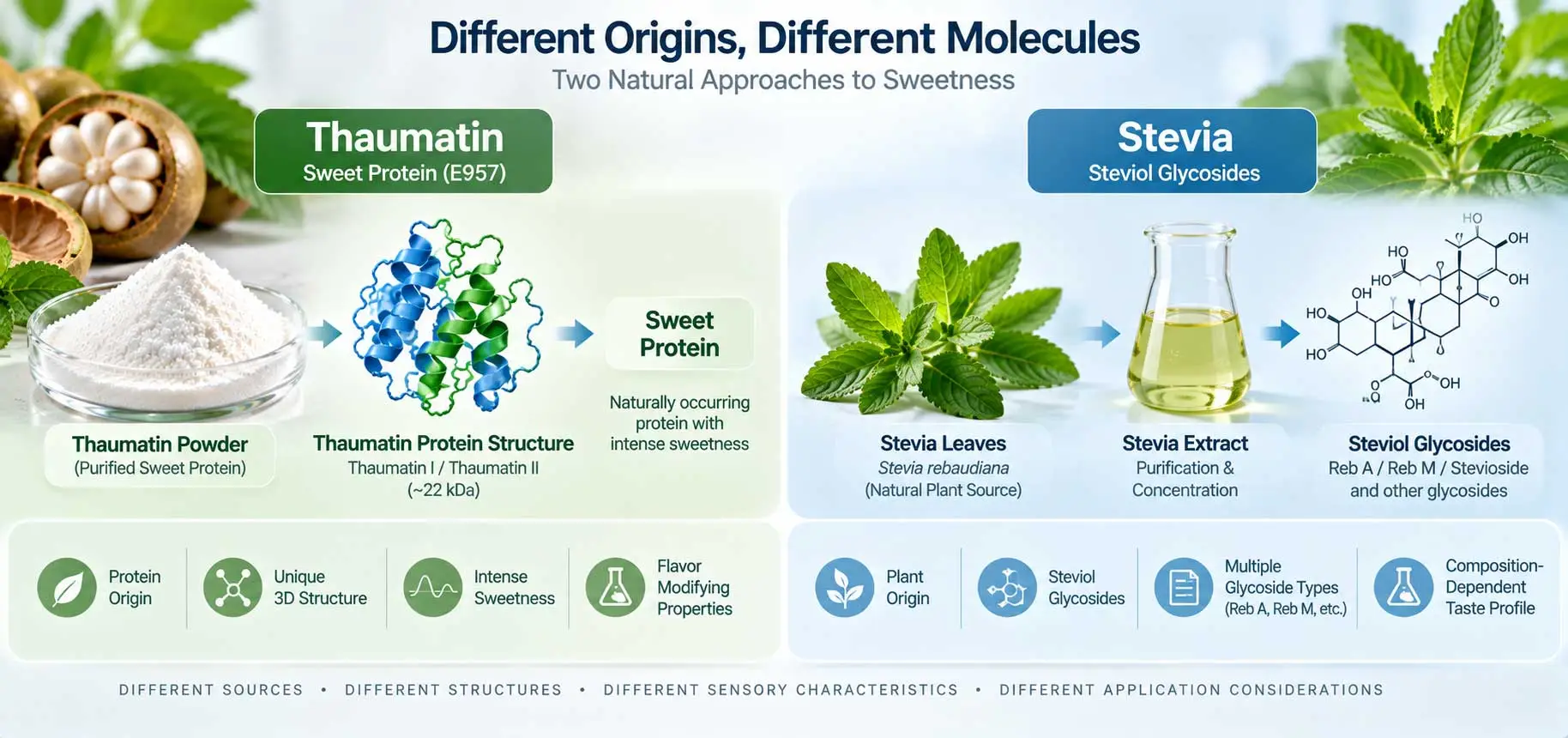
Thaumatin vs stevia is not simply a comparison between two ingredients that make food taste sweeter. Although both can deliver high sweetness at relatively low use levels, they belong to fundamentally different ingredient classes and behave differently in sensory evaluation and food formulation. Thaumatin is a sweet-tasting protein, while the sweetness associated with stevia comes from steviol glycosides such as rebaudioside A (Reb A), rebaudioside M (Reb M) and stevioside.
Those differences matter when a food manufacturer moves from an ingredient datasheet to an actual formulation. Relative sweetness is only one consideration. Sweetness onset and persistence, secondary taste, solubility, processing conditions, flavor modification, ingredient composition and regulatory status can all influence the decision.
For an ingredient buyer, the practical question is therefore not whether thaumatin or stevia is universally “better.” A useful difference between thaumatin and stevia comparison should establish what each material actually is, how its specification is defined and whether its sensory and technical profile fits the intended beverage, dairy, confectionery or other food application.
What Is the Difference Between Thaumatin and Stevia?
The fundamental thaumatin and stevia difference is chemical identity. Thaumatin is a sweet protein. Stevia, by contrast, refers to Stevia rebaudiana and, in commercial sweetener applications, to ingredients containing defined steviol glycosides. This distinction influences how the two materials are specified, tested and used.
|
Comparison |
Thaumatin |
Stevia / Steviol Glycosides |
|
Ingredient class |
Sweet protein |
Steviol glycosides |
|
Important components |
Thaumatin proteins |
Reb A, Reb M, stevioside and other glycosides |
|
Relative sweetness |
Commonly about 2,000–3,000× sucrose by weight |
Commonly around 200–350× for specified steviol-glycoside preparations; varies by composition and conditions |
|
Sweetness profile |
Characteristically slower onset and persistent sweetness |
Depends significantly on glycoside profile |
|
Secondary taste |
Concentration and formulation dependent |
Bitter/licorice-type notes can occur; profile varies by glycoside |
|
Flavor modification |
Important functional characteristic |
Primarily evaluated as a high-intensity sweetening system |
|
Direct sugar replacement |
No |
No |
|
Commercial evaluation |
Specification + application testing |
Glycoside specification + application testing |
These sweetness figures are approximate sensory comparisons rather than fixed formulation ratios. The actual performance of either ingredient depends on concentration, composition, food matrix and test conditions.
Thaumatin vs Stevia Ingredients: Sweet Protein vs Steviol Glycosides
What Is Thaumatin? Understanding the Sweet Protein
Thaumatin belongs to an unusual class of compounds known as sweet-tasting proteins. Conventional thaumatin E957 consists principally of the proteins Thaumatin I and Thaumatin II, historically obtained from the arils of Thaumatococcus daniellii. JECFA specifications list molecular weights of approximately 22.2 kDa for these principal proteins.
This proteinaceous nature distinguishes thaumatin from conventional sugars and most high-intensity sweeteners. Research on the human sweet-taste receptor indicates that sweet proteins such as thaumatin interact with the T1R2/T1R3 receptor system differently from smaller sweet molecules. Thaumatin's large molecular surface and positively charged regions are important to its intense sweet perception.
Commercially, this means thaumatin sweet protein should not be treated as simply another version of stevia. Its molecular identity, sensory behavior and analytical specification are fundamentally different.
Thaumatin is also associated with E957 in established food-additive systems. However, buyers sourcing material produced through newer biosynthetic routes should verify the regulatory status of the specific manufacturing route in the destination market rather than assuming that every thaumatin-containing material automatically meets every jurisdiction's traditional E957 definition.
What Is Stevia? Understanding Steviol Glycosides, Reb A and Reb M
“Stevia” is frequently used as though it describes a single molecule, but this can be misleading for procurement.
The leaves of Stevia rebaudiana contain multiple steviol glycosides, including stevioside, Reb A, Reb D and Reb M. Commercial materials can differ considerably in their total steviol glycoside content and the proportions of individual glycosides.
This matters because a specification dominated by Reb A is not sensorially identical to a high-Reb M ingredient or a broader steviol-glycoside blend.
For example, EFSA documentation for certain steviol glycoside specifications describes preparations as approximately 200–350 times sweeter than sucrose at a specified sucrose equivalency. EFSA has separately described Reb M at around 200 times the sweetness of sucrose and noted its more sucrose-like sensory characteristics compared with major glycosides such as stevioside and Reb A.
For a buyer, “stevia powder” is therefore not enough information. The steviol glycoside profile and analytical basis should be established before technical comparisons are made.
Thaumatin vs Stevia Sweetness: Which Is Sweeter?
•How Sweet Is Thaumatin Compared with Sucrose?
Thaumatin sweetness is commonly reported at approximately 2,000–3,000 times that of sucrose by weight. This makes it one of the most intensely sweet naturally occurring proteins studied for food applications.
However, relative sweetness is not a physical constant like molecular weight. It is derived from sensory comparison, so concentration, reference sucrose level, testing methodology and the surrounding food matrix affect the result.
Consequently, the 2,000–3,000× figure is useful for understanding potency but should not be converted directly into a universal replacement ratio.
•How Sweet Are Steviol Glycosides Compared with Sugar?
The answer is more composition-dependent.
Regulatory specifications have described certain steviol glycoside preparations as approximately 200–350 times sweeter than sucrose under specified comparison conditions. Individual glycosides can have different sensory characteristics, and a finished commercial stevia ingredient may contain several of them in different proportions.
This is why stevia sweetness compared to sugar should always be interpreted alongside the actual specification.
A buyer comparing two quotations marked simply “Stevia 95%,” for example, should establish whether 95% refers to total steviol glycosides and what proportion consists of Reb A, Reb M or other glycosides.
•Is Thaumatin Sweeter Than Stevia?
For commonly quoted weight-based relative sweetness ranges, thaumatin is generally described as having substantially higher sweetness potency than conventional steviol-glycoside preparations. That makes is thaumatin sweeter than stevia a reasonable question, but the answer does not determine which material will perform better in a finished food.
Higher potency does not automatically mean a more suitable taste profile, lower cost-in-use or easier formulation.
The comparison also depends on which stevia ingredient is involved. A defined Reb M material, high-Reb A extract and mixed steviol-glycoside preparation should not be treated as interchangeable reference points.
Thaumatin vs Stevia Taste: How Do Their Sensory Profiles Differ?
►Thaumatin Sweetness Onset and Persistence
The thaumatin taste profile is characterized not only by high potency but also by its temporal behavior. Compared with sucrose, thaumatin is generally associated with a slower development of sweetness and a more persistent sweet sensation.
That persistence can be commercially useful, but it also means that matching peak sweetness alone may not reproduce the desired sensory experience.
Food developers therefore need to evaluate the entire thaumatin sweetness profile—onset, intensity, duration and interaction with the product's flavor system—rather than relying solely on a theoretical sucrose equivalence.
►Stevia Taste Depends on the Steviol Glycoside Profile
The phrase “stevia taste” hides substantial compositional differences.
Stevioside and Reb A have historically been associated with secondary bitter or licorice-like sensory notes, particularly under some concentration and formulation conditions. Later-generation glycosides such as Reb D and Reb M have attracted commercial interest partly because of their different sensory characteristics.
This makes glycoside composition especially relevant when comparing thaumatin vs stevia taste.
If a buyer evaluates a high-Reb M sample and then purchases a materially different steviol-glycoside composition based only on the generic name “stevia,” the finished-product sensory result may change.
►Thaumatin vs Stevia Aftertaste
A simplistic comparison sometimes claims that stevia has an aftertaste while thaumatin does not. That is not a technically sound way to describe either ingredient.
Thaumatin can produce persistent sweetness, and scientific literature has described licorice-like characteristics under certain conditions. Steviol glycosides can also generate bitter, licorice or lingering notes, with the degree and character depending strongly on the individual glycosides, concentration and food matrix.
The practical answer to thaumatin vs stevia aftertaste is therefore application-specific.
For procurement teams, sensory consistency between batches can be just as important as the initial sensory impression of a single sample.
Thaumatin vs Stevia for Flavor Modification and Bitterness Masking
•Thaumatin as a Flavor Modifier
One characteristic that makes thaumatin particularly interesting is that its role extends beyond intense sweetness. Established JECFA specifications identify thaumatin as both a sweetener and flavor enhancer.
As a thaumatin flavor modifier, it can therefore be evaluated in formulations where the development objective includes broader flavor balance rather than sweetness alone. Its ability to influence sensory perception is also why thaumatin bitterness masking appears frequently in technical discussions of the ingredient.
The effect should not be interpreted as universal removal of bitterness. Ingredient concentration, flavor system and food matrix still determine the final result.
•Does Stevia Need Taste Modulation?
Stevia formulations may require a different sensory strategy, particularly where certain glycoside profiles produce undesirable secondary notes at the use level needed to achieve the target sweetness.
This creates an interesting formulation question: the choice does not always have to be thaumatin or stevia.
In some development projects, sweeteners and flavor modifiers can be evaluated together to adjust sweetness onset, persistence and off-notes. Whether such a system works must be established experimentally rather than assumed from the individual ingredients.
Thaumatin vs Stevia Solubility and Processing Stability
Thaumatin Solubility and Processing Considerations
According to JECFA specifications, thaumatin is very soluble in water. This makes thaumatin solubility favorable for many aqueous food systems.
Solubility, however, should not be confused with stability.
Thaumatin is a protein, and protein structure can respond to processing conditions. Research on thaumatin has shown that pH and heat conditions can affect its structural and sensory behavior. A statement that thaumatin is simply “heat stable” therefore lacks enough context for a commercial formulation decision.
Processing temperature, exposure time, pH and food matrix should be evaluated together.
Steviol Glycoside Solubility Depends on Composition
A similar need for specification-level detail applies to stevia.
EFSA specifications for certain steviol-glycoside preparations describe water solubility ranging from freely soluble to slightly soluble. In practice, the behavior of a particular commercial material depends on its glycoside composition and physical form.
For this reason, a meaningful thaumatin vs stevia solubility comparison should use the actual materials being considered rather than generic assumptions about “stevia powder.”
Reb A, Reb M and mixed-glycoside ingredients may present different formulation considerations.
Thaumatin vs Stevia Stability in Food Processing
Both ingredient families can be used in commercial food development, but thaumatin vs stevia stability should be assessed under realistic processing conditions.
For thaumatin, its protein structure makes pH and thermal exposure relevant variables. For steviol glycosides, stability also depends on composition, processing environment and storage conditions.
The most useful approach is to obtain the current technical data for the exact grade being purchased and then validate it under the intended manufacturing process.
Statements such as “completely stable at all temperatures and pH values” should be treated cautiously for either ingredient.
Can Thaumatin Replace Stevia in Food Formulations?
The answer to can thaumatin replace stevia is not on a universal one-to-one basis.
The two ingredients differ in relative sweetness, molecular structure, sweetness onset, persistence and flavor interaction. Their permitted uses and regulatory definitions can also differ by market.
If a formulation currently contains a particular Reb A ingredient, replacing its weight with an arbitrary amount of thaumatin based solely on published sweetness ratios may change the sensory balance significantly.
Why One-to-One Replacement Usually Does Not Work
Suppose a developer knows the nominal sucrose equivalence of two ingredients. Even then, equal calculated sweetness does not guarantee equal sensory performance.
One sweetener may reach peak sweetness more quickly, while another persists longer. Secondary taste can change, and interactions with acids, flavors and other formulation components may produce different results.
The practical replacement process therefore begins with a target sensory profile, not simply a conversion equation.
When Application Testing Becomes Necessary
Application testing is particularly important in beverages, dairy products, confectionery and complex flavor systems.
Bench-top trials can establish an initial range, followed by sensory comparison and processing validation. For commercial scale-up, the exact supplier grade used in development should also be controlled because changes in specification can affect the result.
Can Thaumatin and Stevia Be Used Together?
Can thaumatin and stevia be used together? From a formulation perspective, combinations of sweetening and taste-modifying ingredients can be evaluated where regulations permit their use in the intended product.
A thaumatin stevia blend may be explored because the two materials do not have identical sensory behavior. Instead of asking one ingredient to reproduce every characteristic of sucrose, a developer can investigate whether complementary sweetness profiles provide a more suitable overall result.
Potential development objectives include modifying sweetness onset, extending or controlling sweetness persistence, balancing flavor and addressing secondary sensory notes.
There is no universal thaumatin-to-stevia blending ratio that should be copied across applications. The appropriate relationship depends on the exact steviol glycoside composition, thaumatin grade, finished-product matrix and target sensory profile.
Regulatory conditions for both ingredients must also be checked in the market where the finished product will be sold.
Thaumatin vs Stevia for Beverages, Dairy and Confectionery
Thaumatin vs Stevia for Beverages
For thaumatin vs stevia for beverages, developers should consider more than water solubility. Beverage acidity, thermal treatment, flavor system, sweetness onset and lingering sweetness all influence the result.
In a strongly flavored beverage, flavor-modifying behavior may be particularly relevant. In a delicate flavor system, small sensory differences can become more noticeable.
Thaumatin vs Stevia for Dairy Products
For thaumatin vs stevia for dairy, the surrounding matrix becomes important. Protein, fat, flavor compounds and other solids can influence how sweetness is perceived.
The objective may also extend beyond maximum sweetness intensity. A developer may be trying to preserve a particular flavor character while reducing sucrose, making sensory testing with the complete dairy formulation essential.
Thaumatin vs Stevia for Confectionery
Confectionery introduces another consideration: sugar frequently provides structure and bulk as well as sweetness.
Neither thaumatin nor steviol glycosides automatically reproduce those physical functions. Therefore, thaumatin vs stevia for confectionery should be treated as a sweetener-selection question within a broader formulation project rather than a complete sugar-replacement solution.

Thaumatin vs Stevia Specifications: What Should Ingredient Buyers Compare?
Compare Identity Before Comparing Price
One of the most useful rules in sweetener procurement is simple: establish what you are comparing before comparing quotations.
A “99% thaumatin” specification and a “95% stevia” specification do not mean that the two products contain comparable amounts of the same type of active material.
For conventional thaumatin, JECFA specifications define the material principally in terms of Thaumatin I and II and include an assay based on nitrogen content equivalent to not less than 93% protein on the dried basis. EFSA has also discussed the analytical limitations of relying only on total protein when characterizing thaumatin.
A stevia specification, meanwhile, may refer to total steviol glycosides or a defined glycoside composition. Historical E960 specifications have included not less than 95% total steviol glycosides on the dried basis, while commercial products may further specify individual components such as Reb A or Reb M.
Consequently, a buyer comparing food grade thaumatin with food-grade steviol glycosides should first establish:
|
Buyer Question |
Thaumatin |
Stevia / Steviol Glycosides |
|
What is the ingredient identity? |
Sweet protein material |
Defined glycoside or glycoside mixture |
|
What does the assay measure? |
Verify protein/thaumatin basis and method |
Verify total and/or individual glycosides |
|
Does composition affect sensory performance? |
Yes |
Yes, often substantially |
|
Is manufacturing route relevant? |
Yes |
Yes |
|
Should test methods be reviewed? |
Yes |
Yes |
|
Is application testing recommended? |
Yes |
Yes |
Price per kilogram only becomes meaningful after these questions have been answered.
Thaumatin COA vs Stevia COA
A professional thaumatin COA should be reviewed together with the current product specification and test methods.
For thaumatin, buyers may need to review identity, assay basis, appearance, moisture or loss on drying, microbiological requirements, relevant contaminants and manufacturing-route information.
For steviol glycosides, the stevia COA should make clear whether the assay represents total steviol glycosides, an individual glycoside such as Reb A or Reb M, or another defined compositional basis.
This is especially important when suppliers use percentage figures prominently in quotations. A percentage without a clearly defined analytical basis provides limited information.
Batch number, test method, storage conditions, shelf life and traceability should also form part of commercial qualification.
How Should Buyers Compare Thaumatin and Stevia Suppliers?
Manufacturing Capability and Batch Consistency
Supplier evaluation should extend beyond the sample on a salesperson's desk.
A qualified thaumatin manufacturer should be able to explain product identity, manufacturing route, quality controls and the basis of the specification. For repeat purchasing, capacity, batch consistency, documentation and change control become increasingly important.
CHEN LANG BIO TECH has more than 30 years of experience in sweetener technologies and currently maintains approximately 10 metric tons per year of thaumatin production capacity. Our sweetener platform is supported by biosynthesis capabilities, R&D resources, a synthesis laboratory, an application laboratory and production quality controls.
For customers evaluating a thaumatin supplier, these capabilities support the transition from initial sample testing to repeat commercial purchasing.
Documentation, Samples and Commercial Supply
Our standard thaumatin MOQ starts from 1 kg, providing a practical entry point for customers who need material for qualification and application evaluation.
Standard packaging includes 1–5 kg aluminum foil bags and 25 kg paper drums for larger commercial requirements.
For a thaumatin sample or bulk thaumatin powder inquiry, buyers can request the current specification, COA and other available technical documentation. Providing the intended application, required quantity and destination country at the inquiry stage helps us evaluate both commercial supply and documentation requirements more efficiently.
Frequently Asked Questions About Thaumatin vs Stevia
What is the main difference between thaumatin and stevia?
The primary difference between thaumatin and stevia is chemical identity. Thaumatin is a sweet-tasting protein, whereas commercial stevia sweeteners are based on steviol glycosides such as Reb A, Reb M and stevioside. This difference contributes to distinct sweetness, sensory and specification profiles.
Is thaumatin sweeter than stevia?
Based on commonly quoted weight-based values, thaumatin is generally described as more intensely sweet than conventional steviol-glycoside preparations. Thaumatin is commonly reported at about 2,000–3,000× sucrose, while specified steviol-glycoside preparations are often described in the hundreds-of-times range. Exact comparisons depend on concentration and composition.
Does thaumatin taste like stevia?
No exact sensory equivalence should be assumed. Thaumatin vs stevia taste differs in sweetness onset, persistence and secondary sensory characteristics. Stevia performance also varies considerably according to the individual steviol glycosides present.
Which has more aftertaste, thaumatin or stevia?
There is no useful universal answer to thaumatin vs stevia aftertaste. Thaumatin can produce lingering sweetness and characteristic secondary notes, while some steviol glycosides can produce bitter or licorice-like notes. Concentration, composition and food matrix strongly influence perception.
Can thaumatin replace stevia?
It can be evaluated as an alternative sweetening ingredient, but not through a universal one-to-one replacement. Can thaumatin replace stevia in a specific product should be answered through sensory trials, processing validation and regulatory review.
Can thaumatin and stevia be used together?
They can be evaluated together in applications where the applicable food regulations permit both ingredients. The purpose may be to achieve a particular sweetness curve or sensory balance, but an appropriate ratio must be established for the actual formulation.
Which is more suitable for beverages?
Neither ingredient is universally more suitable. Thaumatin vs stevia for beverages depends on the target sweetness profile, acid system, processing conditions, flavor composition, ingredient specification, regulatory requirements and cost-in-use.
What should buyers check before sourcing thaumatin?
When evaluating a food grade thaumatin supplier, request the current specification and COA and confirm product identity, manufacturing route, assay/test method, microbiological requirements, storage, shelf life, batch consistency and documentation relevant to the destination market.
Sourcing Thaumatin for Commercial Food and Beverage Applications
For commercial buyers, the purpose of a thaumatin vs stevia comparison is not to identify a universal winner. It is to understand which ingredient profile is compatible with the sweetness target, sensory requirements, processing conditions and regulatory framework of the finished product. That evaluation should begin with clearly defined specifications and continue through application testing with the actual commercial grade.
As a thaumatin manufacturer and supplier, CHEN LANG BIO TECH supports projects from initial material evaluation through repeat commercial supply, with approximately 10 MT annual thaumatin production capacity. Customers can begin with a 1 kg MOQ and progress to bulk thaumatin powder requirements after qualification.
For the current thaumatin price, specification, COA or sample availability, please provide your required quantity, application and destination market.
Email: admin@chenlangbio.com
References
1. EFSA Panel on Food Additives and Flavourings (FAF). Re-evaluation of thaumatin (E 957) as food additive. EFSA Journal. 2021;19(11):6884. doi:10.2903/j.efsa.2021.6884.
2. Joint FAO/WHO Expert Committee on Food Additives (JECFA). Thaumatin. Combined Compendium of Food Additive Specifications. Prepared at the 53rd JECFA, 1999. INS 957; CAS 53850-34-3.
3. EFSA Panel on Food Additives and Nutrient Sources added to Food (ANS). Safety of the proposed amendment of the specifications of the food additive steviol glycosides (E 960). EFSA Journal. 2018;16(3):5236. doi:10.2903/j.efsa.2018.5236.
4. EFSA Panel on Food Additives and Flavourings (FAF). Safety of the proposed amendment of the specifications for steviol glycosides (E 960) as a food additive: Rebaudioside M produced via enzyme-catalysed bioconversion of purified stevia leaf extract. EFSA Journal. 2019;17(10):5867. doi:10.2903/j.efsa.2019.5867.
5. Fernstrom JD, Munger SD, Sclafani A, de Araujo IE, Roberts A, Molinary S. Mechanisms for sweetness. Journal of Nutrition. 2012;142(6):1134S–1141S. doi:10.3945/jn.111.149567.
6. Masuda T, Ohta K, Mikami B, Kitabatake N. Positive charges on the surface of thaumatin are crucial for the multi-point interaction with the sweet receptor. Frontiers in Molecular Biosciences. 2018;5:10. doi:10.3389/fmolb.2018.00010.
7. Faus I. Recent developments in the characterization and biotechnological production of sweet-tasting proteins. Applied Microbiology and Biotechnology. 2000;53:145–151.
8. Joseph JA, et al. Bioproduction of the recombinant sweet protein thaumatin: current state of the art and perspectives. Frontiers in Microbiology. 2019;10:695.
9. Masuda T, et al. Structure of thaumatin under acidic conditions: Structural insight into the conformations in lysine residues responsible for maintaining the sweetness after heat-treatment. Food Chemistry. 2022;388:132996.

Send Inquiry

Related Industry Knowledge
- Key Active Compounds in Olive Leaf Extract Powder: Oleuropein vs Hydroxytyrosol
- How Does Quaternium-73 Work? Antimicrobial Activity Explained
- Coenzyme Q10 Powder vs Ubiquinol: Which Raw Material is Best for Supplements
- Are There Any Side Effects or Risks Associated with Genistein?
- How Should Resveratrol Extract Powder be Consumed?
- Where to Buy Bulk Dimethylmethoxy Chromanol
- What is Dimethylmethoxy Chromanol Used for in Skincare
- How Effective is Dimethylmethoxy Chromanol Compared to Other Antioxidants
- What Does Bakuchiol Do to Skin
- Cnidium Monnieri Extract Benefits