
Thaumatin Sweetness: How Sweet Is It Compared with Sugar?
2026-09-23 15:47:22
Thaumatin sweetness is usually described with an attention-grabbing number: approximately 2,000–3,000 times the sweetness of sucrose by weight. That figure is useful for understanding how potent this sweet protein can be, but it is often misunderstood when commercial buyers or food developers compare thaumatin with conventional sugar.
The 2,000–3,000× range does not mean that 1 gram of thaumatin can automatically replace 2–3 kilograms of sugar in every formulation. Relative sweetness is a sensory measurement, not a fixed conversion factor. Concentration, reference sucrose level, food matrix, processing conditions and the presence of other ingredients can all influence perceived sweetness.
For ingredient buyers, this distinction matters. A technically sound evaluation should look beyond how sweet is thaumatin and consider its sweetness profile, flavor-modifying properties, product specification, analytical basis and batch consistency. These factors provide a much more useful picture of commercial food grade thaumatin than sweetness potency alone.
How Sweet Is Thaumatin Compared with Sugar?
Thaumatin is commonly reported as approximately 2,000–3,000 times sweeter than sucrose by weight. Some publications report somewhat different values because relative sweetness depends on the conditions under which sensory comparisons are made.
|
Question |
Quick Answer |
|
How sweet is thaumatin? |
Commonly reported at approximately 2,000–3,000× sucrose by weight |
|
Is thaumatin sweeter than sugar? |
Yes, substantially |
|
Is 2,000–3,000× a fixed value? |
No |
|
Does concentration affect relative sweetness? |
Yes |
|
Does thaumatin taste exactly like sucrose? |
No |
|
Can sugar simply be replaced at 1:2,000? |
No |
|
Ingredient type |
Sweet protein |
|
Food additive designation |
E957 |
|
Other functionality |
Sweetener and flavor modifier/enhancer |
The most important point is that thaumatin sweetness compared to sugar describes sensory potency under defined conditions. It should not be interpreted as a universal formulation ratio.
Why Is Thaumatin So Sweet? Understanding Sweet Protein Sweetness
Why Can a Sweet Protein Produce Such Intense Sweetness?
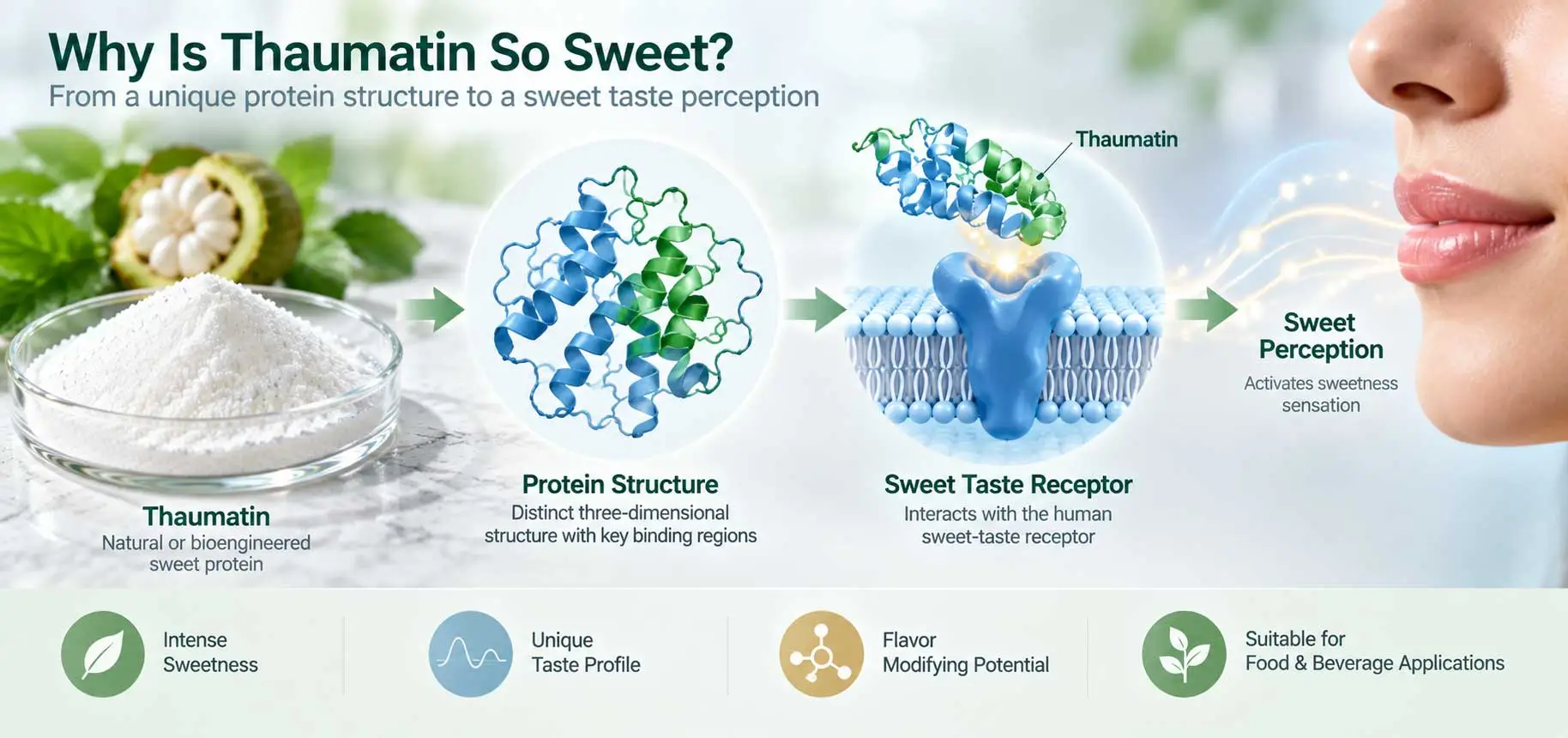
Thaumatin is fundamentally different from sucrose. It belongs to a group of proteins capable of activating the human sweet-taste receptor, which is why the term sweet protein is scientifically meaningful rather than simply a marketing description.
The principal thaumatin proteins are relatively large molecules compared with conventional sweeteners. Thaumatin I and II each contain 207 amino-acid residues and have molecular masses of approximately 22 kDa. Their three-dimensional structures present positively charged and other surface regions that are important to the interaction responsible for sweet-taste perception.
This helps explain an apparent paradox: thaumatin is not a sugar, yet its sweetness intensity can greatly exceed that of sucrose.
On a weight basis, regulatory and scientific sources commonly place thaumatin in the approximately 2,000–3,000× range. On a molar basis, scientific literature has reported values approaching 100,000 times the sweetness of sucrose. These two numbers are not contradictory; they use different bases of comparison and reflect the very different molecular masses of thaumatin and sucrose.
Thaumatin Is Chemically Different from Sucrose
A meaningful thaumatin vs sucrose comparison therefore starts with chemistry.
Sucrose is a disaccharide composed of glucose and fructose units. Thaumatin is a protein composed of amino acids folded into a specific three-dimensional structure. Both can activate sweetness perception, but they reach that outcome through very different molecules.
That difference affects far more than sweetness potency. It also helps explain why thaumatin and sucrose behave differently in sensory timing, processing and finished-food functionality.
Is Thaumatin Really 2,000–3,000 Times Sweeter Than Sugar?
What Does the 2,000–3,000× Sweetness Figure Actually Mean?
Yes, describing thaumatin as approximately 2,000–3,000 times sweeter than sugar is supported by established regulatory and scientific literature, provided the statement is understood correctly.
EFSA's re-evaluation of thaumatin describes the ingredient as approximately 2,000–3,000 times as sweet as sucrose. Food-science references similarly place its relative sweetness within this general range, while some experimental literature reports values outside it.
The important phrase is relative sweetness.
Sweetness is primarily evaluated through sensory comparison rather than measured like molecular weight or moisture content. A panel compares a sweetener solution with a reference sucrose solution under specified conditions and determines the level producing comparable sweetness perception.
Sucrose is typically assigned a relative sweetness value of 1. A material perceived as 2,000 times sweeter under the test conditions would therefore have a relative sweetness of approximately 2,000.
This is why thaumatin sweetness level should be understood as a sensory relationship rather than an immutable physical constant.
Why Do Published Thaumatin Sweetness Values Differ?
Anyone researching how much sweeter is thaumatin than sugar will encounter figures such as 1,600×, 2,000×, 3,000× and occasionally higher values.
This variation does not necessarily mean one source is incorrect.
Relative sweetness can be affected by the concentration of the sweetener and reference sucrose solution, sensory methodology, temperature, pH and the surrounding matrix. Individual sensory responses can introduce additional variation.
The comparison basis also matters. A statement based on mass is not interchangeable with a molar comparison.
For commercial communication, we therefore consider approximately 2,000–3,000× sucrose by weight a more useful description than presenting a single number as an exact specification.
Does Thaumatin Sweetness Change with Concentration?
Relative Sweetness Is Concentration-Dependent
One of the most important concepts for formulators and buyers is that thaumatin relative sweetness should not be treated as a linear property.
Suppose a sweetener is reported to be 2,000 times sweeter than sucrose under one sensory test. It does not automatically follow that every concentration of that sweetener will produce exactly 2,000 times the perceived sweetness of the same weight of sucrose.
Sweetness-response curves are not necessarily parallel across different sweeteners. This is one reason relative sweetness values depend on the sucrose reference concentration used in sensory testing.
The practical consequence is straightforward: calculations based solely on a published thaumatin sweetness intensity are useful for orientation, but they cannot replace sensory validation.
Why Laboratory Numbers May Not Predict Finished-Food Performance
A simple aqueous solution provides controlled conditions for sensory comparison. A finished food does not.
A beverage may contain acids, flavors, minerals and other sweeteners. A dairy matrix contains proteins, fats and other solids. Confectionery products can have completely different moisture and flavor-release characteristics.
Interactions with these components can alter the perceived sweetness profile.
Recent sensory research illustrates the point well. In short-dough biscuits with reduced sucrose, the addition of thaumatin did not simply restore sweetness in a predictable mathematical way; researchers observed effects on flavor perception as part of the overall sensory response.
For commercial development, a theoretical sweetness calculation should therefore be treated as the beginning of evaluation rather than the final formulation answer.
Thaumatin vs Sugar: How Does the Sweetness Profile Differ?
Sweetness Onset and Duration
Thaumatin vs sugar taste differs not only in intensity but also in time.
Sucrose generally produces a relatively familiar sweetness onset and decay. Thaumatin is commonly described as having a slower onset followed by sweetness that persists longer.
That temporal behavior matters because consumers experience a product over time, not as a single numerical sweetness value.
A beverage developer, for example, may reach the desired peak sweetness while still finding that the sweetness persists longer than expected. Conversely, that persistence may be useful in another application. Neither outcome can be predicted adequately from the 2,000–3,000× figure alone.
Does Thaumatin Taste Like Sugar?
Not exactly.
People asking does thaumatin taste like sugar are often trying to determine whether high sweetness potency also means a sucrose-like sensory profile. It does not.
Thaumatin produces intense sweetness, but scientific descriptions report a characteristic temporal profile, including delayed onset and prolonged sweetness. Liquorice-like notes have also been reported, particularly depending on concentration and test conditions.
For food manufacturers, the relevant question is not whether thaumatin perfectly duplicates sucrose. It is whether its sensory characteristics are appropriate for the intended finished product.
Does Thaumatin Have an Aftertaste?
The answer to does thaumatin have an aftertaste requires similar nuance.
Claims that thaumatin universally has “no aftertaste” are too absolute. Sensory literature has reported lingering sweetness and liquorice-like characteristics. Their importance depends on concentration and the formulation in which the ingredient is used.
Thaumatin is also recognized for flavor-modifying functionality and has been studied for reducing or modifying bitter and metallic sensory notes. As a result, its sensory contribution can be more complex than the simple presence or absence of an aftertaste.
This is another reason we recommend evaluating commercial samples within the customer's actual application.
Can Thaumatin Replace Sugar in Food and Beverages?
Sweetness Replacement Is Not the Same as Functional Replacement
The short answer to can thaumatin replace sugar is: it can contribute the sweetness needed in a sugar-reduction strategy, but it cannot automatically replace every functional role of sucrose.
This distinction is fundamental.
Sugar may contribute:
•sweetness;
•solids and bulk;
•texture and mouthfeel;
•browning reactions in heated foods;
•freezing-point control in frozen products;
•water activity and moisture behavior;
•structural properties in bakery and confectionery systems.
Thaumatin is used at very low concentrations because of its extraordinary potency. It therefore cannot provide the same bulk simply by replacing sucrose at a calculated sweetness-equivalent level.
A thaumatin sugar replacement project may consequently require changes elsewhere in the formulation if a substantial amount of sucrose is removed.
Why Thaumatin Is Often Evaluated as Part of a Sweetening System
The characteristics of thaumatin also make it relevant beyond direct sweetness replacement.
Codex identifies thaumatin (INS 957) within the functional classes of sweetener and flavor enhancer. JECFA likewise lists sweetening and flavor-enhancing functions.
This dual role matters commercially. A manufacturer may evaluate thaumatin sweetener not simply to obtain the highest possible sweetness per gram, but because its sweetness profile and flavor modifier properties complement the broader sensory target.
The formulation question therefore changes from “How many grams of sugar does one gram replace?” to “What role should thaumatin play in this particular sweetness system?”
That is a much more useful starting point for product development.
Thaumatin Sweetness vs Other High-Intensity Sweeteners
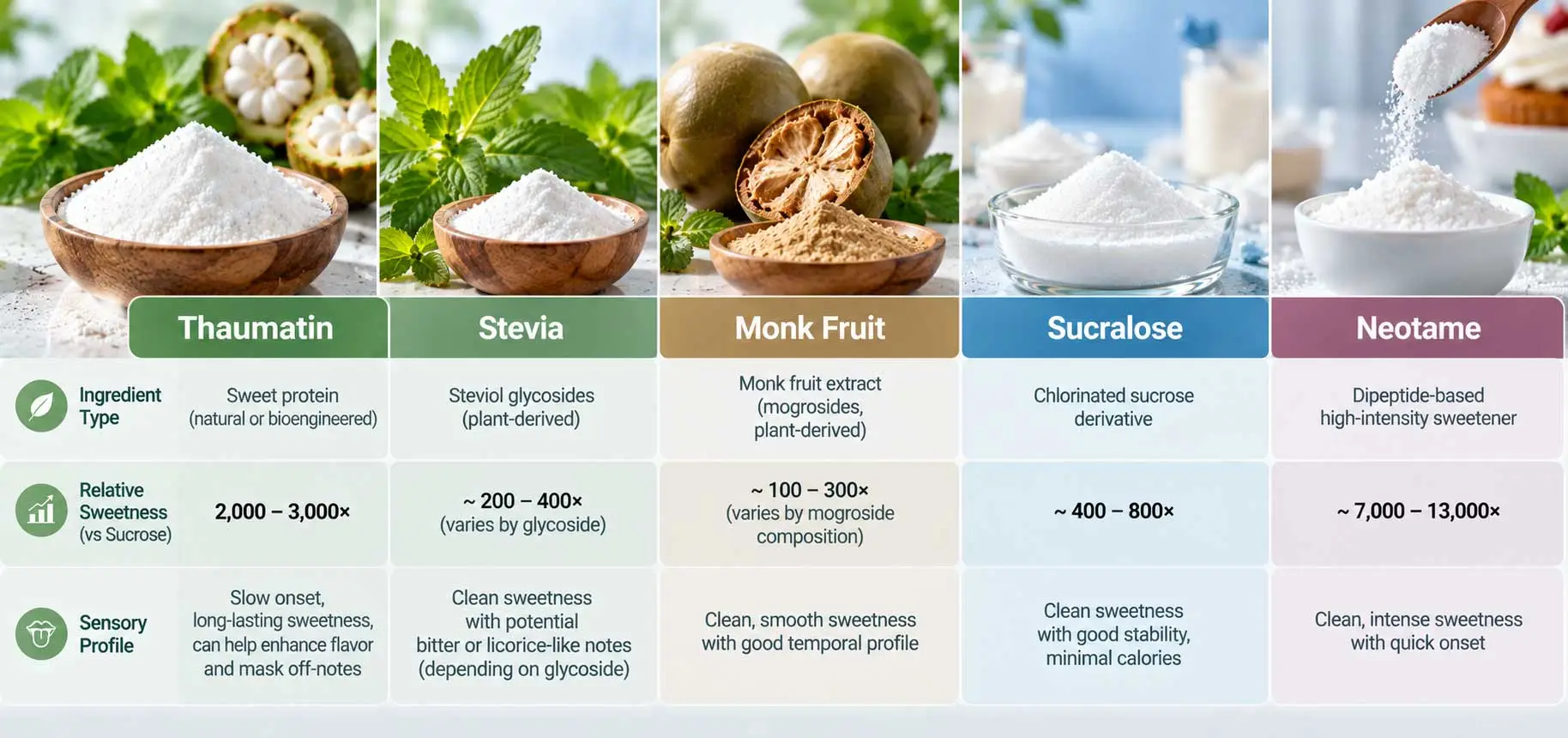
Comparing high-intensity sweeteners by a single potency number can be misleading because their chemical structures, sensory profiles and relative sweetness values differ.
|
Sweetener |
Ingredient Type |
Approximate Relative Sweetness vs Sucrose* |
Important Consideration |
|
Thaumatin |
Sweet protein |
2,000–3,000× |
Slow onset, persistent sweetness and flavor modification |
|
Stevioside |
Steviol glycoside |
Around 300× |
Actual profile depends on glycoside composition |
|
Mogrosides / monk fruit preparations |
Triterpene glycosides |
Specification-dependent |
Composition strongly influences commercial performance |
|
Sucralose |
Chlorinated sucrose derivative |
Approx. 400–800× |
Different sensory and processing characteristics |
|
Neotame |
High-intensity sweetener |
Several thousand times sucrose |
Very high potency; chemically distinct from thaumatin |
*Values are approximate and depend on concentration, reference system and test conditions. They should not be used as direct formulation ratios.
Thaumatin vs Stevia Sweetness
A thaumatin vs stevia sweetness comparison should first identify which steviol glycoside is being discussed. “Stevia” may refer to an extract containing several glycosides or to a more purified ingredient such as Reb A or Reb M.
Thaumatin is a protein, whereas steviol glycosides are diterpene glycosides. Their sweetness intensity, onset, persistence and secondary sensory characteristics differ, so the decision cannot be reduced to which number is higher.
Thaumatin vs Monk Fruit Sweetness
The same principle applies to thaumatin vs monk fruit sweetness. Commercial monk fruit ingredients are generally standardized according to mogroside content, particularly mogroside V, whereas thaumatin is a sweet protein.
Specification therefore matters before any meaningful comparison can be made.
Thaumatin vs Sucralose Sweetness
In thaumatin vs sucralose, thaumatin generally has a higher quoted sweetness potency by weight, but that does not establish which ingredient is appropriate for a particular product.
Sensory profile, processing conditions, regulatory requirements, formulation objectives and cost-in-use all need to be considered.
Why Sweetness Alone Does Not Determine Thaumatin Quality
Sweetness Is a Sensory Property, Not a Complete Quality Specification
For a commercial buyer, a sample tasting intensely sweet does not prove that it is high-quality food grade thaumatin.
Sweetness can confirm that a material has strong sensory activity, but it does not establish identity, composition, microbiological quality, contaminant control or manufacturing consistency.
This is why a professional thaumatin specification should contain measurable quality parameters rather than relying on a claim such as “3,000× sweeter than sugar.”
Established JECFA specifications, for example, include identity and purity-related requirements such as protein-related assay criteria, loss on drying, sulfated ash and other parameters. The exact specification appropriate to a commercial material also depends on its manufacturing route and applicable regulatory framework.
What Should a Thaumatin Specification Tell You?
A useful specification should allow a buyer to answer practical questions:
What exactly is the material? How is the relevant protein content determined? Which analytical method is used? What limits apply to moisture and microbiological quality? What are the storage conditions and shelf life? Does the specification correspond to the manufacturing route being offered?
Those questions are more valuable than simply asking whether the powder is “2,000 times” or “3,000 times” sweeter.
How Should Buyers Evaluate a Thaumatin COA?
Check the Test Basis, Not Just the Percentage
This becomes particularly important when reviewing a thaumatin COA.
If a supplier offers “99% thaumatin,” a professional purchasing team should ask what the percentage represents and how it was measured.
Is the result based on total protein? Does the method specifically quantify thaumatin proteins? Is it reported on an as-is or dried basis? Which analytical procedure was used?
These are not trivial distinctions.
JECFA's conventional specification expresses an assay requirement through nitrogen content corresponding to a minimum protein level. EFSA's re-evaluation also discussed the limitations of relying on total protein measurement and recommended consideration of a validated methodology, such as HPLC, capable of quantifying the combined content of Thaumatin I and II.
For buyers comparing several thaumatin certificate of analysis documents, a percentage without its analytical basis therefore provides incomplete information.
Why Batch Consistency Matters More Than One Sweet Sample
The same principle applies to supplier qualification.
A sample may perform well during initial sensory evaluation, but commercial production requires the next batch—and the batch after that—to remain within agreed specifications.
Reviewing analytical methods, batch records, manufacturing controls and change-management practices gives procurement teams a stronger basis for assessing thaumatin quality than sweetness testing alone.
For long-term purchasing, consistency is part of product performance.
What Should Commercial Buyers Ask a Thaumatin Supplier?
♦Confirm Product Identity and Manufacturing Route
When qualifying a thaumatin supplier, first establish exactly what product is being offered.
Thaumatin has historically been associated with extraction from Thaumatococcus daniellii, while biotechnology has also enabled alternative production routes. These materials should not automatically be assumed to have identical regulatory status in every destination market.
Buyers should therefore confirm product identity, manufacturing route, current specification and regulatory documentation relevant to their intended market.
For international projects, this is particularly important because regulatory definitions and permitted uses can differ between jurisdictions.
♦Confirm Manufacturing Capacity and Repeat Supply
The next question is whether the company can support the purchasing program after the first sample.
CHEN LANG BIO TECH has more than 30 years of experience in sweetener technology and maintains approximately 10 metric tons of annual thaumatin production capacity. Our platform is supported by biosynthesis capabilities, R&D resources, a synthesis laboratory, an application laboratory and production quality controls.
These capabilities matter when evaluating a thaumatin manufacturer because commercial supply requires repeatability, production planning and batch documentation, not simply product availability on the day an inquiry is received.
♦Sample, MOQ and Commercial Supply
For customers beginning qualification, our standard thaumatin MOQ starts from 1 kg. This provides a practical quantity for initial evaluation before moving to larger commercial requirements.
Standard packaging includes:
1–5 kg aluminum foil bags for smaller quantities and 25 kg paper drums for commercial supply.
Customers requesting a thaumatin sample or bulk thaumatin powder can also request the current specification, COA and other available technical documentation. For an accurate quotation, it is helpful to provide the required quantity, destination market and any specific quality or regulatory requirements with the inquiry.
Frequently Asked Questions About Thaumatin Sweetness
How sweet is thaumatin?
Thaumatin is commonly reported to be approximately 2,000–3,000 times sweeter than sucrose by weight. The exact relative sweetness depends on concentration, sensory methodology and the reference conditions used for comparison.
Is thaumatin really 3,000 times sweeter than sugar?
It can be reported at around 3,000× sucrose under certain comparison conditions, but 3,000 should not be treated as a fixed specification. Scientific and technical references report a range of relative sweetness values.
Is thaumatin sweeter than sugar?
Yes. The answer to is thaumatin sweeter than sugar is clearly yes on a weight basis. The difference is substantial, which is why only small quantities are required to produce sweetness. However, sweetness potency does not mean thaumatin reproduces the other functional properties of sugar.
Does thaumatin taste like sugar?
Not exactly. Thaumatin has a different temporal sweetness profile, commonly characterized by a slower onset and more persistent sweetness than sucrose. Its final sensory perception also depends on concentration and the surrounding food matrix.
Does thaumatin have an aftertaste?
A lingering sweetness and liquorice-like note have been reported in sensory literature, so it would be inaccurate to state that thaumatin never has an aftertaste. Perception depends strongly on concentration and formulation.
Can thaumatin completely replace sugar?
Not by sweetness calculation alone. Although thaumatin as a sugar substitute can contribute intense sweetness, sucrose also provides bulk, texture and other functional properties. Significant sugar reduction may therefore require broader formulation changes.
Is thaumatin sweeter than stevia?
Thaumatin generally has a higher quoted relative sweetness than many commonly used steviol glycosides, but thaumatin vs stevia sweetness is not a simple fixed comparison. Stevia products differ in glycoside composition, and relative sweetness changes with concentration and test conditions.
Does a Higher Sweetness Value Mean Better Thaumatin Quality?
No. A quoted sweetness value does not establish purity, identity or batch quality. Commercial buyers should evaluate the thaumatin specification, analytical methods, COA, microbiological requirements, manufacturing controls and batch consistency alongside sensory performance.
Sourcing Thaumatin Powder for Commercial Production
For commercial buyers, the widely quoted 2,000–3,000× thaumatin sweetness range is useful for understanding potency, but it should never be the sole basis for selecting a material or supplier. Product identity, manufacturing route, analytical specification, regulatory suitability and batch consistency provide a much stronger foundation for commercial qualification.
As a thaumatin manufacturer and supplier, CHEN LANG BIO TECH supports customers from initial material evaluation through ongoing commercial purchasing. Our current manufacturing capacity is approximately 10 MT per year, with a standard MOQ starting from 1 kg and packaging options suitable for both evaluation quantities and bulk orders.
If you are comparing food grade thaumatin for a new project, contact our team for the current COA, specification, sample availability and thaumatin price based on your required quantity and destination.
Email: admin@chenlangbio.com
References
1. EFSA Panel on Food Additives and Flavourings (FAF). Re-evaluation of thaumatin (E 957) as food additive. EFSA Journal. 2021;19(11):6884. doi:10.2903/j.efsa.2021.6884.
2. Joint FAO/WHO Expert Committee on Food Additives (JECFA). Thaumatin — Combined Compendium of Food Additive Specifications. FAO. INS No. 957; CAS No. 53850-34-3.
3. Codex Alimentarius. General Standard for Food Additives (GSFA): Thaumatin (INS 957). Functional classes: flavour enhancer and sweetener.
4. van der Wel H, Loeve K. Isolation and characterization of thaumatin I and II, the sweet-tasting proteins from Thaumatococcus daniellii Benth. European Journal of Biochemistry. 1972;31:221–225.
5. Masuda T, et al. Structure of thaumatin under acidic conditions: Structural insight into the conformations in lysine residues responsible for maintaining the sweetness after heat-treatment. Food Chemistry. 2022;388:132996.
6. Kaneko R, Kitabatake N. Structure-sweetness relationship in thaumatin: importance of lysine residues. Chemical Senses. 2001;26(2):167–177.
7. de Souza VR, et al. Sensory dynamic profile and consumer acceptance of short-dough biscuits with reduced sucrose and thaumatin addition. Food Research International. 2025.
8. Faus I. Recent developments in the characterization and biotechnological production of sweet-tasting proteins. Applied Microbiology and Biotechnology. 2000;53:145–151.
9. Gibbs BF, Alli I, Mulligan C. Sweet and taste-modifying proteins: a review. Nutrition Research. 1996;16(9):1619–1630.
10. Joseph JA, et al. Bioproduction of the recombinant sweet protein thaumatin: current state of the art and perspectives. Frontiers in Microbiology. 2019;10:695.

Send Inquiry
Related Industry Knowledge
- Optimal DHEA Dosage for Testosterone: What Supplement Brands Need to Know
- Can Liposomal Coenzyme Q10 Help with Fatigue?
- Is Cetyl Tranexamate HCL Safe?
- How Does Kopexil Work?
- Does Cactus Extract Powder Help with Weight Loss?
- What are Praziquantel Tablets for
- Does Sodium Ascorbyl Phosphate Promote Collagen
- Phellinus Linteus Extract Powder for Sale
- Can Diabetic Person Take Natural Stevia Extract Powder
- What's Unique Functions of Haematococcus Powder in Skin Care