
Thaumatin vs Monk Fruit: Sweetness, Taste and Formulation Differences
2026-09-24 11:49:02
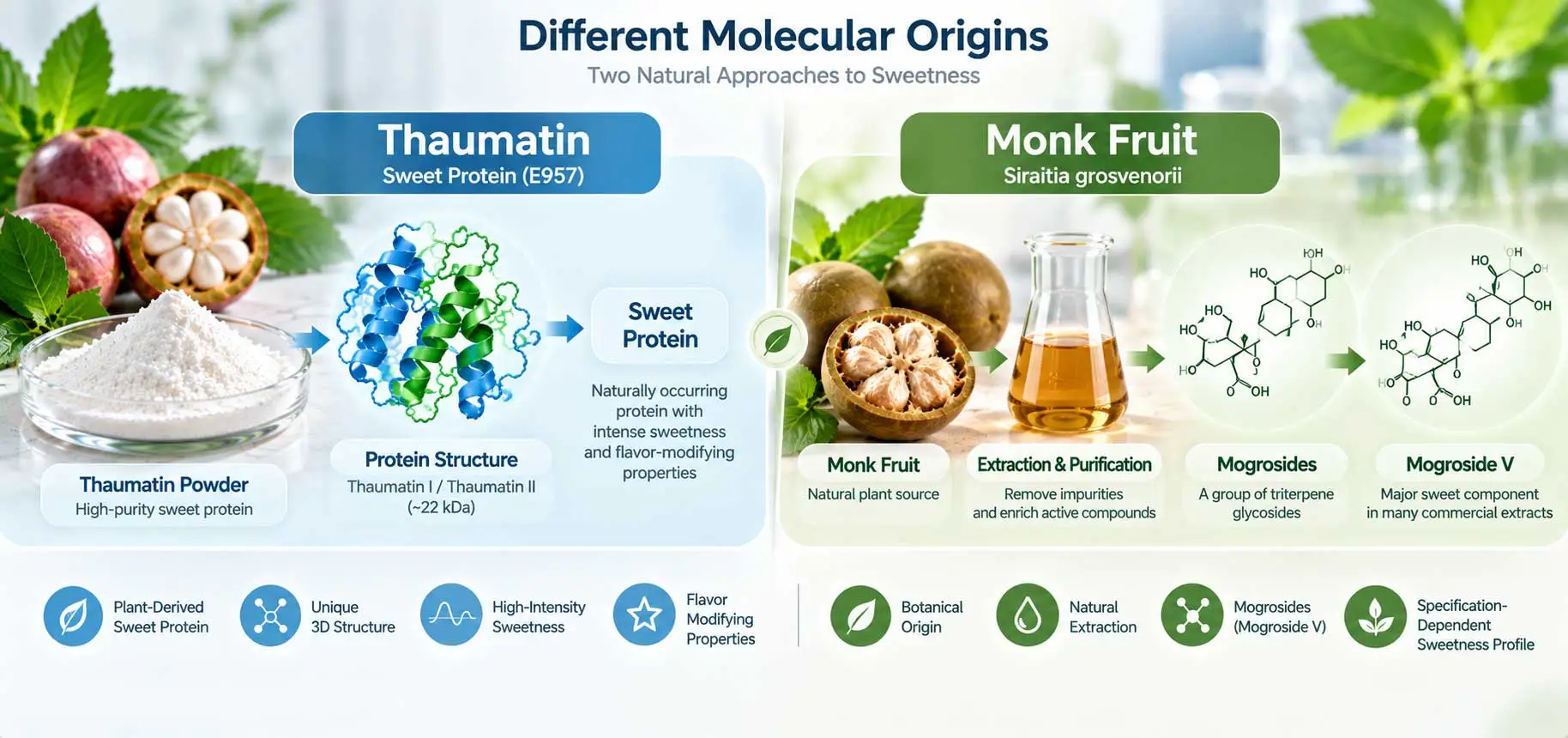
Thaumatin vs monk fruit is a useful comparison for food and beverage developers because both ingredients can deliver high-intensity sweetness at relatively low use levels, yet they are chemically and sensorially very different. Thaumatin is a sweet-tasting protein, whereas the characteristic sweetness of monk fruit comes from a group of triterpene glycosides known as mogrosides, with mogroside V being a major sweet component in many commercial extracts.
For an ingredient buyer, that distinction has practical consequences. Comparing only “times sweeter than sugar” or price per kilogram can lead to a poor purchasing decision. Sweetness onset and persistence, secondary taste, flavor modification, solubility, processing conditions and cost-in-use all matter. Just as importantly, commercial monk fruit extract is sold in multiple mogroside V concentrations, so a 25% grade and a 50% grade should not be treated as the same ingredient.
This guide examines the difference between thaumatin and monk fruit from a formulation and procurement perspective, with particular attention to specifications, sensory performance, COAs and commercial qualification.
What Is the Difference Between Thaumatin and Monk Fruit?
The main thaumatin and monk fruit difference is the chemical nature of the sweet components. Thaumatin is a protein-based sweetener. Monk fruit, obtained from Siraitia grosvenorii, contains cucurbitane-type glycosides collectively called mogrosides. These include mogrosides II, III, IV, V and VI, with mogroside V being an important marker and major sweetness contributor in standardized commercial extracts.
That difference affects far more than ingredient terminology.
|
Comparison |
Thaumatin |
Monk Fruit |
|
Ingredient class |
Sweet protein |
Fruit extract containing triterpene glycosides |
|
Important sweet components |
Thaumatin proteins |
Mogrosides, particularly mogroside V |
|
Source association |
Thaumatococcus daniellii |
Siraitia grosvenorii |
|
Relative sweetness |
Commonly reported around 2,000–3,000× sucrose by weight |
Strongly dependent on mogroside V concentration and extract composition |
|
Sweetness profile |
Slower onset and persistent sweetness |
Grade- and concentration-dependent |
|
Secondary sensory notes |
Concentration and matrix dependent |
Herbal, fruity or lingering notes may occur depending on grade |
|
Flavor modification |
Important functional characteristic |
Primarily evaluated as a sweetening ingredient |
|
Direct sugar replacement |
No |
No |
|
Commercial specification |
Verify thaumatin/protein assay basis |
Verify mogroside V and/or total mogrosides |
|
Best comparison |
Application performance + cost-in-use |
Application performance + cost-in-use |
These relative sweetness values are sensory measurements rather than fixed formulation conversion factors. A developer should not use them as a universal replacement equation.
Thaumatin vs Monk Fruit Ingredients: Sweet Protein vs Mogrosides
What Is Thaumatin? Understanding the Sweet Protein
Thaumatin belongs to a relatively unusual group of compounds known as sweet-tasting proteins. Conventional thaumatin E957 is associated primarily with Thaumatin I and Thaumatin II, proteins of approximately 22 kDa. Unlike sucrose, mogrosides or steviol glycosides, its sweetness originates from a protein structure interacting with the human sweet-taste receptor.
This molecular identity helps explain why thaumatin sweet protein has a distinctive sensory profile. Its sweetness develops differently from sucrose, tends to persist, and can contribute to flavor modification at very low concentrations.
Thaumatin is also used as a flavor modifier, which is important when assessing it commercially. A formulator may therefore evaluate thaumatin E957 not only according to the amount of sweetness delivered per gram but also according to how it changes the overall sensory profile of a formulation.
Manufacturing route should also be established during supplier qualification. Traditional regulatory specifications have historically described plant-derived thaumatin, while newer production technologies include biosynthetic approaches. Buyers should therefore confirm that the specific commercial grade and production route are appropriate for the destination market rather than relying solely on the generic name E957 sweetener.
What Is Monk Fruit Extract? Understanding Mogrosides and Mogroside V
Monk fruit is the fruit of Siraitia grosvenorii, also widely known as Luo Han Guo. Its intense sweetness is associated with monk fruit mogrosides, rather than ordinary sugars in the fruit.
This distinction is particularly important for purchasing because monk fruit sweetener is not one standardized concentration worldwide.
FDA GRAS documentation for one commercial family of Luo Han Guo extracts describes grades containing at least 7%, 12.5%, 20%, 25%, 30%, 40%, 50%, 60%, 90% and 95% mogroside V. An EFSA evaluation separately considered proposed monk fruit extract specifications containing 25%, 40%, 45%, 50% and 55% mogroside V. Commercial ingredient markets commonly offer grades around 20–50% mogroside V, with higher-purity materials also available.
For mainstream food formulation, buyers frequently encounter specifications such as:
|
Commercial Description |
Typical Analytical Basis |
|
Monk Fruit Extract MV20 |
≥20% mogroside V |
|
Monk Fruit Extract MV25 |
≥25% mogroside V |
|
Monk Fruit Extract MV30 |
≥30% mogroside V |
|
Monk Fruit Extract MV40 |
≥40% mogroside V |
|
Monk Fruit Extract MV50 |
≥50% mogroside V |
|
Higher-purity grades |
55%, 60%, 90% or 95% mogroside V may be available |
These are examples of market specifications, not a universal regulatory grading system. A buyer should always confirm the actual monk fruit extract specification, analytical method and other components of the grade being quoted.
Thaumatin vs Monk Fruit Sweetness: How Do They Compare?
How Sweet Is Thaumatin Compared with Sugar?
Thaumatin sweetness is commonly reported in the range of approximately 2,000–3,000 times that of sucrose by weight, although scientific publications report somewhat broader ranges depending on testing conditions.
The figure demonstrates its extraordinary potency but should not be interpreted as “one gram always replaces two or three kilograms of sugar.” Relative sweetness changes with concentration, reference sucrose level, sensory methodology and food matrix.
A formulation also experiences the sweetness over time. Thaumatin generally develops more slowly and persists longer than sucrose, so matching a calculated sweetness number does not necessarily create an equivalent sensory profile.
How Sweet Is Monk Fruit Compared with Sugar?
Monk fruit sweetness compared to sugar requires more qualification because extract concentration can vary substantially.
FDA GRAS documentation for a specific series of commercial Luo Han Guo extracts illustrates this clearly. When evaluated against a 10% sucrose solution, reported sweetness intensity increased as mogroside V concentration increased: a 7% mogroside V extract was reported at about 45 times sucrose, 12.5% at about 80 times, 20% at about 130 times and 25% at about 160 times under the conditions used in that submission.
Other commercial specifications commonly describe higher mogroside V grades in the hundreds-of-times-sucrose range. The exact figure, however, should not be transferred from one supplier's material to another without checking composition and sensory methodology.
This is why mogroside V sweetness and extract specification belong together.
Is Thaumatin Sweeter Than Monk Fruit?
For commonly reported weight-based values, thaumatin generally exhibits considerably greater sweetness potency than standard commercial monk fruit extracts. However, is thaumatin sweeter than monk fruit is only the first question a formulator should ask.
“Monk fruit” could mean MV20, MV25, MV40, MV50 or a substantially more purified grade. Comparing thaumatin against an unidentified monk fruit powder provides little technical value.
Higher sweetness potency also does not automatically mean lower finished-product cost or better sensory performance. The relevant commercial measurement is how much of the actual grade is required to achieve the desired sensory result.
Thaumatin vs Monk Fruit Taste: How Do Their Sensory Profiles Differ?
Thaumatin Taste and Sweetness Persistence
The thaumatin taste profile is characterized by high sweetness intensity, a comparatively slow onset and prolonged sweetness. Scientific reviews also describe possible liquorice-like or other secondary sensory characteristics, particularly depending on concentration and formulation.
This temporal behavior can be useful when designing a sweetening system, but it means thaumatin should not be judged solely by peak sweetness.
Its persistent thaumatin sweetness profile may complement other ingredients with faster sweetness onset. At the same time, excessive use can produce a sensory profile that differs considerably from sucrose.
Monk Fruit Taste Depends on Mogroside Composition
The sensory profile of monk fruit extract also cannot be separated from its specification.
Lower-concentration extracts retain a larger proportion of non-mogroside fruit components than highly purified materials. Commercial grades can therefore differ in color, characteristic fruit or herbal notes and sweetness quality.
Scientific sensory literature has reported lingering sweetness, herbal notes or slight bitterness from Luo Han Guo extracts under some conditions. These characteristics are not necessarily present at the same intensity in every grade.
For this reason, a thaumatin vs monk fruit taste trial should use the exact commercial grades under consideration rather than generic laboratory references.
Thaumatin vs Monk Fruit Aftertaste
Neither ingredient should be marketed with an absolute claim of “no aftertaste.”
In a thaumatin vs monk fruit aftertaste comparison, thaumatin may show persistent sweetness and secondary notes, while monk fruit extracts can exhibit characteristic herbal, fruity, bitter or lingering attributes depending on mogroside concentration and purification.
The finished food matrix can change those perceptions substantially. Acidity, dairy proteins, cocoa, fruit flavors and other high-intensity sweeteners can all alter the sensory outcome.
A representative application sample is therefore more informative than tasting the dry powders alone.
Thaumatin vs Monk Fruit for Flavor Modification and Bitterness Masking
Thaumatin as a Flavor Modifier
Thaumatin is notable because its technological role extends beyond sweetness. Established specifications and scientific literature describe its use as a flavor enhancer or modifier, making thaumatin flavor modifier an important concept when calculating its value in a formulation.
At suitable levels, formulators may investigate thaumatin for balancing bitter or astringent characteristics or modifying the perception of particular flavor systems. Thaumatin bitterness masking should nevertheless be evaluated experimentally rather than treated as a universal effect.
The appropriate concentration for flavor modification may also differ from that required when thaumatin is used primarily for sweetness.
How Monk Fruit Contributes to the Overall Flavor System
Monk fruit is primarily selected for its mogroside-based sweetness, but its own sensory profile becomes part of the finished flavor system. The influence becomes particularly relevant when the use level or concentration of less-purified extract introduces detectable characteristic notes.
This is one reason formulators sometimes evaluate combinations rather than expecting one high-intensity sweetener to reproduce the entire sensory curve of sucrose.
Thaumatin vs Monk Fruit Solubility and Processing Stability
Thaumatin Solubility and Protein Stability
Thaumatin is highly water soluble, making thaumatin solubility suitable for many aqueous formulations. Its protein nature, however, means solubility and structural stability should not be treated as the same property.
Research indicates that thaumatin can retain sweetness under a useful range of processing conditions, but pH, temperature, heating duration and surrounding matrix influence protein behavior. Technical evaluation should therefore use the conditions of the actual process rather than a blanket statement such as “completely heat stable.”
Monk Fruit Extract Solubility Depends on the Commercial Grade
The monk fruit grades considered in EFSA documentation at 25–55% mogroside V were described as freely soluble in water. Commercial suppliers also commonly provide water-soluble powdered grades.
Nevertheless, a thaumatin vs monk fruit solubility comparison should still identify the exact product. A purified mogroside V ingredient, standardized fruit extract and formulated sweetener containing carriers are not necessarily identical in handling or appearance.
Buyers should confirm the test concentration used for solubility claims and whether the quoted material contains carriers or other ingredients.
Why Processing Conditions Matter for Both Ingredients
A meaningful thaumatin vs monk fruit stability assessment should consider pH, thermal treatment, processing time, storage conditions and the finished-food matrix.
This is particularly important for acidic beverages, pasteurized products and formulations expected to maintain a consistent sensory profile throughout shelf life.
The current TDS should be reviewed before scale-up, followed by validation using the actual commercial batch intended for production.
Can Thaumatin Replace Monk Fruit in Food Formulations?
There is no universal one-to-one answer to can thaumatin replace monk fruit.
Even if a formulator calculates theoretically equivalent sweetness, the resulting product can differ because thaumatin and mogrosides do not have identical sweetness onset, persistence or secondary taste.
•Why Sweetness Equivalence Is Not Enough
A mathematical conversion based on “times sweeter than sucrose” ignores several variables: the exact monk fruit grade, concentration-response relationship, flavor interaction and temporal sweetness profile.
Replacing MV25 with thaumatin, for example, is not the same development task as replacing MV50. The initial monk fruit formulation already contains different amounts of mogroside V per gram.
•Why Application Testing Is Necessary
A more reliable development sequence is to establish a sensory benchmark, calculate an initial trial range, conduct bench-scale formulation tests, perform sensory evaluation and then validate processing and storage behavior.
Commercial scale-up should use the same specification qualified during development. A material that carries the same generic ingredient name but differs substantially in composition may not produce the same result.
Can Thaumatin and Monk Fruit Be Used Together?
Can thaumatin and monk fruit be used together? From a formulation perspective, the combination can be evaluated where both specific ingredients are permitted for the intended food and destination market.
A thaumatin monk fruit blend can be technically interesting because the ingredients have different sensory characteristics. Formulators may investigate a combination to adjust sweetness onset and persistence, improve overall flavor balance or reduce the dependence on a single sweetening component.
There is no technically defensible universal blending ratio.
A formulation containing MV20 monk fruit extract will require a different evaluation from one containing MV50. Thaumatin grade, product pH, flavor system and other sweeteners also affect the optimum relationship.
The ratio should therefore come from application testing, not from a generic online formulation.
Thaumatin vs Monk Fruit for Beverages, Dairy and Confectionery
♦Thaumatin vs Monk Fruit for Beverages
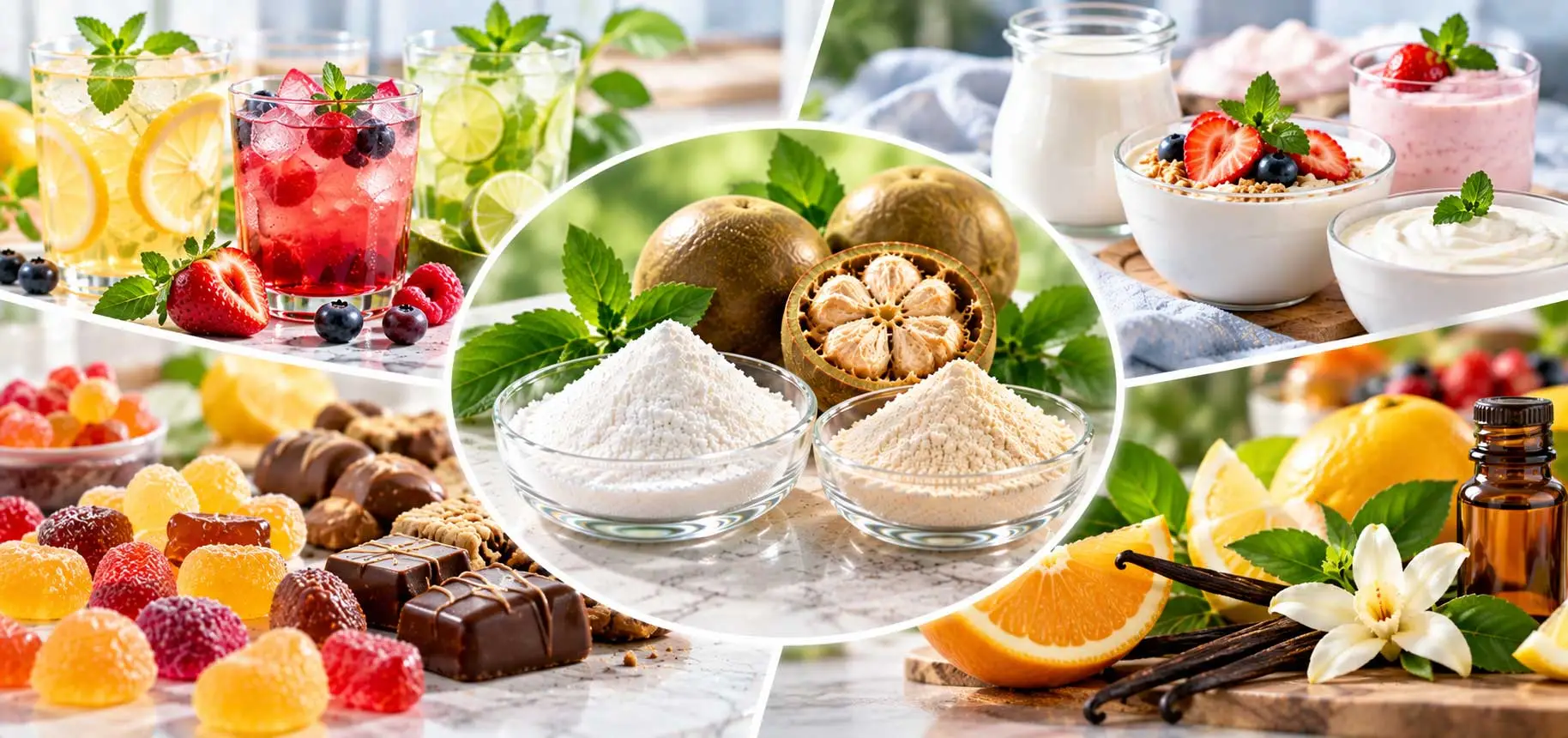
When evaluating thaumatin vs monk fruit for beverages, water solubility is only the starting point. Developers should also examine acidity, thermal treatment, sweetness onset, persistence and interaction with fruit, tea, coffee or other flavor systems.
Clear beverages may additionally require attention to ingredient color and clarity, particularly when comparing monk fruit extracts of different purification levels.
♦Thaumatin vs Monk Fruit for Dairy Products
For thaumatin vs monk fruit for dairy, fat, milk proteins and added flavors can alter perceived sweetness and secondary notes. A vanilla yogurt and a chocolate dairy beverage, for example, should not automatically use the same sweetener strategy.
Sensory evaluation in the complete matrix is therefore more useful than sweetness comparison in water.
♦Thaumatin vs Monk Fruit for Confectionery
For thaumatin vs monk fruit for confectionery, developers must also remember that sucrose provides bulk, structure and textural functions that neither ingredient automatically replaces.
High-intensity sweetness may solve one part of a sugar-reduction project, while bulking, moisture management, texture and browning require separate formulation solutions.
Thaumatin vs Monk Fruit Specifications: What Should Buyers Compare?
Compare Ingredient Identity Before Comparing Price
This is where many purchasing comparisons become misleading.
A quotation for “99% thaumatin” and another for “50% monk fruit” does not represent a 99-versus-50 purity comparison. The percentages refer to fundamentally different analytical entities.
A professional thaumatin specification should identify exactly what the assay represents, the test method and whether results are reported on a dry basis. Manufacturing route should also be clear.
A monk fruit extract specification should state whether the percentage refers specifically to mogroside V, total mogrosides or another defined analytical parameter. FDA GRAS documentation demonstrates how broad the market range can be, describing commercial extracts from 7% through 95% mogroside V. EFSA's assessment of proposed specifications included MV25, MV40, MV45, MV50 and MV55.
For procurement purposes, a description such as “Monk Fruit Extract 50%” should therefore trigger the question:
50% of what, measured by which method?
For many standardized grades, the expected answer is mogroside V specification by HPLC, but the buyer should verify this rather than assume it.
Thaumatin COA vs Monk Fruit COA
A current thaumatin COA should be compared against the approved product specification, with attention to identity, assay basis, analytical method, moisture or loss on drying, relevant contaminants and microbiological requirements.
For a monk fruit COA, buyers should pay particular attention to the declared mogroside V content and method. Depending on the grade and purchasing requirements, useful checks can include:
|
Procurement Check |
Thaumatin |
Monk Fruit Extract |
|
Ingredient identity |
Confirm |
Confirm botanical/extract identity |
|
Primary assay |
Thaumatin/protein basis as specified |
Mogroside V and/or total mogrosides |
|
Analytical method |
Verify |
HPLC commonly used for mogroside V |
|
Dry basis |
Confirm |
Confirm |
|
Moisture / loss on drying |
Review specification |
Review specification |
|
Microbiology |
Grade/market appropriate |
Grade/market appropriate |
|
Heavy metals |
Market/specification appropriate |
Market/specification appropriate |
|
Carrier/excipients |
Confirm if applicable |
Particularly important for formulated grades |
|
Manufacturing route |
Confirm |
Confirm extraction/purification basis |
|
Batch traceability |
Required for commercial qualification |
Required for commercial qualification |
A percentage on a sales sheet is not a substitute for analytical identity.
How Should Buyers Compare Thaumatin and Monk Fruit Cost-in-Use?
The thaumatin price and monk fruit extract price per kilogram can be useful purchasing data, but neither tells a formulator the true economic impact of the ingredient.
A better commercial metric is cost-in-use.
For example, a higher-purity monk fruit extract may have a higher purchase price but require a lower use level or less sensory correction than a lower-purity grade. Similarly, thaumatin's high sweetness potency and flavor-modifying characteristics may affect the total sweetening system rather than simply replacing another ingredient gram-for-gram.
A practical cost model should therefore include the price of the qualified grade, effective use level, additional sweeteners or bulking agents, flavor-masking requirements, processing performance and expected batch consistency.
For international purchasing, freight, minimum order quantity and documentation requirements may also affect landed cost.
How Should Buyers Compare Thaumatin and Monk Fruit Suppliers?
Manufacturing Capability and Batch Consistency
A professional thaumatin manufacturer or monk fruit sweetener manufacturer should be able to move the conversation beyond a product name and price.
Buyers should ask how the grade is defined, which analytical method supports the assay, how batch consistency is controlled and whether the supplier can support repeat commercial production after the initial sample has been approved.
CHEN LANG BIO TECH has worked with sweetener technologies for more than 30 years. Our current production platform includes approximately 10 MT/year of thaumatin capacity and 50 MT/year of mogrosides/monk fruit sweetener capacity, supported by R&D resources, application testing, laboratory capabilities and production quality controls.
Having manufacturing experience with both ingredient categories is particularly useful in a comparison such as this because the commercial decision does not have to begin with the assumption that one ingredient is universally preferable.
Documentation, Samples and Commercial Supply
For customers qualifying a thaumatin supplier, our standard thaumatin MOQ starts at 1 kg, with 1–5 kg aluminum foil bags for smaller commercial quantities and 25 kg paper drums for larger requirements.
For a thaumatin sample, bulk thaumatin powder, monk fruit extract sample or bulk monk fruit extract inquiry, the most useful information to provide is the intended application, target specification, estimated order quantity and destination market.
For monk fruit in particular, stating only “monk fruit powder” is insufficient. Buyers should specify the desired mogroside V concentration—or ask us to discuss an appropriate grade based on the formulation—before comparing commercial quotations.
Frequently Asked Questions About Thaumatin vs Monk Fruit
What is the main difference between thaumatin and monk fruit?
The principal difference between thaumatin and monk fruit is chemical identity. Thaumatin is a sweet protein, whereas monk fruit sweetness comes primarily from mogrosides, a family of triterpene glycosides. This difference contributes to distinct specifications, sweetness profiles and formulation behavior.
Is thaumatin sweeter than monk fruit?
Based on commonly reported weight-based sweetness values, thaumatin generally has greater sweetness potency than standard commercial monk fruit extracts. However, is thaumatin sweeter than monk fruit cannot be answered precisely without defining the monk fruit grade, particularly its mogroside V concentration.
Does thaumatin taste like monk fruit?
No. Thaumatin vs monk fruit taste differs in sweetness onset, persistence and secondary sensory characteristics. Monk fruit sensory performance also changes with mogroside concentration and extract purity, so application testing with the actual grades is recommended.
Does monk fruit have an aftertaste?
Monk fruit extracts can produce lingering, herbal or other secondary sensory notes depending on grade, concentration and food matrix. Higher mogroside V concentration does not by itself guarantee identical sensory performance across suppliers because overall extract composition and processing also matter.
Can thaumatin replace monk fruit?
Can thaumatin replace monk fruit should be evaluated formulation by formulation. There is no universal one-to-one conversion because the ingredients differ in sweetness intensity, temporal profile, composition and flavor interaction.
Can thaumatin and monk fruit be used together?
A thaumatin with monk fruit sweetening system can be evaluated where permitted for the intended product and market. Different temporal sweetness characteristics may make blending technically interesting, but the appropriate ratio must be established through sensory and application testing.
What does mogroside V percentage mean in monk fruit extract?
The mogroside V percentage indicates the amount of mogroside V in a standardized extract according to the stated analytical basis. Commercial specifications include grades such as MV20, MV25, MV30, MV40 and MV50, while substantially higher concentrations are also available. Buyers should confirm the analytical method and dry-basis definition.
What should buyers check before sourcing thaumatin or monk fruit extract?
Before selecting a thaumatin supplier or monk fruit extract supplier, verify ingredient identity, specification, assay basis, analytical method, manufacturing route, COA, microbiological and contaminant requirements, batch consistency, regulatory suitability for the destination market and commercial supply capability.
Sourcing Thaumatin and Monk Fruit for Commercial Production
For commercial buyers, a useful thaumatin vs monk fruit comparison should end with the actual grade rather than the generic ingredient name. The correct decision depends on specification, target sensory profile, processing conditions, applicable regulations and cost-in-use.
Our sweetener platform supports both product categories, with approximately 10 MT/year of thaumatin capacity and 50 MT/year of mogrosides/monk fruit sweetener capacity. This allows customers to discuss the formulation objective first and then evaluate an appropriate ingredient specification rather than beginning with a predetermined solution.
For the current thaumatin price, monk fruit grade options, COA, specification, sample availability or commercial quotation, please send your required quantity, application and destination market to admin@chenlangbio.com
References
1. U.S. Food and Drug Administration. GRAS Notice No. 629: Siraitia grosvenorii Swingle (Luo Han Guo) Fruit Extract. GRAS Notice Inventory.
2. EFSA Panel on Food Additives and Flavourings (FAF). Safety of use of Monk fruit extract as a food additive in different food categories. EFSA Journal. 2019;17(12):5921.
3. EFSA Panel on Food Additives and Flavourings (FAF). Re-evaluation of thaumatin (E 957) as food additive. EFSA Journal. 2021;19(11):6884.
4. Joint FAO/WHO Expert Committee on Food Additives (JECFA). Thaumatin. Combined Compendium of Food Additive Specifications. INS 957.
5. Joseph JA, Akkermans S, Nimmegeers P, Van Impe JFM. Bioproduction of the Recombinant Sweet Protein Thaumatin: Current State of the Art and Perspectives. Frontiers in Microbiology. 2019;10:695.
6. Faus I. Recent developments in the characterization and biotechnological production of sweet-tasting proteins. Applied Microbiology and Biotechnology. 2000;53:145–151.
7. Masuda T, Ohta K, Mikami B, Kitabatake N. Positive charges on the surface of thaumatin are crucial for the multi-point interaction with the sweet receptor. Frontiers in Molecular Biosciences. 2018;5:10.
8. Zhang T, Gao Z, Zeng D, Wang Y. Mogroside V: A Review of Its Structure, Synthesis, Pharmacokinetics, and Toxicity. Archiv der Pharmazie. 2025;358(10):e70112.
9. Recent advancements in mogrosides: A review on biological activities, synthetic biology, and applications in the food industry. Food Chemistry. 2024; DOI: 10.1016/j.foodchem.2024.139277.
10. U.S. Food and Drug Administration. GRAS Notice Inventory — Luo Han Guo fruit extract notices and agency response records.

Send Inquiry
Related Industry Knowledge
- Can 3-O-ethyl Ascorbic Acid Improve Collagen Synthesis and Skin Elasticity?
- What Are the Key Benefits of Pharmaceutical-Grade Progesterone Micronized Powder?
- Natural Cleaning with Soapnut Extract Powder
- Pomegranate Powder Recipes for Every Lifestyle
- What is 4-Butylresorcinol Used for
- What is Ectoin Made of
- What Are the Side Effects of Cactus Extract
- What Effect of Jujuboside
- Resveratrol for Skin
- Is it Safe to use Hyaluronic Acid Powder Cosmetic Grade Every Day