
Red Clover Extract for Supplements: Ingredient Selection and Formulation Guide
November 23, 2026
Red clover extract for supplements is a botanical ingredient used in capsules, tablets, and selected powder formulations, particularly where manufacturers require a defined isoflavone concentration. However, choosing a suitable extract involves more than comparing 8%, 20%, or 40% specifications. Isoflavone composition, solubility, particle size, bulk density, powder flow, and analytical quality can all influence commercial formulation performance.
For supplement brands and contract manufacturers, the priority is to select an ingredient that meets both technical specifications and manufacturing requirements. This guide examines red clover extract supplement formulation, including ingredient standardization, solvent compatibility, dosage-form development, quality testing, and bulk sourcing considerations.
Red Clover Extract for Dietary Supplements: Ingredient Selection Criteria
Selecting red clover extract for dietary supplements begins with botanical identity and a clearly defined ingredient specification. The botanical source is Trifolium pratense L., a flowering plant containing several naturally occurring isoflavones, including biochanin A, formononetin, genistein, and daidzein.
Although these compounds are associated with red clover, their concentrations vary with the plant material, extraction process, and subsequent standardization.
Trifolium pratense Extract: Botanical Identity and Raw Material Selection
A qualified ingredient specification should identify the botanical name, plant part, extraction method where relevant, and standardized active constituent content.
For commercial sourcing, buyers should also determine whether the finished powder contains carriers or processing aids. Maltodextrin, for example, may be used in certain botanical extract preparations, but its presence and concentration should be confirmed rather than assumed.
These details influence ingredient declarations, formulation calculations, and suitability for specific customer requirements.
Standardized Red Clover Extract vs Non-Standardized Botanical Powder
Standardized red clover extract for supplements offers a defined analytical specification, making it easier to calculate the quantity of ingredient required to achieve a formulation target.
Non-standardized botanical powder generally contains a broader range of plant constituents, but its isoflavone concentration may vary considerably.
|
Ingredient Parameter |
Standardized Extract |
Whole-Herb Powder |
|
Isoflavone concentration |
Defined specification |
Naturally variable |
|
Manufacturing |
Extraction and standardization |
Drying and milling |
|
Ingredient loading |
Calculated from assay |
Requires individual testing |
|
Capsule formulation |
Potentially lower loading |
Often requires more material |
|
Quality evaluation |
Assay and contaminant testing |
Identity and quality testing |
Neither ingredient form is universally superior. The appropriate choice depends on product positioning, formulation requirements, and the intended regulatory market.
Red Clover Extract 8%, 20% and 40% Isoflavones for Supplement Formulation
Red clover extract isoflavone standardization is particularly important when manufacturers need consistent ingredient loading across commercial batches.
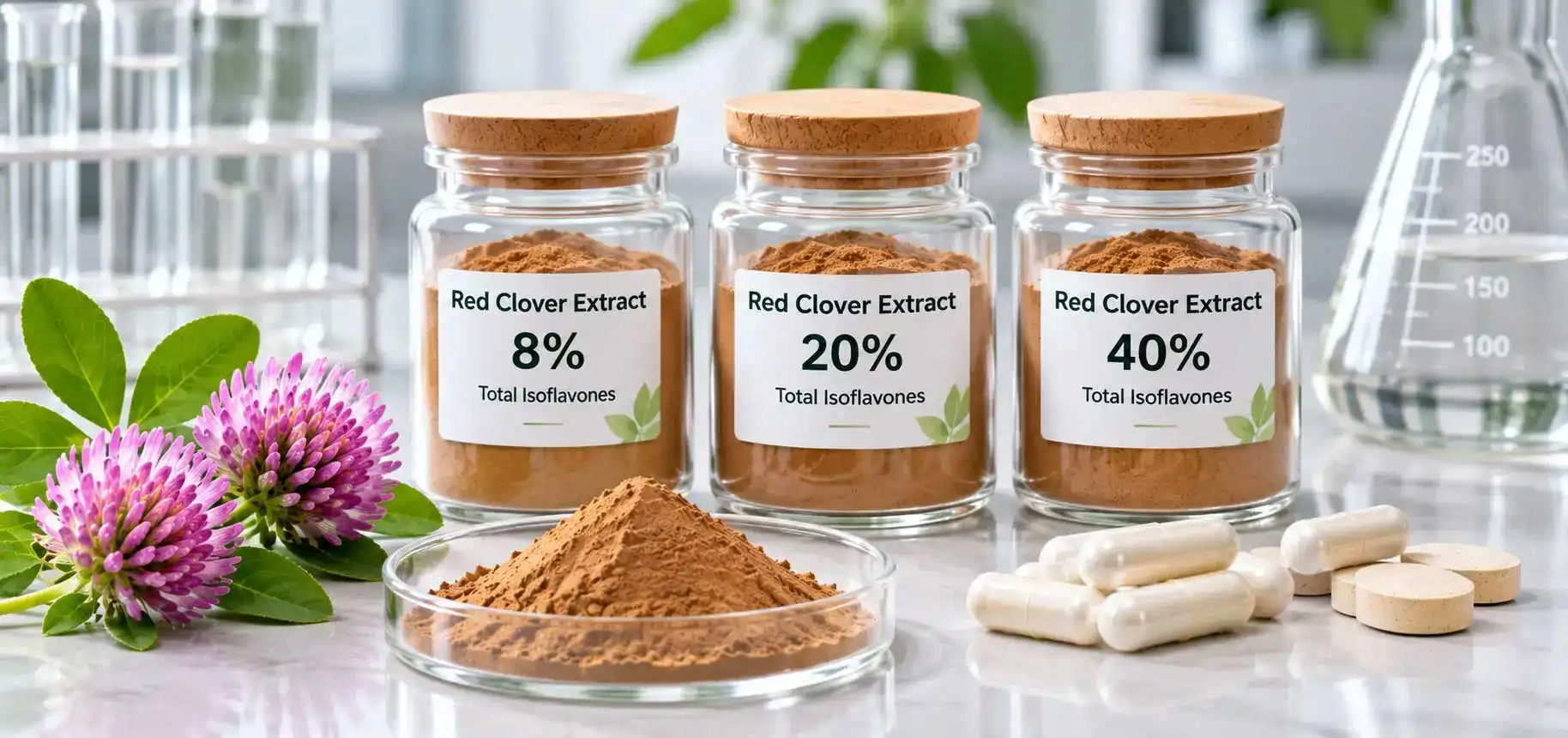
CHEN LANG BIO TECH supplies standardized red clover extract in 8%, 20%, and 40% total isoflavone specifications.
•Isoflavone Standardization and Ingredient Loading Calculations
The declared isoflavone concentration determines the theoretical quantity of extract required for a particular formulation target.
The calculation is:

For illustration, consider a formulation target of 20 mg total isoflavones per finished unit.
|
Extract Specification |
Isoflavone Fraction |
Theoretical Extract Loading |
|
8% |
0.08 |
250 mg |
|
20% |
0.20 |
100 mg |
|
40% |
0.40 |
50 mg |
These values illustrate formulation mathematics, not recommended daily intake or established clinical dosage.
Actual calculations should use the agreed assay definition and account for relevant manufacturing and analytical tolerances.
•Selecting Red Clover Extract Grades for Capsule Fill Weight and Tablet Size
A red clover extract 40% isoflavones specification requires less ingredient mass than an 8% specification to provide the same nominal isoflavone amount.
This may be advantageous when capsule capacity is limited or when a tablet contains several active ingredients.
However, higher concentration does not automatically mean better processing performance. Extracts with different standardization levels may also differ in particle size, density, moisture content, and flow behavior.
Consequently, the selection between red clover extract 20% isoflavones and higher-concentration material should consider both assay requirements and manufacturing suitability.
•Red Clover Extract Ratio vs Standardized Isoflavone Content
An extract ratio such as 10:1 describes a relationship between the starting botanical material and the resulting extract under a particular manufacturing definition.
It does not establish a 10% isoflavone concentration.
For commercial purchasing, a defined HPLC assay is more informative than an extraction ratio when the formulation requires a specified quantity of total isoflavones.
Red Clover Extract Powder Solubility and Formulation Compatibility
Red clover extract powder solubility is an important consideration when developing liquid supplements, suspensions, or formulations involving wet processing.
The solubility of individual isoflavones should not be confused with the behavior of a complete commercial botanical extract.
♦Red Clover Extract Water Solubility vs Water Dispersibility
Many red clover isoflavones have limited aqueous solubility. Consequently, conventional standardized extract powders should not be assumed to dissolve completely in water.
Three characteristics must be distinguished:
Solubility describes the amount of material that dissolves under defined conditions to form a homogeneous solution.
Dispersibility describes how readily powder particles distribute throughout a liquid, regardless of whether they dissolve.
Suspension stability describes the ability of dispersed particles to remain acceptably distributed during storage.
A powder may disperse readily in water while leaving visible suspended particles or sediment.
For manufacturers evaluating red clover extract water solubility, laboratory testing should record the extract concentration, temperature, pH, mixing conditions, appearance, and sedimentation behavior.
♦Red Clover Isoflavone Solubility in Ethanol and Other Solvents
Individual red clover isoflavones can exhibit different dissolution behavior because of their molecular structures and polarity.
For example, biochanin A and formononetin are methoxylated isoflavones, while genistein and daidzein have different hydroxyl substitution patterns. These structural differences influence solvent interactions.
|
Solvent System |
Technical Considerations |
|
Water |
Limited dissolution of many isoflavones |
|
Ethanol |
Can improve dissolution of certain isoflavones |
|
Water–ethanol mixtures |
Performance depends on solvent ratio and compound composition |
|
DMSO |
Useful in some laboratory investigations, not a routine supplement formulation solvent |
|
Vegetable oils |
Conventional extract powders should not be assumed to be oil-soluble |
Red clover extract ethanol solubility should be evaluated using the actual commercial material rather than extrapolating directly from published data for isolated compounds.
Moreover, extraction solvents, analytical solvents, and solvents suitable for finished food or supplement formulations are not necessarily interchangeable.
♦Improving Red Clover Extract Dispersion in Liquid Supplement Formulations
For red clover extract formulation compatibility, manufacturers may investigate particle size reduction, suitable dispersing agents, controlled mixing, and suspension systems.
These approaches can improve physical distribution, but they do not necessarily increase molecular solubility.
Specialized delivery technologies may also be evaluated where technically justified. However, improved dispersion should not be presented as evidence of enhanced bioavailability without appropriate supporting studies.
For clear beverages, a conventional standardized powder may be unsuitable without further formulation development.
Red Clover Extract Particle Size, Bulk Density and Powder Flowability
The physical characteristics of red clover extract powder can influence blending efficiency, capsule filling, tablet compression, and production consistency.
These properties should be evaluated independently of the declared isoflavone concentration.
Red Clover Extract Particle Size and Blend Uniformity
Red clover extract particle size affects powder distribution, segregation tendency, and mixing behavior.
When botanical extracts are blended with ingredients having substantially different particle sizes or densities, segregation may occur during transfer, vibration, or filling.
A particle size distribution test can help determine whether additional screening, blending adjustments, or granulation may be necessary.
Bulk and Tapped Density for Red Clover Extract Capsule Filling
Red clover extract bulk density influences the volume occupied by a given ingredient mass.
For example, if a powder has a hypothetical loose bulk density of 0.50 g/mL, a 200 mg portion would occupy approximately 0.40 mL before accounting for other formulation components and changes during filling.
This is an illustrative calculation, not a measured specification for CHEN LANG BIO TECH red clover extract.
Tapped density provides additional information about powder packing under mechanical consolidation.
Both values can assist with capsule size selection and equipment evaluation.
Powder Flowability, Moisture and Hygroscopicity During Processing
Red clover extract powder flowability can be assessed through suitable measurements such as bulk and tapped density, Hausner ratio, Carr index, and flow testing.
However, no single measurement fully predicts performance in every filling machine.
Moisture content, particle shape, electrostatic behavior, and storage conditions can influence bridging, inconsistent feeding, and powder adhesion.
Manufacturers should therefore confirm processing behavior through representative production trials.
Red Clover Extract for Capsules and Tablets: Manufacturing Considerations
Red clover extract for capsules and red clover extract for tablets may require different processing strategies, even when the same standardized ingredient is used.
Red Clover Extract Capsule Formulation and Fill Weight Control
In red clover extract capsule formulation, the extract must be evaluated alongside excipients and other active ingredients.
The combined powder blend should provide suitable flow, consistent filling, and acceptable content uniformity.
Capsule shell selection also depends on product positioning and compatibility requirements. Both gelatin and suitable plant-derived capsule systems may be considered.
A pilot filling trial is valuable because powder density and flow behavior under production conditions can differ from simple laboratory measurements.
Red Clover Extract Tablet Formulation and Compression Behavior
Red clover extract tablet formulation introduces additional requirements, including compactibility, tablet hardness, friability, disintegration, and potentially dissolution performance.
Direct compression may be considered if the complete blend demonstrates suitable processing characteristics.
Where direct compression is unsuitable, dry granulation or an appropriately designed wet granulation process may be investigated.
However, moisture exposure and drying conditions should be evaluated for their effects on the extract and finished formulation.
Excipient Compatibility and Manufacturing Trials
Common excipients such as microcrystalline cellulose, selected starches, disintegrants, and lubricants may be evaluated according to the intended dosage form.
Their suitability cannot be determined from the extract's isoflavone percentage alone.
|
Formulation Factor |
Capsules |
Tablets |
|
Bulk density |
Important for fill volume |
Influences die filling |
|
Flowability |
Supports consistent filling |
Supports consistent die feeding |
|
Compactibility |
Usually not a primary requirement |
Essential |
|
Blend uniformity |
Important |
Important |
|
Disintegration |
Finished capsule evaluation |
Finished tablet evaluation |
|
Processing trials |
Filling performance |
Compression and tablet quality |
Final excipient selection should be supported by formulation testing rather than assumed compatibility.
Red Clover Extract in Supplement Powder Blends and Liquid Formulations
Beyond conventional solid dosage forms, red clover extract powder blends may be developed for multi-ingredient supplement applications.
However, the technical requirements vary considerably between dry blends and liquid products.
Red Clover Extract in Multi-Ingredient Supplement Powder Blends
When red clover extract is combined with vitamins, minerals, or other botanical ingredients, manufacturers should consider differences in particle size, density, moisture sensitivity, and ingredient concentration.
Low-inclusion components may require a suitable premixing strategy to achieve uniform distribution.
Blend uniformity should be assessed using an appropriate sampling plan and analytical marker.
Red Clover Extract in Functional Beverage and Liquid Supplement Development
Red clover extract liquid formulation requires particular attention to dispersibility, sedimentation, appearance, flavor, and stability.
An extract suitable for encapsulation may produce turbidity or sediment in an aqueous beverage.
Formulators should evaluate the actual material at the intended use concentration and across the product's expected pH and storage conditions.
Red Clover Extract Stability in Finished Supplement Formulations
Red clover extract formulation stability should be evaluated within the finished product rather than inferred from raw material shelf life.
Relevant factors may include moisture exposure, temperature, light, packaging permeability, and interactions with other ingredients.
Accelerated studies can support development, but appropriate real-time stability data remain important when establishing commercial shelf life.
Red Clover Extract Quality Specifications and HPLC Testing for Supplement Manufacturers
Reliable red clover extract quality specifications support both ingredient acceptance and finished-product consistency.
For commercial manufacturing, quality assessment should include the standardized assay and other relevant safety and physical parameters.
Isoflavone Assay and Batch Consistency for Supplement Production
Red clover extract HPLC testing provides an analytical basis for evaluating declared isoflavone concentrations.
Buyers should confirm the analytes included in the total, reference standards, calculation method, and reporting basis.
CHEN LANG BIO TECH maintains laboratory capabilities using HPLC, GC, and AAS instruments, supporting botanical ingredient quality evaluation.
Heavy Metals, Pesticide Residues and Microbiological Quality
Testing requirements should reflect the raw material risk profile, intended application, and destination market.
Our laboratory has testing and control capabilities covering heavy metals, pesticide residues, residual solvents, and microbiological quality.
The appropriate methods, acceptance limits, and batch-testing requirements should be agreed during supplier qualification.
COA, TDS and SDS for Red Clover Extract Ingredient Approval
A red clover extract COA should provide relevant batch-specific analytical results.
The TDS supports technical evaluation, while the SDS provides applicable safety and handling information.
For commercial ingredient approval, these documents should be reviewed together with the agreed product specification.
Bulk Red Clover Extract for Supplements: Supplier Selection and Purchasing Requirements
Purchasing bulk red clover extract for supplements requires coordination between formulation, quality assurance, and procurement teams.
An appropriate red clover extract ingredient supplier should provide clear technical information and commercially realistic supply conditions.
Red Clover Extract Samples and Technical Evaluation Before Bulk Orders
Before placing a commercial order, buyers should request a red clover extract sample that represents the intended product specification.
The sample should be evaluated for assay, physical characteristics, and performance in the proposed formulation.
When possible, technical approval should precede large-scale purchasing commitments.
Red Clover Extract MOQ, Packaging and Commercial Lead Time
The red clover extract MOQ may depend on grade, stock availability, packaging, and purchasing quantity.
Buyers should confirm packaging materials, storage recommendations, lead time, and shipment requirements before issuing a purchase order.
These conditions should be documented in the quotation rather than assumed from previous orders.
Comparing Red Clover Extract Wholesale Price and Ingredient Value
When evaluating red clover extract powder wholesale offers, price per kilogram should be considered alongside assay concentration, quality testing, and processing performance.
A lower-cost extract may require higher formulation loading or additional manufacturing adjustments.
Therefore, red clover extract bulk price comparisons should reflect the complete formulation and procurement requirements.
Red Clover Extract Supplement Formulation Checklist for Ingredient Buyers
A practical red clover extract supplement formulation checklist helps align purchasing decisions with manufacturing requirements.
|
Evaluation Parameter |
Recommended Buyer Verification |
|
Botanical identity |
Trifolium pratense L. and plant part |
|
Isoflavone concentration |
8%, 20%, 40%, or agreed specification |
|
Analytical method |
Defined HPLC assay and calculation basis |
|
Solubility |
Actual dissolution or dispersion performance |
|
Particle size |
Suitable distribution for the process |
|
Bulk density |
Compatible with dosage-form volume |
|
Flowability |
Acceptable manufacturing behavior |
|
Moisture |
Defined specification and storage requirements |
|
Contaminants |
Applicable analytical limits and results |
|
Documentation |
COA, TDS, SDS |
|
Commercial supply |
Samples, MOQ, packaging, price, lead time |
For red clover extract ingredient selection, these parameters should be reviewed as a complete technical package rather than independently.
Red Clover Extract Supplement Formulation FAQ
Is Red Clover Extract Water Soluble?
Conventional standardized red clover extract should not be assumed fully water-soluble. Many constituent isoflavones have limited aqueous solubility, and the complete powder may behave as a dispersion or suspension.
Which Red Clover Extract Grade Is Better for Capsules?
The appropriate grade depends on target isoflavone loading, capsule capacity, powder density, flowability, and formulation cost. Higher assay concentration does not automatically provide better manufacturing performance.
Can Red Clover Extract Be Used in Tablets?
Yes, red clover extract can be evaluated for tablet formulations. However, compression behavior, excipient compatibility, disintegration, and finished-product quality require appropriate development testing.
What Should Supplement Manufacturers Request Before Buying Red Clover Extract?
Buyers should request specifications, relevant analytical documentation, samples, physical property information, and confirmed commercial terms before approving bulk red clover extract powder.
Buy Standardized Red Clover Extract for Supplement Manufacturing
CHEN LANG BIO TECH supplies standardized red clover extract in 8%, 20%, and 40% total isoflavone specifications for commercial ingredient sourcing.
If you are looking to buy red clover extract for supplements, our team can discuss technical specifications, quality documentation, sample requirements, and bulk purchasing conditions.
Contact us with your target isoflavone concentration, dosage form, estimated order quantity, and destination country to request a red clover extract bulk quotation.
Email: admin@chenlangbio.com
References and Technical Resources
1. U.S. Food and Drug Administration. 21 CFR Part 111 — Current Good Manufacturing Practice in Manufacturing, Packaging, Labeling, or Holding Operations for Dietary Supplements.
2. International Council for Harmonisation. ICH Q2(R2): Validation of Analytical Procedures.
3. World Health Organization. Quality Control Methods for Herbal Materials.
4. United States Pharmacopeia. USP–NF and Food Chemicals Codex, where relevant to the ingredient and intended application.
5. European Medicines Agency. Guideline on Quality of Herbal Medicinal Products/Traditional Herbal Medicinal Products.
6. PubChem, National Center for Biotechnology Information. Chemical and physicochemical information for biochanin A, formononetin, genistein, and daidzein.

Send Inquiry
_1747705745203.webp "Natural Beta Glucan")
Related Industry Knowledge
- Berberine HCl Solubility: Water, pH and Formulation Guide
- How to Read a 3-O-Ethyl Ascorbic Acid COA: A Buyer's Guide
- Monobenzone vs Benoquin: Comparing Their Roles in Vitiligo Depigmentation
- High Purity Sialic Acid Benefits for Skin Hydration and Radiance
- Is Zeaxanthin Water Soluble? Understanding Solubility, Dispersion and CWS Forms
- Tadalafil Powder vs Sildenafil Powder: Key Differences and Bulk API Sourcing
- What Does Sodium Polyglutamate Do in a Formulation?
- What Is Asiaticoside Powder Used For?
- Is Minoxidil Powder Effective for Hair Regrowth?
- What not to Mix with Sodium Ascorbyl Phosphate