
Berberine HCl Solubility: Water, pH and Formulation Guide
November 9, 2026
Berberine HCl solubility is an important consideration in dietary supplement formulation because the amount of material that dissolves under defined conditions can influence product development, dissolution testing, and the feasibility of liquid formulations. Although berberine hydrochloride is an ionic compound, its water solubility is limited and depends on temperature, solvent composition, ionic environment, and the solid form being tested.
For supplement manufacturers, berberine HCl water solubility should not be confused with dissolution rate or powder dispersibility. A material may disperse readily without dissolving completely, while reducing particle size may accelerate dissolution without substantially changing equilibrium solubility.
These distinctions matter when selecting berberine HCl powder for supplement manufacturing. Capsule and tablet manufacturers generally prioritize powder processing characteristics and dissolution performance, whereas liquid formulation developers must establish whether the intended concentration remains dissolved throughout processing and storage.
This guide examines the physicochemical factors affecting berberine hydrochloride solubility, practical testing methods, formulation requirements, and raw material specifications that buyers should evaluate before commercial purchasing.
Berberine HCl Water Solubility: What Manufacturers Should Know
Berberine hydrochloride solubility reflects the equilibrium established between the solid material and dissolved species under specific experimental conditions. Although the hydrochloride form is commonly used in supplement manufacturing, its ionic structure does not guarantee unrestricted dissolution in water.
Is Berberine HCl Soluble in Water at Room Temperature?
Berberine HCl can dissolve in water, but its equilibrium solubility is limited. Consequently, manufacturers should not assume that a concentrated aqueous formulation can be prepared simply by increasing mixing time.
The actual berberine HCl solubility in water at room temperature depends on the material's solid-state characteristics, water composition, temperature, and measurement procedure. Published values may differ because studies use different experimental conditions or material forms.
For example, an anhydrous sample and a hydrated crystalline material may exhibit different apparent dissolution behavior. Likewise, measurements performed in purified water cannot automatically be transferred to buffered or electrolyte-containing formulations.
A clear solution also does not guarantee long-term physical stability. If the system becomes supersaturated during preparation, crystallization or precipitation may occur later.
Berberine Hydrochloride Solubility and the Importance of Test Conditions
Three properties must be distinguished during raw material evaluation.
|
Property |
Technical Definition |
Formulation Significance |
|
Equilibrium solubility |
Dissolved concentration at equilibrium under defined conditions |
Determines whether the target liquid concentration is feasible |
|
Dissolution rate |
Rate at which solid material enters solution |
Influences dissolution performance and processing time |
|
Dispersibility |
Ability of particles to distribute throughout a medium |
Affects powder wetting, mixing, and suspension uniformity |
A powder that forms a visually uniform dispersion may still contain substantial undissolved material.
Therefore, berberine HCl water solubility should be assessed through quantitative analysis rather than visual inspection alone.
For commercial development, buyers should request solubility information that identifies the solvent, temperature, measurement method, and relevant solid form.
Berberine HCl pH Solubility: Ionic Environment and Precipitation Behavior
The relationship between pH and berberine HCl solubility is more complex than the behavior commonly described for weakly basic pharmaceutical compounds.
Berberine contains a quaternary ammonium structure. Its positively charged character is not governed by the same simple protonation–deprotonation equilibrium associated with ordinary tertiary amines.
Berberine HCl Solubility at Different pH Levels
When evaluating berberine HCl pH solubility, formulators should consider the complete solution environment rather than pH alone.
Changes in pH may be accompanied by changes in buffer composition, counterion concentration, ionic strength, and other solution properties. These variables can influence apparent solubility and the identity or stability of the solid phase.
For this reason, a solubility result obtained in an acidic buffer cannot necessarily be compared directly with a result obtained in an alkaline buffer of different composition.
A meaningful berberine HCl solubility at different pH study should control temperature, equilibration time, solvent composition, and analytical conditions while documenting the buffers used.
Where precipitation occurs, solid-state characterization may be necessary to determine whether the recovered material remains the original hydrochloride form or has undergone a change in solid phase.
Berberine HCl Precipitation and Counterion Effects
Berberine HCl precipitation may result from changes in solvent composition, temperature, ion activity, or interactions with formulation components.
Chloride is the counterion associated with berberine hydrochloride. Changes in chloride activity may influence dissolution equilibrium through common-ion effects, although the magnitude and direction of the observed response must be established experimentally.
Other ions and excipients may also affect the solution environment.
|
Variable |
Potential Influence |
Recommended Evaluation |
|
pH |
Changes in solution chemistry and solid-phase behavior |
Test across the intended formulation range |
|
Chloride concentration |
Possible common-ion effects |
Evaluate relevant electrolyte concentrations |
|
Buffer composition |
Interactions and changes in ion activity |
Compare buffers under controlled conditions |
|
Ionic strength |
Changes in activity coefficients and solute interactions |
Test the actual formulation medium |
|
Temperature |
Changes in solubility and crystallization behavior |
Evaluate processing and storage conditions |
A formulation should not be considered stable merely because no precipitate appears immediately after mixing.
For liquid development, berberine HCl aqueous solution stability requires observation over a suitable period under defined storage conditions.
Berberine HCl Solubility in Water vs Ethanol: Selecting a Suitable Solvent
Solvent selection is an important part of early formulation screening, particularly when manufacturers are considering concentrated liquids or mixed-solvent systems.
However, berberine HCl solubility in ethanol should not be predicted solely from its behavior in water.
Berberine HCl Solubility in Ethanol and Aqueous Solvent Systems
Water and ethanol differ in polarity, hydrogen-bonding behavior, and their ability to stabilize dissolved ionic species.
As a result, the solubility of berberine hydrochloride in ethanol or water–ethanol mixtures may differ from its solubility in purified water.
Importantly, adding ethanol does not necessarily produce a proportional increase in solubility. Mixed-solvent systems can exhibit non-linear behavior because solvent composition changes multiple molecular interactions simultaneously.
For berberine HCl solvent selection, manufacturers should evaluate the intended solvent mixture experimentally.
|
Solvent System |
Primary Consideration |
Potential Application |
|
Purified water |
Equilibrium solubility and physical stability |
Aqueous formulations |
|
Ethanol |
Solubility under defined solvent conditions |
Solvent screening |
|
Water–ethanol mixtures |
Composition-dependent solubility |
Mixed-solvent development |
|
Buffered aqueous media |
pH, ionic strength, and buffer interactions |
Formulation compatibility testing |
Berberine HCl Solvent Selection for Supplement Formulation
A solvent that performs well during laboratory screening may not be appropriate for the final commercial product.
Food and dietary supplement manufacturers must consider permitted ingredients, solvent concentration, labeling requirements, manufacturing compatibility, and destination-market regulations.
Furthermore, dilution can change solvent composition enough to trigger precipitation.
Therefore, solvent screening should include the final formulation concentration and any expected dilution or processing steps.
A reliable solvent-selection study should report actual dissolved concentration rather than relying on qualitative descriptions such as “soluble” or “partially soluble.”
Berberine HCl Dissolution Rate: Particle Size, Wetting and Powder Properties
For solid dosage forms, berberine HCl dissolution rate can be as important as equilibrium solubility.
Dissolution describes the transfer of material from the solid phase into solution. The rate depends on factors including exposed surface area, concentration gradient, diffusion conditions, and the properties of the dissolution medium.
Berberine HCl Particle Size and Dissolution Performance
Reducing particle size generally increases the surface area available for contact with the dissolution medium.
The Noyes–Whitney relationship provides a simplified description:
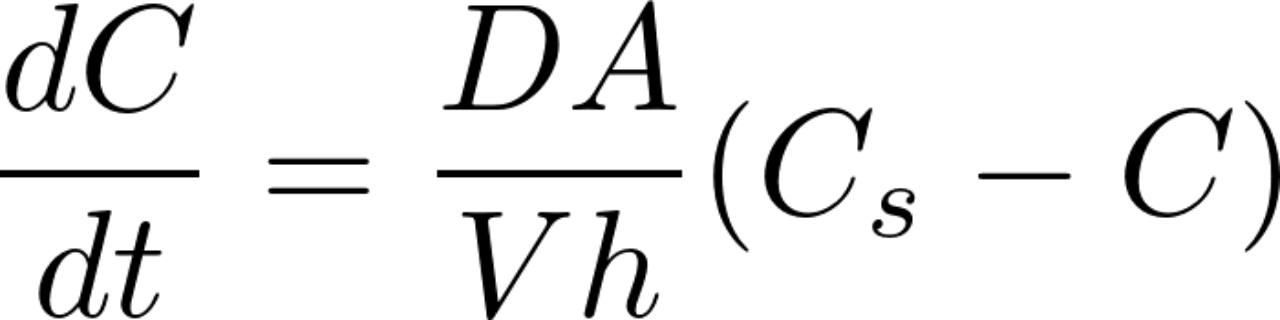
Where:
dC/dtrepresents the rate of change in dissolved concentration.
D is the diffusion coefficient.
Ais the effective solid surface area.
V is the dissolution medium volume.
h is the effective diffusion-layer thickness.
Cs is the saturation concentration.
C is the bulk dissolved concentration.
The equation illustrates why increased effective surface area may improve dissolution rate under otherwise comparable conditions.
However, smaller particles do not necessarily increase equilibrium solubility.
For berberine HCl particle size and dissolution, manufacturers should also consider aggregation, wettability, and changes in solid-state properties.
Particle size distribution is commonly characterized using D10, D50, and D90 values, which describe particle diameters below which 10%, 50%, and 90% of the measured distribution fall, respectively, on the stated distribution basis.
Berberine HCl Powder Dispersibility and Wetting Behavior
A fine powder may exhibit poor wetting or form agglomerates when introduced into water.
These agglomerates reduce the effective surface area exposed to the dissolution medium, potentially limiting the expected benefits of particle-size reduction.
For this reason, berberine HCl particle size specification should not be evaluated independently of powder behavior.
Manufacturers may also need to assess bulk density, flowability, electrostatic behavior, and blending characteristics.
Two batches with identical assay results can behave differently during production if their particle size distributions or powder properties differ.
When selecting a berberine HCl formulation grade, buyers should define the physical characteristics relevant to their manufacturing process rather than relying on purity percentage alone.
Berberine HCl Solubility and Stability in Aqueous Formulations
Solubility and stability describe different aspects of formulation performance.
A material may initially dissolve at the intended concentration but subsequently precipitate, crystallize, or undergo chemical degradation during storage.
Berberine HCl Aqueous Solution Stability During Storage
Berberine HCl aqueous solution stability should be evaluated through both physical and chemical measurements.
Physical stability concerns changes such as precipitation, crystallization, turbidity, and visible particulate formation.
Chemical stability concerns changes in the concentration or chemical identity of the active ingredient, including the formation of degradation products.
A clear appearance does not establish chemical stability, while visible precipitation does not necessarily indicate chemical degradation.
A suitable stability study may include visual inspection, pH monitoring, quantitative assay, and examination of relevant degradation products.
Light exposure, temperature, container compatibility, and formulation composition should be evaluated according to the intended product.
Berberine HCl Precipitation After Dilution or Temperature Changes
Temperature changes may alter the equilibrium between dissolved and solid material.
For example, a solution prepared at an elevated temperature may become supersaturated when cooled, creating conditions favorable for crystallization.
Likewise, dilution with another solvent or changes in electrolyte concentration can alter the system's solubility characteristics.
Therefore, berberine HCl solubility and stability should be tested under realistic manufacturing, transportation, and storage conditions.
A formulation that remains clear immediately after preparation should not be assumed to remain physically stable throughout its intended shelf life.
Berberine HCl Formulation Guide: Capsules, Tablets, Powders and Liquids
The appropriate raw material characteristics depend on the intended dosage form.
For solid products, dissolution and processing performance may be more relevant than the ability to produce a concentrated aqueous solution. Liquid formulations require a different assessment.
Berberine HCl Powder for Capsules and Tablets
When selecting berberine HCl powder for capsules, manufacturers should consider particle size distribution, powder flow, bulk density, fill-weight consistency, and dissolution behavior.
Capsule filling requires predictable powder handling, particularly during commercial production.
For berberine HCl powder for tablets, additional considerations include compressibility, lubricant sensitivity, disintegration, and compatibility with other formulation ingredients.
A material that performs well in a capsule blend may not provide the same processing characteristics during tablet compression.
Berberine HCl Solubility Considerations for Liquid Supplements
Liquid formulations require particular attention to target concentration and long-term physical stability.
Before selecting a raw material, manufacturers should establish whether the intended amount of berberine hydrochloride can remain dissolved in the actual formulation medium.
If the target concentration exceeds the practical solubility under relevant conditions, a suspension or another formulation strategy may need to be considered.
|
Dosage Form |
Primary Technical Requirements |
Recommended Evaluation |
|
Capsules |
Flowability, fill uniformity, dissolution |
Particle size, density, powder flow |
|
Tablets |
Compression, disintegration, dissolution |
Compressibility, particle properties |
|
Powder blends |
Mixing, wetting, uniformity |
Particle distribution, dispersibility |
|
Liquid supplements |
Solubility, precipitation, stability |
Solvent system, pH, concentration, storage |
For berberine HCl powder for supplement manufacturing, raw material selection should reflect the intended dosage form and validated manufacturing process.
Berberine HCl Solubility Testing Methods for Raw Material Qualification
Reliable solubility data require controlled experimental conditions and suitable quantitative analysis.
A qualitative observation that powder dissolves after stirring is not sufficient for determining equilibrium solubility.
Berberine HCl Equilibrium Solubility Testing and Analytical Verification
A commonly used approach to berberine HCl solubility testing method development is the shake-flask technique.
An excess amount of solid material is introduced into a defined solvent system and maintained at a controlled temperature until equilibrium is established.
After equilibration, the undissolved material is separated using an appropriate method, and the dissolved concentration is measured using a suitable analytical procedure.
HPLC may be used when the method has demonstrated adequate specificity and quantitative performance.
Important experimental variables include equilibration time, temperature, solvent composition, pH, solid form, and sample separation.
Filtration and centrifugation should also be evaluated because sample handling can influence the measured concentration.
Berberine HCl Sample Testing Before Formulation Scale-Up
For commercial development, berberine HCl sample testing should reproduce conditions relevant to the intended formulation.
A useful study may compare equilibrium solubility, dissolution behavior, powder wetting, and physical stability under defined conditions.
The resulting data can help manufacturers establish suitable berberine HCl raw material specifications before pilot production.
Testing representative samples early can reduce the risk of discovering incompatibility or processing difficulties after purchasing commercial quantities.
Berberine HCl Raw Material Specifications for Formulation Development
Raw material specifications should support both chemical quality and consistent manufacturing performance.
A berberine HCl powder supplier may provide standard analytical documentation, but additional physical-property requirements should be discussed when they are critical to a customer's formulation.
Berberine HCl Particle Size Specification and Batch Consistency
A practical specification may include identity, assay, moisture or loss on drying, and relevant physical characteristics.
For applications sensitive to dissolution or powder processing, buyers may also request particle size distribution, bulk density, or flowability information.
However, these parameters are not necessarily routine release tests for every commercial grade.
They should be agreed upon according to the intended application, available analytical methods, and purchasing requirements.
Berberine HCl Supplier Qualification for Commercial Manufacturing
Effective berberine HCl supplier qualification should consider batch documentation, specification consistency, manufacturing controls, and the supplier's ability to communicate relevant changes.
For ongoing supply, berberine HCl bulk quality control also requires appropriate lot traceability and a clear process for investigating out-of-specification results.
When comparing a berberine HCl powder manufacturer, buyers should assess whether the available grade meets their technical requirements rather than assuming that all materials with the same assay are interchangeable.
Buying Berberine HCl Powder in Bulk: Samples, MOQ and Price Evaluation
Before deciding to buy berberine HCl powder in bulk, manufacturers should confirm that the proposed grade meets their formulation and quality requirements.
Berberine HCl Sample Request for Formulation Testing
A berberine HCl sample request should identify the intended dosage form, target assay, relevant physical specifications, and planned evaluation methods.
For bulk berberine HCl powder, the qualification sample should be representative of the material intended for commercial supply.
Berberine HCl Price per kg, MOQ and Bulk Quotation
The berberine HCl price per kg may depend on purchasing volume, grade, testing requirements, and packaging.
When evaluating a berberine HCl wholesale supplier, buyers should compare technical suitability and total procurement requirements alongside price.
The berberine HCl MOQ and available commercial quantities should be confirmed before ordering.
For an accurate berberine HCl bulk quotation, provide the target specification, estimated purchasing volume, destination market, and required documentation.
Berberine HCl Powder Supply for Supplement Manufacturers — CHEN LANG BIO TECH
CHEN LANG BIO TECH supplies berberine HCl powder for supplement ingredient procurement and commercial formulation development.
We work with manufacturers and distributors to discuss available raw material specifications, quality documentation, sample arrangements, and bulk purchasing requirements.
If you are evaluating a berberine HCl powder manufacturer for your next project, share your intended dosage form, target assay, particle size requirements, and estimated order quantity.
Our team can discuss available supply options and supporting documentation for your berberine HCl powder bulk order.
Frequently Asked Questions About Berberine HCl Solubility
Is Berberine HCl soluble in water at room temperature?
Berberine HCl has limited water solubility. The measured concentration depends on temperature, solvent conditions, and solid form. Manufacturers should verify quantitative solubility data before developing concentrated aqueous formulations.
How does pH affect Berberine HCl solubility?
pH can influence the overall solution environment, including buffer composition and ionic interactions. Because berberine has a quaternary ammonium structure, its behavior should not be interpreted using a simple weak-base protonation model.
Is Berberine HCl soluble in ethanol?
Berberine HCl may dissolve in ethanol under appropriate conditions, but its solubility depends on solvent composition and temperature. Quantitative testing is necessary before selecting ethanol or mixed-solvent systems.
Does smaller particle size improve Berberine HCl dissolution?
Reducing particle size can increase effective surface area and improve dissolution rate. However, particle aggregation, wetting behavior, and solid-state characteristics may influence the outcome, while equilibrium solubility may remain largely unchanged.
Can Berberine HCl powder be used in liquid supplements?
Berberine HCl can be evaluated for liquid formulations, but the target concentration must be compatible with the selected solvent system. Physical stability, precipitation, chemical stability, and applicable formulation requirements should be verified experimentally.
Conclusion — Berberine HCl Solubility and Practical Raw Material Selection
Berberine HCl solubility is influenced by solvent composition, temperature, ionic environment, and material characteristics. Equilibrium solubility, dissolution rate, and powder dispersibility represent different properties and should be evaluated separately.
For capsules and tablets, particle size and processing behavior are important considerations. Liquid formulations require additional assessment of target concentration, precipitation, and storage stability.
Manufacturers should establish application-specific specifications and evaluate representative samples before commercial purchasing.
A technically suitable raw material, supported by reliable documentation and consistent supply, provides a stronger foundation for successful formulation development.
References
1. Amidon, G. L., Lennernäs, H., Shah, V. P., and Crison, J. R. (1995). A Theoretical Basis for a Biopharmaceutic Drug Classification: The Correlation of In Vitro Drug Product Dissolution and In Vivo Bioavailability. Pharmaceutical Research, 12, 413–420.
2. Noyes, A. A., and Whitney, W. R. (1897). The Rate of Solution of Solid Substances in Their Own Solutions. Journal of the American Chemical Society, 19(12), 930–934.
3. Higuchi, T., and Connors, K. A. (1965). Phase-Solubility Techniques. Advances in Analytical Chemistry and Instrumentation, 4, 117–212.
4. United States Pharmacopeia (USP). General Chapter <711>: Dissolution.
5. International Council for Harmonisation (ICH). Q2(R2): Validation of Analytical Procedures. Final guideline, 2023.
6. International Council for Harmonisation (ICH). Q1A(R2): Stability Testing of New Drug Substances and Products. 2003.
7. Aulton, M. E., and Taylor, K. M. G. (eds.). Aulton's Pharmaceutics: The Design and Manufacture of Medicines. Elsevier.
8. Sinko, P. J. (ed.). Martin's Physical Pharmacy and Pharmaceutical Sciences. Wolters Kluwer.

Send Inquiry
Related Industry Knowledge
- Mangiferin Applications Every Manufacturer Should Know
- Why Zeaxanthin Powder Is a Must-Have Ingredient in Eye Care Formulas?
- Is Chondroitin Sulfate Powder Suitable for Everyone?
- Is Kopexil Effective for Hair Growth?
- Why is Green Tea Extract Good for You
- What are the Benefits of Polyphenols in Apples
- What Is Diprophylline Used For
- How Do I Use Hyaluronic Acid Powder In My Skincare Routine
- What's Difference Between Sleeping Pill and Melatonin Extract Powder
- Explore Gynostemma Pentaphyllum Extract Gynostemma Pentaphyllum Powder in Depth