
Mangiferin Solubility: Water, Solvents & Formulation Guide
November 25, 2026
Mangiferin solubility is an important consideration when developing supplements, functional foods, and cosmetic formulations containing this botanical compound. Although mangiferin contains several hydroxyl groups, its crystalline structure and intermolecular interactions contribute to limited water solubility. Consequently, selecting a suitable solvent or delivery system requires more than checking whether the powder dissolves in a laboratory solvent.
For ingredient buyers, mangiferin powder solubility affects formulation feasibility, processing conditions, product appearance, and the risk of precipitation during storage. It can also influence how a compound becomes available for absorption, although dissolution alone cannot establish bioavailability.
This guide examines mangiferin's behavior in water and organic solvents, the factors controlling dissolution, and formulation approaches worth evaluating. It also explains how manufacturers can use technical specifications, analytical documentation, and sample testing to make better raw material purchasing decisions.
What Is Mangiferin Solubility and Why Does It Matter in Formulation?
Mangiferin is a naturally occurring xanthone C-glucoside found in mango trees (Mangifera indica L.) and several other botanical species. It is studied for its chemical properties and potential applications in pharmaceutical research, nutritional ingredients, and cosmetic development.
For formulators, the central question is not simply whether mangiferin dissolves. It is whether the required concentration can remain compatible with the finished product throughout manufacturing, packaging, and storage.
•Mangiferin Chemical Structure and Water Solubility Properties
Mangiferin, CAS 4773-96-0, has the molecular formula C19H18O11 and a molecular weight of approximately 422.34 g/mol.
Its structure combines a xanthone framework with a glucose moiety and multiple hydroxyl groups. These functional groups can participate in hydrogen bonding, but molecular polarity alone does not determine solubility.
In crystalline solids, molecules interact with one another through hydrogen bonding and other intermolecular forces. Dissolution requires the solvent to overcome these interactions while adequately solvating the released molecules.
This helps explain why mangiferin water solubility remains limited despite the presence of several polar groups.
For commercial formulation work, crystal form, solid-state properties, and solvent composition should therefore be considered alongside chemical identity.
•Mangiferin Solubility vs Dissolution Rate and Powder Dispersibility
Three properties are frequently confused during ingredient evaluation.
Solubility describes the equilibrium concentration of a substance in a defined solvent system under specified conditions. The mangiferin dissolution rate describes how quickly solid material enters solution.
Dispersibility describes how effectively particles distribute throughout a liquid, whether or not they dissolve.
A powder can disperse evenly and produce a uniform-looking suspension while remaining largely undissolved. Conversely, a compound may have a measurable equilibrium solubility but dissolve slowly because of poor wetting or particle aggregation.
This distinction matters when evaluating mangiferin powder dispersion in beverages, emulsions, and liquid concentrates.
Procurement teams should ask suppliers whether a claimed solubility result represents a clear molecular solution, a colloidal dispersion, or a suspended powder.
Is Mangiferin Soluble in Water, Ethanol and Other Solvents?
The answer depends on the solvent, its composition, and the measurement conditions. Published research provides useful reference values, but these should not be treated as universal specifications for every commercial mangiferin grade.
Mangiferin Solubility in Water: Temperature, pH and Concentration
Mangiferin solubility in water is relatively low compared with many conventional water-soluble formulation ingredients.
A 2021 study published in Antioxidants reported an aqueous solubility of 0.11 ± 0.01 mg/mL under its experimental conditions. A separate physicochemical investigation reported 0.38 mg/mL at 25°C. These results illustrate why published solubility values must be interpreted alongside the methods and conditions used to obtain them.
For formulation screening, 0.11 mg/mL corresponds to approximately 110 mg/L. This is a useful reference point, not a guaranteed concentration that every formulation will maintain.
Temperature can influence dissolution, but heating a mixture until it appears clear does not establish stability after cooling. A supersaturated solution may subsequently develop crystals or visible sediment.
Likewise, changes in pH can alter ionization and apparent solubility, but extreme conditions may create stability or compatibility concerns.
For water-based products, developers should evaluate the target concentration at both manufacturing and storage temperatures.
Mangiferin Solubility in Ethanol and Hydroalcoholic Solvent Systems
Mangiferin solubility in ethanol can be higher than in water, although the difference depends on the experimental system.
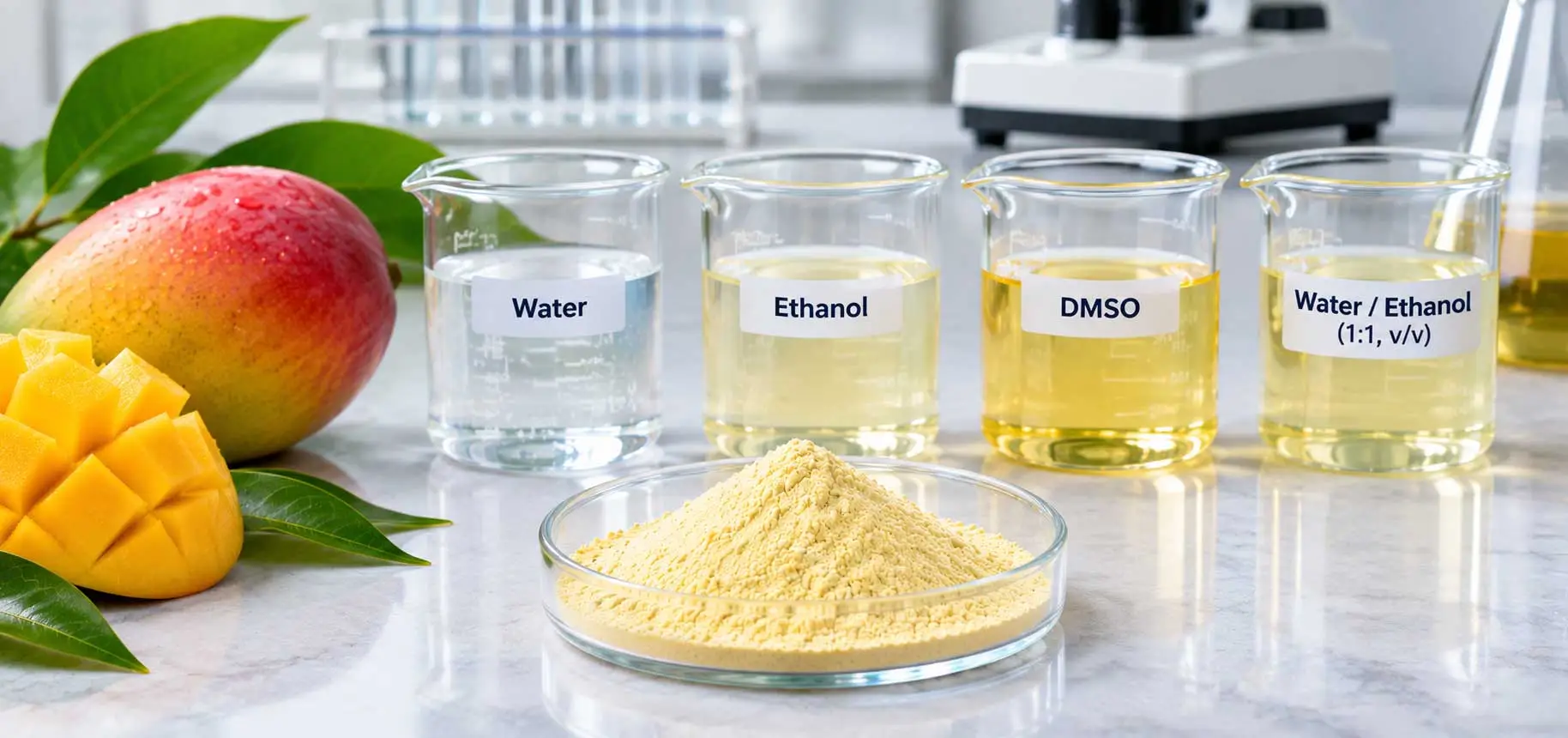
In the 2021 solvent-screening study, ethanol produced a measured solubility of 0.72 ± 0.01 mg/mL, compared with 0.11 ± 0.01 mg/mL in water.
This approximately 6.5-fold difference suggests that ethanol may be useful during solvent-system screening. However, the result does not mean ethanol will provide sufficient solubility for every target concentration.
Hydroalcoholic formulations introduce additional considerations. When an ethanolic concentrate is diluted with water, the solvent environment changes and previously dissolved mangiferin may precipitate.
Consequently, developers should test the final ethanol-to-water ratio rather than relying exclusively on the solubility of the original concentrate.
Ethanol concentration must also be appropriate for the finished product category and intended market.
Mangiferin Solubility in DMSO, Methanol and Laboratory Solvents
Mangiferin solubility in DMSO is relevant primarily to analytical and experimental research.
The same 2021 study measured 4.00 ± 0.10 mg/mL in DMSO, demonstrating substantially greater solubility than in the water system tested.
However, DMSO is not an appropriate default solvent for ordinary nutritional beverages or consumer skincare formulations.
Methanol is also commonly encountered in analytical procedures, but its usefulness in laboratory sample preparation does not make it suitable for routine consumer-product formulation.
The following table summarizes experimentally reported values from one published study.
|
Solvent system |
Reported mangiferin solubility |
|
Water |
0.11 ± 0.01 mg/mL |
|
Ethanol |
0.72 ± 0.01 mg/mL |
|
Methanol |
0.20 ± 0.02 mg/mL |
|
DMSO |
4.00 ± 0.10 mg/mL |
|
DMSO / ethanol, 20:80 v/v |
1.00 ± 0.07 mg/mL |
|
Propylene glycol / water, 60:40 v/v |
0.30 ± 0.04 mg/mL |
Source: Ethosomes and Transethosomes for Mangiferin Transdermal Delivery, Antioxidants, 2021, Table 1. These are experimental results for the investigated material and conditions, not universal product specifications.
MDPI
For mangiferin organic solvent solubility, the practical conclusion is that solvent performance must be assessed experimentally. A higher laboratory solubility does not necessarily indicate better suitability for the finished formulation.
What Factors Affect Mangiferin Powder Solubility and Stability?
The observed dissolution behavior of mangiferin depends on both molecular properties and the physical characteristics of the powder.
Two batches with similar HPLC assay values may behave differently during wetting, mixing, or dispersion if their particle characteristics or processing histories differ.
Understanding these variables helps distinguish genuine ingredient problems from formulation-process limitations.
♦How pH, Temperature and Solvent Composition Affect Mangiferin Dissolution
Temperature influences molecular motion and solid–liquid equilibrium. However, the extent of any solubility increase depends on the compound and solvent system.
A 2016 experimental investigation examined mangiferin in several solvents across different temperatures. The study found that solvent selection and temperature materially affected measured solubility, with ethanol and methanol performing better than several less polar solvents under the investigated conditions.
The findings support controlled temperature screening, but they should not be generalized to every commercial formulation.
pH is another important variable because mangiferin contains ionizable phenolic groups. Changes in ionization can influence apparent solubility and chemical behavior.
Nevertheless, increasing solubility through pH adjustment is useful only when the resulting formulation remains chemically stable, compatible with other ingredients, and appropriate for its intended application.
A practical screening protocol should record pH, temperature, mixing time, solvent composition, and the concentration remaining dissolved after equilibration.
♦Particle Size, Crystal Properties and Mangiferin Powder Dispersion
Mangiferin particle size can influence wetting, dissolution rate, powder flow, and processing consistency.
Smaller particles generally provide greater exposed surface area, potentially accelerating dissolution. However, they may also aggregate, become more difficult to handle, or require additional dust-control measures.
Particle-size reduction does not automatically change the equilibrium solubility of the same crystalline material.
Crystal structure and solid-state changes may also influence dissolution behavior. Amorphous or partially amorphous material can behave differently from a highly crystalline powder, although physical stability must be considered.
For mangiferin powder stability, buyers should distinguish chemical degradation from physical changes such as agglomeration, sedimentation, or recrystallization.
A formulation that remains chemically intact but develops visible sediment may still fail its commercial product specifications.
How Can Mangiferin Solubility Be Improved for Formulation Development?
Several formulation technologies have been investigated to address mangiferin's limited aqueous solubility.
The appropriate strategy depends on the intended dosage form, permitted excipients, manufacturing capabilities, cost targets, and required stability.
Importantly, mangiferin solubility enhancement should be evaluated through reproducible analytical measurements rather than appearance alone.
Mangiferin Solubility Enhancement Using Cosolvents and Solubilizers
Cosolvents can modify the solvent environment and improve the apparent solubility of certain compounds.
Ethanol, propylene glycol, and selected solvent mixtures may be considered during early formulation screening where their use is appropriate.
However, an effective concentrate must also remain stable after dilution into the final product.
Surfactants and other solubilizing agents offer another approach. Depending on their properties and concentration, they may help incorporate poorly soluble compounds into micellar or other organized systems.
The formulation team must verify that the selected excipients are compatible with mangiferin, other ingredients, packaging materials, and applicable product requirements.
For mangiferin solubilization, success should be defined by a measurable improvement at the required concentration, supported by stability testing.
Cyclodextrin Complexes, Encapsulation and Mangiferin Delivery Systems
Cyclodextrin inclusion complexes are among the more extensively studied approaches.
A 2013 study investigating mangiferin with β-cyclodextrin and several derivatives reported substantial improvements in aqueous solubilization. Under the study's experimental conditions, the researchers reported approximately 17.8 mg/mL for a β-cyclodextrin complex and 32.3 mg/mL for a hydroxypropyl-β-cyclodextrin complex, compared with approximately 0.111 mg/mL for uncomplexed mangiferin.
These values refer to the investigated inclusion-complex systems, not untreated mangiferin powder. They demonstrate formulation potential but should not be interpreted as guaranteed performance in commercial products.
Other mangiferin delivery systems under investigation include solid dispersions, lipid-based carriers, and vesicular formulations.
A 2024 solid-dispersion study reported that an optimized mangiferin–HPMC system achieved 81.96% dissolution after 30 minutes and 91.89% after 60 minutes in a pH 1.2 test medium.
These findings concern a specific experimental formulation and dissolution method; they do not establish equivalent performance in finished consumer products.
Mangiferin encapsulation may be worth evaluating when the development objective includes dispersion control, ingredient protection, or delivery-system design.
However, the carrier must be suitable for the intended application, and the finished system requires its own stability and performance evaluation.
How to Evaluate Mangiferin Solubility Enhancement in Pilot Formulations
A useful pilot study begins with a defined target concentration and a clear distinction between dissolved and suspended material.
For each candidate formulation, the development team should document the preparation method, mixing conditions, initial appearance, and measurable dissolved mangiferin concentration.
Subsequent testing should assess precipitation after dilution, temperature cycling, and storage.
Where particulate systems are involved, particle-size distribution and sedimentation behavior may also be relevant.
These measurements help determine whether an improvement is reproducible and commercially useful.
For oral products, mangiferin bioavailability cannot be inferred from solubility alone. Dissolution, permeability, metabolism, and the finished dosage form may all influence exposure.
Therefore, claims about improved absorption require evidence beyond a laboratory solubility test.
How Does Mangiferin Solubility Affect Supplement and Cosmetic Formulations?
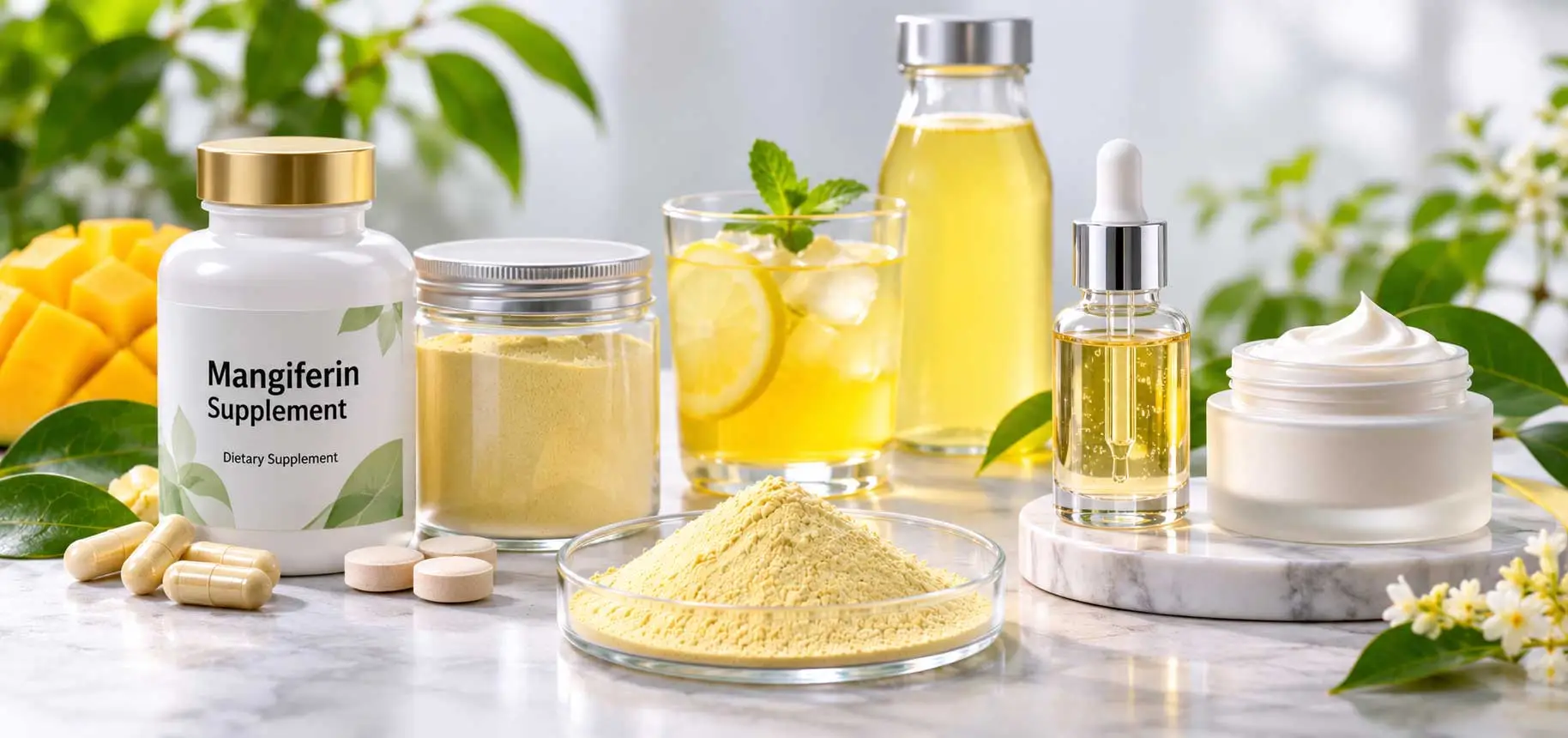
The most suitable mangiferin formulation depends on the product format. A clear serum, compressed tablet, and powdered beverage mix have fundamentally different processing and stability requirements.
For commercial development, the objective is not always to maximize solubility. It is to achieve the physical performance, chemical stability, and ingredient concentration required by the finished product.
Mangiferin Powder for Capsules, Tablets and Nutritional Powder Blends
In mangiferin supplement formulation, capsules and tablets can incorporate a solid ingredient without requiring complete dissolution during manufacturing.
However, powder flow, content uniformity, particle size, and dissolution behavior remain important.
For capsules, manufacturers should evaluate filling consistency and compatibility with excipients. Tablet development may require additional attention to compressibility, disintegration, and dissolution.
Nutritional powder blends introduce different challenges, particularly when the product is intended for reconstitution in water.
A powder that disperses rapidly may still produce visible sediment after standing. Accordingly, the product specification should distinguish instant dispersibility from complete solubility.
Mangiferin Cosmetic Formulation in Serums, Creams and Emulsions
Mangiferin cosmetic formulation requires particular attention to appearance, compatibility, and storage stability.
A transparent water-based serum presents a greater solubility challenge than an opaque cream designed to accommodate dispersed ingredients.
For mangiferin water-based formulation development, the required concentration should be evaluated in the complete formulation rather than purified water alone.
Emulsions offer additional formulation possibilities, but they do not automatically solve the compound's limited aqueous solubility.
The development team should monitor crystallization, sedimentation, color changes, viscosity, and interactions with other ingredients.
Any proposed cosmetic benefit must also be supported by evidence appropriate to the finished formulation and intended market.
Mangiferin in Functional Beverages and Water-Based Products
Mangiferin functional beverage formulation requires careful consideration of the final product's appearance and stability.
Clear beverages generally require a different approach from cloudy drinks or products designed to contain suspended particles.
Acidity, sweeteners, minerals, processing temperature, and other formulation components may affect the finished system.
For beverage applications, developers should assess sedimentation, turbidity, ingredient concentration, and stability throughout the intended shelf life.
The following table summarizes key formulation considerations.
|
Application |
Main Technical Concern |
Recommended Evaluation |
|
Capsules |
Powder flow and uniformity |
Filling and blend testing |
|
Tablets |
Compression and dissolution |
Disintegration and dissolution |
|
Nutritional powders |
Wetting and sedimentation |
Reconstitution testing |
|
Facial serums |
Solubility and clarity |
Precipitation and stability |
|
Creams and emulsions |
Physical compatibility |
Stability and microscopy |
|
Functional beverages |
Sediment and appearance |
Storage and temperature testing |
These assessments help manufacturers identify whether untreated mangiferin powder is suitable or whether additional formulation development is necessary.
How to Select a Mangiferin Powder Supplier for Formulation Development
Choosing a mangiferin powder supplier should involve more than comparing assay percentages and quotations.
The supplier must be able to provide consistent material, relevant quality documentation, and sufficient technical information for the intended application.
For formulation-sensitive projects, raw material qualification should begin before the first commercial production order.
Mangiferin Powder Specifications, HPLC Assay and COA Verification
A reliable mangiferin powder manufacturer should provide clear product specifications and batch-specific analytical documentation.
For standardized mangiferin, buyers should verify botanical identity, declared assay, testing method, and relevant quality parameters.
CHEN LANG BIO TECH supplies Mangiferin 90% and 95% powder, with HPLC-based assay evaluation and available quality documentation.
However, HPLC assay alone does not establish formulation suitability.
A 95% grade may contain more mangiferin per unit weight than a 90% grade, but that difference does not guarantee faster dissolution or better compatibility with a particular solvent system.
When evaluating a mangiferin extract supplier, procurement teams should therefore request the information most relevant to their development project.
For applications sensitive to powder behavior, this may include particle-size information, moisture specifications, available solubility data, and representative samples.
Mangiferin Powder Samples, MOQ and Bulk Supplier Qualification
Before purchasing bulk mangiferin powder, we recommend evaluating a representative sample under the actual processing conditions.
A mangiferin powder sample allows the formulation team to assess dissolution, dispersion, compatibility, and appearance before committing to larger quantities.
CHEN LANG BIO TECH offers 90% and 95% grades with a standard mangiferin powder MOQ of 1 kg.
Our standard packaging includes 1 kg aluminum foil bags and 25 kg paper drums, supporting laboratory evaluation and commercial ingredient supply.
For mangiferin powder wholesale purchasing, customers should confirm the required grade, order volume, destination, packaging requirements, and agreed quality specifications.
An effective supplier qualification process should also establish how future production batches will be evaluated against the approved material.
This reduces the risk of differences between the initial development sample and subsequent commercial deliveries.
Mangiferin Solubility Frequently Asked Questions
Is Mangiferin Powder Soluble in Water at Room Temperature?
Mangiferin has limited aqueous solubility. Published experimental results include approximately 0.11 mg/mL under one set of conditions and 0.38 mg/mL at 25°C in another investigation. The actual result depends on the material and measurement conditions. Commercial formulations should be tested at their intended concentrations.
Does Mangiferin Dissolve Better in Ethanol Than Water?
In a published solvent-screening study, mangiferin exhibited higher measured solubility in ethanol than in water. However, the difference depends on solvent composition and experimental conditions. A formulation containing ethanol should be tested after dilution and under its expected storage conditions.
Can Mangiferin Be Used in Water-Based Cosmetic Serums?
Mangiferin can be evaluated for water-based cosmetic development, but its limited aqueous solubility creates formulation challenges. Developers may need to investigate suitable solubilization or dispersion approaches. The final product should undergo compatibility, stability, and appearance testing before commercial use.
Does Smaller Mangiferin Particle Size Improve Solubility?
Reducing particle size may accelerate dissolution by increasing exposed surface area. However, it does not necessarily increase equilibrium solubility. Particle-size reduction can also affect aggregation, powder handling, and storage behavior, so its benefits should be verified experimentally.
Does Mangiferin Solubility Affect Bioavailability?
Solubility can influence the amount of mangiferin available for dissolution in gastrointestinal fluids. Nevertheless, bioavailability also depends on permeability, metabolism, and formulation characteristics. An improvement in laboratory solubility does not automatically demonstrate greater absorption in humans.
What Documents Should Buyers Request Before Purchasing Mangiferin Powder?
Buyers should request a batch-specific COA, relevant technical specifications, and an SDS. Where formulation performance is critical, additional particle-size or solubility information may be useful. Sample testing should be completed before approving a material for commercial production.
Request Mangiferin Powder Samples, COA and Bulk Pricing
Successful mangiferin formulation begins with understanding the ingredient's physical properties and selecting a raw material that meets the project's technical requirements.
Whether you are developing capsules, nutritional powders, cosmetic emulsions, or specialized delivery systems, early sample evaluation can help identify processing limitations before commercial production.
At CHEN LANG BIO TECH, we supply standardized Mangiferin 90% and 95% powder for international ingredient buyers.
If you are planning to buy mangiferin powder, our team can assist with product specifications, available quality documents, sample arrangements, and international shipping.
For a competitive mangiferin powder price quotation, please share your required purity, purchase quantity, destination, and any specific testing requirements.
We also welcome inquiries concerning a mangiferin powder bulk order or ongoing ingredient supply.
Website: https://www.chenlangbio.com
Email: admin@chenlangbio.com
Request a COA, evaluate a sample, or contact us for bulk pricing.
References
The following published studies support the experimental values and formulation approaches discussed in this article.
1. Ethosomes and Transethosomes for Mangiferin Transdermal Delivery. Antioxidants, 2021, 10(5), 768. Includes measured mangiferin solubility in water, ethanol, methanol, DMSO, and mixed solvent systems.
2. Exploring and Validating Physicochemical Properties of Mangiferin Through GastroPlus Software. Reports experimental aqueous solubility and results in simulated gastrointestinal fluids.
3. Acosta, J., et al. Determination of Mangiferin Solubility in Solvents Used in the Biopharmaceutical Industry. Journal of Pharmacy & Pharmacognosy Research, 2016, 4(2), 49–53. Examines solvent and temperature effects.
4. Host–Guest Inclusion System of Mangiferin with β-Cyclodextrin and Its Derivatives. Materials Science and Engineering: C, 2013, 33(4), 2386–2391. Reports experimental improvements in aqueous solubilization using cyclodextrin inclusion complexes.
5. Huynh, T. M. D., et al. Solid Dispersion System – An Effective Solution to Enhance Solubility of Mangiferin. Science & Technology Development Journal, 2024, 27(3), 3542–3549. Evaluates solid-dispersion formulations and in vitro dissolution.

Send Inquiry
Related Industry Knowledge
- Is Hydroxyphenyl Propamidobenzoic Acid Suitable For All Skin Types
- How to Read a 3-O-Ethyl Ascorbic Acid COA: A Buyer's Guide
- Methyloxetanecarbamido Thiazolyl Resorcinol vs Thiamidol Which Works Better for Hyperpigmentation
- Pine Bark Extract and Collagen Formulations: Benefits, Applications, and Supplier Considerations
- What is Meglumine Powder? Benefits and Uses Explained
- How is D-Luciferin Potassium Salt Prepared for Use?
- What is the Difference Between Curcumin and Tetrahydrocurcuminoids
- Is Aloe Vera Gel Freeze-Dried Powder Good for Skin
- What is Functions of the Pure Puerarin Powder
- Is it Safe to use Hyaluronic Acid Powder Cosmetic Grade Every Day