
Berberine HCl Particle Size and Bulk Density: Capsule Manufacturing Guide
November 13, 2026
Berberine HCl particle size and berberine HCl bulk density are important raw material characteristics in capsule manufacturing because they influence powder flow, packing behavior, fill-weight consistency, and equipment performance. Two batches with comparable assay results may behave differently during capsule filling if their particle size distributions, densities, or cohesive properties are not consistent.
For supplement manufacturers, selecting berberine HCl powder for capsules involves more than confirming chemical purity. The material must also meet the physical requirements of the intended formulation and filling equipment. Fine particles may increase cohesion, while differences in bulk density can affect capsule capacity and powder consolidation.
This guide examines particle size distribution, bulk and tapped density, powder flowability, capsule filling performance, and raw material qualification. It also explains which specifications buyers should request before purchasing bulk berberine HCl powder for commercial production.
Berberine HCl Particle Size Distribution: D10, D50 and D90
Particle size distribution describes the relative proportions of different particle sizes within a powder sample. For capsule manufacturers, this information is often more useful than a single average particle size because it helps explain differences in powder handling, mixing, and filling performance.
•Berberine HCl D10, D50 and D90 Particle Size Measurements
A typical berberine HCl particle size distribution report may include D10, D50, and D90 values obtained through laser diffraction.
|
Parameter |
Technical Meaning |
Relevance to Capsule Manufacturing |
|
D10 |
Particle diameter below which 10% of the measured particle volume falls |
Helps characterize the fine-particle fraction |
|
D50 |
Median particle diameter on a volume basis |
Describes the central particle size |
|
D90 |
Particle diameter below which 90% of the measured particle volume falls |
Helps characterize the coarse-particle fraction |
These values must be interpreted together.
For example, two powders may have similar D50 values but different D10 and D90 results. One batch may contain more fine particles, while another has a broader coarse-particle fraction. Such differences can influence powder cohesion, flow behavior, and the potential for segregation.
Importantly, there is no universally established ideal particle size for every Berberine HCl capsule formulation. The appropriate distribution depends on the capsule size, excipients, equipment, and required finished-product performance.
•Berberine HCl Particle Size Analysis by Laser Diffraction
Berberine HCl particle size analysis can be performed using laser diffraction, a widely established technique for characterizing powder particle size distributions.
However, the measurement method must be considered when comparing results.
Dry dispersion uses air pressure to disperse particles, whereas wet dispersion uses a liquid medium. Sample preparation, dispersion energy, agglomeration, and instrument settings can influence the reported distribution.
For this reason, berberine HCl laser diffraction testing should use a documented procedure with suitable dispersion conditions.
Buyers should request the complete particle size report when particle size is a critical purchasing requirement. A specification stating only that a powder is fine or micronized provides insufficient information for reliable manufacturing qualification.
Berberine HCl Bulk Density vs Tapped Density: Understanding Powder Packing
Bulk density and tapped density describe how powder particles occupy space under different packing conditions.
These characteristics are particularly relevant to capsule manufacturing because the available filling volume is limited.
•Berberine HCl Bulk Density and Capsule Filling Volume
Berberine HCl bulk density refers to the mass of powder divided by its unsettled bulk volume, including spaces between particles.
For capsule manufacturers, the practical implication is straightforward: powders with different bulk densities can occupy different volumes even when their weights are identical.
A lower-density material generally requires more volume to accommodate the same mass. Consequently, it may be more difficult to achieve a target ingredient loading within a selected capsule size.
However, actual filling capacity also depends on powder consolidation, excipient composition, and the filling mechanism.
For example, a capsule-filling system that compacts powder into a plug may achieve a different packing condition from a system relying primarily on gravity filling.
Therefore, density data should support preliminary formulation decisions rather than serve as the sole basis for capsule capacity calculations.
•Berberine HCl Tapped Density and Powder Consolidation
Berberine HCl tapped density measures powder density after a defined mechanical tapping procedure.
Tapping allows particles to rearrange and occupy a smaller bulk volume. The difference between bulk and tapped density provides information about the powder's packing behavior.
|
Property |
Measurement Condition |
Manufacturing Significance |
|
Bulk density |
Unsettled powder |
Preliminary volume and filling assessment |
|
Tapped density |
Powder after standardized tapping |
Indicates consolidation behavior |
|
Packing behavior |
Comparison of density measurements |
Helps characterize powder handling tendencies |
Berberine HCl powder packing density can be affected by particle size, particle shape, surface roughness, and agglomeration.
For procurement purposes, density values should always be accompanied by the testing method. Measurements performed using different equipment or procedures may not be directly comparable.
Manufacturers should also recognize that tapping does not reproduce every mechanical condition encountered during commercial capsule filling.
Berberine HCl Powder Flowability: Carr Index, Hausner Ratio and Practical Testing
Powder flowability determines how consistently a material moves through handling equipment, hoppers, feeders, and filling mechanisms.
Poor flow can contribute to irregular feeding, inconsistent filling, and interruptions during commercial production.
•Berberine HCl Carr Index and Hausner Ratio
The Carr index and Hausner ratio are commonly used to characterize powder packing behavior based on bulk and tapped density measurements.
For berberine HCl powder flowability, these indicators can help identify differences between samples and support preliminary material screening.
A greater difference between bulk and tapped density generally suggests that a powder undergoes more consolidation during tapping.
However, these measurements do not directly describe every aspect of powder flow.
For example, two powders with similar Hausner ratios may behave differently in a production hopper because of differences in particle shape, surface properties, moisture, or equipment geometry.
Consequently, berberine HCl carr index and berberine HCl hausner ratio results should be interpreted alongside other physical measurements.
•Berberine HCl Powder Flowability Under Manufacturing Conditions
Commercial powder flow is influenced by several interacting factors.
Fine particles may exhibit stronger cohesive forces, particularly when they have irregular surfaces or form agglomerates. Moisture can also influence interparticle interactions and change powder handling behavior.
In a production environment, cohesive powders may develop bridging across hopper outlets or form stable flow channels, leaving material in stagnant regions.
These behaviors can interfere with consistent feeding.
Depending on the application, manufacturers may evaluate flow through an orifice, shear-cell behavior, or other suitable powder characterization methods.
Nevertheless, representative equipment trials remain particularly valuable.
A powder that performs adequately during laboratory testing may still require adjustments when processed through a high-speed capsule-filling machine.
For this reason, physical testing should be linked to the actual manufacturing process rather than treated as an isolated laboratory exercise.
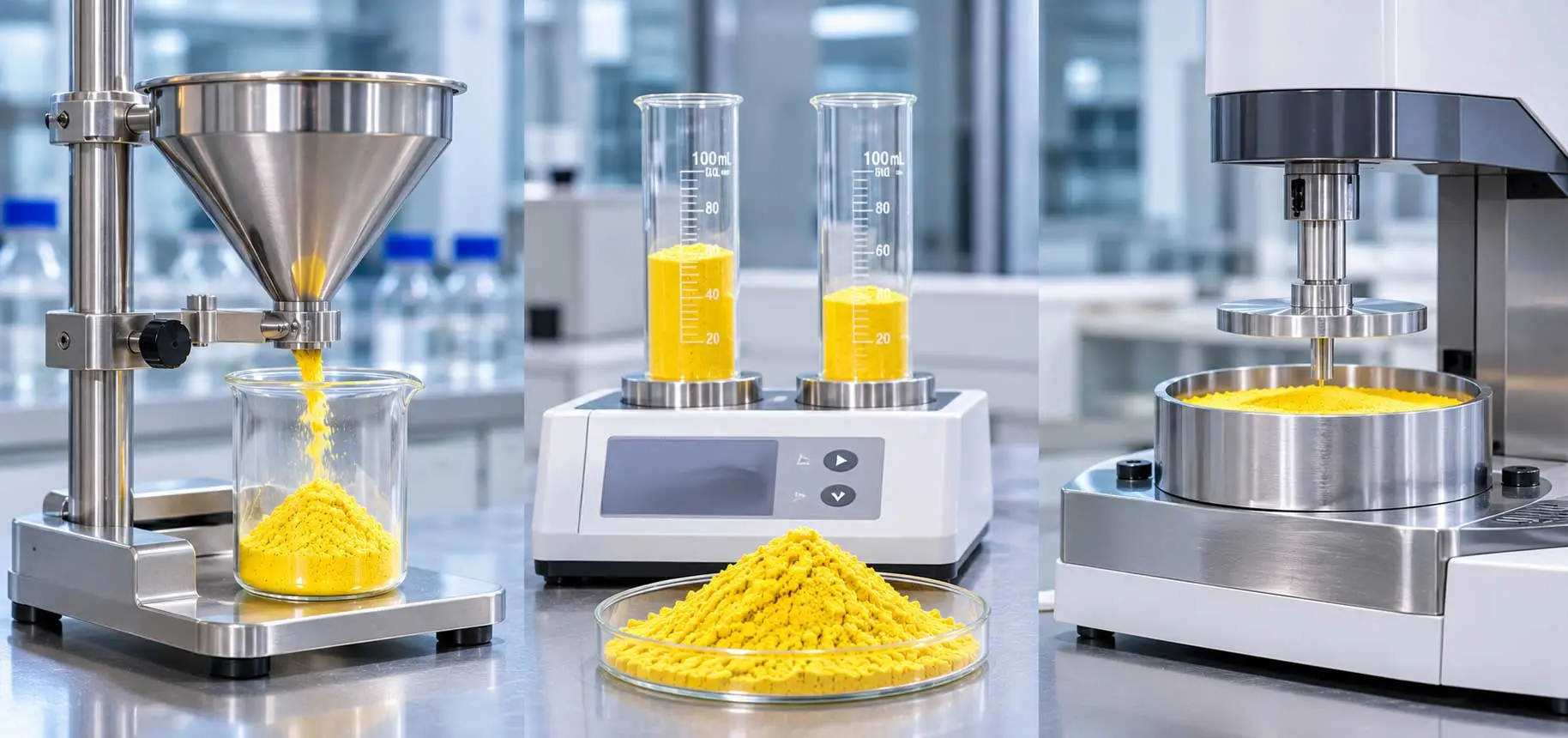
Berberine HCl Capsule Fill Weight: How Particle Size and Bulk Density Affect Capacity
Capsule capacity is one of the most practical considerations when selecting raw materials for supplement manufacturing.
A target ingredient weight must fit within the available capsule volume while leaving sufficient space for any required excipients.
Berberine HCl Capsule Fill Weight and Capsule Size Selection
Berberine HCl capsule fill weight depends on the target ingredient loading, powder density, formulation composition, and filling method.
Capsule size provides a defined nominal volume, but it does not guarantee that a particular mass of powder can be filled consistently.
For example, a formulation containing a high proportion of low-density powder may occupy substantially more volume than expected from the ingredient weight alone.
Furthermore, excipients such as fillers, glidants, and lubricants contribute to the total formulation volume.
Manufacturers should therefore evaluate the complete blend rather than relying exclusively on the bulk density of the active ingredient.
During development, practical filling trials can establish whether the intended capsule size supports the required formulation.
Berberine HCl Capsule Filling Performance on Automatic Equipment
Berberine HCl capsule filling performance depends on how the powder behaves under the specific mechanical conditions of the filling machine.
Dosator-based systems and tamping-pin systems use different powder metering and consolidation mechanisms.
A dosator typically forms and transfers a powder plug, while a tamping-pin system progressively consolidates material within dosing bores.
These differences can influence how powder flowability, packing characteristics, and compressibility affect filling.
Manufacturers should evaluate:
Fill-weight consistency during continuous operation.
Powder feeding and hopper discharge behavior.
Plug formation or powder consolidation where applicable.
Changes in filling performance as the hopper level decreases.
Blend uniformity and potential segregation.
Equipment cleaning and powder adhesion.
For commercial qualification, a representative trial should be conducted using the intended formulation and equipment wherever possible.
The resulting data can help establish meaningful acceptance criteria for future raw material purchases.
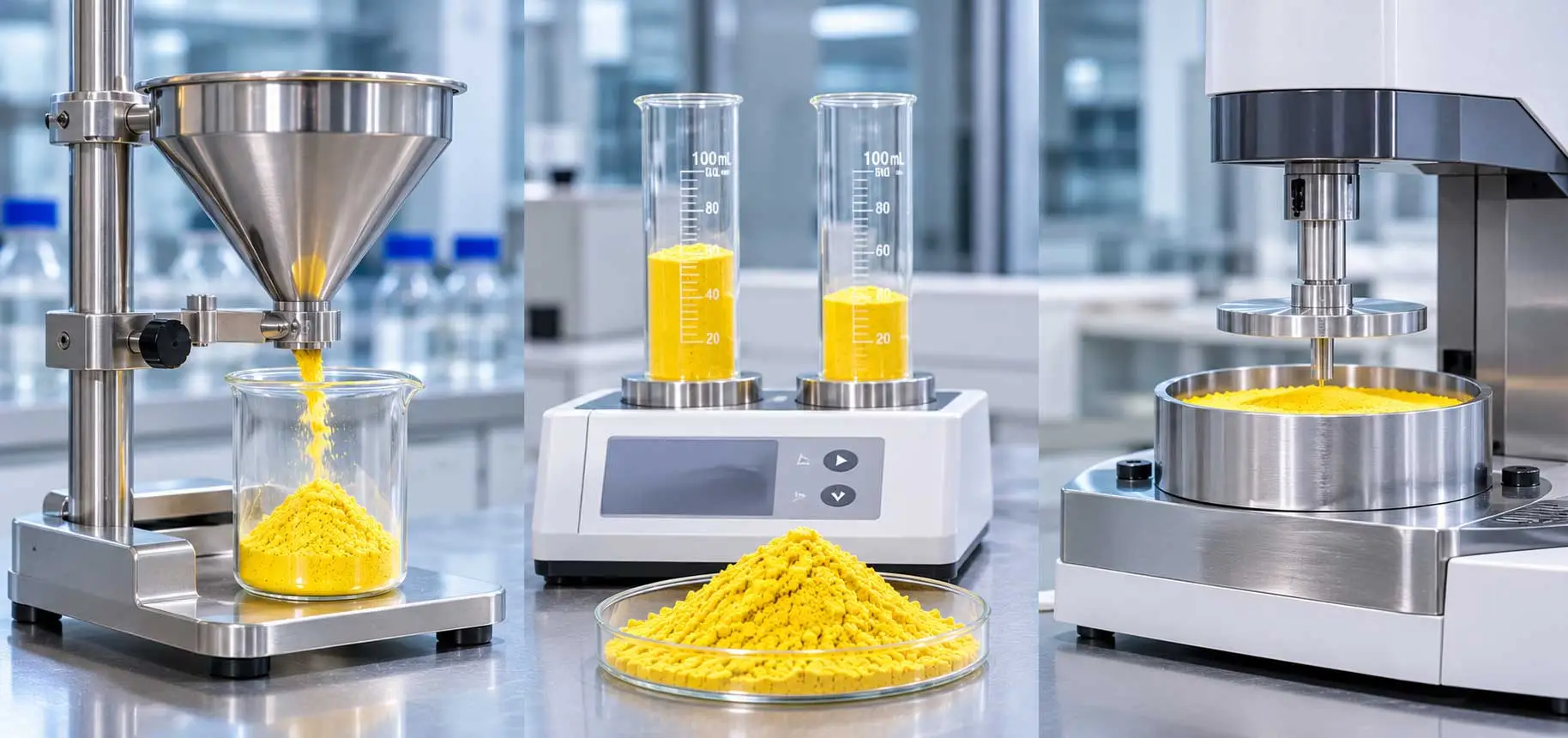
Berberine HCl Particle Size and Powder Segregation During Capsule Blending
Particle size distribution can influence how an active ingredient mixes with excipients and whether the resulting blend remains uniform during manufacturing.
Berberine HCl Particle Size Differences and Blend Segregation
Berberine HCl powder segregation may occur when the active ingredient and excipients have substantially different particle sizes, densities, or shapes.
During powder handling, smaller particles may move through spaces between larger particles. Differences in particle mobility can also contribute to separation during vibration, transfer, or discharge.
However, segregation is formulation-dependent and cannot be predicted from particle size alone.
Powder cohesion, mixer design, blending time, and handling conditions all influence the outcome.
Manufacturers should therefore evaluate the complete formulation rather than attempting to select the active ingredient independently of the excipient system.
Berberine HCl Blend Uniformity During Capsule Manufacturing
Achieving an acceptable blend at the end of mixing does not guarantee that the material will remain uniform throughout production.
Powder transfer, intermediate storage, hopper movement, and repeated filling operations can alter blend distribution.
For berberine HCl capsule manufacturing, representative sampling and appropriate blend or dosage-unit testing can help identify these risks.
When selecting a commercial raw material, buyers should consider whether differences in particle size distribution between batches could affect an established blending process.
This is particularly important when the formulation has already been optimized around a specific raw material profile.
Berberine HCl Particle Size and Dissolution: Balancing Processing and Product Performance
Particle size can influence both manufacturing performance and the rate at which an ingredient dissolves after administration.
These considerations must be evaluated together.
Berberine HCl Particle Size Effects on Dissolution Rate
Smaller particles generally provide greater surface area relative to their mass, which may support faster dissolution under suitable conditions.
However, finer powders can also agglomerate or exhibit poor wetting, potentially reducing the expected improvement.
Moreover, reducing particle size does not necessarily increase equilibrium solubility.
Therefore, berberine HCl particle size should not be selected solely on the assumption that finer powder always provides better finished-product performance.
Berberine HCl Powder Selection for Capsule Formulation
For berberine HCl capsule formulation, an appropriate particle size distribution should balance flowability, blend uniformity, capsule filling, and dissolution requirements.
Manufacturers should evaluate these characteristics using the intended formulation and relevant test methods.
Additional information about solvent effects and dissolution behavior is available in our related guide, Berberine HCl Solubility: Water, pH and Formulation Guide.
Berberine HCl Powder Specifications and Batch-to-Batch Consistency
A purchasing specification should define the properties that matter for both raw material quality and manufacturing performance.
Chemical purity remains essential, but it does not fully describe powder behavior.
Berberine HCl Powder Specification for Capsule Manufacturing
A suitable berberine HCl powder specification may include the following parameters:
|
Specification |
Why It Matters |
|
Identity |
Confirms the supplied ingredient |
|
Assay |
Establishes ingredient content |
|
D10, D50 and D90 |
Characterizes particle size distribution |
|
Bulk density |
Supports capsule capacity assessment |
|
Tapped density |
Provides information about powder consolidation |
|
Moisture or loss on drying |
Supports handling and storage evaluation |
|
Flowability |
Helps assess manufacturing suitability |
|
Heavy metals and microbial limits |
Supports contaminant control |
|
COA and analytical methods |
Enables material qualification |
|
Batch traceability |
Supports commercial supply consistency |
Not all suppliers routinely include particle size, density, or flowability results in their standard certificate of analysis.
Accordingly, berberine HCl raw material specifications should be agreed upon before commercial purchasing.
If a physical parameter is essential to manufacturing, the buyer should confirm whether the supplier can provide suitable testing or support a mutually agreed specification.
Berberine HCl Batch Consistency and Change Control
Berberine HCl batch consistency is especially important after a capsule formulation has been successfully validated or qualified for routine manufacturing.
Differences in milling, drying, handling, or other processing conditions may influence physical characteristics even when the assay remains within specification.
Buyers should therefore consider how critical physical properties will be monitored across commercial lots.
Where appropriate, purchasing agreements can address agreed specifications, analytical methods, batch documentation, and communication of material changes that may affect processing.
The objective is not to eliminate every natural variation in powder properties, but to establish a controlled and technically justified operating range.
Berberine HCl Sample Testing and Supplier Qualification for Capsule Manufacturers
Supplier qualification should connect laboratory documentation with the practical requirements of commercial production.
Berberine HCl Sample Testing Before Commercial Production
Berberine HCl sample testing should begin with a review of the available COA, product specifications, and analytical methods.
Manufacturers can then evaluate the physical properties most relevant to their process.
A practical qualification sequence may include reviewing particle size and density, preparing a representative formulation, conducting capsule filling trials, and evaluating fill-weight consistency.
Where appropriate, finished-product performance should also be assessed.
Importantly, the sample should be representative of the proposed commercial material. Buyers should clarify whether the evaluated physical characteristics can be maintained within agreed limits for future orders.
Berberine HCl Supplier Qualification and Technical Documentation
Effective berberine HCl supplier qualification requires more than obtaining a competitive quotation.
Buyers should evaluate product identity, analytical documentation, traceability, testing capabilities, and the supplier's ability to communicate technical information.
A professional berberine HCl raw material supplier should clearly distinguish standard product specifications from additional customer-specific testing requirements.
This transparency helps manufacturers determine which data are already available and which must be generated during qualification.
Buying Bulk Berberine HCl Powder for Capsule Manufacturing
Once a suitable material has been identified, procurement should focus on maintaining the required quality profile throughout commercial supply.
Berberine HCl Sample Request, MOQ and Commercial Supply
A berberine HCl sample request should include the intended capsule size, target fill weight, assay requirements, particle size preferences, and any critical density or flowability requirements.
Buyers planning to buy berberine HCl powder in bulk should also specify their estimated purchasing quantity, documentation requirements, packaging preferences, and delivery destination.
The berberine HCl MOQ should be confirmed with the supplier because minimum order quantities may depend on the available specification and commercial arrangements.
Berberine HCl Price per kg and Bulk Quotation
The berberine HCl price per kg may depend on purchasing volume, product specifications, testing requirements, packaging, and delivery terms.
When comparing berberine HCl powder wholesale offers, manufacturers should consider technical suitability alongside price.
A lower quotation may offer limited value if the material requires extensive reformulation or creates filling problems.
For a berberine HCl bulk quotation, provide the required specification, quantity, destination, and supporting documentation requirements.
Berberine HCl Powder Supply for Capsule Manufacturers — CHEN LANG BIO TECH
CHEN LANG BIO TECH supplies berberine HCl powder for supplement manufacturers, capsule formulation developers, and ingredient distributors.
As a berberine HCl powder supplier, we support sourcing discussions involving available specifications, quality documentation, sample evaluation, and commercial supply arrangements.
If your manufacturing process requires specific particle size or bulk density characteristics, share your target requirements and estimated purchasing quantity. Our team can review the available material information and discuss suitable supply options.
Frequently Asked Questions About Berberine HCl Particle Size and Bulk Density
What is the ideal Berberine HCl particle size for capsules?
There is no universal ideal particle size. The appropriate distribution depends on capsule size, powder flow, excipients, filling equipment, and finished-product performance requirements.
How does Berberine HCl bulk density affect capsule fill weight?
Bulk density influences the volume occupied by a given powder mass. Actual fill weight also depends on powder consolidation, formulation composition, and the filling mechanism.
What is the difference between Berberine HCl bulk density and tapped density?
Bulk density measures unsettled powder packing, while tapped density measures packing after standardized mechanical tapping. Their comparison provides information about powder consolidation behavior.
Does finer Berberine HCl powder always improve capsule manufacturing?
No. Finer particles may increase surface area but can also increase cohesion, agglomeration, and handling difficulties. Manufacturing suitability requires application-specific testing.
What physical specifications should buyers request for bulk Berberine HCl powder?
Depending on the application, buyers should consider particle size distribution, bulk density, tapped density, moisture, and flowability, alongside identity, assay, contaminant limits, and batch documentation.
Conclusion — Selecting Berberine HCl Powder for Reliable Capsule Manufacturing
Selecting berberine HCl powder for capsules requires evaluating particle size, bulk density, flowability, and batch consistency alongside chemical purity.
Manufacturers should establish application-specific specifications and verify performance through representative capsule filling trials before commercial purchasing.
A technically qualified raw material provides a stronger foundation for consistent production and long-term supply.
References
1. United States Pharmacopeia. General Chapter <429>: Light Diffraction Measurement of Particle Size.
2. United States Pharmacopeia. General Chapter <616>: Bulk Density and Tapped Density of Powders.
3. United States Pharmacopeia. General Chapter <1174>: Powder Flow.
4. United States Pharmacopeia. General Chapter <711>: Dissolution.
5. Aulton, M. E., and Taylor, K. M. G. (eds.). Aulton's Pharmaceutics: The Design and Manufacture of Medicines. Elsevier.
6. International Council for Harmonisation. ICH Q8(R2): Pharmaceutical Development.
7. United States Food and Drug Administration. 21 CFR Part 111: Current Good Manufacturing Practice in Manufacturing, Packaging, Labeling, or Holding Operations for Dietary Supplements.

Send Inquiry
Related Industry Knowledge
- Is Centella Asiatica Extract Powder Better Than Niacinamide?
- Does DHEA Really Raise Testosterone? A Science-Based Guide for Supplement Brands
- Marigold Zeaxanthin: How Zeaxanthin Is Produced from Marigold Flowers
- Meglumine Powder: Everything You Need to Know
- How is D-Luciferin Potassium Salt Administered for in Vivo Imaging?
- How Does Spermidine Trihydrochloride Contribute to Health and Aging?
- What is Water Soluble Coenzyme Q10
- Future Trends of Sodium Methylesculetin Acetate in Healthcare
- Is Honokiol The Same As Magnolia Bark
- Revitalize Your Eyes with Marigold Extract Natural Solution for Eye Health