
What Is Thaumatin (E957)? A Guide to the Sweet Protein
2026-09-23 15:46:34
Thaumatin is an intensely sweet protein best known in food applications as E957. Unlike sucrose, steviol glycosides, sucralose and many other high-intensity sweeteners, thaumatin is proteinaceous in nature. This distinction matters because its commercial value is not limited to sweetness: thaumatin can also function as a flavor modifier, making it relevant to food manufacturers working on sweetness optimization, flavor balance and selected taste-masking applications.
Depending on the reference and test conditions, thaumatin is commonly reported at roughly 2,000–3,000 times the sweetness of sucrose on a weight basis. Yet that headline number tells only part of the story. Its sweetness develops differently from sucrose, its performance depends on concentration and the surrounding food matrix, and it should not be treated as a simple gram-for-gram sugar replacement.
For ingredient buyers, understanding what is thaumatin therefore requires looking beyond sweetness intensity. Product identity, manufacturing route, specification, analytical methods, regulatory status, batch consistency and supplier documentation all matter when qualifying commercial material.
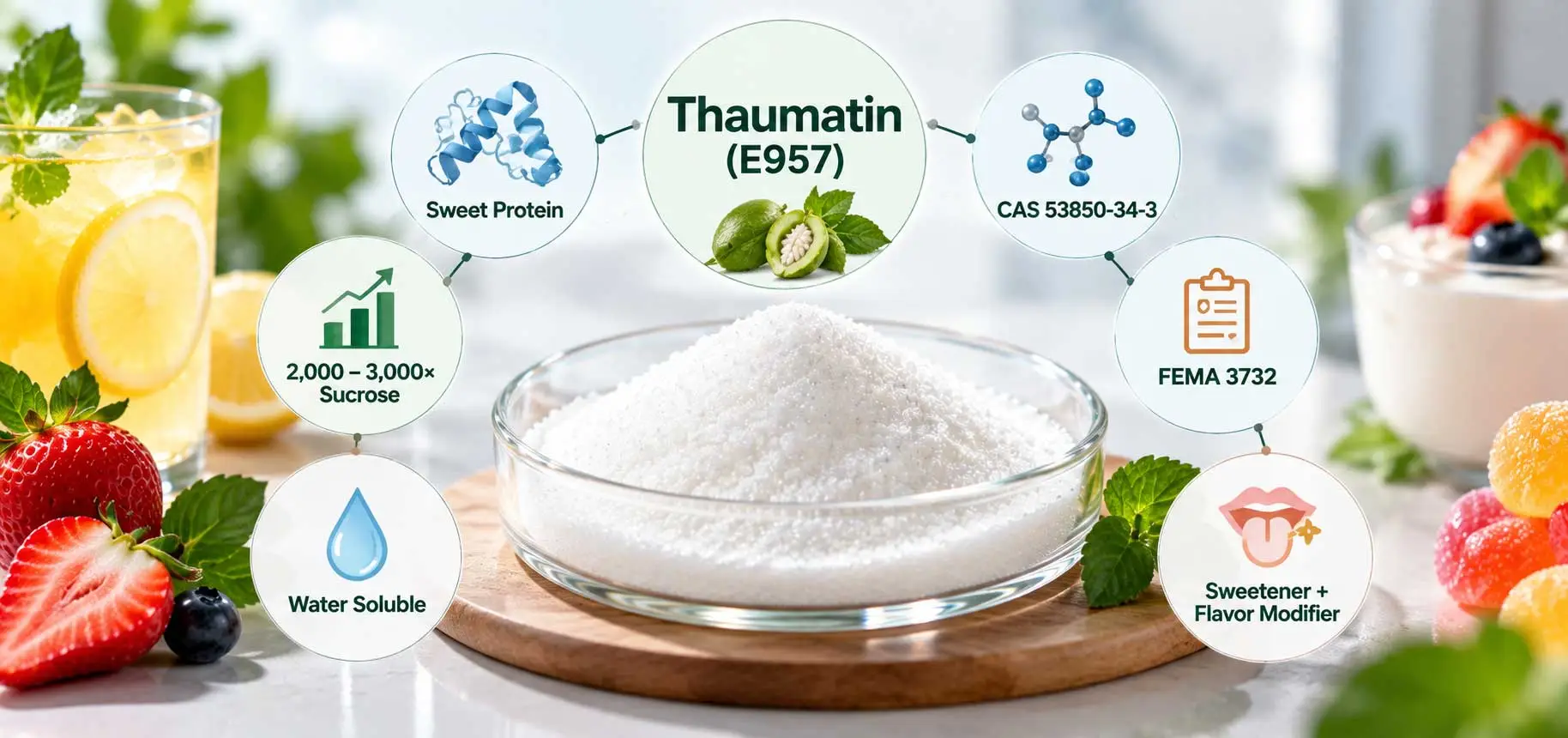
What Is Thaumatin E957? A Quick Answer
Thaumatin is a family of intensely sweet proteins originally identified in the fruit of Thaumatococcus daniellii, a plant native to tropical West and Central Africa. In established food-additive specifications, the principal proteins are Thaumatin I and Thaumatin II. Thaumatin E957 is used in food applications for sweetening and flavor-modifying purposes, subject to the regulations of the market in which the finished product is sold.
|
Question |
Quick Answer |
|
What is thaumatin? |
An intensely sweet protein with sweetening and flavor-modifying functions |
|
E number |
E957 |
|
INS number |
957 |
|
CAS number |
53850-34-3 |
|
FEMA number |
3732 |
|
Ingredient type |
Sweet protein |
|
Principal natural proteins |
Thaumatin I and Thaumatin II |
|
Reported sweetness |
Approximately 2,000–3,000× sucrose by weight, depending on test conditions |
|
Solubility |
Very soluble in water according to JECFA specifications |
|
Functional uses |
Sweetener and flavor enhancer/modifier |
|
Commercial consideration |
Identity and regulatory status should be verified against the manufacturing route and destination market |
For procurement teams, identifiers such as thaumatin CAS 53850-34-3, E957 and FEMA 3732 provide useful starting points, but they should not replace a review of the actual specification and regulatory documentation for the material being purchased.
What Is Thaumatin Made Of? Understanding the Sweet Protein
Why Is Thaumatin Called a Sweet Protein?
The term thaumatin sweet protein is literal rather than a marketing description. Thaumatins are proteins built from amino acids, rather than sugars or small organic molecules that happen to taste sweet.
Naturally occurring thaumatin includes several closely related proteins. Regulatory and scientific descriptions of conventional food-additive thaumatin focus particularly on Thaumatin I and Thaumatin II. Each contains 207 amino-acid residues, with molecular masses of approximately 22 kDa. Their structures are stabilized by multiple disulfide bridges, an important feature when considering the behavior of the protein under different processing conditions.
This proteinaceous nature separates thaumatin from many other commercial high-intensity sweeteners. Steviol glycosides, for example, are glycosides; mogrosides from monk fruit are triterpene glycosides; sucralose is a chlorinated sucrose derivative. Calling thaumatin a natural sweet protein therefore identifies a genuinely different ingredient class rather than another name for a conventional sugar substitute.
Other sweet-tasting proteins have been studied, including brazzein, monellin and mabinlin, but thaumatin has a particularly long history of food-related research and commercialization.
Thaumatin and Thaumatococcus daniellii
Anyone researching where does thaumatin come from will quickly encounter Thaumatococcus daniellii. The intensely sweet proteins occur naturally in the arils surrounding the fruit's seeds, and conventional regulatory definitions of thaumatin have historically been based on aqueous extraction from these arils.
That historical origin needs to be distinguished from modern biotechnology. Research into recombinant and biosynthetic production of thaumatin has developed for decades, using different biological expression systems.
For commercial buyers, this distinction is important: the fact that the thaumatin protein occurs naturally does not mean that every commercial material is produced by direct plant extraction. The manufacturing route should therefore be identified during supplier qualification and checked against the regulatory definition applicable to the destination market.
What Is E957 and Is E957 the Same as Thaumatin?
In food-additive terminology, E957 is the E number associated with thaumatin. In other words, thaumatin is the name of the ingredient, while E957 is its food-additive identifier in regulatory systems that use E numbers.
This is why what is E957 and “what is thaumatin?” often lead to the same ingredient, but the identifiers serve different purposes.
The main identifiers buyers are likely to encounter include:
•Thaumatin — ingredient name
•E957 — E-number designation
•INS 957 — International Numbering System designation
•CAS 53850-34-3 — CAS identifier for thaumatin
•FEMA 3732 — FEMA reference associated with thaumatin
These identifiers are useful for technical documentation, database searches and supplier comparisons. FEMA's Flavor Ingredient Library, for example, lists thaumatin under FEMA No. 3732 and CAS No. 53850-34-3.
There is, however, an important procurement detail. Buyers should not assume that a material qualifies as E957 food additive in every jurisdiction solely because the protein is described as thaumatin. Regulatory definitions can specify source and manufacturing method. This is especially relevant to newer recombinant or biosynthetic routes. Qualification should therefore be based on the current rules of the destination market and the supplier's supporting documentation.
How Sweet Is Thaumatin Compared with Sugar?
Thaumatin Sweetness Is Approximately 2,000–3,000 Times Sucrose
Thaumatin sweetness is one of the first characteristics that attracts attention. Scientific literature commonly reports sweetness intensities in the region of 2,000–3,000 times sucrose by weight, although reported values vary with methodology, concentration and sensory conditions.
That makes the answer to how sweet is thaumatin impressive, but commercially the number needs context.
Sweetness potency is not a fixed conversion factor that works identically in every product. Sensory response is concentration-dependent, while acids, flavors, hydrocolloids and other sweeteners can affect how sweetness is perceived. The temporal profile is also different from sucrose.
Why 2,000–3,000× Does Not Mean a Simple Sugar Replacement Ratio
A comparison of thaumatin vs sugar should not imply that one kilogram of sugar can simply be divided by 2,000 and replaced with thaumatin.
Sucrose provides more than sweetness. It can contribute solids, body, texture, browning behavior, freezing-point effects and other functional properties. Thaumatin is used at much lower concentrations and does not reproduce these bulk functions.
For manufacturers, the more useful question is therefore not simply “is thaumatin sweeter than sugar?” but how thaumatin contributes to the complete sweetness and flavor profile of a specific food system.
This distinction is particularly important during commercial scale-up. A promising theoretical sweetness ratio does not replace application testing with the actual formulation.
What Does Thaumatin Taste Like?
Thaumatin Taste Profile and Sweetness Perception
The thaumatin taste profile differs from the immediate sweetness normally associated with sucrose. Scientific descriptions commonly report a slower onset followed by a more persistent sweetness. At some concentrations, a lingering or liquorice-like note has also been reported.
For this reason, claims that thaumatin universally has “no aftertaste” are too broad. The answer to what does thaumatin taste like depends on concentration, food matrix and the other flavor and sweetening components present.
This does not make the sensory profile a disadvantage. It means thaumatin should be evaluated as a formulation ingredient rather than judged only from a sweetness multiple.
Why Taste Profile Matters to Food Manufacturers
Ingredient buyers and product developers need repeatable sensory performance. When qualifying a commercial batch, consistency in product identity and composition can therefore matter alongside conventional analytical parameters.
For formulations using several sweetening components, the objective may be to create a particular sweetness curve rather than maximize sweetness intensity. Understanding the temporal characteristics of thaumatin helps R&D teams decide where the ingredient fits within that system.
Why Is Thaumatin Used as Both a Sweetener and Flavor Modifier?
♦Thaumatin as a High-Intensity Sweetener
As a high-intensity sweetener, thaumatin provides substantial sweetness at low concentrations. JECFA specifications identify its functional uses as both a sweetener and flavor enhancer, which is an important distinction for commercial applications.
The appropriate use, however, depends on the food category and market. Manufacturers should establish permitted functions and use levels from the regulations governing the finished product rather than assuming one global use condition.
♦Thaumatin as a Flavor Modifier
The second function is particularly interesting. A thaumatin flavor modifier can influence sensory perception at concentrations that are not necessarily selected only to maximize sweetness.
Research and industry experience have explored thaumatin in systems where developers want to enhance certain flavor characteristics or modify undesirable sensory notes. This is why terms such as thaumatin flavor enhancer and thaumatin taste modifier appear alongside its role as a sweetener.
From a purchasing perspective, this dual functionality changes how the ingredient should be evaluated. A sample should not be assessed only in water against a sucrose solution if the commercial objective is flavor modification in a complex finished product.
♦Bitterness and Off-Note Modification
Thaumatin has also been studied for its ability to modify bitter or metallic sensory notes. This makes thaumatin bitterness masking relevant to developers working with ingredients that create challenging flavor profiles.
The effect is formulation-dependent, however, and “masking” should not be interpreted as complete removal of every undesirable taste. Application-specific sensory testing remains important.
Is Thaumatin Soluble in Water?
Yes. According to JECFA specifications, thaumatin is very soluble in water, making thaumatin solubility one of its useful handling characteristics for food applications.
For buyers asking is thaumatin soluble in water, however, solubility should be separated from processing stability. A powder can dissolve readily while still requiring attention to pH, temperature, processing time and interactions with other ingredients.
This distinction is particularly relevant because thaumatin is a protein. Published research shows that thermal behavior can change with pH, so a general statement such as “heat stable” does not adequately describe every manufacturing condition.
For commercial projects, the current TDS and supplier recommendations should therefore be reviewed alongside thaumatin water solubility, especially when the process includes heating or extended holding periods.
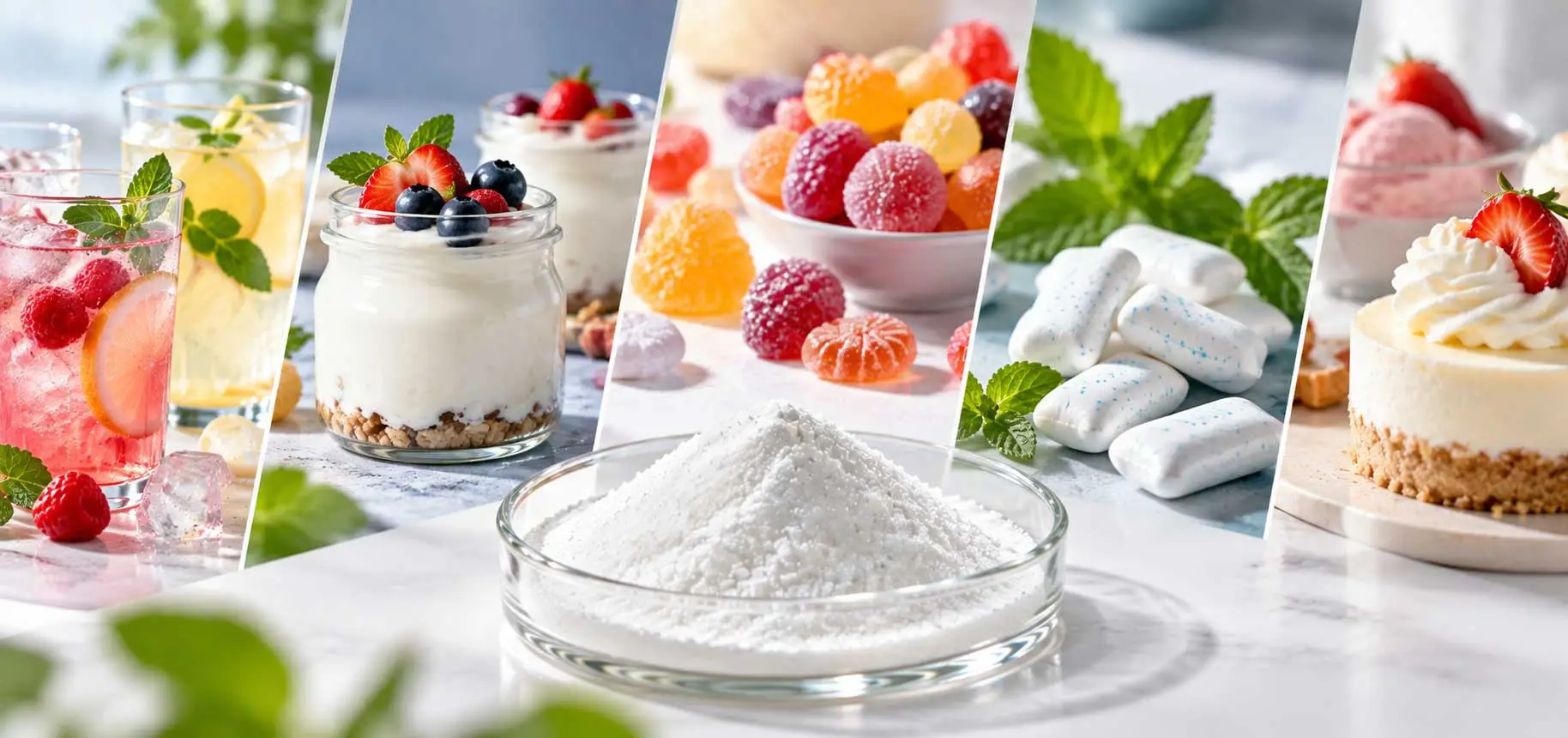
Where Is Thaumatin Used? Common E957 Food Applications
•Thaumatin in Beverages
Thaumatin in beverages is of interest because of its high sweetness intensity, water solubility and flavor-modifying properties. Beverage developers may evaluate it as part of a wider sweetness system rather than as a direct sugar replacement.
Acidity, processing temperature and the other ingredients in the beverage should be considered during development.
•Thaumatin in Dairy Products
Thaumatin in dairy products can be evaluated for both sweetness and flavor modification. This makes dairy a useful example of why the ingredient should not be judged solely by its sucrose-equivalent sweetness.
Commercial use levels and permitted functions must still be checked for the intended market and food category.
•Thaumatin in Confectionery and Chewing Gum
Confectionery and chewing gum are established areas of interest for high-intensity sweeteners. In these applications, the persistent sensory profile of thaumatin may influence the overall sweetness experience.
For thaumatin in chewing gum, buyers should pay particular attention to the regulatory conditions applying to the destination market rather than copying a use level from another region.
•Thaumatin in Flavor Systems
Flavor houses may also evaluate thaumatin where flavor modification is the principal objective. This is one reason the commercial identity of the ingredient extends beyond the simple phrase “sugar substitute.”
Across all these applications, permitted use is market-specific. Food manufacturers should verify current regulations before commercialization.
How Is Commercial Thaumatin Produced?
From Natural Discovery to Modern Commercial Production
Historically, commercial thaumatin has been associated with aqueous extraction of Thaumatococcus daniellii fruit arils. Both JECFA specifications and the current EU regulatory framework describe conventional E957 in this context.
Modern thaumatin production, however, is also an active biotechnology field. Scientific literature documents recombinant production research involving microbial hosts and transgenic plants, and development of alternative production routes continues.
That makes the question how is thaumatin made increasingly important for procurement teams. Two powders may be described using the same protein name while their manufacturing routes, composition and regulatory documentation are not necessarily identical.
Biosynthesis and Commercial Thaumatin Production
CHEN LANG BIO TECH's commercial development is based on biosynthesis technology, supported by our broader sweetener manufacturing and R&D platform. For buyers considering biosynthetic material, manufacturing-route documentation should form part of the qualification process.
There is also an important regulatory point: a biosynthesized or recombinant thaumatin product should not automatically be assumed to fall under every jurisdiction's traditional E957 definition. For example, established EU specifications historically describe material extracted from T. daniellii. Regulatory suitability should therefore be confirmed for the specific product, manufacturing route, intended application and destination market before commercial use.
This route-specific review is much more useful to an international buyer than a generic statement that “thaumatin is globally approved.”
What Should Buyers Check When Sourcing Food-Grade Thaumatin?
Confirm Product Identity and Manufacturing Route
When sourcing food grade thaumatin, start by establishing exactly what material is being offered.
The supplier should be able to identify the product, manufacturing route and relevant specification. E number, CAS number and FEMA number are useful references, but they do not by themselves prove that a particular batch meets the legal definition required in every destination market.
This becomes especially important when comparing plant-extracted and biosynthetic products.
Review the Thaumatin COA and Specification
A thaumatin COA should be read together with the specification rather than treated as a marketing certificate. Buyers should establish which analytical parameters are controlled, what limits apply and which test methods are used.
Depending on the applicable specification and buyer requirements, the review may include identity, protein or assay-related parameters, moisture or loss on drying, ash, microbiological limits and relevant contaminants.
The analytical method deserves particular attention. EFSA's 2021 re-evaluation noted that total protein measurements do not necessarily provide the same information as a method specifically quantifying Thaumatin I and II, and recommended consideration of a validated methodology such as HPLC for the combined content of these proteins.
For procurement teams comparing a thaumatin certificate of analysis from several sources, this is a valuable lesson: two percentage values should not be assumed equivalent until the test basis is understood.
Evaluate Manufacturing and Batch Consistency
A capable thaumatin manufacturer should be evaluated on more than the quality of one sample. Commercial buyers should consider production capacity, batch-to-batch control, traceability, analytical capability, change control, documentation and the ability to reproduce agreed specifications during repeat supply.
This is where a supplier qualification process provides more value than choosing the lowest quoted price per kilogram.
Thaumatin Manufacturer and Commercial Supply Considerations
Production Capacity and Supply Continuity
For customers moving from laboratory evaluation to regular purchasing, supply continuity becomes part of product quality.
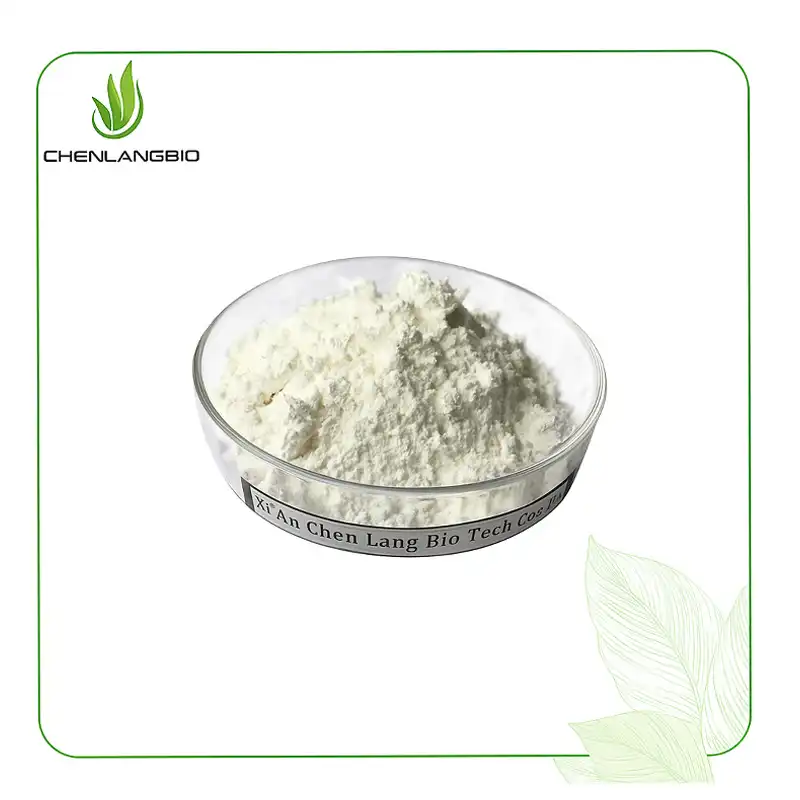
CHEN LANG BIO TECH has more than 30 years of experience in sweetener technologies and has developed capabilities across biosynthesis, chemical synthesis and plant-derived sweetener platforms. Our current thaumatin production capacity is approximately 10 metric tons per year, supported by production facilities, R&D resources, a synthesis laboratory and an application laboratory.
For buyers evaluating a thaumatin supplier, these capabilities are relevant because commercial supply requires more than making an acceptable first sample. Production planning, quality control and repeatability all become increasingly important once a formulation enters routine manufacturing.
MOQ, Packaging and Technical Documentation
Our standard thaumatin MOQ starts from 1 kg, allowing customers to begin with technical evaluation before progressing to larger quantities. Standard packaging includes 1–5 kg aluminum foil bags and 25 kg paper drums.
For bulk thaumatin powder requirements, quantity, production schedule, destination and documentation needs can be reviewed before quotation.
Current COA, specification, TDS, SDS and other available technical documents can be provided according to the project. Customers requesting a thaumatin sample should ideally provide the intended application and destination market as well, particularly when regulatory qualification is part of the development process.
Thaumatin vs Other High-Intensity Sweeteners: What Is Different?
Thaumatin occupies an unusual position because it is a protein and can provide both intense sweetness and flavor modification. Other high-intensity sweeteners achieve sweetness through very different molecular structures.
|
Ingredient |
Ingredient Type |
Key Commercial Distinction |
|
Thaumatin |
Sweet protein |
Intense sweetness plus flavor-modifying functionality |
|
Steviol glycosides |
Diterpene glycosides |
Plant-derived high-intensity sweeteners with a different sensory profile |
|
Mogrosides |
Triterpene glycosides |
Principal sweet components associated with monk fruit |
|
Sucralose |
Chlorinated sucrose derivative |
High-intensity sweetener with different chemistry and processing behavior |
A meaningful thaumatin vs stevia comparison therefore needs to examine more than which ingredient has the larger sweetness number. The same applies to thaumatin vs monk fruit and thaumatin vs sucralose. Ingredient class, sensory profile, processing conditions, permitted uses, labeling considerations and commercial objectives can all affect selection.
These comparisons are best made against a defined finished-product requirement rather than attempting to identify one universally superior sweetener.
Frequently Asked Questions About Thaumatin E957
What is thaumatin?
Thaumatin is a group of intensely sweet proteins originally identified in Thaumatococcus daniellii. Conventional food-additive thaumatin consists principally of Thaumatin I and Thaumatin II and is used for sweetening and flavor-modifying purposes.
Is thaumatin the same as E957?
Thaumatin is the ingredient name, while E957 is its E-number designation. Buyers should still verify whether the specific material and manufacturing route meet the applicable E957 definition in the intended destination market.
What is the CAS number for thaumatin?
The thaumatin CAS number is 53850-34-3. JECFA and FEMA both associate this CAS number with thaumatin, while FEMA lists the ingredient under reference number 3732.
How sweet is thaumatin compared with sugar?
Thaumatin is commonly reported at approximately 2,000–3,000 times the sweetness of sucrose by weight, depending on the reference and sensory conditions. This does not mean it can simply replace sugar at a fixed 1:2,000 ratio because sugar provides functions beyond sweetness.
Is thaumatin soluble in water?
Yes. JECFA describes thaumatin as very soluble in water. Processing performance should nevertheless be assessed separately because pH, temperature, time and interactions with other ingredients can influence protein stability.
What is thaumatin used for?
Thaumatin is used as a high-intensity sweetening and flavor-modifying ingredient in permitted food applications. Potential categories include beverages, dairy products, confectionery, chewing gum and flavor systems, although legal uses and maximum levels depend on the destination market.
Is thaumatin a protein?
Yes. Thaumatin is a sweet-tasting protein, which distinguishes it chemically from sweeteners such as steviol glycosides, mogrosides and sucralose.
What should buyers check before purchasing thaumatin powder?
Before purchasing, review the manufacturing route, current specification, thaumatin COA, analytical methods, microbiological and contaminant requirements, regulatory suitability, packaging, shelf life and batch traceability. For repeat orders, manufacturing capacity and consistency should also be part of supplier qualification.
Sourcing Thaumatin Powder for Commercial Food Production
Understanding what is thaumatin is only the first step in commercial sourcing. For an ingredient buyer, the more consequential questions concern whether the offered material has the correct identity, whether its specification is appropriate for the application, whether the manufacturing route is acceptable in the destination market, and whether the supplier can maintain consistent quality from sample through commercial production.
CHEN LANG BIO TECH supports commercial thaumatin projects with approximately 10 MT annual production capacity, a 1 kg starting MOQ, flexible packaging and technical documentation for buyer review. Customers considering a trial or bulk thaumatin powder order can send us the required quantity, application, destination country and documentation requirements so that the appropriate product and commercial terms can be evaluated.
For the current thaumatin price, COA, specification or sample availability, contact our team at admin@chenlangbio.com.
References
1. EFSA Panel on Food Additives and Flavourings (FAF). Re-evaluation of thaumatin (E 957) as food additive. EFSA Journal. 2021;19(11):6884. doi:10.2903/j.efsa.2021.6884.
2. Joint FAO/WHO Expert Committee on Food Additives (JECFA). Thaumatin — Combined Compendium of Food Additive Specifications. FAO/JECFA, INS No. 957, CAS No. 53850-34-3.
3. JECFA. Thaumatin. Prepared at the 53rd JECFA (1999), Food and Nutrition Paper 52 Addendum 7. Functional uses: sweetener and flavour enhancer.
4. Flavor and Extract Manufacturers Association (FEMA). Thaumatin — FEMA No. 3732. FEMA Flavor Ingredient Library. CAS No. 53850-34-3.
5. Masuda T, et al. Structure of thaumatin under acidic conditions: Structural insight into the conformations in lysine residues responsible for maintaining the sweetness after heat-treatment. Food Chemistry. 2022;388:132996. doi:10.1016/j.foodchem.2022.132996.
6. Joseph JA, et al. Bioproduction of the Recombinant Sweet Protein Thaumatin: Current State of the Art and Perspectives. Frontiers in Microbiology. 2019;10:695.
7. Faus I. Recent developments in the characterization and biotechnological production of sweet-tasting proteins. Applied Microbiology and Biotechnology. 2000;53(2):145–151. doi:10.1007/s002530050001.
8. European Commission. Commission Regulation (EU) No 231/2012 laying down specifications for food additives listed in Annexes II and III to Regulation (EC) No 1333/2008. Specification for Thaumatin (E 957).

Send Inquiry
Related Industry Knowledge
- Hydrolyzed Keratin Powder vs Keratin Peptide Powder Are They the Same Ingredient?
- Does Centella Asiatica Remove Dark Spots
- Buy DHEA Powder: Where to Get High-Quality Wholesale
- 6 Proven Benefits of L-Carnosine for Athletes and Fitness Enthusiasts
- Vitamin E Powder for Functional Foods—Why?
- Does Turkesterone Work for Muscle Growth?
- Should PQQ be Taken with Coenzyme Q10 (CoQ10)?
- Do Hops Have Antioxidants
- Does Olive Leaf Extract Powder Used in Cosmetic Products
- Are Pure Natural Soy Isoflavones Good for You