What Is Red Clover Powder Good For? Uses, Benefits and Quality
November 23, 2026
Red clover powder is used in herbal preparations, dietary supplements, and botanical ingredient formulations. Derived from Trifolium pratense L., it contains naturally occurring isoflavones, including biochanin A and formononetin, which have attracted scientific interest for their potential roles in women's health and menopause-related symptoms. However, clinical findings remain inconsistent, and the benefits observed with specific standardized extracts cannot automatically be attributed to ordinary red clover powder.
For supplement manufacturers, what is red clover powder good for is only the starting question. Ingredient selection also depends on botanical identity, isoflavone concentration, processing characteristics, safety, and batch consistency.
Understanding the difference between whole-plant powder and standardized extract helps manufacturers select appropriate raw materials, establish realistic specifications, and evaluate suppliers before commercial production.
What Is Red Clover Powder? Botanical Source, Processing and Ingredient Forms
Red clover is a flowering plant belonging to the Fabaceae family. Its botanical name is Trifolium pratense L., and its flowering aerial parts have a history of use in herbal preparations.
Commercial red clover powder ingredients may differ considerably depending on the plant material used and how it is processed.
♦Red Clover (Trifolium pratense L.) as a Botanical Ingredient
The botanical identity of Trifolium pratense powder is fundamental to ingredient quality.
For commercial manufacturing, the supplier should identify the botanical species, plant part, country of origin, and processing method. These details help distinguish authentic red clover material from other Trifolium species or inadequately documented botanical mixtures.
The flowering tops and other aerial portions may be used, but their chemical composition is not necessarily identical. Therefore, manufacturers should specify the required plant part rather than relying exclusively on the common name.
Botanical identification, traceability records, and appropriate raw material testing provide the foundation for consistent commercial supply.
How Red Clover Powder Is Produced from Dried Plant Material
Conventional red clover powder is generally manufactured through harvesting, drying, milling, and sieving.
Drying conditions influence moisture content and may affect the preservation of sensitive plant constituents. Milling determines particle size, which subsequently influences powder flow, blending, and packaging behavior.
A fine powder may provide better distribution in certain blends but can also create dusting or handling difficulties.
Unlike standardized extracts, conventional milled botanical powder is not necessarily concentrated to a predetermined isoflavone percentage.
Its composition reflects the original plant material and processing conditions.
♦Red Clover Powder vs Red Clover Extract: Processing Differences
The distinction between red clover powder vs extract is especially important for manufacturers developing products with defined isoflavone specifications.
|
Parameter |
Red Clover Powder |
Red Clover Extract Powder |
|
Production method |
Drying and milling |
Extraction and downstream processing |
|
Ingredient composition |
Broad botanical matrix |
Extracted plant constituents |
|
Isoflavone concentration |
Naturally variable |
May be standardized |
|
Main quality considerations |
Identity, moisture, particle size, contaminants |
Identity, assay, impurities, batch consistency |
|
Formulation consideration |
Botanical powder loading |
Defined isoflavone loading |
Neither ingredient form is automatically superior. The appropriate choice depends on the finished product's formulation objectives and specifications.
Red Clover Powder Benefits: Traditional Uses and Scientific Evidence
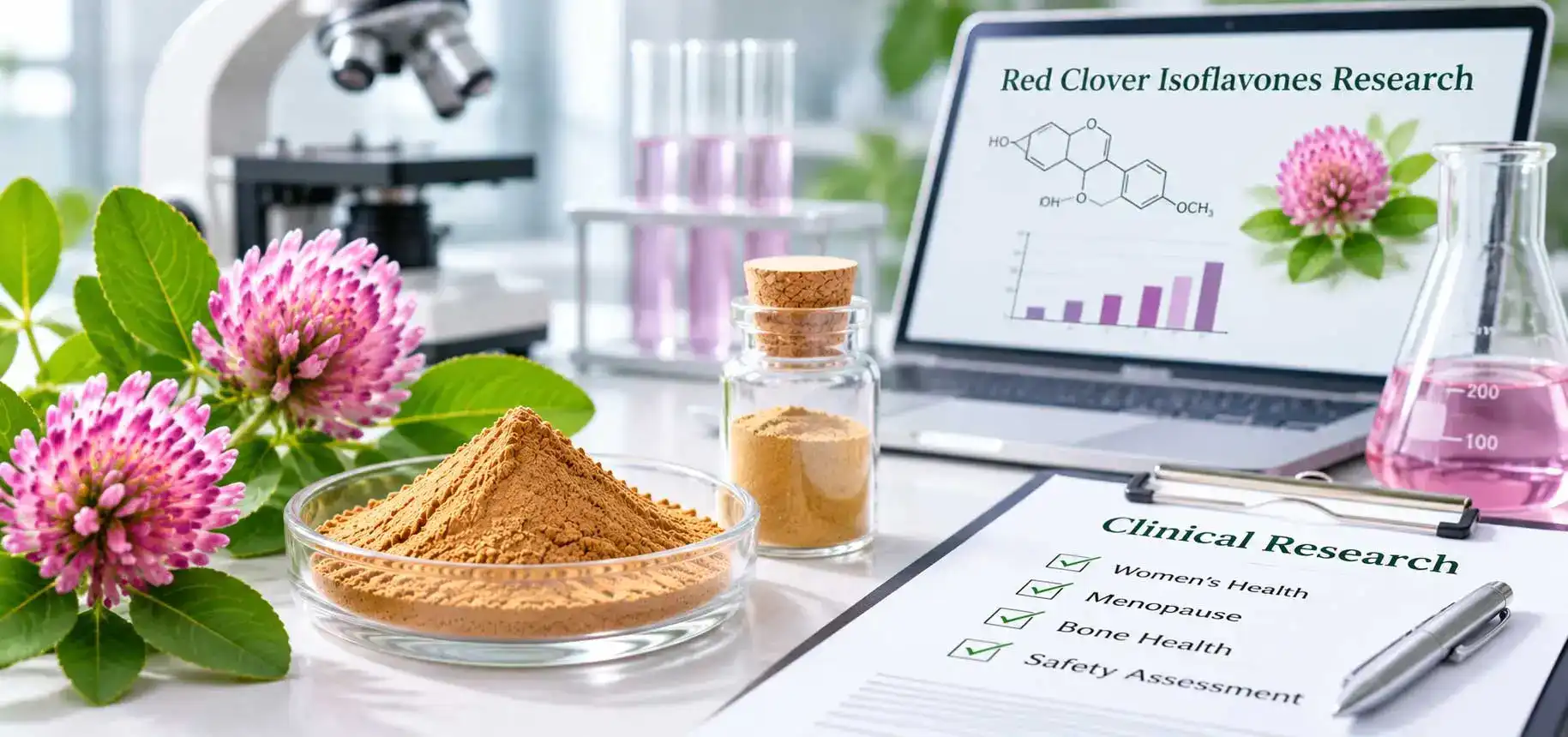
Interest in red clover powder benefits is largely associated with its naturally occurring isoflavones.
These compounds have been investigated in several areas of women's health. Nevertheless, research findings must be interpreted carefully because studies differ in extract composition, dosage, duration, and participant characteristics.
Red Clover Powder for Menopause: What Clinical Studies Suggest
Research involving red clover powder for menopause is frequently discussed in relation to hot flashes and other vasomotor symptoms.
Some clinical trials using standardized red clover isoflavone preparations have reported improvements in selected symptom measures. Other trials and systematic reviews have found inconsistent results or insufficient evidence for a reliable clinical benefit.
Differences in study design may partly explain these findings. Investigations have used different isoflavone concentrations, formulations, treatment periods, and outcome measurements.
Importantly, much of the clinical research concerns standardized extracts rather than unstandardized botanical powders.
Consequently, manufacturers should not assume that an ordinary red clover powder will reproduce outcomes reported for a particular clinical extract.
Red Clover Isoflavones and Women's Health Supplement Research
Red clover contains isoflavones that have been studied for interactions with estrogen-related biological pathways.
This research interest has contributed to the development of botanical ingredients for women's health formulations.
However, biological activity observed in laboratory experiments does not establish a clinically meaningful benefit in humans.
For red clover extract for women's health supplements, ingredient developers should distinguish between the presence of characterized compounds, mechanistic research, and substantiated finished-product claims.
A standardized isoflavone specification can improve compositional consistency, but it does not independently establish efficacy.
Red Clover Extract Benefits for Bone Health: Evidence and Limitations
Some investigations have examined red clover isoflavones in relation to bone metabolism and bone-related biomarkers.
However, findings remain limited and do not establish that red clover powder prevents osteoporosis or reduces fracture risk.
Changes in laboratory markers or intermediate measurements should not be interpreted as proof of improved long-term clinical outcomes.
Manufacturers reviewing red clover extract benefits should examine the actual research formulation, study population, and endpoints before using findings to support product development decisions.
Red Clover Powder Benefits vs Standardized Extract Research
The distinction between ingredient types is essential when interpreting scientific evidence.
|
Research Area |
Evidence Consideration |
Implication for Manufacturers |
|
Menopause-related symptoms |
Clinical findings are mixed |
Avoid assuming consistent efficacy |
|
Women's health |
Research often involves specific extracts |
Verify ingredient comparability |
|
Bone-related outcomes |
Limited and variable evidence |
Avoid unsupported clinical claims |
|
Traditional botanical applications |
Historical use differs from clinical proof |
Separate traditional use from demonstrated benefit |
Scientific findings obtained with a standardized red clover extract cannot automatically be transferred to an unstandardized botanical powder.
This principle should guide both ingredient selection and finished-product claims.
Red Clover Powder Isoflavones: Biochanin A, Formononetin and Active Compounds
The red clover powder isoflavones profile is one of the ingredient's most important chemical characteristics.
Red clover contains several related isoflavones, but their concentrations vary according to botanical material and processing conditions.
Biochanin A and Formononetin in Red Clover Powder
Biochanin A and formononetin are characteristic O-methylated isoflavones associated with red clover.
Both share an isoflavone backbone but differ in hydroxyl substitution and molecular structure.
Their relative concentrations can provide useful information about the chemical composition of red clover-derived ingredients.
For manufacturers, biochanin A in red clover is relevant to analytical characterization, particularly when a purchasing specification requires individual compound testing.
However, total isoflavone concentration should not be interpreted as the concentration of either individual compound.
Genistein, Daidzein and the Red Clover Isoflavone Profile
Genistein and daidzein are additional isoflavones associated with red clover.
These compounds may occur alongside biochanin A and formononetin, including in different chemical forms.
The relative proportions depend on the botanical source and processing history.
A complete isoflavone assessment therefore requires an analytical method that defines which compounds are measured and how their concentrations are reported.
Red Clover Powder Isoflavone Content vs Standardized Extract Assay
The red clover extract isoflavone content is commonly used to distinguish standardized commercial grades.
Conventional botanical powder may contain measurable isoflavones without having a guaranteed concentration.
By comparison, standardized extracts are manufactured and tested against defined assay requirements.
Importantly, 40% total isoflavones does not mean 40% biochanin A or 40% formononetin.
Manufacturers requiring individual compound control should request the relevant analytical results and acceptance limits.
Red Clover Powder Uses in Dietary Supplements and Botanical Formulations
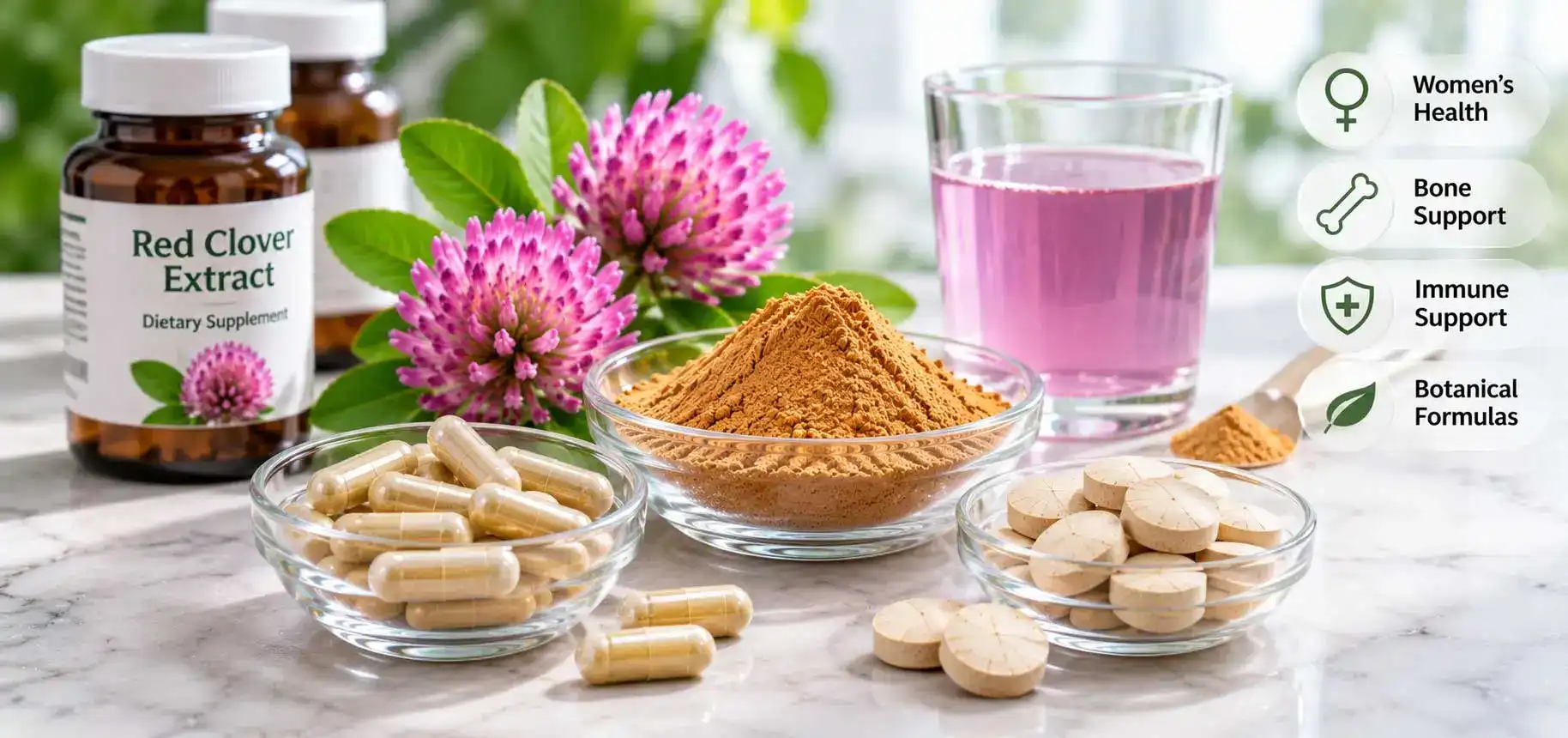
Commercial red clover powder uses include herbal capsules, botanical blends, and other supplement formulations where the ingredient is permitted and technically suitable.
The appropriate ingredient form depends on whether the formulation requires a whole botanical matrix or a defined concentration of extracted constituents.
Red Clover Powder for Supplements: Capsules and Botanical Blends
Red clover powder for supplements may be incorporated into botanical capsules or multi-ingredient formulations.
Because conventional powder retains a broader plant matrix, its physical characteristics can influence processing.
Particle size, bulk density, moisture, and powder flow should be evaluated before production.
Fine powders may require additional attention during blending and capsule filling, while materials with variable bulk density can complicate consistent fill weights.
Manufacturers should conduct representative trials rather than assuming that all milled botanical powders behave similarly.
Red Clover Extract Capsule Formulation and Isoflavone Loading
For red clover extract capsule formulation, the standardized isoflavone percentage influences the theoretical amount of extract required.
Consider a hypothetical formulation target of 40 mg total isoflavones.
|
Extract Grade |
Theoretical Extract Required |
|
8% total isoflavones |
500 mg |
|
20% total isoflavones |
200 mg |
|
40% total isoflavones |
100 mg |
These figures illustrate ingredient loading only. They are not recommended consumption levels and assume comparable assay definitions.
The final capsule composition must also account for excipients, manufacturing losses, blend uniformity, and actual ingredient assay.
Red Clover Extract for Tablets and Powder Supplement Manufacturing
Tablet production introduces additional considerations, including compressibility, particle distribution, moisture sensitivity, and compatibility with binders or other excipients.
A concentrated extract may reduce the amount of botanical ingredient required, but this does not guarantee satisfactory tablet compression.
Similarly, a powder intended for blending should be evaluated for segregation, dusting, and uniformity.
Pilot-scale testing is particularly valuable when changing suppliers or moving between extract grades.
Selecting Red Clover Extract for Supplement Manufacturers
For red clover extract for supplement manufacturers, ingredient selection should begin with the intended finished-product specification.
|
Ingredient Form |
Main Formulation Consideration |
|
Conventional red clover powder |
Broad botanical composition and powder loading |
|
8% standardized extract |
Lower-concentration isoflavone ingredient |
|
20% standardized extract |
Intermediate-concentration ingredient |
|
40% standardized extract |
Higher-concentration ingredient with potentially lower loading |
Manufacturers should select the grade that meets their analytical, processing, and regulatory requirements rather than choosing solely by concentration.
Red Clover Powder vs Standardized Extract: Isoflavone Content and Quality
The commercial value of red clover powder vs extract depends on more than the declared percentage of active constituents.
Manufacturers must consider how the ingredient is produced, how its assay is established, and whether the material consistently meets purchasing specifications.
Red Clover Powder vs Extract: Concentration and Standardization
Ordinary botanical powder contains the milled plant matrix, including constituents that may not be concentrated in an extract.
Standardized extracts undergo additional processing intended to obtain a defined chemical composition.
However, the word extract alone does not guarantee a particular concentration or quality level.
A meaningful specification should identify the botanical source, extraction characteristics where relevant, analytical method, and acceptance criteria.
Red Clover Extract 8%, 20% and 40% Total Isoflavones
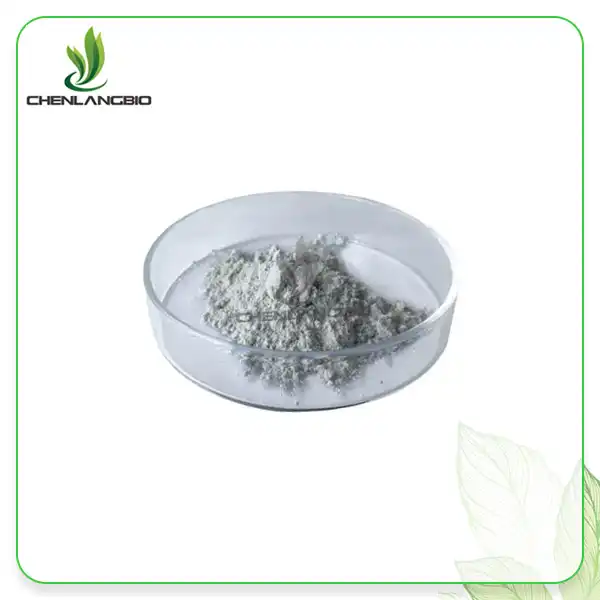
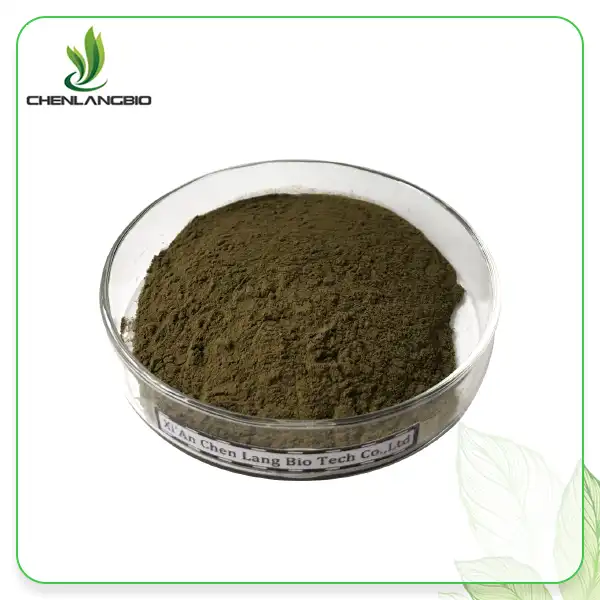
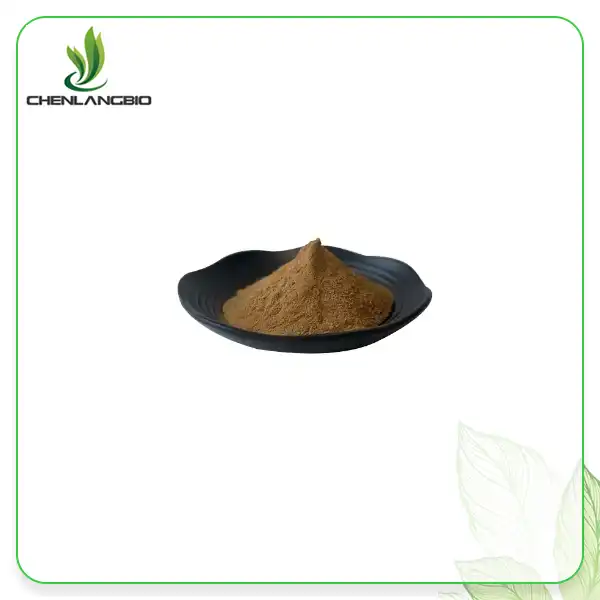
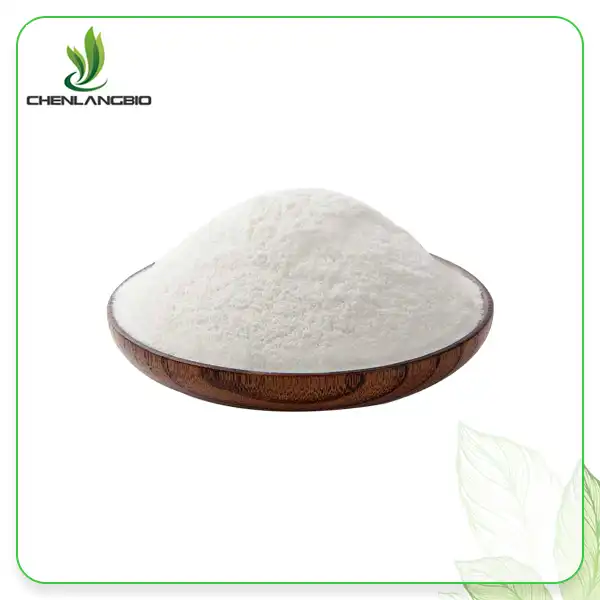
CHEN LANG BIO TECH supplies standardized red clover extract in three total isoflavone grades.
|
Grade |
Standardization |
Main Purchasing Consideration |
|
Red Clover Extract 8% |
8% total isoflavones |
Lower-concentration specification |
|
Red Clover Extract 20% |
20% total isoflavones |
Intermediate-concentration specification |
|
Red clover extract 40% isoflavones |
40% total isoflavones |
Higher-concentration specification |
These percentages describe declared total isoflavone content, not guaranteed individual concentrations of biochanin A or formononetin.
The analytical method and reporting basis should be confirmed before comparing products from different suppliers.
How Red Clover Extract Isoflavone Content Affects Formulation Cost
A higher assay may reduce the quantity of extract needed to reach a specified total isoflavone target.
However, higher-concentration material may also have a different purchase price, processing behavior, or documentation requirement.
For example, a manufacturer comparing 20% and 40% extracts should evaluate the quantity needed for the formulation alongside the quoted price per kilogram.
Testing costs, excipient requirements, manufacturing performance, and freight may also affect the overall commercial decision.
Therefore, the lowest ingredient price per kilogram is not necessarily the lowest cost for the finished formulation.
Choosing Between Red Clover Powder and Standardized Extract
Manufacturers should establish whether their formulation requires a botanical powder or a defined isoflavone assay.
Where ingredient identity and general botanical composition are the primary requirements, conventional powder may be suitable.
Where the finished product requires a specified isoflavone concentration, standardized extract provides a more directly measurable purchasing parameter.
The decision should also account for capsule capacity, batch consistency, processing characteristics, and destination-market requirements.
Red Clover Extract Safety, Side Effects and Regulatory Considerations
Red clover extract safety requires evaluation of the intended ingredient, exposure level, user population, and available evidence.
Natural botanical origin does not establish universal safety.
•Red Clover Powder Side Effects and Safety Considerations
Reported red clover powder side effects and safety concerns should be interpreted in relation to the preparation studied.
Clinical investigations involving red clover preparations have reported adverse events, including gastrointestinal complaints, although their frequency and relationship to the ingredient vary across studies.
Long-term safety evidence remains limited.
Manufacturers should avoid assuming that all botanical powders and concentrated extracts have identical safety profiles.
•Red Clover Isoflavones, Hormone-Sensitive Conditions and Medication Interactions
Because red clover contains biologically active isoflavones, additional caution is appropriate for certain populations.
Pregnancy, breastfeeding, hormone-sensitive conditions, and potential medication interactions require careful consideration.
People taking anticoagulant or other relevant medications should seek qualified medical advice before using red clover supplements.
Ingredient developers should ensure that product labeling and safety assessments reflect the intended consumer population and applicable requirements.
•Red Clover Extract Regulatory Requirements for US and EU Supplements
Regulatory status must be assessed for each destination market.
In the United States, dietary supplement manufacturers must consider applicable ingredient requirements, labeling rules, and dietary supplement current good manufacturing practices.
In the European Union, ingredient classification, novel food considerations where applicable, national restrictions, and permitted health claims require separate review.
A botanical ingredient's commercial availability does not automatically establish regulatory authorization for every intended use or claim.
Red Clover Extract Quality Testing and Supplier Specifications
For commercial purchasing, red clover extract quality specifications should cover identity, chemical composition, relevant contaminants, and batch consistency.
A well-defined specification helps prevent misunderstandings between ingredient suppliers and finished-product manufacturers.
Red Clover Extract HPLC Testing and Total Isoflavone Analysis
Red clover extract HPLC testing is commonly used to characterize and quantify selected isoflavones.
Reliable analysis requires appropriate sample preparation, chromatographic separation, reference standards, and calibration.
Buyers should confirm whether the reported total includes selected individual isoflavones and whether the method measures free compounds, conjugated forms, or an equivalent reporting basis.
Results obtained using different analytical definitions may not be directly comparable.
Red Clover Extract Quality Specifications: Heavy Metals, Pesticides and Microbiology
Relevant quality testing may include heavy metals, pesticide residues, residual solvents, microbiological limits, and moisture.
The appropriate limits depend on the botanical source, extraction process, customer requirements, and applicable regulations.
A higher isoflavone concentration does not compensate for inadequate contaminant control.
Red Clover Extract COA, TDS and SDS for Supplier Qualification
A red clover extract COA should provide batch-specific results against the agreed specification.
The technical data sheet describes relevant product characteristics, while the safety data sheet supports appropriate handling and safety communication.
Our botanical ingredient quality assessment is supported by analytical capabilities including HPLC, GC, and AAS, together with testing programs addressing relevant contaminants.
Documentation should be reviewed before commercial approval, particularly when the material is intended for repeated production.
Red Clover Extract Batch Consistency and Botanical Traceability
Consistent supply depends on controlled raw material sourcing, manufacturing procedures, analytical methods, and batch records.
Manufacturers should establish acceptance criteria before purchasing and evaluate representative samples when qualifying a new supplier.
Where individual isoflavone composition is important, additional testing requirements should be agreed upon in advance.
Bulk Red Clover Extract Powder: Grades, Pricing and Supplier Selection
Purchasing bulk red clover extract powder requires balancing analytical specifications with commercial supply reliability.
The preferred supplier should be able to support both technical qualification and repeat orders.
Choosing a Standardized Red Clover Extract Manufacturer
A qualified standardized red clover extract manufacturer should provide clear information about botanical identity, assay methodology, quality control, and supply capabilities.
Buyers evaluating a red clover extract powder supplier should also review documentation availability and batch consistency.
Red Clover Extract Bulk Price and Wholesale Purchasing
Red clover extract bulk price varies with isoflavone grade, order volume, testing requirements, packaging, and delivery conditions.
For red clover extract powder wholesale purchasing, comparing quotations on an equivalent specification basis is more meaningful than comparing price alone.
Red Clover Extract Samples, MOQ and Bulk Quotations
Before placing an order, request a red clover extract sample for technical evaluation.
Confirm the red clover extract MOQ, packaging options, available documentation, and lead time.
When requesting a red clover extract bulk quotation, provide the required isoflavone grade, estimated quantity, destination country, and any additional testing requirements.
Red Clover Powder FAQ: Benefits, Uses and Ingredient Selection
What Is Red Clover Powder Used For?
What is red clover powder used for? It is primarily used in herbal preparations, botanical capsules, and dietary supplement formulations, subject to applicable regulatory requirements.
Is Red Clover Powder the Same as Red Clover Extract?
No. Conventional red clover powder is generally produced by drying and milling plant material, whereas extract powder undergoes extraction and may be standardized to a specified isoflavone concentration.
Does Red Clover Powder Contain Isoflavones?
Yes. Red clover naturally contains isoflavones, including biochanin A and formononetin. Their concentrations vary with botanical material and processing conditions.
Which Red Clover Extract Grade Is Suitable for Supplements?
The appropriate grade depends on the required total isoflavone concentration, formulation loading, processing characteristics, and product specifications. Manufacturers should evaluate the actual ingredient before selection.
Buy Standardized Red Clover Extract Powder from CHEN LANG BIO TECH
CHEN LANG BIO TECH supplies 8%, 20%, and 40% standardized red clover extract for supplement manufacturers, contract manufacturers, and ingredient distributors.
If you are looking to buy red clover extract powder, contact us to discuss technical specifications, quality documentation, samples, and commercial supply.
Request Red Clover Extract Specifications, Samples and Bulk Pricing
Website: www.chenlangbio.com
References
1. National Center for Complementary and Integrative Health (NCCIH). Red Clover: Usefulness and Safety. U.S. National Institutes of Health.
2. Ghazanfarpour, M., et al. Red Clover for Treatment of Hot Flashes and Menopausal Symptoms: A Systematic Review and Meta-Analysis. Journal of Obstetrics and Gynaecology.
3. EFSA ANS Panel. Risk Assessment for Peri- and Post-Menopausal Women Taking Food Supplements Containing Isolated Isoflavones. EFSA Journal, 2015.
4. World Health Organization. Quality Control Methods for Herbal Materials. WHO, 2011.
5. International Council for Harmonisation. ICH Q2(R2): Validation of Analytical Procedures.
6. U.S. Food and Drug Administration. 21 CFR Part 111: Current Good Manufacturing Practice in Manufacturing, Packaging, Labeling, or Holding Operations for Dietary Supplements.
7. National Center for Biotechnology Information. PubChem Compound Summaries: Biochanin A and Formononetin.

Send Inquiry
Related Industry Knowledge
- How to Read a Red Clover Extract COA: Isoflavones, HPLC and Quality Testing
- How to Choose a Reliable Urolithin A Powder Supplier
- High Purity Sialic Acid Benefits for Skin Hydration and Radiance
- Where to Buy Bulk D-Chiro-Inositol Powder from Reliable Manufacturers in China for Nutritional Supplement Ingredient Sourcing
- The Ultimate Guide to Grape Seed Extract for Anti-Aging
- How to Choose High-Quality Palmitoylethanolamide Powder for Your Brand?
- Do Hops Have Antioxidants
- How Does Dimethylmethoxy Chromanyl Palmitate Work in Skincare
- What is the recommended dosage of 5-HTP?
- Cnidium Monnieri Extract Benefits