
Quaternium-73 for Oily Skin Formulations: Benefits, Use Level and Formulation Considerations
2026-08-31 14:49:08
Quaternium-73 for oily skin is best understood as a low-use-level antimicrobial-functional ingredient rather than a conventional sebum-control active. It can be considered for facial cleansers, lightweight serums, toners, gels and other cosmetics developed for oily or blemish-prone skin, but its role should be defined carefully: Quaternium-73 does not replace the ingredients responsible for cleansing, hydration, sebum management or exfoliation.
For formulators, its unusual combination of very low dosage and poor direct water solubility makes processing as important as ingredient selection. One detailed commercial product data sheet recommends 0.001–0.005%, reports stability at pH 5.5–8.0 and recommends pre-dissolution in butylene glycol, propylene glycol or 1,2-pentanediol. The same documentation identifies facial cleansers and oily-skin care products as intended applications and notes limited photostability. Another commercial TDS gives a broader suggested concentration of 0.001–0.05%, illustrating why the documentation for the exact commercial grade should always take precedence over a generic online dosage.
For R&D and procurement teams, this leads to a more useful question than simply “Is Quaternium-73 good for oily skin?” The practical question is whether its antimicrobial-related role, concentration, incorporation method, pH requirements and compatibility fit the architecture of the product being developed.
What Role Does Quaternium-73 Play in Oily Skin Formulations?
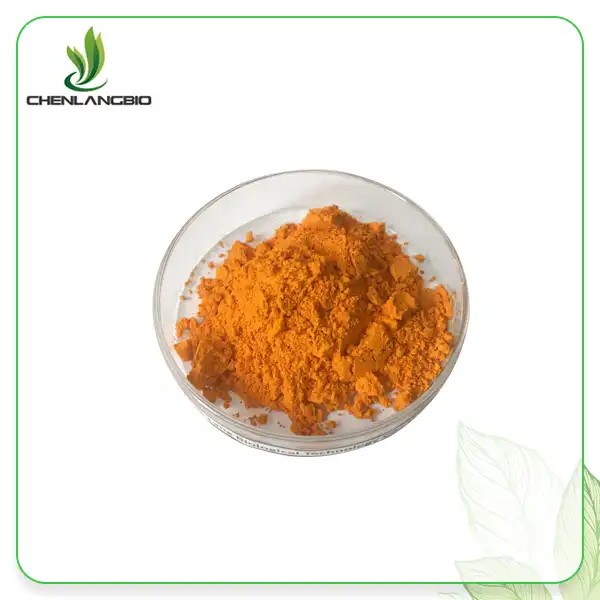
The primary technical rationale for using Quaternium-73 in oily skin formulations is its antimicrobial-related functionality at very low concentrations. Commercial technical literature identifies Quaternium-73 as a thiazolium/quaternary compound, CAS 15763-48-1, typically supplied as a yellowish-to-yellow crystalline powder with HPLC purity specifications of at least 98% for the referenced grade.
That positioning needs to be separated from direct sebum control.
Oily-skin formulation is a multi-variable problem. A developer may need to manage visible shine, cleansing, hydration, sensory feel, follicular buildup and microbial balance at the same time. One ingredient rarely performs all of these jobs. Niacinamide or Zinc PCA, for example, may be selected when the formula specifically requires sebum-management functionality, while surfactants determine cleansing performance and humectants help maintain hydration.
Quaternium-73 antimicrobial activity therefore represents one component of a broader oily-skin strategy. It should not automatically be described as the ingredient that “controls oil” simply because supplier literature recommends it for oil-control skin-care products.
That distinction is important for both formulation accuracy and responsible marketing.
Quaternium-73 Benefits for Oily Skin: What Is Supported and What Should Not Be Overclaimed?
When discussing Quaternium-73 benefits for oily skin, it is useful to separate documented ingredient properties from finished-product marketing claims.
|
Proposed Role |
Appropriate Interpretation |
|
Antimicrobial-related functionality |
Core technical reason for considering Q73 |
|
Very-low-dose functionality |
Supported by commercial formulation guidance |
|
Use in oily/blemish-prone product concepts |
Recognized commercial application |
|
Direct reduction of sebum production |
Should not be assumed without suitable evidence |
|
Reduction of visible shine |
Requires finished-product evidence |
|
Acne treatment |
Not an ordinary cosmetic claim |
This distinction prevents a common formulation-marketing error: moving from “this material has antimicrobial activity” to “this material treats acne and reduces sebum.” Those are not equivalent statements.
Commercial Quaternium-73 documentation contains claims concerning antimicrobial activity and specifically identifies oily-skin products among its applications. Those supplier-generated data are useful when establishing a formulation rationale, but they should not be presented as though they constitute independent clinical proof of every consumer-facing benefit.
For a cosmetic brand, claims such as oil control, reduction in visible shine or improvement in oily-skin appearance should ideally be supported by appropriate finished-product testing rather than inferred solely from the presence of Quaternium-73.
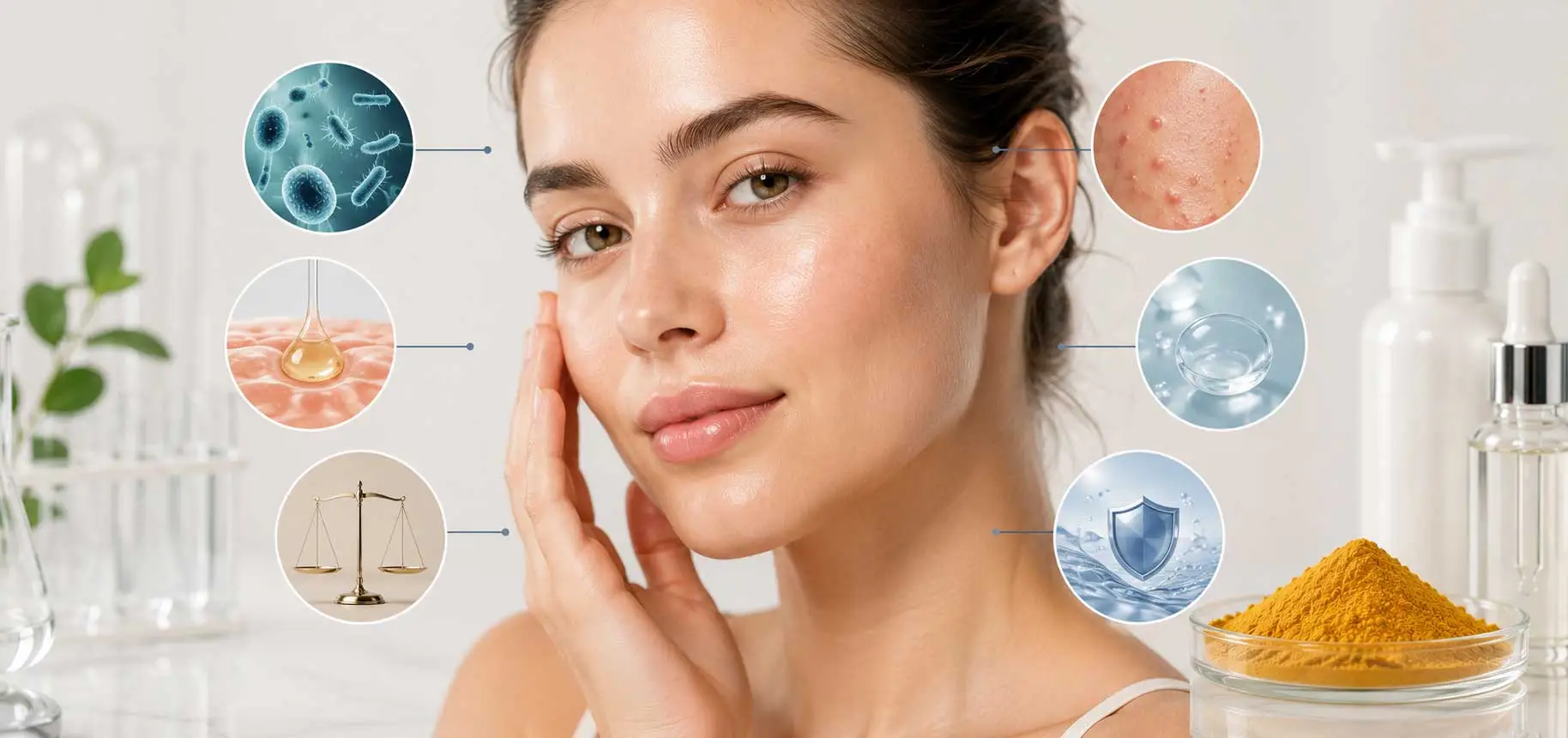
Oily Skin vs Acne-Prone Skin: Why Formulators Should Not Treat Them as the Same Target
An oily skin cosmetic formulation is not automatically an acne formulation.
Sebum production, follicular keratinization, microbial ecology and inflammatory processes are related but distinct variables. A consumer can have oily skin without clinically significant acne, while an acne-prone consumer does not necessarily require an aggressively degreasing formulation.
This distinction changes ingredient selection.
A product developed primarily for visible oiliness may emphasize sebum-management ingredients, lightweight sensorials and appropriate cleansing. A blemish-prone product may additionally consider exfoliating and antimicrobial-related strategies. Hydration and barrier compatibility remain relevant in either case.
This is where Quaternium-73 for blemish-prone skin has a clearer technical role than simply describing it as a “sebum reducer.” It can be evaluated as an antimicrobial-functional component while other ingredients address oil production, hydration and texture.
For ingredient buyers, defining the product objective before requesting samples also makes supplier evaluation more efficient. A quotation for an active is of limited value if R&D has not yet determined what role that active is expected to perform.
What Is the Recommended Quaternium-73 Use Level for Oily Skin Cosmetics?
The Quaternium-73 recommended use level is unusually low compared with many familiar cosmetic actives.
M.C. Biotec's technical documentation recommends 0.001–0.005%, while another commercial TDS specifies a broader suggested range of 0.001–0.05%. These are supplier-specific technical recommendations rather than a universal regulatory concentration applicable to every grade and market.
At the narrower 0.001–0.005% range, the actual quantities are:
|
Batch Size |
0.001% |
0.003% |
0.005% |
|
10 kg |
0.1 g |
0.3 g |
0.5 g |
|
100 kg |
1 g |
3 g |
5 g |
|
500 kg |
5 g |
15 g |
25 g |
This table reveals the real production challenge behind Quaternium-73 dosage in cosmetics. At 0.003%, a 100 kg batch contains only 3 g of raw material. Directly transferring a few grams into a large manufacturing vessel creates obvious opportunities for material loss and nonuniform incorporation.
Balance capability, quantitative transfer and premixing therefore deserve attention during scale-up. A laboratory that produces a 1 kg prototype also needs to recognize that 0.003% represents only 0.03 g. At that scale, weighing capability itself can become a source of experimental error.
The answer to how much Quaternium-73 to use should therefore come from the exact supplier documentation, the formulation objective and validated laboratory work—not from copying the percentage used in an unrelated formula.
Quaternium-73 Solubility: How Should It Be Incorporated Into Oily Skin Formulations?
Quaternium-73 solubility is particularly important because the material is used in tiny quantities but is not readily water-soluble.
The referenced M.C. Biotec PDS describes it as soluble in butylene glycol, propylene glycol, ethanol and 1,2-pentanediol, while estimated water solubility is only 0.6068 mg/L at 25°C. It recommends pre-dissolving Quaternium-73 in butylene glycol, propylene glycol or 1,2-pentanediol before addition to the main formula.
A practical Quaternium-73 premix workflow can therefore be structured as:
accurate weighing → validated solvent premix → complete incorporation → quantitative transfer into the main batch → uniform mixing → final pH and appearance check
This is a process framework, not a universal recipe. Solvent ratio, temperature and addition point need to be validated against the actual formula.
Premixing solves two problems simultaneously. First, it addresses how to dissolve Quaternium-73 when direct water incorporation is inefficient. Second, it converts a micro-dose of raw material into a larger intermediate mass that is easier to transfer and distribute uniformly.
That second function can be just as important at commercial scale as solubility itself.
What pH Works Best for Quaternium-73 in Oily Skin Formulations?
The referenced commercial documentation reports a Quaternium-73 pH range of approximately 5.5–8.0 for the material. It also reports good thermal stability, up to approximately 90°C for that grade.
The 5.5–8.0 figure should not be interpreted as a requirement to formulate every oily-skin product at exactly pH 5.5, nor should it be assumed to apply universally to every commercial grade.
The final Quaternium-73 formulation pH is a property of the complete formulation.
A niacinamide/Zinc PCA serum, for example, presents a different formulation environment from a salicylic-acid system. Likewise, a surfactant cleanser may have rheology and preservation requirements that influence its final pH.
A useful development rule is therefore:
The appropriate pH is the range in which Quaternium-73 and the complete formulation remain stable and perform as intended.
If another essential active requires conditions that fall outside the supplier-supported range for the selected Quaternium-73 grade, R&D should investigate compatibility rather than simply adjusting the formula to satisfy one ingredient.
Quaternium-73 With Niacinamide and Zinc PCA in Oily Skin Serums
Quaternium-73 with niacinamide is an attractive formulation concept because the two ingredients can perform different jobs. Niacinamide is widely used in oily-skin products for broader skin-conditioning and sebum-related formulation objectives, whereas Quaternium-73 contributes a separate antimicrobial-related function.
Zinc PCA is another common component of modern oily-skin formulations. Industry formulation guidance often places Zinc PCA in lightweight serums and toners, frequently alongside niacinamide. However, the zinc salt introduces divalent ions, so rheological behavior deserves attention when electrolyte-sensitive polymers are used.
That becomes relevant when evaluating Quaternium-73 with Zinc PCA. The fact that all three ingredients can appear in oily-skin concepts does not establish universal compatibility in every serum base.
A development team should compare the formula before and after addition for clarity, viscosity, color and precipitation, then repeat those observations during stability testing. The polymer system and total electrolyte load may be more important to physical stability than a simple ingredient compatibility chart suggests.
For Quaternium-73 compatibility with niacinamide, the same principle applies: a plausible shared formulation environment is a starting point for testing, not proof of finished-product compatibility.
Can Quaternium-73 Be Used With Salicylic Acid in Oily Skin Formulations?
Quaternium-73 with salicylic acid requires a more careful assessment because salicylic acid introduces its own solubility and pH constraints.
Salicylic acid is frequently used in products intended for oily or blemish-prone skin, but acid-based systems may operate at a substantially lower pH than the 5.5–8.0 stability range stated in the referenced Quaternium-73 documentation. Some commercial oily-skin formulation guidance, for example, places exfoliating salicylic-acid toner systems around pH 3.5–4.0, depending on concentration, market and regulatory requirements.
That creates an obvious technical question for Quaternium-73 salicylic acid compatibility: can the intended acid system and the selected Quaternium-73 grade share a stable final environment?
It should not be assumed that they can simply because both ingredients are associated with blemish-prone skin.
R&D should examine the actual salicylic-acid solvent/neutralization strategy, final pH, Quaternium-73 incorporation, appearance and long-term stability. Where the intended pH falls outside the technical guidance for the Quaternium-73 grade, the formulation should be reconsidered or supported by appropriate stability data.
Quaternium-73 in Oily Skin Facial Cleansers: What Should Formulators Check?
Quaternium-73 in oily skin cleanser formulations is a commercially recognized application. M.C. Biotec's PDS specifically lists facial cleansers and other cleaning products, as well as oily-skin care products.
The main formulation issue is the surfactant environment.
A modern oily-skin cleanser may contain combinations of anionic, amphoteric and nonionic surfactants together with polymers, humectants, chelators, electrolytes and preservatives. Because Quaternium-73 is an ionic compound, Quaternium-73 surfactant compatibility should be assessed in the complete system rather than inferred from one surfactant in isolation.
After incorporating the premix, R&D should monitor:
•clarity or haze;
•precipitation;
•viscosity;
•foam behavior;
•final pH;
•color;
•accelerated and low-temperature stability.
This is particularly important when the viscosity architecture depends heavily on electrolytes or charged polymers.
For procurement teams supplying a cleanser project, asking the formulator about the intended surfactant system can therefore be more useful than discussing purity alone.
Quaternium-73 in Oily Skin Serums, Toners and Lightweight Gels
A Quaternium-73 oily skin serum presents different technical priorities. Many oily-skin serums are designed to be clear, lightweight and low in residue, so even minor haze or precipitation can become commercially unacceptable.
The low dosage of Quaternium-73 favors serum development from a cost-in-use perspective, while its poor direct water solubility makes the premix strategy important. Multi-active serums also require compatibility evaluation with humectants, niacinamide, zinc salts and the chosen rheology system.
A Quaternium-73 toner formulation places even more emphasis on clarity because low viscosity makes suspended or precipitated material immediately visible. The solvent system and final pH therefore deserve close attention.
In a Quaternium-73 gel formulation, the key issue may shift toward polymer behavior. Electrolyte-sensitive gel networks can lose viscosity when ionic ingredients are introduced, particularly in complex multi-active systems.
These formats illustrate why Quaternium-73 for oily skin cosmetics should not be formulated from a single generic recipe. Serum, toner, gel and cleanser architectures create different technical constraints even when the same raw material concentration is used.
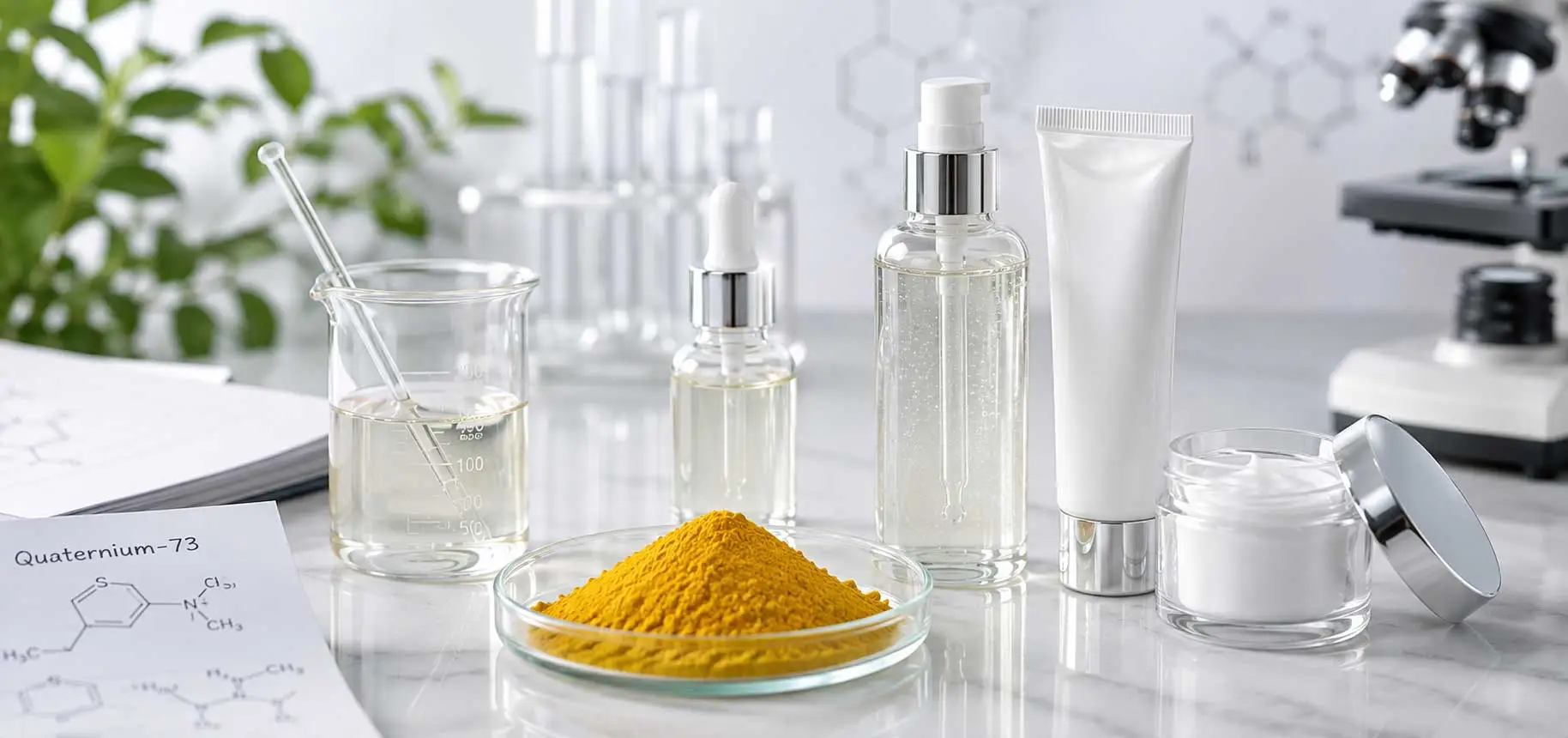
Which Ingredients Can Complement Quaternium-73 in an Oily Skin Formula?
The best ingredients to use with Quaternium-73 depend on what the finished product is actually supposed to achieve.
|
Formulation Objective |
Ingredient Category to Evaluate |
Role of Quaternium-73 |
|
Sebum-management concept |
Niacinamide, Zinc PCA or other validated actives |
Antimicrobial-related component |
|
Blemish-prone serum |
Appropriate multifunctional actives |
Supporting antimicrobial strategy |
|
Exfoliating concept |
Salicylic acid or another suitable exfoliant |
Separate functional role |
|
Hydration |
Glycerin, hyaluronic acid, panthenol |
Does not replace humectants |
|
Daily cleansing |
Mild surfactant architecture |
Functional addition to cleanser |
|
Lightweight gel |
Suitable polymer/humectant system |
Low-dose functional ingredient |
This table also explains what Quaternium-73 should not be expected to do.
It does not replace the humectant system. It does not create a gel network. It does not perform the primary cleansing function of surfactants, and the available technical evidence does not justify treating it automatically as the main sebum-reducing active.
A well-designed oily-skin product gives each ingredient a defined job rather than accumulating multiple ingredients with overlapping marketing stories.
Does Quaternium-73 Replace a Preservative in Oily Skin Cosmetics?
Is Quaternium-73 a preservative? Some supplier technical literature describes preservative or preservative-synergist applications. However, this should not be interpreted as proof that Quaternium-73 can automatically replace a validated broad-spectrum preservation system in every formula.
A water-based cosmetic has to remain adequately protected against relevant bacteria, yeast and mold throughout manufacturing, storage and consumer use. Preservation performance depends on much more than the antimicrobial activity of one ingredient: pH, water activity, packaging, manufacturing hygiene and interactions with the rest of the formulation all matter.
Therefore, a Quaternium-73 preservative system needs to be evaluated at finished-product level.
This distinction is particularly important when comparing Quaternium-73 vs phenoxyethanol or other established preservative ingredients. The appropriate question is not which ingredient sounds more antimicrobial on a supplier brochure, but whether the complete preservation strategy passes the microbiological testing required for the product and target market.
Stability Testing for Quaternium-73 Oily Skin Formulations
Quaternium-73 stability testing should begin with a documented baseline for appearance, color, odor, pH and viscosity.
Clear serums and toners should be examined closely for delayed haze, precipitation or crystallization. Cleansers require additional monitoring of viscosity and phase behavior because surfactant/electrolyte systems can shift during storage. Gels should be checked for polymer-network changes after ionic ingredients are introduced.
Light stability deserves specific attention. The referenced PDS describes Quaternium-73 as photounstable and recommends opaque containers for finished products containing it.
Accordingly, a Quaternium-73 formulation stability program should consider the proposed commercial package rather than evaluating the bulk formula only in laboratory glassware.
Where analytical capability is available, HPLC assay at selected stability intervals provides information that appearance alone cannot. Microbiological testing should be treated as a separate endpoint because physical and chemical stability do not demonstrate adequate preservation.
How to Choose the Right Product Format for Quaternium-73 Oily Skin Formulations
There is no single best Quaternium-73 formulation for oily skin.
|
Product Objective |
Format Worth Evaluating |
|
Daily rinse-off cleansing |
Facial cleanser |
|
Lightweight multi-active care |
Serum |
|
Low-viscosity refreshing concept |
Toner |
|
Oil-free/light sensory profile |
Gel |
|
Acid/exfoliating concept |
Requires separate pH and compatibility assessment |
In a Quaternium-73 cleanser vs serum decision, the cleanser places more emphasis on surfactant compatibility and rheology, while the serum places more emphasis on clarity, multi-active compatibility and prolonged stability.
Toners demand excellent clarity, whereas gels introduce polymer/electrolyte considerations.
Product format should therefore follow the intended finished-product function and sensory profile. Quaternium-73 should fit into that architecture rather than dictate it.
What Should Buyers Check When Sourcing Cosmetic Grade Quaternium-73?
A Quaternium-73 supplier should be evaluated on more than assay and price.
For cosmetic grade Quaternium-73, procurement should request the current specification and a representative batch COA. The referenced commercial grades specify CAS 15763-48-1, yellowish-to-yellow crystalline appearance and HPLC purity of at least 98%.
A useful qualification package should also include the TDS and SDS, together with information on recommended use level, solvent guidance, pH stability, storage conditions and shelf life. Because commercial technical recommendations differ between suppliers, these documents should correspond to the actual Quaternium-73 raw material being offered rather than a generic industry document.
A representative sample is particularly valuable. The correct sequence is:
documentation review → sample qualification → bench formulation → stability evaluation → supplier approval → commercial purchase
For formulation projects, CHEN LANG BIO TECH can provide current specifications, batch documentation and representative Quaternium-73 samples so that R&D teams can evaluate the material in the intended oily-skin formulation before scale-up.
Quaternium-73 Sample, MOQ and Price: What Matters for Bulk Buyers?
The extremely low use level changes the economics of sourcing.
At 0.003%, a 100 kg formula consumes only 3 g of Quaternium-73. For that reason, Quaternium-73 price per kg should not be considered independently from dosage.
The more useful calculation for procurement is cost per finished batch. A difference in Quaternium-73 price that looks substantial on a kilogram basis may become relatively small when only a few grams are consumed per 100 kg of finished cosmetic.
During R&D, a Quaternium-73 sample can support numerous bench trials. Before discussing a commercial Quaternium-73 MOQ, buyers should estimate annual consumption from the proposed use level, production batch size and annual number of batches. Shelf life and inventory turnover should then be considered alongside the purchase quantity.
For companies planning to buy Quaternium-73, consistent assay, technical documentation, formulation performance and reliable batch supply can therefore matter more than simply choosing the lowest kilogram quotation.
FAQ: Quaternium-73 for Oily Skin Formulations
Is Quaternium-73 suitable for oily skin formulations?
Yes. Commercial technical documentation specifically identifies oily-skin care products as an application. Quaternium-73 for oily skin is most appropriately considered for its low-dose antimicrobial-related functionality rather than assumed to perform every aspect of oil control.
Does Quaternium-73 reduce sebum?
It should not automatically be described as a direct sebum-reducing active. Supplier literature positions it in oil-control products, but that does not by itself establish a direct sebum-reduction claim. Finished-product oil-control claims should be supported by suitable evidence.
What is the recommended Quaternium-73 use level?
One commercial PDS recommends 0.001–0.005%, while another TDS gives a wider 0.001–0.05% range. The Quaternium-73 recommended use level should therefore follow the technical documentation for the exact grade being qualified.
What pH is suitable for Quaternium-73?
The referenced commercial grades report stability at approximately pH 5.5–8.0. The finished formulation must nevertheless be optimized around Quaternium-73 and all other ingredients in the complete system.
Can Quaternium-73 be used with niacinamide and Zinc PCA?
They can be investigated in the same oily-skin formulation, but public evidence does not justify claiming universal compatibility. Quaternium-73 with niacinamide and Zinc PCA should be evaluated for pH, clarity, rheology, ionic effects and long-term stability in the actual formula.
Can Quaternium-73 be used with salicylic acid?
Potential co-use requires particular attention to pH because many salicylic-acid systems operate under more acidic conditions than the pH 5.5–8.0 guidance reported for the referenced Quaternium-73 grades. Quaternium-73 salicylic acid compatibility should therefore be demonstrated experimentally rather than assumed.
Is Quaternium-73 better in a cleanser or serum for oily skin?
Neither format is universally better. Cleansers require careful surfactant and viscosity evaluation, while serums emphasize clarity, active compatibility and leave-on stability. The product objective should determine the format.
Where Quaternium-73 Fits in a Modern Oily Skin Formulation
Quaternium-73 for oily skin makes the most technical sense when it is assigned a specific role within a broader formulation rather than promoted as an all-purpose oil-control ingredient. Its antimicrobial-related functionality, very low use level and applicability to both rinse-off and leave-on formats make it interesting for oily and blemish-prone cosmetic concepts, while its limited water solubility, grade-specific pH guidance and photostability require deliberate formulation work.
For procurement teams, supplier qualification should therefore connect directly with R&D: review the specification and technical documents, test representative material in the actual formula, complete stability work, and only then move to commercial purchasing.
For the current Quaternium-73 specification, COA, TDS or sample for formulation evaluation, contact CHEN LANG BIO TECH at admin@chenlangbio.com.
References
1. M.C. Biotec Inc. Quaternium-73 Product Data Sheet. Commercial technical documentation reporting a recommended dosage of 0.001–0.005%, pH stability of 5.5–8.0, thermal stability up to approximately 90°C, estimated water solubility of 0.6068 mg/L at 25°C, solubility in selected glycols and ethanol, premixing guidance, photostability limitations and applications including facial cleansers and oily-skin care products.
2. ZLEY Quaternium-73 Technical Data Sheet. Identifies Quaternium-73 as CAS 15763-48-1 and a yellowish-to-yellow crystalline powder with HPLC purity ≥98%. The document gives a suggested concentration of 0.001–0.05%, recommends pre-dissolution and reports stability at pH 5.5–8.0. These data are commercial technical guidance and should be interpreted accordingly.
3. M.C. Biotec. Quaternium-73 Technical Product Information. Provides commercial formulation, safety, solubility and application information for Quaternium-73, including oily-skin care positioning.
4. Aladdin Scientific. Niacinamide Brightening Mechanisms and Formulation Design. Includes formulation discussion of niacinamide and Zinc PCA and notes the potential effect of divalent zinc ions on rheological networks, relevant when designing multi-active oily-skin systems.
5. Oily Skin Skincare Formulation Guide. Industry formulation resource covering oily-skin product architecture, including niacinamide, Zinc PCA, salicylic-acid systems, mild surfactants, lightweight formats and finished-product testing. Concentrations and pH values described in such commercial formulation guidance should be validated against regional regulation and the actual formulation.

Send Inquiry
Related Industry Knowledge
- Nitenpyram Mode of Action: How This Insecticide Kills Pests
- Safety and Quality Considerations of Pyrroloquinoline Quinone (PQQ)
- Is Ajuga turkestanica the Same as Turkesterone?
- How Does Serrapeptase Powder Ensure Superior Enzyme Stability?
- Is Cactus Extract Good for Hair?
- Kola Nut Extract Powder for Weight Management
- Top Water Soluble Coenzyme Q10 Products in 2024
- How Long Does Sildenafil Powder Last? Effects and Duration
- How Long Does It Take to See Results with Bakuchiol
- Is Hesperidin the Same as Diosmin Powder