NAD Powder for Supplements: Formulation and Stability Considerations
2026-08-17 10:53:08
Formulating NAD powder for supplements requires more than selecting a high-purity raw material and adding it to a capsule or tablet formula. NAD⁺ is a chemically defined coenzyme—PubChem lists the molecular formula as C₂₁H₂₇N₇O₁₄P₂ and molecular weight as 663.4 g/mol—but its performance in a commercial supplement depends on the environment created by the complete formulation.
For product developers, the central issue is therefore not simply whether the incoming NAD+ powder meets specification. Dosage form, moisture exposure, temperature, pH in aqueous systems, excipients, processing time, analytical methodology and packaging can all influence what happens after the ingredient leaves its original container. Published stability studies reinforce this point: NAD⁺ degradation can change substantially with temperature and solution environment, while dry-state formulation can behave very differently from NAD⁺ in solution.
A commercially sound NAD supplement formulation should consequently connect raw-material qualification with formulation-specific testing and finished-product stability work.
NAD Powder Formulation: What Should Supplement Manufacturers Evaluate First?
A practical NAD powder formulation program begins by defining the finished product and then working backward to the raw-material requirements. This avoids a common development mistake: selecting an ingredient because its specification looks attractive and only later determining whether it works in the intended dosage form.
For most projects, the initial assessment should cover the following areas:
|
Formulation Factor |
What the Development Team Should Evaluate |
|
Ingredient identity |
Confirm that the material is the intended NAD⁺ form |
|
Specification |
Review assay/purity, identity and relevant impurity controls |
|
Dosage form |
Determine the processing environment the ingredient will encounter |
|
Solubility |
Evaluate where dissolution or dispersion is important |
|
Moisture and pH |
Consider the local chemical environment of the finished formula |
|
Excipients |
Assess their impact on moisture, flow, processing and stability |
|
Manufacturing process |
Review heat, compression, hold time and environmental exposure |
|
Packaging |
Match barrier properties to the stability needs of the finished product |
This framework is more useful than treating NAD powder formulation considerations as a list of isolated raw-material characteristics. A specification tells a manufacturer what the incoming ingredient is expected to meet; it does not establish how NAD⁺ will behave after blending, compression, encapsulation or extended finished-product storage.
That distinction—raw-material quality versus finished-product performance—is one of the most important concepts in NAD supplement manufacturing.
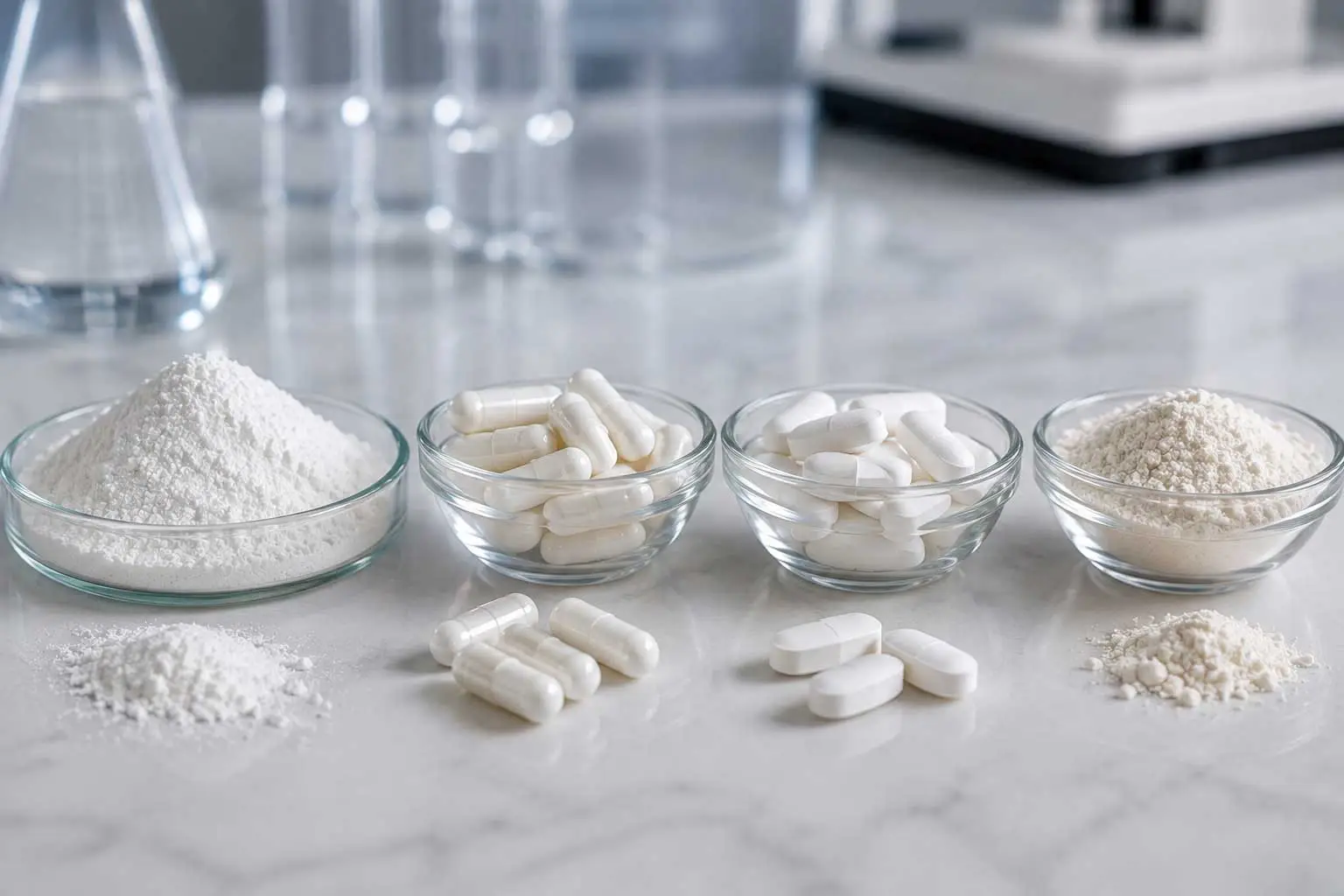
NAD⁺ Powder Specifications for Supplement Formulation
A commercial formulation should start with an adequately characterized raw material. However, procurement teams should resist reducing NAD powder specification review to a single purity number.
Why NAD Powder Purity Alone Is Not Enough
A supplier may offer high purity NAD powder with an assay or chromatographic purity result above a specified threshold, but that number needs context. Buyers should understand whether the value represents assay, HPLC area percentage or another analytical measurement and whether identity has been independently confirmed.
Depending on the grade and intended application, a complete specification may also address related substances, water or moisture, residual solvents where relevant, heavy metals and microbiological limits. The appropriate test panel depends on the material, production process and buyer's quality requirements.
This is particularly important when comparing several potential suppliers. Two products displaying the same NAD powder purity on a sales page are not necessarily equivalent if their analytical methods, impurity controls or batch-release standards differ.
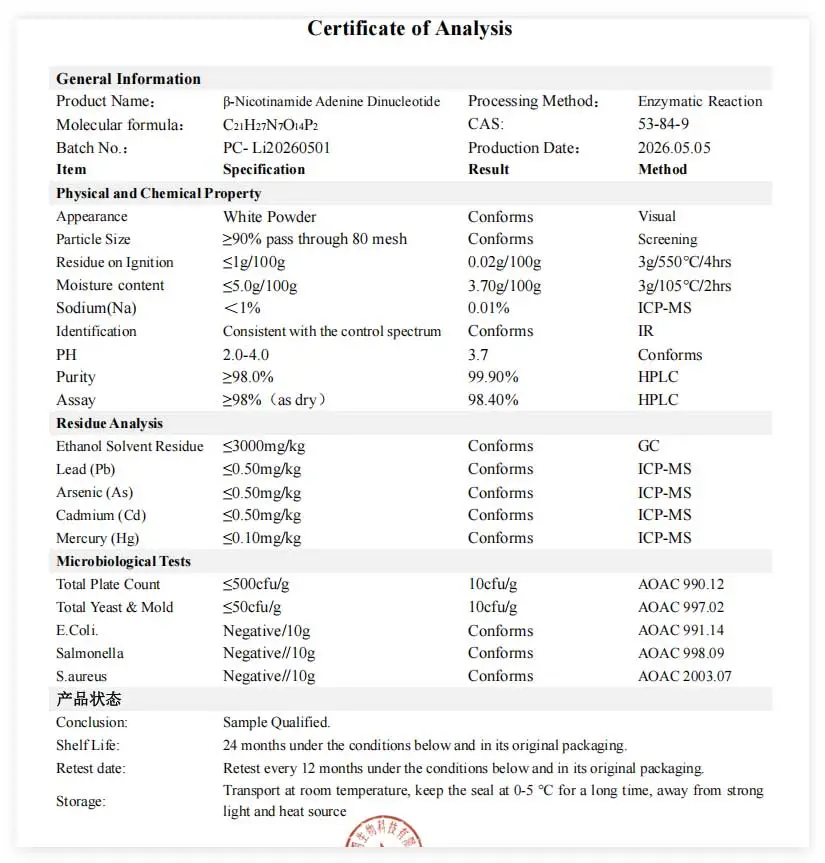
What Should Be Reviewed on an NAD Powder COA?
An NAD powder COA should be linked to an identifiable lot and show the actual results for that batch rather than only generic acceptance criteria. Buyers should review the product identity, lot number, specification limits, reported results and analytical methods or references where provided.
The distinction is straightforward:
The specification defines what the ingredient must meet; the COA reports what a particular batch actually tested.
For commercial sourcing, representative documents are useful during initial qualification, but incoming material should ultimately be supported by documentation corresponding to the supplied batch. Where a brand's quality system requires additional confirmation, independent NAD powder testing can be incorporated into supplier qualification or incoming QC.
NAD Powder for Capsules, Tablets and Powder Blends: Which Dosage Form Is Suitable?
There is no single dosage form that can be declared universally optimal for NAD⁺. The practical question is how the selected format changes the environment around the active ingredient.
|
Dosage Form |
Main Formulation Issues |
|
Capsules |
Flow, fill uniformity, excipients, moisture and capsule environment |
|
Tablets |
Compression, binders, lubricants, processing stress and moisture |
|
Powder blends |
Blend uniformity, segregation, hygroscopic ingredients and pack protection |
|
Aqueous/liquid systems |
Solubility, pH, water exposure and formulation-specific stability |
NAD Powder for Capsules
NAD powder for capsules can appear operationally straightforward because the manufacturing process may involve fewer unit operations than tableting. That does not remove the need for formulation work.
The blend still needs adequate flow for consistent filling, and the formulation must achieve acceptable content uniformity at the intended fill weight. Excipients used to improve flow, bulk density or manufacturing performance also change the microenvironment surrounding NAD⁺. Moisture introduced by other ingredients, storage conditions or the capsule system should be considered during development.
A robust NAD capsule formulation should therefore be evaluated as a complete blend rather than as pure NAD⁺ powder placed into an empty capsule.
NAD Powder for Tablets
Using NAD powder for tablets introduces additional variables. Tablet manufacturing can involve blending, granulation where applicable, lubrication and compression, each of which may alter physical or chemical conditions experienced by the ingredient.
Compression itself does not automatically make a tablet unsuitable, but formulators need to assess the actual process. Binders, fillers and lubricants can affect moisture, flow and local chemical conditions, while process steps that introduce water or heat deserve particular attention.
For an NAD tablet formulation, the appropriate question is whether NAD⁺ remains within the finished-product specification after manufacturing and throughout the proposed shelf life, not merely whether the starting powder passed incoming QC.
NAD Powder in Powder Blends and Other Formats
Dry blends may avoid compression but introduce different issues, particularly blend uniformity and segregation. Particle-size differences between NAD powder and other ingredients can influence distribution, while hygroscopic components may alter the moisture environment during storage.
Liquid or water-containing products require a substantially different assessment. NAD⁺ is a hydrophilic cofactor, but the fact that a material can enter aqueous solution does not establish that it will remain chemically stable in a particular beverage or liquid supplement. pH, buffer composition, temperature and storage duration must be considered together.
NAD Powder Stability: What Can Affect NAD⁺ in a Supplement Formulation?
NAD powder stability should be evaluated under the conditions the ingredient will actually encounter. Data generated for sealed raw material cannot automatically be used to establish the shelf life of a capsule, tablet or multi-ingredient powder.
Published work illustrates why. A 2024 study examining nicotinamide cofactors in aqueous buffers for up to 43 days found that stability depended strongly on both the buffer system and temperature. In Tris buffer, the authors reported that more than 90% of NADH remained after 43 days at 19°C and about 75% at 25°C, while higher degradation rates were observed in phosphate and HEPES systems. The study included both NAD⁺ and NADH and demonstrates an important formulation principle: seemingly modest changes in environment can materially change cofactor stability.
How Temperature and Processing Conditions Can Affect NAD Powder Stability
Temperature should be treated as a formulation variable rather than an isolated storage number. Research on NAD⁺ has demonstrated thermal degradation under elevated-temperature conditions, and a study examining free NAD⁺ in solution at 37°C reported a half-life of 34.5 hours under the specific experimental conditions used. The same study was investigating stabilization strategies rather than supplements, so the figure should not be transferred directly to a finished-product shelf-life calculation. It does, however, show why temperature exposure deserves attention during formulation and processing.
For supplement manufacturers, this means assessing whether production involves heating, prolonged warm hold periods or other unnecessary thermal exposure. The significance of those conditions should then be confirmed experimentally in the actual formulation.
Moisture and Humidity in NAD Supplement Formulations
Moisture deserves similar attention. Even where a commercial NAD+ powder is supplied as a dry material, incorporation into a blend with hygroscopic ingredients can alter the environment experienced during storage.
Relative humidity during manufacturing, repeated opening of raw-material containers, water-containing processing steps and the moisture-barrier performance of the final package can all become relevant.
This is one reason why formulation work should consider water activity and moisture management across the complete system rather than treating NAD powder storage conditions as a warehouse issue alone.
Why Raw Material Shelf Life Does Not Equal Finished Product Shelf Life
A supplier's raw-material shelf life normally applies to a defined ingredient in specified packaging under stated storage conditions. Once NAD⁺ is blended with other materials and transferred to a different package, that system has changed.
A useful illustration comes from an HPLC stability study in which NAD formulated in commercial dry test strips retained more than 80% of its initial level after three months at 50°C under the conditions studied. The result is not evidence that an NAD supplement will perform the same way; rather, it demonstrates how a dry formulated matrix can produce stability behavior specific to that formulation.
A finished NAD supplement shelf life should therefore be supported by data generated on the finished formulation.
NAD Powder Solubility and pH: What Formulators Should Consider
Does NAD Powder Dissolve in Water?
NAD⁺ is described in the scientific literature as a hydrophilic cofactor, and aqueous systems are widely used in laboratory studies of the molecule. However, the practical question behind is NAD powder water soluble is usually not whether pure NAD⁺ can enter solution—it is whether it behaves acceptably at the required concentration in the intended commercial formula.
The answer can depend on concentration, pH, temperature, ionic composition and the presence of other dissolved ingredients. In a multi-component system, precipitation, degradation or other changes cannot be ruled out simply because the isolated raw material dissolves in water.
Consequently, NAD powder solubility data should be treated as an input to formulation work, not as proof of finished-product compatibility.
Why pH Matters in NAD⁺ Formulation Development
The importance of pH becomes clearer in aqueous environments. Published cofactor stability studies have shown that buffer composition and pH can affect degradation behavior, although the magnitude and mechanism vary with the particular NAD form and experimental system.
For an NAD liquid formulation, formulators should therefore establish the actual pH of the finished system and evaluate NAD⁺ over the intended storage period. Selecting a theoretical “best pH” from unrelated laboratory experiments is much less useful than generating stability data on the commercial formulation.
NAD Powder Excipient Compatibility in Supplement Formulations
Excipients are not chemically irrelevant space fillers. They determine flow, compression behavior, water activity and the local environment surrounding the active ingredient, which makes NAD powder excipient compatibility a legitimate formulation question.
What Excipients May Need to Be Evaluated with NAD⁺?
Depending on the dosage form, an NAD formulation may contain fillers, binders, flow aids, lubricants, capsule materials, flavor systems or other active ingredients. There is no justification for declaring an entire excipient category compatible or incompatible with NAD⁺ without formulation-specific data.
The better approach is to select excipients for a defined technical purpose and then test the resulting combination. For example, a flow aid may improve encapsulation performance but does not answer whether the full blend remains stable over time.
Why Multi-Ingredient NAD Formulas Need Compatibility Testing
The issue becomes more important with an NAD multi-ingredient formulation containing vitamins, minerals, botanical extracts or other active materials.
Each ingredient may have satisfactory individual stability while still changing the finished mixture through moisture uptake, pH effects or interactions within the package. Therefore, documentation from individual raw-material suppliers cannot replace testing of the combined formula.
The objective is not necessarily to identify a direct chemical reaction between every pair of ingredients. It is to determine whether the entire formulation continues to meet its specification during the proposed shelf life.
NAD Supplement Manufacturing: Processing Conditions and Scale-Up Considerations
Successful laboratory work still needs to survive commercial scale-up.
A bench-top NAD powder formulation may involve short mixing times and limited environmental exposure, whereas commercial NAD supplement production can involve larger equipment, longer transfer times, different shear conditions and substantially longer periods between weighing and final packaging.
From Laboratory Formulation to Commercial Production
Scale can influence blend uniformity, hold time, equipment contact and exposure to temperature or humidity. A process that works with a 500 g development blend therefore cannot simply be assumed to behave identically when production increases by orders of magnitude.
Manufacturers should identify which process variables could affect the ingredient and monitor them during scale-up. These may include mixing sequence, blending time, compression or filling parameters, intermediate hold periods and time before final sealing.
Why Pilot Batches Matter Before Full-Scale NAD Production
A sensible NAD formulation scale-up pathway moves through representative stages:
raw-material sample → bench formulation → pilot batch → analytical evaluation → stability program → commercial production
The pilot stage provides an opportunity to verify whether the process can deliver acceptable content uniformity and finished-product quality under conditions closer to normal manufacturing.
This is usually more informative than moving directly from a supplier sample to a full commercial batch.
NAD Powder Testing: How to Verify Quality During Formulation and Production
Quality control should follow the ingredient through the development process rather than ending when the raw material is approved.
Incoming NAD Raw Material Testing
Incoming NAD powder testing may include identity confirmation, assay or purity verification and contaminant testing according to the buyer's specification and quality system. HPLC is frequently used in analytical work involving NAD⁺; published research has also demonstrated validated RP-HPLC approaches capable of separating NAD from degradation products such as ADP-ribose and nicotinamide.
An NAD powder HPLC result is still meaningful only in the context of the method. Buyers should understand what is being measured and avoid assuming that an HPLC area percentage is automatically equivalent to assay.
Finished-Product Testing for NAD Supplement Formulations
Finished-product analysis can be more difficult because the analytical matrix is more complex. Fillers, botanicals, vitamins and other actives may introduce peaks, extraction challenges or other interference that does not exist when isolated NAD⁺ powder is tested.
For that reason, a method suitable for raw NAD assay testing may require additional development or validation before it is suitable for a finished supplement.
Depending on dosage form and quality program, NAD supplement testing may also include content uniformity, relevant microbiological testing and stability-indicating analysis over time.
NAD Supplement Packaging and Shelf-Life Considerations
Packaging is part of the formulation strategy because it determines the environment experienced by the finished product after manufacturing.
How Packaging Can Support NAD Product Stability
A suitable NAD supplement packaging system may need to manage moisture, oxygen or light exposure depending on the actual formulation and supporting stability data. Container closure integrity and the barrier characteristics of the package should therefore be considered alongside the ingredient specification.
A desiccant or higher-barrier package may be appropriate for some formulations, but it should not be presented as a universal requirement. Packaging choices should be justified by the product's demonstrated stability needs.
Accelerated vs Real-Time Stability Testing
Accelerated studies can provide useful early information and help identify formulations that are unlikely to be commercially viable. They do not automatically replace real-time data under intended storage conditions.
Published NAD stability work has repeatedly shown that temperature and the surrounding matrix influence degradation behavior. For that reason, establishing a credible NAD supplement shelf life requires a stability program designed around the finished product and its proposed packaging.
How to Choose NAD Powder for Commercial Supplement Formulation
Choosing NAD powder for supplement manufacturing should follow a technical sequence rather than start with price.
First, confirm the exact ingredient identity and current specification. Then review how purity or assay is measured, what impurity and contaminant controls are applied, and whether the documentation meets the requirements of the intended project. Storage and shelf-life information should be reviewed alongside the actual dosage form being developed.
Once the paperwork appears suitable, the next step is usually physical evaluation.
Why NAD Powder Samples Should Be Tested Before Bulk Purchasing
An NAD powder sample is most useful when the formulation team already knows what it intends to evaluate. Depending on the project, sample work may cover incoming identity or assay verification, blending characteristics, excipient compatibility, processing behavior and preliminary stability.
This produces a more informative purchasing path:
specification review → representative COA → sample testing → formulation trial → pilot batch → stability evaluation → supplier approval → commercial order
For brands developing a new product, this approach is more defensible than choosing high purity NAD powder on the basis of a specification sheet alone.
Choosing an NAD Powder Supplier for Commercial Supplement Production
Once the formulation has moved beyond initial development, supplier capability becomes part of the technical decision.
A qualified NAD powder supplier should be able to provide enough information for the buyer to understand what material is being offered, how it is specified and how commercial batches will be documented. Depending on the project, this can include the current specification, representative and batch-specific COAs, analytical information, storage guidance, shelf-life information and appropriate supporting documentation.
What Supplement Brands Should Ask an NAD Powder Supplier
Commercial discussions with an NAD supplement ingredient supplier should also address practical supply questions: sample availability, standard packaging, MOQ, lead time, batch consistency and the ability to support recurring demand.
When comparing an NAD powder manufacturer or NAD raw material supplier, procurement teams should therefore evaluate technical suitability before making a price-per-kilogram comparison. The least expensive material is not necessarily the lowest-cost choice if additional testing, reformulation or supply disruption follows.
From Formulation Sample to Bulk NAD Powder Order
Brands planning to buy NAD powder in bulk should ideally complete formulation qualification before committing to substantial inventory.
Commercial terms such as NAD powder MOQ, packaging and lead time can then be evaluated against the expected production schedule. Likewise, an NAD powder price or NAD powder quotation becomes more meaningful when the supplier knows the required quantity, specification, destination and any special documentation or packaging requirements.
At CHEN LANG BIO TECH, we prefer to discuss those details after understanding the formulation project. For a new development, providing the intended dosage form, approximate commercial volume and destination market makes it easier to supply technical documents and sample information that are relevant to the actual application rather than sending a generic offer for bulk NAD powder.
FAQ About NAD Powder Formulation for Supplements
Is NAD powder suitable for supplement formulations?
NAD powder for supplements can be evaluated for commercial formulation where the ingredient and intended use are appropriate, but suitability should be demonstrated in the actual dosage form. Raw-material purity alone does not establish compatibility, processing performance or finished-product stability.
Is NAD powder suitable for capsules or tablets?
Both NAD powder for capsules and NAD powder for tablets can be investigated during product development, but the technical environments differ. Capsules require attention to flow, content uniformity, excipients and moisture, while tablets introduce additional considerations such as compression, binders, lubricants and any processing steps used before tableting.
Is NAD powder water soluble?
NAD⁺ is a hydrophilic cofactor and is routinely studied in aqueous systems. However, NAD powder solubility in isolation does not establish performance in a finished liquid formulation. Concentration, pH, other dissolved ingredients, temperature and storage time all need to be assessed.
What affects NAD powder stability in a finished supplement?
NAD powder stability can be influenced by temperature, moisture, solution environment where applicable, excipients, processing conditions, packaging and storage duration. Published research demonstrates that NAD-cofactor stability changes with buffer composition and temperature, supporting the need for formulation-specific stability testing.
How should supplement brands evaluate NAD powder quality?
Brands should review NAD powder purity together with identity, assay methodology, relevant impurity and contaminant limits, storage information and batch documentation. An NAD powder COA should correspond to the supplied batch, while the specification should define the acceptance criteria used during supplier and incoming-material qualification.
Should manufacturers test an NAD powder sample before a bulk order?
Yes. A representative NAD powder sample gives the formulation team an opportunity to verify the material, conduct compatibility and processing work, and begin preliminary stability assessment before a bulk NAD powder order is placed. Sample testing is particularly useful when qualifying a new supplier or developing a new dosage form.
Building a Stable and Commercially Viable NAD Supplement Formulation
A commercially viable NAD supplement formulation begins with qualified raw material, but it cannot be developed from a raw-material specification alone. Dosage form, moisture, temperature, pH where relevant, excipients, manufacturing conditions, analytical methodology and packaging collectively determine the environment in which NAD⁺ must remain within specification.
For this reason, brands should connect supplier qualification with formulation trials, pilot-scale manufacturing and finished-product stability work before moving to recurring commercial orders. Companies evaluating NAD⁺ for a new project can contact CHEN LANG BIO TECH Email: admin@chenlangbio.com for current specifications, representative quality documentation and sample information. Sharing the intended dosage form, expected volume and destination market at the beginning of the discussion allows our team to provide information relevant to the actual formulation and supply requirements rather than a generic quotation.
References
1. National Center for Biotechnology Information. PubChem Compound Summary for CID 5892, Nadide (NAD). Molecular formula C₂₁H₂₇N₇O₁₄P₂; molecular weight 663.4 g/mol.
2. Arenas Jal M, Suñé Negre JM. Therapeutic potential of nicotinamide adenine dinucleotide (NAD). European Journal of Pharmacology. 2020;879:173158. doi:10.1016/j.ejphar.2020.173158.
3. Rover L Jr, Fernandes JCB, de Oliveira Neto G, et al. Study of NADH Stability Using Ultraviolet–Visible Spectrophotometric Analysis and Factorial Design. Analytical Biochemistry. 1998;260(1):50–55. doi:10.1006/abio.1998.2656.
4. Long-Term Stability of Nicotinamide Cofactors in Common Aqueous Buffers: Implications for Cell-Free Biocatalysis. Study of NAD⁺ and NADH stability in phosphate, HEPES and Tris buffers at 19°C and 25°C for up to 43 days.
5. Development and Validation of a HPLC Method for NAD: Application to Stability Studies in Buffered Solutions and Dry Test Strips. Journal of Liquid Chromatography & Related Technologies. 2009;32(19). doi:10.1080/10826070903288680.
6. McDonough R, Williams CC, Hartley CJ, et al. Enhanced Thermal Stability of NADH/NAD+ through Tethering to Silica Nanoparticles. ACS Synthetic Biology. 2025;14(6):2368–2374. doi:10.1021/acssynbio.5c00348.

Send Inquiry
Related Industry Knowledge
- Ergothioneine vs CoQ10: Which Ingredient Works Better for Supplement Formulators?
- Chondroitin Sulfate Raw Material for Supplements & Skincare: Supplier, Specifications & Bulk Supply Guide
- What Is Liposomal Glutathione Used to Treat?
- What is the Internal Version of Dimethylmethoxy Chromanol
- What is Phellinus Linteus Extract
- Who Should Avoid Hops
- Should I Take Alpha-GPC Day or Night
- What is 4-Hexylresorcinol Used for
- What Should I Pay Attention to When Using Alpha Arbutin
- when Should I Take Marigold Extract Powder Lutein Morning or Night