
How to Read a Mangiferin COA: HPLC Assay and Quality Checks
November 25, 2026
A Mangiferin COA is one of the most important documents buyers should review before approving a botanical extract for commercial use. However, a certificate showing 90% or 95% mangiferin does not automatically establish that the material meets the buyer's quality requirements. The analytical method, batch identification, reporting basis, and relevant contaminant testing all influence how the results should be interpreted.
For purchasing managers, quality assurance teams, and formulation manufacturers, reviewing a Mangiferin Powder COA requires more than checking the declared purity. A reliable Mangiferin Certificate of Analysis should connect a specific production batch with verifiable analytical results and clearly defined acceptance criteria.
This guide explains how to interpret mangiferin HPLC data, evaluate botanical extract quality, compare production batches, and qualify suppliers before placing commercial orders.
What Should a Mangiferin Powder COA Include?
A Certificate of Analysis records the tested characteristics of a specific material batch against an established specification. For standardized botanical extracts, it provides the basis for incoming material inspection, supplier qualification, and purchasing approval.
A properly prepared COA should distinguish three essential elements: the specification, the analytical method, and the actual test result. These details allow buyers to determine whether the material satisfies their requirements rather than relying solely on a supplier's statement that the product passed inspection.
Essential Mangiferin COA Specifications for Raw Material Buyers
When reviewing Mangiferin Extract Specifications, procurement teams should confirm that the document identifies the product, production batch, and analytical parameters relevant to its intended application.
The following Mangiferin COA Requirements provide a practical starting point for evaluating standardized mangiferin powder.
|
Quality Parameter |
Information to Verify |
Purchasing Significance |
|
Product identity |
Mangiferin, CAS 4773-96-0 |
Confirms the declared ingredient |
|
Botanical source |
Mangifera indica L. and plant part |
Supports botanical identity |
|
Batch number |
Unique production or lot identifier |
Enables material traceability |
|
Mangiferin assay |
Actual percentage and analytical method |
Verifies declared concentration |
|
Appearance |
Color and physical characteristics |
Supports incoming inspection |
|
Moisture or loss on drying |
Specification and measured result |
Helps assess storage suitability |
|
Heavy metals |
Relevant elemental limits and results |
Supports contaminant evaluation |
|
Pesticide residues |
Applicable compounds and test scope |
Addresses botanical sourcing risks |
|
Residual solvents |
Relevant solvents and measured levels |
Evaluates extraction-related residues |
|
Microbiological quality |
Applicable microbial limits |
Supports material safety assessment |
|
Report authorization |
Testing date and responsible approval |
Supports document accountability |
Not every supplier uses an identical testing panel. Requirements depend on the extraction process, intended application, customer specification, and destination market.
For this reason, buyers should establish appropriate Mangiferin Quality Standards before ordering rather than assuming that a generic COA satisfies every regulatory or manufacturing requirement.
Why Batch Numbers and Test Methods Matter on a Mangiferin Certificate of Analysis
A COA is meaningful only when it can be linked to the material being delivered. The batch number on the certificate should correspond to the identification on the packaging and relevant shipping documents.
Effective Mangiferin Batch Traceability allows a supplier to connect finished material with production, testing, and release records.
The analytical method is equally important. Two certificates may report similar mangiferin concentrations while using different procedures, reference standards, or reporting bases. Without this information, the results may not be directly comparable.
Buyers should therefore request clarification whenever the test method is missing, the batch identification is inconsistent, or the certificate contains only a general statement such as “complies” without sufficient supporting data.
How to Interpret Mangiferin HPLC Assay Results
High-performance liquid chromatography is widely used to evaluate standardized botanical ingredients. In Mangiferin HPLC Analysis, the compound is separated from other sample constituents and measured using an appropriate detection system.
However, the presence of an HPLC result does not automatically demonstrate that the reported percentage represents the actual mass concentration of mangiferin.
Understanding how the result was generated is essential when comparing suppliers or approving a high-purity specification.
Mangiferin HPLC Assay vs Peak Area Percentage
A quantitative Mangiferin HPLC Assay typically involves preparing a sample solution and measuring its chromatographic response against a suitable reference standard.
The laboratory uses calibration data, sample weight, dilution factors, and other relevant parameters to calculate the mangiferin concentration.
Peak-area normalization is a different approach. It expresses the area of a particular chromatographic peak as a percentage of the total integrated peak area under the selected conditions.
For example, a chromatogram showing 95% relative peak area does not necessarily prove that the material contains 95% mangiferin by weight.
Different compounds may produce different detector responses. In addition, certain constituents may not be detected under the selected conditions, while sample preparation may exclude insoluble or otherwise unmeasured components.
Consequently, Mangiferin Purity Testing should distinguish a calibrated quantitative assay from relative chromatographic peak-area measurements.
For commercial purchasing, the supplier should clearly identify which approach was used and how the reported percentage was calculated.
How to Evaluate Mangiferin HPLC Chromatograms and Reference Standards
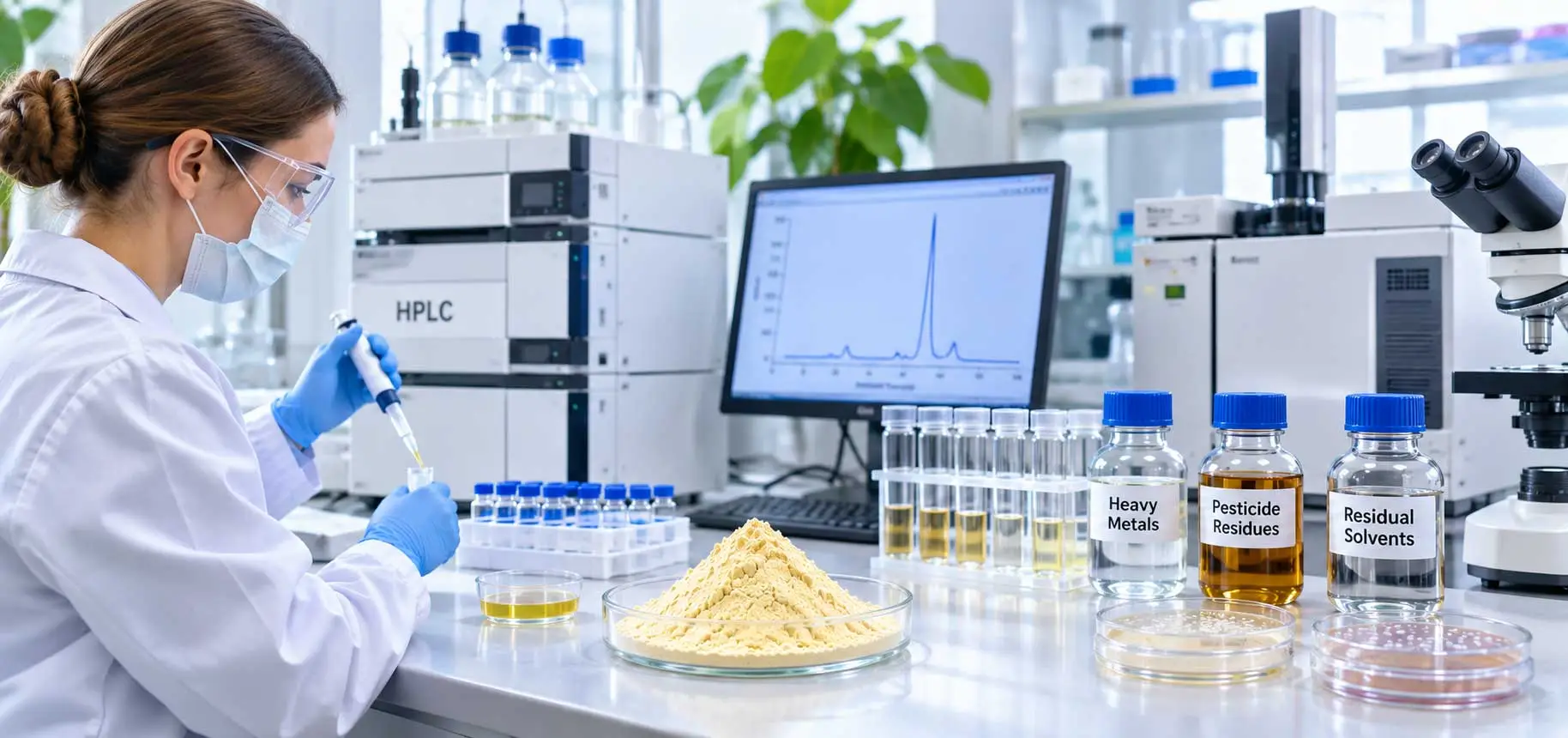
A Mangiferin HPLC Chromatogram can provide useful information about chromatographic separation and the presence of detectable components.
However, a visually dominant peak is not sufficient evidence of identity or quantitative purity.
When evaluating analytical documentation, buyers should consider whether the method uses an appropriate mangiferin reference standard, whether the target peak is adequately separated from interfering compounds, and whether the detector response falls within the validated calibration range.
Retention time can support identification, but retention-time agreement alone does not conclusively establish compound identity. Additional analytical evidence may be necessary, particularly when the botanical matrix contains structurally related constituents.
The Mangiferin Assay Method should also be appropriate for the concentration range being tested. A procedure suitable for a low-concentration botanical extract may require additional validation before being used for a highly purified material.
For important commercial orders, buyers may request a method summary, representative chromatographic data, and information about reference standard qualification.
Mangiferin Assay on a Dry Basis vs As-Received Basis
The reporting basis can materially affect how a purity result is interpreted.
An assay expressed on a dry basis excludes the effect of moisture from the reported concentration. An as-received assay reflects the material in its actual condition at the time of testing.
Consider a hypothetical sample with 95.0% mangiferin on a dry basis and 2.0% moisture. Its corresponding as-received mangiferin content would be approximately 93.1%, assuming the moisture measurement and assay basis are compatible.
Both figures can describe the same material, but they answer different questions.
Before comparing Mangiferin 90% COA and Mangiferin 95% COA documents, purchasing teams should verify that the results use comparable analytical methods and reporting bases.
Mangiferin Powder Quality Testing Beyond HPLC Purity
Mangiferin assay is an important quality attribute, but it does not replace a broader evaluation of the botanical extract.
A material can meet its declared mangiferin concentration while failing another specification relevant to its intended application.
Comprehensive Mangiferin Powder Quality Testing should therefore address identity, chemical composition, potential contaminants, and microbiological characteristics according to the agreed purchasing requirements.
Heavy Metals and Pesticide Residue Testing for Mangiferin Extract
Botanical raw materials can be exposed to environmental contaminants during cultivation, harvesting, handling, and processing.
Mangiferin Heavy Metals Testing may include elements such as lead, cadmium, arsenic, and mercury, depending on the applicable specification and intended market.
The appropriate acceptance limits should be established using relevant regulatory requirements and customer standards rather than adopting arbitrary values.
Similarly, Mangiferin Pesticide Residues testing should consider the botanical source, agricultural practices, extraction process, and destination market.
A certificate reporting “pesticides: pass” without identifying the testing scope may provide insufficient information for buyers operating under detailed residue requirements.
Where pesticide testing is important, purchasers should request the analyte list, analytical method, reporting limits, and applicable acceptance criteria.
Residual Solvents and Microbiological Limits for Botanical Extracts
Extraction and purification processes may involve solvents that require evaluation in the finished ingredient.
Mangiferin Residual Solvents testing should reflect the solvents actually used during manufacturing and the relevant requirements for the intended application.
For example, an ethanol-based extraction process presents different residual-solvent considerations from a process involving other organic solvents.
Microbiological quality also requires attention. Mangiferin Microbiological Testing may include total aerobic microbial count, yeast and mold count, and specified microorganisms, depending on the product's intended use.
The following checklist helps buyers determine whether the testing scope is appropriate.
|
Quality Check |
Main Risk Addressed |
Recommended Buyer Action |
|
HPLC assay |
Incorrect active concentration |
Verify quantitative method and result |
|
Botanical identity |
Incorrect source material |
Confirm species and plant part |
|
Heavy metals |
Elemental contamination |
Review applicable limits |
|
Pesticide residues |
Agricultural chemical residues |
Confirm analytical scope |
|
Residual solvents |
Processing-related residues |
Review solvent history |
|
Microbiology |
Microbial contamination |
Confirm suitable limits and results |
|
Moisture |
Storage and material variability |
Review measured value |
|
Batch identification |
Document mismatch |
Match COA to delivered material |
A high assay percentage should never be used as a substitute for these additional quality checks.
How to Compare Mangiferin 90% and 95% COA Results
Comparing Mangiferin 90% vs 95% requires more than confirming that one certificate reports a higher number.
For purchasing purposes, the key question is whether each material meets its declared specification using a reliable, comparable analytical procedure.
Comparing Mangiferin 90% and 95% HPLC Specifications
A typical Mangiferin Purity Comparison begins with the declared acceptance criteria and actual assay results.
For example, a 90% grade might have a specification of not less than 90.0% mangiferin, while a 95% grade might require not less than 95.0%.
The actual batch results should then be reviewed against those limits.
Buyers should also compare the analytical method, moisture basis, identity testing, and relevant contaminant specifications.
A 95% assay does not automatically demonstrate better microbiological quality, lower solvent residues, or greater manufacturing consistency.
When Different Mangiferin COA Results Are Not Directly Comparable
Differences in sample preparation, reference standards, detector settings, calibration procedures, and reporting bases can affect analytical results.
If two suppliers use different methods, purchasing teams should avoid ranking their materials solely by the reported percentage.
Where necessary, representative samples can be evaluated using a common agreed analytical method.
This approach provides a stronger basis for supplier comparison than relying on unrelated certificates generated under different testing conditions.
How to Verify Mangiferin Batch Consistency and Third-Party Testing
For manufacturers placing recurring orders, one acceptable COA is only the beginning of supplier qualification.
Mangiferin Batch Consistency is particularly important when ingredient concentration and processing characteristics influence finished-product specifications.
A reliable supplier should be able to demonstrate that routine manufacturing and quality controls produce material within agreed limits over time.
Reviewing Multiple Mangiferin COAs for Batch-to-Batch Consistency
Procurement and quality teams should consider reviewing several representative production batches rather than evaluating a single sample.
Important parameters may include actual mangiferin assay, moisture, appearance, particle characteristics, and other critical quality attributes.
A simple supplier quality trend record can help identify gradual changes that remain within specification but may affect manufacturing performance.
For example, repeated variation in moisture or particle size may influence powder handling even when every batch meets its mangiferin assay requirement.
Such observations can support discussions about tighter purchasing specifications or additional process controls.
When to Request Third-Party Mangiferin Laboratory Testing
Independent Mangiferin Third Party Testing can be valuable during initial supplier approval, major procurement decisions, or investigations involving inconsistent results.
It may also be appropriate when a customer requires independent verification or when the supplier changes a significant manufacturing process.
However, third-party testing should be planned carefully. The laboratory must use suitable methods, and the testing scope should reflect the agreed specification.
Different laboratories can generate different results if their procedures are not comparable.
Effective Mangiferin Laboratory Testing therefore requires coordination between the buyer, supplier, and testing laboratory.
A supplier's willingness to discuss analytical discrepancies and provide supporting documentation is an important part of Mangiferin Supplier Quality Control.
How to Qualify a Mangiferin Powder Supplier Using COA and Technical Documents
Selecting a Mangiferin Powder Supplier involves evaluating both the ingredient and the organization responsible for supplying it.
A technically acceptable sample is valuable, but buyers also need confidence in document accuracy, batch traceability, production consistency, and order fulfillment.
This is especially important when purchasing standardized botanical ingredients from international suppliers.
♦Mangiferin Supplier Qualification: COA, TDS, SDS and Traceability
A qualified Mangiferin Powder Manufacturer or Mangiferin Extract Supplier should be able to explain the purpose and scope of its technical documentation.
The COA reports batch-specific testing results. The Technical Data Sheet describes the product's general specifications and relevant technical characteristics. The Safety Data Sheet communicates applicable hazard, handling, storage, and safety information.
These documents serve different purposes and should not be treated as interchangeable.
For example, a Mangiferin Powder TDS may identify the standard purity grades and recommended storage conditions, but it does not replace a batch-specific assay result.
When evaluating a Mangiferin Powder Supplier China, buyers should also confirm the botanical source, manufacturing or sourcing arrangements, traceability procedures, available testing capabilities, and communication process for quality complaints.
A useful qualification process includes document review, sample testing, specification agreement, and confirmation of commercial supply arrangements.
At CHEN LANG BIO TECH, we support botanical ingredient purchasing through HPLC-based quality evaluation, available batch documentation, and technical communication with customers.
♦Mangiferin Powder Samples, MOQ and Bulk Order Quality Checks
Before committing to Bulk Mangiferin Powder, manufacturers should evaluate a representative sample against their intended purchasing specification.
A Mangiferin Powder Sample can support preliminary identity verification, assay confirmation, and formulation testing. However, approval of a sample should not automatically replace incoming inspection of subsequent commercial batches.
Buyers should specify the required purity, analytical method, applicable quality limits, packaging, and documentation when issuing a purchase order.
We offer Mangiferin 90% and 95% powder with a standard Mangiferin Powder MOQ of 1 kg.
For customers evaluating Mangiferin Powder 1kg quantities, aluminum foil bag packaging is available. Larger Mangiferin Powder 25kg orders can be supplied in paper drums.
Customers considering Mangiferin Powder Wholesale purchases should discuss expected order volumes, required documentation, and delivery schedules before confirming supply arrangements.
The same quality requirements should apply to both the approved purchasing specification and the material delivered under a commercial order.
Mangiferin COA Frequently Asked Questions
Does a 95% Mangiferin HPLC Result Guarantee High Quality?
No. A 95% assay confirms only the reported mangiferin concentration under the stated analytical conditions. Overall quality also depends on identity, relevant contaminants, moisture, microbiological characteristics, and batch consistency. Buyers should review the complete certificate rather than treating purity as the sole acceptance criterion.
What Is the Difference Between a Mangiferin COA and TDS?
A COA provides test results associated with a specific production batch, while a TDS describes the product's general technical specifications. Both documents are useful during supplier qualification, but a TDS cannot substitute for batch-specific analytical evidence.
Can Buyers Request a Mangiferin HPLC Chromatogram?
Yes. Buyers may request an available Mangiferin HPLC Report or representative chromatographic data when additional analytical verification is required. The supplier should clarify what documentation is available and whether the data corresponds to the batch under evaluation.
Should Every Mangiferin Batch Have a Separate COA?
For controlled commercial purchasing, a batch-specific COA is generally preferable because it links analytical results to the delivered material. Buyers should verify the lot number and ensure that the certificate corresponds to the shipment rather than an unrelated reference batch.
How Can Buyers Verify a Mangiferin COA Before Bulk Purchasing?
Effective Mangiferin COA Verification includes confirming product identity, batch information, assay method, actual test results, and applicable quality limits. Buyers may also request additional analytical documentation or independent testing when the order value or intended application justifies further verification.
Request a Mangiferin Powder COA, Samples and Bulk Pricing
A reliable purchasing decision begins with a clear specification and supporting analytical evidence. Whether you are evaluating Mangiferin 90% or 95%, the COA should provide enough information to assess identity, assay, batch quality, and compliance with your agreed requirements.
CHEN LANG BIO TECH supplies standardized mangiferin powder for international ingredient purchasing, with HPLC-based testing and available quality documentation.
If you plan to Buy Mangiferin Powder, our team can assist with product specifications, COA requests, sample arrangements, and international shipping options.
For customers comparing Mangiferin Powder Price or planning a Mangiferin Powder Bulk Order, please provide your required purity, purchase quantity, destination, and any specific testing requirements.
We can then review the appropriate supply options and prepare a quotation.
Email: admin@chenlangbio.com
Website: https://www.chenlangbio.com
References
1. International Council for Harmonisation. ICH Q2(R2): Validation of Analytical Procedures.
2. International Council for Harmonisation. ICH Q14: Analytical Procedure Development.
3. International Council for Harmonisation. ICH Q3C(R9): Impurities — Guideline for Residual Solvents.
4. International Council for Harmonisation. ICH Q3D(R2): Guideline for Elemental Impurities.
5. National Center for Biotechnology Information. PubChem: Mangiferin, CAS 4773-96-0.

Send Inquiry
Related Industry Knowledge
- Resveratrol and Skin Care: Benefits, Stability, and How to Use It in Cosmetic Formulations
- Wholesale Horse Chestnut Extract Benefits Reducing Inflammation and Swelling for Wellness Products
- How Does Liposomal Coenzyme Q10 Improve Absorption?
- Everything You Need to Know About Meglumine Powder
- Can Minoxidil Powder Be Used by Both Men and Women
- How to Use Durian Fruit Powder Daily
- What are the Health Benefits of Phellinus Linteus
- How Witch Hazel Leaf Extract Can Transform Your Skin
- How Much EGCG In Lipton Green Tea?
- Does Olive Leaf Extract Powder Used in Cosmetic Products