
Ethyl Ascorbic Acid and Ectoin: Formulation and Stability Guide
2026-10-26 15:41:27
Ethyl ascorbic acid and ectoin can be formulated together in aqueous cosmetic systems, provided their solubility, concentration, pH requirements, and compatibility with other ingredients are properly evaluated. Both are used in modern skincare development, but their different chemical structures and functional roles require careful formulation design.
3-O-Ethyl Ascorbic Acid is a vitamin C derivative used in antioxidant and skin-brightening formulations. Ectoin is a naturally occurring extremolyte, valued for its hydration-related properties and applications in skin barrier care. Combining them offers a formulation approach for products targeting uneven-looking skin tone, dryness, and environmental stress.
For cosmetic manufacturers, however, ingredient compatibility must be demonstrated rather than assumed. A transparent serum containing both ingredients may appear stable initially but develop crystallization, discoloration, viscosity changes, or active ingredient loss during storage.
This guide examines ethyl ascorbic acid ectoin formulation requirements, including solvent selection, chemical stability, processing conditions, analytical testing, and commercial raw material sourcing.
Ethyl Ascorbic Acid and Ectoin Compatibility in Cosmetic Formulations
Ethyl ascorbic acid ectoin compatibility depends on the entire formulation environment. Although both ingredients can be incorporated into water-containing products, their combined performance is influenced by solvent composition, concentration, pH, temperature, and interactions with other formulation components.
Chemical Compatibility Between 3-O-Ethyl Ascorbic Acid and Ectoin
3-O-Ethyl Ascorbic Acid (CAS 86404-04-8) has a molecular formula of C₈H₁₂O₆ and a molecular weight of approximately 204.18 g/mol. Its ethyl ether substitution distinguishes it from L-Ascorbic Acid and affects its physicochemical behavior.
Ectoin (CAS 96702-03-3) has a molecular formula of C₆H₁₀N₂O₂ and a molecular weight of approximately 142.16 g/mol. It is a cyclic amino acid derivative produced by certain microorganisms as an adaptation to environmental stress.
Ectoin is associated with preferential exclusion and hydration-related stabilization mechanisms in biological systems. These properties do not establish that it chemically stabilizes every cosmetic active ingredient.
There is no general basis for assuming that these molecules necessarily react when combined. However, long-term 3-o-ethyl ascorbic acid ectoin compatibility must be assessed experimentally, particularly when formulation conditions change during storage.
Can Ethyl Ascorbic Acid and Ectoin Be Used in the Same Serum?
An ethyl ascorbic acid ectoin serum can be developed as an aqueous solution, hydrogel, or appropriately designed emulsion.
Because both ingredients are compatible with the general concept of water-based formulation, they may be easier to incorporate together than combinations involving a strongly lipophilic active.
Nevertheless, complete dissolution at the intended concentrations must be verified. The presence of glycols, polymers, electrolytes, and preservatives may alter the behavior of the final system.
Ingredient Compatibility vs Finished Product Stability
Ingredient compatibility describes whether materials can coexist under defined conditions without unacceptable interactions.
Finished-product stability involves additional requirements, including chemical integrity, physical consistency, and microbiological quality.
A serum that remains clear after manufacture may still experience gradual active ingredient degradation. Conversely, acceptable assay results do not exclude viscosity loss or precipitation.
Commercial qualification therefore requires testing of the complete formulation in its intended packaging.
Ethyl Ascorbic Acid and Ectoin Solubility in Water-Based Cosmetic Systems
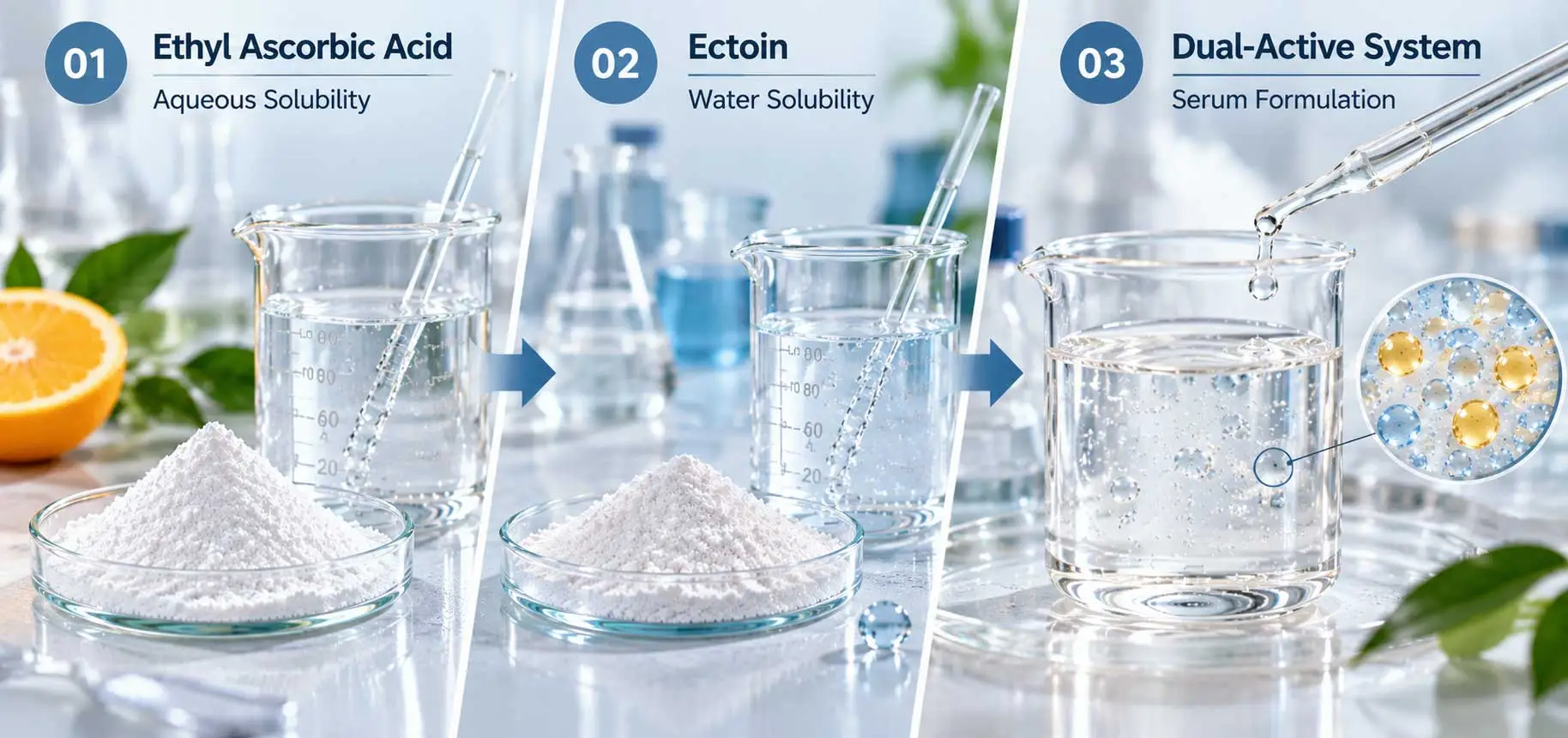
Solvent selection is a fundamental consideration when developing dual-active serums. Ethyl ascorbic acid solubility and ectoin water solubility must be evaluated under the same conditions used in the finished product.
3-O-Ethyl Ascorbic Acid Solubility in Water and Mixed Solvents
3-O-Ethyl Ascorbic Acid contains multiple hydroxyl groups and is commonly used in aqueous or mixed-solvent cosmetic formulations.
Published studies have examined its behavior in individual solvents and complex solvent systems, demonstrating that solvent composition affects its formulation and delivery characteristics.
A single solubility figure cannot reliably describe every formulation.
For practical development, formulators should determine whether the required concentration remains dissolved at the lowest anticipated storage temperature, not merely at the temperature used during manufacturing.
Co-solvents may improve initial dissolution, but their effects on skin feel, preservative performance, and polymer compatibility must also be considered.
Ectoin Water Solubility and Its Role in Aqueous Formulations
Ectoin is a highly hydrophilic molecule whose biological functions are closely associated with interactions involving water and surrounding macromolecules.
Research on ectoine and related compatible solutes has described preferential exclusion from certain biomolecular surfaces, helping explain their protective behavior in biological environments.
However, this mechanism should not be confused with a guaranteed improvement in finished-product hydration performance or the chemical stability of another active ingredient.
In cosmetic development, the selected ectoin concentration should be evaluated alongside the complete humectant system, including its effects on viscosity, clarity, and sensory properties.
Solvent Selection and Crystallization Risk in Dual-Active Serums
Cosmetic serum crystallization may occur when an ingredient exceeds its effective solubility under storage conditions.
Temperature reduction, solvent evaporation, or changes in formulation composition can contribute to precipitation.
|
Formulation system |
Primary technical consideration |
Recommended evaluation |
|
Water-based serum |
Solubility and clarity |
Low-temperature storage and precipitation checks |
|
Hydrogel serum |
Polymer compatibility |
Viscosity and uniformity |
|
Oil-in-water emulsion |
Aqueous-phase composition |
Phase stability and active distribution |
|
Mixed-solvent serum |
Solvent balance |
Solubility after temperature cycling |
For an ethyl ascorbic acid ectoin serum formulation, solubility screening should be completed before optimizing fragrance, texture, or other secondary product attributes.
Ethyl Ascorbic Acid and Ectoin pH Compatibility and Chemical Stability
Ethyl ascorbic acid and ectoin stability should be evaluated separately for each ingredient and then confirmed in the combined formulation.
The key question is whether the selected formulation conditions maintain both active ingredients within established quality specifications throughout storage.
3-O-Ethyl Ascorbic Acid Stability Across Different pH Conditions
3-O-Ethyl Ascorbic Acid differs from L-Ascorbic Acid through substitution at the 3-position of the molecule.
This structural modification changes its chemical behavior, but it does not eliminate the possibility of degradation.
The ingredient's stability can be influenced by pH, temperature, solvent composition, trace impurities, and interactions with other formulation components.
Therefore, published stability observations for L-Ascorbic Acid should not be directly applied to 3-O-Ethyl Ascorbic Acid.
A meaningful 3-o-ethyl ascorbic acid pH stability assessment should measure active content over time rather than rely exclusively on changes in solution color.
Ectoin Stability Under Cosmetic Formulation Conditions
Ectoin is produced by microorganisms that use compatible solutes to tolerate environmental stresses, including high osmotic pressure.
Its molecular properties have attracted interest in cosmetic formulations, particularly those designed for hydration and skin barrier care.
Nevertheless, biological stress tolerance does not establish unlimited ectoin cosmetic formulation stability under every manufacturing or storage condition.
Stability assessment should consider the ingredient's concentration, formulation pH, temperature exposure, and potential interactions with excipients.
Supplier technical information provides a starting point, but finished-product testing remains necessary.
Selecting a Suitable pH for Ethyl Ascorbic Acid and Ectoin Serums
There is no universally validated ethyl ascorbic acid ectoin pH that guarantees stability in every cosmetic product.
The formulation pH must accommodate both active ingredients while remaining compatible with the preservative system, rheology modifiers, and intended product characteristics.
Buffer selection should also be evaluated carefully. A buffer may improve pH consistency without necessarily preventing chemical degradation.
Formulators should compare candidate pH conditions using active-content measurements, physical stability observations, and preservative compatibility testing.
The final pH specification should be based on the performance of the complete formulation.
Does Ectoin Improve Ethyl Ascorbic Acid Stability?
Ectoin has been investigated for its ability to influence hydration environments and protect certain biological structures under stress. However, those findings do not demonstrate that ectoin directly prevents degradation of 3-O-Ethyl Ascorbic Acid in cosmetic formulations.
To establish such an effect, researchers would need to compare otherwise equivalent formulations containing the vitamin C derivative with and without ectoin. The study should measure 3-O-Ethyl Ascorbic Acid content over time using a suitable stability-indicating analytical method.
Until direct evidence is available, ectoin should be selected for its own intended formulation functions rather than marketed as a proven chemical stabilizer of ethyl ascorbic acid.
Ectoin and Ethyl Ascorbic Acid in Hydrating Serum Formulations
Combining these ingredients offers an approach to multifunctional skincare development. However, ectoin hydrating serum formulation requires more than selecting actives with complementary marketing benefits. The vehicle must provide suitable hydration, consistent viscosity, and acceptable active ingredient stability.
Combining Vitamin C Derivatives and Ectoin for Skin Barrier Care
3-O-Ethyl Ascorbic Acid is used in cosmetic formulations designed to improve the appearance of uneven skin tone and provide antioxidant-related skincare benefits. Ectoin has a different functional profile. Studies involving ectoine-containing preparations have investigated its hydration-related and skin-protective properties, including effects associated with environmental stress.
An ectoin skin barrier formulation may therefore complement the intended cosmetic positioning of a vitamin C derivative serum.
However, complementary functions should not automatically be described as proven biological synergy. Claims concerning improved efficacy of the combination require evidence from an appropriately designed study of the finished product.
For product developers, the immediate advantage is the opportunity to address different cosmetic objectives within one formulation.
Ectoin Hydrating Serum Formulation with Humectants
Ectoin may be combined with established humectants such as glycerin, propanediol, and sodium hyaluronate. These materials contribute differently to the water-binding behavior, sensory properties, and structure of the finished formulation.
Glycerin is a widely used humectant, while sodium hyaluronate can contribute to hydration-related product positioning and, depending on molecular weight and concentration, rheological behavior.
Adding multiple humectants does not necessarily improve performance proportionally. High total solute concentrations may affect tackiness, drying characteristics, and ingredient solubility.
A vitamin c derivative hydrating serum should therefore be optimized as a complete system, with sensory testing and instrumental hydration measurements where appropriate.
Polymer Compatibility and Viscosity in Dual-Active Serums
Carbomers, cellulose derivatives, and other cosmetic rheology modifiers can provide different viscosity profiles and application characteristics.
Carbomer-based systems may be sensitive to neutralization conditions and electrolyte concentration. Cellulose-derived polymers have different hydration and thickening behaviors.
The selected polymer should be evaluated after both active ingredients and all solvents have been incorporated.
Viscosity measurements at defined temperatures and shear conditions are more informative than subjective descriptions such as “thick” or “smooth.”
Any significant viscosity drift during storage should trigger investigation of pH changes, polymer compatibility, and formulation structure.
Designing an Ethyl Ascorbic Acid and Ectoin Serum for Commercial Production
Development should begin with raw material qualification, followed by solubility screening at the intended active concentrations.
Candidate formulations can then be compared for pH stability, viscosity, appearance, and active-content retention.
Once a promising composition is identified, laboratory batches should be reproduced under representative manufacturing conditions.
The final formulation must also undergo microbiological evaluation and packaging compatibility testing.
This approach helps distinguish a formulation that looks acceptable immediately after mixing from one suitable for reproducible commercial production.
Processing Temperature, Ingredient Addition and Packaging for Ectoin Serums
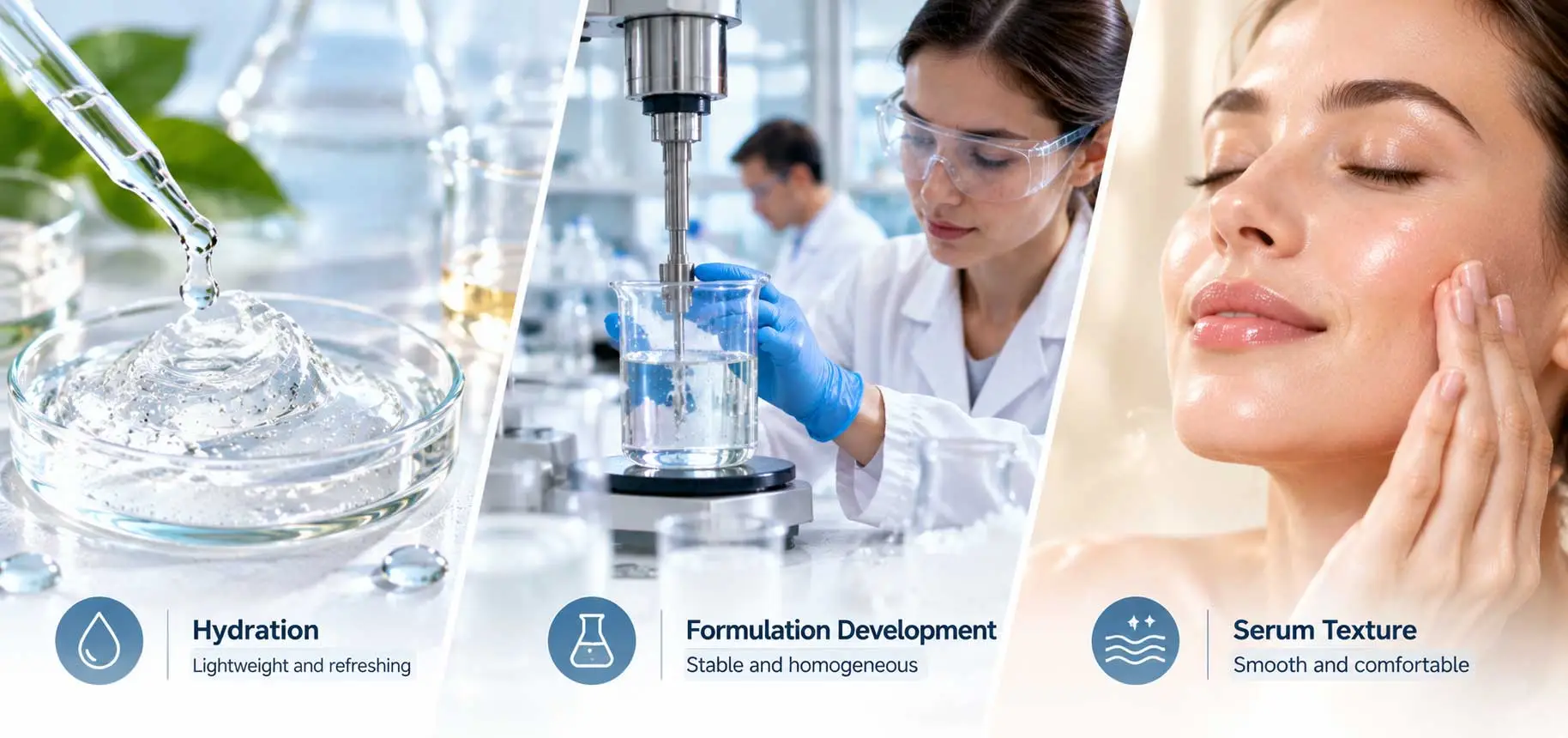
Manufacturing conditions influence both product consistency and active ingredient quality. Ectoin processing temperature and the handling conditions for 3-O-Ethyl Ascorbic Acid should be established using ingredient-specific technical information and finished-product testing.
Processing Temperature for 3-O-Ethyl Ascorbic Acid and Ectoin
The appropriate ethyl ascorbic acid formulation temperature depends on the selected solvent system, ingredient concentration, and processing duration. Although heating may accelerate dissolution, unnecessary thermal exposure can complicate stability assessment.
Manufacturers should distinguish short-term processing tolerance from long-term chemical stability. A material that remains visually unchanged during a brief heating step may still experience measurable degradation under prolonged storage.
Temperature limits should therefore be supported by supplier documentation and process-development results rather than assumed from the ingredient's general reputation for stability.
Ingredient Addition Sequence and Mixing Conditions
The appropriate ectoin ingredient addition sequence depends on the complete formulation. In an aqueous serum, each active may be dissolved separately before incorporation, provided the procedure is compatible with the selected ingredients and manufacturing process.
The formulation team should monitor dissolution, local concentration gradients, mixing time, and final batch uniformity.
During scale-up, differences in vessel geometry and mixing intensity can affect dissolution and distribution.
A successful laboratory batch does not eliminate the need for pilot-scale verification.
Protective Packaging and Storage for Vitamin C Derivative Serums
Vitamin c derivative serum packaging should be selected according to the finished formulation's demonstrated stability requirements.
Opaque or light-protective containers may be appropriate when light exposure contributes to degradation.
Container closure integrity, oxygen permeability, dispensing performance, and material compatibility should also be evaluated.
Packaging cannot compensate for an inherently unstable formulation. Stability studies should therefore be performed in the proposed commercial container rather than laboratory packaging alone.
Stability Testing for Ethyl Ascorbic Acid and Ectoin Cosmetic Serums
A scientifically useful ethyl ascorbic acid ectoin stability testing program should determine whether both ingredients retain their specified chemical quality while the finished product maintains acceptable physical and microbiological characteristics.
HPLC Assay for 3-O-Ethyl Ascorbic Acid and Ectoin
A suitable 3-o-ethyl ascorbic acid HPLC assay should demonstrate adequate specificity, accuracy, precision, and recovery from the finished formulation. Sample preparation must account for polymers, humectants, preservatives, and other components that may interfere with extraction or chromatographic analysis.
Ectoin HPLC analysis requires separate analytical consideration because ectoin has different chromatographic retention and detection characteristics from the vitamin C derivative.
Appropriate methods may involve specialized separation conditions or detection systems. A conventional reversed-phase HPLC-UV method optimized for 3-O-Ethyl Ascorbic Acid should not automatically be assumed suitable for ectoin.
Where necessary, separate validated methods should be used.
Accelerated and Real-Time Stability Testing
Cosmetic serum accelerated stability testing can reveal potential problems associated with temperature exposure, physical instability, and chemical degradation.
However, accelerated testing does not establish an exact commercial shelf life without appropriate supporting evidence.
A comprehensive program should include justified accelerated conditions, real-time storage, and additional temperature cycling where relevant.
Active-content measurements should be compared with predefined acceptance criteria.
Any observed degradation should be investigated alongside changes in pH, appearance, and packaging performance.
Monitoring pH, Color, Clarity and Viscosity
For transparent or translucent serums, clarity and precipitation are particularly useful physical indicators.
Monitoring should include pH, color, odor, viscosity, and visible crystallization.
Measurements should be performed consistently using documented procedures and controlled test conditions.
A clear serum may still experience active ingredient loss, while a change in viscosity may occur without substantial chemical degradation.
Chemical and physical results must therefore be interpreted together.
Comparative Stability Testing: Single-Active vs Dual-Active Formulations
A controlled comparison can help determine whether combining the two ingredients changes their stability.
|
Test formulation |
Evaluation objective |
|
Base formulation |
Establish vehicle stability |
|
Ethyl ascorbic acid only |
Measure vitamin C derivative retention |
|
Ectoin only |
Assess ectoin retention and physical effects |
|
Combined formulation |
Evaluate changes associated with co-formulation |
The formulations should be matched as closely as possible for solvent composition, pH, packaging, and processing conditions.
At each sampling point, researchers can compare the remaining active concentration with the initial value:
\[ \text{Active retention (\%)}=\frac{\text{Measured concentration at time }t}{\text{Initial measured concentration}}\times100 \]
For example, a reduction from 1.00% to 0.92% corresponds to 92% retention. This is an illustrative calculation, not experimental evidence for either ingredient.
A properly controlled study is particularly important before claiming that ectoin improves the chemical stability of 3-O-Ethyl Ascorbic Acid.
Cosmetic-Grade Ethyl Ascorbic Acid and Ectoin: Specifications and Bulk Sourcing
For cosmetic manufacturers, consistent raw material quality is essential when transferring a formulation from laboratory development to commercial production. Even a well-designed serum can become difficult to reproduce when ingredient identity, assay, moisture content, or impurity profiles vary between batches.
3-O-Ethyl Ascorbic Acid 99% Specifications and COA Requirements
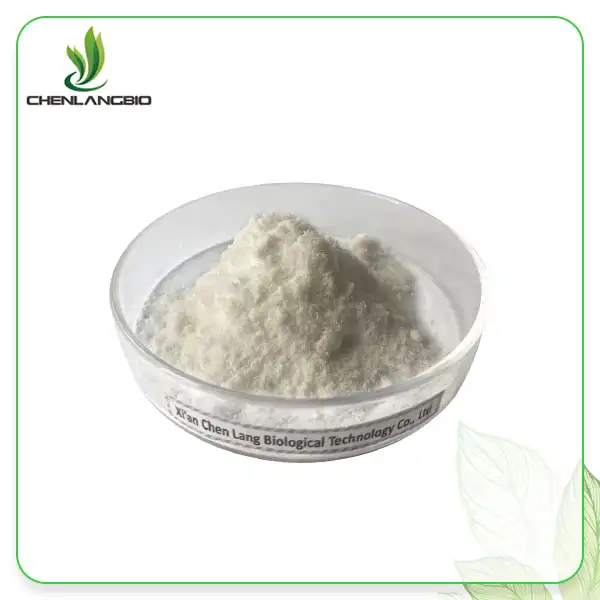
CHEN LANG BIO TECH supplies cosmetic grade ethyl ascorbic acid for skincare formulation and commercial ingredient procurement. Our 3-o-ethyl ascorbic acid 99% grade is available with the following specifications:
|
Parameter |
Specification |
|
INCI |
3-O-Ethyl Ascorbic Acid |
|
CAS number |
86404-04-8 |
|
Molecular formula |
C₈H₁₂O₆ |
|
Molecular weight |
204.18 g/mol |
|
Appearance |
White to off-white crystalline powder |
|
Assay |
≥99% |
|
Packaging |
1–5 kg aluminum foil bags; 25 kg paper drums |
Buyers should request a batch-specific 3-o-ethyl ascorbic acid COA and review the assay method, impurity controls, and applicable storage conditions.
Cosmetic-Grade Ectoin Powder Specifications and Supplier Evaluation
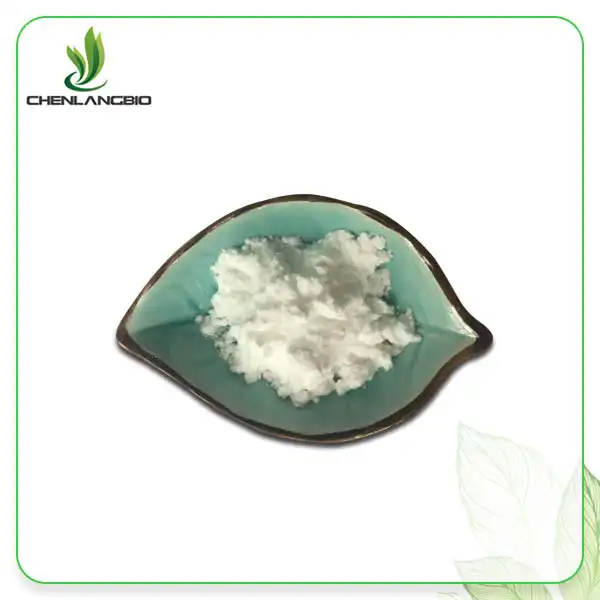
When purchasing cosmetic grade ectoin powder, buyers should verify the declared chemical identity, CAS number, assay, moisture specification, and relevant impurity limits. A batch-specific ectoin COA should identify the analytical results and applicable acceptance criteria.
The selected ectoin supplier should also provide information about storage, packaging, batch traceability, and available technical documentation.
These considerations are especially important for products intended for international cosmetic manufacturing.
Bulk Ethyl Ascorbic Acid and Ectoin Price, Samples and Commercial Supply
For bulk ethyl ascorbic acid powder, commercial evaluation should consider product specifications, analytical documentation, packaging, and delivery requirements alongside the quoted price.
Buyers seeking bulk ectoin powder should apply similar qualification criteria rather than comparing offers solely by nominal purity. The ethyl ascorbic acid price per kg and ectoin price per kg depend on order quantity, selected grade, commercial terms, and destination.
For formulation trials, customers may request technical documentation and sample availability before placing larger orders.
CHEN LANG BIO TECH welcomes inquiries from cosmetic brands, contract manufacturers, and international ingredient distributors.
Frequently Asked Questions About Ethyl Ascorbic Acid and Ectoin
Can ethyl ascorbic acid and ectoin be used together in skincare formulations?
Yes. Both ingredients can potentially be incorporated into aqueous cosmetic formulations. However, successful development requires verification of their solubility, chemical compatibility, and finished-product stability under the intended manufacturing and storage conditions.
What pH is suitable for ethyl ascorbic acid and ectoin serums?
There is no universally established optimum pH for every combined formulation. The appropriate range should be determined by evaluating active ingredient stability, preservative compatibility, rheological behavior, and the requirements of the complete cosmetic system.
Does ectoin improve the stability of ethyl ascorbic acid?
Ectoin has documented protective functions in certain biological systems, but these findings do not establish that it directly prevents 3-O-Ethyl Ascorbic Acid degradation. Comparative chemical stability testing is necessary before making that claim.
Are ethyl ascorbic acid and ectoin both water-soluble?
Both ingredients can be used in aqueous formulation systems. However, their effective solubility depends on concentration, solvent composition, temperature, and other formulation conditions. Complete dissolution and resistance to crystallization should be confirmed experimentally.
What should buyers check when sourcing cosmetic-grade ectoin and ethyl ascorbic acid?
Buyers should verify chemical identity, purity, analytical methods, batch-specific COAs, impurity controls, packaging, and supply consistency. Samples should be evaluated in the intended formulation before commercial purchasing decisions are finalized.
Conclusion: Developing Stable Ethyl Ascorbic Acid and Ectoin Formulations
Combining ethyl ascorbic acid and ectoin offers opportunities for multifunctional skincare development, provided the formulation is supported by appropriate solvent selection, pH evaluation, processing controls, and stability testing.
Reliable raw material specifications and consistent analytical quality are essential for commercial manufacturing.
For 3-O-Ethyl Ascorbic Acid and Ectoin specifications, COA requests, sample availability, or bulk quotations, contact CHEN LANG BIO TECH at admin@chenlangbio.com.
References
1. Iliopoulos, F., et al. (2019). 3-O-Ethyl-L-Ascorbic Acid: Characterisation and Investigation of Single Solvent Systems for Delivery to the Skin. International Journal of Pharmaceutics: X, 1, 100025. DOI: 10.1016/j.ijpx.2019.100025.
2. Iliopoulos, F., et al. (2020). Topical Delivery of 3-O-Ethyl-L-Ascorbic Acid from Complex Solvent Systems. Scientia Pharmaceutica, 88(2), 19. DOI: 10.3390/scipharm88020019.
3. Galinski, E. A., Pfeiffer, H.-P., and Trüper, H. G. (1985). 1,4,5,6-Tetrahydro-2-methyl-4-pyrimidinecarboxylic Acid: A Novel Cyclic Amino Acid from Halophilic Phototrophic Bacteria of the Genus Ectothiorhodospira. European Journal of Biochemistry, 149(1), 135–139.
4. Lippert, K., and Galinski, E. A. (1992). Enzyme Stabilization by Ectoine-Type Compatible Solutes: Protection Against Heating, Freezing and Drying. Applied Microbiology and Biotechnology, 37, 61–65.
5. International Organization for Standardization. ISO/TR 18811:2018 — Cosmetics — Guidelines on the Stability Testing of Cosmetic Products.
6. International Organization for Standardization. ISO 11930:2019 — Cosmetics — Microbiology — Evaluation of the Antimicrobial Protection of a Cosmetic Product.
7. International Organization for Standardization. ISO 22716:2007 — Cosmetics — Good Manufacturing Practices (GMP) — Guidelines on Good Manufacturing Practices.
8. International Council for Harmonisation. ICH Q2(R2): Validation of Analytical Procedures. 2023. General analytical validation principles; not a cosmetic-specific regulatory requirement.

Send Inquiry

Related Industry Knowledge
- Ergothioneine Powder for Healthy Aging: What Supplement Manufacturers Need to Know
- Freeze-Dried Raspberry Powder vs Spray-Dried Raspberry Powder: Which Is Better for Food Manufacturers?
- Where to Buy Spermidine Trihydrochloride in Bulk: A Complete Supplier Guide (2026)
- How Does Kopexil Work for Hair Loss?
- How Does Kopexil Work?
- Benefits of Sea Buckthorn Oligopeptide for Skin Health
- What are the Benefits of Glabridin Powder
- What is EGCG Green Tea Extract Used for
- Is Honokiol Safe to Use
- What is Natural Stevia Extract Powder Used for