
Dimethylmethoxy Chromanyl Palmitate Solubility: Formulation Guide for Cosmetic Chemists
2026-03-07 17:11:13
Is Dimethylmethoxy Chromanyl Palmitate Water-Soluble?
When cosmetic chemists first evaluate a new brightening ingredient, one of the most practical questions is whether the material is compatible with existing formulation systems. In the case of dimethylmethoxy chromanyl palmitate solubility, the answer is relatively straightforward: the ingredient is oil-soluble and not soluble in water.
Dimethylmethoxy chromanyl palmitate is a lipophilic skin-brightening active designed to function within the oil phase of cosmetic formulations. Because of its molecular structure, it dissolves effectively in a variety of ester oils and emollient systems commonly used in creams, emulsions, and oil-based serums. Solvents such as C12-15 Alkyl Benzoate or Caprylic/Capric Triglyceride can dissolve the ingredient efficiently and allow it to be incorporated smoothly into finished products.
Typical cosmetic usage levels of this ingredient range between 0.1% and 0.5%, depending on the formulation strategy and the desired level of skin-tone improvement. For cosmetic chemists developing advanced brightening products, understanding dimethylmethoxy chromanyl palmitate solubility in cosmetic formulations is essential for ensuring stability, compatibility, and consistent performance.
For cosmetic chemists evaluating this brightening active ingredient, the following table summarizes the most important formulation parameters related to dimethylmethoxy chromanyl palmitate solubility and usage in skincare formulations.
|
Parameter |
Technical Information |
|
INCI Name |
Dimethylmethoxy Chromanyl Palmitate |
|
Ingredient Type |
Oil-soluble skin brightening active |
|
Water Solubility |
Insoluble |
|
Oil Solubility |
Soluble in ester oils and emollients |
|
Best Solvents |
C12-15 Alkyl Benzoate, Ethylhexyl Cocoate, Caprylic/Capric Triglyceride |
|
Typical Solubility |
Up to ~34% in C12-15 Alkyl Benzoate |
|
Recommended Phase |
Oil phase |
|
Recommended Usage Level |
0.1% – 0.5% |
|
Typical Applications |
Brightening creams, serums, emulsions |
|
Function |
Tyrosinase inhibition and melanin regulation |
Why Solubility Matters in Skin Brightening Ingredient Formulation
In cosmetic product development, the solubility characteristics of an active ingredient influence far more than simple dissolution. Solubility directly affects ingredient dispersion, stability, bioavailability, and the final sensory profile of a product.
Many brightening actives present formulation challenges because they exhibit limited solubility or a tendency to crystallize during storage. When an ingredient is poorly dissolved, the active compound may precipitate from the formulation, resulting in reduced efficacy and undesirable visual defects in the finished product.
For this reason, cosmetic chemists frequently evaluate dimethylmethoxy chromanyl palmitate in cosmetic formulations by first determining how it behaves in different solvent systems. As an oil-compatible compound, Dimethylmethoxy Chromanyl Palmitate is generally easier to integrate into lipid-rich systems such as creams, emulsions, and anhydrous oil serums.
From a formulation perspective, ensuring proper dissolution of a lipophilic brightening active allows the ingredient to distribute evenly within the product. This improves the likelihood that the active compound will be delivered effectively when applied to the skin.
Understanding skin brightening ingredient formulation strategies is therefore an essential step in maximizing the performance of modern depigmentation actives.
What Is Dimethylmethoxy Chromanyl Palmitate?
Dimethylmethoxy chromanyl palmitate is a synthetic chroman derivative used in cosmetic science as a skin-brightening ingredient. It is commonly associated with tyrosinase inhibition, a mechanism that helps regulate melanin synthesis within the skin.
Melanin production is controlled by the enzyme tyrosinase, which catalyzes several steps in the biochemical pathway responsible for pigmentation. By interfering with this enzymatic process, brightening ingredients such as dimethylmethoxy chromanyl palmitate for hyperpigmentation treatment may help reduce the appearance of dark spots and uneven skin tone.
Unlike some traditional depigmenting agents, dimethylmethoxy chromanyl palmitate is typically positioned as a modern cosmetic brightening ingredient rather than a pharmaceutical depigmenting compound. This distinction makes it suitable for use in a wide range of cosmetic products designed to improve skin tone clarity over time.
The ingredient is commonly incorporated into formulations targeting:
•hyperpigmentation;
•uneven skin tone;
•dark spots caused by UV exposure;
•post-inflammatory pigmentation.
Because it functions effectively within lipid-based systems, oil-soluble cosmetic brightening ingredients like dimethylmethoxy chromanyl palmitate are particularly well suited for creams, emulsions, and oil serums.
Dimethylmethoxy Chromanyl Palmitate Solubility in Cosmetic Solvents
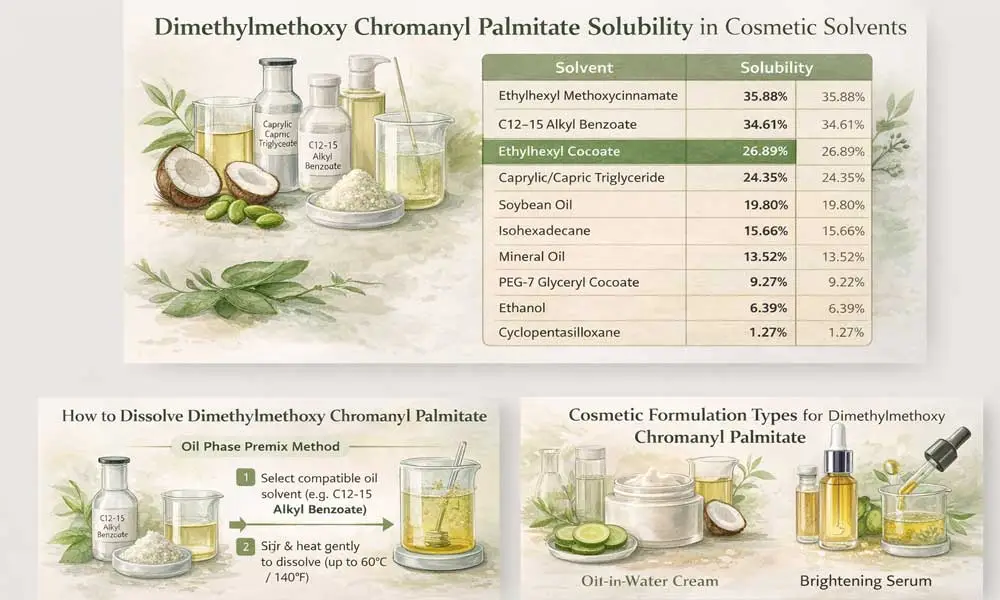
Understanding the solvent compatibility of a cosmetic active is one of the most important steps in formulation design. Available technical documentation provides detailed information regarding dimethylmethoxy chromanyl palmitate solubility in oils and cosmetic solvents.
The following table summarizes the approximate solubility of the ingredient in several commonly used cosmetic solvents at room temperature.
|
Solvent |
Solubility |
|
Ethylhexyl Methoxycinnamate |
35.88% |
|
C12-15 Alkyl Benzoate |
34.61% |
|
Ethylhexyl Cocoate |
26.89% |
|
Caprylic/Capric Triglyceride |
24.35% |
|
Soybean Oil |
19.80% |
|
Isohexadecane |
15.66% |
|
Mineral Oil |
13.52% |
|
PEG-7 Glyceryl Cocoate |
9.27% |
|
Ethanol |
6.39% |
|
Cyclopentasiloxane |
1.27% |
These values illustrate an important characteristic of the ingredient: dimethylmethoxy chromanyl palmitate solubility in oils is significantly higher than in silicone fluids or polar solvents.
For cosmetic chemists, this means the ingredient performs best when dissolved in ester oils or triglyceride systems before incorporation into the oil phase of an emulsion.
Solvents such as C12-15 Alkyl Benzoate and Ethylhexyl Cocoate are particularly effective because they provide both high solubility and excellent sensory properties in finished skincare products.
How to Dissolve Dimethylmethoxy Chromanyl Palmitate in Cosmetic Formulations
One of the most common questions from formulation laboratories is how to dissolve dimethylmethoxy chromanyl palmitate efficiently during product development.
In most cases, the preferred approach involves creating a premix in a compatible oil solvent before introducing the active ingredient into the formulation.
Recommended dissolution method
1. Select a suitable oil solvent such as C12-15 Alkyl Benzoate or Caprylic/Capric Triglyceride.
2. Add the dimethylmethoxy chromanyl palmitate powder gradually while stirring.
3. Apply gentle heat if necessary to accelerate dissolution.
4. Once the mixture becomes clear, incorporate the premix into the oil phase of the formulation.
This premix strategy allows cosmetic chemists to avoid common issues such as incomplete dissolution or crystallization during storage.
Because dimethylmethoxy chromanyl palmitate premix preparation ensures uniform distribution within the formulation, it is widely used in both laboratory development and industrial manufacturing.
Recommended Usage Level in Cosmetic Formulations
The concentration of a brightening ingredient must be carefully balanced to achieve efficacy while maintaining product stability and skin compatibility.
Technical documentation indicates that the dimethylmethoxy chromanyl palmitate usage level in skincare formulations typically falls within the range of 0.1% to 0.5% in finished cosmetic products.
At lower concentrations, the ingredient may function as part of a broader brightening complex alongside other actives such as niacinamide or vitamin C derivatives. Higher concentrations within the recommended range are often used in targeted treatment products designed for visible dark spot correction.
Some cosmetic manufacturers also work with pre-dissolved ingredient solutions. For example, a 5% oil solution of Dimethylmethoxy Chromanyl Palmitate can be used at approximately 5% of the finished formulation to achieve an equivalent active concentration of about 0.25%.
Selecting the appropriate dosage depends on several factors, including product type, formulation architecture, and overall ingredient strategy.
Example Cosmetic Formulations Using Dimethylmethoxy Chromanyl Palmitate
Because of its lipophilic character, the ingredient can be integrated into several different product formats.
Oil-in-Water Brightening Cream
O/W emulsions remain one of the most common formats for delivering dimethylmethoxy chromanyl palmitate skincare formulations. In this system, the ingredient is first dissolved in the oil phase before emulsification.
This format allows formulators to combine the brightening active with moisturizing lipids and barrier-support ingredients.
Brightening Serum
Lightweight serums often rely on emollient ester oils to dissolve active ingredients. In this case, a premix prepared with C12-15 Alkyl Benzoate or similar solvents can be incorporated into a serum base.
Anhydrous Oil Serum
For oil-based treatments, the ingredient may be dissolved directly in a blend of cosmetic oils. This approach simplifies formulation and minimizes stability challenges associated with emulsions.
Formulation Tips for Cosmetic Chemists
When developing formulations containing dimethylmethoxy chromanyl palmitate, several formulation strategies can improve performance and stability.
First, the ingredient should generally be incorporated into the oil phase rather than added directly to the aqueous phase of an emulsion. This approach ensures proper dissolution and prevents crystallization.
Second, using a premix prepared in an ester oil often improves manufacturing consistency, particularly in large-scale production environments.
Finally, cosmetic chemists should conduct routine stability testing when developing formulations containing active ingredients. Monitoring parameters such as temperature stability, phase separation, and crystallization behavior can help ensure long-term product quality.
These formulation considerations are particularly important when working with dimethylmethoxy chromanyl palmitate stability in cosmetic formulations.
Supplier Perspective: Selecting a Reliable Raw Material Source
For cosmetic manufacturers, ingredient quality is just as important as formulation design. Working with a trusted dimethylmethoxy chromanyl palmitate manufacturer helps ensure consistent raw material quality and reliable supply.
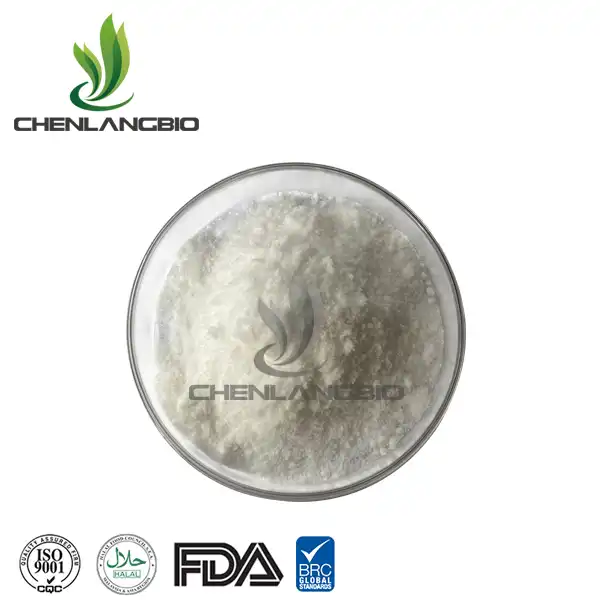
At CHEN LANG BIO TECH, we provide cosmetic manufacturers with high-purity 99% raw powder designed for modern skincare formulations. As a professional dimethylmethoxy chromanyl palmitate supplier, our focus is on delivering stable ingredient performance and technical support for formulation laboratories worldwide.
In addition to bulk supply, our technical team works with customers to provide formulation insights and ingredient documentation for brightening product development.
FAQ About Dimethylmethoxy Chromanyl Palmitate Solubility
Is Dimethylmethoxy Chromanyl Palmitate water soluble?
No. Dimethylmethoxy chromanyl palmitate is not water soluble. The ingredient is classified as a lipophilic cosmetic active and is designed to be incorporated into the oil phase of cosmetic formulations.
When working with dimethylmethoxy chromanyl palmitate solubility in cosmetic formulations, formulators typically dissolve the ingredient in compatible oil solvents such as C12-15 Alkyl Benzoate, Caprylic/Capric Triglyceride, or Ethylhexyl Cocoate before adding it to an emulsion system.
What solvents can dissolve Dimethylmethoxy Chromanyl Palmitate?
Several cosmetic emollients can effectively dissolve the ingredient. Published technical data indicate that dimethylmethoxy chromanyl palmitate solubility in oils is highest in ester-based solvents.
Examples include:
|
Solvent |
Approximate Solubility |
|
Ethylhexyl Methoxycinnamate |
~35.88% |
|
C12-15 Alkyl Benzoate |
~34.61% |
|
Ethylhexyl Cocoate |
~26.89% |
|
Caprylic/Capric Triglyceride |
~24.35% |
These solvents are frequently used in cosmetic emulsions and serums because they combine high solubility with good sensory properties.
What is the recommended usage level in skincare formulations?
The recommended usage level of dimethylmethoxy chromanyl palmitate in skincare formulations typically ranges between 0.1% and 0.5% in finished products.
Lower concentrations may be used in daily brightening serums, while higher concentrations within the recommended range are often used in targeted pigmentation treatments.
Some suppliers also provide pre-dissolved oil solutions of the ingredient, which may be incorporated into formulations to simplify manufacturing.
Can Dimethylmethoxy Chromanyl Palmitate be used in serums?
Yes. The ingredient can be incorporated into both emulsions and oil-based serums. When used in lightweight formulations, cosmetic chemists typically dissolve the ingredient in a suitable ester oil before incorporating it into the serum base.
Because of its oil solubility, dimethylmethoxy chromanyl palmitate skincare formulations often rely on emollient oils or lipid carriers to ensure proper distribution within the product.
Why is premixing recommended for this ingredient?
Premixing helps ensure complete dissolution of the active ingredient before it enters the formulation. This step reduces the risk of crystallization and improves manufacturing consistency.
For large-scale production, preparing a dimethylmethoxy chromanyl palmitate premix in an oil solvent is considered a reliable approach that simplifies incorporation into the oil phase of emulsions or anhydrous systems.
Technical Support and Ingredient Supply
Developing stable brightening formulations requires both reliable ingredient quality and practical formulation knowledge. For cosmetic chemists working with dimethylmethoxy chromanyl palmitate solubility in skincare formulations, selecting the right solvent system and usage level is essential for achieving consistent product performance.
At CHEN LANG BIO TECH, we support cosmetic laboratories and skincare brands by providing high-quality cosmetic raw materials along with technical guidance for formulation development. As an experienced dimethylmethoxy chromanyl palmitate manufacturer and supplier, we focus on delivering consistent ingredient quality suitable for modern brightening products, including creams, emulsions, and oil-based serums.
Our team can provide additional information for formulators, including:
•Technical specifications for Dimethylmethoxy Chromanyl Palmitate;
•Solubility and formulation guidance for cosmetic chemists;
•Recommended usage levels for skincare formulations;
•Documentation such as COA, MSDS, and technical data sheets;
•Bulk supply options for cosmetic manufacturing.
If you are developing pigmentation-targeting skincare products and require technical information about dimethylmethoxy chromanyl palmitate raw material supply, our team will be happy to assist.
CHEN LANG BIO TECH
Email: admin@chenlangbio.com
Website: www.chenlangbio.com
Our technical specialists are available to respond to inquiries from cosmetic chemists, product developers, and skincare manufacturers worldwide.
References
Lipotec S.A. Chromabright™ Technical Data Sheet.
Chromabright™ Cosmetic Ingredient Formulation Guide.
Cosmetic Ingredient Review and Technical Documentation on Tyrosinase Inhibitors.
Industry formulation data for oil-soluble cosmetic brightening actives.

Send Inquiry
Related Industry Knowledge
- Feed the Growing Demand: Supply High-Quality Levodopa Powder for Global Parkinson's Care
- Unlocking Radiance: The Science Behind 3-O Ethyl Ascorbic Acid
- How Do I Use Kojic Acid Dipalmitate in My Skincare Routine?
- Can Chondroitin Sulfate Powder Improve Skin Health?
- What is 4-Butylresorcinol Used for
- What is the Difference Between Ibuprofen And Flurbiprofen
- What is 4-Hexylresorcinol in Food
- Does Elderberry Extract Powder Good For Flu
- What Are the Benefits of Chaga Mushroom Extract Powder
- What is Difference Between Alpha Arbutin White Powder and Beta Arbutin