
Biochanin A vs Formononetin: Composition, HPLC and Quality
November 23, 2026
Biochanin A vs formononetin is an important technical comparison for manufacturers purchasing standardized red clover extract. Both compounds are naturally occurring O-methylated isoflavones found in Trifolium pratense L., but they differ in molecular structure, hydroxyl substitution, molecular weight, and physicochemical properties.
These differences matter when evaluating HPLC results, interpreting total isoflavone specifications, and establishing ingredient acceptance criteria. Two red clover extracts labeled 40% total isoflavones may meet the same overall assay requirement while containing different proportions of biochanin A and formononetin.
For supplement manufacturers, formulation scientists, and botanical ingredient buyers, understanding these compounds individually provides a more reliable basis for quality assessment than relying exclusively on total isoflavone content.
Biochanin A vs Formononetin Chemical Structure and Molecular Properties
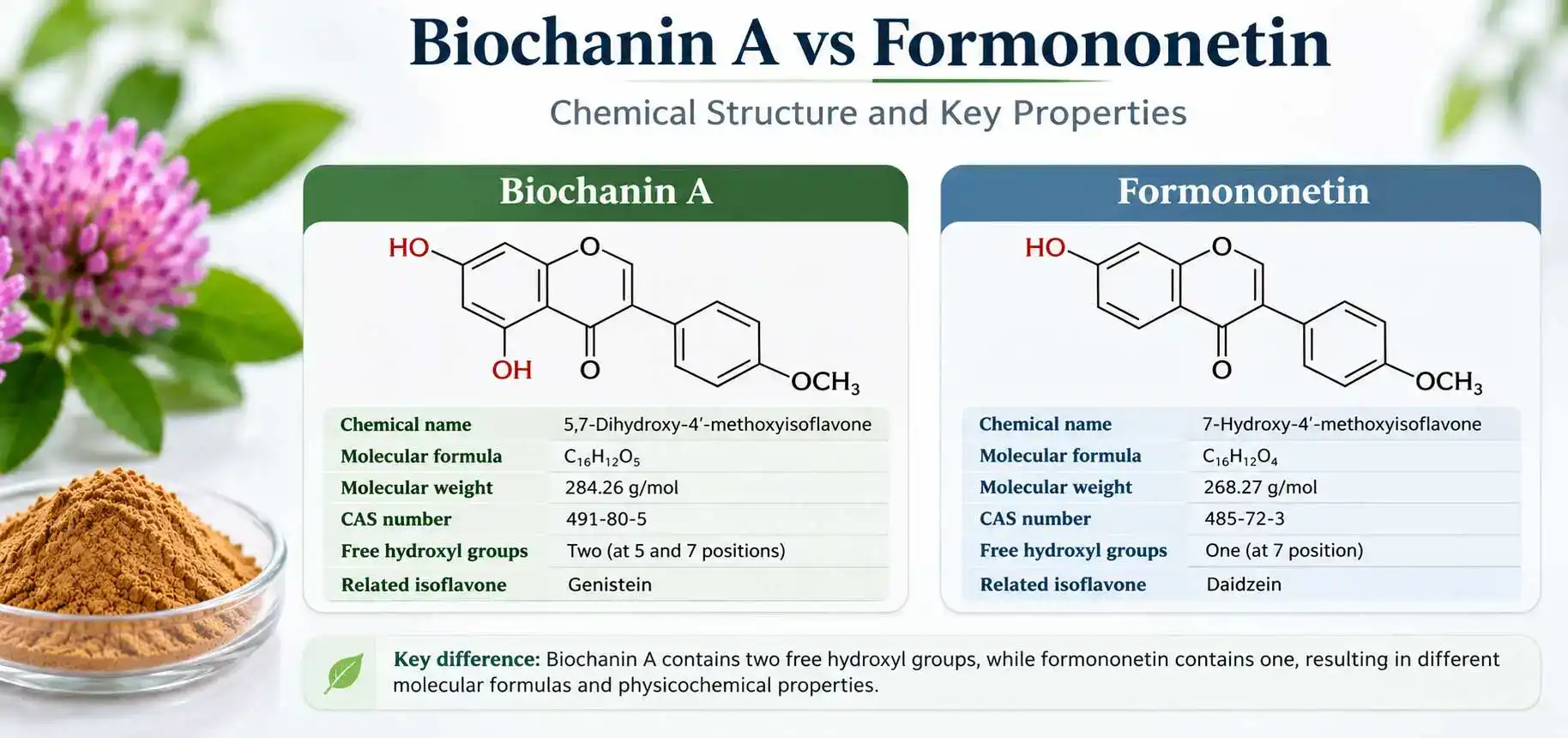
Although biochanin A and formononetin belong to the same chemical family, their structures are not identical. Both contain an isoflavone backbone and a methoxy group at the 4′ position, but biochanin A has an additional hydroxyl group.
This structural distinction influences molecular polarity, interactions with solvents, and chromatographic behavior.
♦Biochanin A Chemical Structure, Molecular Formula and Molecular Weight
Biochanin A, chemically identified as 5,7-dihydroxy-4′-methoxyisoflavone, has the molecular formula C16H12O5 and a molecular weight of approximately 284.26 g/mol. Its CAS number is 491-80-5.
The molecule contains hydroxyl groups at positions 5 and 7 and a methoxy group at position 4′.
Biochanin A is structurally related to genistein, which contains a hydroxyl group instead of the 4′-methoxy group.
This relationship is relevant to biochanin A vs genistein comparisons, particularly when examining chemical identity and analytical methods.
♦Formononetin Chemical Structure, Molecular Formula and Molecular Weight
Formononetin, or 7-hydroxy-4′-methoxyisoflavone, has the molecular formula C16H12O4 and a molecular weight of approximately 268.27 g/mol. Its CAS number is 485-72-3.
Unlike biochanin A, formononetin contains only one free hydroxyl group.
It is structurally related to daidzein, making the formononetin vs daidzein relationship important in understanding red clover isoflavone chemistry.
The absence of the additional hydroxyl group distinguishes formononetin from biochanin A and contributes to differences in molecular interactions.
♦Biochanin A vs Formononetin: Hydroxyl Groups and Structural Differences
|
Property |
Biochanin A |
Formononetin |
|
Chemical name |
5,7-Dihydroxy-4′-methoxyisoflavone |
7-Hydroxy-4′-methoxyisoflavone |
|
CAS number |
491-80-5 |
485-72-3 |
|
Molecular formula |
C16H12O5 |
C16H12O4 |
|
Molecular weight |
284.26 g/mol |
268.27 g/mol |
|
Free hydroxyl groups |
Two |
One |
|
Methoxy groups |
One |
One |
|
Related isoflavone |
Genistein |
Daidzein |
|
Chemical classification |
O-methylated isoflavone |
O-methylated isoflavone |
The biochanin A vs formononetin chemical structure comparison helps explain why the compounds require separate analytical identification.
However, molecular structure alone cannot establish which compound has better formulation performance. That determination requires experimental data under defined conditions.
Biochanin A and Formononetin Content in Red Clover Extract
The red clover isoflavone composition includes several structurally related compounds, with biochanin A and formononetin generally recognized as characteristic constituents.
Their relative concentrations are influenced by botanical origin, plant maturity, extraction conditions, and downstream processing.
Red Clover Isoflavone Composition: Biochanin A, Formononetin, Genistein and Daidzein
The principal isoflavones commonly evaluated in red clover include biochanin A, formononetin, genistein, and daidzein.
Biochanin A and formononetin frequently account for substantial portions of the measured isoflavone profile, although their proportions vary among botanical materials and commercial extracts.
These constituents may occur in free or conjugated forms, depending on the plant material and processing conditions.
Consequently, the red clover extract isoflavone profile should be evaluated using a defined analytical method rather than assumed from the botanical name.
Biochanin A and Formononetin Content Across Red Clover Extract Batches
Variations in biochanin A in red clover extract and formononetin in red clover extract can arise from several manufacturing variables.
Plant origin and harvesting conditions affect the starting material, while solvent selection influences which constituents are preferentially extracted.
Hydrolysis and purification may further change the measured distribution of individual compounds.
For commercial buyers, this means that two batches meeting the same total isoflavone specification may not necessarily have identical individual isoflavone concentrations.
Where compositional consistency is critical, the purchasing specification should include appropriate limits for selected individual compounds.
Red Clover Extract Isoflavone Profile vs Total Isoflavones
Total isoflavones and individual isoflavone content describe different aspects of ingredient quality.
Consider two hypothetical batches standardized to 40% total isoflavones:
|
Parameter |
Batch A |
Batch B |
|
Total isoflavones |
40% |
40% |
|
Biochanin A |
22% |
16% |
|
Formononetin |
12% |
18% |
|
Other measured isoflavones |
6% |
6% |
Illustrative example only. These figures are not actual CHEN LANG BIO TECH batch results and assume a consistent assay basis.
Both batches satisfy the same total concentration, yet their individual compositions differ.
This distinction becomes important when manufacturers require a reproducible biochanin A and formononetin content profile across commercial production batches.
Biochanin A vs Formononetin Solubility and Formulation Compatibility
The biochanin A vs formononetin solubility comparison is relevant to ingredient development, especially when evaluating liquid formulations, extraction systems, and analytical sample preparation.
Both compounds have limited water solubility, although their behavior varies with solvent composition, temperature, and experimental conditions.
Biochanin A Water Solubility and Organic Solvent Behavior
Biochanin A water solubility is limited by its relatively hydrophobic aromatic structure, despite the presence of hydroxyl groups.
The compound is commonly handled in suitable organic solvent systems for analytical and laboratory applications.
However, solubility values reported for purified biochanin A should not be applied directly to commercial red clover extract powder.
Other plant constituents, carriers, particle characteristics, and processing conditions can influence the apparent dissolution or dispersion behavior of the finished ingredient.
Formononetin Solubility in Water, Ethanol and Formulation Systems
Formononetin also exhibits limited aqueous solubility.
Its single free hydroxyl group and methoxy-substituted aromatic structure influence its interactions with polar and organic solvents.
When examining formononetin solubility in ethanol, manufacturers should consider solvent concentration, temperature, and the required compound loading.
Without comparable experimental conditions, it would be inappropriate to claim that formononetin is universally more soluble than biochanin A.
Biochanin A vs Formononetin in Standardized Red Clover Extract Formulations
For supplement manufacturers, the relevant consideration is the performance of the complete standardized extract.
|
Formulation Parameter |
Recommended Evaluation |
|
Water solubility |
Dissolved concentration under defined conditions |
|
Dispersibility |
Powder distribution in the intended medium |
|
Suspension stability |
Sedimentation and physical separation |
|
Particle size |
Effects on mixing and dissolution |
|
Solvent compatibility |
Behavior in permitted formulation solvents |
|
Excipient compatibility |
Interaction with other formulation ingredients |
A powder that disperses uniformly in water is not necessarily water-soluble.
Therefore, ingredient suppliers should distinguish true dissolution from physical suspension when discussing formulation suitability.
Biochanin A vs Formononetin HPLC Analysis and Quantification
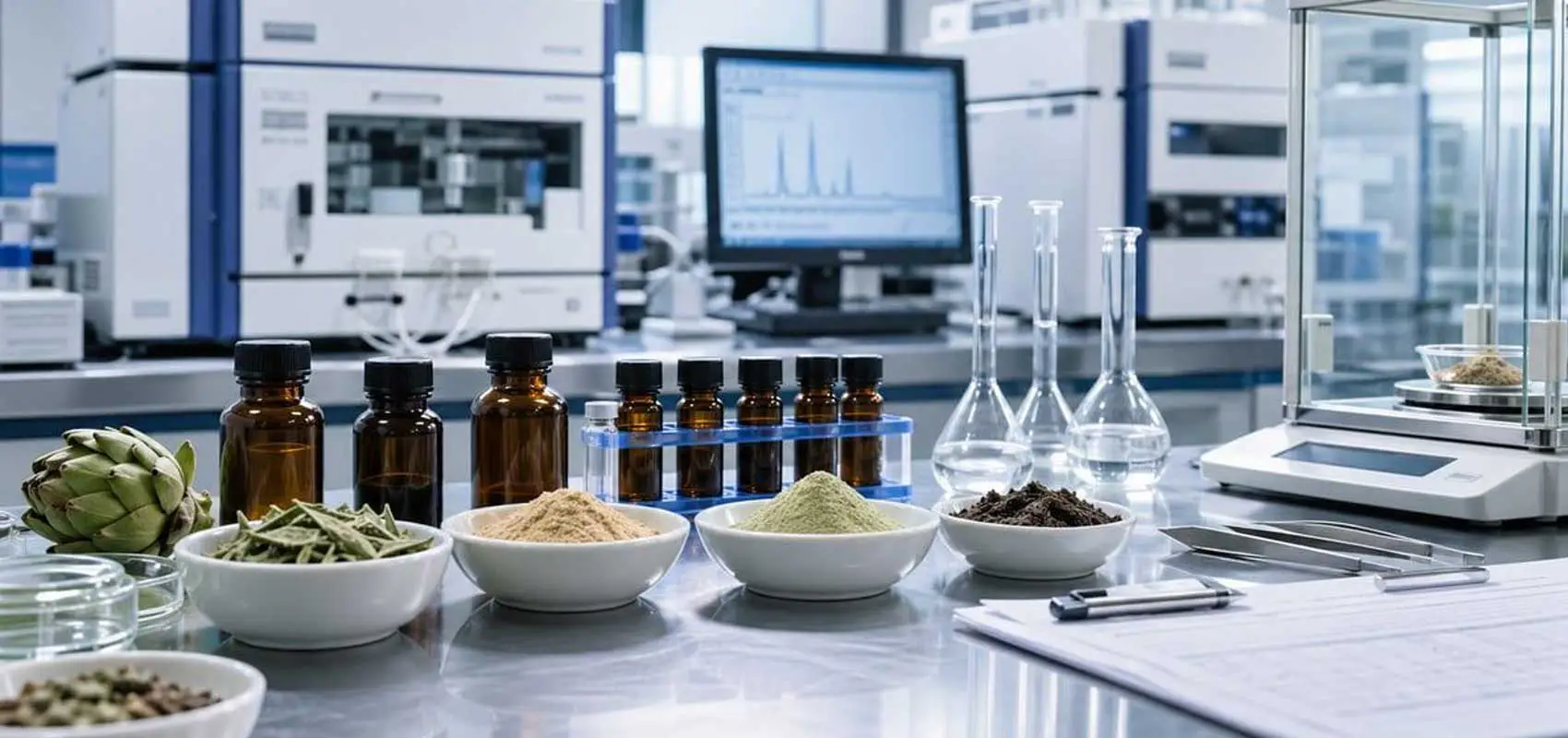
Biochanin A HPLC analysis and formononetin HPLC analysis are important tools for identifying and quantifying individual isoflavones in standardized red clover extract.
High-performance liquid chromatography allows laboratories to separate compounds within a complex botanical matrix and determine their concentrations using appropriate reference standards.
However, reliable results depend on method suitability, sample preparation, calibration, and accurate interpretation.
HPLC Identification of Biochanin A and Formononetin in Red Clover Extract
During red clover extract HPLC testing, a prepared sample is introduced into a chromatographic system designed to separate the relevant isoflavones.
Biochanin A and formononetin can be identified by comparison with authenticated reference standards under the same analytical conditions.
Retention time provides useful information, but it should not be treated as conclusive evidence of compound identity without appropriate method specificity.
Where necessary, additional spectral or mass spectrometric information can strengthen identification.
The laboratory should also establish whether the analytical procedure measures free compounds, conjugated forms, or compounds released through hydrolysis.
Biochanin A vs Formononetin HPLC Peak Area and Assay Calculation
One of the most common analytical misunderstandings is assuming that chromatographic peak area directly represents compound weight percentage.
Peak area reflects detector response, which depends on analyte concentration, detection conditions, and compound-specific response characteristics.
Because biochanin A and formononetin may respond differently at a selected wavelength, their peak areas cannot automatically be compared as equivalent masses.
Reliable quantification generally requires suitable reference standards and calibration procedures.
The calculation must account for sample weight, extraction recovery where relevant, dilution factors, and the established reporting basis.
For procurement teams, a chromatogram showing prominent peaks is useful supporting information, but it does not replace a properly calculated quantitative result.
HPLC Method Validation for Red Clover Isoflavone Quantification
A suitable analytical method should demonstrate that it can reliably measure the intended compounds in the relevant botanical matrix.
Important validation characteristics include specificity, accuracy, precision, linearity, working range, and robustness.
Detection and quantitation limits may also be relevant, depending on the method's intended purpose.
The ICH Q2(R2) framework provides useful principles for analytical procedure validation, although the specific validation requirements should reflect the application and applicable quality standards.
For routine commercial testing, method performance should remain appropriate across the expected concentration range.
Red Clover Extract HPLC Chromatogram and Reference Standards
A red clover extract HPLC chromatogram can support ingredient identification and batch comparison when interpreted alongside the analytical method.
Buyers evaluating laboratory documentation should confirm that the relevant peaks have been identified using appropriate standards and that quantitative results correspond to the agreed specification.
A supplier reporting only a total isoflavone percentage may provide sufficient information for some purchasing specifications.
However, manufacturers requiring controlled individual isoflavone concentrations should request additional quantitative data.
Red Clover Extract Isoflavone Standardization: Total Content vs Individual Compounds
Red clover extract HPLC standardization establishes a defined concentration of selected isoflavones in a commercial botanical ingredient.
Nevertheless, the meaning of the declared percentage depends on the analytical method and calculation basis.
Red Clover Extract 8%, 20% and 40% Total Isoflavones
CHEN LANG BIO TECH supplies standardized red clover extract in 8%, 20%, and 40% total isoflavone grades.
|
Product Grade |
Total Isoflavone Specification |
Purchasing Consideration |
|
Red Clover Extract 8% |
8% |
Lower-concentration ingredient |
|
Red Clover Extract 20% |
20% |
Intermediate-concentration ingredient |
|
Red Clover Extract 40% |
40% |
Higher-concentration ingredient |
Higher concentrations can reduce the theoretical extract quantity required to achieve a specified total isoflavone target.
However, higher total concentration does not establish superior quality or guarantee a particular individual isoflavone profile.
Total Isoflavones vs Biochanin A and Formononetin Content
The distinction between total isoflavones vs biochanin A content is particularly important when reviewing commercial specifications.
A product labeled standardized red clover extract 40% isoflavones does not necessarily contain 40% biochanin A or 40% formononetin.
The declared percentage represents the total determined according to the supplier's specified analytical procedure.
Depending on that procedure, the result may include selected individual isoflavones, conjugated compounds, or concentrations expressed using a defined equivalent basis.
Manufacturers requiring a minimum concentration of biochanin A or formononetin should establish separate acceptance criteria.
Standardized Red Clover Extract COA and Isoflavone Specifications
A standardized red clover extract COA should identify the product, batch, analytical method, specification limits, and actual test results.
Where individual compound concentrations are commercially important, those requirements should be agreed upon before purchasing.
For example, a buyer may require both a minimum total isoflavone concentration and additional limits for biochanin A or formononetin.
This approach provides greater control over ingredient composition than relying exclusively on a single total assay value.
Biochanin A and Formononetin in Supplement Formulation
Biochanin A supplement formulation and the use of formononetin-containing botanical ingredients require consideration of the complete extract specification.
For most supplement manufacturers, the practical raw material is a standardized red clover extract rather than an isolated individual compound.
Red Clover Extract Capsule Formulation and Isoflavone Loading
In red clover extract capsule formulation, the declared total isoflavone concentration influences the theoretical quantity of extract required.
For an illustrative target of 40 mg total isoflavones:
|
Extract Grade |
Theoretical Extract Quantity |
|
8% total isoflavones |
500 mg |
|
20% total isoflavones |
200 mg |
|
40% total isoflavones |
100 mg |
These are formulation calculations, not recommended intake levels. They assume comparable assay definitions.
The actual capsule design must also account for bulk density, other ingredients, manufacturing losses, and finished-product specifications.
Biochanin A and Formononetin in Tablet and Powder Formulations
For tablet and powder applications, particle size distribution, moisture, bulk density, and powder flow influence manufacturing performance.
A high-isoflavone extract may reduce the required ingredient weight but still require excipients to achieve suitable processing characteristics.
Therefore, a formononetin supplement ingredient or biochanin A-containing extract should be evaluated through representative formulation trials rather than selected solely on chemical concentration.
Selecting Red Clover Extract for Supplement Manufacturers
For red clover extract for supplement manufacturers, the preferred grade should satisfy the required assay, individual compound specifications where applicable, and physical processing requirements.
The choice should also reflect the intended product category and destination-market regulatory requirements.
Red Clover Extract Quality Specifications and Batch-to-Batch Consistency
Consistent botanical ingredient quality requires control over both chemical composition and potential contaminants.
A total isoflavone specification provides one measure of standardization, but it does not fully describe every quality characteristic.
Biochanin A and Formononetin Content as Quality Indicators
Individual compound concentrations can support red clover extract batch consistency assessments.
Monitoring biochanin A and formononetin may help identify meaningful changes in the extract profile between production batches.
However, there is no universal ratio that defines the quality of every red clover extract.
Acceptance limits should be based on the intended ingredient specification, manufacturing process, and available analytical evidence.
Red Clover Extract Heavy Metals, Pesticide Residues and Microbiological Testing
Appropriate red clover extract quality specifications should address relevant contaminants, including heavy metals, pesticide residues, residual solvents, and microbiological quality.
Moisture and storage conditions may also affect ingredient stability and handling.
Testing requirements should reflect the botanical source, manufacturing process, customer specifications, and destination-market regulations.
Red Clover Extract COA, TDS and SDS for Supplier Qualification
A complete supplier evaluation generally includes the batch-specific COA, technical data sheet, and applicable safety data sheet.
CHEN LANG BIO TECH uses analytical capabilities including HPLC, GC, and AAS to support botanical ingredient quality assessment.
Our quality control approach also addresses pesticide residues, residual solvents, heavy metals, and microbiological testing.
These controls help customers evaluate ingredient suitability before commercial production.
Bulk Red Clover Extract Supplier: Standardization, Price and Purchasing Considerations
Selecting a standardized red clover extract supplier requires evaluating technical capability alongside commercial supply conditions.
For manufacturers purchasing ingredients repeatedly, consistent specifications and reliable documentation are essential.
Choosing a Standardized Red Clover Extract Manufacturer
When evaluating a red clover extract manufacturer, buyers should review botanical traceability, extraction and standardization capability, analytical testing, batch documentation, and supply reliability.
A supplier should be able to explain how the declared isoflavone concentration is measured and whether individual compound testing is available.
This is particularly important for manufacturers requiring controlled biochanin A and formononetin profiles.
Red Clover Extract Bulk Price and Isoflavone Grade Selection
Red clover extract bulk price should be evaluated in relation to the declared isoflavone concentration and the required formulation quantity.
A higher-concentration extract may require less material to achieve the same total isoflavone target, but the price per kilogram may also differ.
For meaningful cost comparisons, buyers should consider the assay basis, individual compound requirements, processing performance, testing costs, and shipping conditions.
A lower quotation does not necessarily represent a lower finished-product ingredient cost.
Red Clover Extract Samples, MOQ and Bulk Quotations
Before ordering bulk red clover extract powder, procurement teams should confirm the required grade and technical documentation.
A red clover extract sample allows customers to evaluate the ingredient before approving commercial quantities.
For red clover extract powder wholesale orders, request confirmation of the red clover extract MOQ, packaging, lead time, and applicable shipping terms.
Buyers seeking a red clover extract bulk quotation should provide their target specification, expected quantity, destination country, and any individual isoflavone testing requirements.
Biochanin A vs Formononetin FAQ for Ingredient Buyers
What Is the Main Difference Between Biochanin A and Formononetin?
Biochanin A contains two free hydroxyl groups and has a molecular weight of approximately 284.26 g/mol. Formononetin contains one free hydroxyl group and has a molecular weight of approximately 268.27 g/mol.
Does 40% Red Clover Extract Contain 40% Biochanin A?
No. A 40% total isoflavone specification does not establish that biochanin A individually accounts for 40% of the extract.
Can HPLC Measure Biochanin A and Formononetin Separately?
Yes. An appropriately developed and validated HPLC method can separate and quantify the compounds using suitable reference standards and calibration procedures.
Should Buyers Specify Individual Isoflavone Content?
Yes, when the formulation or quality program requires control over particular compounds. Individual limits should be included in the agreed purchasing specification.
Buy Standardized Red Clover Extract Powder from CHEN LANG BIO TECH
CHEN LANG BIO TECH supplies 8%, 20%, and 40% standardized red clover extract for supplement ingredient sourcing and formulation development.
If you are looking to buy red clover extract powder, contact our team to discuss specifications, HPLC documentation, sample evaluation, and commercial supply requirements.
As a red clover extract 40% isoflavones supplier, we welcome inquiries from supplement manufacturers, contract manufacturers, and botanical ingredient distributors.
Request Red Clover Extract Specifications, Samples and Bulk Pricing
Email: admin@chenlangbio.com
References
1. National Center for Biotechnology Information. PubChem Compound Summary: Biochanin A, CID 5280373.
2. National Center for Biotechnology Information. PubChem Compound Summary: Formononetin, CID 5280378.
3. Andres, S., et al. Determination of the Isoflavone Composition and Estrogenic Activity of Commercial Dietary Supplements Based on Soy or Red Clover. Food & Function.
4. International Council for Harmonisation. ICH Q2(R2): Validation of Analytical Procedures.
5. World Health Organization. Quality Control Methods for Herbal Materials.
6. U.S. Food and Drug Administration. 21 CFR Part 111 — Current Good Manufacturing Practice in Manufacturing, Packaging, Labeling, or Holding Operations for Dietary Supplements.

Send Inquiry

Related Industry Knowledge
- 3-O-Ethyl Ascorbic Acid vs L-Ascorbic Acid: Stability and Formulation
- What Is Turkesterone Powder Used For in Supplements?
- Zeaxanthin for Gummies: Ingredient Selection and Formulation Considerations
- NAD vs NR: Which Ingredient Should Supplement Brands Choose?
- Why Is Hydrolyzed Keratin Popular in Premium Hair Products?
- What Concentration of Kojic Acid Dipalmitate is Most Effective?
- Podophyllin Powder: A Complete Guide
- Is Camellia Oleifera Seed Extract Good for Skin
- Can Icariin Increase Testosterone
- What is Garlic Extract Powder Allicin