
Zeaxanthin for Gummies: Ingredient Selection and Formulation Considerations
2026-09-09 18:56:23
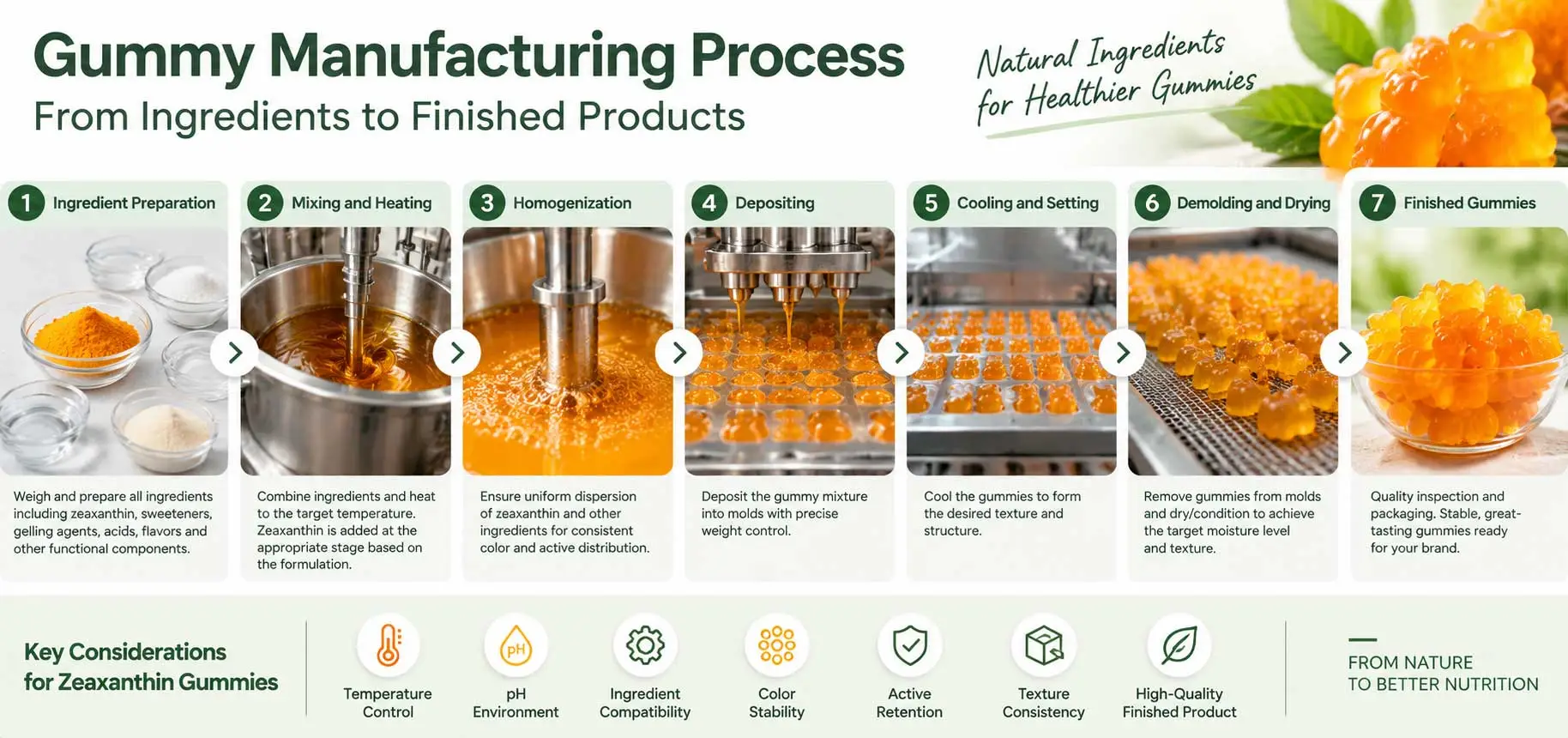
The development of zeaxanthin for gummies requires a different formulation approach compared with capsules, tablets or simple powder blends. A gummy is not just a delivery format; it is a complex food matrix involving water, sugars, hydrocolloids, proteins or plant-based gelling systems, heating steps, cooling processes and long-term storage conditions.
For ingredient buyers, the key question is not simply whether a zeaxanthin powder contains the required amount of active carotenoid. The more important question is whether the selected ingredient form can maintain its identity, color, dispersion, stability and active content throughout the entire gummy manufacturing process.
A conventional high-assay zeaxanthin powder may provide a higher active concentration, but a microencapsulated zeaxanthin for gummies grade may provide advantages when the formulation requires improved dispersion, better handling or additional protection from environmental stress.
The right choice depends on the relationship between the ingredient and the finished product.
The best zeaxanthin ingredient for a gummy formulation is the one that matches the processing conditions, matrix structure and quality requirements of the final product, not simply the one with the highest assay.
Why Gummies Create Different Challenges Compared with Capsules
A capsule and a gummy may contain the same active ingredient, but the manufacturing environment is completely different.
For a capsule, zeaxanthin powder for gummies is not directly comparable because capsule production generally involves dry filling, blending and encapsulation with limited thermal exposure.
Gummy production introduces several additional challenges:
•water-based processing;
•heating during syrup preparation;
•interaction with gelatin, pectin or other gelling systems;
•cooling and setting;
•drying or conditioning;
•storage under changing humidity conditions.
During gummy manufacturing, the zeaxanthin ingredient must survive multiple stages before reaching the consumer.
This is particularly relevant because zeaxanthin belongs to the xanthophyll carotenoid family. Its conjugated structure gives it strong color properties but also contributes to sensitivity toward environmental factors such as oxygen, light and heat.
A review of carotenoid chemistry highlights that carotenoids can undergo oxidation and isomerization under unfavorable processing or storage conditions, with stability influenced by temperature, oxygen exposure, light and surrounding formulation components.
Therefore, a zeaxanthin gummy formulation should not be evaluated only at the raw-material stage. The ingredient needs to be considered as part of the complete manufacturing process.
A powder that performs well in a dry blend may behave differently once introduced into a warm aqueous gummy system.
Conventional vs Microencapsulated Zeaxanthin for Gummies: Which Form Is More Suitable?
One of the most important decisions for a gummy manufacturer is selecting between a conventional powder and a delivery-system-based ingredient.
A conventional zeaxanthin powder usually focuses on providing a higher active concentration. This can be useful when the formulation requires a concentrated carotenoid source and the surrounding matrix can accommodate its physical properties.
A microencapsulated zeaxanthin powder, however, introduces a carrier system around the carotenoid. The purpose is not simply to reduce active concentration. The carrier can influence powder handling, dispersion behavior, protection from environmental exposure and compatibility with challenging formulations.
|
Factor |
Conventional zeaxanthin powder |
Microencapsulated zeaxanthin powder |
|
Active loading |
Usually higher |
Lower because carrier materials are included |
|
Water interaction |
Limited without additional formulation |
Designed for improved dispersion |
|
Processing flexibility |
Depends on application |
Often selected for complex matrices |
|
Powder handling |
Grade dependent |
Influenced by encapsulation system |
|
Stability protection |
Depends on packaging and formulation |
Carrier may provide additional protection |
|
Selection basis |
Assay and application |
Assay, carrier system and application |
It is important not to assume that encapsulation automatically makes one product superior.
The correct question is:
What does the gummy formulation require?
A simple gelatin gummy with a short processing cycle may have different requirements from a vegan pectin gummy containing multiple botanical ingredients.
For this reason, CWS zeaxanthin for gummies should be evaluated according to the finished formula rather than selected only because it represents a more advanced technology.
How Zeaxanthin Assay Affects Gummy Formulation
A common misunderstanding during ingredient selection is confusing active concentration with ingredient quality.
Zeaxanthin powder assay determines how much active zeaxanthin is present in the ingredient, but it does not automatically indicate how well the ingredient will perform during gummy manufacturing.
For example, assume a gummy product requires 5 mg of active zeaxanthin per serving. The required ingredient weight depends on the assay:
•5% zeaxanthin powder → 100 mg ingredient
•10% zeaxanthin powder → 50 mg ingredient
•20% zeaxanthin powder → 25 mg ingredient
The calculation is:
Ingredient required = target active zeaxanthin ÷ ingredient assay
This is a formulation calculation only and should not be interpreted as a recommended intake level.
In commercial development, the choice is more complicated than simply selecting the highest concentration.
A higher assay reduces the amount of powder added to each gummy, but a lower-assay microencapsulated system may provide better handling or dispersion characteristics.
This creates an important distinction:
Assay determines how much ingredient is required, while ingredient form determines how that ingredient behaves during processing.
For procurement teams, this is why comparing only the percentage number on a specification sheet can lead to the wrong decision.
Heat Processing and Zeaxanthin Stability During Gummy Manufacturing
Zeaxanthin heat stability is one of the most important considerations in gummy production because many gummy processes involve elevated temperatures.
The actual thermal exposure depends on:
•heating temperature;
•holding time;
•addition sequence;
•moisture content;
•pH;
•carrier system.
A common mistake is to ask whether zeaxanthin is simply “heat stable” or “not heat stable.” In reality, stability depends on the complete formulation environment.
A study investigating xanthophyll degradation in blood-orange juice and model systems evaluated temperatures from 45°C, 60°C, 75°C and 90°C. The researchers found that degradation behavior depended not only on temperature but also on the surrounding food matrix and carotenoid form.
This is highly relevant for gummy manufacturers because the same temperature can produce different results in different systems.
A gelatin gummy, a pectin gummy and a starch-based gummy do not provide the same chemical environment.
A carrier system may also influence thermal behavior. Research on carotenoid delivery systems has shown that interactions between carotenoids and food-grade carriers can affect protection during processing and storage.
Therefore, zeaxanthin gummy processing should be evaluated through actual pilot production rather than relying on a general temperature statement.
Does Gummy pH Affect Zeaxanthin Stability?
Zeaxanthin pH stability is another factor that cannot be separated from the complete gummy matrix.
Different gummy systems may use different acid profiles depending on flavor, preservation strategy and texture requirements. Citric acid, malic acid and other organic acids can influence the surrounding environment.
Research on xanthophyll delivery systems demonstrates that pH can change interactions between carotenoids and carrier materials.
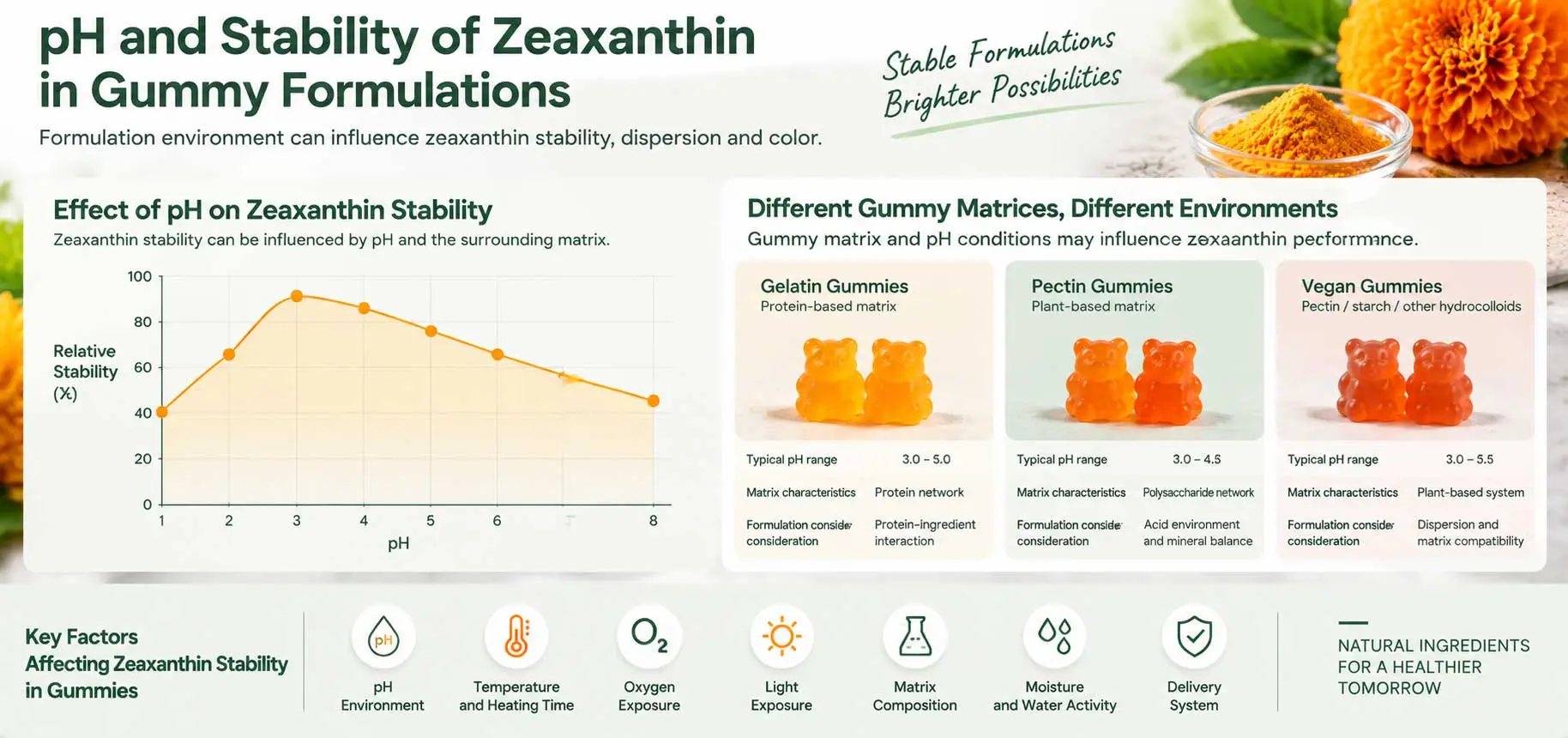
A 2024 study in Food Research International examined lutein/zeaxanthin interactions with sodium caseinate across pH values from 1.5 to 7.5. The researchers found that pH influenced carotenoid–protein interactions and that lower pH conditions strengthened hydrophobic interactions in that specific system.
However, these results should not be interpreted as a universal optimum pH for every gummy.
A gelatin gummy, pectin gummy and vegan gummy use different structural systems. The interaction between zeaxanthin and the surrounding matrix depends on:
•carrier material;
•ionic environment;
•water activity;
•processing conditions.
The practical conclusion is:
The suitable pH environment for zeaxanthin depends on the delivery system and gummy matrix, not only on the carotenoid itself.
Gelatin vs Pectin Gummies: Does the Matrix Affect Zeaxanthin Performance?
The choice between gelatin and pectin can significantly influence ingredient behavior.
Zeaxanthin gelatin gummies and zeaxanthin pectin gummies represent different formulation environments.
Gelatin is a protein-based gelling system. It can interact with hydrophobic compounds and may influence dispersion behavior through protein–ingredient interactions.
Pectin gummies, particularly vegan gummy systems, rely on polysaccharide networks and often have different requirements regarding solids content, acidity and mineral balance.
For manufacturers developing vegan zeaxanthin gummies, the ingredient selection process may require additional attention because plant-based systems often rely on combinations of pectin, starches or other hydrocolloids.
A suitable ingredient should therefore be evaluated according to:
•gel structure;
•mixing conditions;
•heating profile;
•final texture;
•storage conditions.
The same zeaxanthin powder may perform differently in different gummy bases.
This is why formulation compatibility should be tested rather than assumed.
Color Stability Is a Key Consideration for Zeaxanthin Gummies
Zeaxanthin is naturally associated with yellow-orange coloration, which can be an advantage in gummy products but also creates formulation considerations.
Zeaxanthin gummy color stability depends on more than the initial appearance.
Factors that may influence color over time include:
•oxygen exposure;
•light exposure;
•storage temperature;
•interactions with other pigments;
•oxidation reactions.
For brands developing natural-color gummies, color consistency between production batches is often commercially important.
However, visual appearance should not replace analytical testing.
A gummy may maintain an acceptable color while active zeaxanthin content changes. Conversely, slight color differences may not necessarily indicate meaningful active loss.
For this reason, color evaluation should be combined with analytical measurement such as zeaxanthin HPLC assay when stability is being assessed.
How Microencapsulation Improves Zeaxanthin Performance in Gummies
Zeaxanthin microencapsulation is widely used because the delivery system can influence how the carotenoid behaves during manufacturing.
A microencapsulation system may improve:
•powder handling;
•dispersion;
•protection from oxygen;
•compatibility with aqueous processing;
•storage performance.
A study comparing different drying technologies for co-encapsulated carotenoids, including zeaxanthin, showed that carrier materials and processing methods significantly affected encapsulation efficiency, water activity, density and storage behavior. The reported water activity values for tested powders ranged approximately from 0.229 to 0.280, demonstrating how formulation design influences powder properties.
These results do not represent a universal specification for commercial products. Instead, they demonstrate a broader principle:
Two zeaxanthin powders with the same active assay can behave differently because their surrounding delivery systems are different.
For gummy applications, this difference can affect how easily the ingredient integrates into the manufacturing process.
Moisture and Water Activity in Zeaxanthin Gummies
Unlike capsules or dry powder supplements, gummies are high-moisture food systems. Therefore, zeaxanthin gummy stability depends not only on the incoming raw material but also on how the ingredient behaves inside a hydrated gel matrix during storage.
For gummy manufacturers, moisture-related considerations include:
•water migration within the gummy;
•interaction between the carotenoid delivery system and the gel network;
•packaging barrier properties;
•storage humidity;
•changes in texture over time.
It is important to distinguish moisture content from water activity. Moisture content describes how much water exists in a product, while water activity describes how available that water is for chemical reactions, physical changes and microbial growth.
Research on carotenoid microcapsules containing zeaxanthin and other carotenoids showed that different encapsulation systems produced different powder properties. In one study comparing multiple drying technologies and carrier systems, measured water activity values were approximately 0.229–0.280, while differences were also observed in encapsulation efficiency, density and powder flow behavior.
These values should not be interpreted as universal targets for every commercial zeaxanthin ingredient. Their importance is demonstrating that carrier design influences how a carotenoid powder behaves before it enters the final product.
For zeaxanthin moisture stability, gummy developers should consider the complete system:
raw ingredient → gummy manufacturing → packaging → storage.
A stable powder does not automatically guarantee a stable finished gummy.
How to Test Zeaxanthin Before Commercial Gummy Production
Before moving from laboratory development to commercial manufacturing, a zeaxanthin gummy formulation test should evaluate the actual finished product rather than only the raw material.
A representative evaluation may include:
•ingredient incorporation behavior;
•color distribution;
•active retention after processing;
•texture compatibility;
•storage stability;
•batch-to-batch reproducibility.
This is particularly important because gummy manufacturing introduces variables that are difficult to reproduce in a simple laboratory mixing test.
For example, a small-scale formulation may show good dispersion, but commercial production may introduce:
•longer heating exposure;
•larger mixing volumes;
•different shear conditions;
•longer holding times before molding.
A zeaxanthin powder sample therefore has the greatest value when it represents the same commercial grade that will later be purchased.
The sample evaluation process should connect directly with the future production process:
laboratory trial → pilot batch → commercial batch.
This approach reduces the risk of approving an ingredient that performs well during development but creates unexpected issues during scale-up.
At CHEN LANG BIO TECH, we support customers through specification review, technical communication and sample evaluation so that ingredient selection is based on the actual application rather than a general product description.
Why HPLC Assay Matters for Zeaxanthin Gummies
A zeaxanthin HPLC assay provides important information about the active ingredient, but gummy manufacturers should understand that incoming raw-material testing and finished-product testing answer different questions.
The incoming COA answers:
“How much zeaxanthin is present in the ingredient batch?”
Finished-product testing answers:
“How much zeaxanthin remains after gummy processing and storage?”
These are related but not identical questions.
A raw material may enter production with a compliant assay, but the final gummy is influenced by:
•heating conditions;
•mixing efficiency;
•exposure time;
•oxygen;
•packaging;
•storage environment.
For this reason, analytical verification should be considered throughout the product lifecycle.
Visual appearance alone is not sufficient. A gummy can maintain an attractive orange-yellow color while active content changes, and small color changes do not always indicate significant active loss.
A professional zeaxanthin quality control approach therefore combines:
•supplier batch analysis;
•formulation validation;
•finished-product testing.
This provides a more complete understanding of whether the ingredient performs as expected.
How to Select Zeaxanthin for Different Gummy Applications
Different gummy categories create different formulation priorities.
A zeaxanthin gummy supplement designed for a simple vitamin matrix may have different requirements from a multifunctional beauty gummy containing multiple botanicals, minerals and vitamins.
|
Gummy type |
Main ingredient consideration |
|
Vitamin gummy |
Accurate active delivery and blend uniformity |
|
Vegan pectin gummy |
Hydrocolloid compatibility and dispersion |
|
Beauty gummy |
Color stability and ingredient interaction |
|
Functional gummy |
Active retention and processing stability |
|
Children’s gummy |
Sensory acceptance and formulation simplicity |
For zeaxanthin ingredient selection, the finished product should determine the raw material form.
For example:
A highly concentrated conventional powder may be attractive when formulation space is limited.
A microencapsulated grade may be more suitable when the product requires improved dispersion or additional protection during processing.
A CWS grade may be preferred when the formulation contains a significant aqueous phase or when powder handling and reconstitution performance are important.
The correct choice depends on balancing:
active concentration + processing requirements + finished-product expectations.
Packaging and Storage Considerations for Zeaxanthin Gummy Projects
Although the final gummy has its own packaging system, raw-material protection remains important before production.
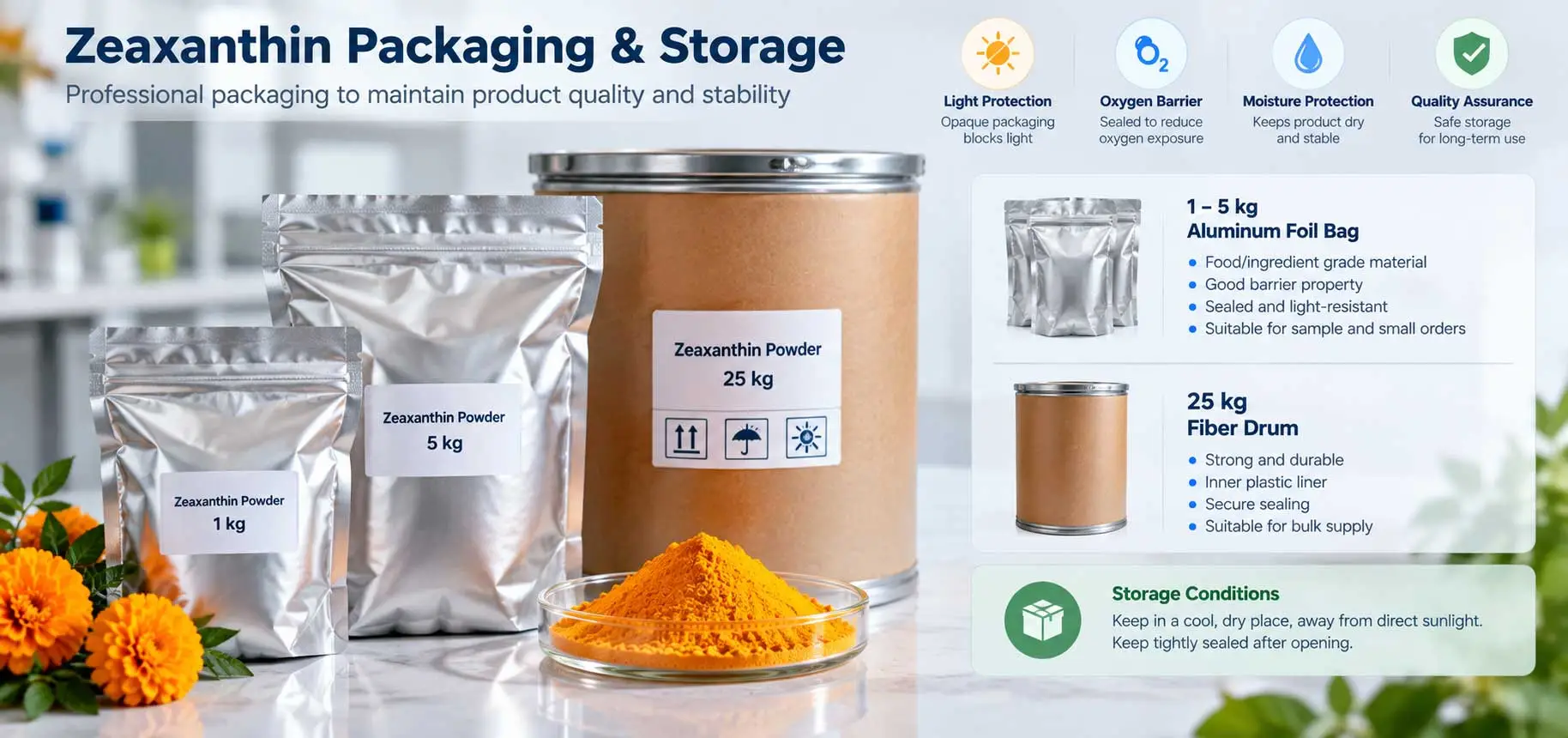
Zeaxanthin powder packaging should help protect the ingredient from unnecessary exposure to light, oxygen and moisture.
For commercial supply, CHEN LANG BIO TECH provides packaging options including:
•1–5 kg aluminum foil bags for smaller quantities;
•25 kg fiber drums for larger commercial requirements.
The purpose of protective packaging is not only transportation convenience. It helps maintain the ingredient condition established during production and quality release.
After opening, storage practices also become important. Repeated exposure to air and humidity can create a different environment from the original sealed package.
For manufacturers developing gummies, the ingredient storage period before production should therefore be considered as part of the overall quality system.
Raw-material stability and finished-product stability are connected, but they are not the same evaluation.
Scaling Zeaxanthin Gummies from R&D Trial to Commercial Production
Moving from a successful laboratory formula to commercial production requires more than increasing batch size.
During scale-up, several variables may change:
•mixing efficiency;
•heating profile;
•ingredient addition sequence;
•holding time;
•molding conditions;
•drying environment.
A formulation that works in a small beaker may behave differently in industrial equipment.
For a commercial zeaxanthin manufacturer, production consistency is therefore just as important as product availability.
CHEN LANG BIO TECH combines upstream marigold sourcing with industrial processing capability. Our raw-material network covers more than 200,000 mu across Yunnan, India and Zambia, providing a foundation for long-term carotenoid supply.
We also operate continuous counter-current extraction equipment with raw-material processing capacity reaching up to 30 metric tons per day, supporting consistent industrial production rather than only laboratory-scale preparation.
For gummy manufacturers, this matters because a successful ingredient partnership requires more than receiving one good sample. It requires confidence that future commercial batches can reproduce the approved specifications.
How Should Buyers Compare Zeaxanthin Powder Cost for Gummies?
When comparing zeaxanthin powder price, the lowest price per kilogram does not always represent the lowest formulation cost.
A conventional high-assay powder may appear attractive because it contains more active ingredient per kilogram. However, a microencapsulated grade may provide additional functionality that reduces formulation challenges.
A more practical calculation is:
Active-equivalent cost = ingredient price ÷ active fraction
However, commercial evaluation should also consider:
•required addition level;
•processing performance;
•dispersion behavior;
•potential reformulation risk;
•finished-product stability.
For gummy manufacturers, a small difference in ingredient cost may be less important than whether the ingredient consistently produces an acceptable final product.
Therefore, cost should be evaluated after technical suitability has been established.
What Should Buyers Expect from a Zeaxanthin Supplier for Gummies?
A reliable zeaxanthin supplier should be able to provide more than a product name and a quotation.
Before approving an ingredient, gummy manufacturers should understand:
•exact product grade;
•active assay basis;
•available technical documents;
•COA information;
•storage recommendations;
•application suitability;
•sample availability.
A good supplier should also understand the customer's manufacturing environment.
A gummy producer does not only need zeaxanthin. They need a grade that works with their:
•gel system;
•heating process;
•flavor profile;
•packaging;
•shelf-life requirements.
At CHEN LANG BIO TECH, we focus on connecting ingredient characteristics with the customer's formulation objectives. Instead of recommending one universal product, we evaluate the intended application and provide the technical information needed for an informed decision.
Frequently Asked Questions About Zeaxanthin for Gummies
What is the best zeaxanthin form for gummies?
The best zeaxanthin for gummies depends on the formulation requirements. A conventional powder may be suitable when higher active concentration is the priority, while a microencapsulated grade may be preferred when dispersion, processing tolerance or stability support is important.
Can zeaxanthin survive gummy manufacturing?
Zeaxanthin stability in gummies depends on the entire manufacturing process. Heat exposure, processing time, pH, oxygen and carrier system all influence final retention. A pilot trial using the actual gummy process provides more reliable information than a general temperature assumption.
Is microencapsulated zeaxanthin better for gummies?
Microencapsulated zeaxanthin for gummies can provide advantages in some formulations because the carrier system may improve powder handling and protect the carotenoid. However, suitability depends on the specific gummy matrix and processing conditions.
Can zeaxanthin affect gummy color?
Yes. Zeaxanthin gummy color is influenced by the natural orange-yellow pigment of the carotenoid and interactions with other ingredients. Color evaluation should be combined with analytical testing because appearance alone does not confirm active retention.
How much zeaxanthin powder is needed for gummies?
The amount depends on the ingredient assay. A higher-assay powder requires less ingredient weight to provide the same active level. The calculation should be based on the actual specification of the selected ingredient.
Can I test zeaxanthin before commercial gummy production?
Yes. A representative zeaxanthin powder sample should ideally be tested in the intended gummy formula before commercial production. This helps evaluate compatibility, processing performance and final-product quality.
What should I check before I buy zeaxanthin powder?
Before deciding to buy zeaxanthin powder, review the ingredient specification, assay method, COA, physical form and suitability for the intended gummy system. Technical qualification before purchasing reduces the risk of formulation problems later.
Developing Better Zeaxanthin Gummies with the Right Ingredient Partner
Developing a successful zeaxanthin gummy is not only about adding a carotenoid ingredient. It requires matching the ingredient form with the realities of gummy manufacturing.
The most effective projects usually begin with a technical conversation:
What type of gummy is being developed?
What processing conditions will the ingredient experience?
What active level is required?
Is the priority higher concentration, better dispersion or stronger formulation flexibility?
By understanding these factors early, ingredient selection becomes more predictable and commercial development becomes smoother.
CHEN LANG BIO TECH supports gummy, supplement and functional-food projects with zeaxanthin specifications, analytical documentation and formulation-oriented technical communication.
For product information, application discussion or a representative sample request, contact admin@chenlangbio.com.
References
1. PubChem. Zeaxanthin, CID 5280899. National Center for Biotechnology Information (NCBI).
Molecular formula C₄₀H₅₆O₂, molecular weight 568.9 g/mol and calculated XLogP3-AA 10.9. Provides fundamental physicochemical information supporting the lipophilic characteristics of zeaxanthin.
2. Saini R.K., et al. Chemistry, Occurrence, Properties, Applications, and Encapsulation of Carotenoids—A Review. Plants. 2023;12.
Reviews carotenoid structure, oxidation mechanisms, sensitivity to light, heat and oxygen, and the role of encapsulation technologies in improving carotenoid stability and food application performance.
3. Syamila M., Gedi M.A., Briars R., et al. A Comparison of Microfluidic-Jet Spray Drying, Two-Fluid Nozzle Spray Drying, and Freeze-Drying for Co-Encapsulating β-Carotene, Lutein, Zeaxanthin, and Fish Oil. Foods. 2021;10(7):1522.
Evaluates the effects of drying technologies and carrier systems on carotenoid encapsulation efficiency, water activity, powder flow properties, density, reconstitution behavior and storage performance.
4. Wang S., et al. Supercritical Fluid CO₂ Extraction and Microcapsule Preparation of Lycium barbarum Residue Oil Rich in Zeaxanthin Dipalmitate. Foods. 2021;10.
Investigates zeaxanthin-rich microcapsule preparation and the influence of wall materials on encapsulation efficiency, wetting behavior, solubility and powder characteristics.
5. Zhang G., et al. Decreased Formulation pH and Protein Preheating Treatment Enhance the Interaction, Storage Stability, and Bioaccessibility of Caseinate-Bound Lutein/Zeaxanthin. Food Research International. 2024;195.
Studies the influence of pH and protein heat treatment on lutein/zeaxanthin binding, storage stability and delivery performance in food-grade carrier systems.
6. Zhang G., et al. pH-Driven Fabrication of a Caseinate–Pectin Polyelectrolyte Complex as a Promising Carrier for Lutein and Zeaxanthin Delivery: Microencapsulation, Stability, and Sustained Release Properties. International Journal of Biological Macromolecules. 2024;281.
Discusses how carrier structure and pH conditions influence lutein/zeaxanthin protection, stability and controlled delivery in food formulation systems.
7. Hadjal T., Dhuique-Mayer C., Madani K., Dornier M., Achir N. Thermal Degradation Kinetics of Xanthophylls from Blood Orange in Model and Real Food Systems. Food Chemistry. 2013;138(4):2442–2450.
Examines thermal degradation behavior of xanthophyll carotenoids, including zeaxanthin, under different temperature conditions and highlights the influence of food matrix, pH and processing environment.
8. Carotenoids: Dietary Sources, Extraction, Encapsulation, Bioavailability, and Health Benefits—A Review of Recent Advancements. Antioxidants. 2022;11.
Reviews carotenoid physicochemical properties, oxidation pathways, isomerization, thermal and light sensitivity, extraction technologies and encapsulation strategies for improving application performance.

Send Inquiry
Related Industry Knowledge
- Avenanthramides Skin Benefits Explained: What International Buyers Should Know Before Sourcing
- Are Bergenia Plants Full Sun?
- How to Boost Your Energy with Sesamin Powder?
- Why Tart Cherry Extract Powder Is a Superfood
- What Does Andrographolide Do for Your Skin
- How to Make Tadalafil Powder: A Step-by-Step Guide
- Does Alpha-GPC Affect the Liver
- What is the Role of Aminolevulinic Acid
- China Natural Pearl Powder manufacturers for Skin Whitening
- Is Pure Natural Green Tea Extract the Same as Caffeine