
Berberine vs Berberine HCl: Differences, Purity and Uses
November 2, 2026
When comparing berberine vs berberine hcl, the most important distinction is chemical form. Berberine is a naturally occurring isoquinoline alkaloid, while berberine hydrochloride is a chloride salt commonly supplied as a standardized ingredient for dietary supplements. Both contain the berberine molecular structure, but their molecular composition, assay calculations, and physical properties require careful interpretation.
For supplement manufacturers, the difference between berberine and berberine hcl is not simply a matter of choosing one ingredient over another. Commercial materials labeled “berberine” may already contain berberine hydrochloride. Therefore, buyers should verify the chemical identity, assay basis, moisture content, and analytical documentation before comparing products or requesting quotations.
What Is Berberine? Understanding the Natural Alkaloid
Berberine is a yellow-colored, plant-derived protoberberine alkaloid found in several botanical families. It occurs naturally in plants such as Coptis chinensis, Phellodendron amurense, and certain Berberis species. These berberine botanical sources contain different alkaloid profiles, making botanical identification and extraction control important for ingredient standardization.
Chemically, berberine is a quaternary ammonium alkaloid. Its positively charged molecular structure is relevant to understanding the salts supplied in the commercial ingredient market.
Berberine Chemical Structure and Botanical Sources
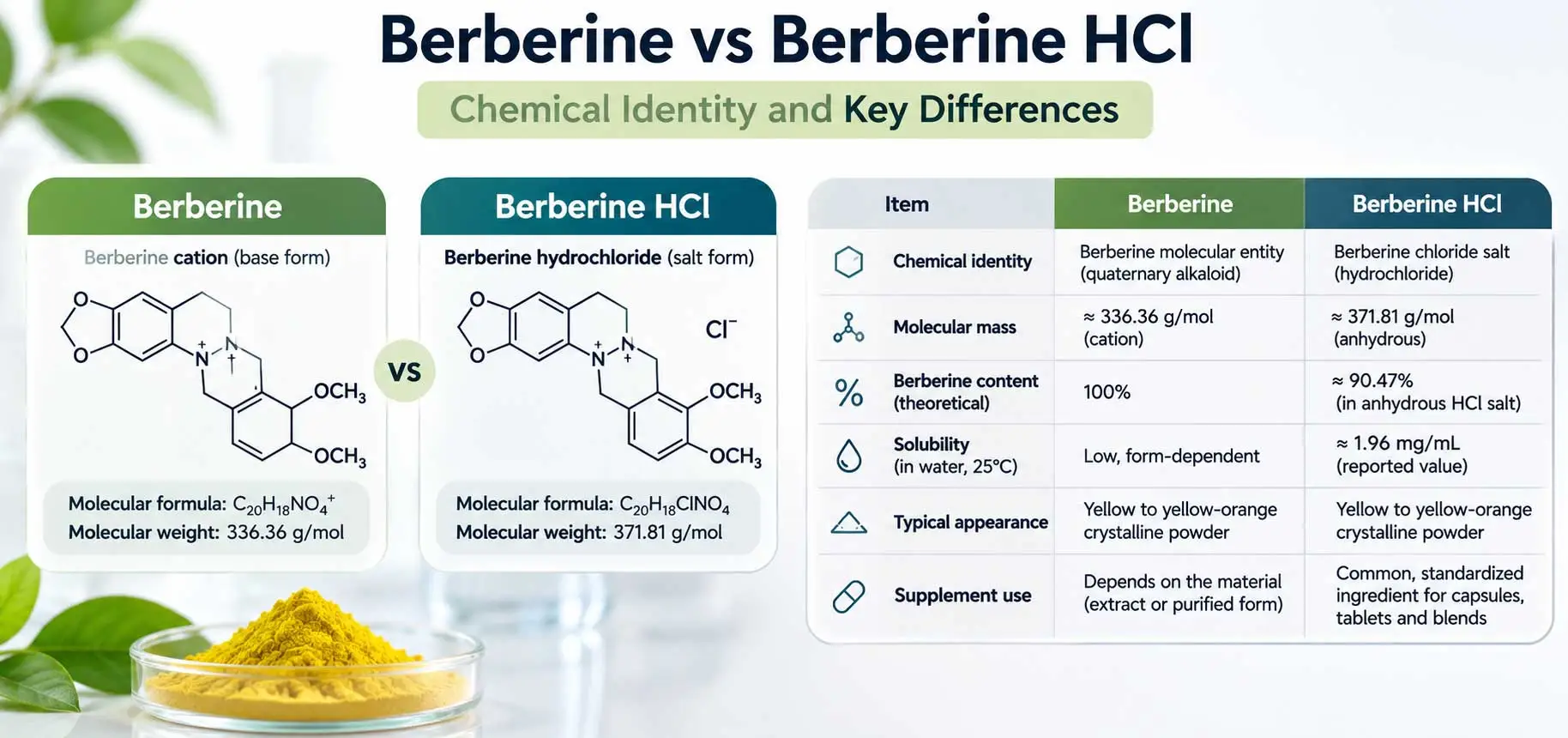
The berberine cation has the molecular formula C₂₀H₁₈NO₄⁺ and a calculated molecular mass of approximately 336.36 g/mol. Unlike a conventional neutral alkaloid, this cation requires a counterion in an isolated salt.
Consequently, the expression berberine base can be ambiguous in commercial documentation. It may describe the berberine moiety used for assay calculations rather than a separately characterized neutral ingredient.
Natural berberine alkaloid content also varies with plant species, harvested material, extraction method, and purification conditions. A crude botanical extract should not be considered equivalent to a purified berberine salt merely because both contain the same characteristic yellow alkaloid.
Berberine Base vs Berberine Salts
The distinction between berberine base vs berberine hcl becomes particularly important when interpreting analytical results.
A specification may express berberine content as the berberine moiety, while another reports the concentration of berberine hydrochloride. These values are not automatically interchangeable because the chloride counterion contributes to the molecular weight of the salt.
For commercial purchasing, the supplier should clearly identify the actual chemical form rather than relying exclusively on the general ingredient name.
What Is Berberine HCl? Chemical Identity and Raw Material Properties
Berberine hydrochloride powder, commonly called berberine HCl, is the chloride salt of berberine. It is widely encountered as a purified ingredient in the supplement raw-material market, where manufacturers require a defined identity and measurable assay specification.
Berberine Hydrochloride Chemical Formula and CAS Number
Anhydrous berberine hydrochloride has the molecular formula C₂₀H₁₈ClNO₄ and a molecular weight of approximately 371.81 g/mol. Its commonly referenced CAS number is 633-65-8.
The difference between the berberine cation and the anhydrous hydrochloride salt can be expressed through their molecular weights:
|
Chemical identity |
Molecular weight |
|
Berberine cation, C₂₀H₁₈NO₄⁺ |
Approximately 336.36 g/mol |
|
Anhydrous berberine hydrochloride, C₂₀H₁₈ClNO₄ |
Approximately 371.81 g/mol |
|
Berberine moiety as a percentage of pure anhydrous HCl salt |
Approximately 90.47% |
This calculation is useful when reviewing ingredient declarations. However, it is a theoretical molecular-weight relationship, not a substitute for an analytical assay. Hydration state, impurities, and the basis of reporting must also be considered.
Commercial berberine hcl CAS 633-65-8 documentation should identify the salt form and, where relevant, whether the material is anhydrous or hydrated.
Berberine HCl Powder in Commercial Ingredient Supply
A typical berberine hcl raw material is supplied as a yellow to yellow-orange crystalline powder. However, appearance alone cannot confirm identity, purity, or suitability for supplement manufacturing.
Buyers evaluating berberine hcl powder for supplements should review the assay method, identification results, moisture or loss-on-drying limits, contaminant specifications, and batch traceability.
A standardized ingredient is valuable because its quality can be assessed against defined acceptance criteria. Nevertheless, a high assay does not automatically establish regulatory suitability, good manufacturing practice compliance, or consistency across commercial batches.
Berberine vs Berberine HCl: Key Chemical and Physical Differences
The practical comparison of berberine vs berberine hydrochloride depends on whether “berberine” refers to the molecular entity, a botanical extract, or a specifically identified purified material.
|
Property |
Berberine |
Berberine HCl |
|
Chemical identity |
Berberine molecular entity |
Berberine chloride salt |
|
Molecular composition |
Berberine cation, C₂₀H₁₈NO₄⁺ |
C₂₀H₁₈ClNO₄, anhydrous |
|
Molecular mass |
336.36 g/mol for the cation |
371.81 g/mol for anhydrous salt |
|
Botanical origin |
Naturally occurs in multiple plant species |
May be manufactured from purified botanical berberine |
|
Purity declaration |
Requires a clearly defined assay basis |
May be reported as hydrochloride salt content |
|
Solubility |
Depends on the actual chemical form |
Depends on solvent, temperature, concentration and medium |
|
Supplement application |
Depends on the material supplied |
Common commercial ingredient form |
|
Quality verification |
Identity and assay must be established |
Identity, salt form, assay and contaminants must be verified |
The berberine chemical differences most relevant to procurement involve counterion composition, molecular weight, analytical reporting, and the physical characteristics of the supplied powder.
Importantly, the presence of a hydrochloride counterion does not independently establish superior clinical performance. Such claims would require formulation-specific and appropriately designed comparative evidence.
For buyers, the more useful question is whether the proposed ingredient meets the intended product specification and can be supported by reproducible quality documentation.
Berberine HCl Purity: Understanding 97%, 98% and HPLC Assay
Commercial berberine hcl purity is commonly expressed as a percentage, with 97% and 98% appearing in supplier specifications. Although these figures look straightforward, their technical meaning depends on the analytical method and the basis used to calculate the result.
Berberine HCl 97% vs 98%: What the Assay Means
When comparing berberine hcl 97% vs 98%, the difference is one percentage point in the declared assay. It does not necessarily indicate a meaningful difference in processing performance, nor does it establish that the higher-assay material has lower levels of every impurity.
For example, a 100 kg batch containing 98% berberine hydrochloride on an as-is basis theoretically contains 98 kg of the specified compound. However, if the assay is reported on a dried basis, moisture must be considered before calculating the actual compound content in the delivered material.
The difference also matters when comparing suppliers quoting different analytical methods.
HPLC Testing and the Basis of Purity Claims
Berberine hcl HPLC assay testing can provide quantitative information about the target compound, but the calculation method must be clearly identified.
A validated external-standard method determines content against a reference standard. By contrast, chromatographic area normalization estimates the relative contribution of detected peaks under the selected conditions. The two approaches should not automatically be treated as equivalent.
Buyers evaluating berberine hcl 98% hplc should therefore request the test method, reference-standard information, calculation basis, and representative chromatographic data where appropriate.
A high purity berberine hcl specification is most useful when supported by identity testing, impurity controls, and consistent batch results rather than an assay figure alone.
Berberine HCl Solubility and Stability in Supplement Formulation
Berberine hcl solubility is an important consideration for liquid formulations, premixes, and products in which dissolution behavior may influence processing. However, its solubility cannot be described accurately without specifying the solvent, temperature, concentration, and surrounding chemical environment.
Berberine HCl Water Solubility and pH Considerations
A published physicochemical study reported an aqueous solubility of approximately 1.96 ± 0.11 mg/mL at 25°C and approximately 3.16 mg/mL at 37°C, calculated from the reported molar solubility. These values illustrate that berberine chloride has measurable but limited aqueous solubility under the experimental conditions.
The same research found that buffer composition substantially influenced the measured solubility. At 25°C, phosphate buffer at pH 7.0 produced approximately 4.05 mM solubility, while several other tested buffer systems produced much lower values.
Interestingly, when phosphate-based buffers were used across different pH conditions, the observed solubility became relatively consistent. This suggests that the buffer components, rather than pH alone, contributed significantly to the differences.
For formulators asking is berberine hcl water soluble, the practical answer is that it dissolves to a limited extent, but its behavior is formulation-dependent. A published solubility value should not be treated as a universal limit for every commercial formulation.
Stability, Processing Temperature and Ingredient Compatibility
The same study reported less than 5% degradation over six months under its tested solution-stability conditions. This is useful experimental evidence, but it should not be interpreted as proof that every berberine formulation will remain stable for six months.
Commercial berberine hcl stability depends on the formulation matrix, storage conditions, packaging, and compatibility with other ingredients.
For dry capsules and tablets, moisture control and physical properties may be more immediately relevant than aqueous solubility. For liquid products, formulators should evaluate precipitation, assay retention, color changes, and compatibility throughout the proposed shelf life.
Consequently, berberine hcl formulation development should rely on actual product testing rather than assuming that the hydrochloride salt will behave identically in water, buffered solutions, and multi-ingredient systems.
Berberine HCl Uses in Capsules, Tablets and Nutraceutical Products
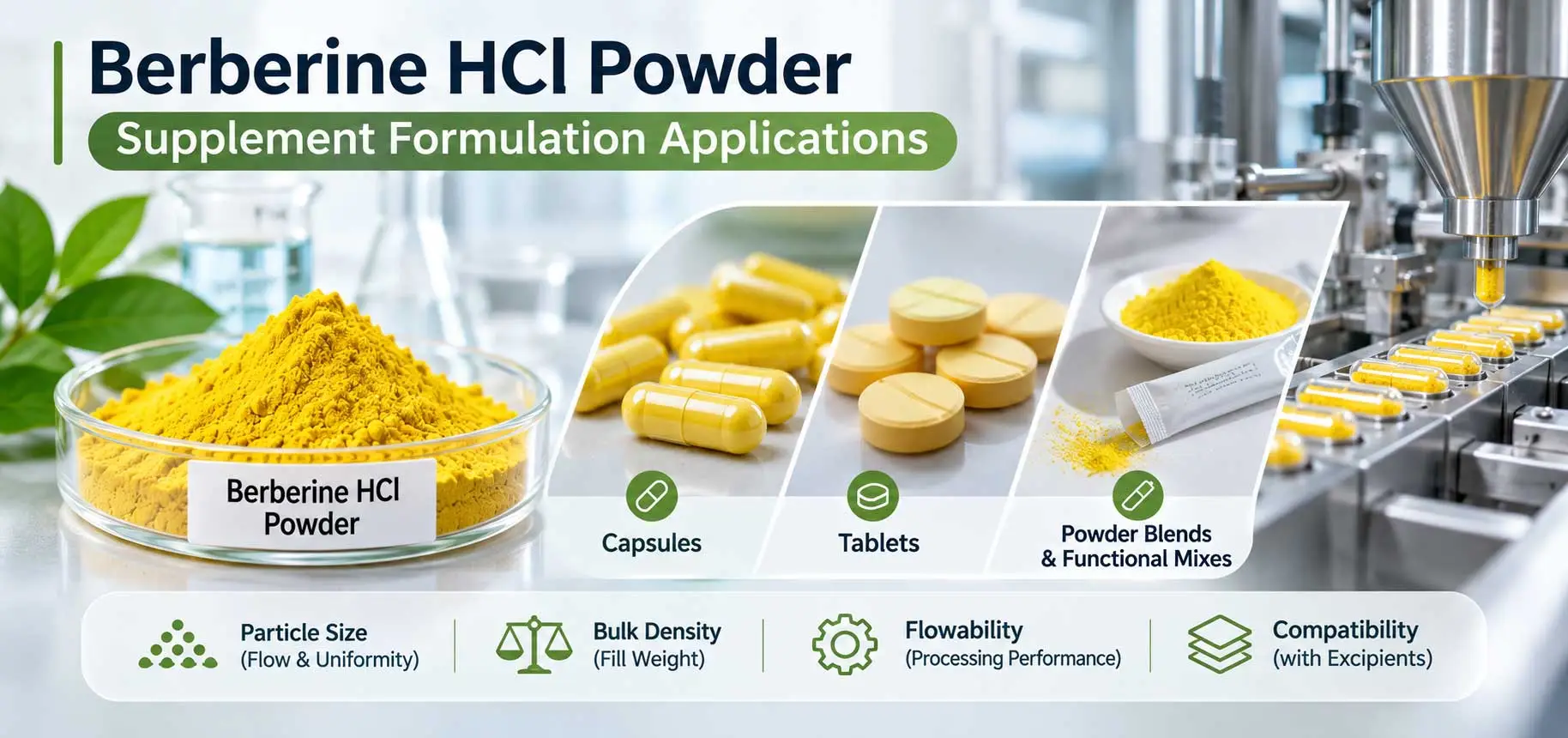
The main commercial berberine hcl uses in supplement manufacturing involve solid oral dosage forms, particularly capsules and tablets. The ingredient's standardized identity makes it suitable for evaluation in formulations requiring controlled input quantities and documented quality specifications.
Berberine HCl for Capsule and Tablet Manufacturing
When selecting berberine hcl for capsules, manufacturers should assess particle-size distribution, bulk density, flowability, and blending uniformity.
A fine powder may provide a different surface area and mixing behavior from a coarser grade, while low bulk density can affect capsule-fill volume. These properties are not reliably predicted by the assay percentage.
For berberine hcl for tablets, additional considerations include compressibility, excipient compatibility, lubrication, and the finished tablet's disintegration performance.
A powder that meets chemical purity requirements may still require formulation adjustments before it performs consistently on commercial equipment.
Berberine HCl Powder in Multi-Ingredient Formulations
In multi-ingredient products, berberine supplement raw material selection should account for interactions with excipients and other components, particularly where moisture, color, or dissolution behavior may affect the finished formulation.
For example, a capsule containing multiple botanical extracts may present different flowability and blend-uniformity challenges from a simple formulation containing berberine hydrochloride and standard excipients.
Manufacturers should therefore qualify the raw material under conditions representative of their intended production process.
Berberine HCl Quality Standards: What Raw Material Buyers Should Verify
A reliable berberine hcl specification should define more than assay and appearance. For commercial ingredient approval, purchasing and quality teams need sufficient documentation to establish identity, purity, contaminant control, and consistency.
Berberine HCl COA, Identification and Contaminant Testing
A batch-specific berberine hcl coa should be reviewed against an agreed specification rather than accepted solely because the reported assay meets a numerical target.
|
Quality parameter |
What buyers should verify |
|
Appearance |
Color and physical form against the agreed specification |
|
Identification |
Appropriate analytical confirmation of the target compound |
|
Assay |
Method, acceptance range, and reporting basis |
|
Loss on drying or water |
Moisture-related results and their relevance to assay |
|
Related substances |
Defined impurity controls where applicable |
|
Heavy metals |
Element-specific limits appropriate to the intended use |
|
Microbiology |
Applicable microbial acceptance criteria |
|
Particle size |
Distribution or mesh requirements when relevant |
|
Batch information |
Lot number, testing date, and traceability |
For berberine raw material testing, contaminant limits should reflect the applicable market, intended use, and finished-product exposure rather than relying on a single universal specification.
Batch Consistency and Supplier Documentation
A supplier's quality system should support repeatable manufacturing and traceable documentation.
Buyers may request representative COAs from multiple batches, a technical data sheet, safety documentation, and information about analytical methods. Where risk assessment justifies it, independent laboratory verification can provide additional confidence.
A dependable berberine hcl supplier quality program should also address deviations, specification changes, and the management of nonconforming batches.
For long-term manufacturing projects, these controls may be more valuable than a small difference in nominal assay or a marginally lower purchase price.
Sourcing Bulk Berberine HCl Powder: Supplier, Price and Purchasing Criteria
Purchasing bulk berberine hcl powder requires more than comparing quotations. For supplement manufacturers and ingredient distributors, the objective is to secure a material that meets the agreed specification and remains consistent across repeat orders.
Evaluating a Berberine HCl Powder Supplier
A qualified berberine hcl powder supplier should provide clear information about the material's identity, assay method, botanical origin where applicable, and batch quality controls.
Before approving a supplier, buyers should establish whether the proposed specification is compatible with their manufacturing process and target market. Sample evaluation is particularly important when particle size, bulk density, or blending performance affects production.
Documentation should also be reviewed for consistency. The product name, chemical identity, specification, and COA should refer to the same material.
Bulk Berberine HCl Price, MOQ and Sample Requirements
The berberine hcl powder price may vary with assay specification, raw material sourcing, order quantity, analytical requirements, and delivery terms.
When comparing berberine hcl wholesale quotations, buyers should confirm whether prices refer to equivalent specifications and include the same documentation, packaging, and shipping arrangements.
The berberine hcl MOQ and sample availability should also be established before commercial qualification. For repeat purchasing, consistency of supply and predictable lead times can be as important as the initial price per kilogram.
CHEN LANG BIO TECH — Berberine HCl Powder Supply for Commercial Buyers
At CHEN LANG BIO TECH, we understand that selecting a berberine hcl manufacturer or ingredient supply partner involves both technical evaluation and commercial planning.
We supply berberine hydrochloride powder for customers evaluating raw materials for supplement development and commercial manufacturing. Our team can discuss specification requirements, available quality documentation, sample evaluation, packaging, and bulk purchasing arrangements.
For companies planning to buy berberine hcl powder in bulk, we recommend confirming the required assay basis, physical properties, and destination-market documentation before finalizing an order.
Contact us to request the current specification, batch COA, sample availability, and quotation for our Berberine HCl Powder.
Frequently Asked Questions About Berberine vs Berberine HCl
Is berberine the same as berberine HCl?
Berberine refers to the molecular entity, while berberine HCl is its chloride salt. Both contain the berberine structure, but the hydrochloride salt includes a chloride counterion. Commercial products labeled simply as berberine may contain berberine hydrochloride, so buyers should verify the actual chemical identity and assay basis.
What is the difference between berberine base and berberine hydrochloride?
The expression berberine base may refer to the berberine moiety rather than a separately defined neutral ingredient. Berberine hydrochloride is a specific salt with a defined molecular composition. This distinction affects molecular-weight calculations and how ingredient content is reported.
Is berberine HCl 98% better than 97%?
Not necessarily. A 98% assay indicates a higher reported content under the stated analytical method, but it does not independently establish better formulation performance or overall quality. Buyers should compare testing methods, moisture, impurities, contaminants, and batch consistency before selecting a grade.
Is berberine HCl water soluble?
Berberine hydrochloride has limited aqueous solubility that depends on temperature and solution composition. Published research reported approximately 1.96 mg/mL at 25°C in water. However, buffer components can substantially influence measured solubility, so formulation-specific testing is necessary.
What should buyers check before purchasing bulk berberine HCl powder?
Buyers should confirm chemical identity, assay specification, analytical method, moisture limits, contaminant testing, particle-size requirements, and batch documentation. They should also evaluate supplier reliability, sample availability, packaging, lead time, and applicable regulatory requirements before placing a commercial order.
Final Takeaway — Choosing Berberine HCl for Supplement Manufacturing
The essential distinction in berberine vs berberine hcl lies in chemical identity and salt composition, not an automatic difference in ingredient quality or effectiveness. For commercial supplement manufacturing, reliable sourcing begins with a clearly defined specification, appropriate analytical testing, and a qualified supplier capable of supporting consistent raw material quality.
References
1. National Center for Biotechnology Information. PubChem Compound Summary: Berberine Chloride, CID 12456. Molecular formula, molecular weight, chemical identity, and CAS 633-65-8. https://pubchem.ncbi.nlm.nih.gov/compound/12456
2. Physicochemical Characterization of Berberine Chloride: A Perspective in the Development of a Solution Dosage Form for Oral Delivery. Published research on aqueous solubility, buffer effects, temperature dependence, and solution stability. https://pmc.ncbi.nlm.nih.gov/articles/PMC2974104/

Send Inquiry
Related Industry Knowledge
- What Is Olive Leaf Extract Powder? Composition, Oleuropein Content & Manufacturing Process
- Shilajit Extract Powder for Capsules and Tablets: A Formulation Guide for Supplement Manufacturers
- The Growing Demand for Chondroitin Sulfate in Premium Pet Joint Supplements
- Chondroitin Sulfate vs Glucosamine: Which One is Better for Joint Health?
- Melatonin Powder: Sourcing High-Quality Ingredients for Optimal Efficacy
- Ashwagandha Extract Withanolides Benefits You Need to Know
- What Is Asiaticoside Powder Used For?
- Top Benefits of Isobutylamido Thiazolyl Resorcinol in Skincare
- Kavalactone Powder Benefits
- What is Epimedium Extract Powder