
Asiaticoside vs Centella Asiatica Triterpenoids
2026-01-02 13:29:19
In the centella supply chain, one of the most common points of confusion we see from buyers is the difference between a single marker compound—such as asiaticoside—and broader specifications such as “Centella asiatica triterpenoids.” When procurement teams compare offers, it is easy to assume these terms are interchangeable. They are not. And that distinction matters for quality control, batch consistency, formulation performance, and cost.
This is why searches like asiaticoside vs centella asiatica triterpenoids, difference between asiaticoside and triterpenoids, and what is total triterpenes in Centella extract continue to increase. Buyers are trying to answer a practical question: Am I purchasing a defined active, or a standardized botanical system—and how does that choice impact my product?
At CHEN LANG BIO TECH, we work with customers who develop cosmetics and personal care products using centella-derived ingredients. In this guide, we explain asiaticoside vs total triterpenoids in a buyer-friendly but technically accurate way—so your team can select the right specification with confidence, compare suppliers on equal terms, and reduce risk during formulation and commercialization.
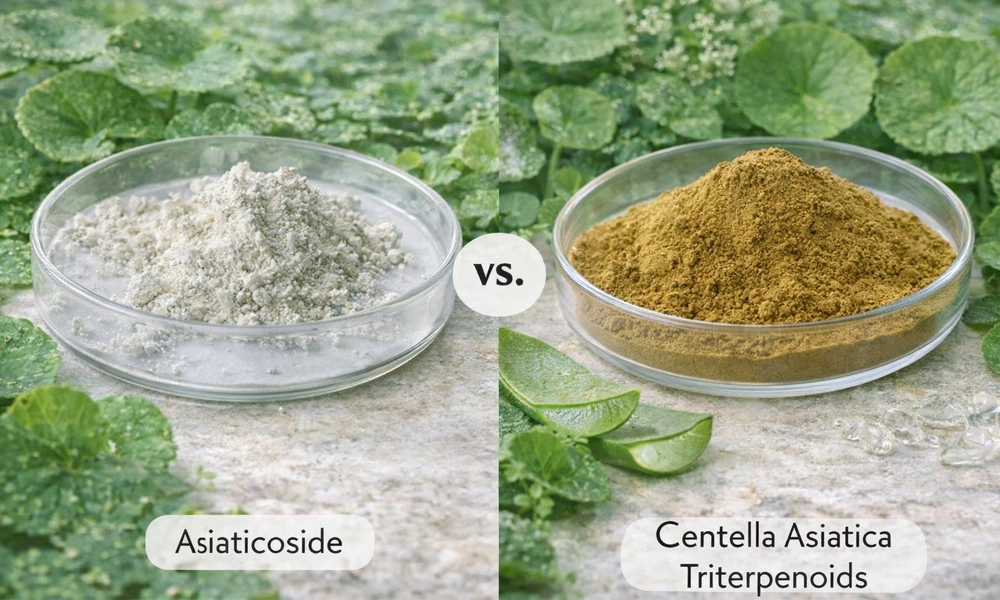
Quick Answer: What’s the Difference Between Asiaticoside and Centella Triterpenoids?
The simplest way to understand asiaticoside vs centella triterpenoids is:
Asiaticoside is a single, defined compound (one of the key triterpenoid saponins found in Centella asiatica).
Centella asiatica triterpenoids usually refers to a group-based specification, such as “total triterpenes” or “sum of marker triterpenoids,” which may include multiple components such as asiaticoside, madecassoside, asiatic acid, and madecassic acid.
So, is asiaticoside the same as centella triterpenoids? No. Asiaticoside can be part of a triterpenoid specification, but “triterpenoids” generally implies a broader, multi-component profile or a standardized total.
For procurement, the choice is not about which term sounds stronger. It is about what you need: a precise single marker, or a standardized botanical indicator that can deliver a consistent profile at scale.
Why This Comparison Matters for Procurement
From a buyer’s perspective, asiaticoside vs triterpenoids is more than chemistry—it’s a specification and risk-control decision.
Here are the practical reasons it matters:
1, You may be comparing different product categories without realizing it. A supplier quoting “asiaticoside 90%” is offering a very different material than a supplier quoting “total triterpenes 10%.” Without clarification, the pricing comparison becomes misleading.
2, Standardization affects batch consistency. Botanical extracts require robust raw-material control and standardized production. Whether an extract is standardized to total triterpenes or a sum of markers will impact how repeatable it is.
3, Your finished-product claims and positioning depend on what you can document. If your marketing and regulatory files rely on specific markers, you need a COA and method that can support that.
4, Formulation behavior changes with composition. A single compound and a multi-component extract can behave differently in terms of solubility, dispersibility, and sensory impact—even if both come from Centella.
This is why buyers frequently search for centella triterpenoids specification, supplier comparison for Centella extract, and how to buy asiaticoside. The goal is not only to buy a cheaper ingredient, but to buy a specification that will hold up over time.
What Is Asiaticoside?
What is asiaticoside? Asiaticoside is a naturally occurring triterpenoid saponin found in centella asiatica. It is one of the primary marker compounds used to characterize Centella-based ingredients and is frequently discussed alongside madecassoside in cosmetics.
In market practice, asiaticoside may be supplied in different formats:
•As a high-purity material (often referred to as asiaticoside powder);
•As part of a standardized extract, where asiaticoside content is one of several markers;
•As a component of “triterpenoids” specifications, depending on the standardization approach;
For buyers, the key is to understand what “asiaticoside content” actually means in a COA. When you see a specification such as “asiaticoside ≥ X%,” you should confirm:
•the analytical method (typically HPLC method for asiaticoside)
•the reference standard used
•the scope of what is being measured (pure compound vs extract marker)
Because asiaticoside can be used as a defined marker, it is sometimes favored by brands that want a more “active-led” specification and a clear assay number that supports internal documentation.
What Are “Centella Asiatica Triterpenoids”?
The term centella asiatica triterpenoids is widely used, but it is not always used consistently across suppliers. This is where buyers can easily face confusion.
In practice, “triterpenoids” commonly appears in two standardization approaches:
1) Total triterpenes (broad total)
This approach measures “total triterpenes” as a class. It may use colorimetric methods or other broad assays. Buyers will often see terms like total triterpenes Centella or “total triterpenoids” with a percentage value.
2) Marker-sum triterpenoids (specific marker total)
This approach defines triterpenoids as a sum of specific markers, often including:
♦asiaticoside
♦madecassoside
♦asiatic acid
♦madecassic acid
This is what buyers often mean when they search madecassoside asiaticoside total triterpenoids or “centella triterpenoids composition.” It is generally more specific and better aligned with cosmetics documentation, because each marker can be individually measured using HPLC/UPLC and then summed.
For procurement, this distinction is critical:
“Total triterpenes” is not always equivalent to “sum of specific marker triterpenoids.” If you do not confirm the method, you may think you are buying the same specification when you are not.
Asiaticoside vs Total Triterpenoids: Side-by-Side Comparison Table
Below is a practical comparison for buyers evaluating asiaticoside vs total triterpenes.
|
Category |
Asiaticoside (Single Marker) |
Centella Triterpenoids (Total / Marker Sum) |
|
What it is |
Defined single compound |
A group specification (broad total or marker sum) |
|
How it’s measured |
Typically HPLC method for asiaticoside |
Either broad total assay or marker-sum HPLC/UPLC |
|
Batch consistency |
High if purity is controlled |
Depends on raw material + standardization system |
|
Procurement clarity |
Straightforward “assay/purity” |
Must confirm definition + method |
|
Positioning |
Active-led, precise marker |
Botanical profile / standardized extract positioning |
|
Cost structure |
Often higher per kg |
Often more scalable for bulk applications |
|
Best use case |
High-end “active-led” formulas |
Broad cosmetics lines and standardized botanical systems |
This table also helps explain related comparisons such as asiaticoside vs madecassoside which is better—because “better” depends on whether you are evaluating a single marker strategy or a broader Centella profile strategy.
Which One Makes More Sense for Cosmetics?
When buyers ask which is “better,” the more useful question is: Which specification best supports the product I’m building? Below is how we typically guide customers in cosmetics development.
Comfort-focused daily care (creams, lotions, barrier products)
For mainstream daily products that require strong scalability, reliable supply, and consistent positioning, Centella triterpenoids (especially marker-sum standardization) often makes more sense. A standardized triterpenoid profile supports the “Centella story” with measurable markers while remaining cost-effective for volume products.
High-end serums and performance-led concepts
If the product concept emphasizes a “defined active” and the brand wants to document a specific marker, high-purity asiaticoside in cosmetics may be attractive. It supports precise dosage control and can be easier to anchor in internal technical files.
Sensitive-skin positioning
In many sensitive-skin lines, buyers favor standardized Centella triterpenoids because the profile is broader and supports botanical positioning. However, a defined asiaticoside approach can also be used if the formula is carefully designed and documentation is well managed.
In short:
If you need precision and marker-led documentation, asiaticoside can be a strong choice.
If you need scalability and botanical profile consistency, triterpenoids standardization often fits better.
How to Read a COA: What Buyers Should Check First
When comparing suppliers, COA review is not a formality—it is your primary risk-control tool. For both asiaticoside and triterpenoids materials, we recommend buyers focus on these points first.
1) Confirm the definition and the test method
If the supplier lists “triterpenoids,” ask: is it total triterpenes or marker-sum triterpenoids? If it is asiaticoside, confirm the method is HPLC method for asiaticoside (or UPLC) and that it references a recognized standard.
This aligns with searches like asiaticoside COA and Centella triterpenoids COA because buyers want clarity, not just numbers.
2) Check assay format and reporting consistency
A high-quality supplier provides:
•clear assay value
•defined acceptance criteria
•stable reporting format across batches
If your team can obtain multiple-batch COAs, compare them. Consistency across batches is often more informative than a single “perfect” COA.
3) Review contaminants and safety parameters
For cosmetics supply chains, buyers typically expect:
•heavy metals limits
•microbial limits
•residual solvent control (if applicable)
Even when the triterpenoid assay looks good, a weak safety profile creates downstream compliance and brand risk.
4) Ask how standardization is achieved
Standardization can be done through blending, concentration control, or process optimization. Buyers should understand whether the supplier’s standardization is repeatable and supported by raw-material quality control.
A strong COA is not only a certificate; it is a reflection of the supplier’s manufacturing discipline.
Typical Specifications and Purity Ranges
Buyers frequently ask: asiaticoside purity—what is typical? Or centella triterpenoids percentage—what’s common?
Because the market includes multiple grades, we recommend thinking in “typical ranges” rather than single fixed numbers. In cosmetic supply chains, you may see:
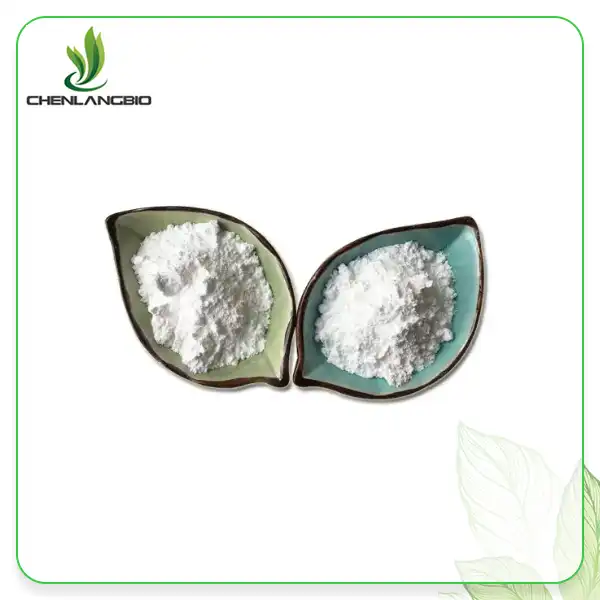
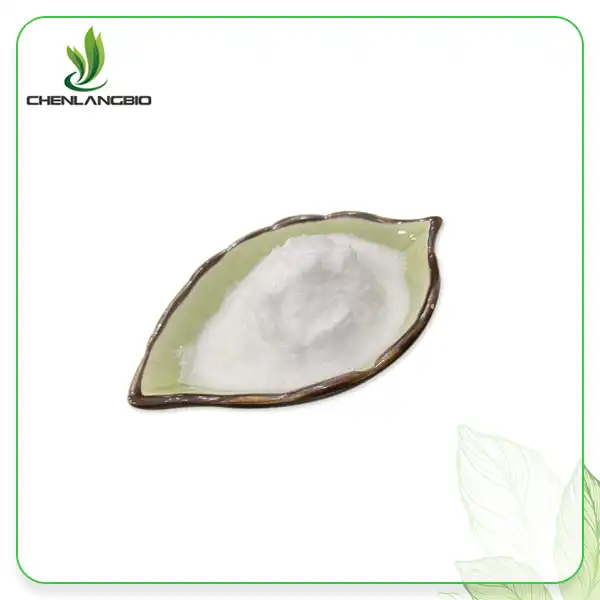
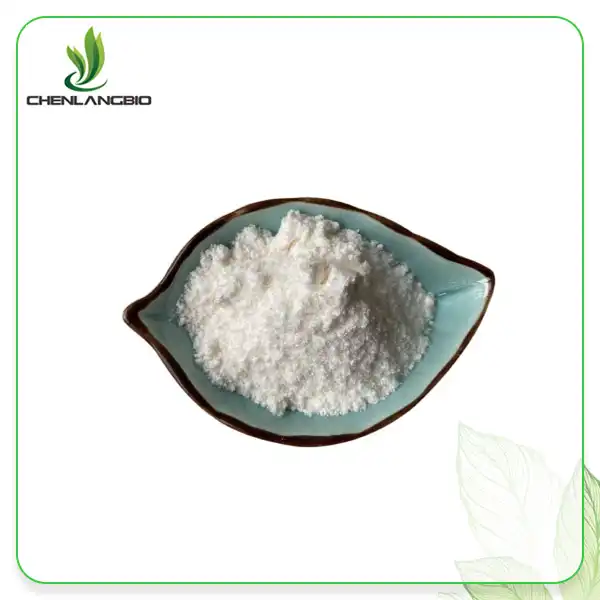
high-purity asiaticoside products at higher assay levels, we always supply 80%, 90% asiaticoside white powder
standardized extract products with lower marker percentages but stronger cost efficiency
triterpenoids specs defined either as broad total or marker sum, with different numbers that are not always comparable.
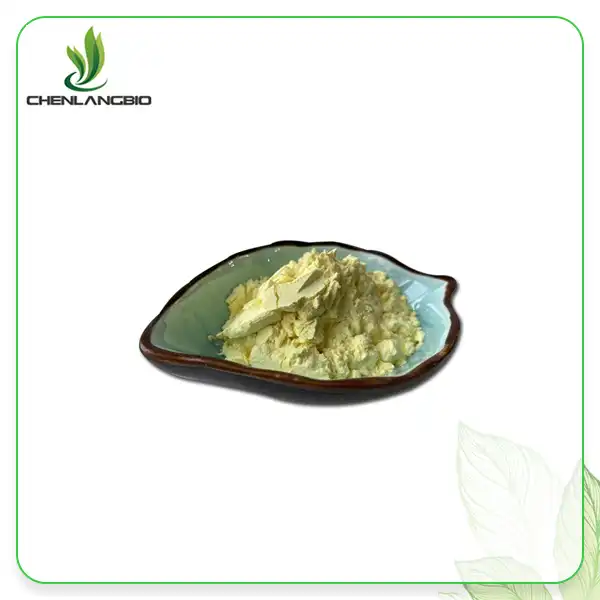
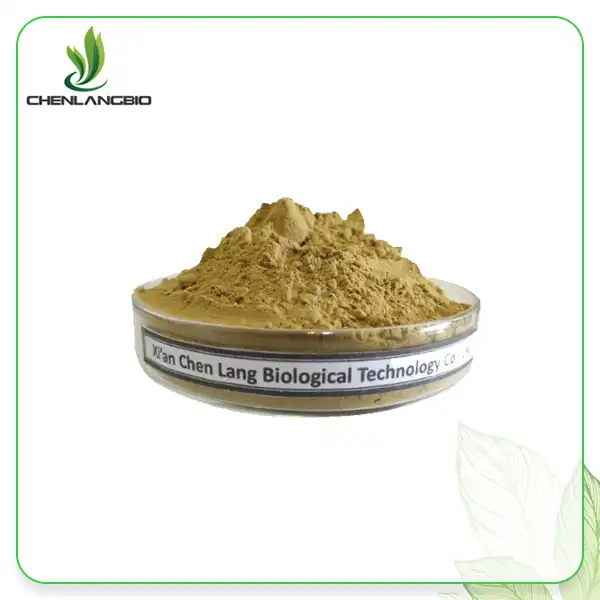
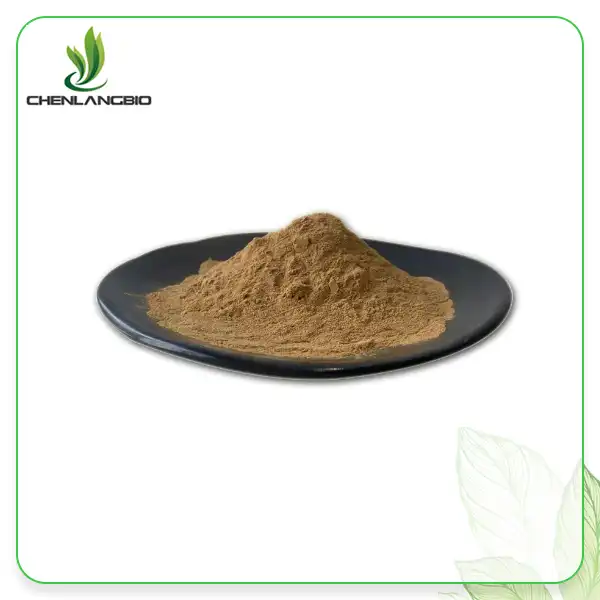
Our centella triterpenoids specifications:
|
Centella Triterpenoids |
Specifications |
Appearance |
|
20% |
Brownish yellow powder |
|
|
20% |
Water soluble white powder |
|
|
40% |
Brownish yellow powder |
|
|
50% |
Light yellow powder |
|
|
60% |
Light yellow powder |
|
|
70% |
Light yellow powder |
|
|
80% |
Water soluble light yellow powder |
|
|
90% |
Light yellow powder |
This is exactly why procurement teams should avoid comparing suppliers on percentage alone. A “10% total triterpenes” product is not necessarily lower quality than a “40% marker sum” product—these can be entirely different definitions.
When you review offers, focus on:
•definition of the specification
•method and standard
•batch consistency
•safety parameters
•suitability for your product’s positioning and usage level
Formulation Notes: Solubility, pH, and Compatibility
For procurement teams supporting R&D, it helps to understand basic formulation implications. Many sourcing problems only show up once the ingredient enters the lab.
Solubility and dispersibility
Questions like asiaticoside solubility and Centella triterpenoids solubility are common because solubility influences processing time and product stability. In practice, solubility depends on:
♦whether the product is a pure compound or an extract
⇔what carriers are used
♦the target dosage and base formulation
♦pH and compatibility
Centella-based ingredients are generally compatible with a wide range of cosmetic pH values, but extreme systems can still create stability challenges. Compatibility also depends on the presence of strong acids, high electrolyte loads, or highly oxidative components.
Processing considerations
Even stable botanical ingredients can be impacted by excessive heat or prolonged high-shear processing. For best results, many formulators add sensitive actives during the cool-down stage or under controlled temperature conditions.
For buyers, these notes matter because they influence:
•development timeline
•reformulation risk
•customer complaints and product returns
•long-term performance consistency
Can You Standardize on Asiaticoside Alone? Pros, Cons, and Risk Control
Some buyers ask whether they can standardize a Centella ingredient program using only asiaticoside. This is a valid strategy in certain cases, especially for active-led products. But it comes with trade-offs.
Pros
•clear marker assay for documentation
•precise dosage control
•straightforward supplier comparison when purity definition is consistent
Cons
•Centella’s botanical performance is not represented by a single compound alone
•relying on one marker increases the risk of “specification-driven” sourcing that overlooks broader profile quality
•cost can be higher, especially for high-purity materials at scale
For buyers, the risk-control approach is:
•confirm method and standardization approach
•request multi-batch COAs
•evaluate broader safety and impurity profile
•ensure the specification aligns with product claims and customer expectations
This is exactly what procurement teams mean when they search standardize centella extract by asiaticoside and risk of single-marker standardization—they want the benefits of precision without introducing hidden consistency risk.
FAQ: Asiaticoside vs Centella Asiatica Triterpenoids
Is asiaticoside the same as centella triterpenoids?
No. Is asiaticoside the same as centella triterpenoids is a common question because the terms are often used loosely. Asiaticoside is one compound; triterpenoids usually refers to a group specification or total/marker-sum standardization.
Asiaticoside vs madecassoside—which is better?
For asiaticoside vs madecassoside which is better, the answer depends on your positioning and standardization strategy. Both are centella markers used in cosmetics, and “better” should be defined by your product goals and documentation needs.
What is total triterpenes in centella extract?
What is total triterpenes in centella extract refers to a group-based assay. Buyers should confirm whether it is a broad total triterpenes measurement or a marker-sum defined by specific triterpenoids measured via HPLC/UPLC.
How to choose centella extract standardization?
When deciding how to choose centella extract standardization, clarify whether your product needs a single defined marker, a marker-sum triterpenoid profile, or a broader total assay, then align the choice with your claims, cost targets, and batch consistency expectations.
Is asiaticoside suitable for sensitive skin products?
Asiaticoside for sensitive skin products can be suitable when the formula is designed for tolerance and documentation. Many sensitive-skin lines use broader standardized triterpenoid extracts, but single-marker approaches can also work for active-led concepts.
Final Takeaway: How Buyers Can Choose the Right Spec with Confidence
If your goal is to source centella-derived ingredients with consistency, clarity, and minimal risk, here is a buyer-friendly takeaway for asiaticoside vs centella asiatica triterpenoids:
•Choose asiaticoside when you need a defined marker with clear assay control and active-led positioning.
•Choose centella triterpenoids (marker-sum standardization) when you need a scalable botanical system that supports broad cosmetics applicati ons and consistent profile positioning.
•Always confirm how triterpenoids are defined and measured, because “total” and “marker sum” are not the same thing.
At CHEN LANG BIO TECH, we support customers with specification documentation, multi-batch COA review, and formulation guidance for centella-derived ingredients. If you would like to compare specifications, request samples, or review quality parameters for your project, please contact our team.
Contact CHEN LANG BIO TECH
📧 Email: admin@chenlangbio.com
🌐 Website: https://www.chenlangbio.com
References
1, Brinkhaus, B., Lindner, M., Schuppan, D., & Hahn, E. G. (2000). Chemical, pharmacological and clinical profile of Centella asiatica. Phytomedicine, 7(5), 427–448.
2, James, J. T., & Dubery, I. A. (2009). Pentacyclic triterpenoids from Centella asiatica. Journal of Ethnopharmacology, 126(2), 181–187.
3, Barel, A. O., Paye, M., & Maibach, H. I. (2014). Handbook of Cosmetic Science and Technology. CRC Press.
4, General analytical practice references for botanical marker standardization (HPLC/UPLC methods) as used across cosmetic ingredient supply chains.

Send Inquiry
Related Industry Knowledge
- Vitamin E Powder: Insights from Clean-Label Demand
- How Does Fucoidan Powder Improve Skin Elasticity?
- What is the Difference between Chondroitin Sulfate and Glucosamine?
- What is the Difference between Alpha-Ketoglutarate and Calcium Alpha-Ketoglutarate Monohydrate?
- Top 5 Reasons to Choose Bulk Dimethylmethoxy Chromanol
- How is Phellinus Linteus Extract Used
- Witch Hazel Leaf Extract: An All-Natural Beauty Essential
- Which Is Better, Bakuchiol or Niacinamide
- Elastin Peptide for Skin
- Resveratrol for Skin