
3-O-Ethyl Ascorbic Acid pH: Stability and Formulation Guide
2026-10-20 09:23:52
The 3-o-ethyl ascorbic acid ph is an important formulation parameter for cosmetic manufacturers developing vitamin C serums, lotions, and creams. Unlike conventional L-ascorbic acid, 3-O-Ethyl Ascorbic Acid contains an ether modification that changes its physicochemical properties. Consequently, the pH requirements established for unmodified vitamin C should not automatically be applied to this derivative.
Published research reports a pKa of 7.72 ± 0.01 for 3-O-Ethyl Ascorbic Acid. However, this value describes acid-base ionization rather than the pH at which the ingredient exhibits maximum chemical stability.
For cosmetic formulators, selecting an appropriate pH requires evaluating ingredient retention, solvent compatibility, color development, other active ingredients, and finished-product stability. This guide examines the scientific evidence and provides practical recommendations for formulation development, quality control, and commercial ingredient sourcing.
What Is the Recommended pH Range for 3-O-Ethyl Ascorbic Acid?
The ethyl ascorbic acid ph range should be established according to the specific commercial grade and finished formulation rather than a universal numerical recommendation.
Although suppliers may publish different suggested formulation ranges, these values are not necessarily supported by comparative long-term stability studies conducted under identical conditions.
♦What Is the Optimal pH for Ethyl Ascorbic Acid?
The optimal ph for ethyl ascorbic acid is the pH at which a particular formulation achieves an acceptable balance of chemical stability, physical compatibility, product performance, and skin tolerability.
Importantly, this is not necessarily the pH at which the ingredient exhibits maximum solubility.
A formulation containing ethyl ascorbic acid, niacinamide, a polymeric thickener, and a preservative system may require a different pH from a simple aqueous solution containing only the vitamin C derivative.
For commercial development, formulators should first identify a practical pH window using supplier documentation. They should then compare ingredient retention and finished-product stability across that window.
Without controlled experimental results, it would be misleading to describe pH 5.0, 6.0, or any other single value as universally optimal.
♦How Should Formulators Interpret the Ethyl Ascorbic Acid pH Range?
A supplier's recommended pH range should be treated as a formulation development guideline, not proof of stability under every processing and storage condition.
When reviewing a technical data sheet, formulators should establish whether the stated range refers to ingredient solubility, chemical stability, recommended use conditions, or a combination of these factors.
The distinction matters because a solution can remain visually clear while its active ingredient concentration decreases.
Does Ethyl Ascorbic Acid Require a Low-pH Serum?
Ethyl ascorbic acid does not automatically require the same strongly acidic conditions used in certain L-ascorbic acid formulations.
The two ingredients differ in chemical structure and acid-base behavior.
However, this does not establish that every higher-pH ethyl ascorbic acid serum will be stable. The selected pH must still be validated through formulation-specific testing.
How Does pH Affect Ethyl Ascorbic Acid Chemical Stability?
Ethyl ascorbic acid ph stability is influenced by the interaction between molecular ionization, solvent composition, temperature, oxygen exposure, and other formulation components.
The pH of a solution may influence degradation pathways, but pH alone cannot predict the finished product's shelf life.
Ethyl Ascorbic Acid Stability at Different pH Levels
A useful investigation of ethyl ascorbic acid stability at different ph levels should compare samples prepared under identical conditions, changing only the target pH.
Each sample should contain the same ingredient concentration, solvent composition, and relevant excipients.
Chemical stability can then be evaluated using a validated stability-indicating HPLC method.
A published study investigating 3-O-Ethyl Ascorbic Acid in topical solvents reported that, after 120 hours at 32 ± 1°C, recoveries in tripropylene glycol and dipropylene glycol were 76.64% and 82.76%, respectively.
These findings demonstrate that the surrounding solvent can substantially influence ingredient stability. They do not establish an optimal aqueous formulation pH because the experiment was not a controlled comparison of different pH values in an otherwise identical water-based formulation.
This distinction is important when interpreting published data.
Does pH Influence Oxidation and Color Changes?
Vitamin C derivatives may undergo chemical changes under unfavorable formulation conditions, including exposure to heat, oxygen, light, or reactive impurities.
However, ethyl ascorbic acid oxidation stability should not be evaluated from color alone.
Yellowing or browning may indicate chemical changes, but the discoloration could also involve other ingredients, fragrance components, botanical extracts, or packaging interactions.
Likewise, a formulation that remains colorless may still experience measurable active ingredient loss.
Manufacturers should therefore evaluate color and chemical assay independently.
How Should Manufacturers Measure Ethyl Ascorbic Acid Stability?
A meaningful stability program should combine chemical and physical measurements.
|
Parameter |
Purpose |
|
HPLC assay |
Measure remaining active ingredient |
|
Related impurities |
Investigate chemical degradation |
|
pH monitoring |
Identify changes during storage |
|
Color measurement |
Detect visible formulation changes |
|
Appearance |
Identify precipitation or separation |
|
Temperature exposure |
Evaluate storage-related changes |
|
Packaging compatibility |
Assess interactions with the container |
For example, if a formulation initially contains 1.00% ethyl ascorbic acid and later contains 0.95%, its calculated assay retention is 95%, assuming comparable sampling and validated analytical measurements.
That result describes chemical retention; it does not independently establish acceptable product stability.
What Is the pKa of 3-O-Ethyl Ascorbic Acid, and Why Does It Matter?
The experimentally determined 3-o-ethyl ascorbic acid pka is 7.72 ± 0.01 at room temperature.
This measurement provides useful information about the compound's acid-base behavior and helps explain why its ionization differs from that of unmodified L-ascorbic acid.
Understanding the Published 3-O-Ethyl Ascorbic Acid pKa
In the published investigation, the dissociation constant was determined using UV spectroscopic measurements across controlled pH conditions.
The researchers observed differences between the absorption spectra of ionized and non-ionized forms and used those measurements to calculate the pKa.
The study also reported an experimental octanol/water partition coefficient of −1.07 ± 0.03, consistent with the ingredient's hydrophilic character.
These measurements help formulators understand the molecule's behavior but do not replace finished-product testing.
How Does pKa Affect Ionization and Solubility?
For a simplified monoprotic acid equilibrium, the Henderson–Hasselbalch relationship can estimate the proportion of ionized molecules:
[
\frac{[A^-]}{[HA]}=10^{pH-pK_a}
]
Using the reported pKa of 7.72, the approximate ionized fractions are:
|
pH |
Calculated Ionized Fraction |
|
4.0 |
0.019% |
|
5.0 |
0.190% |
|
6.0 |
1.87% |
|
7.0 |
16.0% |
|
7.72 |
50.0% |
|
8.0 |
65.6% |
These values are theoretical calculations based on a simplified acid-base model, not experimentally measured stability or solubility results.
They show that the molecule is predominantly in its non-ionized form at several pH values commonly investigated during cosmetic formulation development.
Is the pKa the Best pH for Formulation?
No. The pKa identifies the pH at which the ionized and non-ionized forms are present in approximately equal proportions under the model's assumptions.
It does not indicate where degradation is slowest.
The ethyl ascorbic acid ionization profile may influence formulation behavior, but determining the best pH requires experimental stability measurements.
Ethyl Ascorbic Acid vs L-Ascorbic Acid: Do They Need the Same pH?
The comparison of ethyl ascorbic acid vs l ascorbic acid ph requirements is particularly relevant to manufacturers reformulating conventional vitamin C serums.
Although both ingredients are related to ascorbic acid, they should not be treated as interchangeable.
Why Is L-Ascorbic Acid Often Formulated at Low pH?
A frequently cited skin-delivery study investigated topical L-ascorbic acid formulations using porcine skin.
The researchers evaluated 15% L-ascorbic acid solutions at pH values between 2.0 and 5.0 and reported enhanced skin delivery at pH below 3.5.
The study also identified 20% as the concentration associated with maximum measured skin uptake under its experimental conditions.
These findings relate to a particular ingredient, delivery model, and experimental design. They do not establish universal pH or concentration requirements for every vitamin C derivative.
How Does Ether Modification Change Ethyl Ascorbic Acid Formulation?
3-O-Ethyl Ascorbic Acid contains an ethyl ether group attached to the oxygen at the third carbon position of the ascorbic acid structure.
This modification changes the molecule's physicochemical properties, including its measured acid dissociation behavior.
Consequently, ethyl ascorbic acid vs ascorbic acid stability should be assessed using data obtained for the actual ingredients rather than assumptions based on their shared vitamin C origin.
Can Formulators Use the Same pH for Both Vitamin C Ingredients?
A formulation developed for L-ascorbic acid should not be converted to ethyl ascorbic acid through a simple ingredient substitution.
The solvent system, active concentration, pH, and compatibility with other ingredients may require adjustment.
Manufacturers should conduct a new formulation assessment before transferring the product to commercial production.
How to Adjust pH in an Ethyl Ascorbic Acid Serum Formulation
Understanding how to adjust ph in ethyl ascorbic acid serum development is essential for maintaining batch consistency and avoiding unnecessary processing changes.
The pH adjustment procedure should be integrated into the manufacturing process rather than performed only at the end.
•When Should Formulators Measure and Adjust Serum pH?
A practical development procedure includes several measurement points:
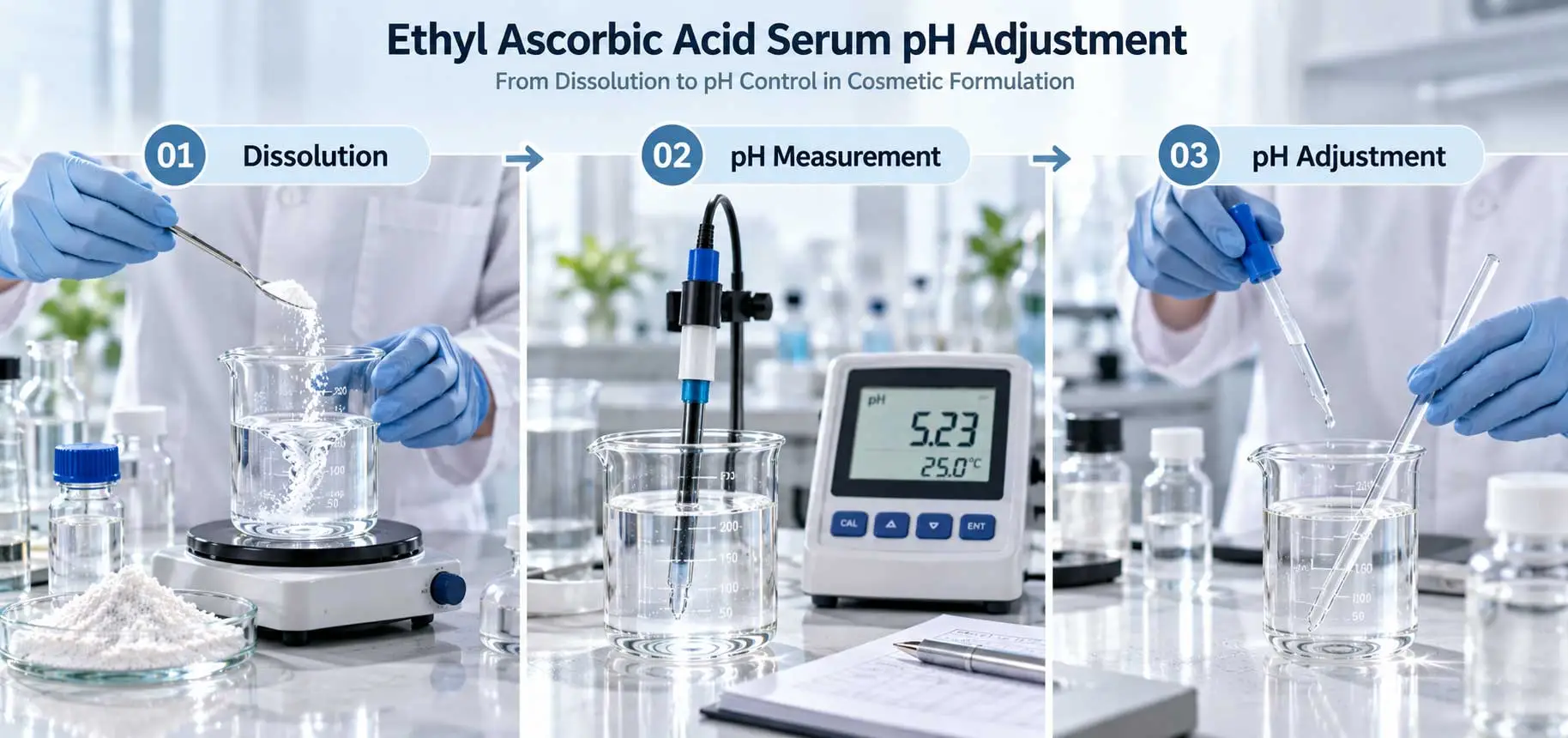
1.Measure the initial pH of the prepared aqueous phase.
2.Add and dissolve ethyl ascorbic acid under controlled conditions.
3.Record the pH after complete ingredient incorporation.
4.Add other active ingredients and formulation components.
5.Adjust the final pH gradually using a suitable adjustment solution.
6.Recheck pH after the formulation reaches a consistent temperature.
7.Monitor pH during stability testing.
Measurements should be made using a calibrated pH meter and a documented procedure appropriate for the sample.
For viscous or multiphase formulations, manufacturers should establish whether direct measurement or a defined sample preparation method is required.
•Which pH Adjusters and Buffer Systems Are Suitable?
Common cosmetic pH-adjusting ingredients include citric acid, sodium citrate, sodium hydroxide, and other formulation-appropriate acids or bases.
However, the correct ethyl ascorbic acid buffer system depends on the intended target pH, buffering requirements, and compatibility with the complete formula.
Citric acid and sodium citrate may be considered when developing a suitable acidic buffer system. Their concentrations should be determined through testing rather than copied from unrelated formulations.
A strong buffer is not always desirable. Excessive buffering capacity may complicate final pH adjustment or affect other formulation properties.
The objective is to maintain an acceptable pH throughout the product's shelf life without compromising ingredient compatibility.
•How Can Manufacturers Prevent pH Drift During Storage?
pH drift can arise from chemical reactions, interactions among formulation ingredients, changes in dissolved gases, or other storage-related processes.
Manufacturers should compare pH measurements at defined intervals and evaluate any changes alongside HPLC assay, color, and physical appearance.
Packaging should also be considered, particularly when the formula is sensitive to oxygen exposure or interactions with container materials.
A stable initial pH does not guarantee long-term chemical stability.
•What Processing Temperature Should Be Used?
For our 3-O-Ethyl Ascorbic Acid 99%, we recommend incorporating the ingredient below 40°C as an initial formulation development condition.
This ethyl ascorbic acid processing temperature recommendation is intended to support controlled manufacturing and should not be interpreted as a universal thermal degradation threshold.
If a production process requires higher temperatures, the manufacturer should evaluate ingredient retention under the proposed time-temperature conditions.
Is Ethyl Ascorbic Acid Compatible with Niacinamide and Other Skincare Actives?
Multi-active formulations require a common operating window in which the ingredients, preservative system, and physical structure remain compatible.
Ethyl Ascorbic Acid and Niacinamide pH Compatibility
Ethyl ascorbic acid compatibility with niacinamide should be evaluated in the complete formulation.
The presence of both ingredients does not automatically make a serum unstable, but neither does it guarantee compatibility at every pH or processing temperature.
Formulators should examine ingredient assay, pH drift, appearance, and any changes that occur during accelerated or real-time storage.
Compatibility should be established experimentally rather than inferred solely from ingredient names.
Can Ethyl Ascorbic Acid Be Combined with Hyaluronic Acid?
Ethyl ascorbic acid and hyaluronic acid may be investigated together in water-containing skincare formulations.
However, the molecular weight and grade of the hyaluronic acid material, electrolyte content, polymer hydration, and viscosity requirements can influence processing.
The pH must also be suitable for the complete system.
For transparent serums, formulators should monitor clarity, viscosity, and ingredient uniformity after manufacturing and during storage.
What About Alpha Arbutin, Peptides, and Other Actives?
Formulations containing alpha arbutin, peptides, or other functional ingredients require a review of each material's technical specification.
Some ingredients have narrower recommended processing or pH conditions than others.
The final formulation should be developed around an experimentally validated compatibility window, not the assumption that all cosmetic actives remain stable under identical conditions.
How to Test Ethyl Ascorbic Acid pH Stability Before Commercial Production
A structured ethyl ascorbic acid stability testing program helps manufacturers identify potential problems before investing in large-scale production.
♦Designing a pH Stability Study for Cosmetic Formulations
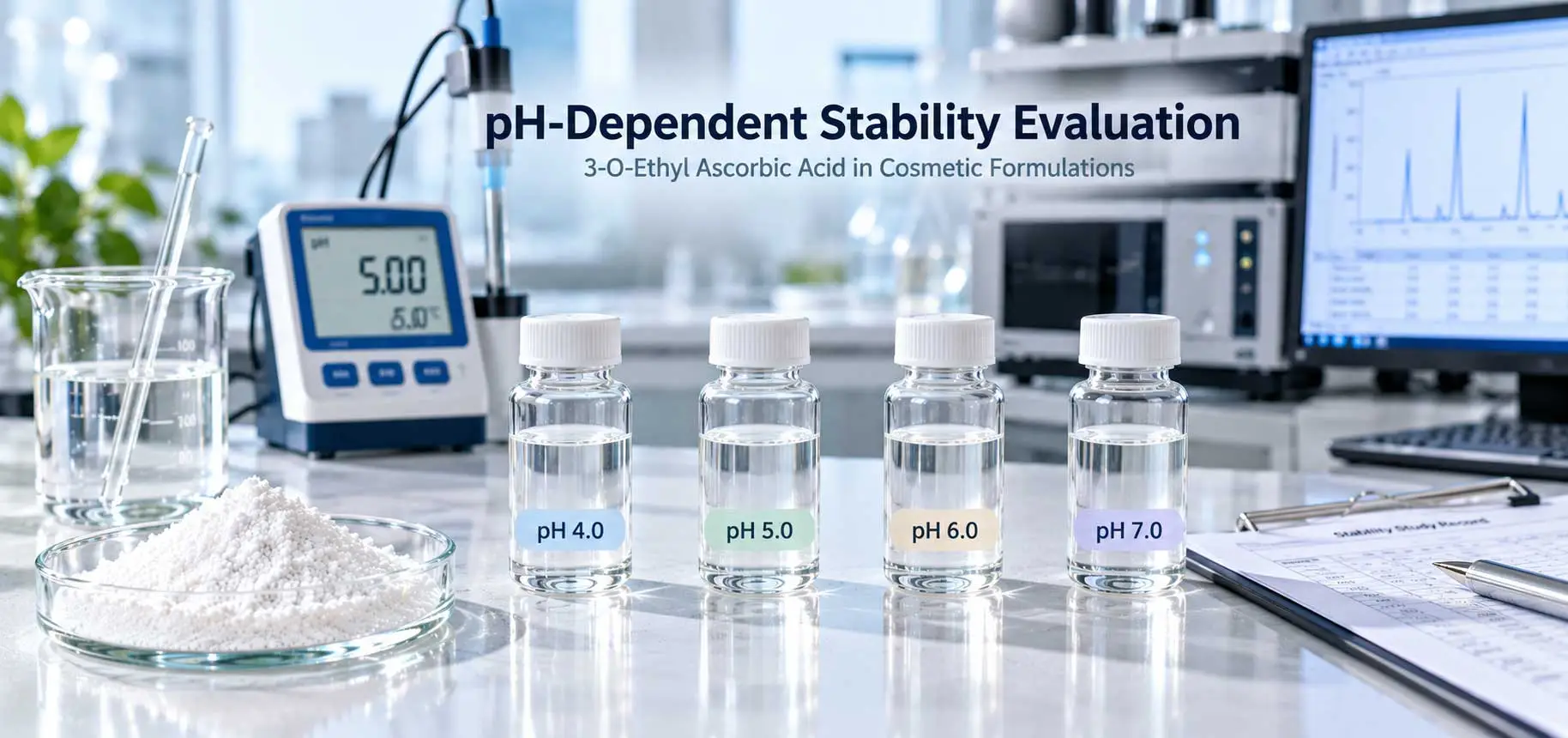
One useful screening approach is to prepare otherwise identical formulations at pH 4.0, 5.0, 6.0, and 7.0.
These values are proposed experimental conditions, not established optimal or universally acceptable pH limits.
Each formulation should contain the same active concentration, solvent system, and packaging materials.
Samples may be evaluated at controlled storage temperatures such as 5°C, 25°C, and 40°C, with the actual protocol selected according to the product and development objectives.
|
Test Variable |
Suggested Screening Design |
|
Formulation pH |
4.0, 5.0, 6.0, 7.0 |
|
Storage temperatures |
5°C, 25°C, 40°C |
|
Initial sampling |
Day 0 |
|
Follow-up sampling |
Days 7, 14, 28, and later as required |
|
Chemical analysis |
Validated HPLC assay |
|
Physical evaluation |
Color, clarity, precipitation, viscosity |
|
Additional monitoring |
pH drift and relevant impurities |
This is an illustrative development matrix. It does not replace a validated product-specific stability protocol.
♦Which Stability Parameters Should Be Recorded?
The ethyl ascorbic acid hplc assay should be measured using a suitable analytical method capable of distinguishing the active ingredient from relevant degradation products.
Manufacturers should calculate assay retention relative to the initial concentration and investigate unexpected changes.
Physical appearance, color, pH, and viscosity should be recorded separately because these parameters may change independently of active ingredient concentration.
♦How Should Buyers Interpret Accelerated Stability Data?
Accelerated testing is useful for identifying formulation weaknesses, but it does not automatically establish a commercial shelf life.
For example, four weeks of acceptable appearance at 40°C cannot, by itself, prove a specific number of months of stability at room temperature.
Commercial shelf-life decisions should be supported by an appropriate stability program, including real-time data and packaging compatibility.
Cosmetic-Grade Ethyl Ascorbic Acid 99%: What Specifications Should Buyers Check?
A consistent cosmetic grade ethyl ascorbic acid supply is essential for meaningful formulation comparisons.
If raw material quality changes between laboratory development and commercial production, it may become difficult to determine whether differences in stability originate from the formulation or the ingredient.
How to Evaluate an Ethyl Ascorbic Acid COA
An ethyl ascorbic acid coa should identify the batch and provide results against defined acceptance criteria.
Buyers should review identity, assay, related impurities, moisture, appearance, and applicable analytical methods.
For 3-o-ethyl ascorbic acid 99%, the assay requirement should be clearly distinguished from chromatographic peak-area purity.
A 99% HPLC area result does not necessarily establish 99% content by weight unless supported by the analytical method and calculation procedure.
Why Does Raw Material Quality Matter for pH Stability Testing?
Batch consistency is particularly important when comparing small differences in chemical stability.
Variations in impurities, moisture, or trace contaminants may influence formulation behavior, although higher nominal purity does not automatically guarantee better stability.
Using a qualified ethyl ascorbic acid raw material helps manufacturers reduce avoidable variability during development.
What Technical Documents Should Cosmetic Manufacturers Request?
Procurement teams should request a current specification, batch-specific COA, TDS, and SDS.
Depending on the intended market and customer requirements, additional quality or regulatory documentation may be necessary.
Samples should be evaluated against the same acceptance criteria intended for commercial purchasing.
How to Choose an Ethyl Ascorbic Acid Supplier for Commercial Manufacturing
Selecting an ethyl ascorbic acid supplier involves evaluating analytical quality, documentation, manufacturing consistency, and commercial service.
A technically suitable material must also be available in quantities and packaging appropriate for the customer's production schedule.
•What Should Buyers Expect from an Ethyl Ascorbic Acid Manufacturer?
An ethyl ascorbic acid manufacturer should provide a defined specification, batch traceability, technical documentation, and clear storage recommendations.
For repeat purchasing, buyers should discuss quality consistency, lead times, packaging, and change-notification expectations.
These considerations become increasingly important when moving from sample evaluation to ongoing commercial production.
•What Affects Bulk Ethyl Ascorbic Acid Price per Kilogram?
The ethyl ascorbic acid price per kg depends on factors including order quantity, grade, packaging, destination, and delivery terms.
For bulk ethyl ascorbic acid powder, buyers should compare quotations using the same quality specification and commercial conditions.
A lower initial price may offer limited value if additional testing, production delays, or inconsistent material quality increase the total manufacturing cost.
•How to Request an Ethyl Ascorbic Acid Sample or Quotation
CHEN LANG BIO TECH supplies 3-O-Ethyl Ascorbic Acid 99% for cosmetic formulation and commercial manufacturing.
Customers requesting an ethyl ascorbic acid sample or ethyl ascorbic acid quotation should provide the required quantity, destination country, intended application, and any specific documentation requirements.
Our standard packaging options include 1–5 kg aluminum foil bags and 25 kg paper drums, subject to order arrangements.
For customers planning to buy ethyl ascorbic acid powder, sample evaluation and technical document review are recommended before commercial approval.
Frequently Asked Questions About 3-O-Ethyl Ascorbic Acid pH
What Is the Best pH for 3-O-Ethyl Ascorbic Acid?
There is no universally established optimal pH for every ethyl ascorbic acid formulation. The appropriate range should be selected using supplier guidance and confirmed through chemical stability and finished-product testing.
Is Ethyl Ascorbic Acid Stable at pH 5?
pH 5 can be included in a formulation stability study, but stability at that pH must be demonstrated under defined conditions. Ingredient retention, temperature, solvent composition, and storage duration all matter.
Does Ethyl Ascorbic Acid Need a Low pH?
Ethyl ascorbic acid should not automatically be formulated according to the strongly acidic conditions investigated for conventional L-ascorbic acid. Its different chemical structure requires an independent formulation assessment.
Can Ethyl Ascorbic Acid Be Used with Niacinamide?
Both ingredients can be considered during multi-active serum development. However, their compatibility should be verified in the finished formulation through pH monitoring, analytical testing, and appropriate stability studies.
How Can Manufacturers Verify Ethyl Ascorbic Acid Stability?
Manufacturers should use a suitable HPLC assay together with pH measurements, appearance checks, impurity monitoring, and real-time and accelerated stability testing under defined storage conditions.
Conclusion: Selecting the Right pH for Ethyl Ascorbic Acid Formulations
The appropriate pH for 3-O-Ethyl Ascorbic Acid depends on the complete formulation, not a universal numerical target. Reliable development combines supplier guidance, analytical testing, and finished-product stability evaluation.
CHEN LANG BIO TECH supplies 3-O-Ethyl Ascorbic Acid 99% for cosmetic manufacturing. Contact us for specifications, COA, samples, and commercial quotations.
Email: admin@chenlangbio.com
References
Iliopoulos, F., Sil, B. C., Moore, D. J., Lucas, R. A., & Lane, M. E. (2019). 3-O-Ethyl-L-Ascorbic Acid: Characterisation and Investigation of Single Solvent Systems for Delivery to the Skin. International Journal of Pharmaceutics: X, 1, 100025. DOI: 10.1016/j.ijpx.2019.100025.
Pinnell, S. R., Yang, H., Omar, M., Riviere, N. M., DeBuys, H. V., Walker, L. C., Wang, Y., & Levine, M. (2001). Topical L-Ascorbic Acid: Percutaneous Absorption Studies. Dermatologic Surgery, 27(2), 137–142. DOI: 10.1046/j.1524-4725.2001.00264.x.
International Organization for Standardization. (2018). ISO/TR 18811:2018 — Cosmetics: Guidelines on the Stability Testing of Cosmetic Products.
CHEN LANG BIO TECH. 3-O-Ethyl Ascorbic Acid 99% — Technical Data Sheet, Product Specification, and Batch-Specific Certificate of Analysis. Current supplier documentation should be requested for product qualification.

Send Inquiry
Related Industry Knowledge
- Shilajit Extract Powder for Capsules and Tablets: A Formulation Guide for Supplement Manufacturers
- Fermentation vs Natural Extraction L-Theanine: Manufacturing Differences & Supplier Guide for Bulk Buyers 2026
- Ergothioneine vs Alpha Lipoic Acid: Which Antioxidant Delivers Better Value for Supplement Formulators?
- What are the Main Benefits of Ascorbyl Tetraisopalmitate?
- What is the Difference Between Broccoli Powder and Broccoli Extract Powder?
- Can Kopexil be Used in Combination with Other Hair Loss Treatments?
- What is the Dosage for Nitenpyram
- What is Sodium Copper Chlorophyllin Used For
- Does Cyanotis Arachnoidea Extract Ecdysone Can Use in Cosmetic Products
- Is Glutathione GSH Powder Good for Skin Whitening