
Fermentation vs Natural Extraction L-Theanine: Manufacturing Differences & Supplier Guide for Bulk Buyers 2026
2026-07-07 15:54:12
L-Theanine Fermentation vs Natural Extraction Market Overview
L-Theanine fermentation vs natural extraction has become one of the most important sourcing topics in the global amino acid and functional ingredient industry. As demand for L-Theanine powder continues to expand across functional beverages, dietary supplements, and nootropic formulations, procurement teams are increasingly evaluating not only product quality but also underlying manufacturing pathways.
From a global supply chain perspective, L-Theanine bulk supplier China networks dominate the industrial production landscape, primarily due to advanced fermentation capacity and scalable manufacturing systems. In contrast, natural extraction methods remain limited in output and are generally positioned for niche or premium-grade applications.
The shift toward industrial-scale sourcing has significantly increased demand for bulk L-Theanine ingredient supply systems, especially among beverage manufacturers and supplement brands seeking stable long-term production partners. As a result, sourcing decisions are no longer based solely on price, but on production method, batch consistency, and regulatory compliance.
In parallel, nutraceutical raw material supplier requirements have become more stringent. Buyers now expect full transparency in production methodology, including whether the material is produced via fermentation or natural extraction, as this directly impacts scalability, cost structure, and supply reliability.
Overall, the 2026 market structure clearly shows that fermentation-based production has become the dominant industrial standard, while natural extraction remains a secondary, high-cost supply pathway with limited global scalability.
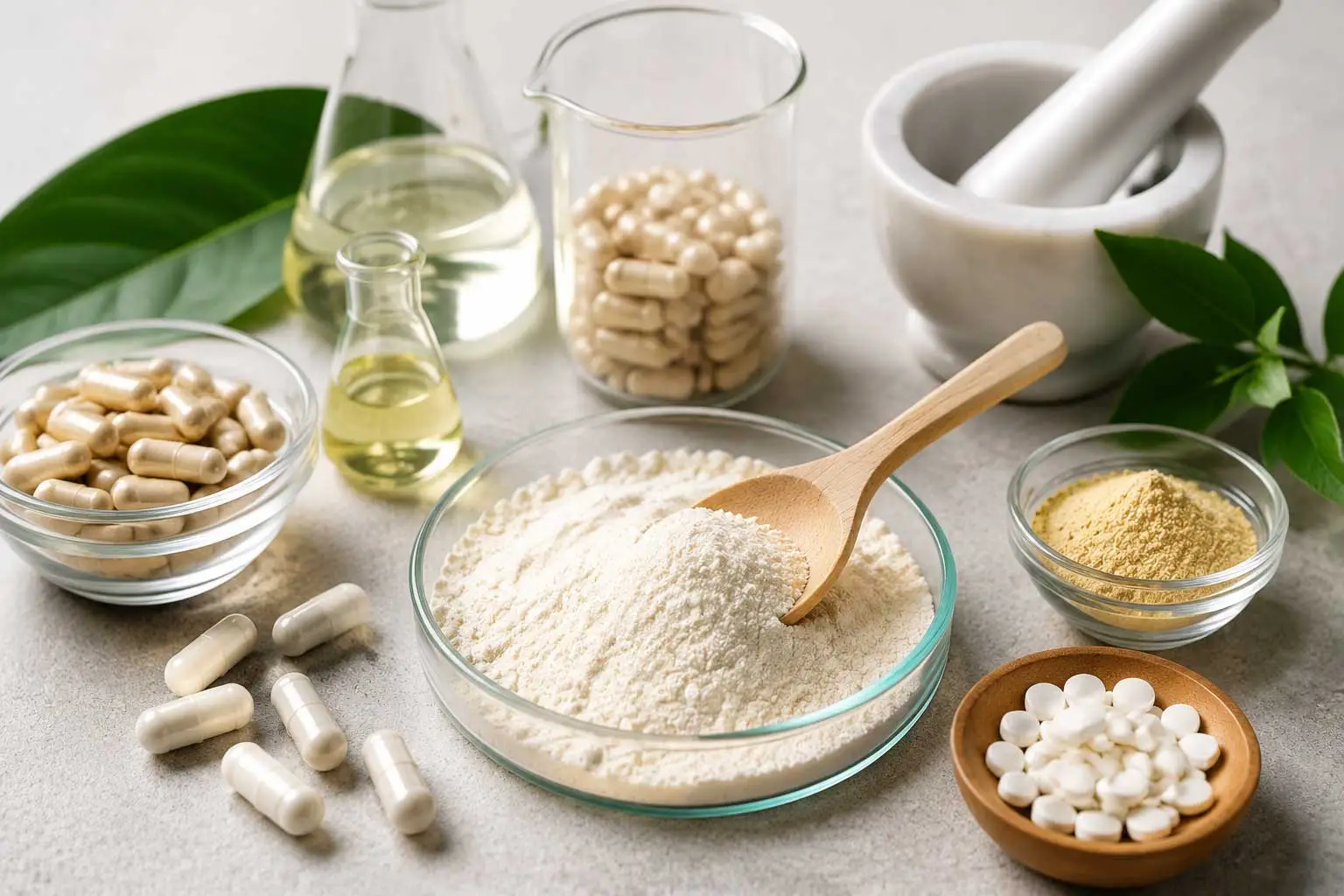
Fermentation-Based L-Theanine Production (Industrial Manufacturing & Supply Chain Model)
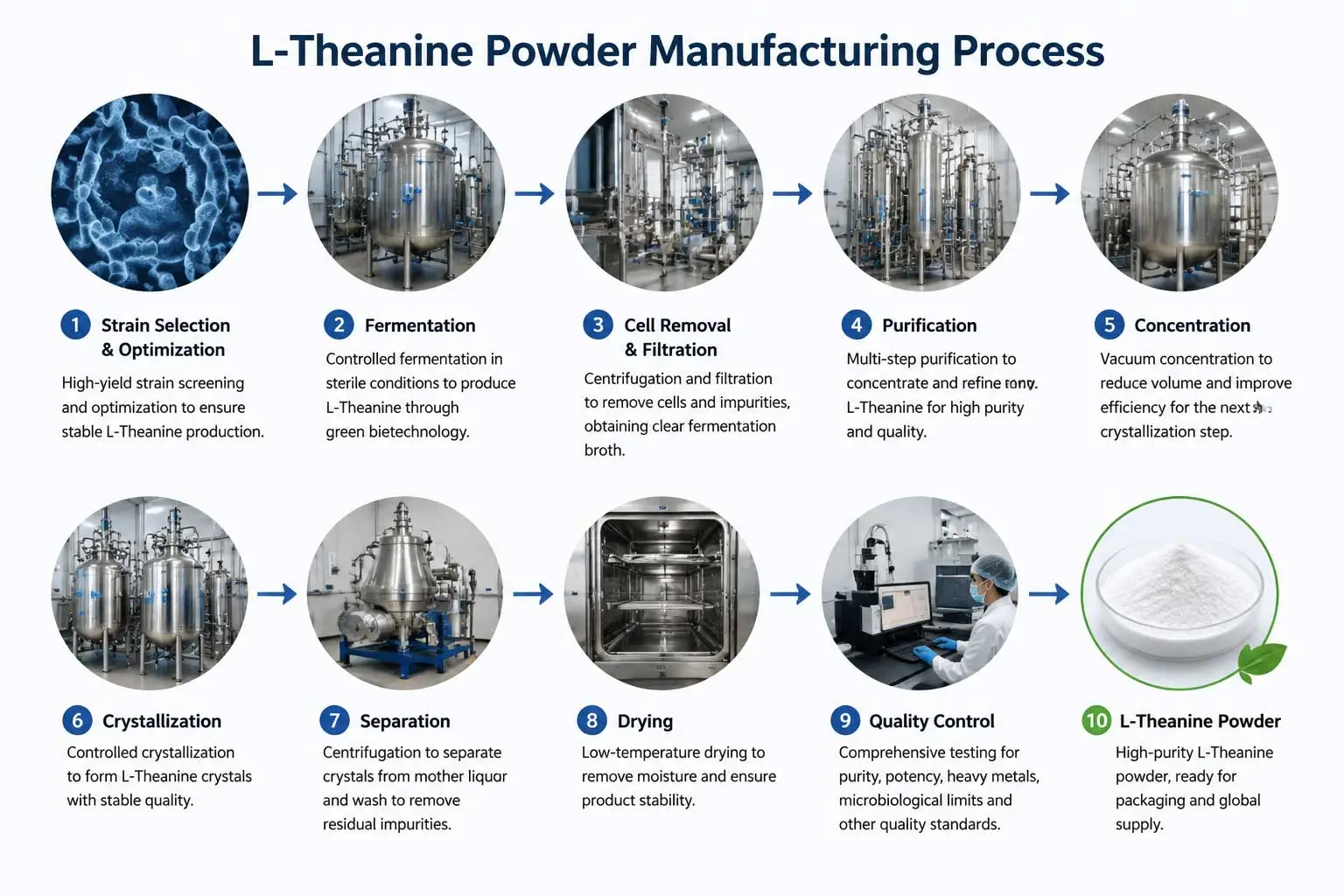
Fermentation-based L-Theanine manufacturing has become the primary production method used by modern L-Theanine manufacturer China facilities. This process utilizes microbial fermentation technology to synthesize amino acids under controlled industrial conditions, ensuring consistency, scalability, and high purity output.
In large-scale production environments, bulk L-Theanine powder is produced through a multi-stage process involving fermentation, purification, crystallization, and drying. This controlled system allows manufacturers to achieve stable product specifications that meet global nutraceutical industry requirements.
One of the key advantages of fermentation technology is its ability to support GMP L-Theanine factory supplier standards at industrial scale. Unlike plant extraction, fermentation does not depend on seasonal raw material availability, which significantly improves supply chain stability for global buyers.
In addition, fermentation-based production enables consistent compliance with international quality requirements. Each batch of L-Theanine HPLC tested powder is typically verified through analytical testing systems to ensure purity, safety, and regulatory alignment across different markets including the EU, US, and Asia-Pacific regions.
From a procurement perspective, fermentation-based suppliers are often preferred by OEM supplement manufacturers and functional beverage brands due to their ability to provide continuous supply, predictable cost structures, and scalable production capacity. This makes fermentation the dominant model within bulk amino acid supplier China networks.
Natural Extraction L-Theanine (Tea-Derived Production & Industrial Limitations)
Natural extraction L-Theanine production is derived primarily from tea leaves, where the amino acid naturally exists in small concentrations. This method is often positioned as a “plant-based” or “natural source” approach within the nutraceutical ingredient supplier industry, particularly for premium or niche product positioning.
However, compared to fermentation-based systems, extraction methods face significant limitations in industrial scalability. The yield of L-Theanine powder from natural sources is relatively low, which directly impacts production efficiency and increases overall cost per kilogram.
As a result, natural L-Theanine bulk supply chains are generally limited to smaller production volumes and higher-end applications. These materials are often used in specialty formulations where marketing positioning emphasizes “natural origin” or “botanical-derived ingredients.”
From a manufacturing standpoint, natural extraction processes require complex purification steps to achieve consistent quality standards. This increases variability in batch performance and makes it more challenging for L-Theanine supplier China networks to maintain stable large-scale output.
Due to these limitations, natural extraction is typically not the preferred method for functional beverage ingredient supplier systems or large-scale supplement manufacturing. Instead, it is used selectively in premium product categories where cost efficiency is less critical than ingredient origin positioning.
Fermentation vs Natural Extraction L-Theanine: Key Manufacturing Differences for Bulk Buyers
When evaluating fermentation vs natural extraction L-Theanine, the most important consideration for bulk buyers is not only ingredient origin, but also manufacturing consistency, scalability, and supply chain reliability.
In fermentation systems, L-Theanine bulk ingredient production is highly controlled, allowing manufacturers to achieve consistent purity levels and stable batch-to-batch performance. This is particularly important for nutraceutical raw material supplier China operations, where regulatory compliance and product consistency are critical.
In contrast, natural extraction systems often experience greater variability due to raw material dependency and environmental factors. This can affect both yield efficiency and final product consistency, which may introduce challenges for bulk L-Theanine supplier China networks serving industrial-scale buyers.
From a commercial perspective, fermentation-based systems offer a more predictable wholesale L-Theanine price per kg structure, making them more suitable for long-term procurement contracts and OEM manufacturing partnerships.
In terms of industrial application, fermentation-based L-Theanine powder supplier systems are widely used in functional beverages and supplement formulations due to their compatibility with high-volume production environments. Natural extraction, while valuable in niche markets, is less commonly adopted in large-scale manufacturing due to cost and supply limitations.
Ultimately, bulk buyers prioritize stability, scalability, and regulatory compliance, which is why fermentation has become the dominant production model in the global amino acid ingredient supplier industry.
Cost Structure & Pricing Impact in L-Theanine Supply (Fermentation vs Natural Extraction)
The L-Theanine price per kg is significantly influenced by the underlying manufacturing process, with fermentation-based production generally offering more competitive and stable pricing compared to natural extraction methods.
In fermentation systems, economies of scale allow L-Theanine manufacturer China facilities to reduce production costs through optimized microbial processes and continuous manufacturing systems. This results in more predictable bulk L-Theanine pricing structures, which are highly valued by OEM supplement brands and functional beverage manufacturers.
On the other hand, natural extraction involves higher raw material input costs and lower yield efficiency, which directly increases the final cost per kilogram of L-Theanine bulk ingredient supply. This makes it less competitive in large-scale industrial applications.
From a procurement standpoint, buyers working with bulk ingredient supplier China networks often prefer fermentation-based materials due to their cost efficiency, stable availability, and long-term contract feasibility.
In addition, pricing models in the nutraceutical raw material supplier industry are increasingly tied to supply chain reliability and documentation support, rather than just production method alone. This includes factors such as COA verification, GMP compliance, and export documentation capability.
As a result, fermentation-based L-Theanine has become the dominant choice for wholesale ingredient supply chains, particularly in global functional beverage and supplement manufacturing sectors.
Application Impact of Fermentation vs Natural Extraction L-Theanine in Functional Beverages & Supplements
The differences between fermentation vs natural extraction L-Theanine are not only relevant at the manufacturing level, but also have a direct impact on final product applications in functional beverages and dietary supplements. In modern formulation systems, ingredient sourcing plays a critical role in determining product consistency, scalability, and commercial positioning.
In the functional beverage industry, L-Theanine powder is widely used in combination with caffeine to create balanced energy and focus-oriented drink systems. Beverage manufacturers typically prefer fermentation-based materials due to their stability, solubility, and suitability for high-volume production environments.
As a result, functional beverage ingredient supplier China networks are increasingly centered around fermentation-derived amino acids, particularly for RTD (ready-to-drink) beverages and powdered drink systems. These products require consistent ingredient performance across large production batches, which is difficult to achieve with natural extraction sources.
In dietary supplement applications, L-Theanine supplement ingredient systems are widely used in capsules, tablets, and powder blends. OEM manufacturers often rely on fermentation-based raw materials to ensure formulation stability and consistent dosing accuracy in large-scale production.
Natural extraction, while valued in niche premium positioning, is less commonly used in industrial supplement manufacturing due to higher cost and limited scalability. This makes fermentation-based bulk L-Theanine ingredient supply systems the preferred choice for global supplement brands and contract manufacturers.
GMP Manufacturing Standards & Quality Control in L-Theanine Production
In global ingredient sourcing, manufacturing standards are a critical evaluation factor for any L-Theanine manufacturer China. The ability to consistently deliver high-quality L-Theanine powder depends on the strength of production systems, quality control protocols, and regulatory compliance infrastructure.
Modern fermentation-based production facilities operate under GMP L-Theanine factory supplier standards, ensuring that every stage of production—from microbial fermentation to purification and final drying—is strictly controlled and documented.
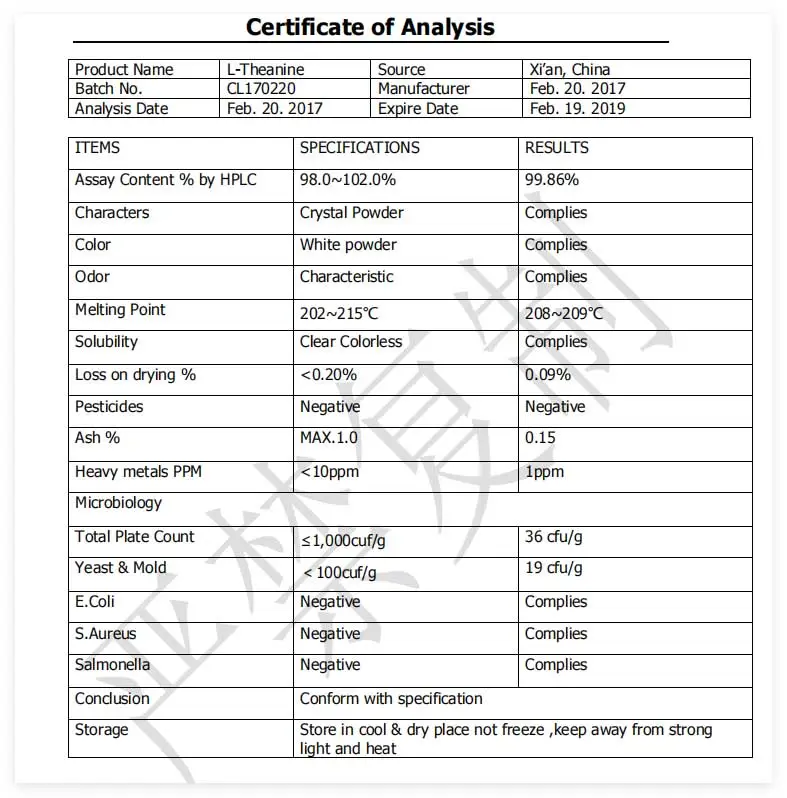
Quality verification typically includes HPLC testing, ensuring that each batch of bulk L-Theanine powder meets defined purity specifications. This level of analytical control is essential for international markets where regulatory compliance is mandatory for nutraceutical and functional food applications.
In addition to analytical testing, documentation systems play a key role in supplier qualification. Standard requirements include COA (Certificate of Analysis), MSDS (Material Safety Data Sheet), and technical data sheets, all of which are expected from a professional nutraceutical raw material supplier China.
For global buyers, GMP compliance is not only a regulatory requirement but also a risk management tool. It ensures consistency, traceability, and reliability across all shipments, which is particularly important for bulk amino acid supplier China networks serving large-scale OEM manufacturers.
How to Choose a Reliable L-Theanine Supplier in China
Selecting a reliable L-Theanine supplier China requires a structured evaluation approach that goes beyond price comparison. In the global ingredient industry, supplier reliability is determined by manufacturing capability, quality systems, and long-term supply stability.
The first distinction buyers must make is between a direct L-Theanine manufacturer China and a trading intermediary. Factory-based suppliers are generally able to provide more consistent bulk L-Theanine ingredient supply, better pricing transparency, and stronger documentation support.
In contrast, trading companies may lack control over production processes, which can result in variability in quality and supply stability. This is particularly important for OEM brands relying on continuous production cycles and long-term formulation consistency.
Another key evaluation factor is certification and compliance. A qualified GMP L-Theanine factory supplier should be able to provide ISO certifications, COA reports, and full batch traceability documentation. These elements are essential for approval in regulated markets such as the EU and US.
Production capacity is also a critical consideration. Buyers sourcing bulk L-Theanine powder should ensure that the supplier has scalable fermentation capabilities and stable raw material supply chains to support long-term commercial contracts.
Ultimately, the most reliable sourcing strategy is to prioritize verified ingredient supplier China networks that combine manufacturing capability with strong quality assurance systems and export experience.
MOQ, Packaging & Global Bulk Supply Capability for L-Theanine Ingredients
For international buyers, sourcing L-Theanine bulk ingredient is not limited to product specifications alone. Packaging formats, minimum order quantity (MOQ), and global logistics capability are equally important in evaluating a reliable L-Theanine supplier China.
Standard packaging options typically include 1 kg aluminum foil bags for sampling and pilot production, and 25 kg fiber drums for industrial-scale manufacturing. These formats ensure stability, moisture protection, and safe transportation during international shipping.
In terms of MOQ, flexible supply structures are increasingly demanded by OEM supplement manufacturers and functional beverage brands. A professional bulk ingredient supplier should be able to support both small development batches and large-scale commercial orders.
From a logistics perspective, global distribution capability is essential. Buyers increasingly expect suppliers to provide fast shipping, export documentation support, and stable international logistics processes. As a result, wholesale L-Theanine supplier systems with established export experience are preferred in global procurement strategies.
Packaging and logistics are now considered part of the supplier qualification process, alongside pricing and product quality.
Regulatory Compliance & Documentation (COA, MSDS, Export Standards)
In the global nutraceutical industry, regulatory compliance is a fundamental requirement for any L-Theanine powder supplier China operating in international markets. Buyers typically require complete documentation packages before approving raw materials for commercial use.
Standard documentation includes COA, MSDS, and technical data sheets. These documents ensure transparency in product specifications, safety data, and batch-level traceability, which are essential for regulatory approval in the EU, US, and other regulated regions.
A professional GMP certified L-Theanine manufacturer must also maintain audit-ready production systems, allowing third-party inspections and customer audits when required. This ensures compliance across multiple regulatory frameworks.
For bulk L-Theanine ingredient supply chains, regulatory compliance is not only a legal requirement but also a key factor influencing supplier selection and long-term procurement decisions.
As global regulations continue to tighten, documentation capability has become a critical differentiator among nutraceutical ingredient supplier China networks, directly affecting competitiveness in international markets.
Why Choose Us as Your L-Theanine Manufacturing Partner (Bulk Supplier China)
In the current global sourcing environment, selecting a reliable L-Theanine manufacturer China is a strategic decision that directly impacts product quality, supply chain stability, and long-term commercial success.
As a vertically integrated supplier, we focus on providing consistent production quality, scalable fermentation capacity, and reliable global supply systems for L-Theanine bulk ingredient and related amino acid materials.
Our manufacturing system is designed to support both pilot-scale development and large-scale commercial production. Each batch is produced under strict quality control systems and verified through HPLC testing to ensure consistency and compliance.
From a commercial perspective, we offer flexible wholesale L-Theanine price per kg structures based on order volume and long-term cooperation models. This allows OEM manufacturers and supplement brands to optimize procurement costs while maintaining supply reliability.
In addition to manufacturing capabilities, we provide full OEM and private label support, including formulation assistance, documentation support, and global logistics coordination for functional beverage and supplement manufacturers.
Our goal is to serve as a long-term functional ingredient supply partner, not just a transactional supplier, supporting global brands in building stable and scalable product lines.
Contact for Bulk L-Theanine Supply, Samples & OEM Cooperation
For procurement teams, supplement brands, and beverage manufacturers seeking a reliable L-Theanine supplier China, we provide full support for sampling, technical documentation, and bulk quotation requests.
Whether you are developing functional beverages, nootropic supplements, or cognitive performance formulations, our team can assist with specification matching, pricing evaluation, and global supply coordination.
📩 Contact Information:
•Email: admin@chenlangbio.com
•WhatsApp: +86-17782478823
•Company: Xi’an Chen Lang Bio Tech Co., Ltd.
We respond quickly to all bulk L-Theanine ingredient inquiries and support global customers across North America, Europe, Japan, South Korea, and Southeast Asia.
For OEM, wholesale, or long-term supply agreements, we provide samples, COA documentation, and customized sourcing solutions tailored to your production needs.

Send Inquiry
Related Industry Knowledge
- What is Liposomal Glutathione?
- 5 Powerful Benefits of Asiaticoside Powder
- Quinoa Seed Extract for Natural Wellness
- What is Dimethylmethoxy Chromanyl Palmitate Used for
- What are the Life Threatening Considerations for Loratadine
- What Are the Downsides of Bakuchiol
- Is Ascorbyl Tetraisopalmitate Better Than Ascorbic Acid
- Premium Haematococcus Pluvialis Extract for Optimal Health Benefits
- What Functions Phytosphingosine Powder in Skin Care
- What is Epimedium Extract Powder