
Zeaxanthin for Solid Drinks: How to Select the Right Ingredient Form
2026-09-09 18:38:19
Choosing zeaxanthin for solid drinks is not simply a matter of selecting the highest assay on a specification sheet. A solid drink presents two different formulation environments: the ingredient must first behave predictably as part of a dry powder blend and then perform again when the consumer adds water. A grade that flows well during sachet filling may still wet poorly during reconstitution, while a highly concentrated conventional powder may require such a low inclusion level that uniform distribution becomes more difficult.
For formulators and ingredient buyers, the right choice therefore depends on active concentration, particle characteristics, dry-blend compatibility, reconstitution behavior and storage stability. Conventional zeaxanthin and CWS microencapsulated forms can both have a place, but they solve different formulation problems.
The practical rule is straightforward:
The best zeaxanthin form for a solid drink is not necessarily the grade with the highest assay. It is the grade that delivers the required active content while meeting dry-blend uniformity, reconstitution, stability and sensory requirements in the finished product.
What Makes Zeaxanthin Difficult to Use in Powdered Beverage Formulations?
The challenge with zeaxanthin for powdered beverages begins with the chemistry of the carotenoid itself. Zeaxanthin has a molecular formula of C40H56O2 and a molecular weight of 568.9 g/mol. PubChem reports a calculated XLogP3-AA of 10.9, reflecting its strongly lipophilic character.
That characteristic is important because an instant beverage eventually has to interact with water. Untreated zeaxanthin does not naturally behave like a highly water-soluble food ingredient. Depending on particle and formulation characteristics, poor aqueous compatibility may appear as floating powder, incomplete wetting, agglomeration, uneven color or sediment after reconstitution.
Solid drinks add another complication. Before reconstitution, the zeaxanthin ingredient must coexist with flavors, sweeteners, vitamins, minerals, proteins or other powders during blending, transportation and filling. After water is added, the same material faces an entirely different physical environment.
For that reason, zeaxanthin powder dispersibility should not be assessed independently from dry-powder performance.
A zeaxanthin ingredient for a solid drink must be evaluated as both a dry powder and a reconstituted beverage ingredient.
Conventional vs CWS Zeaxanthin Powder: Which Form Fits a Solid Drink?
One of the first formulation decisions is whether to use a conventional zeaxanthin powder or a CWS grade designed for improved aqueous handling.
Conventional products can offer attractive active concentrations, particularly where the formulation already contains an appropriate lipid or delivery system. CWS products take a different approach. In microencapsulated zeaxanthin powder, the carotenoid is incorporated into a carrier or wall system intended to improve handling, dispersibility and, depending on the formulation, protection against environmental exposure.
“CWS” is frequently described commercially as cold water soluble. For zeaxanthin, however, cold-water-dispersible is often the more technically useful description. The delivery system changes the behavior of the commercial powder; it does not transform the zeaxanthin molecule itself into a freely water-soluble compound.
|
Selection factor |
Conventional zeaxanthin |
CWS / microencapsulated zeaxanthin |
|
Active concentration |
Often higher |
May be lower because a carrier is present |
|
Behavior in water |
Limited without a suitable delivery system |
Engineered for improved dispersion |
|
Carrier contribution |
Grade dependent |
Integral to product functionality |
|
Reconstitution |
Must be validated |
Usually a major design consideration |
|
Addition level |
Primarily assay driven |
Assay and carrier system both matter |
|
Stability |
Depends on grade and matrix |
Encapsulation may provide additional protection |
|
Purchasing comparison |
Assay and $/kg |
Assay, functionality and cost-in-use |
For a product that is swallowed as a capsule, aqueous behavior may have relatively little importance during manufacturing. For an instant beverage, it is central to the consumer experience. This is why CWS zeaxanthin for solid drinks is particularly relevant when rapid and visually acceptable reconstitution is part of the product specification.
It does not follow, however, that CWS is automatically the right choice for every powder drink. The finished formula should determine the grade.
Why the Highest Zeaxanthin Assay Is Not Always the Best Choice
Zeaxanthin powder assay determines how much commercial ingredient is required to deliver a defined amount of active carotenoid, but assay alone says little about how the ingredient will behave during production or reconstitution.
Consider a formulation designed to contain 10 mg of active zeaxanthin per serving. This is simply a formulation calculation, not an intake recommendation:
•5% ingredient: 200 mg of ingredient
•10% ingredient: 100 mg
•20% ingredient: 50 mg
The calculation is:
Ingredient required = target active zeaxanthin ÷ ingredient assay
A higher assay reduces the amount of carrier entering the formula and can reduce ingredient mass per serving. At the same time, very low inclusion levels can make uniform distribution through a large powder batch more demanding.
A lower-assay CWS system may require a larger inclusion quantity, but part of that additional mass represents the carrier system responsible for its technological performance.
This distinction is important when evaluating zeaxanthin active content:
Assay determines how much ingredient is required; it does not by itself determine which ingredient will perform best in a solid drink.
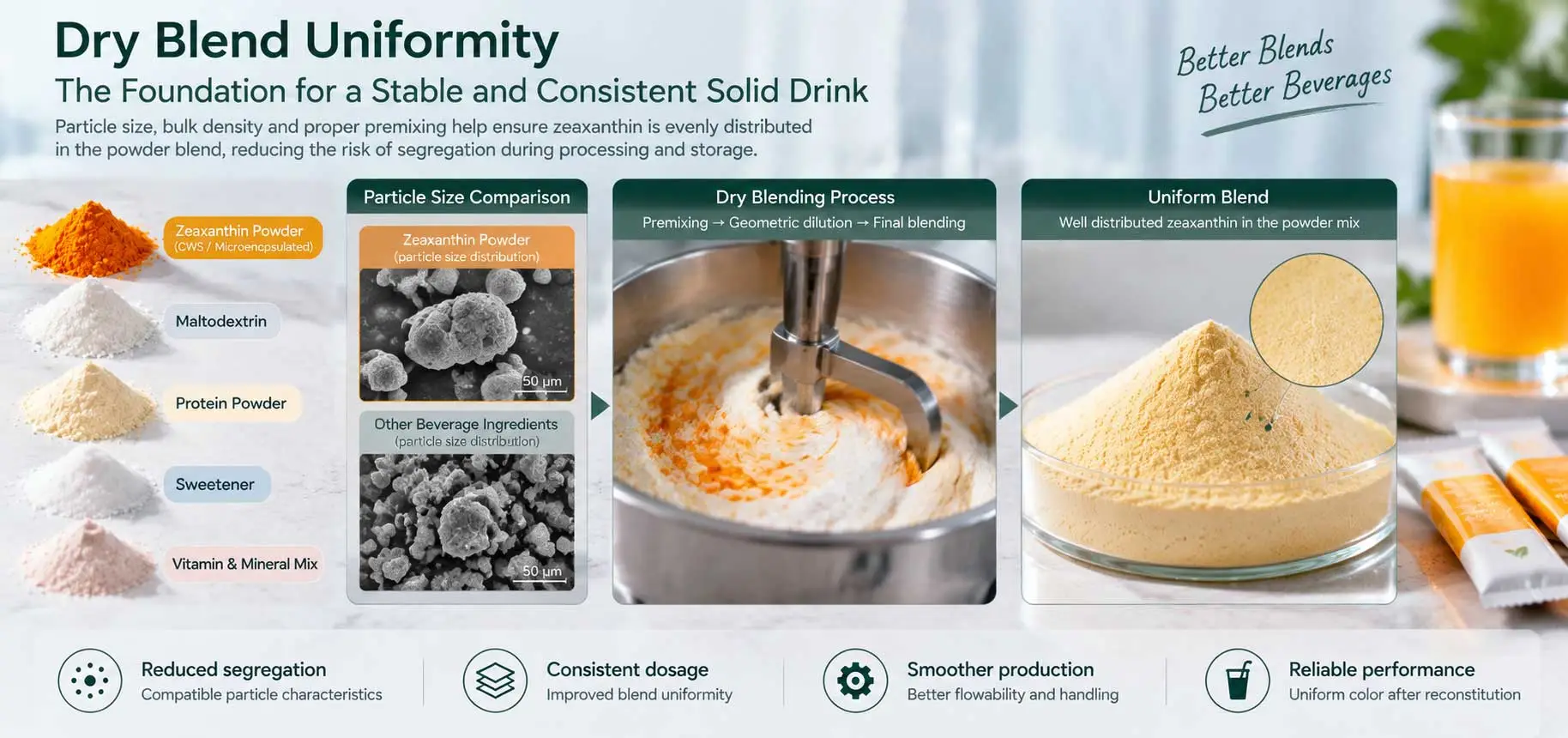
How Particle Size and Bulk Density Affect Dry-Blend Uniformity
Particle characteristics become especially important when zeaxanthin represents only a small fraction of the finished powder.
A typical drink mix may contain hundreds or thousands of times more base powder than carotenoid ingredient. If the zeaxanthin powder particle size differs substantially from the other components, segregation can occur as the blend moves through mixers, intermediate containers, hoppers and filling equipment.
Density matters for the same reason. A very light powder and a substantially denser powder do not necessarily move through a production system in the same way.
Research comparing several techniques for co-encapsulating β-carotene, lutein, zeaxanthin and fish oil illustrates how large these physical differences can become. Depending on drying technology and wall material, tapped densities ranged from approximately 0.27 to 0.65 g/cm³ in that study.
Those figures are experimental data, not specifications for CHEN LANG BIO TECH material. Their value is in demonstrating why apparently similar carotenoid powders can behave differently.
When evaluating zeaxanthin powder bulk density, compatibility with the entire premix is therefore more useful than an isolated “good” or “bad” number.

Flowability Matters During Mixing, Filling and Sachet Production
Zeaxanthin powder flowability influences much more than whether a powder pours easily from a laboratory container.
At production scale, flow affects transfer through hoppers, dosing into mixers and consistency during auger or sachet filling. Poor flow can also make small-volume addition less predictable.
The same carotenoid microencapsulation study found substantial differences in Carr Index according to drying process and carrier system, with values ranging from about 16% to 48% among the experimental powders. This reinforces an important procurement point: the manufacturing method and carrier system can alter powder behavior even when the active ingredient is nominally the same.
For zeaxanthin powder for sachets, flow should consequently be considered together with the behavior of the complete formulation and the intended filling equipment rather than treated as an isolated supplier specification.
Reconstitution Is the Key Performance Test for Zeaxanthin in Solid Drinks
A dry powder can pass incoming inspection and blend successfully yet still fail at the moment that matters most to the consumer: when water is added.
Zeaxanthin powder reconstitution encompasses several related behaviors. The ingredient has to contact the water surface, become wetted, distribute through the liquid and remain acceptably dispersed for the intended consumption period.
Carrier chemistry can materially affect this process. In a study of microcapsules prepared from Lycium barbarum residue oil rich in zeaxanthin dipalmitate, an OSA-starch system had a measured wetting time of 256 ± 5 seconds, while an OSA-starch/gum arabic/maltodextrin system required 298 ± 11 seconds. Other carrier combinations in the same experiment showed still different results.
These numbers should not be interpreted as target values for commercial CWS zeaxanthin. The study involved specific wall systems and experimental conditions. What it demonstrates is more useful: zeaxanthin powder wetting can change when the carrier architecture changes.
An instant drink zeaxanthin powder should therefore be evaluated under realistic use conditions. Water temperature, mixing method, powder-to-water ratio and the other ingredients in the drink all matter.
Reconstitution performance depends on the complete powder system—including carrier chemistry, particle structure and the finished drink matrix—not simply on the presence of zeaxanthin.
Water Dispersible Does Not Mean Sedimentation-Free
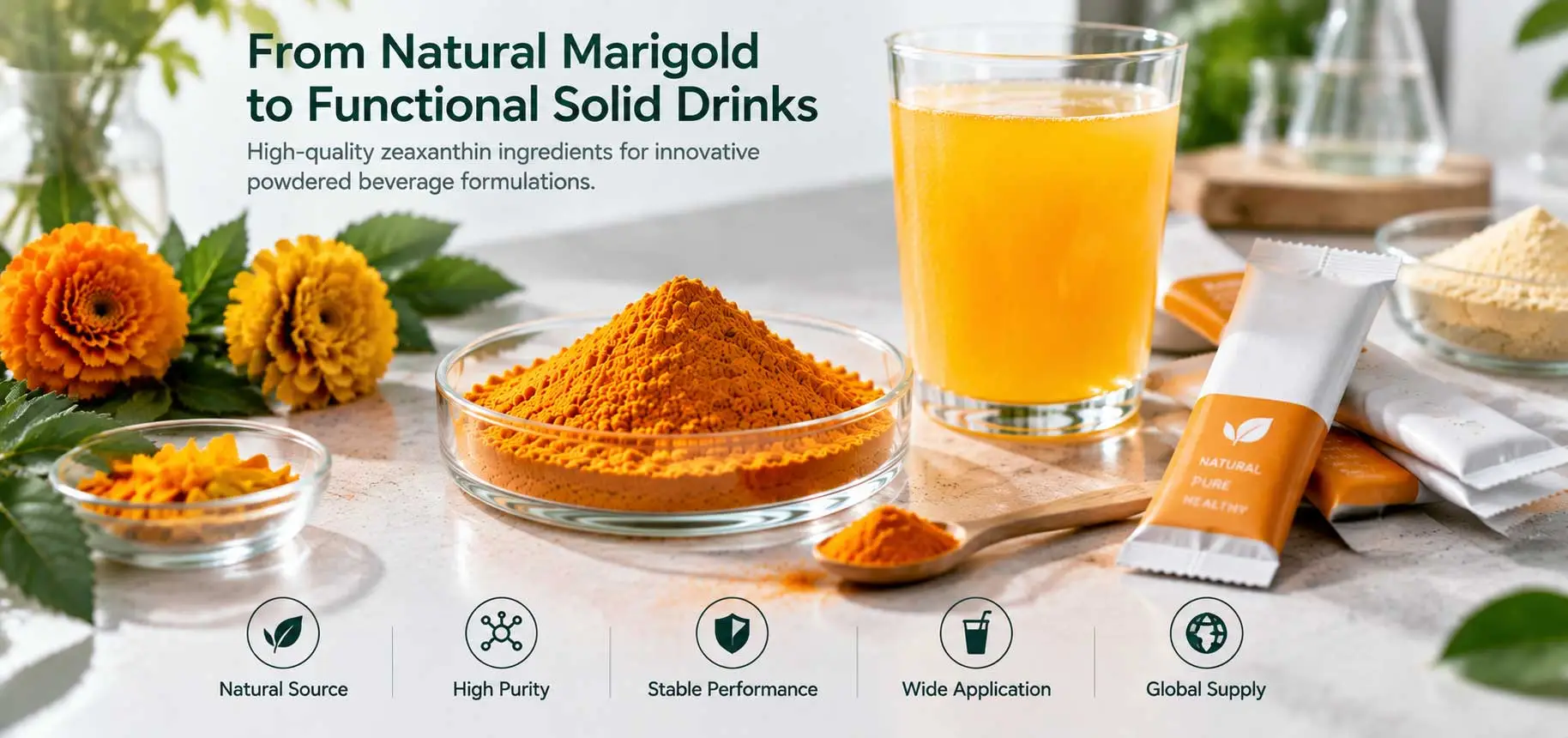
The description water dispersible zeaxanthin powder should not be interpreted as a guarantee that particles will remain suspended indefinitely.
Initial dispersibility asks whether the ingredient can be distributed through the liquid. Zeaxanthin dispersion stability asks what happens after that dispersion has formed.
The distinction is particularly relevant to solid drinks because their use pattern differs from an RTD beverage. A bottled drink may need to remain physically stable for months. An instant powder may only need to maintain an acceptable appearance and distribution during the normal period between preparation and consumption.
This does not make sedimentation irrelevant. Rapid settling, surface rings or visible agglomerates can still undermine product quality. It simply means the stability criterion should reflect the real application.
A solid drink does not necessarily require the same long-term suspension stability as a ready-to-drink beverage, but the reconstituted product should remain acceptable for its intended consumption period.
How Microencapsulation Changes Zeaxanthin Powder Performance
The value of zeaxanthin microencapsulation extends beyond getting a hydrophobic carotenoid into a powder.
Wall materials and drying methods can influence water activity, density, encapsulation efficiency, powder flow and reconstitution. In the comparative study that co-encapsulated β-carotene, lutein, zeaxanthin and fish oil, water activity ranged from 0.229 to 0.280 across the tested systems. Microencapsulation efficiency ranged from 69.9% to 95.1%, while tapped density and Carr Index also varied materially with carrier and drying technology.
The experiment compared spray drying, freeze drying and microfluidic-jet spray drying, using whey protein isolate, OSA-modified starch and combinations of the two. It therefore should not be used as performance data for a different commercial grade.
Its formulation lesson is highly relevant, however:
Two zeaxanthin powders with the same active assay can perform differently if their carrier systems and particle structures are different.
That is why buyers evaluating microencapsulated zeaxanthin for solid drinks should understand both active concentration and delivery-system characteristics.
Moisture and Water Activity Matter During Solid Drink Storage
Moisture management is fundamentally different in a dry drink than in a liquid beverage.
Moisture content describes the amount of water present, whereas water activity describes the availability of water within the system. The two values are related but not interchangeable.
In the carotenoid microcapsule study discussed above, measured water activities were approximately 0.229–0.280. The authors also found that carrier selection influenced water-binding behavior. Again, those figures should not be adopted as a specification for an unrelated commercial zeaxanthin powder.
The practical concern is that moisture uptake can alter powder properties during storage. Caking can affect dosing and consumer handling, while changes in particle structure may alter reconstitution.
For zeaxanthin solid drink stability, the relevant environment therefore includes not only the ingredient container at the supplier but also the customer's manufacturing room, intermediate storage and final sachet or tub.
This makes moisture-barrier packaging and appropriate storage conditions part of formulation performance rather than merely logistics.
Light and Oxygen Protection Still Matter in Dry Powder Formulations
Zeaxanthin powder stability also depends on protection from environmental exposure.
The molecule contains an extended conjugated polyene structure, and carotenoid systems are generally sensitive to oxidative and photochemical degradation. Encapsulation can create a physical barrier between a carotenoid core and the surrounding environment, but the degree of protection depends on wall composition, particle integrity and storage conditions.
Research across carotenoid encapsulation systems consistently shows that wall-material selection influences protection against light, oxygen, heat and other stresses, although results from one carotenoid or carrier system should not be transferred directly to another.
For an ingredient buyer, zeaxanthin light stability therefore needs to be considered alongside the final package. A technically well-designed microcapsule cannot compensate indefinitely for poor moisture and oxygen barriers or unnecessary light exposure.
What Other Ingredients Can Affect Zeaxanthin Reconstitution?
A zeaxanthin drink powder formulation rarely consists of zeaxanthin and a neutral carrier alone.
Proteins can change viscosity and particle interactions after reconstitution. Minerals can alter ionic conditions. Acids change pH, while fibers and hydrocolloids influence hydration and suspension behavior. Flavor powders and botanical ingredients introduce additional particles with their own density and wetting characteristics.
As a result, a CWS grade that appears uniform in laboratory water can behave differently in a protein-rich nutritional powder or an acidic fruit drink mix.
This is why zeaxanthin formulation compatibility should be established in the finished recipe.
The principle is simple:
A CWS grade that disperses well in water should still be tested in the complete solid-drink formula because other ingredients can change its reconstitution behavior.
For development teams, purified-water screening is useful for comparing candidate grades, but it should not replace application testing.
How to Select Zeaxanthin for Different Solid Drink Formats
Different products place different demands on the ingredient.
|
Solid drink format |
Main selection priority |
|
Instant fruit drink |
wetting, color distribution and acid compatibility |
|
Protein drink powder |
dry-blend uniformity and matrix interaction |
|
Nutritional powder |
assay accuracy and multi-ingredient compatibility |
|
Sachet drink |
flow, filling consistency and reconstitution |
|
Effervescent powder |
acid/base compatibility and rapid dispersion |
|
Functional drink mix |
active loading, sensory performance and stability |
For zeaxanthin for instant beverages, rapid wetting may carry more weight than achieving the highest possible carotenoid concentration in the raw material.
A zeaxanthin for protein drink powder project may need greater attention to matrix interactions after reconstitution. A complex nutritional formulation introduces yet another issue: zeaxanthin may be present at a relatively low level among many micronutrients, making blend uniformity especially important.
There is therefore no single “best” grade across all powdered beverages.
The application determines the grade, not the other way around.
How Should Zeaxanthin Be Added to a Solid Drink Premix?
How to add zeaxanthin powder to drink mix becomes important when the ingredient represents a very small percentage of the total batch.
Adding a small quantity directly to a large mixer and assuming final blending will distribute it uniformly can create unnecessary risk. A controlled zeaxanthin premix can improve distribution by first combining the carotenoid ingredient with a suitable portion of the formulation and then progressively incorporating that premix into the larger batch.
Geometric dilution is one possible approach when concentration differences are substantial.
The appropriate sequence, however, depends on equipment, batch size, powder properties and formulation composition. A universal mixing time or rpm would therefore be misleading.
For commercial zeaxanthin dry blending, process validation should demonstrate that the selected addition method actually produces acceptable content uniformity.
Why HPLC Assay and Blend Uniformity Should Be Verified Separately
A zeaxanthin HPLC assay on the supplier's COA answers an essential incoming-material question: how much zeaxanthin is present in the tested ingredient batch?
It does not answer whether that ingredient has been evenly distributed through the finished powder.
These are separate quality questions.
Incoming assay establishes raw-material strength. Zeaxanthin blend uniformity evaluates distribution after mixing. Analysis of the finished or reconstituted product can then help confirm whether the formulation and manufacturing process deliver the intended active content.
This distinction becomes increasingly important when the inclusion rate is low.
A compliant incoming zeaxanthin COA does not by itself demonstrate uniform distribution in the finished solid drink.
For procurement teams, this is also why an apparently attractive COA should not be evaluated without understanding the intended manufacturing process.
Test a Zeaxanthin Powder Sample in the Actual Solid Drink Formula
A zeaxanthin powder sample has the greatest value when it is treated as a miniature production qualification rather than simply inspected for color.
The same grade should ideally move through the relevant development sequence: dry blending, representative processing, storage and reconstitution. The formulation team can then evaluate whether the ingredient integrates into the powder blend and whether its behavior after water addition meets the intended product standard.
Where quantitative retention is important, analytical testing can be added rather than relying on appearance alone.
Another point is often overlooked: the development sample should represent the grade intended for commercial supply.
A supplier sample has procurement value only when it represents the grade that will later be supplied commercially.
This avoids approving one delivery system during R&D and discovering that the production material has different handling characteristics.
Packaging Should Protect Zeaxanthin and Preserve Powder Performance
Zeaxanthin powder packaging needs to address the properties of a carotenoid ingredient as well as those of a dry microencapsulated powder.
At CHEN LANG BIO TECH, small commercial quantities are typically supplied in sealed 1–5 kg aluminum foil bags, while larger quantities can be packed in 25 kg fiber drums with appropriate inner protection. The purpose is to reduce unnecessary exposure during storage and transportation and preserve the powder in a suitable condition before formulation.
This ingredient packaging should not be confused with the packaging requirements of the finished solid drink.
Once the material is blended with other ingredients, the sachet, stick pack or tub becomes the relevant barrier system. Zeaxanthin moisture protection must therefore be considered across the complete supply chain rather than only at raw-material receipt.

Scaling from a Laboratory Premix to Commercial Solid Drink Production
Approval in a one-kilogram development blend does not guarantee identical performance in a commercial mixer.
When bulk zeaxanthin powder enters production, differences in mixer geometry, fill level, mixing energy, transfer distance and filling speed can change powder distribution. Segregation can also occur after blending as material moves through downstream equipment.
The scale-up program should therefore verify both content uniformity and physical handling under representative manufacturing conditions.
Supply security becomes more relevant at this stage as well. Our natural carotenoid supply chain is supported by a marigold cultivation network of more than 200,000 mu across Yunnan, India and Zambia. Continuous extraction equipment provides raw-material processing capacity of up to 30 metric tons per day, supporting the transition from formulation trials to sustained commercial demand.
For a manufacturer, however, capacity only matters when the approved grade remains consistent from development to routine production.
How to Evaluate Zeaxanthin Powder Price for a Solid Drink
Zeaxanthin powder price is most useful when compared on an equivalent formulation basis.
A 5% and a 20% grade cannot be meaningfully compared simply by looking at price per kilogram because four times as much of the 5% material is required to deliver the same theoretical amount of active zeaxanthin.
A useful first calculation is:
Active-equivalent ingredient cost = ingredient price ÷ active fraction
Even that is not the complete answer. A functional CWS carrier may influence reconstitution, handling and stability, while a cheaper material that creates processing problems can increase rework or development costs.
The cheapest zeaxanthin powder per kilogram is not necessarily the lowest-cost ingredient in the finished solid drink.
Technical equivalence should therefore be established before commercial quotations are compared.
What Should a Solid Drink Manufacturer Expect from a CWS Zeaxanthin Supplier?
A technically capable CWS zeaxanthin supplier should be able to identify exactly what grade is being offered and provide documentation that allows the customer to evaluate it against the finished application.
The discussion should go beyond a single assay number. The product form, assay basis, relevant carrier information, specification, COA, TDS, SDS and storage guidance all contribute to qualification. Application samples should correspond to the material intended for subsequent production.
Our approach combines traceable marigold sourcing with industrial processing and HPLC-based quality control. For solid-drink projects, the more productive conversation usually starts with the formulation—target active level, serving size, other major ingredients and expected reconstitution behavior—before a grade is selected.
That produces a more useful recommendation than treating every powdered beverage as the same application.
Frequently Asked Questions About Zeaxanthin for Solid Drinks
What is the best zeaxanthin form for solid drinks?
The best zeaxanthin for solid drinks depends on the finished formulation. A conventional grade may be appropriate where a higher active concentration is the main priority and the formulation can accommodate its physical properties. A CWS microencapsulated form is often worth evaluating when aqueous reconstitution is important. Assay, blend uniformity, stability and sensory performance should be considered together.
Is CWS zeaxanthin better for powdered beverages?
CWS zeaxanthin for powdered beverages can offer an advantage when improved wetting and aqueous dispersion are important, but “CWS” alone does not guarantee compatibility with every formulation. The carrier system and finished matrix still influence reconstitution. A representative application trial is more reliable than choosing solely from the product name.
Does zeaxanthin powder dissolve completely in water?
Native zeaxanthin is strongly lipophilic; PubChem reports a calculated XLogP3-AA of 10.9. CWS technology can improve the behavior of the commercial ingredient in water, but dispersion should not automatically be interpreted as complete molecular dissolution.
How do I calculate the amount of zeaxanthin powder in a drink mix?
For formulation purposes:
Ingredient amount = target active amount ÷ assay expressed as a decimal.
For example, delivering 10 mg of active from a 10% ingredient requires 100 mg of that ingredient. This is formulation mathematics only, not a recommended intake level.
Can I evaluate the material before commercial production?
Yes. Application testing is particularly useful for solid drinks because the material needs to perform in both the dry blend and after reconstitution. The development grade should correspond to the intended commercial material so the trial remains relevant when production is scaled.
What affects zeaxanthin powder price?
The cost can vary with active concentration, delivery system, manufacturing requirements, analytical specifications and commercial volume. For microencapsulated products, the carrier contributes functionality as well as weight, so cost-per-active and finished-formulation performance provide a better comparison than raw $/kg alone.
What should I check before I buy zeaxanthin powder?
Before deciding to buy zeaxanthin powder, establish the specification required by the finished product first. Confirm the assay and product form, review batch documentation and then evaluate a representative grade in the actual drink formulation. Commercial purchasing becomes much easier once technical equivalence has been established.
From Ingredient Selection to a Production-Ready Solid Drink
A solid-drink project rarely fails because a buyer did not have enough zeaxanthin options. The harder task is identifying which option continues to work after the ingredient leaves the laboratory jar and enters a real premix, filling line, sachet and glass of water.
That is where we prefer to start a project.
If your formulation team is comparing conventional and CWS grades, send us the product format, target active level, approximate serving size and the main components of the powder base. We can use that information to narrow the grade discussion and provide the relevant specification and evaluation material, rather than sending a generic recommendation that ignores the formulation.
For technical or commercial project discussions with CHEN LANG BIO TECH, contact admin@chenlangbio.com.
References
1. National Center for Biotechnology Information. PubChem Compound Summary for CID 5280899, Zeaxanthin. Molecular weight 568.9 g/mol; calculated XLogP3-AA 10.9.
2. Xiao, et al. A Comparison of Microfluidic-Jet Spray Drying, Two-Fluid Nozzle Spray Drying, and Freeze-Drying for Co-Encapsulating β-Carotene, Lutein, Zeaxanthin, and Fish Oil. Foods. 2021;10(7):1522. The study compared drying technologies and carrier systems and reported differences in water activity, microencapsulation efficiency, tapped density and Carr Index.
3. Supercritical Fluid CO₂ Extraction and Microcapsule Preparation of Lycium barbarum Residue Oil Rich in Zeaxanthin Dipalmitate. The study compared wall-material systems and reported differences in moisture, wettability, solubility and microencapsulation efficiency; measured wetting times included 256 ± 5 s and 298 ± 11 s for two of the tested systems.
4. Martínez-Álvarez, et al. Recent Advances in Astaxanthin Micro/Nanoencapsulation to Improve Its Stability and Functionality as a Food Ingredient. Marine Drugs. 2020;18(8):406. Although focused on another carotenoid, the review provides supporting formulation evidence on how encapsulation architecture and wall materials can affect carotenoid dispersibility and protection against light, oxygen, pH, moisture and thermal stress; these findings are used here as general carotenoid-delivery context rather than zeaxanthin-specific commercial performance data.

Send Inquiry
Related Industry Knowledge
- Key Active Compounds in Olive Leaf Extract Powder: Oleuropein vs Hydroxytyrosol
- Can Madecassoside Be Used with Retinol?
- Ergothioneine Price per Kg in 2026: What Affects Bulk Cost?
- Is Spermidine Safe? Dosage, Safety, Side Effects and Supplement Guide
- Why Bodybuilders Choose Turkesterone Powder?
- Does Centella Asiatica Help Acne Scars
- What is Ectoin Made of
- Apple Polyphenol Benefits
- What is Resveratrol Extract Powder Good for
- What is Milk Thistle Extract Powder Good For