
Can Madecassoside Be Used with Retinol?
2025-12-30 15:43:52
As retinol continues to be one of the most widely used active ingredients in modern skin care, formulators and product developers are increasingly focused on improving its tolerability without compromising performance. This naturally leads to a common and very practical question: can madecassoside be used with retinol?
From an ingredient supplier’s perspective, this question reflects a broader shift in formulation strategy. Brands are no longer looking at actives in isolation. Instead, they are designing balanced systems, where performance-driven ingredients such as retinol are supported by complementary components that help manage irritation, dryness, and overall skin comfort.
In this context, understanding whether madecassoside and retinol can be used together is not just a formulation curiosity—it is a real development challenge. This article explores can madecassoside be used with retinol from a professional formulation and ingredient-compatibility standpoint, focusing on stability, system design, and practical considerations rather than consumer myths.
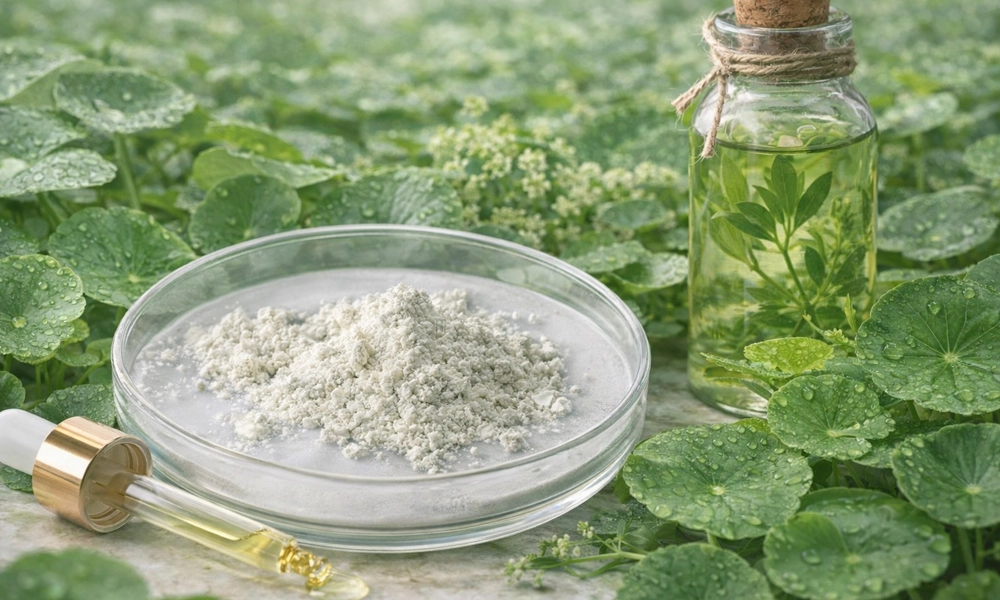
Quick Answer: Can You Use Madecassoside with Retinol?
Can madecassoside be used with retinol?
The short answer is yes—and in fact, they are commonly used together in modern skin care formulations.
From a formulation perspective, madecassoside and retinol are considered compatible ingredients when the system is designed correctly. The key is not whether they can be combined, but how the formulation manages pH, oxidation, and overall active load. When these factors are properly controlled, madecassoside can play a valuable supporting role in retinol-based products.
This is why many formulators view madecassoside as part of a broader strategy to improve the user experience of retinol-containing products, especially in formulations aimed at long-term use or sensitive skin profiles.
Why Retinol Causes Irritation (and Why Pairing Matters)
To understand why the question can madecassoside be used with retinol is so relevant, it is important to briefly revisit how retinol behaves in skin care formulations.
Retinol is a biologically active vitamin A derivative that works by influencing skin cell turnover and differentiation. While this activity makes retinol highly effective, it also explains why retinol irritation, dryness, redness, and peeling are common side effects—particularly during the early stages of use.
From a formulation standpoint, retinol places stress on the skin barrier, especially when used at higher concentrations or in leave-on products. As a result, formulators often look for supporting ingredients that help mitigate discomfort without interfering with retinol’s functionality.
This is where interest in madecassoside with retinol has grown. Rather than reducing retinol concentration alone, many modern formulations focus on balancing the system, pairing retinol with ingredients that contribute to skin comfort and formulation stability.
What Is Madecassoside and What Does It Do in Formulas?
Before evaluating can madecassoside be used with retinol, it is important to clarify what madecassoside is from an ingredient perspective.
Madecassoside is a triterpenoid saponin naturally derived from Centella asiatica. In cosmetic formulations, it is typically supplied as a highly standardized ingredient, allowing formulators to work with a clearly defined active rather than a complex botanical extract.
From a formulation point of view, madecassoside is widely recognized for its gentle profile and compatibility with sensitive-skin systems. This is why searches such as what is madecassoside, madecassoside for sensitive skin, and madecassoside in skincare continue to increase.
Importantly, madecassoside is not used to “counteract” retinol in a chemical sense. Instead, it is valued for how it fits into formulations designed to support skin comfort and barrier-focused product concepts, making it a logical candidate for combination with more aggressive actives like retinol.
Madecassoside and Retinol Together: What the Research Suggests
Interest in madecassoside and retinol together is not based solely on anecdotal formulation trends. There is a growing body of scientific literature examining madecassoside in dermocosmetic contexts, particularly in formulations designed to improve skin tolerance.
Several studies suggest that madecassoside may contribute to improved skin comfort and recovery parameters when used in topical formulations. While research does not frame madecassoside as a treatment or cure, it does support its inclusion in systems designed to manage skin stress.
This is why searches such as madecassoside retinol study, madecassoside with retinoids, and madecassoside clinical study are increasingly relevant to formulators. The key takeaway from existing research is not that madecassoside changes how retinol works, but that it may help support the formulation environment in which retinol is delivered.
Is Madecassoside Compatible with Retinol Formulation-Wise?
From a purely technical standpoint, madecassoside compatibility with retinol depends on formulation design rather than ingredient conflict.
Retinol presents known formulation challenges related to:
♦Oxidation sensitivity
♦Light sensitivity
♦pH constraints
Madecassoside, by contrast, is relatively stable under standard cosmetic conditions and does not introduce additional oxidative stress when properly incorporated.
As a result, madecassoside and retinol compatibility is generally considered good, provided that the formulation includes appropriate antioxidant systems, controlled processing conditions, and suitable packaging. This is why many formulators treat madecassoside as a supporting active rather than a destabilizing factor.
Best Practices for Formulating Retinol with Madecassoside
When formulators ask can madecassoside be used with retinol, the most useful answer often comes in the form of best practices rather than simple yes-or-no statements.
Based on common industry approaches, the following practices are widely applied:
Incorporation stage: Madecassoside is often added during the cool-down phase to minimize unnecessary thermal stress.
♦pH control: Retinol formulations typically operate within a carefully controlled pH range. Madecassoside is compatible with these systems when pH is stabilized.
♦Antioxidant support: Retinol formulations benefit from antioxidant systems that protect all actives in the formulation, including madecassoside.
♦Packaging selection: Airless and opaque packaging helps protect retinol and contributes to overall system stability.
These practices explain why madecassoside formulation tips and retinol serum formulation guidance frequently appear together in professional discussions.
What Not to Combine with Retinol in the Same Formula (Common Pitfalls)
While the question can madecassoside be used with retinol has a positive answer, formulators must still be mindful of broader system challenges.
Common formulation pitfalls often involve:
♦Extremely low pH exfoliating systems
♦Highly oxidative ingredient combinations
♦Excessive active stacking without adequate support
These issues are often framed in searches like what not to mix with retinol or retinol conflicts ingredients. Importantly, these challenges are not caused by madecassoside itself, but by overly aggressive formulation environments.
Understanding this distinction helps prevent unnecessary ingredient exclusions and supports more thoughtful system design.
How Brands and Formulators Use Madecassoside with Retinol
From a product development perspective, there are two common strategies for using madecassoside with retinol.
Some brands incorporate both ingredients into a single formulation, positioning the product as a comfort-focused retinol. Others design complementary products, such as a retinol serum paired with a madecassoside-containing support product.
In both cases, the goal is the same: to improve overall user experience while maintaining performance. This approach aligns with searches such as how to use retinol with madecassoside and retinol calming ingredient, which reflect growing interest in balanced skin care systems.
Recommended Usage Levels: Madecassoside with Retinol
When formulators consider madecassoside concentration in cosmetics alongside retinol, typical industry ranges provide useful guidance.
|
Ingredient |
Typical Cosmetic Use Level |
|
Retinol |
0.1% – 1.0% (formulation-dependent) |
|
Madecassoside |
0.05% – 1.0% (depending on concept) |
This is why searches like madecassoside dosage and retinol percentage in skincare remain highly context-dependent.
FAQ: Madecassoside and Retinol Compatibility Questions
Can sensitive skin use retinol with madecassoside?
Formulations designed for sensitive skin often include madecassoside alongside retinol to support comfort, but suitability depends on overall formulation design.
Does madecassoside reduce retinol irritation?
Madecassoside is commonly included in formulations aimed at improving tolerance, though it does not change retinol’s biological mechanism.
Madecassoside vs Centella extract with retinol—what’s the difference?
Madecassoside offers greater formulation precision, while centella extracts provide broader botanical complexity.
Final Takeaway: Yes—When the Formula Is Designed Correctly
So, can madecassoside be used with retinol?
Yes—when the formulation is designed with stability, balance, and user experience in mind.
Rather than viewing compatibility as a restriction, formulators increasingly see madecassoside as a valuable supporting ingredient in retinol systems. When pH, oxidation, and active load are properly managed, madecassoside integrates smoothly into retinol-containing formulations.
At CHEN LANG BIO TECH, we work closely with customers to support ingredient selection and formulation design involving madecassoside and retinol, offering technical documentation, specifications, and formulation insight.
Contact CHEN LANG BIO TECH
📧 Email: admin@chenlangbio.com
🌐 Website: https://www.chenlangbio.com
References
1, Brinkhaus, B., Lindner, M., Schuppan, D., & Hahn, E. G. (2000). Chemical, pharmacological and clinical profile of the East Asian medicinal plant Centella asiatica. Phytomedicine, 7(5), 427–448.
2, James, J. T., & Dubery, I. A. (2009). Pentacyclic triterpenoids from the medicinal herb, Centella asiatica. Journal of Ethnopharmacology, 126(2), 181–187.
3, Cosmetic Ingredient Review (CIR). Safety Assessment of Centella asiatica–Derived Ingredients.
4, Barel, A. O., Paye, M., & Maibach, H. I. (2014). Handbook of Cosmetic Science and Technology. CRC Press.
5, Tadros, T. (2013). Emulsion Formation and Stability. Wiley-VCH.

Send Inquiry
Related Industry Knowledge
- What Is Sialic Acid Used For? Benefits, Applications, and Supplier Guide
- The Science Behind Pure Fisetin
- Isobutylamido Thiazolyl Resorcinol: A Powerful Brightening Agent
- Rutecarpine Powder for Beginners: Benefits and Dosage
- Sea Buckthorn Oligopeptide vs. Collagen: Which is Better
- Does Sodium Copper Chlorophyllin Increase Potassium Levels
- Can You Grow Bergenia in Pots
- How Long Does It Take Bakuchiol to Work
- Quaternium-73 for Acne
- Resveratrol Antioxidant