
Is Spermidine Safe? Dosage, Safety, Side Effects and Supplement Guide
2026-04-28 14:44:35
What Is Spermidine?
Spermidine is a naturally occurring polyamine present in all living cells, where it contributes to maintaining normal cellular activity. For readers asking what is spermidine, it can be understood as a small organic compound involved in fundamental biological processes that support cellular balance and internal regulation.
From a scientific standpoint, the spermidine meaning is closely tied to its role in cell growth, differentiation, and stability. It is found in a variety of natural sources, including plant-based foods, but for industrial and commercial applications, it is typically produced under controlled conditions to ensure consistency and purity.
The concept of spermidine function in the body is often discussed in relation to its involvement in cellular processes that help maintain normal biological function. While research continues to explore these interactions, spermidine has become a subject of growing interest in both academic and product development environments.
In practical terms, spermidine is widely used as a spermidine supplement ingredient in the nutraceutical sector. Its compatibility with different formulation systems, along with the availability of standardized forms, makes it suitable for use in capsules, tablets, and powder-based products.
From an industry perspective, the focus is not only on understanding the compound itself, but also on ensuring that it can be reliably sourced and integrated into consistent formulations. This is why standardized forms such as spermidine trihydrochloride are often preferred when reproducibility and quality control are essential.

Is Spermidine Safe? (Scientific and Regulatory Perspective)
The question of is spermidine safe is one of the most common concerns among both consumers and product developers. In scientific discussions, spermidine safety is typically evaluated within the context of research findings, formulation design, and regulatory frameworks.
Current spermidine safety research is largely based on laboratory and experimental studies, where the compound has been examined in relation to various cellular processes. These studies provide valuable insights, but they are conducted under controlled conditions and should be interpreted within that context.
From a regulatory perspective, spermidine supplement safety depends on how the ingredient is used within finished products. Different regions have their own guidelines governing dietary supplements, and manufacturers are responsible for ensuring that formulations comply with local requirements.
In practice, safety is not determined by a single factor. It depends on multiple variables, including dosage, formulation, and the quality of the raw material used. This is why industry professionals tend to evaluate safety in a broader framework rather than making absolute statements.
For companies developing spermidine-based products, working with standardized materials and verified specifications helps support consistency and traceability—both of which are important components in safety evaluation.
Recommended Spermidine Dosage
When discussing spermidine dosage, it is important to distinguish between research data and real-world product formulation. Unlike vitamins or minerals with established daily intake values, there is currently no universally standardized recommendation for spermidine dosage per day across all applications.
Most available information comes from observational studies and controlled research settings, where spermidine intake is evaluated within specific dietary or experimental frameworks. As a result, discussions around how much spermidine to take should be understood in context rather than as fixed guidelines.
From an industry perspective, manufacturers determine spermidine supplement dosage based on formulation design, regulatory requirements, and target market standards.
Typical Spermidine Intake Levels in Research and Products
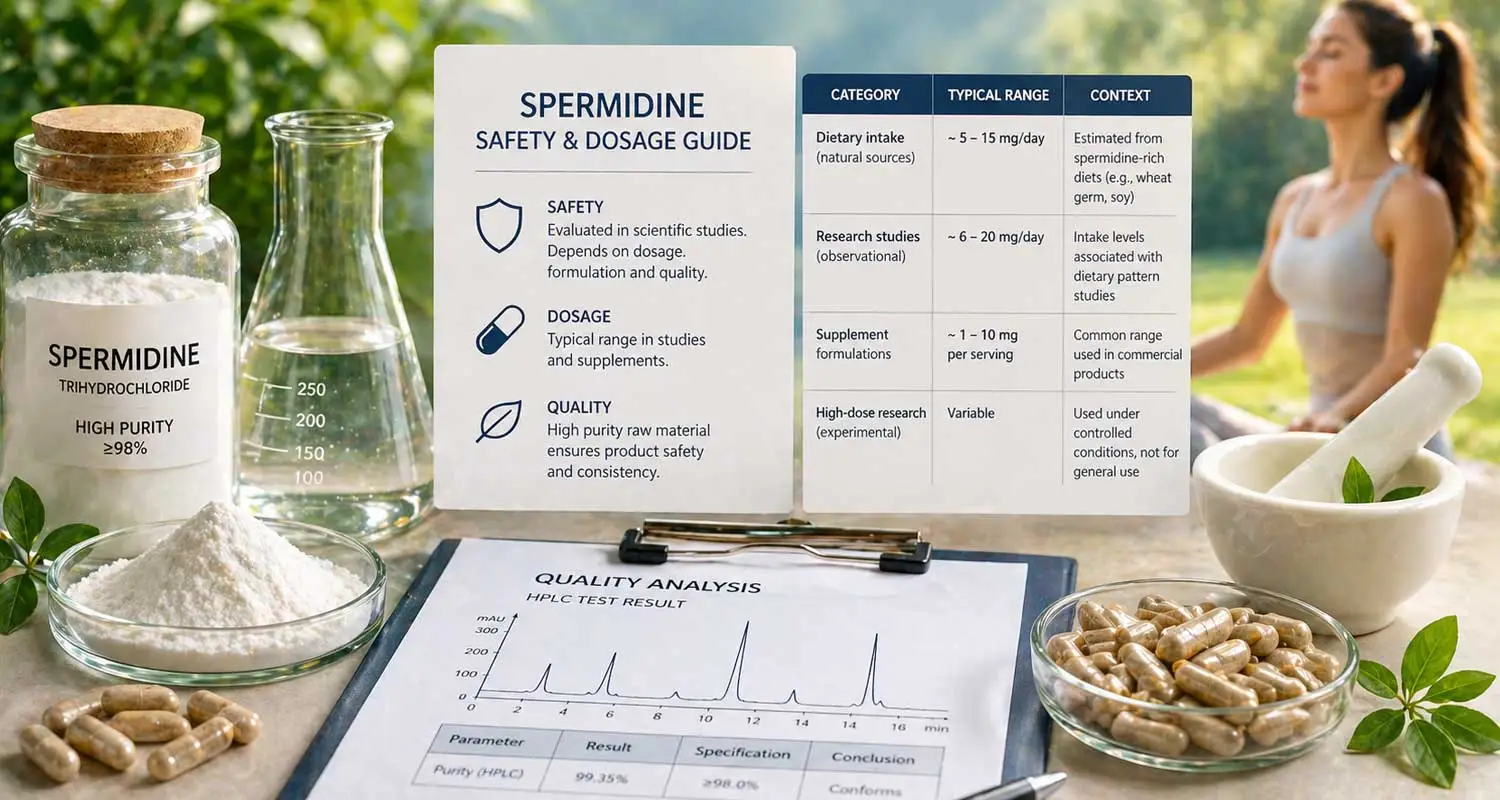
Below is a general overview based on commonly cited ranges in scientific literature and commercial formulations:
|
Category |
Typical Range |
Context |
|
Dietary intake (natural sources) |
~5–15 mg/day |
Estimated from spermidine-rich diets (e.g., wheat germ, soy) |
|
Research studies (observational) |
~6–20 mg/day |
Intake levels associated with dietary pattern studies |
|
Supplement formulations |
~1–10 mg per serving |
Common range used in commercial products |
|
High-dose research (experimental) |
Variable |
Used under controlled conditions, not for general use |
Key Considerations When Interpreting Dosage
It is important to note that:
•spermidine dosage depends heavily on the form used (natural extract vs. standardized compound such as spermidine trihydrochloride)
•Bioavailability and formulation design can influence how the ingredient is utilized
•Regulatory frameworks in different regions may define acceptable usage levels for supplements
For manufacturers, dosage is not determined in isolation. It is part of a broader formulation strategy that considers ingredient interactions, delivery format, and product positioning.
From Raw Material to Final Dosage
From a supply chain perspective, consistency in raw material plays a critical role in supporting accurate formulation. Variability in purity or composition can directly impact how spermidine supplement dosage is calculated and applied in finished products.
This is why many companies prefer working with standardized, high-purity materials that allow for more precise formulation control and reproducibility across batches.
Potential Side Effects of Spermidine (Research-Based Discussion)
The topic of spermidine side effects is closely related to how the compound is studied and used. In scientific literature, discussions about spermidine risks are generally based on controlled studies that explore how compounds interact with biological systems.
When evaluating whether is spermidine dangerous, it is important to consider context. Most available data comes from research environments, where variables such as dosage and conditions are carefully managed. These findings are useful for understanding potential interactions, but they are not intended to represent real-world product outcomes without further evaluation.
Reports of spermidine adverse effects in the literature are limited and often depend on specific experimental conditions. As with many compounds, individual responses may vary, and factors such as formulation, dosage, and overall product design can influence outcomes.
From an industry standpoint, the focus is on minimizing variability and ensuring product consistency. This includes using high-quality raw materials, maintaining strict production standards, and providing clear documentation to support traceability.
For manufacturers and suppliers alike, responsible communication is essential. Rather than overstating conclusions, the emphasis remains on providing accurate information based on current research while supporting safe and compliant product development.
Factors That Affect Spermidine Safety
When evaluating safety, it is rarely sufficient to look at a single variable in isolation. In practice, spermidine safety is influenced by several interrelated factors, including raw material quality, formulation design, and intended use.
One of the most important considerations is spermidine purity. Variations in purity can lead to differences in composition, which may affect how the ingredient behaves within a formulation. For this reason, manufacturers often prioritize sourcing high purity spermidine with clearly defined specifications.
Another factor is the presence of impurities or residual components. Even at low levels, these can introduce variability, particularly in large-scale production. This is why consistent analytical verification is essential when evaluating spermidine quality.
Formulation also plays a role. The way spermidine is incorporated into a product—whether as a standalone ingredient or part of a complex blend—can influence its stability and compatibility. As a result, safety considerations extend beyond the raw material itself to include the overall product design.
Ultimately, a comprehensive view of safety requires looking at the entire supply chain, from production to final application.
Why Raw Material Quality Matters
In industrial practice, the quality of the raw material is one of the most critical factors in ensuring consistent outcomes. For companies working with spermidine, selecting a reliable spermidine supplier is closely linked to both product quality and long-term stability.
A professional spermidine manufacturer typically provides more than just the material itself. It includes supporting data that allows buyers to verify identity, purity, and consistency. This often involves analytical techniques such as chromatographic testing and structural verification.
For standardized forms like spermidine trihydrochloride, these quality controls are especially important. They ensure that each batch meets the same specifications, which is essential for reproducible formulation.
In addition to testing, documentation plays a key role. Certificates of analysis and technical data sheets provide transparency and help manufacturers meet regulatory and internal quality requirements.
From a broader perspective, sourcing decisions are increasingly based on long-term reliability rather than short-term cost. Consistent supply, clear communication, and technical support all contribute to building stable partnerships within the industry.
Spermidine Trihydrochloride vs Natural Spermidine
The choice between different forms of spermidine often comes down to consistency and control. When comparing spermidine vs spermidine trihydrochloride, the differences are primarily related to how the material is produced and standardized.
Natural sources, often referenced in discussions of natural spermidine vs synthetic, can vary significantly depending on origin, processing, and extraction methods. While these sources may be appealing in certain contexts, they can present challenges in maintaining consistent specifications.
In contrast, standardized forms such as spermidine trihydrochloride are produced under controlled conditions. This allows for more precise definition of purity and composition, which is particularly important in commercial applications.
Comparisons like wheat germ spermidine safety often highlight this difference. Natural extracts may contain a broader range of compounds, whereas standardized materials are designed to provide a more predictable profile.
For manufacturers, this predictability is often a key factor when evaluating safety and suitability for large-scale production.
Who Should Be Careful When Using Spermidine?
While spermidine is widely studied, it is important to approach its use with appropriate consideration. Discussions around who should not take spermidine are generally framed in terms of general precautions rather than specific recommendations.
In practice, spermidine precautions may apply in situations where products are being developed for specific population groups or under particular regulatory frameworks. This is especially relevant in cases where formulation design needs to align with market-specific guidelines.
Questions related to spermidine safety concerns are typically addressed during product development, where manufacturers evaluate ingredient compatibility, dosage, and intended use. This process ensures that finished products meet applicable safety and compliance standards.
Rather than focusing on isolated factors, industry practice emphasizes a holistic approach—considering formulation, sourcing, and regulatory alignment together.
How to Choose a Safe Spermidine Supplement or Raw Material
For companies moving toward commercialization, selecting the right material is a critical step. Evaluating a spermidine supplement quality involves more than reviewing basic specifications—it requires understanding how the ingredient will perform within a formulation.
One of the first considerations is purity. Consistent, well-defined materials allow for more accurate formulation and reduce variability. This is particularly important for companies working with high purity spermidine in regulated markets.
Sourcing is equally important. Working with a reliable spermidine bulk supplier helps ensure that materials are available in consistent quantities and specifications. For buyers looking to buy spermidine trihydrochloride, this often means evaluating both production capability and technical support.
Documentation and analytical verification are also essential. Access to batch-specific data provides transparency and allows manufacturers to validate quality before incorporating materials into finished products.
In practice, selecting a supplier is not a one-time decision but an ongoing process that supports product development, scaling, and long-term supply stability.
Where to Buy High-Quality Spermidine in Bulk
For companies planning to scale production, identifying a reliable sourcing channel is essential. Buyers searching for spermidine trihydrochloride bulk materials typically evaluate suppliers based on consistency, documentation, and responsiveness.
The global supply landscape is structured around both manufacturing and distribution. While multiple regions participate in the market, production capacity is largely concentrated among experienced manufacturers with established processes.
When selecting a spermidine supplier China, buyers often consider factors such as production standards, export experience, and ability to meet international requirements. This is particularly relevant for companies entering regulated markets.
Working directly with a qualified spermidine trihydrochloride supplier can provide greater transparency, especially when technical clarification or customization is required. It also allows for more efficient communication during product development and scaling.
From an industry standpoint, long-term partnerships tend to provide more stability than transactional purchasing, particularly as demand continues to grow.
FAQ About Spermidine Safety and Dosage
Is spermidine safe long term?
Current discussions around is spermidine safe long term are based on research findings and product-specific evaluations. Long-term use considerations are typically assessed within formulation and regulatory contexts.
Can you take spermidine daily?
Questions such as can you take spermidine daily depend on how the product is formulated and intended to be used. Manufacturers define usage guidelines in accordance with regulatory standards.
What are the side effects of long-term use?
Research related to spermidine side effects long term remains limited and context-dependent. Observations are generally based on controlled studies rather than broad real-world conclusions.
What is the best spermidine supplement?
When evaluating the best spermidine supplement, factors such as ingredient quality, formulation design, and supplier reliability are often more important than a single defining feature.
Conclusion: Safety Depends on Quality and Proper Use
Understanding spermidine safety requires looking beyond individual claims and considering the broader context in which the ingredient is used. Research provides valuable insights, but real-world applications depend on formulation, sourcing, and regulatory alignment.
For companies working in the nutraceutical space, the focus often shifts toward reliability. Access to high purity spermidine, supported by consistent production and clear documentation, plays a central role in ensuring product quality.
At this stage, sourcing decisions become closely tied to long-term strategy. Working with a dependable spermidine bulk supplier helps reduce variability and supports stable product development.
Contact and Technical Inquiry
For teams evaluating sourcing options or planning to buy spermidine trihydrochloride, direct communication with a qualified manufacturer can help clarify technical and supply details.
If you require:
•Product specifications and COA
•Analytical data such as HPLC or NMR
•Sample evaluation before bulk orders
•Information on spermidine trihydrochloride bulk supply
You can contact CHEN LANG BIO TECH for further details.
📧 Email: admin@chenlangbio.com
🌐 Website: www.chenlangbio.com
💬 WhatsApp / WeChat: +86-17782478823

Send Inquiry

Related Industry Knowledge
- Oleuropein Powder: A Rising Star in the Botanical Extract Industry
- How Does Kojic Acid Dipalmitate Differ from Regular Kojic Acid?
- Is Spermidine Trihydrochloride Toxic?
- Enhance Your Skincare Routine with Pro-Xylane Powder
- Natural Cleaning with Soapnut Extract Powder
- How is Mung Bean Peptide Powder Used
- Sodium Methylesculetin Acetate: Uses, Benefits & Safety
- Is loratadine Soluble in Water
- Magnesium Ascorbyl Phosphate Benefits for Skin
- Explore Gynostemma Pentaphyllum Extract Gynostemma Pentaphyllum Powder in Depth