
What Is Quaternium-73 Powder Used for in Cosmetics?
2026-08-21 16:01:39
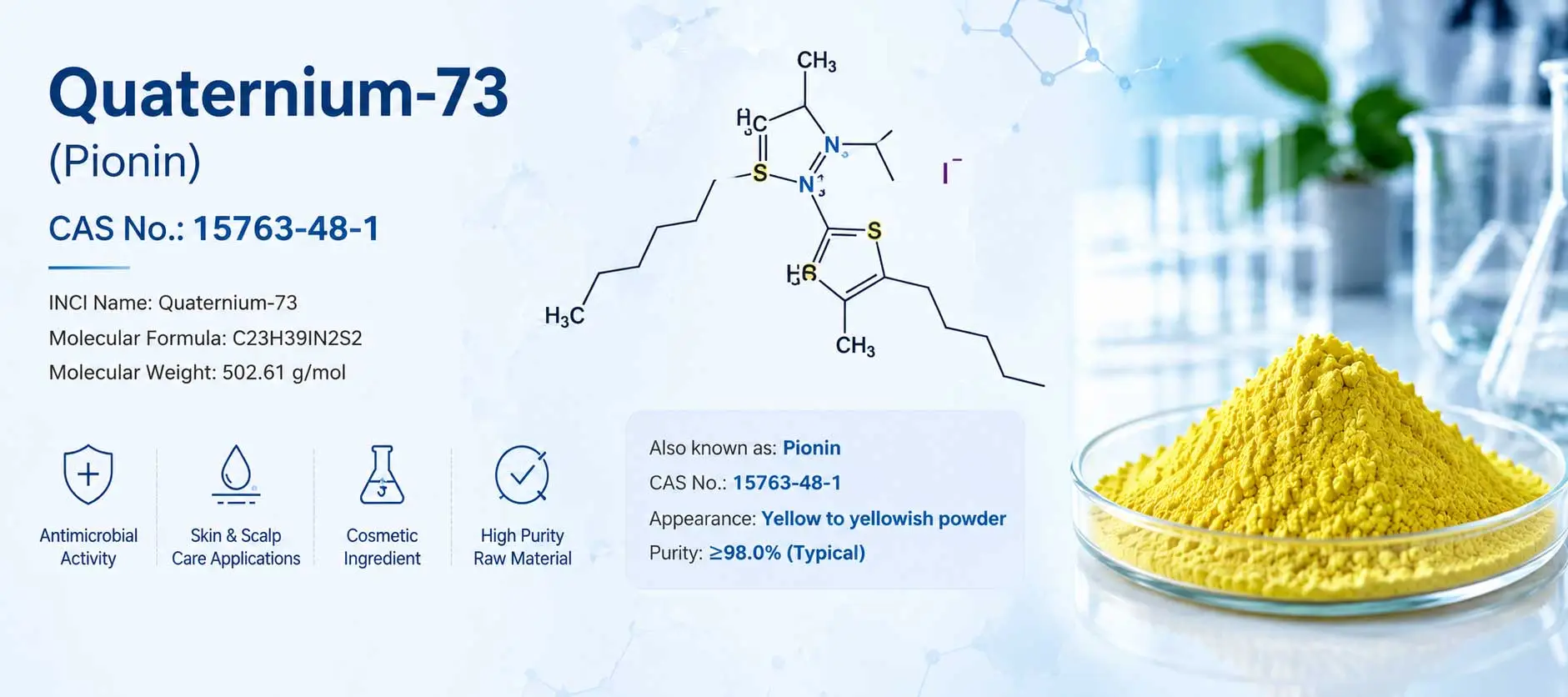
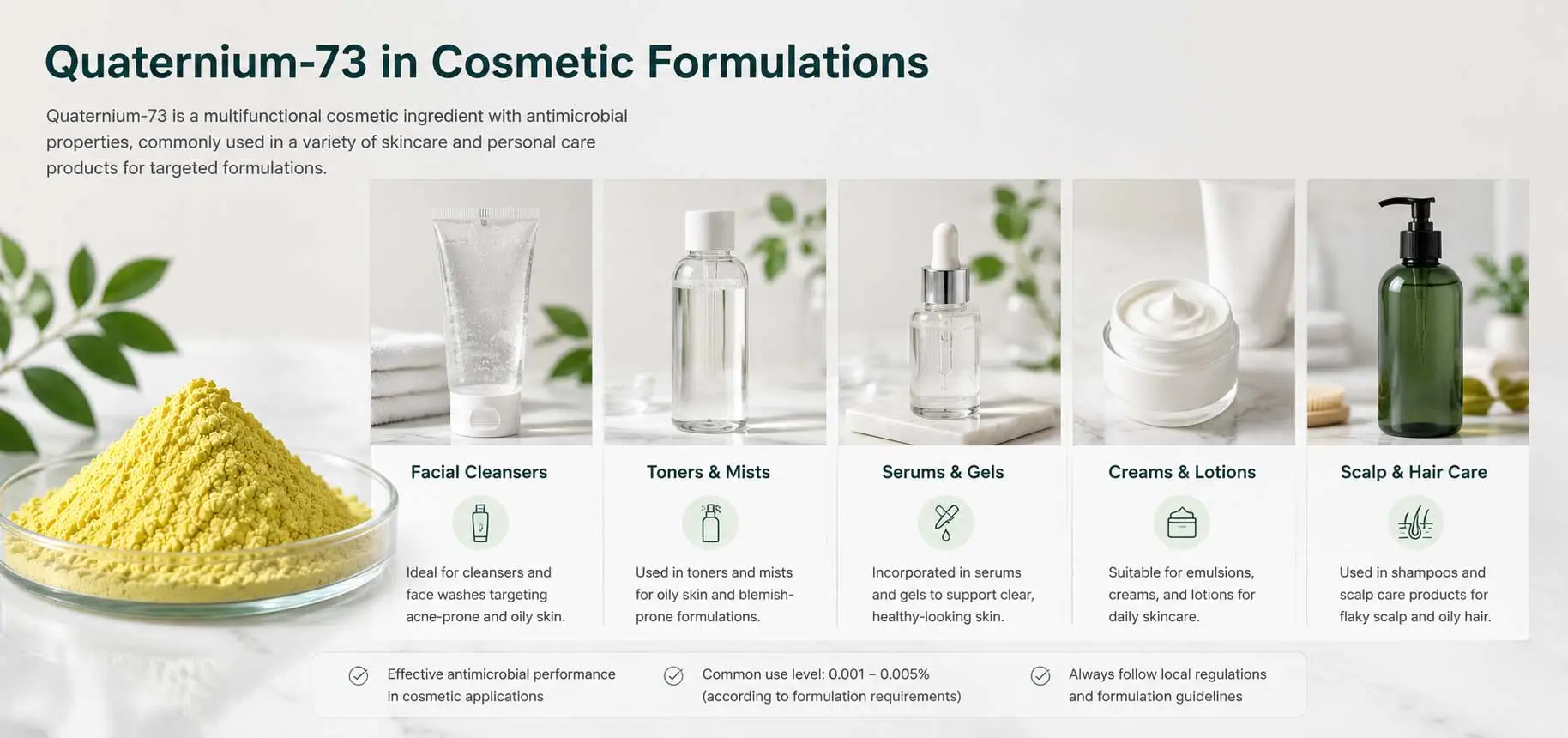
Quaternium-73 is used in selected cosmetic and personal-care formulations where its antimicrobial characteristics are relevant, particularly products developed for acne-prone or oily skin. Depending on the formulation concept, it may be evaluated in facial cleansers, toners, serums, gels, creams and selected scalp-care products. Commercial technical literature commonly places the Quaternium-73 use level in a low concentration range; several supplier technical sources specify approximately 0.001–0.005%, while some grades are recommended over a broader 0.001–0.05% range. These figures should be treated as formulation guidance rather than a universal dosage, because the appropriate concentration depends on the supplied grade, finished product, target market and regulatory assessment.
For raw-material buyers, understanding what Quaternium-73 is used for is therefore only part of the sourcing decision. The purchasing team also needs to know whether the supplied material matches the required specification, whether it can be incorporated into the intended formulation, how its assay is verified, and whether the supplier can maintain consistent quality when the project moves from a laboratory sample to repeat commercial production.
Quaternium-73 is also commonly associated with the name Pionin and CAS 15763-48-1. In this article, the focus is not on presenting a long list of consumer-facing claims, but on explaining where Quaternium-73 in cosmetics fits from the perspective of formulators, R&D teams and professional ingredient buyers.
Why Is Quaternium-73 Used in Cosmetic Formulations?
The main reason formulators investigate Quaternium-73 cosmetic uses is its antimicrobial activity. Commercial technical literature describes Quaternium-73 as active against microorganisms relevant to skin-care formulation and particularly discusses its activity in relation to Cutibacterium acnes, historically known as Propionibacterium acnes. This explains why many of the established Quaternium-73 cosmetic applications are concentrated in formulations for oily or acne-prone skin.
The important formulation distinction is that raw-material antimicrobial activity is not the same thing as proven finished-product performance. Once an ingredient enters a serum, emulsion or surfactant system, its behavior depends on concentration, solvent environment, pH, processing conditions and interactions with other ingredients. A laboratory should therefore evaluate the material in the actual formula rather than assuming that performance data generated for the isolated ingredient will transfer unchanged to every cosmetic product.
This is also why Pionin in cosmetics should be considered within a complete formulation strategy. Ingredient selection can be based on a technically relevant property, but claims and performance ultimately need to be supported at finished-product level.
What Role Does Quaternium-73 Play in a Finished Cosmetic Formula?
When buyers ask what does Quaternium-73 do in cosmetics, the most useful answer is that it is a specialty cosmetic raw material selected primarily for its antimicrobial characteristics in targeted skin- and personal-care formulations.
Its role should not be confused with that of a surfactant, emulsifier or conventional oil-control material. It is incorporated at comparatively low levels, so accurate weighing, suitable pre-dissolution and uniform distribution can be more important than its small percentage might initially suggest.
Quaternium-73 for Acne-Prone Skin Formulations: Why Do Formulators Use It?
Quaternium-73 for acne is one of the ingredient's most established application directions in commercial technical literature. The rationale is closely connected to antimicrobial activity rather than exfoliation or conventional sebum absorption. This distinction matters when an R&D team is deciding where the material fits alongside other ingredients in a formula.
For an anti acne cosmetic ingredient, formulators should separate three stages of evidence. First, the raw material must meet its identity and assay specification. Second, it must remain compatible and adequately dispersed or dissolved in the finished formula. Third, the finished product must be evaluated for the performance and claims the brand intends to make.
This approach is particularly important for Quaternium-73 for acne-prone skin because language around acne can cross the boundary between cosmetic positioning and therapeutic claims depending on the country and claim. A raw-material supplier's technical data should therefore not be copied directly into finished-product marketing without regulatory review.
In practical formulation development, Quaternium-73 may be evaluated in cleansing products, toners, gels, serums and emulsions intended for oily or blemish-prone skin. Supplier technical sheets commonly cite very low recommended concentrations, including 0.001–0.005%, with some suppliers specifying a broader range up to 0.05%.
Quaternium-73 and Cutibacterium acnes
The connection between Quaternium-73 and Cutibacterium acnes is one reason the ingredient attracts interest in this category. Commercial technical literature describes disruption of bacterial cell membranes as part of the proposed antimicrobial mechanism.
However, formulators should be cautious about extrapolating an MIC or other in-vitro result directly to a recommended finished-product dose. Microbiological test conditions and a commercial cosmetic formulation are fundamentally different systems. An ingredient concentration should be established through supplier technical guidance, regulatory review and finished-formula testing rather than by converting an in-vitro microbiological value into a formulation percentage.
Quaternium-73 for Oily Skin: Where Does It Fit in Formulation?
Quaternium-73 for oily skin frequently appears alongside acne-prone skin applications, but these two formulation objectives should not be treated as interchangeable.
Oily skin refers primarily to sebum production and the sensory consequences of excess surface oil. Antimicrobial activity addresses a different aspect of a formulation concept. A formulator developing an oily-skin product may therefore combine different ingredient functions rather than expecting one raw material to perform every role.
This distinction is useful for procurement teams because it helps define why an ingredient is being purchased. If the formulation objective is direct sebum regulation, the R&D team should assess evidence relevant to that function. If Quaternium-73 is selected because of its antimicrobial characteristics within a broader oily-skin formulation, its role should be documented accordingly.
Is Quaternium-73 an Oil-Control Ingredient?
Commercial suppliers sometimes position Quaternium-73 oily skin applications under “oil control,” but formulators should not automatically interpret that wording as evidence of a direct sebum-regulating mechanism.
For a technically defensible formulation, the claimed function should match the evidence available for the ingredient and, where necessary, the finished product.
Quaternium-73 in Facial Cleansers: Application and Formulation Considerations
A Quaternium-73 facial cleanser presents different formulation conditions from a leave-on serum. Cleansers normally contain surfactants and are rinsed from the skin after a relatively short contact period, so compatibility with the cleansing system and performance in a rinse-off environment need to be considered.
When developing a Quaternium-73 cleanser, the laboratory should check whether the material remains uniformly incorporated throughout the product's expected pH and temperature range. Surfactants, salts, fragrances and other actives may affect clarity or physical stability, especially in transparent facial washes.
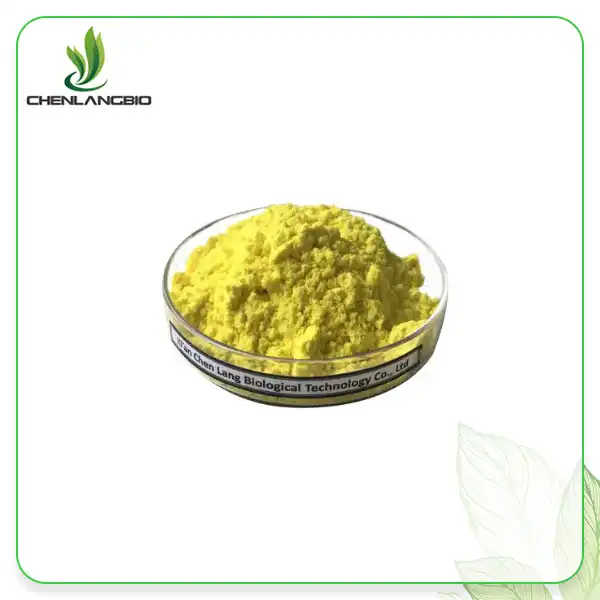
The processing method also deserves attention. Technical information from multiple commercial sources describes Quaternium-73 as a yellow or yellowish crystalline powder with alcohol solubility, and one TDS recommends pre-dissolution using ethanol, butanediol or a suitable diol before incorporation.
That guidance provides a useful starting point, but the exact procedure should be validated in the manufacturer's own Quaternium-73 cleansing formulation rather than copied into production without a laboratory trial.
Quaternium-73 in Serums, Gels and Creams: Leave-On Cosmetic Applications
Leave-on products allow formulators to use Quaternium-73 in skincare formulations very differently from rinse-off cleansers. Serums, gels and creams remain on the skin, so ingredient compatibility, distribution, long-term stability and regulatory use conditions become particularly important.
Quaternium-73 in Serums and Gels
For a Quaternium-73 serum, the laboratory should pay particular attention to solubility and visual appearance. A transparent serum makes incomplete dissolution, precipitation or color changes readily visible. If the supplied powder requires pre-dissolution, the chosen solvent system must also be compatible with the rest of the formula.
Gel systems introduce another variable because rheology modifiers can respond to solvent composition, ionic materials and pH. A stable premix does not guarantee that the complete gel will retain its viscosity or clarity after Quaternium-73 is added.
Quaternium-73 in Cream and Emulsion Systems
A Quaternium-73 cream adds the complexity of an emulsion. The development team needs to determine the appropriate incorporation stage and avoid exposing the material to unnecessary processing conditions simply because the base emulsion is normally manufactured at elevated temperature.
A practical development program should observe the finished emulsion for separation, precipitation, color change, viscosity drift and other stability indicators. Accelerated testing can help identify incompatibilities before the formula proceeds to commercial scale, but it should be used as part of the manufacturer's established stability protocol rather than as a substitute for it.
Quaternium-73 in Scalp-Care and Anti-Dandruff Formulations
Quaternium-73 scalp care is another application area mentioned in commercial ingredient literature. The antimicrobial characteristics that make the ingredient interesting for skin-care development can also prompt evaluation in scalp-focused formulations.
The product format again matters. A Quaternium-73 shampoo is a rinse-off surfactant system, while a scalp tonic or serum may remain on the scalp. These formats differ substantially in contact time, solvent environment and compatibility requirements.
For an antimicrobial scalp care ingredient, formulators should also distinguish cosmetic scalp care from treatment claims for a medical scalp condition. A supplier can provide raw-material specifications and formulation information, but the finished-product manufacturer remains responsible for substantiating claims and confirming regulatory suitability in the intended market.
Can Quaternium-73 Be Used in Shampoo?
Quaternium-73 can be evaluated in shampoo and other cleansing formulations; commercial application information specifically includes shampoo among potential uses.
Before commercialization, compatibility with the surfactant system, processing method, stability and finished-product microbiological requirements should be verified.
Is Quaternium-73 Used as a Cosmetic Preservative?
Searches for is Quaternium-73 a preservative require a more careful answer than simply pointing to its antimicrobial activity.
Some commercial technical sources describe Quaternium-73 preservative applications or preservative-supporting activity. However, antimicrobial activity of a raw material does not automatically establish that it can replace the preservation system required for a finished cosmetic.
Preservation depends on the complete formula, water activity, pH, packaging, manufacturing conditions and potential contamination routes. A water-containing cream presents a different microbiological challenge from an anhydrous product, regardless of whether another ingredient in the formula demonstrates antimicrobial activity.
There is also a regulatory distinction between an ingredient possessing antimicrobial properties and an ingredient being used as an authorized preservative in a particular jurisdiction. For example, a current Chinese ingredient-information database lists Quaternium-73 but does not identify it as a permitted cosmetic preservative.
Manufacturers should therefore validate the finished preservative system and check current destination-market regulations rather than treating Quaternium-73 as a universal preservative replacement.
How to Use Quaternium-73 in Cosmetic Formulations
A practical answer to how to use Quaternium-73 starts with three questions: what grade is being supplied, what product is being formulated, and what use level is permitted and technically justified for that project.
Quaternium-73 Solubility and Addition Method
Commercial TDS information describes Quaternium-73 solubility as alcohol-soluble and recommends pre-dissolution in ethanol or certain diols before addition to the main formulation.
Because the ingredient is normally used at low concentration, preparing a controlled premix can also make accurate and uniform incorporation easier than adding a very small quantity of powder directly to a large production vessel.
Formulators should document the actual solvent, ratio, temperature and order of addition established during development. That creates a reproducible manufacturing procedure rather than relying on an informal instruction such as “pre-dissolve before adding.”
Quaternium-73 Use Level Depends on the Finished Formula
For buyers specifically searching Quaternium-73 dosage, a commonly published supplier recommendation is 0.001–0.005%. Other commercial technical literature gives a wider 0.001–0.05% suggested range.
These ranges should not be interpreted as a single universal recommended dose.
For perspective, 0.001% corresponds to 10 mg of ingredient per kilogram of finished product, while 0.005% corresponds to 50 mg/kg. At such low addition rates, weighing accuracy and homogeneous incorporation become practical manufacturing considerations.
Regulatory context also matters. China's 2025 ingredient-use information reports historical marketed-product use information for Quaternium-73 of up to 0.1% for eye-area leave-on products, 1% for face/neck leave-on products and 0.05% for whole-body leave-on products. Those values are historical use information, not a formulation recommendation.
A manufacturer should therefore determine its actual Quaternium-73 use level from the supplier's grade-specific technical information, product design, safety assessment and regulations of the destination market.
Compatibility, pH and Stability
Quaternium-73 compatibility should be tested in the complete formula. One commercial TDS reports stability in approximately pH 5.5–8.0, but that information should be treated as supplier data for the corresponding grade rather than a universal guarantee for every formulation.
The development team should monitor the parameters relevant to its product—such as appearance, pH, viscosity, precipitation, odor and microbiological quality—under its established stability program.
How Should Cosmetic Manufacturers Evaluate Quaternium-73 Raw Material Quality?
Before a formulation trial, a buyer should establish that the Quaternium-73 raw material is what the supplier claims it to be and meets the agreed commercial specification.
Identity should be cross-checked using the INCI name Quaternium-73 and CAS 15763-48-1. Appearance is useful as an incoming inspection parameter—commercial references describe the material as yellowish to yellow powder or crystals—but appearance alone cannot confirm identity or assay.
Check Identity and Assay Before Formulation Trials
A Quaternium-73 specification should define measurable acceptance criteria. For example, one published commercial TDS specifies yellowish-to-yellow crystalline powder, water content not more than 1.0% and HPLC purity not less than 98.0%.
Those figures illustrate the type of information a buyer should request; the purchasing specification should ultimately be based on the grade actually being qualified.
For Quaternium-73 purity, the analytical method matters. A percentage without a stated or understood test method provides less information than an assay supported by an appropriate analytical procedure.
Compare the COA With the Approved Specification
A Quaternium-73 COA should report results for an identifiable production batch. The specification defines what is acceptable; the COA shows how a particular lot performed against those requirements.
Purchasing and quality teams should therefore compare the two documents rather than treating either one as a substitute for the other.
Batch Consistency Matters After Scale-Up
The sample that passes R&D evaluation establishes a useful benchmark. When subsequent commercial lots arrive, their COAs and incoming test results can be compared with the approved specification and, where appropriate, the qualified reference material.
This becomes especially important for low-use-level specialty ingredients because small variations in handling characteristics can create disproportionate production inconvenience.
What Should Buyers Check When Sourcing Quaternium-73 for Cosmetic Production?
A professional Quaternium-73 supplier should be evaluated on evidence relevant to the material rather than broad claims about company size or product quality.
When qualifying a Quaternium-73 manufacturer, request a current specification and representative COA first. Depending on your internal requirements, supporting documents may include TDS, SDS/MSDS, storage information and relevant analytical data.
The same qualification process applies whether a purchasing team searches for a Pionin supplier, CAS 15763-48-1 supplier or Quaternium-73 raw material supplier.
Samples and Formulation Evaluation
A Quaternium-73 sample should ideally represent the same grade intended for future commercial orders. Test it in the actual formulation or a sufficiently representative prototype rather than evaluating only powder appearance.
Record the supplier, lot number and trial conditions so that the approved sample can be traced back to its analytical documentation.
Commercial Supply Capability
After technical approval, assess practical supply factors: MOQ, available packaging, normal lead time, batch consistency, export documentation and the supplier's ability to support repeat orders.
CHEN LANG BIO TECH supplies Quaternium-73 for cosmetic formulation projects. Our current commercial product page specifies 98%+ material, with 1 kg aluminum-foil bags and 25 kg fiber drums among the available packaging formats; standard stocked quantities are generally dispatched within 2–3 working days.
These details are worth confirming again at quotation stage because packaging, stock and lead time can change with order quantity.
Buying Quaternium-73 in Bulk for Cosmetic Manufacturing
Companies preparing to buy Quaternium-73 should compare the technical offer and commercial offer together. A low Quaternium-73 price per kilogram is not necessarily economical if the grade does not match an already qualified specification or creates additional testing and reformulation work.
A controlled bulk Quaternium-73 purchasing sequence normally looks like this:
Specification review → COA review → representative sample → formulation trial → supplier qualification → commercial order → incoming batch verification.
Buyers searching where to buy Quaternium-73 or buy Pionin should therefore ask prospective suppliers for the current specification before comparing quotations. For repeat procurement, consistency against the approved grade is generally more valuable than repeatedly switching sources to obtain a small difference in Pionin price.
A competent Quaternium-73 bulk supplier should be able to discuss both sides of the purchase: analytical quality and the practical requirements of packaging, lead time, documentation and international shipment.
Quaternium-73 Uses FAQ for Cosmetic Formulators and Buyers
What is Quaternium-73 mainly used for in cosmetics?
The principal Quaternium-73 uses are in selected skin- and personal-care formulations where its antimicrobial characteristics are relevant. Commercial technical information particularly identifies oily and acne-prone skin-care formulations, with applications extending to cleansers and selected scalp-care products.
Is Quaternium-73 used in acne-prone skin formulations?
Yes. Quaternium-73 for acne-prone skin is a widely documented formulation direction because of the ingredient's antimicrobial activity, including reported activity relevant to C. acnes. Finished-product performance and claims still require appropriate formulation testing and regulatory review.
Can Quaternium-73 be used in facial cleansers?
It can be evaluated in facial cleansing products. For a Quaternium-73 facial cleanser, formulators should confirm compatibility with the surfactant system, incorporation method, pH and finished-product stability rather than relying solely on raw-material application data.
Can Quaternium-73 be used in serums and creams?
Yes, supplier technical information identifies leave-on skin-care formats among potential applications. For a Quaternium-73 serum or Quaternium-73 cream, solubility, premixing, compatibility and long-term stability should be validated in the actual formula.
Is Quaternium-73 a preservative?
Quaternium-73 has documented antimicrobial properties, and some commercial sources describe preservative applications. That does not mean it should automatically replace a finished cosmetic's validated preservation system. Preservative requirements and regulatory status should be assessed separately for the target market.
Where can cosmetic manufacturers source Quaternium-73?
When evaluating a Quaternium-73 supplier or cosmetic raw material supplier, manufacturers should request a specification, batch COA, sample and relevant technical documentation before moving to commercial quantities.
CHEN LANG BIO TECH supplies Quaternium-73 to formulation laboratories, cosmetic manufacturers and ingredient distributors. Buyers can request current specifications, COA information, sample availability and a quotation before placing a Quaternium-73 bulk order.
Final Considerations When Selecting Quaternium-73 for a Cosmetic Application
The answer to what is Quaternium-73 used for in cosmetics is broader than a list of product categories. Its antimicrobial characteristics explain its use in targeted skin-care and personal-care development, but whether it belongs in a particular cleanser, serum, cream or scalp formulation depends on the complete formulation, appropriate use level, compatibility, stability, regulatory assessment and raw-material quality.
For procurement teams, the same principle applies to supplier selection. Confirm Quaternium-73 powder identity and specification first, evaluate a representative sample in the intended formulation, and then assess COA consistency, packaging, lead time and repeat commercial supply.
For current Quaternium-73 specifications, COA information, samples or bulk Quaternium-73 quotations, cosmetic manufacturers and ingredient distributors can contact CHEN LANG BIO TECH at admin@chenlangbio.com.
References
1. ZLEY Holdings. Technical Data Sheet for Quaternium-73. INCI/CAS identification, appearance, HPLC purity specification, suggested use range, pre-dissolution guidance and reported pH stability.
2. CellMark Japan / IPROS. Quaternium-73 Product Information. Yellow powder form, cosmetic formulation application and recommended use level of 0.001–0.005%.
3. Winkey Technology. WActive Pionin. INCI Quaternium-73, application information and recommended use level of 0.001–0.005%.
4. Suzhou Health Chemicals. Quaternium-73. Cosmetic/personal-care applications, recommended use level and storage information.
5. China cosmetic ingredient-use information database. Quaternium-73 Ingredient and Safety Information. 2025 historical marketed-product use information for leave-on product categories.
6. CHEN LANG BIO TECH. Quaternium-73 Product Information. Commercial purity, packaging, dispatch and supply information.

Send Inquiry
Related Industry Knowledge
- Ergothioneine vs NMN: Which Ingredient Works Better for Supplement Manufacturers?
- Top 6 Industries Benefiting from Mangiferin Today
- How Much Dihydromyricetin Should I Take?
- Can Chondroitin Sulfate Powder Improve Skin Health?
- Enhance Your Skincare Routine with Pro-Xylane Powder
- Can Powdered L-Carnosine Be Mixed into Body Lotion
- Is Camellia Oleifera Seed Extract Good for Skin
- What is the Ectoin Trend in Skincare
- Where Can I Buy Natural Cranberry Extract Powder
- Does Naringin Powder Lower Cholesterol